• 검색 결과가 없습니다.

How to Increase the Supply of Rental Housing through Urban Regeneration Program in Korea

N/A
N/A
Protected

Academic year: 2021

Share "How to Increase the Supply of Rental Housing through Urban Regeneration Program in Korea"

Copied!
13
0
0

로드 중.... (전체 텍스트 보기)

전체 글

(1)

How to Increase the Supply of Rental Housing through Urban Regeneration Program in Korea

Pil-Won Huh

1

, Duk-Ki Kim

2

, Yo-Sep Hong

3

and Gyo-Eon Shim

4

(Received June 30, 2014 / Revised July 24, 2014 / Accepted July 25, 2014)

ABSTRACT

The authors derived rental housing policy measures that are appropriate for the current conditions of Korean housing supply and demand based on the confirmation of the issues of Korean rental housing system and reviewing implications from review of cases of foreign countries and these measures can be categorized into linkage with the urban regeneration and multi-functional development, acquisition of financial resources, operational management, policy and institutional aspects. For the expansion of supply of rental housing, it is essential to link the rental housing policy with urban regeneration. To pursue regeneration of underdeveloped areas and expansion of supply of rental housing in line with urban regeneration, more development sites should be added. Further, the rental home policy must be integrated into a new paradigm that includes securing commercial viability and providing various residential conveniences through multi-functional development. In addition, diversification of developers of real estates turning away from the existing framework of policy that has been focused only on the state-led housing supply so that local governments and private sector players can take part in. Next, new options for funding the supply of rental housing must be sought. First, raising financial resources sequentially through cyclical development approach could be considered. Or, various funding schemes including utilizing Tax-increment financing (TIF) based on the local tax revenues that will be accrued after the development projects and supply of rental housing. Or there should be various schemes to raise funds including utilization of TIFs that are based on the revenues that will be realized after the development projects and supply of rental housing, or utilizing REITs where funds can be provided through private sector investments. Also, getting out from the planning practice that focused only on physical expansion of supply of rental housing, continual operational management must be performed even after the development. These activities must be supported through establishment of control- tower at the national level and continuous attention must be paid even after the development by developing specialized operational management companies that are led by private sector players. Finally, in addition to the hardware support that is focused on the public rental housing only, software support such as conditional provision of housing voucher or tax exemption for low-income classes should be provided, too. In other words, a shift from policies that are supplier-centric to ones that are customer-centric must take place.

Key words: Urban Regeneration, Rental Housing, Happiness Housing

http://lhi.lh.or.kr

1) Ph.D. Candidate, Konkuk University, Korea (Main author: [email protected]) 2) Ph.D. Course, Konkuk University, Korea

3) MA Course, Konkuk University, Korea

4) Professor, Konkuk University, Korea (Corresponding author: [email protected])

1. Introduction

Many administrations up to now, regardless of what party was in charge, have announced various housing policies aimed at stabilizing the real estate market and assuring residential stability of low income class. Among those, enhancing housing welfare through provision of rental homes has been always one the top policy priorities. As each administration has supplied about 100,000 housing units every year, the distribution rate of rental homes has risen to a little bit over of 5% of all the total housing units as of 2012. This has greatly contributed to the improvement of housing welfare of the low-income class. However, the expansion

of state-led rental housing supply has resulted in the increase of government's financial expenditure and various side-effects such as the accumulation of enormous amount of liabilities of Korea Land and Housing Corporation which has been taking lead in the supply of rental housing. In addition, as most of rental home developments were performed in linkage with new city or housing land development projects and thus are located in suburban areas, problem of consumers turning their faces away from the rental housing because of difficulties of access to works from home, traffic congestions has emerged.

Park Geun-hye administration, which inaugurated in 2013,

also announced Happiness Housing as the new rental housing

(2)

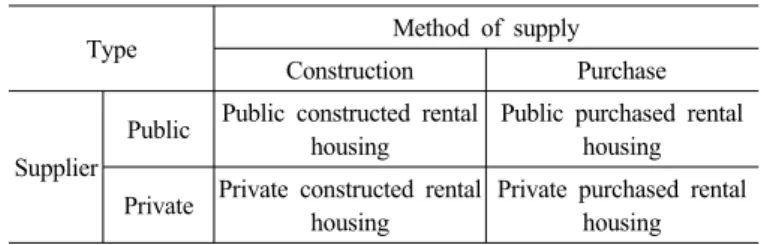
Table 1. Types of Rental Housing

Type Method of supply

Construction Purchase

Supplier

Public Public constructed rental housing

Public purchased rental housing Private Private constructed rental

housing

Private purchased rental housing

supply policy. This, as one of the key housing policies of the new administration, is aimed at further stabilizing residential conditions of the low-income families who have been suffering from excess repayment burden of housing loans and skyrocketing housing rents. In the first real estate measures announced the administration, a plan to supply 200,000 housing units of Happiness Housing utilizing rail beds and unused national and public lands was given a shape. Happiness Housing program is a concept where the state supplies rental homes utilizing unused lands and public lands in city centers and was evaluated as a policy that is differentiated from the rental housing supply methods of the former administrations.

The policy is, however, drifting from the selection of the sites for the pilot projects because of the concerns from related experts and oppositions from stake-holders and the original purpose of introducing the program is spoiled as the scope of the program is reduced and original plan is changed. In addition to this, the plan is confronting numerous problems such as oppositions from residents and local governments, disturbance of the real estate market, lack of commercial viability, etc.

At a time when a public-sector driven rental housing policy is giving rise to a lots of problems, the authors reviewed the rental housing supply policies of the past and considered the changes and problems in rental housing supply policy in this study. Further, the authors reviewed the developments in the housing market and changes in the urban policies and paradigm in urban regeneration, and searched for the direction of rental housing into the future.

Additionally, the authors examined some foreign cases that might shed light on the policy-making for Korea and, based on this insight, explored options for policy rental housing measures to address the current issues of rental housing conditions in Korea.

2. Changes in Rental Housing Supply Policy and Emergence of Happiness Housing Policy

2.1 Types of Rental Housing

Rental housing can be classified largely based on method of supply and supplier of the housing. Based on the method of supply, it is classified as constructed rental house and purchased rental house and on the supplier it is classified as public rental housing and private rental housing. Public rental housing includes housing that is provided for rent which is constructed with the funds from state or local governments and housing that is provided for rent which is constructed by a business entity on the lands developed through housing and public project with funds supported from national housing fund. Private constructed rental housing is one which is constructed with pure private funds on a land that is not included in lands developed with public development project and private purchased rental housing is one provided for rent by private rental business after acquiring the title on the real estate (Ministry of Land, Infrastructure and Transport, 2011).

Most of the supply in Korea have been led by public sector and the types of public rental housing have been diversified very

much as successive administrations supplied rental housing through different policies. While the provision of private rental housing has been rather simple taking the form of private constructed rental housing and private purchased rental housing, public rental housing is classified into various types such as permanent and 50 year rental housing, national rental housing, and employee rental housing.

Permanent rental housing is a form of rental housing that was introduced for the purpose of renting houses permanently, and is provided to people who are eligible for national basic living security, people of national merit, and families of single parent, and 50 year public rental housing means housing that would be provided for rental continuously without selling out. National rental housing is housing that is constructed or purchased for the purpose of renting at least 30 years by LH, local governments, or public authorities according to Special Act for Public Lease Housing Construction. Long-term deposit lease housing is a kind of lease housing based on deposit at a price that is equal to or less than the price of same size in the neighborhood and provided to lease up-to 20 years to the same family. Because 5 or 10 year public rental housing can be converted to sellable real estate, the residents of this kind of housing can get the title of it at that time.

Besides these, there are about 10 variants of currently existing rental housing including employee rental housing, reserve rental housing, etc.

2.2 Changes in Rental Housing Supply Policy by Administration

The history of public rental housing policy dates back to Roh

Tae-woo regime when permanent rental housing was included in

the 2 Million Housing Unit Supply Plan and succeeded by Public

Rental Housing in Kim Young-sam administration, National

Rental Housing in Kim Dae-jung administration. Among them, it

can be said that the period where the administration devoted

oneself to the rental housing policy most was in president Roh

Moo-hyun's Participatory Government. Roh Moo-hyun administration

continued the “Rental Housing 1 Million Unit Supply” program

succeeding the national rental housing supply plan started in Kim

Dae-jung administration. To improve residential conditions of

low-income class and to resolve the root cause of the residential

instability, the administration enacted “Special Act for Public

Lease Housing Construction,” and tried to expand supply of

rental housing through ‘National Rental Housing’ which is a 30

(3)

Table 2. Supply Volume of Rental Housing by Successive Administration

(Unit: housing unit) Division Roh, Tae-woo

administration

Kim, Young-sam administration

Kim, Dae-jung administration

Roh, Moo-hyun administration

Lee, Myung-bak administration

Total 418,307 418,210 488,287 561,873 432,781

Annual average 83,661 83,642 97,657 112,375 108,195

Source: Ministry of Land, Infrastructure and Transport(2012)

* For Lee, Myung-bak administration supply volume reflects ony four years (2008~2011)

* Supply volume of public rental housing includes constructed rental, purchased rental, long-term deposit lease housing

Table 3. Inventory of Private Rental Housing Supplied based on Rental Housing Act

Division Nation-wide Seoul

Private constructed rental

Private construction 27,200 units 1,889 units

Housing maintenance project association 6,622 units 5,435 units

Licensed by the construction Act 131,909 units 31,686 units

Purchased rental Purchased rental 274,587 units 60,083 units

Total 440,318 units 99,093 units

Source: MOLIT Statistics Portal(2012), Rental Housing Statistics

(Quoted from Park, Hyeok-seo(2012), A study of the Role of the Public Rental Housing Policy in Rental Housing Markets)

year rental housing. Lee Myung-bak administration proposed

“Bogeumjari Housing” and “Urban-type Housing” as the key real estate policies of the administration. For the end, the administration extensively amended the special act enacted in the former administration as ‘Special Act for Bogeumjari Housing Construction.’

Bogeumjari Housing is defined as a comprehensive concept that covers house for installment sale, rental house that are supplied at 50 to 70% of price compared to the neighborhood that is constructed on land developed through removing a ban on development or renovation of greenbelt areas, and public, national, and permanent rental housed.

Although there are differences in type, supply volume, and eligible people for supply by administration, the volume of supply of rental housing is continually increasing. The volume of public rental housing supply maintained average level of 400,000 housing units with 418,308 housing units in Roh Tae-woo admi- nistration and 418,210 in Kim Young-sam administration, then significantly increased through 488,287 housing units in Kim Dae-jung administration and to 561,873 housing units in Roh Moo-hyun administration. In Lee Myung-bak administration, the volume of supply of rental housing has been greatly reduced compared to that in the Participatory Government. Although volume of supply through new programs has decreased, supply volume through purchase and rent of deposit lease housing has greatly increased 1) , and poured effort to supply rental housing for

1) Volume of housing units for newly approved projects (annual average): Participatory Government (106 thousand units) → MB administration (89 thousand units). And volume of housing units supplied through purchasing and rented as deposit lease housing (annual average): Participatory Government (6,679 units) → MB

low-income class by resuming permanent rental housing supply program that has been on suspension since 1993.

2.3 Problems in Korean Rental Housing Policy

2.3.1 Frequent Policy Changes and Creation of Different Rental Housing Types

Based on the consensus that the supply of rental housing is essential for the stabilization of the housing market, all of the former administrations have continually implemented the policies for expansion of the supply of rental housing. As a result of this, the share of rental housing has been increased greatly and it is true that it has contributed to the enhancement of the residential welfare level. However, as each successive administration announced policies related to rental housing, types of rental housing has been diversified. As a result, there comes to be many types of rental housings as to reach to more than 10 kinds, including permanent rental, 50 year rental, national rental, etc. and this caused only confusion to housing consumers.

2.3.2 Problems in Methods of Supply

Although the supply of rental housing can be classified into supply by public sector and supply by private sector, up to now the supply of rental homes in Korea has mainly depended on supply through constructions led by public sector. Government- led supply has mainly taken the form of supply through allotment of share of supply of rental housing to land development projects.

administration (19,093 units) (Ministry of Land, Infrastructure

and Transport, 2012).

(4)

New cities or large-scale housing site development projects have been concentrated on suburban areas or development restriction areas where cost of land is comparatively low and acquisition of land is easier, and rental homes also were supplied in large volume in these areas. As rental homes are constructed in suburban areas, there arose problems such as difficulty of access to work from home and traffic congestion, thus consumers turned their faces from the rental housing. This is the result of policies that are supplier-centered rather than customer-centered and led to a criticism that the policies have not got off from the development approach depending on the old large-scale public housing site development.

As for the rental housings that are supplied by the private sector, majority of the volume is provided in the form of purchased rental housing rather than constructed rental housing and this can be interpreted as the result of the fact that the legal and institutional foundation for the provision of rental housing through private sector construction.

2.3.3 Increase of Financial Burden

Although public rental housing has contributed to realization of residential welfare by supplying up to 5% of total housing supply, it also caused increase in financial burden. As public rental housing is provided at a lower price than the market price level of rents, increase in volume of its supply naturally led to increase of financial expenditures. The period when the largest financial expenditures have occurred was during the Participatory Government, and enormous amount of financial resources have been devoted to the plan for construction of 1 million national rental housing units. Numerous public housing site development projects were carried out throughout the nation and, as it was mandated to allot more than 70% of public housing lots to national rental homes for rent of 30 year or more, it forced Korea Land and Housing Corporation (LH) to bear an enormous amount of liabilities. Most of the funding for the development of public rental housing comes from National Housing Fund 2) and the amount of the fund carried over to the next year was more than KRW 4 trillion every year for the years from 2004~2006, but it decreased rapidly from 2007 until there remained only KRW 730 billion in the year 2009 (National Assembly Budget Office, 2009).

2.3.4 Others

In addition, many other problems are pointed out such as the

2) National Housing Fund is created using revenues from national housing bond that taxpayers purchase when they are registering real estate to government, saving for subscription, transferred money from general ledger, lottery fund and is used for the purpose of national and/or public rental housing construction, public lot-sold apartment construction, loan for low-income family and laborer deposit lease.

fact that there is no system in place for the systematic operation and management of public rental housing, lack of harmonious progress in development led by private sector, lack of long-term and systematic management, increase in financial burden caused by rising rents and management costs, and lack of awareness of residential welfare and lack of linkage to welfare policies.

2.4 The Emergence of Happiness Housing

Happiness Housing is name for public rental housing for residential welfare of the low-income class proposed as one of the a presidential election pledges. Different from the existing public rental housing supply policies, this policy is carried out aiming at constructing 200,000 housing units until 2017 utilizing rail beds and unused national and public lands which are located in places convenient to use public transportation. The people eligible for moving are young people taking part in social life and resi- dentially vulnerable groups such as college students, newlymeds, new graduates into the society and the move-in ratio would be 60% for young people taking part in social life, and the remainder would be supplied in a ratio of 20% for residentially vulnerable groups and 20% for non-homeowners based on income.

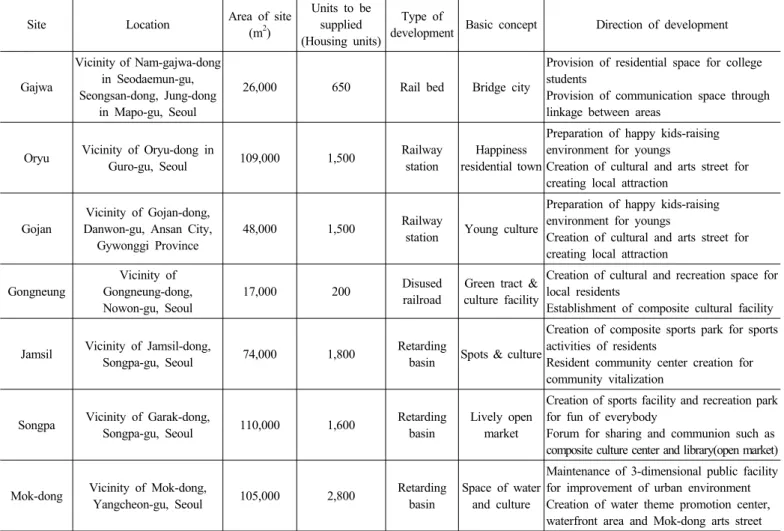
To create nation-wide consensus and examine the possibility of success of the program before a full-fledged introduction of the plan, some pilot sites were selected. The criteria for selection were good access to public transportation; areas that have schools, commercial facilities and housing facilities in place; and proportional division by zone. As the result of environmental analysis and site visit, gathering of opinions such as from expert forums, and preliminary consultation with local governments and Korail, currently total of 7 pilot sites (Gajwa, Gongneung, Mok-dong, Oryu, Jamsil, Songpa, Ansan, Gojan) including 4 rail beds, 3 retarding basins are selected.

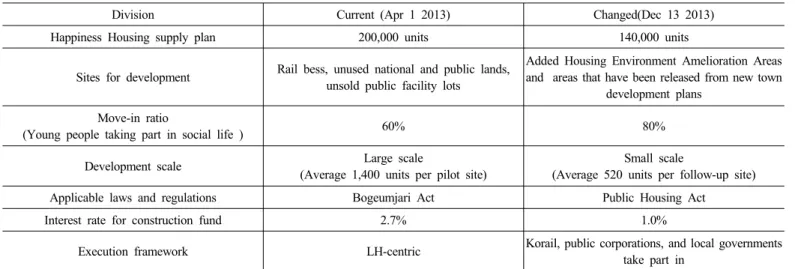
However, at this time when 1 year has passed since the inauguration of the new government, the program is laboring through heavy seas because of strong opposition from the local governments and local residents. Thus, government has proposed a plan for the invigoration of the Happiness Housing policy with the announcement of 'Follow-up plan for April 1 and August 23 real estate measures' on December 3 of 2013. In this plan are included the plans to decrease the supply volume to 140,000 units until 2017 and to supplement the loss of the supply volume with national rental housing supply. Also, this plan expanded the scope of the sites for the developments that were restricted to rail beds and unused national and public lands to include Housing Environment Amelioration Areas and areas that have been released from new town development plans.

The Happiness Housing policy that Park Geun-hye administration

is implementing has some differences from the rental housing

policies of the previous administrations. It can be said we can find

the significance of the plan in that, representative areas where the

housing is supplied are in downtown areas; housing is supplied

utilizing public lands and unused lands in city centers such as rail

(5)

Table 4. Overview of the Pilot Sites for Happiness Housing

Site Location Area of site

(m

2

)

Units to be supplied (Housing units)

Type of

development Basic concept Direction of development

Gajwa

Vicinity of Nam-gajwa-dong in Seodaemun-gu, Seongsan-dong, Jung-dong

in Mapo-gu, Seoul

26,000 650 Rail bed Bridge city

Provision of residential space for college students

Provision of communication space through linkage between areas

Oryu Vicinity of Oryu-dong in

Guro-gu, Seoul 109,000 1,500 Railway

station

Happiness residential town

Preparation of happy kids-raising environment for youngs

Creation of cultural and arts street for creating local attraction

Gojan

Vicinity of Gojan-dong, Danwon-gu, Ansan City,

Gywonggi Province

48,000 1,500 Railway

station Young culture

Preparation of happy kids-raising environment for youngs

Creation of cultural and arts street for creating local attraction

Gongneung

Vicinity of Gongneung-dong, Nowon-gu, Seoul

17,000 200 Disused

railroad

Green tract &

culture facility

Creation of cultural and recreation space for local residents

Establishment of composite cultural facility

Jamsil Vicinity of Jamsil-dong,

Songpa-gu, Seoul 74,000 1,800 Retarding

basin Spots & culture

Creation of composite sports park for sports activities of residents

Resident community center creation for community vitalization

Songpa Vicinity of Garak-dong,

Songpa-gu, Seoul 110,000 1,600 Retarding basin

Lively open market

Creation of sports facility and recreation park for fun of everybody

Forum for sharing and communion such as composite culture center and library(open market)

Mok-dong Vicinity of Mok-dong,

Yangcheon-gu, Seoul 105,000 2,800 Retarding basin

Space of water and culture

Maintenance of 3-dimensional public facility for improvement of urban environment Creation of water theme promotion center, waterfront area and Mok-dong arts street Source: Ministry of Land, Infrastructure and Transport (2013)

beds and retarding basins; and finally, the plan sought to create national consensus through design approach that reflects perspectives of consumers, departing from a supplier-oriented policy.

However, the plan reveals several problems, too. In an article by Yoon et al. (2013), the authors point out as the problems with the Happiness Housing, such things as opposition from local governments and local residents; disturbance of the housing market; degradation of the residential environments; commercial viability; difficulties in the collaboration among actors of the program. Besides these, issues such as fund acquisition, operational management in the future, and problems arising from the concentration of vulnerable classes and foreigner in those areas and raised as problems related to the plan.

3. Shifting of Urban Policy Paradigm and City Regeneration

3.1 Changes in Circumstances Surrounding the Housing Market

Korea has maintained average per annum 5.5% of economic

growth for the last decade from 1999 through 2008 but, during 2009 through 2012, the growth trend has slowed down showing 3.1% of annual growth rate. Further, it is expected that Korea will become a low-growth economy maintaining around 3% of growth rate in the future (Korea Research Institute for Human Settlements, 2013). In addition to this, the acceleration of retirements of baby boomer generation (For 2010, 7,130,000 3) ), decrease of key consumption classes and reduction in economically active population (age of 15 through 64), increase of family debts are pointed out as the factors that could bring impacts to the housing market.

Even though the number of population and households are steadily increasing but the rate of growth is slowing down. As of June 2012, the population passed over 50 million and is expected to decrease in the next decade or so. Number of households is 17,340,000 as of 2010 and expected to increase to 20,330,000 by 2022. On the other hand, number of 1 or 2 person household (from 34.6% in 2000 to 48.2% in 2010) and old age households have increased significantly (Korea Research Institute for Human Settlements, 2013).

3) Ministry of Lands, Infrastructure, and Transport (2013)

(6)

Table 5. Summary of Changes to the Happiness Housing Supply Plan

Division Current (Apr 1 2013) Changed(Dec 13 2013)

Happiness Housing supply plan 200,000 units 140,000 units

Sites for development Rail bess, unused national and public lands, unsold public facility lots

Added Housing Environment Amelioration Areas and areas that have been released from new town

development plans Move-in ratio

(Young people taking part in social life ) 60% 80%

Development scale Large scale

(Average 1,400 units per pilot site)

Small scale

(Average 520 units per follow-up site)

Applicable laws and regulations Bogeumjari Act Public Housing Act

Interest rate for construction fund 2.7% 1.0%

Execution framework LH-centric Korail, public corporations, and local governments

take part in

Source: 4.1 Real estate measures and 12.3 Follow-up plan for 4.1 real estate measures (Ministry of Land, Infrastructure and Transport, 2013)

In addition to the socio-economic changes and changes in population and household composition, there arose a great change in housing market. Owing to the supply of housing through the government-led new city or housing site development, the distribution rate of housing has reached 102.7% (capital area 99%, based on new housing distribution rate) as of 2012 and number of housing per 1,000 persons has increased from 330.4 units in 2005 to 363.8 units in 2010, contributing greatly to the housing market stabilization.

However, new problems arose because of this such as depression of the existing downtowns, increase of unsold apartments. Number of unsold apartments in the capital area is continuing to increase, from 7 thousand units in 2003 to 27 thousand units in 2008, and to 33 thousand units in 2012. Because of the excess supply of housing sites compared to the demand for housing, the accumulation of unsold housing is not expected to be resolved for the time being.

Housing improvement projects can be raised as another issue of housing market. The ration of houses that are over 15 to 30 years of age that need management such as repair or maintenance has risen from 4,980 thousand units in 2010 from 2,450 thousand units in 2005, among this number of apartments has greatly risen to 2,690 thousand units in 2010 from 1,030 thousand units in 2005. Considering the level of inventory of housing by year, the number of inventory needing management will become an important topic of the future housing market.

Rental housing market also is changing rapidly. Due to the increase in the number of households with 1 to 2 family numbers, demand is shifting from large housing to small housing, and as the perception of housing is shifting from that of owning the house to demand for living, the demand for rental housing is expected to increase in the future. Also, as the demand for short-term rental housing is continually increasing as the result of the demand for housing in the city centers and the demand for

housing of the type of affinity of work and home, a diversification in demand surrounding the demand for rental housing is anticipated (KORAMCO REITs & TRUST, 2013).

3.2 Paradigm Shift in Urban Policy

As of 2011, the share of resident in urban regions in Korea is 91% and this is far much higher than the world average 58%. This can be conjectured as the result of the rapid growth in volume of Korean urban regions through the high expansion period. Land for housing that have been developed from 1981 until 2011 reached 946km

2

(326 times the area of Yeouido-dong) and the area of industrial complex developed from 1991 until 2011 reached 1,343km

2

(463 times the area of Yeouido-dong). However, as the economy in entering an era of stagnation of population growth and low economic growth, voluminous expansion of urban regions centered to the suburban areas is confronting at the limit. In addition, in contrast to the increase in the demand for various values such as quality of life and culture and environments, urban areas in Korea are not responding to these demands.

Reflecting these circumstances, urban policies are shifting from ones new city centric policies of the past to a perspective that is centered on the regeneration of the existing downtowns. In the

「 National Basic Plans for Urban Regeneration (Draft)」 that Ministry of Lands, Infrastructure, and Transport has announced in 2013, it is stressed that it is needed to shift to an urban paradigm which is concentrating on the regeneration of the existing downtowns and to prepare a comprehensive supporting system for urban regeneration at the national level.

Foreign countries are also defining the degradation of cities as

a national level problem, and preparing and executing strategies

to cope with this issue. Further, they are pouring efforts to urban

regeneration policies such as forming organization that provide

oversight and devoting enormous budget. In the case of Great

Britain, the government has prepared national regeneration strategy

(7)

and has the Homes and Communities Agency (HCA) under the Prime Minister's Office coordinate regeneration-related activities.

Also, to support this effort, allocated Integrated Regeneration budget amounting up to £2.2 billion per year. In the case of Japan, government has developed a strategy called Urban Regene- ration Plan and established and is running Local Regeneration Center that coordinates pan-governmental urban regeneration activities with the Prime Minister acting as the leader of the organization, and is supporting this organization with ¥1.4 trillion of budget per year called Social Capital Maintenance General Grant.

3.3 Urban Regeneration is the Utmost Welfare

‘Urban Regeneration’ means the economic, social, physical, and environmental revitalization of urban areas that are decaying due to reduction of population, changes in industrial structure, thoughtless expansion of urban areas, and deterioration of the residential environments, through means such as strengthening of the local capabilities, introduction, creation and utilization of new functions at the local level (① of the Section 1, Close 2 of the Law). In the recently enacted 「Urban Regeneration and Assistance Act (hereafter called as “Urban Regeneration Act”)」, urban regeneration is defined from the perspective of Korea.

As mentioned earlier, new city development has greatly contributed to the resolution of the housing difficulties and improvement of residential conditions through supply of new lands for housing. However, it has also caused various problems such as deterioration of the old downtowns, increasing costs of transportation and logistics, reduction of green tract lands, etc.

According to Ministry of Lands, Infrastructure, and Transport and Korean Urban Regeneration Center, among 144 cities and districts (autonomous districts), two thirds(96)are showing symptoms of urban deterioration 4) and deteriorating cities have inferior in terms of social public services such as social welfare facilities, cultural and sports facilities than rural areas. Further, deteriorating cities are in such poor conditions that it is impossible to pursue in their own without support from the central government.

To enhance the urban environments of the regions where the deterioration of the city is taking place rapidly, Korean government is supporting urban maintenance activities at the national level.

Government is achieving visible results including provision of about 2,150 thousand units of new housing through housing reconstruction and redevelopment projects that enhance residential environments by maintaining worn-out and inferior houses in the existing downtowns and providing infrastructures that are lacking. However, it is pointed out that the program caused problems such as conflict among local residents and separation of

4) Urban deterioration symptoms areas: Means the case where one or more of the average population growth (reduction) rate for 5 years, total change (reduction) rate for 5 years, ratio of buildings with equal to or more than 20 years (at least 50%) is applying.

original residents from the place, and neglected issues such as unemployment and welfare of residents by concentrating on the resolution of physical issues of the deteriorating areas. Furthermore, as most of regeneration projects at halt status 5) due to lack of the commercial viability of the projects, voices of concern on this also are coming out.

To resolve this problem, a paradigm shift is taking place in the urban regeneration, too. A change is pursued from the existing urban regeneration that emphasized physical environmental improvement such as redevelopment and reconstruction to an approach which aims at economic and social growth through reliving the local community with residents acting as main force of the change. A change perception is taking place where the urban regeneration including improvement of residential stability, implementation of differentiated residential welfare policy, and revitalization of the city is seen as the utmost welfare.

4. Plan for Supply of Rental Housing through Urban Regeneration

4.1 Urban Regeneration and Rental Housing in Foreign Countries

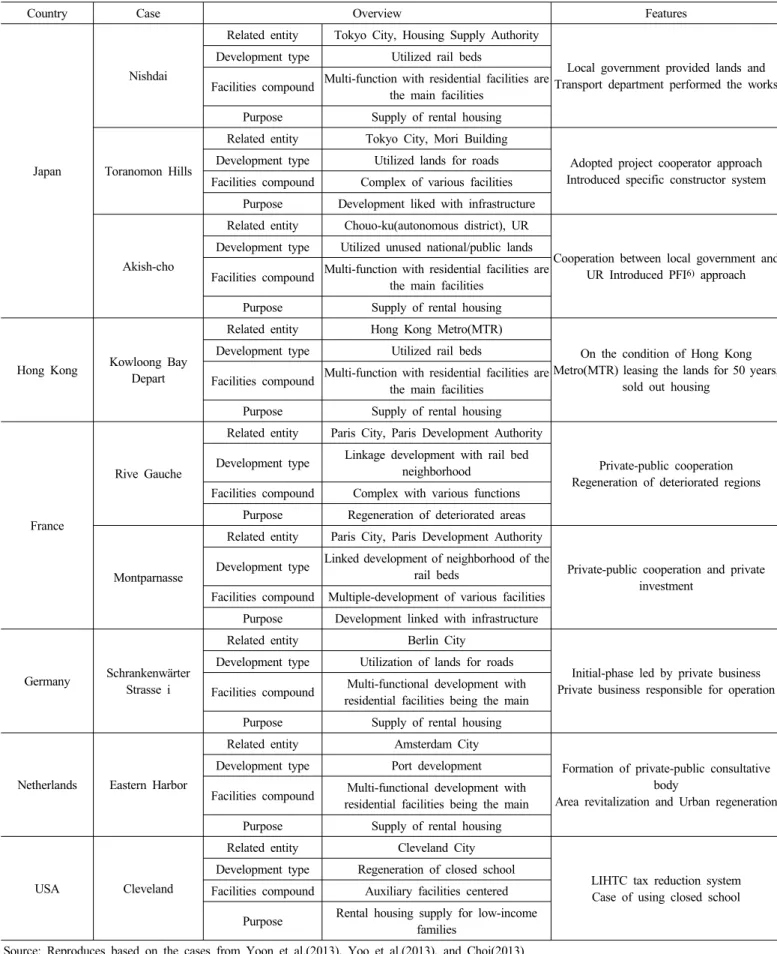
Here the authors derive implications through review of foreign cases of supply of rental housing linked with urban regeneration and use this in developing strategies appropriate to responding to Korean specifics of rental housing conditions. For foreign cases, the authors selected cases of rental housing provision that are linked with urban regeneration focusing some developed nations such as Japan, Hong Kong and France.

Nishidai residential complex in Japan was developed as a multi-function complex aimed at supply of rental housing in the 1970s. This is a case where they constructed an artificial foundation over a depot in Nishidai Station in Itabashi-Ku of Tokyo and developed a residential complex to overcome the difficulty of acquisition of lands in downtown areas and, in that sense, it can be said to be a case nearest to concept of Happiness Housing. There is a characteristic to this case where Tokyo City and Housing Supply Corporation have played leading roles in p=the project and local government has provided funds. Toranomon Hills project is a unique case in the sense that it alleviated the traffic congestion by rearranging Circular Number Two Line that can be called as the center of the traffic in the downtown area of Tokyo and supplied rental housing. This project provides im- plications in that, utilizing project cooperators approach, this project actively exploited the construction and management

5) Excepting some commercially viable capital regions, most of the

regions have low rate of proceeding with the reconstruction projects

(Among 1,428 renewal projects, only 9.4% have started works), in

provincial cities, as the rate of progress of works for renewal

projects are so low, and in many cities the designation for renewal

projects have been cancelled.

(8)

Table 6. Summary of the Overview and Features of Foreign Cases

Country Case Overview Features

Japan

Nishdai

Related entity Tokyo City, Housing Supply Authority

Local government provided lands and Transport department performed the works Development type Utilized rail beds

Facilities compound Multi-function with residential facilities are the main facilities

Purpose Supply of rental housing

Toranomon Hills

Related entity Tokyo City, Mori Building

Adopted project cooperator approach Introduced specific constructor system Development type Utilized lands for roads

Facilities compound Complex of various facilities Purpose Development liked with infrastructure

Akish-cho

Related entity Chouo-ku(autonomous district), UR

Cooperation between local government and UR Introduced PFI

6)

approach Development type Utilized unused national/public lands

Facilities compound Multi-function with residential facilities are the main facilities

Purpose Supply of rental housing

Hong Kong Kowloong Bay Depart

Related entity Hong Kong Metro(MTR)

On the condition of Hong Kong Metro(MTR) leasing the lands for 50 years,

sold out housing Development type Utilized rail beds

Facilities compound Multi-function with residential facilities are the main facilities

Purpose Supply of rental housing

France

Rive Gauche

Related entity Paris City, Paris Development Authority

Private-public cooperation Regeneration of deteriorated regions Development type Linkage development with rail bed

neighborhood Facilities compound Complex with various functions

Purpose Regeneration of deteriorated areas

Montparnasse

Related entity Paris City, Paris Development Authority

Private-public cooperation and private investment

Development type Linked development of neighborhood of the rail beds

Facilities compound Multiple-development of various facilities Purpose Development linked with infrastructure

Germany Schrankenwärter Strasse i

Related entity Berlin City

Initial-phase led by private business Private business responsible for operation Development type Utilization of lands for roads

Facilities compound Multi-functional development with residential facilities being the main Purpose Supply of rental housing

Netherlands Eastern Harbor

Related entity Amsterdam City

Formation of private-public consultative body

Area revitalization and Urban regeneration Development type Port development

Facilities compound Multi-functional development with residential facilities being the main Purpose Supply of rental housing

USA Cleveland

Related entity Cleveland City

LIHTC tax reduction system Case of using closed school Development type Regeneration of closed school

Facilities compound Auxiliary facilities centered Purpose Rental housing supply for low-income

families

Source: Reproduces based on the cases from Yoon et al.(2013), Yoo et al.(2013), and Choi(2013)

(9)

knowhow of private sector businesses and that it provided benefits to local residents through multi-function development. The multi- function facility at the Akaish-cho 1-chome is a case where they developed rental housing and social welfare multi-function facility utilizing unused public lands. This project was realized by leasing public lands to private sector businesses by establishing 70 year fixed length leasehold of the autonomous district and shraing the land with UR Urban authority based on the share of leasehold.

This case is valued as a case where the project has contributed to the local area revitalization through curing of community facilities in the downtown area.

Kowloon Bay Depart is a residential complex where they constructed artificial foundation over the depot that Hong Kong Metro (MTR) owns and constructed high-rise multi-function facilities. The rental housing here adopted house selling method with 50 year land lease condition so that residents can move in at lower costs. This is a case valued as improved city center function in the sense that realized walking access to surrounding areas around Kowloon Station.

Rive Gauche in France has a meaning in that this project has achieved a linkage development of rail beds and surrounding areas as a part of urban regeneration of an old region. This project is one where SEMAPA (Paris Development authority) has started the project entrusted the implementation and is currently under construction aiming at resolution of the separation of the region due to the railroad and three dimensional development of the region. Montpranasse Station project is, like Live Gauche project, aimed at linked development of the rail beds and surrounding areas, and SNCF (National Railroad Suthority), Paris City, and Private sector businesses provided funds jointly. Here, design was performed considering convenience of loral residents by deploying public facilities, parks, and sports facilities over an artificial deck.

Schrankenwärter Strasse in Germany is a representative case of utilizing lands used for roads where used part of the downtown autobahn in West Berlin. Even though rent is expensive because a private sector business (Mosche Group) has led the earlier part of the project and operational management also is left to a private sector business, it provides a good residential environments. The fact the three-dimensional complex rearrangement was performed to resolve vibration and noise problems due to highway is a unique characteristic of this project.

6) Japanese government has enacted Act for Promotion of Renewal of Public Facilities Usin Private Sector Funding (Private Finance Institute, hereafter referred to as PFI) in July of 1997 and established Promotion Committee for Basic Poly Preparation and Utilization of Private Sector Funds (RFI: Promotion Committee) in March of 2000. It became possible to introduce public facilities, common use facilities, public benefit facilities, other facilities and through this raising the effect of ‘provision of quality and low-cost public services’ and ‘revitalization o the economy through the creation of business opportunities for private sector’

Eastern harbour development case in Netherlands is one where harbour was redeveloped and shows differences from other projects. By redeveloping harbor rather than rail beds or unused public lands, this project realized regional revitalization through urban regeneration. Also it is worth paying attention that this project has reduced the duration through creation of private- public consultative body.

West-Tech apartment in Cleveland, USA introduced LIHTC (Low Income Housing Tax Credit, tax reduction system for low-income classes). Government, City Development Authority, Non-profit organizations that was in charge of community welfare have formed a cooperative and renovated an unused school as an apartment. In the sense that the aim of this project is residential stabilization of low-income classed which is similar to Happiness Housing, the formation of cooperative provides some implications.

Some implications that can be grafted in Korean environment from the review of foreign cases are as the followings:

First, case projects tried to provide vitality to the city centers

that lost vigor and to realize residential environment improvement

and residential welfare. They utilized downtown unused lands

and national/public lands such as rail beds and lands for roads and

through regeneration of urban spaces infused vitality into deteriorated

city centers. Furthermore, it offers an important implication for

urban regeneration policies of Korea in that through provision of

residential convenience facilities and public facilities by linking

urban regeneration, those projects not only improved the residential

environments in the deteriorated areas but also contributed to the

improvement of residential welfare of the residents. Second,

through engagement of various players they resolved the problem

of shortage of financial resources. through linked development

with surrounding areas or multiplication of function implemented,

they concentrated not only residential function but also commercial

and business functions in the area and thereby attracted the

participation of private businesses. Further, by engaging local

governments and authorities, they realizing smooth land supply

and resolving financial resources deficit problems. Third, they

are performing operational management even after development

of the properties. Not confining their role in development only,

they are devoting efforts for the enhancement of the residential

environment of the residents through continuous operational

management. And utilizing the creativity of private businesses,

they are nurturing specialized companies to ensure that efficient

operational management and entrusting various works to those

companies. They ar using various measures of providing numerous

incentives to attract participation from the residents and participation

and investment from private businesses. In addition, they are

shifting away from supplier-oriented policies towards consumer-

oriented policies and try to realize residential welfare through

effective support measures rather than physical measures only.

(10)

4.2 Plan for Expansion of Rental Housing

4.2.1 Linkage with Urban Regeneration and Multi-functional Development

For rental housing supply liked with urban regeneration, expansion of scope of sites, local government initiated environment creation, attracting participation from private sector, and multi- functional development could be considered.

The first way to expand the supply rental housing is to expand the scope of sites that can be included in the program. Happiness Housing program current government is trying to implement is expanding the scope of sites in addition to the original program where rail beds, unused lands, national/public lands and unsold lands for public facility, includes residential environment im- provement zones and lands released from new town development zones. Going further from here, there is a need to expand the scope to include areas for redevelopment of deteriorated areas in suburban regions so that those areas could be utilized. This is appropriate for the urban regeneration paradigm and it is required to increase the supply of rental housing in linkage with urban economy foundation type 7) and vicinity regeneration type 8) regeneration projects that have been introduced recently.

Next, the development environment must be changed to one where local governments are leading the process. As a result of the rental housing supply policies that have been led by central government, government finance is burdened. To resolve this problem, it is required to establish legal and institutional conditions to allow local governments to lead the supply of rental housing. It is needed supply of rental housing would be performed reflecting the specificities of each locality and local government could accumulate business know-how so that other localities would be able to utilized that know-how in their respective development projects. Furthermore, local governments realized excellent per- formances should be compensated and it would be desirable by doing so to induce competition among local governments.

And opportunities of private sector businesses to participate in the program should be expanded so that not only land owners not only in the urban regeneration areas but also landowners of the neighboring areas and private sector developers can take part in the business. Currently Japan is supplying public housing mainly through local governments, it also is supplying public housing by purchasing or leasing constructed house. The basic structure of

7) A type of introducing new economic functions and creating employment through linked development of anchor projects (old industrial complex or port, station area development, removed place complex development) and neighboring background areas. Focuses on overall revitalization of the urban area.

8) Type of expanding living infrastructure and employments in the are through revitalization of deteriorated commercial areas and renewal of neighborhood residential areas. Focuses on enhancement of quality of life per living area unit.

Japanese public housing is such that first private businesses lease public lands and perform construction and then, upon completion of the construction, local government purchase or lease the housing from private businesses. On the other hand, local government performs activities that are not commissioned to private businesses such as recruitment and selection of residents and commissions maintenance and management job to private businesses after construction. Benefits that local governments can expect to enjoy from introducing private investment into public housing are promotion of effective utilization of public lands, reduction of initial investment requirements for supply of public housing, and high intensity utilization of public lands through multi-function development with private rental housing and private rental offices (Korea Development Institute, 2013). It is required to provide support to allow the development in similar ways utilizing the capabilities of local governments and private sector.

Finally, multi-functional development of public rental housing and for other use must be fostered. By increasing opportunities of participation from land-owner in neighboring areas, the realization of urban regeneration with various function being mixed should be promoted. Considering the land utilization conditions such as business, distribution and commercial facilities, duplication of functions should be prevented, and newly introduced functions should be harmonized with neighboring areas so that synergy from the development should be realized. Further, there is a need to reflect changes in trend of multi-function development, and to utilized creativity of the private sector to achieve mixtures of various uses that are appropriate to the local conditions.

4.2.2 Funding

When supplying rental housing through urban regeneration, a new approach to the fund raising should be pursued. As the representative method among them, financing through cyclical development, utilization of TIF based on tax revenues that would realized in the future, and REITs where private investments could be activated could be considered.

The first method is fund raising through utilization of cyclical development. After supplying rental housing using funds supported at low interest rates utilizing the supply of rental housing linked with urban regeneration, using rental revenues to development of commercial facilities such as commercial quarters, convenient facilities or parks and other community facilities. Or, utilizing the revenues for the repair and refurbishment of deteriorated facilities in the area could be considered.

Next is the method of utilizing TISs based on the tax revenues

that would realized through the rental housing. TIF is a financing

technique acquiring funds by issuing bonds using revenues that

would be realized in the future as a security and in most of the

states in the United States this is used broadly as means of raising

funds for the development of local community. By linking this to

supply of rental housing, funds could be raised through the

issuance of bonds using future property tax revenues that will

(11)

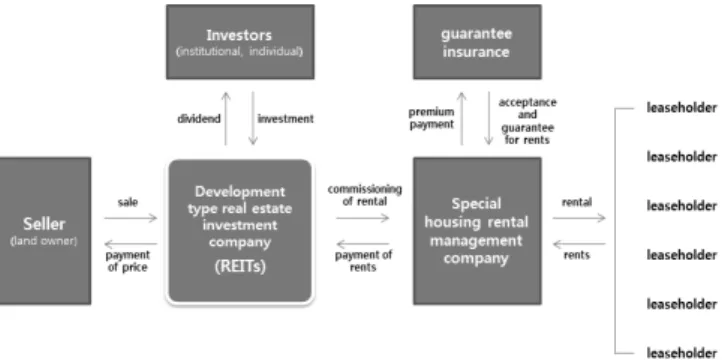
Fig. 1. Business Structure of REITs for Rental Housing

increase in the future.

Lastly, a method of utilizing REITs 9) etc. for the rental housing supply through attraction of private sector investment. REITs is constituted by first getting investment funds from numerous investors and then investing this funds into real estate or other marketable securities that are related to real estate, and then dividing dividends from the revenues realized by the investment (Seo et al., 2013). The business structure is to manage the rental housing acquired through REITs by commissioning to the specialized housing rental management companies 10) that were introduced recently and returning the realized rental revenues to the investors. By means of directly constructing rental housing or commissioning management, the complex contracts with numerous leaseholders can be managed by those companies. It is critical to be prepared for the avoidance of or provisions for vacancies for the active use of REITs through rental housing, and the provision of precautions using linkage with insurance should be prepared.

4.2.3 Operational Management and Policy

Provision of policies that would ensure continuous operational management is performed on the real estates for rental, going further from a planning where it focused on simple urban regeneration or rental housing supply is definitely required, too.

Preparation of legal and institutional support under which the state would help to stabilize the linkage between urban regeneration and supply of rental housing by introducing control-tower function

9) REITs (Real Estate Investment Trust; REITs)is a company established for the purpose of investment and management of assets in real estates and is classified itto self management, commissioned mana- gement and corporate restructuring (Real Estate Investment Company Act 1 of Clause 2).

10) This means a company that provides general services related to rental housing management including leaseholder introduction, rental collection, and housing maintenance and repair. housing rental management company registers as housing construction company (construction company) and then can construct building directly or leave the construction to other companies. Company performs various services such as from facility and equipment management for com- missioned building and resident and leaseholder recruiting, rental collection, leaseholder management, etc.

at the national level, and to allow public sector, local government, and private sector could continue to participate in the management of the rental housing after the supply of it by fostering companies specializing in operational management of real estate, should accompany, too.

It is desirable to gradually delegate urban regeneration or rental housing supply to local governments and private businesses and central government would play the role of supporting or overseeing those activities. For this end, ensuring continuous support and management of urban regeneration activities and monitoring of status across the country through establishment of control-tower function is required. Further, the ministry should be developed as an agency that could provide guidelines that are appropriate for the conditions of Korean government and the market and could perform leading roles such as benchmarking successful cases.

In addition to the hardware support that is focused on the public rental housing, software support such as provision of housing voucher or tax reduction for low-income classes should be provided, too. In other words, a shift from policies that are supplier-centric to ones that are customer-centric must take place.

As for the voucher system, even though it has been reviewed in various ways, it is currently not utilized actively because of side-effects such as the issue of selecting eligible people, diversion to other purposes, etc. To resolve this problem, utilization of voucher system with conditional payment could be considered.

Conditional payment means provision of voucher to the beneficiary classes in the condition that the beneficiary should perform specific activities such as searching for works or participating in rehabilitation programs. Use of conditional vouchers could be utilized as a means to instill vitalism into the local economy going far from simplistic rental subsidization means.

Low Income Housing Tax Credit (LIHTC) system is a system where operating rental housing for low-income classes, taxes on the rel estate are exempted and in the United States utilized as one of the low-income classes 11) It is needed to introduce a policy by which this system would be used in Korea and provide benefits when private sector are participating in the provision of rental housing.

Further, this system can be utilized as a alternative means to induce settlement of low-income classes. After the urban redeve- lopment projects, it is actually almost impossible for exiting low-income residents to re-settle in the area because of the rising price of housing and burden of living costs 12) . Furthermore,

11) Housing policies of the United States for low-income families can be divided largely into provision of public rental housing and distribution of housing voucher and Low Income Housing Tax (Credit: LIHTC) systems (Kim, 2006).

12) Settlement ratio of original residents (Seoul): Redevelopment 10%, new town 8~15% (Municipal Policy Research Institute, 2008).

Average land price increase rate (2004~2008): Seoul average

(12)

because of the full demolish approach in favor of profitability, conflicts among residents are occurring and problems related to collapse of the local communities are emerging (Urban Regeneration Center, 2013). To resolve this problem, when supplying rental housing to people who want to re-settle in the area in urban regeneration, supporting those people by means of tax reduction is possible.

Consequentially, the policy should shift from supplier-oriented one to one that is customer-oriented. Demand-oriented policy can expand the options of selection for beneficiaries and enhance welfare for beneficiaries at the same costs (Kim, 2006). For this end, provision of systems and criteria that can be applied adaptively considering the local specialties and conditions must be supported.

Only when effective support measures are provided n line with rental housing supply, then real residential welfare could be realized.

5. Conclusion

At a time when policies for provision of government-led rental housing is causing various problems, the authors tried to find the future directions for the future that are appropriate for the current conditions and circumstances if rental housing policy in Korea.

Further, the authors pursued response measures of the rental housing policies. For this end, authors reviewed the foreign cases that will shed light on the direction of policies in Korea and the followings are the summary of the derived implications.

First, foreign cities have tried to give new versions lives to deteriorated city centers through urban regeneration and tried to improve residential environments and to realize residential welfare. Second, they resolved shortage in financial resources by means of participation from local governments and private sector players. Third, even after the development, they are continuously performing operational management of the real estates. Fourth, they are inducing private-public cooperation and supporting these activities at the national level. In addition to these, they the authors were able to ascertain that they have shifted from a supplier-oriented policies to customer-oriented policies and trying to realize residential welfare through effective support measures rather than physical supports.

Based on the confirmation of problems with rental housing supply in Korea, the authors derived counter-measures in rental housing policies that would address the issues in current conditions and that are appropriate for them and these can largely classified as linkage with urban regeneration, multi-functional development aspects, operational management aspects, and policy and institutional aspects.

For the expansion of supply of rental housing, it is essential to link this with urban regeneration. To pursue revitalization of the

7.6%, New town zones 48~258% (Urban Regeneration Center, 2013).

deteriorated areas and expansion of supply of rental housing, the scope of site included in the development must be expanded. In addition, integration with a new paradigm such as ensuring commercial viability of projects and providing various residential benefits through multi-functional development. In addition to this, diversification of players in supply of rental housing is required getting out from the policies depending on public sector led physical supply only approach so that local governments and private sector players can take part in. Next, new alternatives to the fund raising should be pursued. First, raising funds sequentially by use of cyclical development approach. Or, other various means of financial resources acquisition schemes are required such as utilization of TIFs that are based on the revenues that will be realized after the development projects and supply of rental housing, or utilizing REITs where funds can be provided through private sector investments. Additionally, getting out of the planning that focused on the expansion of physical supply and the continuous operational management should be provided. And through introduction of national level control-tower, continual attention must be spent to the operational management of the real estates even after development utilizing specialized real estate companies that are led by private sector players. Finally, in addition to the hardware support that is focused on the public rental housing only, software support such as conditional provision of housing voucher or tax exemption for low-income classes should be provided, too. In other words, a shift from policies that are supplier-centric to ones that are customer-centric must take place.

However, for the expansion of supply of rental housing, the most important thing above any other countering strategies, is the consistent policy of the government. Utilizing the trial-and-errors of the previous administrations as mirror, government must prepare a systematic policy that is far-reaching into the future.

References

1. Choi, Yu-Jin (2013), A Study on the Policy Measures for Reuti- lization of Brownfield, Kangnam University.

2. Kim, Jung-hoon (2013), “Analysis of the Impact that Locational Conditions of Rental Housing Complex Has in the Price of Apartment”, The Korea Spatial Planning Review, 79.

3. Kim, Sun-woong (2006), “Change in the Housing Policies of the US and Its Implications”, National Land, 298.

4. KORAMCO REITs Management and Trust Co. Ltd. (2013), Review on the Problems of Rental Housing LIETs and Plan for Its Commercialization, KORAMCO.

5. Korea Urban Renaissance Center, Urban Regeneration Center (2013), Sharing Hope, Urban Regeneration, Ministry of Lands, Infrastructure, and Transport.

6. Ministry of Land, Infrastructure and Transport, Follow-up plans for April 1, and August 28 Counter Measures (Press Release).

7. Ministry of Land, Infrastructure and Transport (2013), Comprehensive

(13)

Plan for Housing Market Stabilization for the Residential Stabi- lization of Low-Income Families (Press Release).

8. Ministry of Land, Infrastructure and Transport (2013), 2nd Long- term Comprehensive Plan (Press Release).

9. Ministry of Land, Infrastructure and Transport (2013), Basic Plan for National Urban Regeneration (Draft) (Press Release).

10. Park, Hyeok-seo (2012), “A Study on the Role of Public Rental Housing Policy in the Rental Housing Market”, Residential Envi- ronment, 11(1).

11. Park, Kyong-ae et al. (2013), “A Study on the Measures to Expand the Supply of Public Rental Housing through Private Sector Investment”, Private Sector Investment Policy Research Report 2012, Korea Development Institute.

12. Seo, Min-seok et al. (2013), “A Study on the Measures for

Improvement of Rental Housing LIETs”, Residential Environment, 11(1).

13. Yoo, Jae-yoon et al, (2013), Measures to Urban Regeneration to Strengthen the Economic Foundation, Korea Research Institute for Human Settlements.

14. Yoon, Jeong-joong et al. (2013), “Meanings of Happiness Housing, Foreign Cases, and Implications”, Urban Information Service, 376.

15. Happiness Housing homepage: www.molit.go.kr/happyhouse.

16. Ministry of Lands, Infrastructure, and Transport homepage:

http://www.molit.go.kr.

17. Ministry of Lands, Infrastructure, and Transport Statistics Portal : http://stat.molit.go.kr.

18. National Assembly Budget Office homepage: http://www.nabo.go.kr.

수치

Table 1. Types of Rental Housing
Table 3. Inventory of Private Rental Housing Supplied based on Rental Housing Act
Table 4. Overview of the Pilot Sites for Happiness Housing
Table 5. Summary of Changes to the Happiness Housing Supply Plan
+3

참조

관련 문서

In order to realize environmental justice in the residential areas near airport, a system to guarantee the involvement of the residents in the matters likely

The analysis of the evaluation results of quantitative and qualitative supply service levels of urban parks shows that the sites for parks have been secured due to the

□ The least-upper-bound property (sometimes called completeness or supremum property) is a fundamental property of the real number system. The least-upper-bound

Choose the Language after “Sign Up” at application homepage.. Choose the course (Undergraduate or Post-graduate) and

시장의 모든 강의들은 기본 R 코드 강의로 시작함 오롯이 tidyverse 만을 위한 전문 강의.

The “Asset Allocation” portfolio assumes the following weights: 25% in the S&P 500, 10% in the Russell 2000, 15% in the MSCI EAFE, 5% in the MSCI EME, 25% in the

The Transfer Plan of the JeonSe Rental Housing Business to the Housing

- Through its energy development and supply, Russia has tried to join dynamic Northeast Asian economy in order to boost the depressed economies of East