Kor. J. Hort. Sci. Technol. 30(4):437-441, 2012 DOI http://dx.doi.org/10.7235/hort.2012.12054
생물반응기를 통해 대량증식된 사계성 딸기 ‘고하’ 소식물체의 순화용기에 따른 생육특성과 묘생산 경제성
이종남1†ㆍ김혜진1†*ㆍ김기덕1ㆍ임주성1ㆍ임학태2ㆍ용영록3
1국립식량과학원 고령지농업연구센터, 2강원대학교 생명건강공학전공, 3강릉원주대학교 식물생명과학과
Growth Characteristics and Economic Efficiency of Nursery Plants Production According to Transplanting Container for Acclimatization of Mass Propagated
Plantlets via Bioreactor Culture of Ever-bearing Strawberry ‘Goha’
Jong Nam Lee1†, Hye Jin Kim1†*, Ki Deog Kim1, Ju Sung Im1, Hak Tae Lim2, and Young Rok Yeoung3
1Highland Agriculture Research Center, National Institute of Crop Science, Rural Development Administration, Pyeongchang 232-955, Korea
2Department of Bio-Health Technology, Kangwon National University, Chuncheon 200-701, Korea
3Department of Plant Science, Gangneung-Wonju National University, Gangneung 210-702, Korea
Abstract. This study was conducted to find out the optimum container for increasing acclimatization rate of in vitro mass propagated plantlets of Ever-bearing strawberry (Fragaria × ananassa Duch.) via bioreactor.
Four types of containers were used such as transparent plastic container (TPC), plug tray (PT), I-pot (IP), and black vinyl pot (BVP). Number of date maintaining soil water content above 10% was five days in TPC, three to four days in BVP, two days in PT, and one day in IP. Survival rate of plantlets was 80% in BVP, 70% in TPC, 55% in IP, and 15% in PT. In TPC, growth increment of plantlets was the greatest among all the tested containers and the lowest in IP. Numbers of runner per plant were 3.3 in BVP, 2.9 in TPC, 1.6 in PT, and 1.2 in IP. Total cost was 44,405,300 won/10 a in BVP, resulting in reducing more 6,659,400 won/10 a than IP’s (51,064,700 won/10 a). Around 102,718 plants/10 a were produced by using BVP, suggesting that 30,265.1 plants/10 a more could be produced than IP (72,452.9 plants/10 a). Production cost per plant was 432.3 won in BVP, resulting in reducing 272.5 won than IP’s (704.8 won). As a result, BVP was appropriate for acclimatization of in vitro plantlets through bioreactor system.
Additional key words: black vinyl pot, Fragaria × ananassa, soil water content, survival rate, total output
*Corresponding author: [email protected]
†These authors contributed equally to this work.
※ Received 14 March 2012; Revised 11 May 2012; Accepted 22 May 2012. 본 논문은 농촌진흥청 국립식량과학원 고령지농업연구센터의
‘여름재배용 육성품종의 기본묘, 원원묘 생산 및 보급’ 연구과제비용으로 수행된 결과의 일부이며, 이에 감사를 드립니다.
서 언
딸기(Fragaria × annassa Duch.)는 우리나라 과채류 중 육묘 비중이 매우 큰 영양번식 작물 중의 하나로 모주가 바 이러스에 감염되었을 경우 자묘에도 바이러스가 감염되며 이에 따라 생산량이 급격히 줄어들 수 있어, 조직배양을 통 한 무병묘를 이용하는 것이 바람직하다. 현재 딸기 조직배 양묘 대량생산에 관한 생물반응기 배양 연구는 Lee et al.(2010a, 2010b) 와 Kim et al.(2011)에 의해 최근 많은 진행이 되었
으나, 소식물체의 순화에 관한 연구는 부족한 실정이다.
조직배양 시 어린 식물체나 신초는 식물체 증식에 알맞은 환경, 즉 스트레스를 최소화하는 적정 조건인 미세환경에서 자라게 되어 기내 소식물체 잎의 왁스층과 기공발달이 매우 부진하여 건조한 외부환경과 접촉 시 수분손실에 대한 방어 를 할 수 없을 정도로 매우 약해져 있는 상태이다(Grout and Aston, 1977; Sutter and Langhans, 1982; Wetzstein and Sommer, 1982). 또한 기내에서 발생된 뿌리는 굵고 잔뿌리가 없으며, 뿌리가 수평으로 자라고 쉽게 끊어져 해를 입기 쉽다. 특히
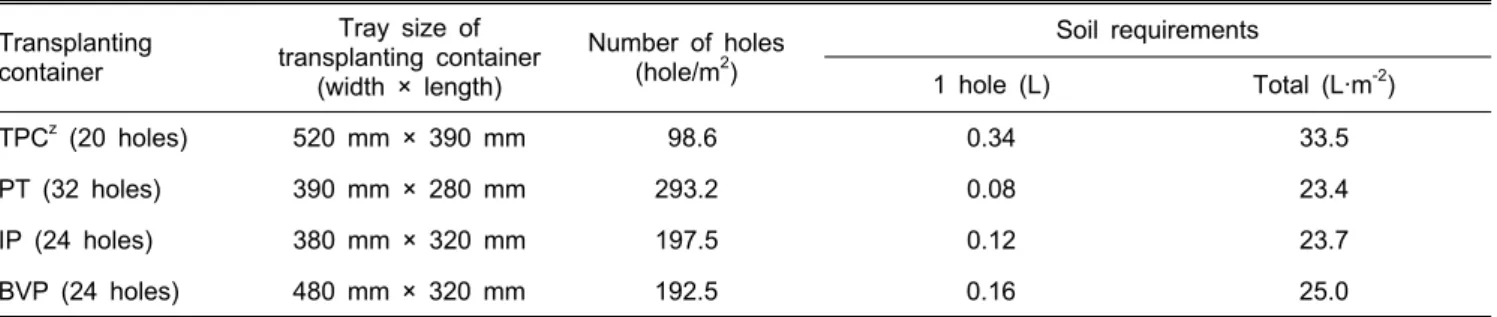
Table 1. Comparison of soil requirements according to several transplanting containers for acclimatization of in vitro plants of ever-bearing strawberry ‘Goha’.
Transplanting container
Tray size of transplanting container
(width × length)
Number of holes (hole/m2)
Soil requirements
1 hole (L) Total (L·m-2)
TPCz (20 holes) 520 mm × 390 mm 98.6 0.34 33.5
PT (32 holes) 390 mm × 280 mm 293.2 0.08 23.4
IP (24 holes) 380 mm × 320 mm 197.5 0.12 23.7
BVP (24 holes) 480 mm × 320 mm 192.5 0.16 25.0
zTransparent plastic container (TPC), plug tray (PT), I-pot (IP), black vinyl pot (BVP).
딸기 조직배양 시 생물반응기 배양묘의 경우 뿌리발생은 많 으나 뿌리 신장이 불량하여(Lee et al., 2010a), 배양이 성공 적으로 이뤄졌다 하더라도 소식물체가 기외 순화 단계에서 고사되는 경우가 많아 이 문제를 반드시 해결해야 한다. 이 러한 문제를 해결하기 위해 딸기 조직배양묘 배양 시 배지 내 화학물질 조절 또는 순화 시 기상환경을 조절하는 방법 (Rita and Floh, 1995; Skirvin and Sriskandarajah, 1993; Slavtcheva and Dimitrova, 1997; Thomas, 1998) 등을 이용해 왔다.
순화용기는 토양 수분 보유 및 식물 생육과 관계가 깊어 용기 크기에 따라 소식물체의 생존 및 생육에도 영향을 미 칠 수 있다(Carmi, 1995; Hess and De Kroon, 2007; Ray and Sinclair, 1998). 그리고 순화용기의 크기에 따라 단위면적 당 순화를 할 수 있는 개체수가 달라져, 용적이 작은 용기를 사용할수록 많은 양의 소식물체를 순화할 수 있는 장점을 가지고 있다. 그러나 딸기 조직배양묘의 식물생장 및 반응 에 영향을 미치며 경제적인 순화용기에 관한 연구가 매우 부족한 실정이다.
따라서 본 실험은 생물반응기를 통해 배양된 딸기 소식물 체의 순화용기 별 생존율 및 생육특성을 비교하고, 순화용 기에 따른 묘생산 경제성을 비교하고자 실시하였다.
재료 및 방법
본 실험에 사용된 식물재료는 Kim et al.(2011)의 방법에 따라 생물반응기에서 6주간 배양한 후 식물체의 엽수가 6-10 매 정도 확보된 ‘고하’ 조직배양묘를 이용하였다. 순화 실험 은 2010년 3월 3일부터 4주간 유리온실에서 실시하였으며, 온실 내 기온은 10-25℃ 범위였다. 이식 직후 일주일간 50%
차광망으로 차광하였고, 투명비닐 터널로 습도를 90% 이상 유지한 후 자연광 하에서 순화하였다.
본 실험에서 순화용기는 플라스틱 투명용기(520mm × 390mm, 20구), 플러그 트레이(390mm × 280mm, 32구), I- 포트(380mm × 320mm, 24구), 흑색비닐포트(480mm × 320mm,
24구)를 사용하였다. 순화용기의 종류에 따른 용적은 Table 1 과 같다. 순화용기 1구당 용적은 플라스틱 투명용기 0.34L, 흑색비닐포트 0.16L, I-포트 0.12L, 플러그 트레이 0.08L 순 이며, 단위면적 1m2당 각 33.5L, 23.4L, 23.7L 및 25.0L의 상토를 필요로 하고, 단위면적 1m2당 플러그 트레이가 293.2 구로 가장 많고, I-포트 197.5구, 흑색비닐포트 192.5구, 플 라스틱 투명용기 98.6구의 순으로 나타났다.
토양함수율은 차광망 제거 후 5일간, 오전 9시 30분부터 오후 5시 30분까지 2시간 간격으로 5회/일, 5반복 측정하였 다. 관수 조건은 토양 표면이 살짝 말랐을 때의 함수율인 10%
이하 시 두상 관수하였다. 생육조사는 순화 4주 후에 실시하 였으며, 조사 후 고설식 수경재배에 정식하여 EC 0.8dS・m-1, pH 6.8인 양액(Yamazaki 딸기전용양액)을 50mL/plant/회, 4회/일 관수하였으며, 정식 10일 후 런너의 수를 조사하였다.
순화용기에 따른 묘의 생산 비용 산정은 플라스틱 투명용 기와 플러그 트레이는 신흥상사 납품가 기준, I-포트는 준우 산업 납품가 기준, 흑색비닐포트는 (주)한국영농자재 납품 가를 기준으로 실시하였으며, 조직배양묘는 Lee et al.(2010a) 의 단가를 기준으로 책정하였다.
결과 및 고찰
순화용기별 토양 내 함수율을 측정한 결과(Fig. 1), 함수 율 10% 이상 지속일수가 플라스틱 투명용기는 약 5일, 흑색 비닐포트는 3-4일, 플러그 트레이는 2일 그리고 I-포트는 1 일 순이었다. 따라서 관수횟수는 순화 후 8일부터 29일까지 21일 동안 플라스틱 투명용기는 4회, 흑색비닐포트는 5-7 회, 플러그 트레이는 10회 그리고 I-포트가 21회로 가장 빈 번하였다. 토양함수율 및 관수횟수는 순화용기의 용적에 따 라 차이를 보였는데, 용적이 작은 플러그 트레이와, I-포트 의 경우 토양함수율이 빠르게 낮아져 관수횟수가 많아지고, 용적이 큰 흑색비닐포트와 플라스틱 투명용기는 토양함수 율이 높아 관수횟수가 줄어드는 경향을 보였다(Fig. 1). 따
Fig. 1. Soil water content of transplanting containers used for acclimatization of ever-bearing strawberry ‘Goha’ in vitro plants through bioreactor culture: transparent plastic container (TPC); plug tray (PT); I-pot (IP); black vinyl pot (BVP).
Table 2. Growth characteristics of acclimated plantlets of ever-bearing strawberry ‘Goha’ according to transplanting containers.
Transplanting containerz
Survival rate (%)
Number of survival plant
(plant/m2)
Shoot length (mm/plant)
Crown diameter (mm/plant)
Number of leavesy
(ea/plant) Leaf area (mm2/plant)
Root length (mm/plant) SL NL Total
TPC 70 69.0 88.0ax 4.7a 4.2 3.2 7.4a 119a 137b
PT 15 44.0 73.4b 3.5b 2.8 3.4 6.2b 97b 168b
IP 55 108.6 52.8c 2.0c 3.4 1.8 5.2b 51c 166b
BVP 80 154.0 74.4b 3.9b 3.8 2.4 6.2b 92b 199a
zTransparent plastic container (TPC), plug tray (PT), I-pot (IP), black vinyl pot (BVP).
ySL (simple leaf), NL (normal leaf).
xMean separation within columns by Duncan’s multiple range test (P ≤ 0.05).
라서 조직배양묘 순화 시 노동력 절감을 위하여 순화용기의 용적이 비교적 큰 흑색비닐포트 또는 플라스틱 투명용기를 사용하는 것이 알맞을 것으로 판단되었다.
순화 후 용기별 생육을 비교한 결과는 Table 2와 같다.
생존율은 흑색비닐포트가 80%로 가장 높았고, 플라스틱 투 명용기가 70%, I-포트가 55%, 플러그 트레이가 15% 순으로 낮았다. 플라스틱 투명용기는 초장이 88mm/plant, 관부직경 이 4.7mm/plant, 엽수가 7.4개/plant 및 엽면적이 119mm2/plant 로 생육이 가장 왕성하였으며, 플러그 트레이와 흑색비닐포 트의 생육량은 비슷하였고, I-포트가 가장 부진하였다. 그러 나 뿌리길이는 흑색비닐포트가 199mm/plant로 가장 길었 다. 용기별 런너의 수는 흑색비닐포트가 3.3개/plant로 가장 많았으며, 플라스틱 투명용기 2.9개/plant, 플러그 트레이 1.6 개/plant 및 I-포트 1.2개/plant 순으로 나타났다(Fig. 3).
Zhu et al.(2006)는 포도나무를 작은 포트에 심어 토양 부 피를 제한하면 지상부 생육이 감소한다고 보고하였고, Ronchi et al.(2006)는 커피나무의 경우 작은 포트를 사용하여 발근 공간이 좁아지면 지상부 생육이 현저히 감소된다고 보고하
여, 여러 식물 종의 생장에 있어서 발근 공간의 물리적 제한 이 식물체 생육에 많은 영향을 미친다(Carmi, 1995; Hess and De Kroon, 2007; Ray and Sinclair, 1998)는 것을 알 수 있었다. 용적이 적어서 발근 공간이 좁고 작은 포트(플러 그 트레이, I-포트)들은 큰 포트(플라스틱 투명용기, 흑색비 닐포트)에 비해 초장, 관부직경 및 엽면적 등의 생장이 작아, 식물체의 지상부 생육이 제한되었다(Table 2). 용적이 큰 흑 색비닐포트와 플라스틱 투명용기의 지상부 및 지하부 생육 이 왕성하였고(Table 2 and Fig. 2), 고설식 수경재배 포장에 정식 후 활착이 빨라 러너 발생수가 많았던 것으로 판단되 었다(Fig. 3).
묘 생산량을 계산한 결과, 흑색비닐포트가 154.0주・m-2로 가장 많았고, I-포트가 108.6주・m-2, 플라스틱 투명용기가 69.0주・m-2, 플러그 트레이가 44.0주・m-2 순이었다(Table 2).
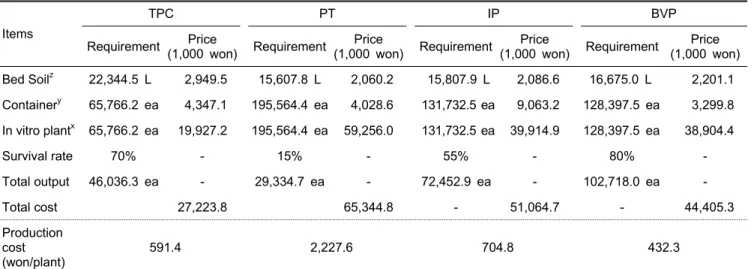
딸기 육묘에 가장 많이 사용되는 I-포트와 흑색비닐포트 를 비교하여 경제성을 분석한 결과는 Table 3과 같다. 상토 량은 I-포트는 15,807.9L・10a-1로 흑색비닐포트의 16,675.0L・
10a-1에 비해 약 867.1L・10a-1 더 필요하여, 상토 구매에 필
Fig. 2. Comparison of shoot and root growth of ever-bearing strawberry ‘Goha’ according to transplanting container: after 4 weeks from acclimatization date and that is arranged in TPC, PT, IP, and BVP from the left.
Fig. 3. Comparison on number of runners of Ever-bearing strawberry ‘Goha’ according to transplanting container in the field: transparent plastic container (TPC); plug tray (PT); I-pot (IP); black vinyl pot (BVP).
Table 3. Comparison of economic efficiency of I-pot and black vinyl pot during acclimatization of Ever-bearing strawberry 'Goha' in vitro plants (10a).
Items
TPC PT IP BVP
Requirement Price
(1,000 won) Requirement Price
(1,000 won) Requirement Price
(1,000 won) Requirement Price (1,000 won) Bed Soilz 22,344.5 L 2,949.5 15,607.8 L 2,060.2 15,807.9 L 2,086.6 16,675.0 L 2,201.1 Containery 65,766.2 ea 4,347.1 195,564.4 ea 4,028.6 131,732.5 ea 9,063.2 128,397.5 ea 3,299.8 In vitro plantx 65,766.2 ea 19,927.2 195,564.4 ea 59,256.0 131,732.5 ea 39,914.9 128,397.5 ea 38,904.4
Survival rate 70% - 15% - 55% - 80% -
Total output 46,036.3 ea - 29,334.7 ea - 72,452.9 ea - 102,718.0 ea -
Total cost 27,223.8 65,344.8 - 51,064.7 - 44,405.3
Production cost (won/plant)
591.4 2,227.6 704.8 432.3
Economic efficiency was calculated expected probably a cost at 10a (using 66.7% of area) during acclimatization time of ever-bearing strawberry ‘Goha’ in vitro plantlets.
zPurmi was used in this experiments. Soil is 132 won per liter.
yTPC is 66.1 won/hole, PT is 20.6 won/hole, IP is 68.8 won/hole, and BVP is 25.7 won/hole each.
xIn vitro plant is 303 won per one plantlet (Lee et al., 2010a).
요한 금액은 114,500원・10a-1의 손실이 있었다. 그러나 용기 값은 흑색비닐포트가 3,299,800원・10a-1로 I-포트의 9,063,200 원・10a-1보다 적어 약 2/3가량 용기비용을 절약할 수 있었다.
생존율과 용기면적에 따른 순화에 필요한 조직배양묘수도 I-포트는 131,732.5주・10a-1, 흑색비닐포트는 128,397.5주・
10a-1로 흑색비닐포트가 더 적었다. 그러나 흑색비닐포트의 생존율이 80% (Table 2)로 최종 생산주수는 102,718주・
10a-1로 I-포트의 72,452.9주・10a-1보다 30,265.1주・10a-1 더 많이 생산할 수 있었으며, 주당 생산비용은 흑색비닐포트가 432.3원으로 I-포트의 704.8원에 비해 272.5원 절약할 수 있 었다.
따라서, 생물반응기를 이용해 대량생산된 딸기 소식물체 의 알맞은 순화용기는 타 순화용기에 비해 생존율과 생육량
많고, 저비용으로 많은 양을 순화할 수 있으며, 정식 후 런너 발생도 많은 흑색비닐포트를 사용하는 것이 알맞을 것으로 판단되었다.
초 록
본 실험은 생물반응기를 통해 대량증식된 사계성 딸기 조 직배양묘의 적정 순화용기를 선발하기 위해 실시하였다. 순 화용기는 플라스틱투명용기, 플러그 트레이, I-포트 및 흑색 비닐포트 등 4가지를 사용하였다. 토양함수율 10%이상 지 속일수는 플라스틱 투명용기가 5일, 흑색비닐포트가 3-4일, 플러그 트레이 2일, I-포트가 1일 순이었다. 생존율은 흑색 비닐포트가 80%, 플라스틱투명용기가 70%, I-포트가 55%
및 플러그 트레이가 15% 순으로 나타났다. 또한 생육량은 플라스틱 투명용기가 가장 왕성하였고, 흑색비닐포트와 플 러그 트레이는 비슷하였으며, I-포트가 가장 저조하였다. 런 너 발생은 흑색비닐포트가 주당 3.3개로 가장 많았으며, 플 라스틱투명용기가 2.9개, 플러그 트레이가 1.6개 및 I-포트 가 1.2개 순으로 나타났다. 총 생산비용은 흑색비닐포트가 44,405,300원/10a로 I-포트의 51,064,700원/10a보다 6,659,400원 /10a이 더 절감되었으며, 총 생산주수도 흑색비닐포트가 102,718주/10a로 I-포트의 72,452.9주/10a보다 30,265.1주/10a 더 생산되었다. 또한 주당 생산비용은 흑색비닐포트가 432.3원 으로 I-포트의 704.8원에 비해 272.5원의 감소하였다. 따라 서 생물반응기를 통해 대량증식된 사계성 딸기 조직배양묘 의 순화용기는 흑색비닐포트가 적당하였다.
추가 주요어 : 흑색비닐포트, Fragaria × ananassa, 토양 함 수율, 생존율, 총 생산량
인용문헌
Carmi, A. 1995. Growth, water transport and transpiration in root -restricted plants of bean, and their relation to abscisic acid accumulation. Plant Sci. 107:69-76.
Grout, B.W.W. and M.J. Aston. 1977. Transplanting cauliflower plants regenerated from meristem culture. I. Water loss and water transfer related to changes in leaf wax to xylem regeneration.
Hort. Res. 17:1-7.
Hess, L. and H. De Kroon. 2007. Effects of rooting volume and nutrient availability as an alternative explanation for root self/
non-self discrimination. J. Ecol. 95:241-251.
Kim, H.J., J.N. Lee, K.D. Kim, J.S. Im, H.T. Lim, and Y.R. Yeoung.
2011. Suitable hormone-free medium for in vitro mass propagation via bioreactor culture of Ever-bearing strawberry. J. Plant Biotechnol.
38:221-227.
Lee, J.N., H.Y. Kim, K.D. Kim, Y.S. Kwon, H.T. Lim, and Y.R.
Yeoung. 2010a. In vitro mass propagation and economic effects of bioreactor culture in Ever-bearing strawberry ‘Goha’. Kor. J.
Hort. Sci. Technol. 28:845-849.
Lee, J.N., H.Y. Kim, K.D. Kim, Y.S. Kwon, J.S. Im, Y.R. Yeoung, and H.T. Lim. 2010b. Appropriate in vitro culture conditions of growing medium for new ever-bearing strawberry ‘Goha’. Kor.
J. Hort. Sci. Technol. 28:1051-1056.
Ray, J.D. and T.R. Sinclair. 1998. The effect of pot size on growth and transpiration of maize and soybean during water deficit stress.
J. Exp. Bot. 49:1381-1386.
Rita, I. and E.I.S. Floh. 1995. Tissue culture and micropropagation of Cuphea ericoides, a potential source of medium-chain fatty acids. Plant Cell, Tiss. Org. Cult. 40:187-195.
Ronchi, C.P., F.M. DaMatta, K.D. Batista, G. Moraes, M.E. Loureiro, and C. Ducatti. 2006. Growth and photosynthetic down-regulation in Coffee arabica in response to restricted root volume. Functional Plant Biol. 33:1013-1023.
Skirvin, R.M. and S. Sriskandarajah. 1993. The use of fogging and phototron units to acclimatize in vitro-derived apple shoots.
HortTechnology 3:208-210.
Slavtcheva, T. and V. Dimitrova. 1997. Gas exchange with in vitro cultured vine plants during their acclimatization. Riv. Vitic. Enol.
2:3-9.
Sutter, E. and R.W. Langhans. 1982. Formation of epicuticular wax and its effect on water loss in cabbage plants regenerated from shoot-tip culture. Can. J. Bot. 60:2896-2902.
Thomas, P. 1998. Humid incubation period and plantlet age influence acclimatization and establishment of micropropagated grapes. In Vitro Cell. Dev. Biol. Plant. 34:52-56.
Wetzestein, H.Y. and H.E. Sommer. 1982. Leaf anatomy of tissue -cultured Liquidambar styraciflua (Hammelidaceae) during acclimatization. Amer. J. Bot. 69:1579-1586.
Zhu, L.N., S.P. Wang, T.Y. Yang, C.X. Zhang, and W.P. Xu. 2006.
Vine growth and nitrogen metabolism of ‘Fujiminori’ grapevine in response to root restriction. Sci. Hort. 107:143-149.