• 검색 결과가 없습니다.

The Effects of Abdominal Drawing-in on Muscle Activity in the Trunk and Legs during Ramp Walking

N/A
N/A
Protected

Academic year: 2021

Share "The Effects of Abdominal Drawing-in on Muscle Activity in the Trunk and Legs during Ramp Walking"

Copied!
8
0
0

로드 중.... (전체 텍스트 보기)

전체 글

(1)

| Abstract |

Purpose: This study examined the effects of the abdominal drawing-in maneuver (ADIM) on muscle activity in the trunk and legs while subjects walk on a ramp.

Methods: The subjects were healthy adult males (n=15) and females (n=8) in their twenties. The subjects were asked to maintain the ADIM contraction for 15 minutes using a pressure biofeedback unit. Their muscle activity was then measured while ascending or descending the ramp with or without the ADIM contraction maintained. Activity in the sternocleidomastoid, splenius capitis, rectus abdominis, external oblique abdominal, transversus abdominis, erector spinae, vastus medialis, and vastus lateralis muscles was measured using surface electromyography (TM DTS, Noraxon, USA). A paired t-test was conducted using SPSS 18.0 (IBM) for statistical data processing.

Results: Maintaining the ADIM contraction during ascension led to a significant increase (p<0.05) in muscle activity for the rectus abdominis, transversus abdominis, vastus medialis, and vastus lateralis, but a significant decrease (p<0.05) in muscle activity for the erector spinae, when compared to the same activity without the ADIM maintained. Furthermore, maintaining the ADIM contraction during descent led to a significant increase (p<0.05) in muscle activity for the rectus abdominis, external abdominal oblique, transversus abdominis, vastus medialis, and vastus lateralis, but a significant decrease (p<0.05) in muscle activity for the erector spinae, when compared to the same activity without the ADIM maintained.

Conclusion: As a result of this study, it maintains the ADIM and reduces lumbar muscle activity at the waist and increases muscle activity in the legs when walking on a ramp. Therefore, maintaining the ADIM contraction during ramp walking is recommended as training to improve the function of patients’ muscular skeleton.

Key Words: Ramp, Pressure biofeedback unit, Abdominal drawing-in maneuver, Muscle activity

†Corresponding Author : Su-Kyoung Lee ([email protected])

Original Article Open Access

경사로 보행 시 복부 드로잉-인 기법이 몸통 및 다리의 근활성도에 미치는 영향
이수경

1)

동의대학교 물리치료학과

The Effects of Abdominal Drawing-in on Muscle Activity in the Trunk and Legs during Ramp Walking

Su-Kyoung Lee

Department of Physical Therapy, College of Nersing and Healthcare Sciences, Dong-Eui University

Received: March 4, 2019 / Revised: March 25, 2019 / Accepted: March 25, 2019

ⓒ 2019 Journal of Korea Proprioceptive Neuromuscular Facilitation Association

This is an Open Access article distributed under the terms of the Creative Commons Attribution Non-Commercial License

(http://creativecommons.org/licenses/by-nc/3.0) which permits unrestricted non-commercial use, distribution, and reproduction

in any medium, provided the original work is properly cited.

(2)

Ⅰ. 서 론

복부 중심근육(Core muscle)은 운동 시 근 골격구조 를 적절하게 유지시켜주고, 자세 조절에 관여하기 때 문에 코르셋 근육(Corset muscle)이라고도 불린다 (Kinser & Colby, 2010). 대표적으로 배가로근 (transverse abdominis), 배빗근(obilique abdominis), 척 추옆근육(paraspinalis), 볼기근(gluteus), 뭇갈래근 (multifidus), 골반바닥근(pelvic floor)과 엉덩관절 주변 근육들이 복부 중심근육을 이루고 있다(Verhryden et al., 2006). 이러한 복부 중심 근육의 불안정성은 척추 만곡의 변형을 일으켜 거북목(turtle neck), 굽은 등 (sway back), 척추의 과도한 앞굽음증(lordosis), 과도한 뒤굽음증(kyphosis), 또는 심한 옆굽음증(scoliosis)을 유발하게 된다. 또한, 허리뼈에 대한 과도한 부하 증가, 골반의 변형, 다리의 정렬 이상 등의 결과를 가져올 수도 있다(Kendall et al., 2005). 따라서 정상적인 복부 중심근육은 외부 환경이 변화할 때, 신체의 상태를 일정하게 유지하거나 조절하는 능력인 몸통 안정성 (trunk stability)에 매우 중요한 역할을 하며(McNeil, 2010; Zazulak et al., 2008), 이는 몸통의 균형과 보행에 큰 영향을 미친다(Verhryden et al., 2006).

보행은 일상생활동작에서 매우 중요하고 기초적인 동작으로, 기본적인 운동기능과 몸통의 이동이 동시 에 이루어지는 활동이며(Hubble et al., 2014), 동시에 신체를 유지하거나 조절하기 때문에 복근의 역할이 강조되고 있다(McNeil, 2010; Zazulak et al., 2008). 또 한, 보행은 일정한 방향으로 필요한 속도를 유지하며 신체를 단계적으로 움직이는 고도로 협응된 교대적인 운동이며 보행과정에서 다리는 기본적으로 체중부하 를 담당하고 안정성과 균형을 유지하고 신체를 전방 으로 추진시키며 이동에 필요한 기본적 운동을 제공 한다 (Galley & Foster, 1987). 특히 경사로 보행은 보행 훈련 시 기본적인 요소가 되고(Well, 1981), 계단을 대 신할 수 있는 수직이동의 수단이며 , 특히 계단을 이용 하기 어려운 장애인이나 노인, 임산부들을 위한 필수 적인 시설이기 때문에(Ryu, 1995) 경사로 보행 또한

인간에게 있어서 일상생활을 살아가는데 매우 필수적 이다 (Yoon, 1998). 경사로 보행에 관한 선행연구를 살 펴보면 경사로를 오르는 동안 큰볼기근 (gluteus maximus), 안쪽넓은근(vastus medialis), 뒤넙다리근 (hamstring)등 대부분의 다리근육의 활성과 발현시간 이 증가하였으며(Han, 2005), Ounpuu (1990)는 경사로 를 내려오는 동안 무릎 굽힘근과 폄근의 수축력이 증 가됨을 보고하였다. 따라서 경사로를 보행할 때 평지 를 보행할 때 보다 근 활성도가 증가하며 , 그에 따른 역학적 노력이 더 많이 필요함을 알 수 있다 . 따라서 경사로 보행에 대한 체계적인 이해는 다리의 기능을 분석하고, 다리 기능에 영향을 미치는 여러 질환의 역학적 병인을 연구하는데 필수적임을 확인할 수 있 다(Well, 1981). 이처럼 경사로 보행 훈련이 효과적이 라는 연구결과가 있지만 이를 응용한 연구와 더 효과 적으로 훈련을 하는 방법에 관한 연구는 부족한 실정 이다. 따라서 본 연구에서는 더 효과적인 경사로 보행 훈련을 위해서 복부 드로잉-인 기법 적용의 유무가 몸통 및 다리의 근 활성도에 미치는 영향에 대해 알아 보고자 한다 . 본 연구의 가설은 복부 드로잉-인 기법을 유지한 상태로 경사로 오르기가 유지하지 않은 상태 보다 복부 근육과 다리 근육의 활성도가 증가되고 척 추세움근은 더 감소될 것이다 라고 설정하였다.

Ⅱ. 연구 방법

1. 연구 대상

본 연구는 부산광역시 D 대학교에 재학 중인 건강

한 성인 남자 15명, 여자 8명을 대상으로 하였으며,

본 연구의 내용 및 목적에 대한 설명을 듣고 , 실험에

참여 의사를 밝힌 사람들을 대상으로 연구를 진행하

였다 . 본 연구의 대상자 선정은 근육뼈대계 질환으로

전문의의 진단을 받지 아니한 자, 정상적인 보행이

가능한 자 , 배와 다리의 근력약화가 없는 자, 신경학적

질환이 없는 자로 선정하였다.

(3)

2. 측정 도구

1) 표면 근전도

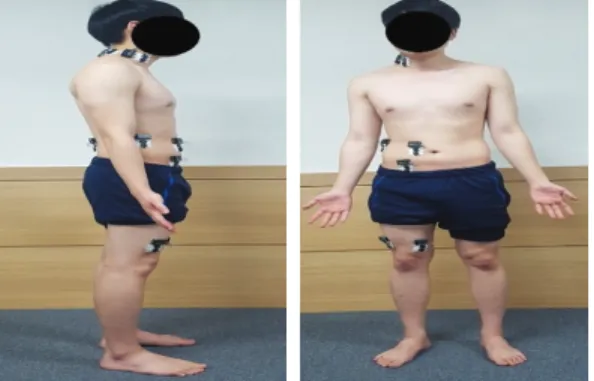
본 연구에서는 복부 드로잉 -인 기법이 경사로 오르 기와 내려오기 시 근활성도에 미치는 영향을 측정하 기 위해서 표면 근전도(TM DTS, Noraxon, USA)를 사 용하였다. 전극을 부착하기 전에 부착부위의 각질을 제거한 뒤, 표면이 부드러운 사포로 약 3회 문지른 후 알코올로 닦아서 피부의 저항을 줄여주었다 . 전극 은 몸의 오른쪽 부위 중 최대 수축한 근육의 근복 (muscle belly)에 양극전극을 부착하였고, 2cm 떨어진 부위에 음극전극을 근섬유결의 방향과 평행하게 부착 하였다. 부착부위는 목빗근(sternocleidomastoid, SCM), 머리널판근(splenius capitis), 배곧은근(rectus Abdominal), 배바깥빗근(external oblique,EO), 배가로 근(transverse abdominal), 척추세움근(elector Spinae), 안쪽넓은근(vastus medialis), 가쪽넓은근(vastus lateralis)에 부착하였다(Cram et al., 1998)(Fig. 1).

Fig. 1. EMG attachment site.

2) 압력 생체 피드백 장치

본 연구에서는 압력 생체 피드백 장치(Fig. 2)를 통 해 복부 드로잉 -인 기법을 실시하였다. 대상자는 안정 적인 지지면 위에서 무릎관절은 90° 굽히고 누운 자세 를 취한 상태에서 장치를 대상자의 허리뼈 5번 아래에 위치시켜서 운동을 실시하였다(Kim, 2008; Kim,

2014). 대상자는 압력 생체피드백 장치에 연결되어 있 는 압력계를 40㎜Hg인 상태에서 10㎜Hg를 증가시킨 후 그 상태를 유지하도록 훈련하였고 , 이때 대상자는 호기할 때처럼 복부가 약간 들어가도록 배꼽을 상방 과 후방(허리방향)으로 당긴 채로 15분간 실시하였다 (Kim, 2014; Yun, 2013)(Fig. 3).

Fig. 2. EMG attachment site.

Fig. 3. Abdominal drawing- in maneuver.

3) 모의 경사로 설계

경사로는 높이 45cm, 폭이 100cm, 길이가 360cm인 기울기가 1 : 8인 경사로를 제작하였다(Fig. 4).

Fig. 4. Ramp design.

3. 연구 방법

1) 실험 전

대상자는 연구 방법을 숙지하기 위해 복부 드로잉 -

인 기법을 15분간 실시한 뒤 3분간 휴식 후 복부 드로

잉-인 기법을 유지한 상태와 유지하지 않은 상태로

경사로 오르기와 내려오기를 각 1회씩 실시하였다.

(4)

2) 실험

본 실험은 무작위 배정 비교(randomized controlled trial)를 통해(Ahn, 2018) 복부 드로잉-인 기법을 유지한 상태와 유지하지 않은 상태에 대한 순서를 정하였고 그 순서절차에 따라 연구대상자는 경사로 오르기와 내려오기 시에 대한 근 활성도를 측정하였으며 , 대상 작용을 방지하기 위해 각 순서절차마다 3회 반복 측정 후 3분간 휴식을 취하였다.

4. 자료 분석

1) 근전도 신호처리 분석

근활성도를 측정하기 위하여 8개 채널의 표면 근전 도를 사용하였으며, 데이터는 경사로 보행 시 첫 걸음 과 마지막으로 내딛은 걸음을 제외한 중간값을 사용 하였다. 필터링(Band pass filter 20-450Hz, Notch filter 60Hz)과 기타 신호를 처리(rectification, smoothing)하 였다. 또한 수집된 근전도 신호를 RMS (root mean square)로 처리하였으며 특정 동작을 기준 값으로 하여 사용하는 %RVC (reference voluntary contraction)값을 이용해 정규화(normalization)하였다.

2) 통계 분석

자료 분석은 SPSS version 18.0을 이용하여 통계처 리를 실시하였으며 , 복부 드로잉-인 기법으로 경사로 보행 시 몸통 및 하지 근육의 활성화를 알아보기 위하 여 각각의 대응표본t-test (paired t test)을 사용하였다.

이때 통계학적 유의수준을 검증하기 위한 유의수준은 0.05로 설정하였다.

Ⅲ. 연구 결과

1. 연구 대상자의 일반적인 특성

본 연구는 정상 성인 남녀 23명을 대상으로 실험을 실시하였으며, 평균나이는 22.57±2.02세이며, 평균 키 169.57±9.77cm, 평균 몸무게는 63.57±13.26Kg 이었다 (Table 1).

Characteristics

Sex (geneder) Male (15)/Female (8) Age (yerars) 22.57±2.02 Height (cm) 169.57±9.77 Weight (kg) 63.57±13.26 Table 1. General characteristics of subjects (n=23)

2. 경사로 오르기 시 복부 드로잉-인 기법 유무에 따른 근활성도 비교

근전도를 이용하여 오른쪽 몸통 및 다리의 근활성 도를 측정한 결과 경사로 오르기 시 배곧은근 , 배가로 근 , 안쪽넓은근, 가쪽넓은근은 복부 드로잉-인 기법을 적용하기 전보다 적용 후에 유의하게 증가하였고 (p<0.05), 척추세움근은 유의하게 감소하였다 (p<0.05)(Table 2).

3. 경사로 내려오기 시 복부 드로잉-인 기법 유무에 따른 근활성도 비교

근전도를 이용하여 오른쪽 몸통 및 다리의 근활성

도를 측정한 결과 경사로 내려오기 시 배곧은근, 배바

깥빗근, 배가로근, 안쪽넓은근, 가쪽넓은근은 복부 드

로잉 -인 기법을 적용하기 전보다 적용 후에 유의하게

증가하였고(p<0.05), 척추세움근은 유의하게 감소하

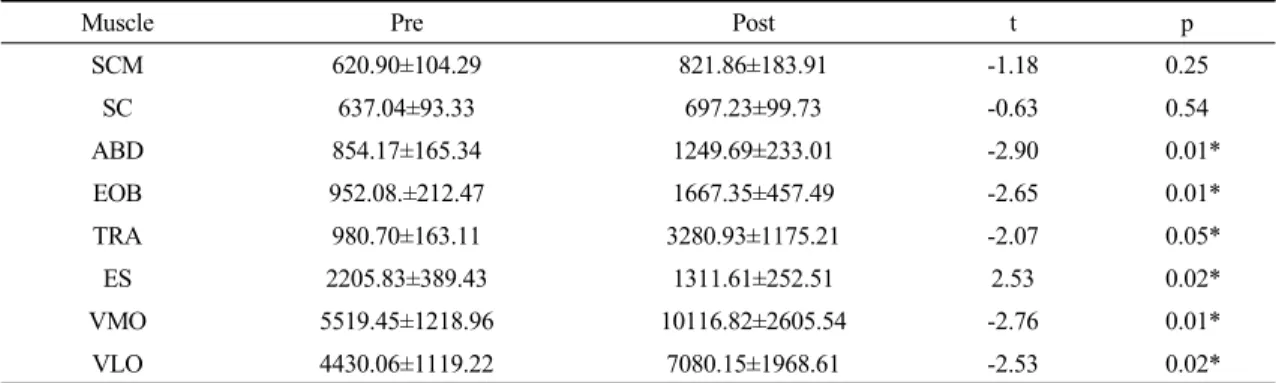
였다(p<0.05)(Table 3).

(5)

Ⅳ. 고 찰

본 연구에서는 경사로 오르기와 내려오기 시 복부 드로잉 -인 기법의 유무에 따라 몸통 및 다리 근 활성도 차이를 알아보고자 한다 . 본 연구 결과 경사로 오르기 시 복부 드로잉-인 기법을 유지한 상태가 유지하지 않은 상태에 비하여 배곧은근, 배가로근의 근 활성도 가 유의하게 증가하였고 경사로 내려오기 시에는 배 가로근 , 배곧은근, 배바깥빗근의 근 활성도가 유의하 게 증가하였다.

복부 드로잉 -인 기법 수행 시 복부근육이 많이 활성 화되는데 특히 배가로근 , 배바깥빗근, 배곧은근 등이 많이 활성화 되며 (O’ Sullivan et al., 2013), 이러한 근육 들은 기능적 활동 시에 내부 복압을 증가시켜 체간을 안정화 시키는 역할을 한다 (Standaert et al., 2008). 복부 드로잉-인 기법은 복부근육의 두께를 두꺼워지게 하 여 근 활성도를 증가시키며(chon, 2010), 또한, 수직보 행 시에 복부 드로잉-인 기법을 적용하였을 때도 복부 근육의 활성도는 유의하게 증가한다고 하였다 (Lee et al., 2011). 본 연구에서도 선행논문에서의 결과와 일치

Muscle Pre Post t p

SCM 651.17±127.25 814.10±181.65 1.48 0.15

SC 764.07±140.52 614.23±87.97 -1.70 0.10

ABD 835.04±151.82 1219.73±248.47 2.70 0.01*

EOB 1180.69±285.94 1553.93.±395.56 1.86 0.08

TRA 1212.65±208.43 3049.15±874.06 2.39 0.03*

ES 2532.38±541.27 1250.11±188.79 -2.79 0.01*

VMO 4552.05±1267.24 8818.56±2309.85 3.47 0.00*

VLO 4782.78±1265.16 7122.00±1807.74 2.58 0.02*

SCM: sternocleidomastoid, SC: splenius capitis, ABD: rectus abdominis, EOB: external abdominal oblique, TRA: transverse abdominis, ES: erector spinae, VMO: vastus medialis, VLO: vastus lateralis

*p<0.05, Mean±SE

Table 2. Comparison of muscle activity according to abdominal drawing-in maneuver with ascending ramp (n=23, unit: %RVC)

Muscle Pre Post t p

SCM 620.90±104.29 821.86±183.91 -1.18 0.25

SC 637.04±93.33 697.23±99.73 -0.63 0.54

ABD 854.17±165.34 1249.69±233.01 -2.90 0.01*

EOB 952.08.±212.47 1667.35±457.49 -2.65 0.01*

TRA 980.70±163.11 3280.93±1175.21 -2.07 0.05*

ES 2205.83±389.43 1311.61±252.51 2.53 0.02*

VMO 5519.45±1218.96 10116.82±2605.54 -2.76 0.01*

VLO 4430.06±1119.22 7080.15±1968.61 -2.53 0.02*

SCM: sternocleidomastoid, SC: splenius capitis, ABD: rectus abdominis, EOB: external abdominal oblique, TRA: transverse abdominis, ES: erector spinae, VMO: vastus medialis, VLO: vastus lateralis

*p<0.05, Mean±SE

Table 3. Comparison of muscle activity according to abdominal drawing-in maneuver with descending ramp

(n=23, unit: %RVC)

(6)

하게 수직보행 중 하나인 경사로 보행 시 복부 드로잉 - 인 기법을 적용하였을 때 복부근육의 활성도가 유의 하게 증가하였다는 결과가 나왔다.

반면에 척추세움근의 근 활성도는 복부 드로잉-인 기법을 적용한 상태에서 경사로 오르기와 내려오기를 했을 시 유의하게 감소하였다. 복부 드로잉-인 기법은 체간을 안정화 시켜주어 복부근육들의 근 활성도를 증가시켜주며(Hong, 2014), 복부근육 활성 시 척추에 작용하는 압력과 전단력을 줄여준다(Kendal, 2005). 그 러므로 복부 드로잉-인 기법을 유지하였을 때 척추세 움근의 근 활성도가 감소한다(Kinser & Colby, 2010).

또 다른 선행논문에서는 복부 드로잉-인 기법이 복강 내압을 증가시켜 척추가 받는 힘을 낮춰주어 척추사 이에 가해지는 내부 압력을 감소시키기 때문에 척추 세움근의 근 활성도가 감소한다고 보고하였다(Park

& Kim, 2009; Smith et al., 1996; Udo & Yoshinaga, 1997). 본 연구에서도 복부 드로잉-인 기법을 적용하였 을 때 척추세움근의 활성도가 유의하게 감소하여 선 행 논문들과 일치한 결과가 나왔다. 복부 드로잉-인 기법 시 복부근육들의 동시수축을 유도하여 과도한 허리의 전만이나 골반의 전방 경사를 줄여주고 , 척추 사이 내부 압력을 감소시켜 효과적인 허리안정화 (lumbar stabilization)에 기여한다(Kinser & Colby, 2010). 결과적으로 복부 드로잉-인 기법 적용 시 복부 내압을 증가시킴과 동시에 체간의 안정성을 증진시켜 척추세움근의 근 활성도가 감소된다고 판단된다.

보행 시 사용되는 다리 근육 중 안쪽넓은근과 가쪽 넓은근은 체중부하구조로서 신체를 앞으로 이동시키 며 이동에 필요한 운동을 제공하는 역할을 한다(Yun et al., 1999). 경사로 보행 시 안쪽넓은근, 가쪽넓은근의 근활성도가 증가하며(Han, 2017), 다리 근육의 근활성 도가 증가할 시 체간의 안정성이 증진된다(Ahn, 2009).

또 다른 선행연구에서도 복부 드로잉 -인 기법 시 다리 근 활성도가 높게 나타났다고 보고하였다(Lee et al., 2016). 본 연구에서도 복부 드로잉-인 기법을 적용하였 을 때 가쪽넓은근, 안쪽넓은근의 활성도가 유의하게 증가하였다. 복부근육의 강화는 다리의 근 수축을 방

산시켜 다리의 근력을 증가시키며(Hwang & Kim, 2011), 따라서 복부 드로잉-인 기법을 유지하였을 때 몸통의 안정성이 증진되면서 다리 근육의 근 활성도 증가된다는 본 연구의 결과와 일치한다. 본 연구에서 도 경사로 보행 시 복부 드로잉-인 기법을 적용하기 전보다 후에 복부, 다리근육에서 근 활성도는 높게 측정되었고 척추세움근에서 근 활성도가 낮게 측정되 었다. 따라서 복부 드로잉-인 기법을 유지한 상태로 경사로 보행을 하게 되면 복부근육과 다리근육의 근 활성도가 증가하고, 척추세움근의 근 활성도가 감소 하여 결론적으로 체간의 안정성을 증가시킨다. 이러 한 결과를 토대로 복부 드로잉-인 기법을 유지하고 경사로 오르기 과제를 수행하는 방법이 근육뼈대계 환자들의 몸통 근육 기능을 회복하는데 기여를 할 수 있을 것으로 사료된다 . 그러나 본 연구는 몇 가지 제한 점이 있는데 제한점으로는 근육뼈대계 환자들을 대상 으로 하지 않고 20대 건강한 대학생을 대상으로 하였 으며 , 복부 드로잉-인 기법 유무에 따른 경사로 오르기 시의 즉각적인 효과만을 측정하여 일시적인 변화를 기록하였다. 따라서 향후 연구에서는 근육뼈대계 환 자군을 대상으로 몇 주간의 중재를 통하여 비교적 정확 한 방법으로 다양한 연구들이 이루어져야 할 것이다 .

Ⅴ. 결 론

본 연구는 부산 D대학에 재학중인 남자 15명, 여자8

명을 대상으로 근전도를 이용하여 경사로에서 보행

시 복부 드로잉-인 기법 적용의 유무가 근 활성도에

미치는 영향에 대해 알아보고자 하였다 . 복부 드로잉-

인 기법을 적용하고 경사로 오르기 시에 배곧은근,

배가로근, 안쪽넓은근, 가쪽넓은근의 근활성도가 유

의하게 증가하였고 척추세움근의 근활성도는 유의하

게 감소하였다 . 또한, 복부 드로잉-인 기법을 적용하고

경사로 내려오기 시에 배곧은근, 배가로근, 배바깥빗

근, 안쪽넓은근, 가쪽넓은근의 근활성도가 유의하게

증가하였고 척추세움근의 근활성도는 유의하게 감소

(7)

하였다. 이러한 결과의 의미는 복부 드로잉-인 기법을 적용하였을 때 복부와 다리 근육이 활성도가 증가하 고 척추세움근 활성도가 감소한다는 것을 알 수 있다.

따라서 경사로 보행 시 과제의 경제적, 역학적 특성을 토대로 근육뼈대계 환자들의 기능 개선을 위한 훈련 으로 복부 드로잉-인 기법을 유지하고 경사로 보행을 수행하는 것을 추천한다.

References

Ahn SH. Effects of various handle grip directions on muscle activity of trunk and upper limb of wheelchair attendant and ground reaction force during ramp climbing.

Dong-eui University. Dissertation of Master’s Degree.

2018.

Ahn SY. The effect of core stability exercise on function of upper extremities and activities daily of living in patients with stroke. Young-in University.

Dissertation of Master’s Degree. 2009.

Cram JR, Kasman GS, Holtz J. Introduction to surface electromyography. Gaithersburg. Aspen. 1998.

Chon SC, Chang KY, You JS. Effect of the abdominal draw-in manoeuvre in combination with ankle dorsiflexion in strengthening the transverse abdominal muscle in healthy young adults: apreliminary, randomised, controlled study. Physiotherapy. 2005;96(2):130-136.

Galley PM, Foster AL. Human movement. New York. Churchill Livingstone. 1987.

Han JT, Kim K, Lim SG. Comparison of plantar foot pressure and shift of COP among level walking stairs and slope climbing. Korean Journal of Sport Biomechanics. 2008;18(4):59-65.

Han SW. The effect of forward walking and backward walking on quadriceps muscles with treadmill inclination:

surface electromyographic analysis. Physical Therapy Korea. 2005;12(1):63-70.

Han SW. Effects of inclined backward and forward walking on surface electromyographic activity, functional capacity and pain for patients with patellofemoral pain syndrome. Journal of Sport and Leisure Studies.

2017;67(2):509-518.

Hong EJ. Biomechanics analysis of EMT’s trunk during CPR at abdominal drawing-in. Daegu University.

Dissertation of Doctorate Degree. 2014.

Hubble RP, Naughton GA, PSilburn PA, et al. Trunk muscle exercises as a means of improving postural stability in people with Parkinson’s disease: a protocol for a randomised controlled trial. BMJ Open.

2014;4(12):2014;4:e006095.

Hwang BJ, Kim JW. Effects of lumbar stabilization exercise on umbar and lower extremity strength of the elderly women. Journal of the Korean Society of Physical Medicine. 2011;6(3):267-275.

Kendall FP, McCreary EK, Provance PG, et al. Muscles, testing and function: with posture and pain. Philadelphia.

Williams & Wilkins. 2005.

Kim EO. The influence of abdominal drawing-in maneuver on lumbar lordosis and trunk and lower extremity muscle activity during bridging exercise. Hanseo University. Dissertation of Master’s Degree. 2008.

Kim HW. Effects of the abdominal draw-in maneuver in combination with ankle dorsiflexion in transverse abdominis and balance in patients with chronic stroke.

Daegu University. Dissertation of Master’s Degree.

2014.

Kisner C, Colby LA. Therapeutic exercise: foundation and techniques, 5th ed. Philadelphia. F.A. Davis Company.

2010.

Lee HJ, Lee NG, Tae KS. Comparison of lower-limbs muscle activity according to the abdominal co-contractive activation. Journal of Rehabilitation Welfare Engineering & Assistive Technology. 2016;10(1):

81-86.

(8)

Lee JK, Desmoulin GT, Khan AH, et al. Comparison of 3D spinal motion during stair-climbing between individuals with and without low back pain. Gait Posture. 2011;34(2):222-226.

McNeil W. Core stability is a subset of motor control. Journal of bodywork and movement Therapies. 2010;14(1):

80-83.

O’ Sullivan SB, Schmitz TJ, Fulk GD. Physical rehabilitation, 6th ed. Philadelphia. F.A. Davis Company. 2013.

Ounpuu S. The biomechanics of running: a kinematic and kinetic analysis. Instructional course lectures.

1990;1(39):305-318.

Park HK, Kim TH. Effect of pelvic tilting and the back-belt on electromyographic activity of erector spinae during lifting. The Korea Contents Society. 2009;9(3):

296-304.

Ryu NH. Walkability on ramps by gait analysis. Journal of the Korean Institute of Landscape Architecture.

1995;23(2):157-166.

Smith EB, Rasmussen AA, Lechner D, et al. The effects of lumbosacral support belts and abdominal muscles strength on functional lifting ability in healthy women.

Spine. 1996;21(3):356-366.

Standaert CJ, Weinstein SM, Rumpeltes J. Evidence-informed

management of chronic low back pain with lumbar stabilization exercise. Spine, 2008;8(1):114-120.

Udo H, Yoshinaga F. Effect of a pelvic belton abdominal pressure by various weights and bending angles.

Industrial Health. 1997;35(2):229-234.

Verhryden G, Vereeck L, Truijen S. Trunk performance after stroke and the relationship with balance, gait and functional ability. Clinical Rehabilitation.

2006;20(5):451-458.

Well R. The protection of the ground reaction force as a predictor of internal joint moments. Bulletin of prosthetics research. 1981;10(35):15-19.

Yun JH. Effects of abdominal drawing-in maneuver on pulmonary function and abdominal muscles activation of chronic stroke patients. Young-in University.

Dissertation of Master’s Degree. 2013.

Yun NS, Lee KO, Kim JY. Kinematic comparison of walking on various inclined walkways. Journal of Korean Physical Education Association for Girls and Women.

1999;3(1):89-101.

Zazulak B, Cholewicki J, Reeves NP. Neuromuscular control

of trunk stability: clinical implications for sports injury

prevention. Journal of the American Academy of

Orthopaedic Surgeons. 2008;17(1):497-505.

수치

Fig. 3. Abdominal drawing- drawing-in maneuver.
Table 3. Comparison of muscle activity according to abdominal drawing-in maneuver with descending ramp  (n=23, unit: %RVC)

참조

관련 문서

다양한 번역 작품과 번역에 관한 책을 읽는 것은 단순히 다른 시대와 언어, 문화의 교류를 넘어 지구촌이 서로 이해하고 하나가

The index is calculated with the latest 5-year auction data of 400 selected Classic, Modern, and Contemporary Chinese painting artists from major auction houses..

1 John Owen, Justification by Faith Alone, in The Works of John Owen, ed. John Bolt, trans. Scott Clark, &#34;Do This and Live: Christ's Active Obedience as the

Illustration of canine eminence of occlusal appliance that used in test 2, which about masticatory muscle activity according to the steepness of lateral

Changes in functional physical fitness, after the experiment compared to before the experiment in the group of exercise, showed a significant difference in

For changes in physical fitness, the physical fitness group showed a statistically significant difference in muscle strength, endurance, flexibility,

Effects of Nitroglycerin(Ni) on Spontaneous Activity(S.A) and Oxytocin (OT) Induced Contractions in the Uterine Smooth Muscle. Data are expressed as mean

In the change of physical strength, The exercise group showed statistically significant differences in muscle strength(right), muscle strength(left),