Vol.14, No.2, pp.12-19 (2020)
A Study on the Regulation of Civil Flight Simulator
Jung-hoon Lee1,†
1Korea Aerospace Research Institute
Abstract
In Korea, the regulation is MOLIT Notice 2018-290, Guidance for Approval of Synthetic Flight Trainer as Flight Simulator and Flight Training Device. The FAA (Federal Aviation Administration) categorizes FSTD (Flight Simulation Training Device) into FFS (Full Flight Simulator) and FTD (Flight Training Device), according to its level.
Additional categories for regulation are airplane and helicopter, depending on the type of aircraft. In this study, the objective tests for the handling quality of the FAA and Korean regulations were compared and analyzed. In QPS (Qualification Performance Standard), related test titles, flight conditions, and tolerance limits were analyzed for the handling quality. Based on this study, recommendations on amendments to the regulation was presented.
Key Words : Flight Simulation Training Device, Full Flight Simulator, Flight Training Device, Qualification Test Guide, Qualification Performance Standard
XXUUGGppGG
Development in electronics and IT technology has fueled the improvement and universalization of flight simulators. With advances in related technologies, flight simulators have been developed and improved to closely simulate real airplanes at a lower cost, which makes it easier for users to acquire and operate flight simulators with convenience.
A flight simulator can be categorized into a simulator for R&D and a simulator for flight training, depending on its purpose of use. Various specifications have been prescribed for a simulator for flight training such as its definition, classification, level, requirements and tolerance limit.
In Korea, there has been a study on the certification system of flight simulators for civilian and military use [1], and the preparation for the Qualification Test Guide (QTG) that can meet the standard of flight simulator Flight Training Device (FTD) Level 5, utilizing X-plane,
a commercial flight simulation game engine [2].
In this study, major items such as handling qualities related to Full Flight Simulators (FSS) are identified for
a civil simulator for flight training, based on U.S.
regulations, and additionally domestic and U.S.
regulations are compared and analyzed. In particular, by analyzing several selected items on flight simulators and also analyzing their differences with the domestic regulations in depth, we present our suggestions to amend the regulations.
YYUUGGyyGGGGmmGGzzGGGGrrGG
The representative regulation related to a flight simulator in Korea is the Ministry of Land, Infrastructure and Transport Notice No. 2018-290 (2018.
5. 18) ‘Synthetic Flight Trainer Qualification Standard and Test Guide’ [3]. In this regulation, a synthetic flight trainer can be categorized into a flight simulator and a flight training device, and thus defined.
The representative regulation related to a flight simulator in Korea is the Ministry of Land, Infrastructure and Transport Notice No. 2018-290 (2018.
5. 18) ‘Synthetic Flight Trainer Qualification Standard and Test Guide’ [3]. In this regulation, a synthetic flight trainer can be categorized into a flight simulator and a Received: Mar. 10, 2019 Revised: Dec. 20, 2019 Accepted: Jan. 07, 2020
† Corresponding Author Tel: +82-42-860-2291, E-mail: [email protected]
Ⓒ The Society for Aerospace System Engineering
flight training device, and thus defined.
In Article 3, for “a flight simulator”, the requirements for airplanes are shown in Annex 2 of this guide and they are classified into level 1, level 2, and level 3 airplanes, according to requirements. The requirements for helicopters are specified in Annex 9, and they are classified into helicopter level 1, level 2, and level 3, according to requirements. The requirements and standards of each level are stipulated to comply with level B, level C and level D of AC120-40B [5] for
airplanes, and AC120-63 [6] for helicopters.
The requirements of the 'flight training device (FTD)' in Article 4 are specified in Annex 3. These FTDs are classified into level A, level B, level C, and level D, according to requirements and has been specified to comply with the standards of level 4, level 5, level 6, and level 7 defined in AC120-45A [7].
ZZUUGGyyGGGGmmmmzzGGGGGG||zzGG
GG
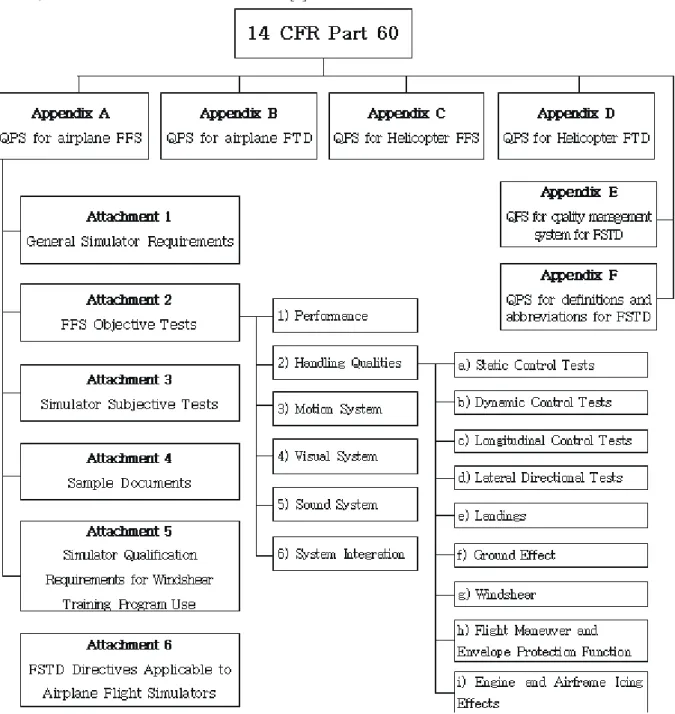
Fig. 1 Hierarchy of FAA 14 CFR Part 60 FFS for Handling Qualities
Before the amendment, the FAA of the US specified the regulations related to FFS for training on airplanes in AC120-40B and on helicopters in AC120-63, as well as for FTD AC120-45A. However, these were all revised in 2006 and incorporated into 14 CFR Part 60 (FSTD, Flight Simulation Training Device Initial and Continuing Qualification and Use). This revised regulation provides all the rules specifying the first and continued qualification and the use of FSTD, to satisfy the requirements for the training, evaluation or flight experience of this chapter regarding the certification or qualification of crew. In addition, the performance standards for qualifying the simulator are presented in the Appendix, and the details are specified in the Attachment.
In §60.4 of Part 60, the Qualification Performance Standard (QPS) , that is, the performance standards for qualifying a simulator, are presented in the Appendix and each item is specified as below:
(a) Appendix A: QPS for airplane FFS (b) Appendix B: QPS for airplane FTD (c) Appendix C: QPS for helicopter FFS (d) Appendix D: QPS for helicopter FTD
(e) Appendix E: QPS for quality management system for FSTD
(f) Appendix F: QPS for definitions and abbreviations for FSTD
Appendix A of Part 60 contains the contents of
“Qualification Performance Standards for Airplane Full Flight Simulators”, and provides the following rules as shown in the Attachments:
(a) Attachment 1: General Simulator Requirements (b) Attachment 2: FFS Objective Tests
(c) Attachment 3: Simulator Subjective Tests (d) Attachment 4: Sample Documents (e) Attachment 5: Simulator Qualification
Requirements for Windshear Training Program Use (f) Attachment 6: FSTD Directives Applicable to
Airplane Flight Simulators
Among these, Table A2A of Attachment 2 describes the functions for Objective Tests of Full Flight Simulator as follows:
1) Performance 2) Handling Qualities 3) Motion System 4) Visual System 5) Sound System 6) System Integration
Among the above items, 2) Handling Qualities are comprised as follows:
a) Static Control Tests b) Dynamic Control Tests c) Longitudinal Control Tests d) Lateral Directional Tests e) Landings
f) Ground Effect g) Windshear
h) Flight Maneuver and Envelope Protection Functions
i) Engine and Airframe Icing Effects
The Handling Qualities of FFS is shown in the block diagram in Fig. 1, as above. In this study, we compare the domestic regulations with the US regulations for c) Longitudinal Control Tests and d) Lateral Directional Tests in the Handling Qualities.
[[UUGGjjGGhh GGGGyyGG
GGGGooGGxxG
A QTG must be submitted in order to demonstrate that the QPS for a full flight simulator (FFS) of the US standard or a flight simulator in Korea have been met. In order to prepare the QTG, it is necessary to demonstrate that the manufactured FFS or a flight simulator satisfies the requirements specified by QPS and also satisfies the specified tolerance when the same procedure is performed under the same conditions for the presented test title.
[[UUXXGGjjGGGGyy GGppGGGG ssGGjjGG{{GG GGG
Items on “c. Longitudinal control tests” of “2.
Handling qualities” in Attachment 2 of Appendix A in 14 CFR Part 60 stipulated by the US FAA, were compared with those on “C. Longitudinal Test” of
Annex 4 “Performance standard by detailed item of Flight Training Device” of Notice No. 2018-290 of the
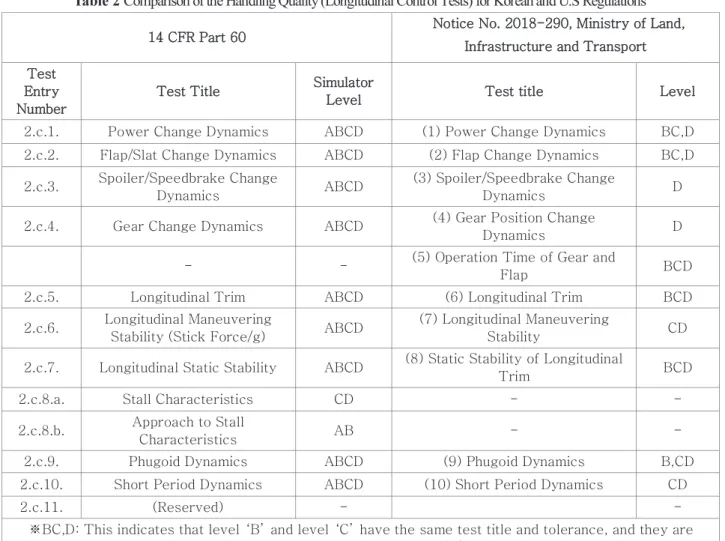
“Synthetic Flight Trainer Qualification Standard and Test Guide” stipulated by the Ministry of Land, Infrastructure and Transport, Korea. The comparison is presented in Table 1. Within the domestic regulations in Table 1, 'BCD' refers to the same tolerance for level B, level C, and level D, while 'B,CD' indicates that the tolerance of level B and the tolerance of levels C and D are different.
On comparing the regulations of Korea with those of the US, the Korean regulation was found to contain “(5) Operation time of Gear and Flap”, which was not found in the US regulation, while ‘2.c.8.a. Stall Characteristics’
and ‘2.c.8.b. Approach to Stall Characteristics' of the US regulation are not found in the Korean regulation. In addition, we have identified that the levels for the test
titles are not identical between the domestic and US regulations. More specific analysis is summarized as follows:
In the US regulation, “2.c.1. Power Change Dynamics” has specifications for all of the levels A, B, C, and D, while in the Korean regulation, “(1) Power Change Dynamics” has specifications that are divided into [level BC] and [level D], according to the tolerance.
In the US regulation, “2.c.2. Flap/Slat Change Dynamics” has specifications for all of the levels A, B, C, and D but in the Korean regulation, “(2) Flap Change Dynamics” has specifications that are divided into [level BC] and [level D], according to the tolerance.
1
144 CCFFRR PPaarrtt 6600 NNoottiiccee NNoo.. 22001188--229900,, MMiinniissttrryy ooff LLaanndd,, IInnffrraassttrruuccttuurree aanndd TTrraannssppoorrtt T
Teesstt E Ennttrryy N Nuummbbeerr
T
Teesstt TTiittllee SSiimmuullaattoorr L
Leevveell TTeesstt ttiittllee LLeevveell
2.c.1. Power Change Dynamics ABCD (1) Power Change Dynamics BC,D
2.c.2. Flap/Slat Change Dynamics ABCD (2) Flap Change Dynamics BC,D 2.c.3. Spoiler/Speedbrake Change
Dynamics ABCD (3) Spoiler/Speedbrake Change
Dynamics D
2.c.4. Gear Change Dynamics ABCD (4) Gear Position Change
Dynamics D
- - (5) Operation Time of Gear and
Flap BCD
2.c.5. Longitudinal Trim ABCD (6) Longitudinal Trim BCD
2.c.6. Longitudinal Maneuvering
Stability (Stick Force/g) ABCD (7) Longitudinal Maneuvering
Stability CD
2.c.7. Longitudinal Static Stability ABCD (8) Static Stability of Longitudinal
Trim BCD
2.c.8.a. Stall Characteristics CD - -
2.c.8.b. Approach to Stall
Characteristics AB - -
2.c.9. Phugoid Dynamics ABCD (9) Phugoid Dynamics B,CD
2.c.10. Short Period Dynamics ABCD (10) Short Period Dynamics CD
2.c.11. (Reserved) - -
※BC,D: This indicates that level ‘B’ and level ‘C’ have the same test title and tolerance, and they are different from those of level ‘D’.
BCD: This indicates that all of level ‘B’, level ‘C’, and level ‘D’ have the same test title and tolerance.
Table 2 Comparison of the Handling Quality (Longitudinal Control Tests) for Korean and U.S Regulations
In the US regulation, “2.c.4. Gear Change Dynamics”
has specifications for all of the levels A, B, C, and D but in the Korean regulation, the specifications are divided into “(4) Gear Position Change Dynamics [level D]” and “(5) Operation Time of Gear and Flap [level ABC]”.
In the US regulation, “2.c.8.a. Stall Characteristics”
and “2.c.8.b. Approach to Stall Characteristics” have been specified, but there is no corresponding regulation in Korea.
The test titles of the US regulation and those of the Korean regulation are similar, while the designated simulator levels are different.
[[UUYYGGjjGGGG{{GGGGGGssGG jjGG{{GG
The tolerance of test results should be presented for the case of approach (flight conditions of cruise or approach in Korean cases) in the test title “Power
Change Dynamics” and for the shape of cruise in the test titles “Phugoid Dynamics” and “Short Period Dynamics”.
In the domestic regulation, there is the item 'Force required for power change' in the test title “Power Change Dynamics”, which is not found in the US regulation.
Power Change Dynamics and Short Period Dynamics have the same tolerance limits between the US and domestic regulations.
Power Change Dynamics and Short Period Dynamics have the same tolerance limits in both US and domestic regulations.
In the domestic regulation, for (9) Phugoid Dynamics, the possibility for confusion is high because the expression for tolerance is ambiguous.
1
144 CCFFRR PPaarrtt 6600 NNoottiiccee NNoo.. 22001188--229900,, MMiinniissttrryy ooff LLaanndd,, IInnffrraassttrruuccttuurree aanndd TTrraannssppoorrtt T
Teesstt E Ennttrryy N Nuummbbeerr
T Teesstt T
Tiittllee TToolleerraannccee FFlliigghhtt C
Coonnddiittiioonn TTeesstt TTiittllee TToolleerraannccee
2.c.1.
Power Change Dynamics
Air speed: ±3 kt Altitude: ±30 m (100 ft) Pitch angle: ±1.5° or
±20%
Approach
(1) Power change dynamics
-Force required for
power change
Air speed: ±3 kt Altitude: ±100 ft (30 m) Pitch: ±20% or ±1.5°
±5 lb or ±20%
2.c.9. Phugoid Dynamics
period: ±10%
T1/2 or T2: ±10% or damping ratio: ±0.02
Cruise (9) Phugoid Dynamics
Phugoid period: ±10%
Time: 1/2 at ±10% or 0.02 of damping ratio or double amplitude 10% of the period of a representative value
2.c.10.
Short Period Dynamics
pitch angle: ±1.5° or pitch rate: ±2°/sec vertical acceleration:
±0.1 g
Cruise
(10) Short Period Dynamics
pitch angle: ±1.5° or pitch rate: ±2°/sec
normal acceleration: ±0.10 g Table 2 Comparison of the Tolerance (Longitudinal Control Tests) for the Korean and U.S Regulations
In the domestic regulation, we propose that for the tolerance of Phugoid Dynamics, the following should be included:
◻ Phugoid dynamics
Period: ±10%
Time taken up to 1/2 or double the amplitude: ±10%
or damping ratio: ±0.02
[[UUZZGGjjGGGGyy GGppGGGGssGG k
kGG{{GG
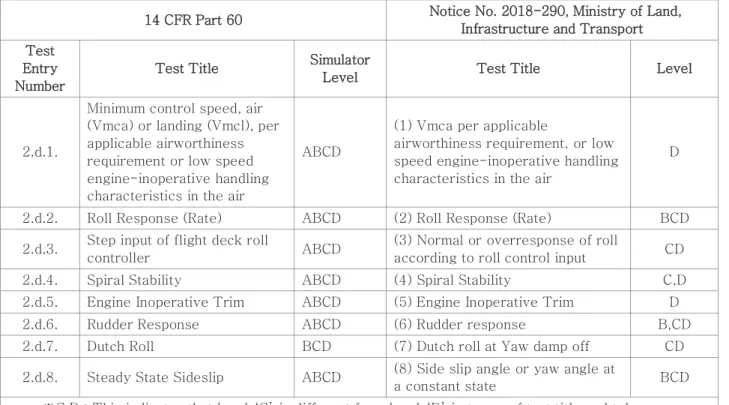
Table 3 presents a comparison between “d. Lateral Directional Tests” in Attachment 2 of the US regulation and “D. Lateral Directional Test” of the domestic regulation, for the handling qualities. In the case of Lateral Directional Tests, it was confirmed that the test titles had little differences between the two regulations.
However, as in the case of the Longitudinal Control Tests,
it can be seen that there is a very large difference in the level of each test title.
In the US regulation, “2.d.4. Spiral Stability” has specifications for all of the levels A, B, C, and D but in
“(4) Spiral Stability” of the Korean regulation, the specifications are divided into [level C] and [level D], according to the tolerance.
In the US regulation, “2.d.6. Rudder Response” has specifications for all of the levels A, B, C, and D but in “(6) Rudder response” of the Korean regulation, the specifications are divided into [level B] and [level CD], according to the tolerance.
The test titles of the US regulation and those of the Korean regulation are almost identical, while the designated simulator levels are different.
1
144 CCFFRR PPaarrtt 6600 NNoottiiccee NNoo.. 22001188--229900,, MMiinniissttrryy ooff LLaanndd,, IInnffrraassttrruuccttuurree aanndd TTrraannssppoorrtt T
Teesstt E Ennttrryy N Nuummbbeerr
T
Teesstt TTiittllee SSiimmuullaattoorr L
Leevveell TTeesstt TTiittllee LLeevveell
2.d.1.
Minimum control speed, air (Vmca) or landing (Vmcl), per applicable airworthiness requirement or low speed engine-inoperative handling characteristics in the air
ABCD
(1) Vmca per applicable
airworthiness requirement, or low speed engine-inoperative handling characteristics in the air
D
2.d.2. Roll Response (Rate) ABCD (2) Roll Response (Rate) BCD
2.d.3. Step input of flight deck roll
controller ABCD (3) Normal or overresponse of roll
according to roll control input CD
2.d.4. Spiral Stability ABCD (4) Spiral Stability C,D
2.d.5. Engine Inoperative Trim ABCD (5) Engine Inoperative Trim D
2.d.6. Rudder Response ABCD (6) Rudder response B,CD
2.d.7. Dutch Roll BCD (7) Dutch roll at Yaw damp off CD
2.d.8. Steady State Sideslip ABCD (8) Side slip angle or yaw angle at
a constant state BCD
※C,D : This indicates that level ‘C’ is different from level ‘D’ in terms of test title and tolerance.
CD : Level ‘C’ and level ‘D’ have the same test title and tolerance.
Table 3 Comparison of the Handling Quality (Lateral Directional Tests) for the Korean and U.S Regulations
[[UU[[GGjjGGGG{{GGGGssGG k
kGG{{GG
From the Lateral Directional Tests for handling qualities in Appendix A of Part 60, the tolerance range and test conditions were compared specifically for roll responses (rate), spiral stability, and Dutch roll as shown in Table 4
For the roll response, the tolerance standards of the domestic regulation and the US regulation are the same, but in the US regulation, the standard for the size of the control force are specified for the airplane of the reversible flight control system.
In terms of spiral stability, the tolerances of “correct trend” and “roll angle are ± 3° or ± 10% within 30 s”
as the standard in the domestic regulation, while for the US regulations, the tolerances of the “correct trend and roll angle” are ±10% in 20 s, and if an
alternate test is used, the tolerances of the “correct trend and aileron angle” are ±2°, showing a slight difference.
In the case of “(7) Dutch roll at yaw damp off” in the domestic regulation, the possibility for confusion is high because the expression for tolerance is not clearly defined.
We propose that the following should be included for the Dutch roll tolerance:
◻Dutch Roll
Period: ±0.5 s or ±10%
Time to one half or double amplitude: ±10%
or damping ratio: ±0.02
Time difference between peaks of roll angle and sideslip angle:
±1 sec or ±20%
1
144 CCFFRR PPaarrtt 6600 NNoottiiccee NNoo.. 22001188--229900,, MMiinniissttrryy ooff LLaanndd,, IInnffrraassttrruuccttuurree aanndd TTrraannssppoorrtt T
Teesstt E Ennttrryy N Nuummbbeerr
T
Teesstt TTiittllee TToolleerraannccee FFlliigghhtt C
Coonnddiittiioonn TTeesstt TTiittllee TToolleerraannccee
2.d.2.
Roll Responses (Rate)
Roll rate: ±10% or ±2°/s Additionally, for the airplane of reversible flight control system,
control force: ±1.3 daN (3 lbf) or ±10% of wheel force
Cruise, and Approach or landing
(2) Roll Responses (Rate)
Roll rate: ±10% or ±2°/s
2.d.4 Spiral Stability
Correct trend and roll angle in 20s: ±10%
If alternate test is used:
correct trend and aileron angle : ±2°
Cruise, and Approach or landing
(4) Spiral Stability
Correct trend:
roll angle ±3° or
±10% within 30 s
2.d.7 Dutch Roll
period: ±0.5 s or ±10%
T1/2 or T2: ±10% or damping ratio: ±0.02 time difference between peaks of roll angle and sideslip angle: ±1 s or ±20%
Cruise, and Approach or landing
(7) Dutch roll at yaw damp off
Dutch roll period: ±10%
Time: ±10% or ±0.5 s. or time taken for doubling the amplitude or damping ratio:
±0.02
Correct trend and ±10% of the period with the number of overshoots included Table 4 Comparison of the Tolerance (Lateral Directional Tests) for the Korean and U.S Regulations
In QTG, all three items should present actual data of the airplane and simulation results for the shape of cruise, and approach or landing.
\\UUGGjjGG
In this study, we investigated the domestic regulation of Notice No. 2018-290, Ministry of Land, Infrastructure and Transport (2018. 5. 18) “Synthetic flight trainer qualification standard and test guide” and the US FAA regulation of “14 CFR Part 60 (Flight Simulation Training Device Initial and Continuing Qualification and Use)” in relation to the simulator for flight training. In particular, handling qualities specified in the Attachment of Appendix A of QPS, a performance standard for the qualification of the airplane flight simulator were examined in detail and the differences between the US regulation and the Korean regulation were compared and analyzed. In the US regulation, before the amendment, AC120-40B provided specifications for Full Flight Simulators (FFS), AC120-45A for Flight Training Devices (FTD), and AC120-63 for helicopters. These regulations have been revised in 2006, and FFS of all cases were incorporated into CFR Part 60 (Flight Simulation Training Device Initial and Continuing Qualification and Use). However, the domestic regulation has not been revised in this regard, and thus Article 3 stipulates that AC120-40B shall be complied with for airplanes and AC120-63 for helicopters, for flight simulators. In addition, although Article 4 specifies the independent domestic regulation of the flight training device, it also presents AC120-45A as a reference to be complied with, indicating possible confusion when implementing the regulation in practice.
As a result of comparing the Korean regulation with the American regulation, it was confirmed that the test titles are similar on the whole, but there are some differences. In addition, in the case of phugoid dynamics and tolerance of Dutch rolls, we suggest that if the specifications are expressed more clearly and similarly to the US regulation, it would be useful for related personnel.
Therefore, while amendments are necessary to correspond with the levels of 14 CFR Part 60 of the current US regulation, it is thought that there is a more pressing need to revise the details on the handling qualities and the tolerance specifications.
hhGG
This study was conducted with the support of “Study on the Core Technologies of Electric Vertical Take-Off &
Landing Aircraft” Project of the Korea Aerospace Research Institute.
yyGG
[1] Chang young Kim and Ki yong Choi, “A Study on the Flight Simulator Certification System,” Journal of Aerospace System Engineering, vol. 5, No. 1, pp. 36-40, March 2011.
[2] Il-Woo Kim, Taejun Park and Sukjun Yoon, “A Study on QTG Generation for a Flight Training Device to be Qualifiable at FAA Level 5,” Journal of the Korea Society for Aeronautical & Space Sciences, vol. 44, No. 12, pp.
1035-1042, December 2016.
[3] “Approval for Synthetic Flight Trainer,” Bulletin 2018-290, The Ministry of Land, Infrastructure and Transport Affairs, May 2018.
[4] “Flight Simulation Training Device Initial and Continuing Qualification and Use,” 14 CFR Part 60, NSP Consolidate Version 2016.
[5] “Airplane Simulator Qualification", Advisory Circular 120- 40B, Federal Aviation Regulation, July 1991.
[6] “Helicopter Simulator Qualification", Advisory Circular 120-63, Federal Aviation Regulation, October 1994.
[7] “Airplane Flight Training Device Qualification", Advisory Circular 120-45A, Federal Aviation Regulation, February 1992.
GG