quartz- and/or muscovite-rich layers developed in the mylonite. In the feldspar-rich layer, fine-grained albitic plagioclase and interstitial K-feldspar were deformed dominantly by granular flow. On the other hand, quartz-rich layers containing core-mantle and quartz ribbons structures were deformed by dislocation creep. Based on calculations from conventional two-feldspar and ternary feldspar geothermometers, mylonitization temperatures of the leucocratic granite range from 360 to 450oC. It thus indicates that the mylonitization has occurred under greenschist-facies conditions. Based on the geochemical features and previous chronological data, the leucocratic granite was emplaced during the Middle Jurassic at volcanic arc setting associated with crustal thickening. And then the mylonitization of the granite occurred during the late Middle to Late Jurassic (150-165 Ma). Therefore, the mylonitization of the Jurassic granitoids in the Taebaeksan Basin was closely related to the development of the Honam shear zone.
Keywords: The Mesozoic leucocratic granite, Taebaeksan Basin, mylonitization temperatures
Introduction
The NE-trending Mesozoic granitoids in South Korea intruded the Precambrian Gyeonggi and Yeongnam massifs, and the Paleozoic metasedimentary rocks during the Mesozoic magmatism (Kim et al., 1996; Chough et al., 2000; Sagong et al., 2005; Park et al., 2010). Some of the granitoids were mylonitized due to crustal-scale ductile shearing that produced the Honam shear zone (Fig. 1). The Honam shear zone is characterized by a dextral strike-slip shear zone and mainly developed around the Okcheon belt and the Yeongnam massif (Kim and Kee, 1994; Chang and Lee 1996a, 1996b; Cho et al., 1999; Ree et al., 2001, 2005; Cheong et al., 2006; Kim et al., 2009; Park et al., 2009). Yin and Nie (1993) suggested that the dextral strike-slip shear zone developed during the middle–late Triassic Songrim orogeny associated with collision between the North and South China Blocks
(e.g., Yanai et al., 1985). However, recent radiometric age data and structural evidence indicate that the multiple strike-slip shear movements along the Honam shear zone occurred during the Middle Jurassic to the Early Cretaceous (Turek and Kim, 1995; Cho et al., 1999; Ree et al., 2001; Cheong et al., 2006; Kim et al., 2009). Thus, the Honam shear zone is not the Permian to Triassic tectonic features related to the Chinese collision (Cheong et al., 2006; Kim et al., 2009).
Deformation events of the Mesozoic granitoids in the Okcheon Basin have been studied intensively, while those in the Taebaeksan Basin is relatively not well-known. Kim et al. (1996) documented that the Imgye granitoid in the northeastern margin of the Taebaeksan Basin intruded during the Precambrian based on Rb-Sr age dating (20882108 Ma: Choo and Kim, 1985) and regional structural relationships.
They also interpreted that the mylonitization of the granitoid occurred during the Cambrian and reactivated during the Late Jurassic and the late Cretaceous (Kim et al., 1996).
*Corresponding author: [email protected]
*Tel: +82-53-950-5918
*Fax: +82-53-950-5946
Jurassic (>ca.165 Ma; Lee, 1992), and was strongly mylonitized. However, mylonitization of the leucocratic granite did not study previously. Therefore this paper presents characteristics of mylonitization of the leucocratic granite based on observations of microfabrics and calculation of deformation temperatures. Then, temporal and spatial relationship of the mylonitization will be discussed with the Mesozoic tectonomagmatic evolution in the Taebaeksan Basin combined with mylonitization of the Mesozoic granitoids in the Honam shear zone.
Geological Backgrounds
The Taebaeksan Basin, which is located between two Precambrian massifs (Gyeonggi and Yeongnam massifs) in the eastern portion of the Korean Peninsula, mainly consists of the early Paleozoic Joseon Supergroup (mainly carbonates with subordinate siliciclastics) and the late Paleozoic Pyeongan Supergroup (mainly siliciclastics with some carbonates in its lower part), which are intruded by Mesozoic granitoid (Chough et al., 2000; Fig. 1a).
The metasedimentary rocks of the Pyeongan Supergroup in the study area have experienced low- temperature (LT)/medium-pressure (MP) regional metamorphism followed by thermal metamorphism (Kim and Ree, 2010; Kim, 2012). These multiple metamorphic events produced three metamorphic zones: (1) And+Cld±Ky (zone I; mineral abbreviations from Kretz, 1983), (2) Grt+St±And (zone II), and (3) Sil+St+Bt (zone III). Zones I and II were produced by the LT/MP regional metamorphism, and zone III has resulted from the later thermal metamorphism due to intrusion of the leucocratic granite. Kim and Ree (2012) suggested that andalusite and chloritoid porphyroblasts in zone I have grown during E-W crustal shortening, and garnet and staurolite porphyroblasts in zone II have grown during N-S crustal shortening during the Permo-Triassic Songrim (Indosinian) orogeny.
The leucocratic granite in the study area consists of
Quartz grains are highly stretched parallel to the mylonitic S-C foliation, and formed ribbon structure (Fig. 2). Feldspar grains occurred as porphyroclasts that were deformed dominantly by fracturing. Mylonitic foliations generally strike to NW-WNW and dip to NE with development of stretching lineations. The stretching lineations are generally NW-SE trending and NW and SE plunging at a lower angle (<30o; Fig.
1b), and show top-to-the-northwest (sinistral) shear sense (Figs. 2 and 3).
Petrography and Microfabrics
There is a transition from a weakly deformed to highly deformed granites in the outcrop, referred to as protomylonite and mylonite, respectively, in this paper.
The protomylonite consists of porphyroclasts (0.8 to 17 mm in length) of plagioclase (35%), K-feldspar (11%), and matrix of quartz (24%), K-feldspar (13%), plagioclase (10%) and muscovite (6%) with a minor content of biotite, chlorite and opaque minerals (Fig.
3a). On the other hand, the mylonite is composed of porphyroclasts (0.5 to 6 mm in length) of plagioclase (19%), K-feldspar (6%), and matrix of quartz (30%), K-feldspar (14%), plagioclase (13%) and muscovite (16%) with a minor content of biotite, chlorite and opaque minerals (Fig. 3b). There is a significant increase in muscovite, quartz and K-feldspar contents, and a decrease in plagioclase content in the mylonite as compared with the protomylonite. Also, the feldspar porphyroclasts of the mylonite decrease both in size and amount.
Protomylonite
K-feldspar grains are deformed dominantly by fracturing, although some grains display patchy undulatory extinction (Fig. 4a). On K-feldspar porphyroclast faces sub-parallel to the mylonitic foliation, myrmekitic intergrowth of plagioclase and quartz occurs (Figs. 4a and 4b). The myrmekite lobes
commonly embay the margins of K-feldspar porphyroclasts showing quarter structure (Figs. 4a and 4b). Along the shear fractures of K-feldspar porphyroclasts, fine-grained plagioclase grains occur as a band (Figs. 4c and 4d) The phase boundary between the horst K-feldspar and the neocrystallized
plagioclases are wavy or lobate (Figs. 4c and 4d), suggesting phase boundary migration (e.g., Ree et al., 2005). Grain-size reduction of the K-feldspar has resulted from the myrmekitic intergrowth together with neocrystallization of plagioclase and fracturing.
Deformation of plagioclase porphyroclasts is also Fig. 1. (a) Schematic tectonic map showing major Paleozoic mobile belts (Taebaeksan, and Okcheon Basins) with the Precam- brian massifs (Nangrim, Gyeonggi, and Yeongnam massifs), and locations of the Honam shear zone (Sunchang, Jeonju, and Yecheon) in the Korean peninsula (Chough et al., 2000). (b) Geological map of the study area showing distribution of the mylonitized leucocratic granite. Pole diagram showing orientation of mylonitic foliations and stretching lineations.
occurred by fracturing. Most grains show patchy undulatory extinction (Figs. 3a and 5). Cleavage fractures within plagioclase porphyroclasts are filled mostly by K-feldspar and occasionally muscovite and quartz (Fig. 5). Incipient development of alternating layers of fine-grained feldspar, quartz and muscovite occurs in the protomylonite. The feldspar-rich layer is composed mainly of subrounded to subangular plagioclase with interstitial K-feldspar and subordinated quartz filling the space between the plagioclase fragments.
Quartz grains in the protomylonite commonly display patchy or sweeping extinction and deformation bands (Fig. 3a). When the quartz grains occur between the feldspar-rich layers, these are highly stretched parallel to the mylonitic foliation (Figs. 4a and 4b).
Most of quartz grains show core-mantle structures with diffuse grain boundaries. These microfabrics of the protomylonite indicate that the quartz grains were deformed by dislocation creep (e.g., Ree et al., 2005).
Mylonite
The main differences between mylonite and Fig. 2. Outcrop photographs of mylonitized leucocratic granite. (a) Leucocratic granite developed mylonitic foliations and linea- tion. (b) and (c) S-C foliation and preferred alignment of feldspar porphyroclasts indicating sinistral shear sense. (d) Quartz rib- bon structure.
Fig. 3. Photomicrographs of leucocratic granite. (a) Proto- mylonite containing plagioclase porphyroclasts showing patch undulatory extinction (Crossed Polarized Light; XPL). (b) Mylonite (XPL).
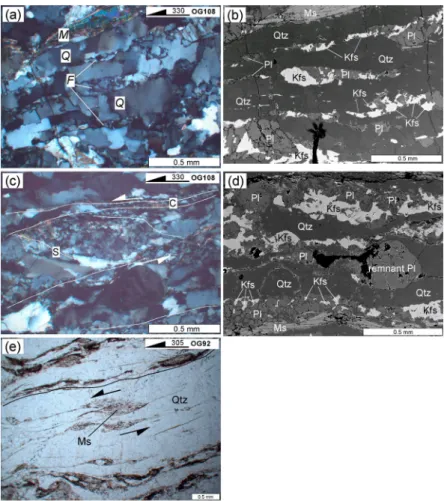
protomylonite are feldspar grain-size reduction, increase in the muscovite and quartz contents, and decrease in the plagioclase content in the mylonite. Also, the feldspar-, quartz- and muscovite-rich layers defined by mylonitic foliations are developed (Figs. 6a and 6b).
The feldspar-rich layers consist of mostly fine-grained plagioclase and interstitial K-feldspar, with some muscovite and quartz (Figs. 6c and 6d). The interstitial K-feldspar appears to fill the spaces between the fine- grained plagioclase. The plagioclase grains in the layer
show patchy undulatory extinction, and are subrounded to subangular in shape, although remnants of plagioclase porphyroclasts occasionally occur in the layer (Fig.
6d). These microfabrics of the feldspar-rich layers in the mylonite indicate that feldspar grains were deformed by granular flow (e.g., Stünitz and Fitz Gerald, 1993; Ree et al., 2005), although minor fracturing still occurred in the layers. Muscovite grains in the quartz–rich layer show mica-fish structure indicating top-to-the-northwest shear sense (Fig. 6e).
Fig. 4. Microstructures of K-feldspar porphyroclasts in protomylonite. (a) K-feldspar shows patchy undulatory extinction, and myrmekite formation around the K-feldspar porphyroclast displays quarter structure (XPL). (b) Backscattered SEM micrograph of (a). (c) Neocrystallization of albitic plagioclase along a shear fractures within and around a K-feldspar porphyroclast (XPL). (d) Backscattered SEM micrograph of (c). All mineral abbreviations are from Kretz (1983).
Fig. 5. Microstructures of plagioclase porphyroclasts in protomylonite. (a) Photomicrogrphs of K-feldspar precipitation in cleav- age fractures of a plagioclase porphyroclast (XPL). (b) Backscattered SEM micrograph of (a). All mineral abbreviations are the same as Fig. 4.
Bulk Rock and Mineral Chemistry
The deformed leucocratic granite contain high SiO2
(>75 wt.%) and Na2O+K2O (5.0-10.0 wt.%) indicating granite compositions (Fig. 7a; Middlemost, 1985). The granite has molar ratios of Al2O3/(CaO+Na2O+K2O) ranging from 0.8 to 1.2 corresponding to peralkaline and peraluminous (Fig. 7b). The granite has very low iron abundances (total Fe as Fe2O3 of 0.4-1.5 wt.%), MgO (0.2-0.3 wt.%), and CaO (0.4-1.1 wt.%; Table 1). In a modified alkali-lime index (MALI; Frost et al., 2001) diagram, the granite plot dominantly in calc- alkali field, and also lie in the domain delineated by the Australian I- and S-type granites (Fig. 7c).
The leucocratic granite shows enriched light rare earth element (LREE) patterns in a chondrite-normalized diagram (Fig. 8a; Nakamura, 1974) with (La/Yb)N= 5.2-31.8 (Table 1). Most leucocratic granites display strong to weak negative Eu anomalies (Eu/Eu*=0.23- 0.89), but some (samples OG92, 98 and 103) show moderate positive Eu anomalies (Eu/Eu*=1.81-3.05;
Fig. 8a). On trace-element spider diagram normalized to primitive mantle (Sun and McDonough, 1989), the granites have large-ion lithophile element (LILE) enrichment with depletions in Nb, Zr, Ti with respect to primitive mantle (Fig. 8b). The geochemical features probably suggest that the leucocratic granite has generated from magmatic arc setting. On a Y+Nb Fig. 6. Microstructures of mylonite. (a) Photomicrograph of the alternation of feldspar (F)-, quartz (Q), and muscovite (M)-rich layers (XPL). (b) Backscattered SEM micrograph of (a). (c) Enlargement of feldspar-rich layer (XPL). (d) Backscattered SEM micrograph of (c). (e) Mica fish in quartz-rich layer indicating sinistral shear sense (Plane Polarized Light). All mineral abbrevia- tions are the same as Fig. 4.
versus Rb diagram (Pearce et al., 1984; Pearce, 1996), the granite plot in the volcanic arc field (Fig. 7d).
The compositions of K-feldspar porphyroclasts in the protomylonite and mylonite range from Or85 to Or98 that is similar to that of precipitated K-feldspars (Table 2; Figs. 9a and 9b). The compositions of porphyroclastic and myrmekitic plagioclases range from An2 to An30 without systematic difference (Fig.
9c). However, neocrystallized plagioclase tends to be more albitic composition (An2-10) than porphyroclastic plagioclase in the protomylonite (Fig. 9c). The dominant compositions of the plagioclase and K- feldspar within feldspar-rich layers in the mylonite range from An20 to An30, and Or90 to Or98, respectively
(Figs. 9b and 9d). The plagioclase compositions in the mylonite show no systematic difference in myrmekites, fragments, porphyroclasts, and feldspar- rich layers (Fig. 9d).
Mylonitization Temperature
Deformation temperatures of the protomylonite and mylonite are calculated from conventional two-feldspar (Powell and Powell, 1977; Stormer and Whitney, 1985; Perchuk, 1989) and ternary feldspar geother- mometers (Furhman and Lindsley, 1988). The pressure of 3 kbar is assumed because the microfabrics of quartz and feldspar indicate a greenschist-facies Fig. 7. (a) Classification of the leucocratic granite and Imgye granitoid (Middlemost, 1985). (b) Molar Al/(Na+K) vs. molar Al/
(Ca+Na+K) diagram. (c) Na2O+K2O-CaO vs. SiO2 diagram for granitic rocks compositions from Lachlan Fold Belt (From Frost et al., 2001) in which the leucocratic granite are plotted in the calc-alkali field. (d) Rb vs. Y+Nb tectonic diagram (Pearce et al., 1984; Pearce, 1996) for the leucocratic granite. Data for the Imgye granitoid are from Min and Kim (1990).
condition (e.g., Stipp et al., 2002; Ree et al., 2005).
Deformation temperatures of the protomylonite and mylonite are not much different although the temperature appears to increase from protomylonite to
mylonite. The deformation temperatures for the protomylonite calculated from plagioclase porphyroclasts/
precipitated K-feldspar in fractures, myrmekitic plagioclase/K-feldspar porphyroclasts and fine-grained
OG85 OG86 OG88 OG89 OG98 OG103 OG106 OG92 OG108
Major elements (wt. %)
SiO2 77.99 77.19 80.62 79.17 81.04 74.82 75.80 77.37 77.03
TiO2 0.12 0.13 0.02 0.07 0.04 0.03 0.05 0.03 0.08
Al2O3 10.30 10.63 9.87 10.56 10.11 13.40 11.88 11.83 11.46
Fe2O3* 1.16 1.47 0.65 0.64 0.86 1.15 0.37 0.65 0.63
MnO 0.01 0.02 0.01 0.01 0.02 0.01 0.01 0.01 0.02
MgO 0.27 0.26 0.21 0.22 0.28 0.21 0.17 0.25 0.15
CaO 0.36 0.56 0.67 0.85 0.71 0.57 1.08 0.68 0.83
Na2O 2.96 3.19 4.90 3.42 2.65 5.58 3.99 3.75 3.23
K2O 5.63 5.20 2.13 3.90 2.71 2.09 5.39 4.00 5.46
P2O5 0.13 0.23 0.11 0.08 0.12 0.30 0.17 0.11 0.09
LOI** 0.68 0.82 0.54 0.67 1.15 1.56 0.78 0.93 0.75
Total 99.61 99.69 99.73 99.59 99.66 99.72 99.71 99.61 99.73
Trace elements (ppm)
Cr 119.016 142.848 212.970 160.634 197.571 4.181 1.971 106.911 152.398
Zn 14.035 33.655 3.966 12.131 13.520 9.277 7.699 11.279 14.770
Ga 14.493 17.380 11.383 12.101 11.154 17.968 10.956 12.985 15.760
Sr 100.652 66.019 107.304 242.536 96.796 190.607 190.212 141.365 262.788
Rb 84.327 114.779 36.292 70.695 59.797 60.878 68.493 70.640 101.154
Y 7.658 10.534 4.972 7.173 2.975 1.214 12.546 1.854 5.422
Zr 31.085 36.453 16.786 24.604 1.597 2.785 22.492 1.398 21.898
Nb 9.246 13.145 0.331 1.943 0.665 0.478 0.895 0.960 4.880
Cs 0.519 0.932 0.300 0.606 0.819 0.972 0.628 0.587 0.947
Ba 214.949 168.468 174.113 698.234 320.759 133.405 394.831 237.819 691.543
La 13.680 11.464 4.966 21.006 3.029 2.138 8.966 2.475 13.213
Ce 29.293 24.097 9.375 40.696 5.252 3.817 16.897 4.363 24.541
Pr 3.532 2.877 1.023 4.577 0.494 0.410 1.918 0.438 2.806
Nd 13.250 10.943 3.618 17.387 1.743 1.383 6.635 1.644 10.661
Sm 3.488 2.928 0.966 3.940 0.379 0.242 1.784 0.403 2.178
Eu 0.278 0.233 0.289 0.749 0.410 0.188 0.520 0.233 0.562
Gd 3.299 3.228 1.014 3.663 0.446 0.235 2.108 0.378 1.881
Tb 0.469 0.515 0.158 0.433 0.068 0.033 0.422 0.060 0.242
Dy 1.947 2.524 0.961 1.911 0.466 0.257 2.415 0.352 1.246
Ho 0.267 0.373 0.184 0.293 0.095 0.033 0.465 0.069 0.205
Er 0.572 0.923 0.526 0.689 0.314 0.115 1.348 0.178 0.511
Tm 0.066 0.102 0.080 0.061 0.043 0.016 0.178 0.021 0.064
Yb 0.433 0.733 0.568 0.442 0.391 0.165 1.070 0.173 0.481
Lu 0.042 0.077 0.068 0.050 0.050 0.015 0.163 0.014 0.060
Hf 1.317 1.185 0.343 0.622 - - 0.585 - 0.718
Pb 40.565 27.039 11.235 32.702 15.682 20.469 35.255 29.375 33.675
Th 8.854 6.120 2.401 10.188 - - 0.947 0.071 3.851
U 11.303 15.511 1.511 1.307 0.420 3.411 2.225 0.787 1.454
Eu/Eu* 0.25 0.23 0.89 0.60 3.05 2.39 0.82 1.81 0.83
(La/Yb)N 21.11 10.45 5.84 31.81 5.18 8.65 5.60 9.54 18.37
*, Total iron as Fe2O3. **, LOI=loss of ignition. Eu/Eu*=EuN/(SQRT(SmN×GdN)). (La/Yb)N=Normalized ratio
plagioclase and interstitial K-feldspar in the feldspar- rich layers ranges from 366 to 446oC, 362 to 452oC, and 431 to 446oC, respectively (Fig. 10). In sample
OG89 (protomylonite), deformation temperatures calculated from plagioclase porphyroclasts and precipitated K-feldspar in fractures, and myrmekitic Fig. 9. Compositions of K-feldspar and plagioclase. (a) and (b) K-feldspar in protomylonite and mylonite, respectively. (c) and (d) Plagioclase in protomylonite and mylonite, respectively.
Fig. 8. (a) Chondrite-normalized REE pattern (Nakamura 1974). (b) Primitive-mantle-normalized trace element pattern (Sun and McDonough, 1989).
OG89 OG93 OG98 OG106 OG92 OG108 Porpha Myrmb Fragc Neod Porph Frag Porph Myrm Frag FLe Myrm Frag FL Myrm Frag FL
(17)* (6) (17) (6) (7) (8) (11) (4) (2) (8) (10) (3) (5) (10) (2) (4)
SiO2 65.32 64.00 65.25 67.41 64.70 66.20 64.24 65.90 64.54 65.18 66.32 65.62 65.64 64.82 63.86 64.90 Al2O3 21.65 22.53 21.82 20.89 21.94 21.43 22.57 21.91 22.68 22.26 21.59 22.08 21.78 22.27 22.96 22.37 FeO** 0.02 0.04 0.02 0.01 0.01 0.02 0.01 0.01 0.02 0.01 0.01 0.01 0.05 0.03 0.02 0.02 MnO 0.00 0.01 0.00 0.00 0.01 0.00 0.01 0.03 0.00 0.00 0.01 0.01 0.00 0.01 0.00 0.01 MgO 0.00 0.01 0.00 0.02 0.00 0.00 0.00 0.00 0.00 0.01 0.00 0.00 0.01 0.00 0.00 0.00 CaO 2.12 2.89 2.38 0.82 2.43 2.12 3.14 2.19 3.20 2.65 1.87 2.38 1.86 2.65 3.63 3.21 Na2O 10.32 9.72 10.06 11.19 9.61 10.06 9.74 10.32 9.75 10.10 10.61 10.25 10.39 10.03 9.58 9.58 K2O 0.18 0.34 0.26 0.26 0.95 0.23 0.19 0.20 0.33 0.19 0.14 0.23 0.28 0.19 0.28 0.10 Total 99.62 99.53 99.84 100.59 99.63 100.06 99.90 100.55 100.52 100.40 100.56 100.57 100.01 100.00 100.31 100.19
Cations per 8 oxygens
Si 2.965 2.912 2.956 3.027 2.945 2.983 2.911 2.962 2.910 2.937 2.980 2.951 2.967 2.933 2.887 2.925 Al 1.158 1.208 1.165 1.105 1.177 1.139 1.205 1.161 1.205 1.182 1.144 1.170 1.160 1.188 1.223 1.188 Fe 0.001 0.001 0.001 0.000 0.000 0.001 0.000 0.000 0.001 0.000 0.000 0.000 0.002 0.001 0.001 0.001 Mn 0.000 0.000 0.000 0.000 0.000 0.000 0.000 0.001 0.000 0.000 0.000 0.000 0.000 0.000 0.000 0.000 Mg 0.000 0.001 0.000 0.001 0.000 0.000 0.000 0.000 0.000 0.001 0.000 0.000 0.001 0.000 0.000 0.000 Ca 0.103 0.141 0.116 0.039 0.118 0.102 0.153 0.106 0.155 0.128 0.090 0.115 0.090 0.129 0.176 0.155 Na 0.454 0.429 0.442 0.487 0.424 0.439 0.428 0.450 0.426 0.441 0.462 0.447 0.455 0.440 0.420 0.419 K 0.005 0.010 0.007 0.007 0.028 0.007 0.006 0.006 0.009 0.005 0.004 0.007 0.008 0.006 0.008 0.003 Ab 0.81 0.74 0.79 0.91 0.74 0.81 0.73 0.80 0.72 0.77 0.83 0.79 0.83 0.77 0.70 0.73 An 0.18 0.24 0.20 0.07 0.21 0.18 0.26 0.19 0.26 0.22 0.16 0.20 0.16 0.22 0.29 0.27 Or 0.01 0.02 0.01 0.01 0.05 0.01 0.01 0.01 0.02 0.01 0.01 0.01 0.01 0.01 0.01 0.00
K-feldspar
Protomylonite Mylonite
OG89 OG93 OG98 OG106 OG92 OG108
Porph Precpf Porph Precp Porph Precp Porph Interstg Porph Interst (5) (15) (5) (12) (8) (7) (11) (8) (10) (3) SiO2 63.90 63.98 64.98 64.15 64.95 64.51 64.62 64.45 64.34 64.48 Al2O3 18.73 18.65 19.00 18.71 18.84 18.77 18.95 18.71 18.76 18.72 FeO** 0.04 0.02 0.02 0.02 0.01 0.02 0.02 0.02 0.01 0.03 MnO 0.00 0.01 0.00 0.01 0.01 0.01 0.00 0.01 0.01 0.01 MgO 0.00 0.01 0.01 0.01 0.00 0.01 0.01 0.00 0.01 0.01 CaO 0.06 0.03 0.03 0.02 0.04 0.03 0.02 0.01 0.03 0.00 Na2O 0.95 0.81 0.74 1.00 1.13 0.60 1.09 0.60 0.87 0.51 K2O 15.36 15.57 15.00 15.32 14.46 15.17 14.66 15.40 14.68 15.29 Total 99.07 99.07 99.78 99.22 99.43 99.14 99.38 99.20 98.70 99.05
Cations per 8 oxygens
Si 3.072 3.077 3.081 3.077 3.085 3.083 3.077 3.084 3.082 3.085 Al 1.062 1.057 1.061 1.058 1.055 1.057 1.064 1.055 1.059 1.055 Fe 0.002 0.001 0.001 0.001 0.000 0.001 0.001 0.001 0.000 0.001 Mn 0.000 0.000 0.000 0.000 0.000 0.001 0.000 0.000 0.000 0.001 Mg 0.000 0.000 0.001 0.000 0.000 0.001 0.000 0.000 0.001 0.001 Ca 0.003 0.001 0.002 0.001 0.002 0.002 0.001 0.000 0.001 0.000 Na 0.044 0.038 0.034 0.046 0.052 0.028 0.050 0.028 0.040 0.024 K 0.471 0.478 0.454 0.469 0.438 0.462 0.445 0.470 0.449 0.467 An 0.01 0.00 0.00 0.00 0.00 0.00 0.00 0.00 0.00 0.00 Ab 0.09 0.07 0.07 0.09 0.10 0.06 0.10 0.06 0.08 0.05 Or 0.91 0.92 0.93 0.91 0.89 0.94 0.90 0.94 0.92 0.95
*, Number in the parentheses represents total number of analysis. ** Total iron as FeO. Ab=Na/(Na+Ca+K)×100, An=Ca/
(Na+Ca+K)×100, Or=K/(Na+Ca+K)×100. a, Porph=Porphyroclast; b, Myrm=Myrmekite; c, Frag=Fragment; d, Neo=Neocrytallization;
e, FL=Feldspar layer; f, Precp=Precipitation; g, Interst=Interstitial.
plagioclase and K-feldspar porphyroclasts is 366±22
oC and 362±23oC, respectively, and that calculated from fine-grained plagioclase and interstitial K- feldspar in the feldspar-rich layers is 440±12oC (Fig.
10).
Discussion
Timing of mylonitization of granitoids in the Taebaeksan Basin and the Honam shear zone The NE or ENE-trending Honam shear zone (Fig.
1a) is recognized by mylonitized granitoid rocks. The Honamshear zone mainly developed around the tectonic boundaries between the Yeongnam massif and the Okcheon Basin (e.g., Sunchang, Cheongsan, and Yecheon shear zones; Cho et al., 1999; Cheong et al.,
2006; Cho et al., 2007) and within the Okcheon Basin (Jeonju–Muan shear zones; Lee et al., 2001; Lee et al., 2003; Kim et al., 2003; Park et al., 2009). These shear zones are dominantly characterized by right lateral strike-slip movement of ductile or brittle-ductile shearing (Kim and Kee, 1994; Chang and Lee, 1996a, 1996b; Chough et al., 2000; Ree et al., 2001). Cluzel et al. (1991) suggested that the shear zones are amalgamated during the Triassic associated with the Chinese continental collision. However, as mentioned before, geochronologic data for the shearing indicate that the Honam shear zone dominantly initiated during the Middle to Late Jurassic and then reactivated during the Early Cretaceous (Cho et al., 1999; Cheong et al., 2006; Kim et al., 2009; Park et al., 2009).
The Triassic granites, Daegang (219.6±1.9 Ma) and Fig. 10. Box-Whisker diagram showing deformation temperatures of protomylonite and mylonite. (a) Deformation temperatures calculated from plagioclase porphyroclasts and K-feldspar in fractures. (b) Deformation temperatures calculated from myrmekitic plagioclase and K-feldspar porphyroclasts. (c) Deformation temperatures calculated from fine-grained plagioclase and interstitial K-feldspar in feldspar-rich layers. A: Furhman and Lindsley (1988). B: Stomer and Whitney (1985). C: Powell and Powell (1977). D: Perchuk (1989). Temperature within the gray colored boxes represent average deformation temperature.
Mylonitization of the Triassic and Jurassic granitoids in the Sunchang shear zone developed during multiple deformations. The first one occurred during the Middle Jurassic (Fig. 11; 160-180 Ma; Cho et al., 1999; Cheong et al., 2006; Cho et al., 2007), and then reactivated around the Late Jurassic (Fig. 11; ca. 140 Ma Cheong et al., 2006). In the Cheongsan shear zone, mylonitization occurred between ca. 172 Ma and 217 Ma (Fig. 11; Ree et al., 2001). Ree et al. (2001) suggested that the Cheongsan shear zone is transform fault boundary generated from juxtaposition of the South China Block (involving Okcheon Basin and Gyeonggi massif) and North China Block (involving the Taebaeksan Basin and Yeongnam massif) during a late stage of the Middle Triassic Songrim orogeny.
However, another interpretation for the mylonitization timing is that the Cheongsan shear zone can be developed during the Early to Middle Jurassic (Fig.
11). Because the shear zone predates intrusion of the Boeun granitoid (ca. 172 Ma; Ree et al., 2001).
Multiple shear movements also preserved in the Jeonju–Muan and Yecheon shear zones (Fig. 11). The first deformation occurred during the Middle Jurassic (160–180 Ma; Lee et al., 2001; Jeong et al., 2008;
Kim et al., 2009), and then reactivated around the Late Jurassic (145-155 Ma Cheong et al., 2006; Kim et al., 2009) and the Early Cretaceous (125-140 Ma;
Cheong et al., 2006; Kim et al., 2009).
Mylonitization of granitoids in the northeastern margin of the Taebaeksan Basin documented in the Imgye granitoid (Kim et al., 1996) and the leucocratic granite (in this study). Kim et al. (1996) suggested that the Imgye granitoid has mylonitized during the Cambrian, and then reactivated multiply during the Jurassic Daebo and the Cretaceous Bulguksa orogenies based on muscovite and biotite K-Ar (150-163 Ma) and relative timing of regional structures. However, Sagong et al. (2005) reinterpreted that the intrusion age of the Imgye granitoids is around 165-175 Ma based on U-Pb sphene and zircon ages. The intrusion
reinterpreted to the Late Jurassic rather than the Cambrian. Moreover, the muscovite and biotite K-Ar ages of the Imgye granitoid are similar to muscovite K-Ar (150-160 Ma; Lee, 1992) ages of the leucocratic granite in the study area. Therefore the shear zones developed in the leucocratic and Imgye granitoid in the Taebaeksan Basin probably initiated during the Middle to Late Jurassic (Fig. 11).
Zircon saturation temperatures of the Mesozoic granitoids in the Taebaeksan Basins and the Honam shear zone
Shear zone developed within the leucocratic granite in the study area shows NW to WNW-trending and left lateral strike-slip movement with minor dip-slip sense (Fig. 1b). Mylonitized Imgye granitoid in the Taebaeksan Basin displays NE- to ENE-striking and dominantly reverse dip-slip movement (Kim et al., 1996). As mentioned above, the right lateral strike-slip movement is dominant shear sense in the Honam shear zone, although striking of the shear zones is a little different. The striking of the Sunchang and Cheongsong shear zone is NE-SW (Chang and Lee, 1996a, 1996b), whereas that of the Yecheon shear zone and Jeonju–Muan shear zone (especially Muan area) is E-W (Fig. 1a; Lee et al., 2001; Ree et al., 2005). If the E-W or NE-SW trending right lateral shearing affected on the northeastern margin of the Taebaeksan Basin, the NW trending sinistral shear sense in the leucocratic granite represents antithetic R2 shear, and the NE-trending reverse shear sense in the Imgye granitoid have generated from NW-SE bulk shortening during the late Middle to Late Jurassic.
The Triassic post-orogenic granitoids (Ian and Daegang) in the Sunchang and Chengsan shear zones were emplaced in extensional setting subsequent to a major compressional event (Cho et al., 2008). Zircon saturation temperatures (TZr) of the Daegang and Ian granites calculated from bulk-rock compositions (e.g., Watson and Harrison, 1983; Miller et al., 2003
Gutierrez-Alonso et al., 2011) are 780-960oC and 990- 1150oC, respectively (Fig. 11). On the other hand, most Jurassic granitoids in the Honam shear zone show relatively low TZr (<800oC) except for some of Sunchang and Buyeo granites (Fig. 11). Miller et al.
(2003) documented that TZr provides estimates of magma temperatures of granitoids those divided into two types: (1) hot magma (TZr>800oC) and cold magma (TZr<800oC). The cold granites appear to
form at temperatures too low for dehydration melting probably associated with fluid flux, whereas the hot granites may have generated from dehydration melting combined with a substantial transient heat flux, if they are produced in the crust (Miller et al., 2003).
Furthermore, Miller et al. (2003) argued that most of the cold granites were emplaced in tectonic setting of crustal thickening, whereas the hot granites dominantly intruded in environments of extensional or transtensional Fig. 11. Zircon saturation temperatures (TZr)-Time diagram with emplacement and mylonitization ages of the Mesozoic grani- toid rocks in the Honam shear zone. The Late Triassic Ian and Daegang A-type granites (Cho et al., 2008) within the Yecheon and Sunchang shear zones display higher TZr (> 800oC), whereas most Jurassic granitoids including the leucocratic granite show lower TZr (<800oC). Geochemical and chronologic source data: 1=Hong and Lee (1989), 2=Min and Kim (1990), 3=Lee (1992), 4=Turek and Kim (1995), 5=Cheong and Chang (1996), 6=Kim et al. (1996), 7=Kim et al. (1998), 8=Lee et al. (1999), 9=Cho et al. (1999), 10=Lee et al. (2001), 11=Ree et al (2001), 12=Kim et al. (2003), 13=Lee et al. (2003), 14=Sagong et al. (2005), 15=Cheong et al. (2006), 16=Cho et al. (2007), 17=Cho et al. (2008), 18=Jeong et al. (2008), 19=Kim et al. (2009), 20=Park et al. (2009), 21=William et al. (2009), 22=Kim et al. (2011), 23=Khim et al. (2012), 24=Jo (2012). See text for more detailed explanation.
Okcheon Basins probably developed in extensional or transtensional tectonic setting after N-S bulk crustal shortening that occurred during the late Songrim orogeny (Kim and Ree, 2012). And most Jurassic granitoids involving the leucocratic granite in the study area appear to be emplaced in crustal shortening setting during the Daebo orogeny.
Conclusions
1. The Mesozoic leucocratic granite in the northeastern margin of the Taebaeksan Basin was emplaced in the volcanic arc environment during the Middle Jurassic. The granite was transformed to protomylonite and mylonite. Mylonitic foliations strike to NW-WNW and dip to the NE with development of top-to-the-northwest (sinistral) shear sense.
2. Significant grain-size reduction of feldspar in the mylonitic granite occurred due to fracturing, myrmekite formation and neocrystallization of albitic plagioclase along the shear fractures of K-feldspar porphyroclasts.
As the deformation proceeded, compositional layering consisting of feldspar-, quartz-, and/or muscovite-rich layers developed in the mylonite. The feldspar-rich layers, composed of fine-grained albitic plagioclase and interstitial K-feldspar, were deformed dominantly by granular flow, whereas the quartz-rich layers were deformed by dislocation creep.
3. Deformation temperatures of mylonitic leucocratic granite range from 360 to 450oC, indicating the shear zone deformed under middle greenschist-facies conditions.
The mylonitization of the leucocratic granite probably initiated during the late Middle to Late Jurassic that can be correlated to the Honam shear zone.
Acknowledgments
This research was supported by the Basic Science Research Program through the National Research Foundation of Korea (NRF), funded by the Ministry
constructive reviews by Prof. C.W. Oh and an anonymous referee which improved the paper significantly.
References
Chang, T.W. and Lee, M.K., 1996a, Fabric development of granite mylonites in the Sunchang shear zone: 1. Grain size reduction. Journal of the Geological Society of Korea, 32, 421-430.
Chang, T.W. and Lee, M.K., 1996b, Fabric development of granite mylonites in the Sunchang shear zone: 2. Fabric.
Journal of the Geological Society of Korea, 32, 500- 508.
Cheong, C.-S. and Chang, H.-W., 1996, Tectono- magmatism, -metamorphism, and -mineralization of the central Ohcheon belt, Korea (I): Sr, Nd and Pb isotopic systematics and geochemistry of granitic rocks in the Boeun area. Journal of the Geological Society of Korea, 32, 91-116.
Cheong, C.-S., Kee, W.-S., Jeong, Y.-J., and Jeong, K.-Y., 2006, Multiple deformations along the Honam shear zone in southwestern Korea constrained by Rb-Sr dating of synkinematic fabrics: Implications for the Mesozoic tectonic evolution of northeastern Asia.
Lithos, 87, 289-299.
Cho, D.-L., Kee, W.-S., and Suzuki, K., 2007, CHIME Monazite Ages of Jurassic Foliated Granites in the Vicinity of the Gangjin Area, Korea. Journal of Petrological Society of Korea, 16, 101-115.
Cho, D.-L., Lee, S.R., and Armstrong, R., 2008, Termination of the Permo-Triassic Songrim (Indosinian) orogeny in the Ogcheon belt, South Korea: Occurrence of ca. 220 Ma post-orogenic alkali granites and their tectonic implications. Lithos, 105, 191-200.
Cho, K.-H., Takagi, H., and Suzuki, K., 1999, CHIME monazite age of granitic rocks in the Sunchang shear zone, Korea: Timing of dextral ductile shear.
Geosciences Journal, 3, 1-15.
Choo, S.-H. and Kim, S.-J., 1985, Rb-St age determinations in the Ryeongnam massif (I). In research report of Korea Institute of Energy and Resources, KR85-24, 7- 40.
Chough, S.K., Kwon, S.-T., Ree, J.-H., and Choi, D.-K., 2000, Tectonic and sedimentary evolution of the Korean Peninsula: a review and new view. Earth Science Reviews, 52, 175-235.
Cluzel, D., 1991, Late Paleozoic to early Mesozoic
doi:10.1029/2010TC002845.
Hong, Y.-K. and Lee, B.-J., 1989, Geochemical and microstructural studies on the Sunchang foliated granodiorite at a shear zone in SW part of the Ogcheon fold belt, Korea. Journal of Geological Society of Korea, 25, 294-311.
Jeong, Y.-J., Cheong, C.-S., Park, C.-Y., and Shin, I.-H., 2008, Geochemistry, Isotope Properties and U-Pb Sphene Age of the Jeongeup Foliated Granite, Korea.
Journal of Korean Earth Science Society, 29, 539-550.
Jo, H.J., 2012, U-Pb zircon geochronology and Sr-Nd-Pb isotopic studies on Namwon, Sunchang and Daegang granites distributed in the southwestern part of the Korean Peninsula. M. S. thesis, Pukyong National University, Busan, Korea, 58 p.
Khim, Y.H., Hwang, J.H., and Kim, S.W., 2012, Geological structures of the northern Gangneung coalfield. Journal of the Geological Society of Korea, 48, 131-147.
Kim, C.-B., Chang, H.-W., and Turek, A., 2003, U-Pb zircon ages and Sr-Nd-Pb isotopic compositions for Permian-Jurassic plutons in the Ogcheon belt and Ryeongnam massif, Korea: Tectonic implications and correlation with the China Qinling-Dabie belt and the Japan Hida belt. The Island Arc, 12, 366-382.
Kim, H.S., 2012, Metamorphism and deformation of the late Paleozoic Pyeongan Supergroup in the Taebaeksan Basin: Reviews on the Permo–Triassic Songrim Orogeny. Journal of Petrological Society of Korea, 21, 151-171.
Kim, H.S. and Ree, J.-H., 2010. P-T modeling of kyanite and sillimanite paramorphs growth after andalusite in late Paleozoic Pyeongan Supergroup, South Korea:
implication for metamorphism during the Mesozoic tectonic evolution. Lithos, 118, 269-286.
Kim, H.S. and Ree, J.-H., 2012, Permo-Triassic changes in bulk crustal shortening direction during deformation and metamorphism of the Taebaeksan Basin, South Korea using Foliation Intersection/inflection Axes: Implications
Kim, S.W., Kwon, S., and Ryu, I.-C., 2009, Geochronological constraints on multiple deformations of the Honam Shear Zone, South Korea and its tectonic implication. Gondwana Research, 16, 82-89.
Kim, Y.-J., Cho, D.-L., and Lee, C.-S., 1998, Petrology, geochemistry and tectonic implication of the A-type Daegang granite in the Namwon area, southwestern part of the Korean Peninsula. The Korean Society of Economic and Environmental Geology, 31, 399-413.
Kretz, R., 1983, Symbols for rock-forming minerals.
American Mineralogist, 68, 277-279.
Lee, B.-J., Lee, S.-R., Cho, D.-L., and Armstrong, R., 2001, Multiple ductile shearing during the Jurassic times in Jeonju ductile shear zone, Korea. Geological Society of Korea Annual Meeting, Abstract with program, p. 35.
Lee, C.H., 1992, Metamorphism of the Pyeongan Supergroup in the Kangreung-Bukpyung area. Journal of the Geological Society of Korea, 28, 553-570.
Lee, J.I., Jwa, Y.-J., Park, C.-H., Lee, M.J., Moutte, J., and Kagami, H., 1999, Sr and Nd isotopic compositions of late Paleozoic Youngju and Andong granites in the northeastern Yeongnam Massif, Korea. Geocheimcal Journal, 33, 153-165.
Lee, S.-R., Lee, B.-J., Cho, D.-L., Kee, W.-S., Kim, B.-C., Song, K.-Y., Hwang, J.H., and Choi, B-Y., 2003, SHRIMP U-Pb zircon ages of granites in Jeonju shear zone: Review on movement timing of the Honam shear zone. The annual Joint meeting of the Petrological and Mineralogical Society of Korea.
Middlemost, E.A.K., 1985, Magma and Magmatic rocks:
An Introduction to Igneous Petrology. Longman. Inc., London, UK, 266 p.
Miller, C.F., McDowell, S.M., and Mapes, R.W., 2003, Hot and cold granite? Implications of zircon saturation temperatures and preservation of inheritance. Geology, 31, 529-532.
Min, K.W. and Kim, S.B., 1990, Petrogeochemistry of the granitic rocks distributed in Imgye and Samhwa area,
Na, and K in carbonaceous and ordinary chondrites.
Geochimica et Cosmochimica Acta, 38, 757-775.
Park, K.-H., Kim, M.J., Yang, Y.S., and Cho, K.O., 2010, Age Distribution of the Jurassic Plutons in Korean Peninsula. Journal of Petrological Society of Korea, 19, 269-281.
Park, Y.S., Kim, S.W., Kee, W.-S., Jeong, Y.-J., Yi, K., and Kim, J., 2009, Middle Jurassic tectono-magmatic evolution in the southwestern margin of the Gyeonggi Massif, South Korea. Geosciences Journal, 3, 217-231.
Pearce, J.A., 1996, Sources and settings of granitic rocks.
Episodes, 19, 120-125.
Pearce, J.A., Harris, N.B.W., and Tindle, A.G., 1984, Trace element discrimination diagrams for the tectonic interpretation of granitic rocks. Journal of Petrology, 25, 956-983.
Perchuk, L.L., 1989, P-T-fluid regimes of metamorphism and related magmatism with specific reference to the granulite-facies Sharyzhalgay complex of Lake Baikal.
In Daly, J.S., Cliff, R.A., and Yardley, B.W.D. (eds.), Evolution of Metamorphic Belts, Geological Society of London Special Publication, London, UK, 275-291.
Powell, R. and Powell, M., 1977, Plagioclase-alkali feldspar geothermometry revisited. Mineralogical Magazine, 41, 253-256.
Ree, J.-H., Kwon, S.-H., and Park, Y., 2001. Pretectonic and posttectonic emplacements of the granitoids in the south central Okchon belt, South Korea: Implications for the timing of strike-slip shearing and thrusting.
Tectonics, 20, 850-867.
Ree, J.-H., Kim, H.S., Han, R., and Jung, H., 2005, Grain- sized reduction of feldspars by fracturing and neocrystallization in a low-grade granitic mylonite and its rheological effect. Tectonophysics, 407, 227-237.
Sagong, H., Kwon, S.-T., and Ree, J.-H., 2005. Mesozoic episodic magmatism in South Korea and its tectonic implication. Tectonics, 24, 1-18.
a temperature range from 250 to 700 °C. Journal of Structural Geology, 24, 1861-1884.
Stormer, J.C. and Whitney, J.A., 1985, Two-feldspar and iron-titanium oxide equilibria in silicic magmas and the depth of origin of large volume ash-flow tuffs. Amerian Mineralogist, 70, 52-64.
Stünitz, H. and Fitz Gerald, J.D., 1993, Deformation of granitoids at low metamorphic grade: II granular flow in albite-rich mylonite. Tectonophysics, 221, 299-324.
Sun, S.S. and McDonough, W.F., 1989, Chemical and isotopic systematic of oceanic basalts: implications for mantle composition and process. In Saunder, A.D., Norry, M.J. (eds.), Magmatism in the Ocean Basins.
Geological Society of London Special Publications, 313-345.
Turek, A. and Kim, C-B., 1995, U-Pb zircon ages of Mesozoic plutons in the Danyang-Geochang area, Ryeongnam massif, Korea. Geochemical Journal, 29, 243-258.
Watson, E.B. and Harrison, T.M., 1983, Zircon saturation revisited: Temperature and composition effects in a variety of crustal magma type. Earth and Planetary Science Letters, 64, 295-304.
William, I.S., Cho, D-L., and Kim, S.W., 2009, Geochronology and geochemical and Nd-Sr isotopic characteristics of Triassic plutonic rocks in the Gyeonggi Massif, South Korea: Constraints on Triassic post-collisional magmatism. Lithos, 107, 239-256.
Yanai, S., Park, B.-S., Otoh, S., 1985, The Honam shear zone (South Korea): Deformation and tectonic implication in the Far east. Scientific Papers of the College of Arts and Sciences, University of Tokyo, 35, 181-210.
Yin, A. and Nie, S., 1993, An indentation model for the north and south China collision and the development of the Tan-lu and Honam fault systems, eastern Asia.
Tectonics, 12, 801-813.
Manuscript received: July 2, 2012 Revised manuscript received: August 16, 2012 Manuscript accepted: September 4, 2012