INFLUENCES OF SOIL-WATER PROPERTIES ON GROWTH OF MEDICINAL PLANT
“KANZO” UNDER CONSTANT GROUNDWATER LEVEL
HARUKA KIYOTOMO i), NORIYUKI YASUFUKU ii), KIYOSHI OMINEiii), TAIZO KOBAYASHI iv)
and
ZENTARO FURUKAWAi)ABSTRACT
The medicinal plant, Kanzo (Glycyrrhiza uralensis), mainly grows on arid lands. The root of Kanzo has been compounded about 70% of herbal medicines in Japan because it has an important medicinal element. In addition, in recent years, the expansion of desertification becomes a serious problem. The cause is chiefly man activity such as over gathering plants1). The aim of this study is to prevent desertification by cultivating Kanzo with high quality. The first step is to grow Kanzo for greening. The second step is to stably produce the root with high medicinal quality. This paper presents growth properties of cultivating Kanzo by bottom watering method, which is under constant groundwater level. The main results of this paper are as follows: (1) The lower water content of cultivating soil is, the longer the root length is, (2) Growth of Kanzo is influenced by soil types, (3) Thick primary roots grow directly and vertically in low water content. On the other hand, thin secondary roots grow curvedly and horizontally in high water content and (4) Measuring evapo-transpiration velocity is the effective method to evaluate roots’ growth tendency in the field.
Key Words : Kanzo, Arid lands, Groundwater, Soil conditions
1 INTRODUCTION
The medicinal plant, Kanzo, is a leguminous plant, and Kanzo mainly grow in arid areas. Especially, this study deals with Glycyrrhiza uralensis growing in Inner Mongolia.
Kanzo has very useful ingredients for human physiology and the root is used about 70% of herbal medicines in Japan because it has much medicinal point such as painkiller, antifebrile, anti-inflammatory and so on. Therefore, Kanzo is one of the most important medicinal plants in Japan.
On the other hand, desertification becomes a serious problem in a lot of places. The cause is mainly man activity such as over gathering plants. Kanzo is also picked redundantly.
The aim of this study is to prevent desertification by cultivating Kanzo with high quality at the viewpoint of geo-environmental engineering. The first step is to grow Kanzo for greening. The second step is to produce the root with high medicinal quality stably. This paper presents influences of water-properties on Kanzo using bottom watering method.
2 TEST METHOD AND SAMPLES 2.1 Methodology
In this study, the purpose is to investigate effective ways for growing roots of Kanzo fast and long in consideration of arid areas because Kanzo is dicotyledonous and has long primary roots and secondary roots. It is supposed that the root of Kanzo
Picture 1. Medicinal plant: Kanzo
i) Graduate Student, Department of Civil Engineering, Kyushu University, Fukuoka, Japan. ii) Professor, Department of Civil Engineering, Kyushu University, Fukuoka, Japan.
iii)Associate Professor, Department of Civil Engineering, Kyushu University, Fukuoka, Japan. v)Assistant Professor , Department of Civil Engineering, Kyushu University, Fukuoka, Japan.
grows deeply toward underground to search for water and nutrient because the surface of the ground lacks of them. Therefore, when Kanzo is cultivated modeling condition assuming arid areas, it is more effective to supply water and nutrient from lower the roots2) than
from the surface of the ground. Therefore, Kanzo should be cultivated paying attention to water conditions on ground especially.
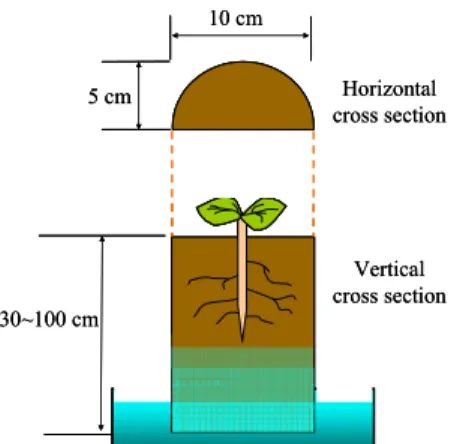
In this experiment, pipe-shaped pot made from polyvinyl chloride (PVC) was used for cultivating Kanzo. Because it was easy to control conditions such as soils, water conditions and so on. The diameter was 10 cm, and the shape of its cross section of axis direction was semicircle. A transparent acrylic board was attached for observing the soil conditions and roots of Kanzo. Several holes for absorbing water were drilled at the bottom.
Liquid manure was stored into a container. The given manure was Otsuka liquid fertilizer A-type [N:P:K:Ca:Mg=18.6:5.1:8.6:8.2:3.0 (me/l)], and it was diluted to 1/8th concentration. Then, the pots were crammed with soils were set up in the container and potted Kanzo. Figure 1 shows the pot shape and the way of absorbing water. The pot heights used in this experiment were 30, 50, 70, and 100 cm. Figure 2 shows the pot heights and soil types. Basically, decomposed granite soil was used, in addition, Silica sand No.3 and No.7 were used in 50 cm pipes for comparison. The characteristics of each soil are mentioned later. Initial conditions of the cultivation are shown in Table 1.
In this cultivation, there are some influential factors on growth of Kanzo. This paper discusses relationships among volumetric water content, suction, length of roots and evapo-transpiration velocity.
2.2 Materials
In this experimental cultivation of Kanzo, three kinds
of soil were used. These were decomposed granite soil, Silica sand No.3 and Silica sand No.7. Figure 3 shows grain size distribution curves of each soil. Table 2 shows characteristics grain size distribution on each soil.
Figure 3 indicates that decomposed granite soil has the widest grain size distribution in comparison of other soils. Silica sand No.3 and Silica sand No.7 resembles in their slopes, but the grain size of Silica sand No.3 is larger than that of Silica sand No.7.
Table 2 shows characteristics of grain size distribution on each soil, namely average grain diameter, uniformity coefficient and coefficient of curvature. This table indicates that Silica sand No.3 has the biggest average grain diameter. Accordingly, it is considered that Silica sand No.3 has the poorest capacity of absorbent water in three soil types because of the biggest average grain diameter. Next, concerning decomposed granite soil, uniformity coefficient is over 10 and coefficient of curvature is over 1 and under 3. Therefore, decomposed granite soil has good gradation.
It is considered that these soil characteristics in geotechnical engineering viewpoint causes some differences of growing Kanzo.
30~100 cm 5 cm 10 cm Horizontal cross section Vertical cross section 30~100 cm 5 cm 10 cm Horizontal cross section Vertical cross section
Figure 1. The pot shape and the way of absorbing water
Heights of pots : 30 cm 50 cm 70 cm 100 cm
Decomposed granite soil Silica sand No.3 Silica sand No.7
Heights of pots : 30 cm 50 cm 70 cm 100 cm
Decomposed granite soil Silica sand No.3 Silica sand No.7
30 cm 50 cm 70 cm 100 cm
30 cm 50 cm 70 cm 100 cm
Decomposed granite soil Silica sand No.3 Silica sand No.7
Figure 2. Pot heights and soil types Table 1. Initial Conditions
Pot heights (cm) Soil types Initial water content (%) Initial wet density (g/cm3) 30 Decomposed granite soil 20 1.94 Decomposed granite soil 20 1.79
Silica sand No.3 15 1.41
Silica sand No.7 20 1.40
70 Decomposed
granite soil 20 1.76
100 Decomposed
granite soil 20 1.76
3 RESULTS AND DISCUSSIONS
3.1 Volumetric water content of arbitrary depths of the pots
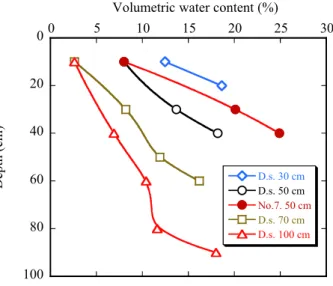
As mentioned above, volumetric water content was measured in this experiment. The procedure is indicated as follows. At first, holes were drilled at arbitrary depths of the pots. For example, a pipe with height of 30 cm was drilled at 10 and 20 cm from the surface, and a pipe with height of 50 cm was drilled at 10, 30 and 40 cm. Second, probes of WET sensor (Delta-T Devices) were inserted into the pots.
Figure 4 shows volumetric water content of each depth of pots. Horizontal axis means volumetric water content (%) and vertical axis means pot depths from the surface. Legends in the figure mean soil types and pot heights. D.s. means decomposed granite soil, No.7 is Silica sand No.7. The pot with Silica sand No.3 could not be measured because it was too poor of water to measure using this sensor.
As shown in the figure, in comparison with soil types, Silica sand No.7 has the highest volumetric water content among used soils. The difference of volumetric water content is larger with depth.
Furthermore, in comparison of pot heights, the difference of volumetric water content is larger as
approaching the surface in every pot.
It is found that the difference of soil water property influences growth of Kanzo.
3.2 Suction of arbitrary depths of the pots
Regarding relationship between soil water condition and growth of general plant, soil has an ability of keeping and draining water itself. When water supplies to plant from soil become less, the plant becomes in a condition of “water stress”, which is water lack in the plant itself. Generally, soil water potential influences evapo-transpiration and photosynthesis. When it is less, general plants are inactive, which is called as “depletion of moisture content for normal growth”. It is reported that the value describes as a unit of pressure, namely -50~-100kPa3)4), although it varies in a kind of plants. In addition, there is an example of increasing quality of crops by giving slight water stress.
Then, suction was measured by being used tensio meters. Suction is absolute value of matric potential substantially.
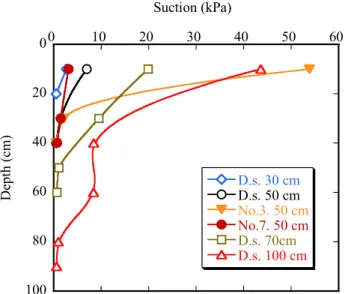
Figure 5 shows suction of each depth of the pots. As shown in the figure, in comparison of soil types, in order of Silica sand No.3, Decomposed granite soil and Silica sand No.7, suction changes largely nearby the surface.
Furthermore, in comparison of pot heights, on condition of Decomposed granite soil, Figure 5 indicates that the difference of suction is greater in the vicinity of the surface as well as volumetric water content.
Figure 3. Grain size distribution curves Table 2. Characteristics of grain size distribution on each soil
Decomposed granite soil Silica sand No.3 Silica sand No.7 Average grain diameter (D50) 0.46 1.45 0.23 Uniformity coefficient (Uc) 12.67 1.43 1.92 Coefficient of curvature (Uc? 1.79 1.24 1.11 0 5 10 15 20 25 30 0 20 40 60 80 100 D.s. 30 cm D.s. 50 cm No.7. 50 cm D.s. 70 cm D.s. 100 cm
Volumetric water content (%)
Depth (cm
)
Figure 4. Volumetric water content of each depth of the pots
3.3 Length of roots
The length of roots was measured by observing through acrylic boards. Figure 6 shows growth of roots in each condition. Horizontal axis means days for growing roots. 0 is a day of starting the experiment. Vertical axis means growth of roots without considering initial length of roots.
Figure 6 indicates the roots grown by pots of 100 cm. Decomposed granite soil was the longest growth of roots of all conditions. Figure 4 represents that the pot in height with 100 cm was the poorest volumetric water content in all pot depths. Therefore, the roots of Kanzo grow longer to get water and nutrient lacked at nearby the roots and to approach groundwater.
Furthermore, in comparison with soil types, the condition of decomposed granite soil is the best condition for growth of roots of all soil types.
As shown in Figs. 4 and 5, volumetric water content and suction change due to pot depths. Therefore, the changing velocity of growing of roots regards to be caused water condition in the pot.
The conditions that growing speed has slowed in about 4 months later from the start of cultivation because the roots reached the bottom of pots.
Furthermore, it is found that characteristics of roots growth are different in soil types and water conditions in ground by observing roots. The examples are as follows.
Picture 2 shows that the characteristics of roots growth in comparison with soil types. The roots with Silica sand No.3 are thick and grow directly and vertically. The roots with Silica sand No.7 are thin and grow curvedly and horizontally. Then, from Table 2, average grain diameter of Silica sand No.3 is smaller than Silica sand No.7. That is caused to absorb water into pots. Picture 3 shows that the characteristics of
0 10 20 30 40 50 60 0 20 40 60 80 100 D.s. 30 cm D.s. 50 cm No.3. 50 cm No.7. 50 cm D.s. 70cm D.s. 100 cm Suction (kPa) Depth (cm)
Figure 5. Suction of each depth of the pots
Silica sand No.3 Silica sand No.7 Silica sand No.3 Silica sand No.7
Picture 2. Characteristic of roots growth in comparison with soil types 0 10 20 30 40 50 60 0 20 40 60 80 100 120 140 160 D. s. 30 cm D s. 50 cm No.3 50 cm No.7 50 cm D.s. 70 cm D.s. 100 cm Gr ow th o f r oo ts ( cm ) Days Figure 6. Growth of roots
Picture 3. Characteristic of roots growth in comparison with the top and the bottom of a pot
roots growth in comparison with the top and the bottom of a pot with decomposed granite soil. Distribution of water between the top and the bottom of a pot are different. It is found from Fig. 4. At the top, thick roots grow. At the bottom, thin roots grow.
From pictures 2 and 3, it is concluded that thick primary roots grow directly and vertically in low water content. On the other hand, thin secondary roots grow curvedly and horizontally in high water content.
3.4 Evapo-transpiration velocity and length of roots
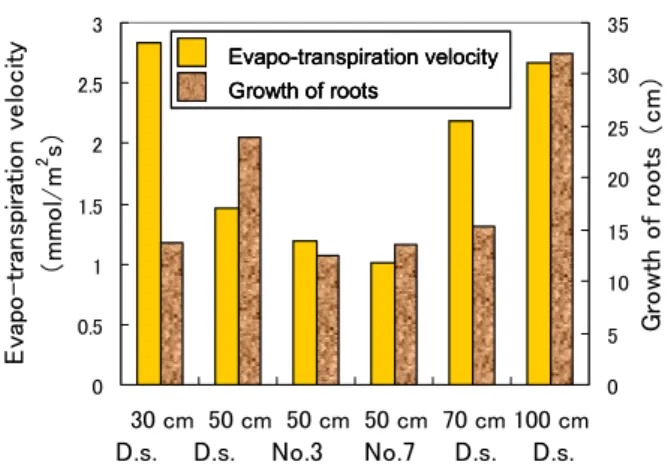
In previous sections, soil conditions and roots of Kanzo were mainly discussed. But in the field, it is not easy to observe under the ground. In this section, evapo-transpiration property is discussed based on the measurement of evapo-transpiration velocity on leaves. Evapo-transpiration velocity is one of the evaluations of Kanzo growing. The method is that leaves were pinched by a sensor, AP-4 (Delta-T Devices), and measured every two hours in a day, about 80 day later from the start of cultivation. Figure 7 shows that the peak of evapo-transpiration velocity in a day and growth of roots. Horizontal axis means heights of pots and the soil types.
Figure 7 indicates that evapo-transpiration velocity relates to the length of roots. The larger the velocity is, the longer the length. The velocity Kanzo growing on pots of 30 cm is large because the roots arrived at the bottom of pots and got enough water.
This result indicates that evapo-transpiration velocity has a close relation to growth of roots. It may be effective to evaluate a tendency of root growth in the field from the characteristic of leaf evaporation without excavation of soil5).
4 CONCLUSIONS
The following conclusions were obtained from this study.
(1) The lower water content of cultivating soil was, the longer the root length was. Roots of Kanzo grew to gain water and nutrient lacking on the surface of the ground. (2) Growth of Kanzo is influenced by soil types with different soil water properties.
(3) Thick primary roots grew directly and vertically in low water content. On the other hand, thin secondary roots grew curvedly and horizontally in high water content.
(4) Measuring evapo-transpiration velocity can be the effective method to evaluate roots’ growth tendency in the field.
ACKNOWLEDGEMENT
The author would like to acknowledge financial support from the project between Kyushu-University and Genkai town, and P&P (Kyushu University Interdisciplinary Programs Education and Projects in Research Development).
REFERENCES
1) Masahiro Shoyama “The wisdom and nature of Asia”, Publication association of Kyushu University
2) Haruka Kiyotomo, Notiyuki Yasufuku, Kiyoshi Omine, Taizo Kobayashi, Zentaro Furukawa (2010): “Influences of water condition in ground on growth of medicinal plant Kanzo”, Proc. Of the 65th JSCE Annual Meeting (in Japanese)
3) Nobuhide Takahashi (2008): “The limit of water condition of living Eucalyptus camaldulensis”, Research of desert, 17-4,157-165 (in Japanese)
4) Tsuyoshi Miyazaki (2005): “Physics of soil”, Asakura bookstore (in Japanese)
5) Haruka Kiyotomo, Noriyuki Yasufuku, Kiyoshi Omine, Taizo Kobayashi (2010): “Influences of moisture property in ground on root growth of medicinal plant Kanzo (Glycyrrhiza uralensis)”, Proc. of the 2010 Meeting the Japanese Association
for Arid Land Studies (in Japanese)
0 0.5 1 1.5 2 2.5 3 30 cm 50 cm 50 cm 50 cm 70 cm 100 cm E va po -tra n sp iratio n v e lo c it y ( mmo l/ m 2 s) 0 5 10 15 20 25 30 35 G row th of r o ot s ( c m ) D.s. D.s. No.3 No.7 D.s. D.s. Evapo-transpiration velocity Growth of roots 0 0.5 1 1.5 2 2.5 3 30 cm 50 cm 50 cm 50 cm 70 cm 100 cm E va po -tra n sp iratio n v e lo c it y ( mmo l/ m 2 s) 0 5 10 15 20 25 30 35 G row th of r o ot s ( c m ) D.s. D.s. No.3 No.7 D.s. D.s. Evapo-transpiration velocity Growth of roots Evapo-transpiration velocity Growth of roots Evapo-transpiration velocity Growth of roots
Figure 7. Relationships between Evapo-transoiration and Growth of roots