J Korean Acad Community Health Nurs (지역사회간호학회지) https://doi.org/10.12799/jkachn.2018.29.1.41
Factors Affecting Unmet Healthcare Needs of Working Married
Immigrant Women in South Korea
Yi, Jinseon
1· Lee, Insook
21Graduate School, Seoul National University, Seoul 2College of Nursing, Seoul National University, Seoul , Korea
Purpose: This study was conducted to identify the factors affecting on unmet healthcare needs of married immigrant women, especially who are working in South Korea. Methods: It is designed as a cross-sectional descriptive study. We analyzed data from 8,142 working married immigrant women to the ‘National Survey of Multicultural Families 2015.’ Based on Andersen’s health behavior model, logistic regression was conducted to determine the predictors of unmet healthcare need. Results: The prevalence of unmet healthcare needs among the subjects was 11.6%. In multivariate analysis, significant predictors of unmet needs included existence of preschooler, country of origin, peri-od of residence in predisposing factors, monthly household income, helpful social relationship, social discrimination, Korean proficiency, working hour per week in enabling factors, and self-rated health, experience of grief or desper-ation in need factors. Conclusion: The associdesper-ation between labor-related factors and unmet healthcare needs of mar-riage immigrant women currently working was found from nationally representative sample. Support policies for immi-grant women working more than legally defined hours and having preschooler should be supplemented to reduce unmet healthcare needs. In addition, eradicating discrimination in workplace, enlarging social relationship, and de-veloping culturally competent nursing services tailored to health problems caused by labor are needed.
Key Words: Immigrants, Working women, Health services accessibility, Healthcare disparities
Corresponding author: Lee, Insook
College of Nursing, Seoul National University, 103 Daehak-ro, Jongno-gu, Seoul 03080, Korea. Tel: +82-2-740-8828, Fax: +82-2-765-4103, E-mail: [email protected]
Received: Aug 20, 2017 / Revised: Jan 28, 2018 / Accepted: Jan 29, 2018
This is an open access article distributed under the terms of the Creative Commons Attribution Non-Commercial License (http://creativecommons.org/licenses/ by-nc/3.0), which permits unrestricted non-commercial use, distribution, and reproduction in any medium, provided the original work is properly cited.
INTRODUCTION
1. Background
Due to an increase of international marriages and dras-tic influx of foreign workers and international students since 2000, the proportion of foreigners in the total pop-ulation of Korea has steadily increased, reaching 3.4% of the total population in 2017. Among foreigners staying in Korea, marriage immigrants account for the second high-est percentage after migrant workers. Around the 82% of the total marriage immigrants are women, because the dominant type of international marriage in Korea is the union of woman from a lower income country and Korean man. They were known to choose to immigrate to Korean due to motivations such as the need to support family in their home countries, expansion of employment
oppor-tunities, and desire for a better life and life satisfaction [1]. According to the results of the National Survey of Multi-cultural Families 2015, the first ranked item among the supporting services which marriage immigrants want to receive wasjob training andjob placement. Especially the group of immigrants who have lived in Korea for a long period over 10 years had showed the highest needs of employment. As reflected in this situation, the employ-ment rate of marriage immigrant women has risen stead-ily over the past decade, and 59.5% of them were in em-ployment in 2015, far exceeding the emem-ployment rate of 49.9% of Korean women [2].
As the history of international marriage gets longer in Korea, many female marriage immigrants have passed the initial adaptation phase and entered into the real integra-tive adaptation phase. In order for immigrants to become stable members of society, participating to economic
activ-ities in the society they have moved into is essential. Since the income generated by working enables them to make various consumption activities for social adaptation, par-ticipation in economic activities contributes to improving the adaptation level of immigrants and lowering the risk of social exclusion derived from poverty [3]. However, de-spite the increased participation of female immigrants in economic activities and the improvement of household in-come of multicultural families, the proportion of multi-cultural households with the average monthly household income of less than 3 million won in 2015 is 63.0%, show-ing that they are still economically vulnerable. In addition, most of marriage immigrants are engaged in low-skilled jobs such as simple labor, have low social status, receive lower wages and are more exposed to poor working con-ditions compared to Korean workers [2].
The poor working conditions and low socioeconomic status of working married immigrant women serve as so-cial determinants of deteriorating health. In addition, low accessibility to healthcare services, weak social networks and social supports, vulnerable health behaviors, high lev-els of stress, and exposure to dangerous environments are known to be the determinants that adversely affect immi-grants’ health [4]. Female migrant workers in Korea have been reported to be suffering from frequent gender-based discrimination and violence at working place, and immi-grants who experienced such social discrimination and vi-olence have been found to have poor physical and mental health status [5,6]. These findings suggest that working married immigrant women may also be exposed to similar risks. Moreover, they are faced with the task of adapting to the new society and culture since they are not only foreign workers but also immigrants who have settled in Korea as spouse of Korean. It is known that immigrants who have experienced the adaptation stress shows high risk of vari-ous physical and mental health problems [5]. In addition, as women, they experience pregnancy and childbirth that cause the physical changes and role transitions in Korea. Pregnancy-related health problems such as anemia, gyne-cological disease, and toxemia of pregnancy as well as de-pression, conflicts, and stress are common in marriage im-migrant women [7]. These health problems increase the needs for healthcare services naturally.
Despite the high healthcare needs of marriage immi-grant women, they do not utilize sufficient healthcare ser-vices for various reasons, such as difficulty in communi-cating with medical staffs, unfamiliarity with the Korean health system, distant health facilities and inconvenient transportation, no person available to care for their child, the burden of medical costs due to poor economic status,
and absence of health insurance [8,9]. As described above, in the case of individuals do not receive healthcare serv-ices required to avoid negative health consequences as de-scribed above, it is defined as unmet healthcare needs [10]. Unmet healthcare needs are important for assessing cover-age of the national health care system and used as a proxy indicator of accessibility to healthcare. To achieve the goal of the Korean National Health Plan 2020, which is to elimi-nate the health disparities among different groups of the population and to improve health equity of the society, the efforts to address the causes of unmet healthcare needs of marriage immigrants should be accompanied. In previous studies, demographic characteristics such as age, educa-tion level, employment status, country of origin; and fac-tors enable to utilize healthcare facilities such as residence area, period of residence in Korea, household income, en-rollment of health insurance, type of household, Korean proficiency, experience of social discrimination were found to affect unmet healthcare needs of marriage immigrant women. In addition, self-rated health status and experi-ence of disease within past two weeks that directly related to healthcare needs have been shown to have a significant effect [11,12]. One of the affecting factors mentioned above, unemployment status is generally known to be the main cause of increasing unmet healthcare needs since it de-creases the income level and lowers the ability to pay for medical costs. However, in the previous studies on mar-ried immigrant women in Korea, unmet healthcare needs among employed persons were consistently higher than unemployed. These results imply the possibility that al-though the participation of immigrant women in econom-ic activities improves the ability to pay for healthcare serv-ices, other factors related to economic activities increase the healthcare needs or hinder the use of healthcare servi-ces. Kim & Lee [12] attributed higher unmet healthcare needs in working married immigrant women to the time constraints on the healthcare utilization due to fixed work-ing hours, but this interpretation did not supported by ad-ditional analyses considering occupational characteristics of participants. A prior study which analyzed the factors affecting unmet healthcare needs in wage workers in Ko-rea showed that employment status and working hours were significant related factors, suggesting that occupational characteristics are related to unmet healthcare needs [13].
Social investment to deal with unmet healthcare needs of working married immigrants is an important social task because it can reduce health disparities in Korean society. Through this, we can improve the entire population’s health status in the long term by lowering unmet health-care needs of vulnerable people. Although many previous
studies have focused on married immigrant women’s health problems and their use of healthcare services, work-ing married immigrant women, who may be a more vul-nerable than those who are not working, relatively have been received little attention. Therefore, this study aimed to contribute to improving their healthcare accessibility and health status by investigating the current status of un-met healthcare needs of working married immigrant wom-en and elucidating the effects of various characteristics in-cluding occupational characteristics on unmet healthcare needs.
2. Purpose of the Study
The purpose of this study was to investigate the charac-teristics of working married immigrant women and the level of unmet healthcare needs and to elucidate the fac-tors affecting their unmet healthcare needs. Through this research, we attempt to provide a basis for policy develop-ment to secure the healthcare accessibility of working mar-ried immigrant women in Korea. The specific objectives of this study are as follows:
To identify general characteristics and occupational characteristics of working married immigrant women. To analyze the unmet healthcare needs of working
married immigrant women according to general and occupational characteristics.
To clarify the factors affecting unmet healthcare needs of working married immigrant women.
METHODS
1. Study Design
This study was designed as descriptive, cross-sectional study that analyzing secondary data from the National Survey of Multicultural Families 2015 conducted by the Ministry of Gender Equality & Family and Statistics Korea.
2. Data Source and Study Population
This study used the National Survey of Multicultural Families 2015 (hereafter, NSMF), which is a nationally representative survey on multicultural families. It is con-ducted in every three years based on the Multicultural Family Support Act (Act No. 8937, Mar. 21, 2008) since 2009. The target population of NSMF was household member of multicultural family (i.e. marriage immigrants, their spouse, and offspring) and naturalized non-marriage migrants residing in Korea during the survey period. 544
trained investigators directly visited the households and surveyed through in-person interview fromJuly 22 to Au-gust 18, 2015. The sample of NSMF was selected through two-stage sampling process. In the first stage, Statistics Korea selected 850 district from the 3,470 total admin-istrative district in Korea by clustered systematic sam-pling, using the registration data (alien registration data, family-relationship registration data, and resident regis-tration data). Then, in the second stage, multicultural households registered in 850 district were selected by stratified systematic sampling. The 17,879 households out of total 26,098 household participated in the survey, and the response rate was 65.8%[2].
The subjects of this study are female marriage immi-grants who are currently working in Korea. Out of 17,109 marriage immigrants and naturalized people who were surveyed, male (2,702 persons), unmarried (132 persons), and persons who did not answer to the item measuring unmet healthcare needs (318 persons) were excluded. In addition, people aged 65 years or more (321 persons) were excluded considering possible working age (15 to 64 years), and people who did not currently working (5,869 persons) were also excluded. Thus, a total of 8,142 persons were fi-nalized as the subjects of this study.
3. Conceptual Framework
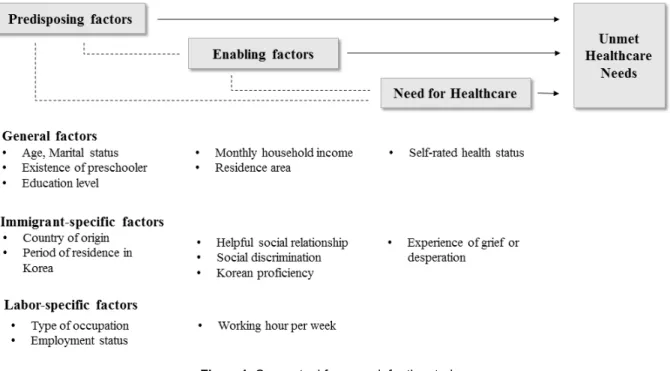
Based on Andersen’s health behavior model, which ex-plains the use of healthcare services, the conceptual frame-work of this study was constructed. Assuming that the be-havioral characteristics of individuals influence the use of healthcare services, Andersen classified the affecting fac-tors into three categories. Predisposing facfac-tors include demographic characteristics (i.e. gender and age), social structure (i.e. education level and occupation), and in-dividuals’ beliefs, values or knowledge about disease or the use of health care services. Enabling factors refer to the means of accessing and using healthcare services, and in-clude the resources of individuals or families (i.e. income, health insurance, and usual source of care) and commun-ity resources (i.e. healthcare workers and facilities). The need for healthcare is a factor directly related to the health-care service utilization, and includes the subjective health status perceived by individual and clinical health needs assessed by healthcare professionals [14]. This model was first published in the 1960s, has been revised and steadily used in various researches studying healthcare accessi-bility of vulnerable groups such as homeless and immi-grants. However, since the model does not sufficiently em-brace the immigrants’ characteristics that could influence
Figure 1. Conceptual framework for the study. to their behavior of healthcare utilization, a research
mod-el including factors like duration of residence, host lan-guage proficiency, immigrant generation status, age at im-migration, and legal status is needed [15]. Therefore, in this study, a theoretical framework is proposed to reflect working married immigrant women’s characteristics by dividing Andersen’s three categorized factors into general factors, immigrant-specific factors, and labor-specific fac-tors (Figure 1).
4. Measures
1) Unmet healthcare needs
The unmet healthcare needs of working marriage immi-grant women was measured by survey questionnaire, “Have you ever had the experience of being unable to visit healthcare facilities when you wanted to see a doctor be-cause of sickness in the past one year?” Survey partic-ipants who answered ‘Yes’ to the questionnaire was de-fined as the case who experienced unmet healthcare needs in this study.
2) Predisposing factors
Predisposing factors included in this study were age, marital status, existence of preschooler, education level, country of origin, period of residence in Korea, type of oc-cupation, and employment status. Age group was classi-fied into three categories of 19 to 24 years, 25 to 49 years, and 50 to 64 years, considering the criterion of the working
age. The marital status dichotomized into the currently married and previously married (widowed, divorced, or separated). Regarding the existence of a child under five years of age, it was defined as ‘none’ if the respondent an-swered ‘no preschooler’ to the question “Have you ever used caring services for preschool child?” If respondent answered to other options, it was defined as ‘yes’ in this study. The education level was divided into middle school graduate or lower, high school graduate, and college grad-uate or higher. The country of origin was categorized into Vietnam, China (Korean-Chinese), China,Japan, the Philip-pines, and others. The period of residence in Korea was divided into 1~5 years, 6~10 years, and 11 years or more. Type of occupation is classified into three categories re-ferred to the Korean standard classification of occupa-tions: ‘professional ․ office worker (manager, professional, and office worker)’, ‘service ․ sales worker (service and sales workers)’, ‘manual worker (skilled worker in agri-culture, forestry, and fishery, technical worker, equip-ment/machinery operator and assembly worker, and sim-ple labor worker).’ Employment status is divided into ‘unpaid family worker’, ‘self-employed’, and ‘wage work-er (including regular workwork-er, temporary workwork-er, and dai-ly worker).’
3) Enabling factors
Enabling factors consisted average monthly household income, residence area, social relationship to ask for help in the event of illness, experience of social discrimination,
Korean proficiency, and working hours per week. Average monthly household income was classified into ‘less than 1 million won’, ‘1 to 1.99 million won’, ‘2 to 2.99 million won’, and ‘3 million won or more.’ The residence area was divided into ‘urban (dongs)’ and ‘rural (eups or myeons).’ If the response to the question “Do you have anyone whom you can ask for help excepting your family member when you are sick?” was ‘yes’, it was defined as the ‘having helpful social relationship.’ Experience of social discrimination was dichotomized as ‘yes’ and ‘no’ based on the answer to the questionnaire, “Have you ever been discriminated against or neglected based on ethnicity or nationality while living in Korea?” Korean proficiency was measured by the 5-Likert scale from very good (1) to very poor (5) in four domains of speaking, listening, read-ing, and writing. Scores from each domain were coded re-versely and average score was calculated. It was catego-rized into ‘low (1 to 2.25), ‘medium (2.5 to 3.5)’, and ‘high (3.75 to 5).’ Average working hours per week was divided into ‘40 hours or less’, ‘41 to 59 hours’, and ‘60 hours or more’ based on the Article 50 of the Labor Standard Act. 4) Needs for healthcare
Self-rated health status and experience of grief or desper-ation were selected as need factors in this study. Self-rated health status was measured on a 5-Likert scale (1=very good, 2=good, 3=fair, 4=poor, and 5=very poor) and reclassified into ‘good’, ‘fair’, and ‘poor.’ Experience of grief or desper-ation was measured by a survey questionnaire, “Have you ever felt grief or desperation lasting for two weeks that make you difficult to continue daily life within the past year?” The response was dichotomized into ‘never experienced’ and ‘experienced (sometimes, often, and very often).’
5. Ethical Considerations
The NSMF is conducted by performing education and training for survey investigators based on survey guide-lines prior to data collection. In particular, it is empha-sized that the interviewers should not disclose the in-formation learned during the survey process or use them for other purposes. In addition, the survey should be con-ducted after sufficiently explaining that the survey results are used for statistical purposes only and confidentiality is guaranteed. The raw data of NSMF are disclosing to the public through the website of the Micro Data Integrated Service (MDIS) of the Statistics Korea. Since personally identifiable information is deleted from the data provided, the anonymity and confidentiality of participants are gua-ranteed. Researchers obtained the data following
proce-dures posted at the web-site, and this study was conduct-ed after gaining the approval of the Institutional Review Board of the university to which the researchers belong (IRB No. E1705/003-005).
6. Statistical Analysis
Frequency analysis was conducted to understand the general and occupational characteristics of working mar-ried immigrant women. To determine the unadjusted rela-tionship between predictors and outcome variable, x2 test
was used. Logistic regression analysis was applied to de-termine the factors independently associated with unmet healthcare needs of working married immigrant women. All statistical analysis were performed using STATA/IC version 14.0 and the significance level was set at 95%.
RESULTS
1. General and Occupational Characteristics of Subjects
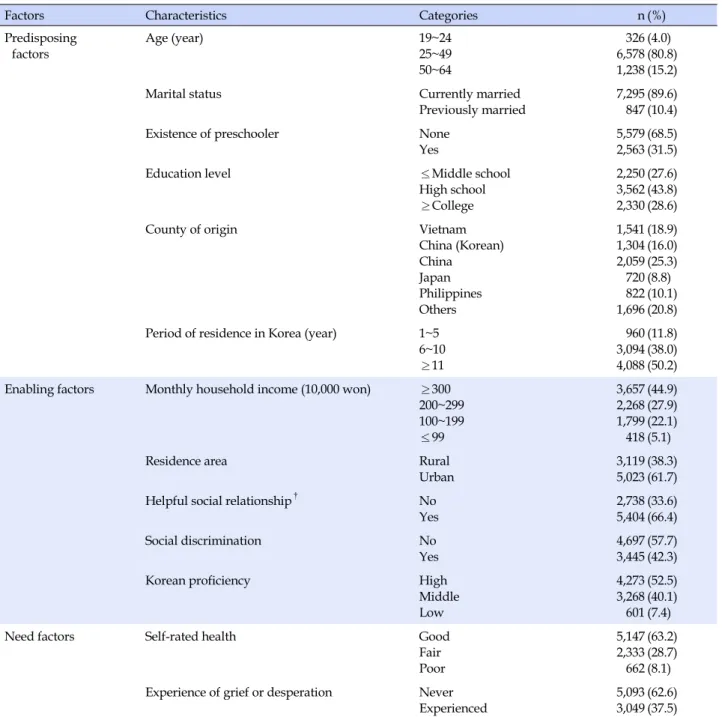
A total of 8,142 working married immigrant women aged 19 to 64 years were analyzed in this study. Their gen-eral characteristics and occupational characteristics are pre-sented in Table 1. As for the age, 80.8% of participants were in the 25 to 49 age group. 10.4% of subjects were previously married, and 31.5% lived with preschooler. Regarding the level of education, the percentage of high school graduate was the highest (43.8%), followed by college graduate or higher (28.6%) and middle school graduate or lower (27.6 %). The largest number of subjects came from China (25.3 %), followed by Vietnam (18.9%), Korean-Chinese (16.0%), the Philippines (10.1%) andJapan (8.8%). Over half of sub-jects 50.2%) were long-term residents who lived in Korea more than 10 years. The average household income was in the order of 3 million won or more (44.9%), 2~2.99 million won (27.9%), 1~1.99 million won (22.1%), and less than 1 million won (5.1%). Much more subjects were lived in ur-ban area (61.7%) than rural area (38.3%). 66.4% of subjects reported that having helpful social relationship, and 42.3% experienced social discrimination. The level of Ko-rean proficiency was in the order of the high level (52.5%), medium level (40.1%), and low level (7.4%). The highest percentage of respondents assessed their self-rated health status as good (63.2%), and 37.5% answered that they ex-perienced grief or desperation lasting for two weeks with-in the past year.Regarding the occupations, more than half of subjects were manual workers (57.6%), followed by service ․ sales workers (26.6%) and professional ․ office workers (15.8%).
Table 1. General Characteristics of the Subjects (N=8,142)
Factors Characteristics Categories n (%)
Predisposing factors Age (year) 19~24 25~49 50~64 326 6,578 1,238 (4.0) (80.8) (15.2)
Marital status Currently married
Previously married
7,295 847
(89.6) (10.4)
Existence of preschooler None
Yes 5,579 2,563 (68.5) (31.5) Education level ≤Middle school High school ≥College 2,250 3,562 2,330 (27.6) (43.8) (28.6) County of origin Vietnam China (Korean) China Japan Philippines Others 1,541 1,304 2,059 720 822 1,696 (18.9) (16.0) (25.3) (8.8) (10.1) (20.8) Period of residence in Korea (year) 1~5
6~10 ≥11 960 3,094 4,088 (11.8) (38.0) (50.2) Enabling factors Monthly household income (10,000 won) ≥300
200~299 100~199 ≤99 3,657 2,268 1,799 418 (44.9) (27.9) (22.1) (5.1) Residence area Rural Urban 3,119 5,023 (38.3) (61.7) Helpful social relationship†
No Yes 2,738 5,404 (33.6) (66.4) Social discrimination No Yes 4,697 3,445 (57.7) (42.3)
Korean proficiency High
Middle Low 4,273 3,268 601 (52.5) (40.1) (7.4)
Need factors Self-rated health Good
Fair Poor 5,147 2,333 662 (63.2) (28.7) (8.1) Experience of grief or desperation Never
Experienced 5,093 3,049 (62.6) (37.5) †
The presence of social relationships that can ask for help in the event of illness.
Among manual workers, the percentages of simple labor workers (31.2%) and equipment/machinery operator ․ as-sembly workers (14.5%) took relatively high proportion. As for employment status, wage workers accounted for the highest percentage (82.7%), followed by unpaid family workers (9.5%) and self-employed (7.8%). Among wage workers, the percentage of regular workers was highest (33.4%), followed by temporary workers (32.8%), and dai-ly workers (16.5%). For the average working hour per week, the majority of subjects (54.5%) were working 40 hours or
less per week, 28.9% working 41 to 59 hours, and 16.7% working 60 hours or more (Table 2).
2. The Current Status of Unmet Healthcare Needs of
Subjects
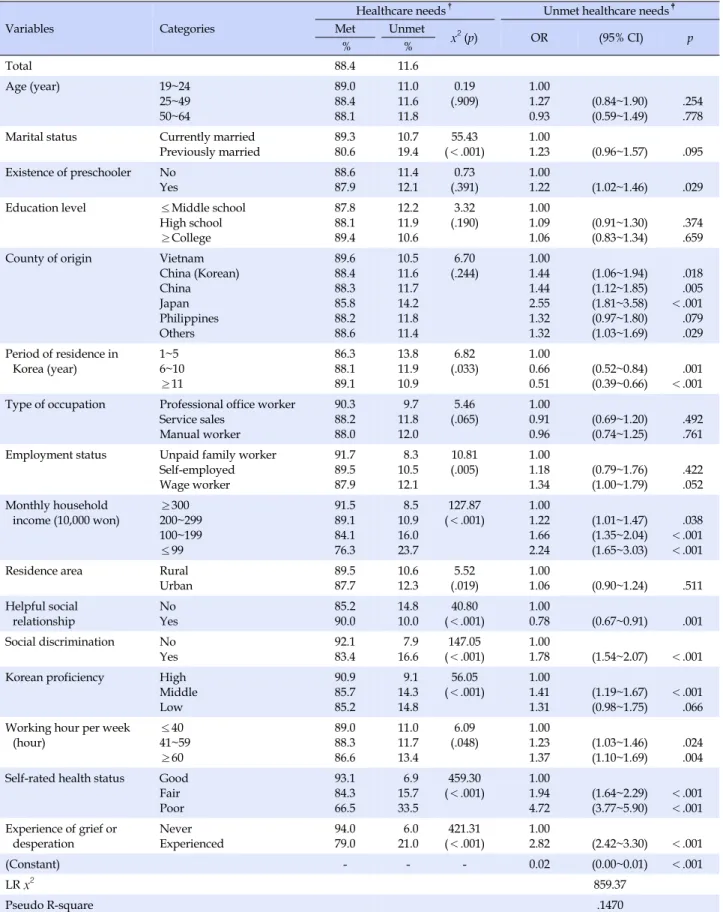
Overall, 11.6% of working married immigrant women reported having experienced unmet healthcare needs within the past year (Table 3). Among predisposing fac-tors, there were significant differences in unmet
health-Table 2. Occupational Characteristics of the Subjects (N=8,142)
Factors Characteristics Categories n (%) Sub-categories n (%)
Predisposing factors Type of occupation Professional office worker 1,288 (15.8) Manager Professional Office worker 3 971 314 (<0.1) (11.9) (3.9) Service ․ sales 2,167 (26.6) Service worker
Sales worker 1,561606(19.2)(7.4) Manual worker 4,687 (57.6) Farmer, fisher
Technical worker
Equipment/machinery operator, assembly worker
Simple labor worker
446 523 1,178 2,540 (5.5) (6.4) (14.5) (31.2) Employment status Unpaid family worker
775 (9.5) Unpaid family worker 775 (9.5)
Self-employed 638 (7.8) Self-employed 638 (7.8)
Wage worker 6,729 (82.7) Regular worker Temporary worker Daily worker 2,716 2,670 1,347 (33.4) (32.8) (16.5) Enabling
factors Working hour per week (hour) ≤4041~59 ≥60 4,435 2,351 1,356 (54.5) (28.9) (16.7)
care needs according to the marital status, period of resi-dence in Korea, and employment status. The respondents previously married (p<.001), those whose residence peri-od in Korea was shorter (p=.033), and those who were self-employed or wage workers compared to unpaid fam-ily workers more experienced unmet healthcare needs (p= .005). As for all enabling factors, the statistical differences in unmet healthcare needs were found. The level of unmet healthcare needs was higher when the average monthly household income was lower (p<.001), subjects who are living in urban area (p=.019), having no helpful social rela-tionship (p<.001), and experienced social discrimination (p<.001) showed higher unmet healthcare needs than their counterparts. In addition, unmet healthcare needs was higher in the group with a medium or low Korean ciency compared to the group with high Korean profi-ciency (p<.001). The longer the average working hours, the higher the unmet healthcare needs (p=.048). Accord-ing to need factors, bad self-rated health status (p<.001) and experience of grief or desperation lasting 2 weeks (p<.001) were also significantly associated with high un-met healthcare needs.
3. Factors Affecting Unmet Healthcare Needs of
Working Married Immigrant Women
In the multivariate analysis, factors independently asso-ciated with an unmet healthcare needs for working
mar-ried immigrant women included existence of preschooler, country of origin, period of residence in Korea, monthly household income, helpful social relationship, experience of social discrimination, Korean proficiency, working hour per week, self-rated health status, and experience of grief and desperation (Table 3). Marriage immigrant women who had preschool child more likely to have experienced an unmet healthcare needs (OR=1.22, 95% CI=1.02~1.46). Compared to the subjects from Vietnam, those fromJapan (OR=2.55, 95% CI=1.81~3.58), China (OR=1.44, 95% CI= 1.12~1.85), Korean-Chinese (OR=1.44, 95% CI=1.06~1.94), and from other countries (95% OR=1.32, CI=1.03~1.69) were more likely to experience unmet healthcare needs. Com-pared to the period of residence of 1 to 5 years, the like-lihood of experiencing unmet healthcare needs was 0.66 times lower when the period of residence in Korea was 6 to 10 years (p<.001), and 0.51 times lower when the period of residence in Korea was 11 years or longer (p=.001). Com-pared to the group with the monthly income of 3 million won or more, the lower the monthly household income, the higher the likelihood of unmet healthcare needs (OR= 1.22, 95% CI=1.01~1.47 for 2~2.99 million won; OR=1.66, 95% CI=1.35~2.04 for 1~1.99 million won; OR=2.24, 95% CI=1.65~3.03 for less than 1 million won). The person with helpful social relationships was 0.78 times less likely to have unmet healthcare needs (p<.001), on the other hand, the person experienced social discrimination was 1.78 times more likely to have unmet healthcare needs than their
Table 3. Affecting Factors Unmet Healthcare Needs of Working Married Immigrant Women
Variables Categories
Healthcare needs†
Unmet healthcare needs‡
Met Unmet x2 (p) OR (95% CI) p % % Total 88.4 11.6 Age (year) 19~24 25~49 50~64 89.0 88.4 88.1 11.0 11.6 11.8 0.19 (.909) 1.00 1.27 0.93 (0.84~1.90) (0.59~1.49) .254 .778 Marital status Currently married
Previously married 89.3 80.6 10.7 19.4 55.43 (<.001) 1.00 1.23 (0.96~1.57) .095 Existence of preschooler No Yes 88.6 87.9 11.4 12.1 0.73 (.391) 1.00 1.22 (1.02~1.46) .029 Education level ≤Middle school
High school ≥College 87.8 88.1 89.4 12.2 11.9 10.6 3.32 (.190) 1.00 1.09 1.06 (0.91~1.30) (0.83~1.34) .374 .659 County of origin Vietnam
China (Korean) China Japan Philippines Others 89.6 88.4 88.3 85.8 88.2 88.6 10.5 11.6 11.7 14.2 11.8 11.4 6.70 (.244) 1.00 1.44 1.44 2.55 1.32 1.32 (1.06~1.94) (1.12~1.85) (1.81~3.58) (0.97~1.80) (1.03~1.69) .018 .005 <.001 .079 .029 Period of residence in Korea (year) 1~5 6~10 ≥11 86.3 88.1 89.1 13.8 11.9 10.9 6.82 (.033) 1.00 0.66 0.51 (0.52~0.84) (0.39~0.66) .001 <.001 Type of occupation Professional office worker
Service sales Manual worker 90.3 88.2 88.0 9.7 11.8 12.0 5.46 (.065) 1.00 0.91 0.96 (0.69~1.20) (0.74~1.25) .492 .761 Employment status Unpaid family worker
Self-employed Wage worker 91.7 89.5 87.9 8.3 10.5 12.1 10.81 (.005) 1.00 1.18 1.34 (0.79~1.76) (1.00~1.79) .422 .052 Monthly household income (10,000 won) ≥300 200~299 100~199 ≤99 91.5 89.1 84.1 76.3 8.5 10.9 16.0 23.7 127.87 (<.001) 1.00 1.22 1.66 2.24 (1.01~1.47) (1.35~2.04) (1.65~3.03) .038 <.001 <.001 Residence area Rural Urban 89.5 87.7 10.6 12.3 5.52 (.019) 1.00 1.06 (0.90~1.24) .511 Helpful social relationship No Yes 85.2 90.0 14.8 10.0 40.80 (<.001) 1.00 0.78 (0.67~0.91) .001 Social discrimination No Yes 92.1 83.4 7.9 16.6 147.05 (<.001) 1.00 1.78 (1.54~2.07) <.001 Korean proficiency High
Middle Low 90.9 85.7 85.2 9.1 14.3 14.8 56.05 (<.001) 1.00 1.41 1.31 (1.19~1.67) (0.98~1.75) <.001 .066 Working hour per week
(hour) ≤4041~59 ≥60 89.0 88.3 86.6 11.0 11.7 13.4 6.09 (.048) 1.001.23 1.37 (1.03~1.46) (1.10~1.69) .024 .004 Self-rated health status Good
Fair Poor 93.1 84.3 66.5 6.9 15.7 33.5 459.30 (<.001) 1.00 1.94 4.72 (1.64~2.29) (3.77~5.90) <.001 <.001 Experience of grief or
desperation NeverExperienced 94.079.0 6.021.0 (<.001)421.31 1.002.82 (2.42~3.30) <.001
(Constant) - - - 0.02 (0.00~0.01) <.001
LR x2 859.37
Pseudo R-square .1470
OR=odds ratio; CI=confidence interval; †Chi-square test of unmet healthcare needs according to predisposing, enabling, and need factors; ‡Logistic regression with all variables controlled.
counterparts (p<.001). The group with medium-level Ko-rean proficiency was 1.41 times more likely to experience unmet healthcare needs than the group with high-level Korean proficiency (p<.001). The longer working hours (OR=1.23, 95% CI=1.03~1.45 for 41 to 59 hours; OR=1.37, 95% CI=1.10~1.69 for 60 hours or more) were associated with high risk of unmet healthcare needs. Subject with bad (OR=4.72, 95% CI=3.77~5.90) and fair (OR=1.94, 95% CI= 1.64~2.29) health status were more likely to experience un-met healthcare needs than those who with good health status. The person who experienced grief or desperation was 2.82 times more likely to have unmet healthcare needs than those who without any experience (p<.001).
DISCUSSION
From the study results, 11.6% of the working married immigrant women in Korea reported that they could not use healthcare services when they wanted within the past year. This figure is higher than reported in the NSMF 2012 of 10.8%[12], but is similar to 11.7% of the NSMF 2009[11]. Since the NSMF is not a longitudinal survey, it has limi-tations in explaining the change in unmet healthcare needs over time. But, despite the various support programs and policy efforts for marriage immigrant women in the past decade, there seems to be no significant change in unmet healthcare needs. In accordance with the Support for Multi-cultural Families Act, national and local government have provided health services, such as nutrition and health edu-cation, pre- and post-natal care assistance, medical exami-nation, and medical interpretation services. However, due to lack of data to assess the degree of delivery and accept-ance or the effect of the services provided, it is not suffi-cient to establish evidence-based policies. Public health center in Korea is designed to providing health screening and healthcare services for multicultural families by home visiting [16]. In the real world, however, there are limi-tations in providing professional health services due to low competence of visiting nurses and lack of specific guideline. Although the nursing care for multicultural fa-milies should be provided differently according to the Korean language proficiency, education level, cultural backgrounds and needs of the individuals, there are large disparities in the quality of care provided by visiting nur-ses. Most visiting nurses were suffered from lack of cul-tural competency, as well as difficulty in communication, and discrepancy between education materials and actual characteristics of multicultural families [17]. Therefore, it is necessary to provide professional training for improv-ing cultural competency of nurses, to publish customized
health education materials, and to develop evaluation sys-tem for assessing the effectiveness of home visiting care. Although the current home visiting services are centered on the pregnancy-related care such as breastfeeding and vaccination [17], various nursing services tailored to work-ing immigrants should be developed to meet the health-care needs of them differ from the initial immigrants.
The self-rated health status and experience of grief and desperation were found to be the major determinants of unmet healthcare needs, and these results are consistent with previous studies [11,12]. Migrant workers have high-er incidence of industrial accidents resulting from the in-adequate work ability, low communication skills, and fail-ure to comply with occupational safety rules, compared with native Korean workers [18]. Musculoskeletal disease and gastrointestinal disease occur frequently in migrant workers who do strenuous physical labor. In addition, it is reported that married women engaged in simple labor or service ․ sales had high incidence of depression compared to in professionaljobs [19]. Majority of our study subjects were engaged in manual labor (57.6%) or service ․ sales (26.6%), therefore similar health problems are expected to be common in working married immigrant women in Korea. However, in most countries, public mental health programs for immigrants are deficient including Korea [4]. Therefore, it is urgent to expand support programs for physical and mental health of working married immi-grants.
In relation to the occupational characteristics of subjects, employment status (p=.005) and working hours (p=.048) were significantly associated with unmet healthcare needs in univariate analysis. Nevertheless, after controlling co-variates, only working hours were found to influencing unmet healthcare needs of working married immigrant women. In this study, the longer the working hours per week, the subjects experienced the more unmet healthcare needs. This finding is in agreement with the previous study of female wage workers in Korea: 41~48 hours (OR= 1.40, 95% CI=1.00~1.95), 49~60 hours (OR=1.48, 95% CI= 1.08~2.03), and 61 hours or more (OR=2.20, 95% CI=1.32~ 3.65) reference to 40 hours or less [13]. According to the National Health and Nutrition Survey 2010~2012, the largest number of respondents (38.1%) answered that they experienced unmet healthcare needs because ‘hospitals or clinics are closed during the time I was available.’ It was also found that in the groups who were younger, had a higher income, and were currently employed had the higher unmet healthcare needs due to a lack of time [20]. This could support the possibility that unmet healthcare needs occurred in married immigrant women with longer
working hours due to the time constraints on visiting healthcare facilities. Working hours of married women are closely related to child rearing. According to the NSMF 2015, the proportion of short-time worker, weekly work-ing hours of less than 36, were much higher in married im-migrant women (27.0%) than men (18.6%)[2]. It shows the preference of working mom for short-time work to secure childcare time. Working women often experience the con-flict between work and family if they have children to take care of, and the conflict increases as the age of the child be-comes lower [21]. The time conflict resulting from the dou-ble burden was reported to lower the physical activity, stress management, and health promoting behaviors of women [22]. In this study, the existence of preschool child increased the likelihood of unmet healthcare needs even when all other factors were controlled. This finding in-dicates the possibility that the presence of young children increases unmet healthcare needs of working married im-migrant women related to the time conflicts. In the uni-variate analysis, unmet healthcare needs of subjects was significantly higher in self-employed and wage workers than in unpaid family workers, but significant difference was disappeared after controlling covariates including working hours per week. Nevertheless, unmet healthcare needs of wage workers tended to be higher than unpaid family workers (OR=1.34, 95% CI=1.00~1.79, p=.052). The reason of this tendency is presumed to be the low employ-ment security of wage workers. Insecurity of employemploy-ment status causes economic instability and poor health con-ditions [23], therefore, unmet healthcare needs of tempo-rary and daily workers are usually higher than that of reg-ular workers with stability [13]. In this study, unpaid fam-ily workers and self-employed were included as study subjects in order to reflect the distribution of the overall occupational status of working married immigrants. How-ever, further study is required to examine the effect of em-ployment security on unmet healthcare needs of marriage immigrants by limiting the subjects to wage workers.
The ability to pay is known as a major predictor of un-met healthcare needs. The average household income of multicultural family is lower than that of Koreans, so their accessibility to healthcare is expected to be lower. To com-pensate for the limitation in ability to pay for healthcare services, Korea operates the National Health Insurance Service (NHIS). Although the enrollment rate of health in-surance of marriage immigrants was not released in NSMF 2015, it is reported that 14.2% of married immigrant women do not have health insurance in 2012 [12]. Most marriage immigrants gain the status of subscribers by con-firming their dependency of Korean spouse. Foreigners
who have lived or expected to live in Korea for 3 months or more, regardless of whether they have acquired Korean nationality or not, can obtain the status of local subscribers upon request. However, many married migrant women do not benefit from national health insurance (NHI) for their lack of information [24]. Working married immigrant women are automatically registered for NHI as employee subscriber, yet daily workers with the period of employ-ment of less than one month, part-time workers, or short- time workers with fixed working hours of less than 60 hours per month cannot be enrolled as employee subscri-ber. Health insurance is known to contribute to lowering unmet healthcare needs of immigrants, so it is important to increase the enrollment rate of married immigrant wo-men who are in the blind spot.
As reported by previous studies, the experience of so-cial discrimination was found to increase the likelihood of unmet healthcare needs [11]. If immigrants experience dis-crimination at work or in healthcare facilities, the utiliza-tion of healthcare services is delayed due to psychological withdrawal or restrictions on socio-economic opportuni-ties [6], and increased distrust in the health care system [25]. In addition, social discrimination increase in the need for healthcare services by deteriorating immigrants’ phys-ical and mental health status [5,6]. Female foreign workers in Korea have lower status and wage than men in the workplace, lack maternity protection, and be at high risk of gender-based discrimination and sexual violence [26]. Therefore, efforts to eliminate discrimination and violence against female immigrant workers are urgently needed in entire society including at workplace. The immigrants who have better social support and social relationships are less likely to experience unmet healthcare needs [27] be-cause it is easy to obtain information on healthcare uti-lization [26]. However, due to long working hours, fati-gue, competition in the workplace, and different holidays with friends, marriage immigrant women have difficulty establishing a social networks [28]. Therefore, we need to support them to build social relationship, and provide ap-propriate health information and education through pub-lic institutions, the workplace, or existing immigrant com-munities.
Generally, the period of settlement and language profi-ciency are used as the indicator of immigrant’s social adaptation. Low level of social adaptation is related to low understanding of health system in settled country, and causes difficulty in communication with healthcare pro-viders explaining their health conditions or understand-ing the medical statements of the professionals [27]. A study of immigrants in the United States and Canada have
also shown that the longer the settlement period and bet-ter language proficiency, there was the more frequent use of healthcare services [29]. Consistent with previous re-search results, unmet healthcare needs of our study sub-jects were found to be lower in the group of longer settle-ment period and better language proficiency.
Depending on the socio-cultural concept of health and disease, health risk perception, and health beliefs of home country, the level of unmet healthcare needs of marriage immigrants could be perceived differently [15]. As in pre-vious studies, unmet healthcare needs of Vietnamese im-migrants were the lowest among the subjects [11,12]. Con-sidering that the percentage of people who perceived their health status as good was high among the Vietnamese (70.7%), it is possible that good perception to their own health status may lower the need to healthcare. Immi-grants from Asian countries in the United States are re-ported to share the belief that disease is caused by the dis-turbance in the harmony of yin and yang, and actively use traditional medicine to solve health problems [15]. A study of Vietnamese immigrants who visited to public health-care center located in Boston found that 89% were using Traditional Vietnamese Medicine to treat mild symptoms such as pain and cold [30]. However, given the fact that immigrants from China, which also belongs to the East Asian cultural sphere, are also highly dependent on tradi-tional medicine like Vietnamese immigrants, there is a need for another interpretation to the difference in unmet healthcare needs between Chinese and Vietnamese mar-riage immigrants. In other words, more meticulous inves-tigation is required in order to find out whether the differ-ence in unmet healthcare needs according to the country of origin can be attributed to racial or ethnic differences or socio-cultural differences.
This study constructed the conceptual framework based on Andersen’s model. Although his model has been ap-plied in many previous studies for immigrants unmet healthcare needs, Yang & Hwang pointed out that since this model does not include immigrant-specific factors, it is not sufficient to explain their use of healthcare services. Therefore, they developed a comprehensive model by mo-difying Andersen’s model, which dividing predisposing, enabling, and need factors into general factors and migra-tion-related factors. Emphasizing the influence of mac-ro-structural and contextual factors, this model included the government policies and national health system of set-tled country, social, economic, and political conditions, the context of the immigration and settlement process, and the use of healthcare services in home country as determi-nants [15]. Because we could not use all of these variable
due to using secondary data, our study have limitations on interpreting the difference of unmet healthcare needs ac-cording to country of origin, and understanding influence of macro-structural factors such as the difference in health system between the immigrants’ home country and settle-ment country on unmet healthcare needs. Most recent stu-dies of marriage immigrant women in Korea have been fo-cused only vulnerable populations. However, in future studies, unmet healthcare needs of marriage immigrant women from Europe or America, and those who are pro-fessionals or office workers with relatively high socio-eco-nomic status should be explored. For explaining these population’s unmet healthcare needs, contextual factors suggested by Yang & Hwang expected to be important.
The design of this study has the following limitations. First, although it was possible to identify the factors re-lated to unmet healthcare needs of the subjects but not to determine the causal relationships. In order to establish specific measures to prevent and manage unmet health-care needs of immigrant women related to occupational characteristics, the study design to reveal the causal rela-tionship is needed. Second, since the NSMF was not a sur-vey focused on health areas, it was not possible to include various determinants of unmet healthcare needs to the analysis. Third, there is a possibility of measurement er-rors due to the recall bias related to the self-reporting tech-nique for measuring dependent variable. On the other hand, measuring through self-reported survey could be an appropriate way to investigate immigrants’ unmet health-care needs because it can include individual and social fac-tors by directly reflecting respondents’ perspective. To complement this error, it is necessary to use objective vari-ables such as presence of illness diagnosed by a physician, the amount of outpatient and inpatient use, and expen-diture for healthcare services in the future study.
This study is the first research than investigated the re-lationship between occupational characteristics and un-met healthcare needs using a representative sample of working married immigrant women secured by a large- scale survey across the country. Despite the limitations mentioned above, the result of this study addressed the importance of establishing a variety of nursing interven-tions and support policies considering occupational char-acteristics to meet the health needs of working married im-migrant women.
CONCLUSION
Working married immigrant women are at high risk of experiencing unmet healthcare needs, because of low
soci-oeconomic status, unhealthy work environment, and con-flict between work and family at the same time. Therefore, it is necessary to supplement the support system so that health promotion, disease prevention, and proper treat-ment for existing disease are properly impletreat-mented. First, married immigrant women should be properly monitored to ensure that they are not discriminated to using the ma-ternity protection benefits stipulated by the Labor Stan-dard Act. In addition, the accessibility to healthcare serv-ices should be improved by expanding enrollment in the National Health Insurance of working married immigrant women. In particular, there is a need to encourage wage workers and self-employed who are working in small-scale businesses to enroll in the National Health Insurance by providing information and practical support. On the other hand, it is necessary to strengthen the management and supervision to eliminate discrimination in the workplace and improve harmful work environment which may lead to deterioration of health status. The development of visit-ing nursvisit-ing service model focused on small-scale busi-nesses by expanding the area of occupational health nurs-ing also should be considered. It is possible to envisage a system that provides nursing services tailored to occupa-tional characteristics of married immigrants who have limited access to healthcare due to time constraints by cul-tivating visiting occupational health nurses with cultural competencies. In addition, developing nursing interven-tions focused on frequently occurring disease for each type ofjob and health programs for shift workers, self-em-ployed are needed. Finally, it is necessary for working married immigrant women to participate in civil society to form a healthy relationship, and it should be accompanied by expert’s effort to share accurate health information to immigrant communities.
REFERENCES
1. Lee Y. Study on the determinants of international migration: Focusing on narratives of marriage migrants of Filipino. Dias-pora Studies. 2014;8(1):119-144.
2. Chung HS, Kim YS, Yi T, Ma KH, Choi Y, Park G, et al. An anal-ysis on the national survey of multicultural families 2015. Re-search Report. Seoul: Korean Women's Development Insti-tute; 2016January. Report No.: 2016-03.
3. Portes A, Rumbaut RG. Immigrant America: A portrait. 4th ed. Oakland, California: University of California Press; 2014. 496 p. 4. Lee Sl. Migration and health: A theoretical perspective. Work-ing Paper. Goyang City, Gyeonggido: IOM Migration Research & Training Centre; 2011 October. Report No.: 2011-03. 5. Singh S, Schulz AJ, Neighbors HW, Griffith DM. Interactive
ef-fect of immigration-related factors with legal and discrimina-tion acculturative stress in predicting depression among Asian American immigrants. Community Mental HealthJournal. 2017;53(6):638-646. https://doi.org/10.1007/s10597-016-0064-9 6. Lee C, Ayers SL, KronenfeldJJ. The association between per-ceived provider discrimination, health care utilization, and health status in racial and ethnic minorities. Ethnicity & dis-ease. 2009;19(3):330-337.
7. Kim HR, YeoJY, ChungJJ, Paik SH. Health status of marriage immigrant women and children from multicultural families and health policy recommendations. Research Report. Seoul: Korea Institute for Health and Social Affairs; 2012 December. Report No.: 2012-10.
8. Yang SJ. Health status, health care utilization and related fac-tors among Asian immigrant women in Korea.Journal of Ko-rean Academy of Public Health Nursing. 2010;24(2):323-335. 9. Kim CM, Park MS, Kim EM. Married immigrant women's
uti-lization of health care and needs of health services.Journal of Korean Academy of Community Health Nursing. 2011;22(3): 333-341. https://doi.org/10.12799/jkachn.2011.22.3.333 10. Donabedian A. Aspects of medicalcare administration:
Speci-fying requirements for health care. 1st ed. Cambridge, MA: Harvard University Press; 1973. 800 p.
11. Cha SJ. Unmet health care needs of marriage migrant women in Korea [master's thesis]. [Seoul]: Seoul National University; 2012. 74p.
12. Kim SH, Lee CY. Analysis of factors affecting unmet healthcare needs of married immigrant women.Journal of Korean Acad-emy of Nursing. 2013;43(6):770-780.
https://doi.org/10.4040/jkan.2013.43.6.770
13. ParkJS, KwonJH, ParkJW, Kim SY, Choi HR, Im SY. Relation-ship between occupational characteristics and unmet health care needs. Paper presented at: The 55th Autumn Conference of The Korean Society for Occupational and Environmental Medicine; 2015 November 5-7; Hotel Geumosan, Gumi City, Korea.
14. Andersen RM. Revisiting the behavioral model and access to medical care: Does it matter?.Journal of Health and Social Behavior. 1995;36(1):1-10. https://doi.org/10.2307/2137284 15. Yang PQ, Hwang SH. Explaining immigrant health service
uti-lization: A theoretical framework. SAGE Open. 2016;6(2):1-15. https://doi.org/10.1177/2158244016648137
16. Ministry of Health and Welfare & Korea Health Promotion Foundation. 2016 Community integrated health promotion program guide. Guide Book. Sejong & Seoul, Korea: Ministry of Health and Welfare & Korea Health Promotion Foundation; 2016 February. Report No.: 11-1352000-000874-10.
17. Kang YS, Hong E. A study on health education needs of the multicultural family as perceived by visiting nurses.Journal of Korean Public Health Nursing. 2014;28(3):445-459.
https://doi.org/10.5932/JKPHN.2014.28.3.445
18. Lee SW, Kim KS, Kim TW. The status and characteristics of in-dustrial accidents for migrant workers in Korea compared with native workers. KoreanJournal of Occupational and Environ-mental Medicine. 2008;20(4):351-361.
19. Cho I, Ahn S, Kim SY, Park YS, Kim HW, Lee SO, et al. Depres-sion of married and employed women based on socialrole theory. Journal of Korean Academy Nursing. 2012;42(4):496-507. https://doi.org/10.4040/jkan.2012.42.4.496
20. Choi SH. Unmet health care needs among adults in Korea. Public Health Weekly Report. Cheongju City, Chungcheong-buk-do: Korea Center for Disease Control & Prevention; 2014 March. Report No.: 2005-811X.
21. Beaujot R, LiuJ. Models of time use in paid and unpaid work. Journal of Family Issues. 2005;26(7):924-946.
22. Baek HC. Comparative study on health promoting behavior in working and non-working mothers with infants and toddlers. Journal of Korean Academy Community Health Nursing. 2014; 25(4):282-290. https://doi.org/10.12799/jkachn.2014.25.4.282 23. Kim YS. The influence that labor market flexibility exerts on
worker health. Health and Social Science. 2014;36:201-222. 24. Koh CK, Koh SK. Married female migrants' experiences of
health care services. TheJournal of Korean Academic Society of Nursing Education. 2009;15(1):89-99.
25. Boulware LE, Cooper LA, Ratner LE, LaVeist TA, Powe NR.
Race and trust in the health care system. Public Health Re-ports. 2003;118(4):358-365.
https://doi.org/10.1093/phr/118.4.358
26. Lee EJ, LeeJM. Quality of life and health service utilization of the migrant workers in Korea.Journal of the Korea Academia-Industrial cooperation Society. 2014;15(7):4370-4379.
https://doi.org/10.5762/KAIS.2014.15.7.4370
27. Wu Z, Penning MJ, Schimmele CM. Immigrant status and un-met health care needs. Canadian Journal of Public Health. 2005;96(5):369-373.
28. Cheon JH, ChoiJW. Involvement of internationally married female immigrants in social networks by employment status in Busan metropolitan city and adjacent areas.Journal of Wo-men's Studies. 2012;22(1):139-164.
29. Lebrun LA. Effects of length of stay and language proficiency on health care experiences among Immigrants in Canada and the United States. Social Science & Medicine. 2012;74(7):1062-1072. https://doi.org/10.1016/j.socscimed.2011.11.031
30. Nguyen LT, Kaptchuk TJ, Davis RB, Nguyen G, Pham V, Tringale SM, et al. The use of traditional Vietnamese medicine among Vietnamese immigrants attending an urban commun-ity health center in the United States. TheJournal of Alterna-tive and Complementary Medicine. 2016;22(2):145-153. https://doi.org/10.1089/acm.2014.0209