http://dx.doi.org/10.7236/IJASC.2021.10.1.197
Production of Polyphenols and Flavonoids and Anti-Oxidant Effects of Lactic
Acid Bacteria of Fermented Deer Antler Extract
Hyun-Kyoung Kim
1†, Kang-Ju Choi
2, Jong-Ho Ahn
2, Han-Hyung Jo
2, Chang-Soon Lee
2,
Ji-Ae Noh
21 †
Professor, Department of Food Science and Engineering, Seowon University, Cheongju, Korea
2Mom and Young Bio Agricultutal Corporation, Cheongju, Korea
[email protected]
†Abstract
The deer antler has been used as a major drug in oriental medicine for a long time. Recently, the demand for easy-to-take health functional foods is increasing due to economic development and changes in diet. As part of research on the development of functional materials for antlers, lactic acid fermentation of antler extract was performed. It was intended to develop a functional material with enhanced total polyphenol and flavonoid content and enhanced antioxidant activity. Lactic acid bacteria fermentation was performed by adding 4 types of lactic acid bacteria starter products, B. longum, Lb. Plantarum, Lb. acidophilus and mixture of 8 types of lactic acid bacteria to the antler water extract substrate, respectively. During the fermentation of lactic acid bacteria, the number of proliferation, total polyphenol and total flavonoid content, DPPH radical scavenging and antioxidant activity were quantified and evaluated. As a result of adding these four types of lactic acid bacteria to the antler water extract substrate, the number of lactic acid bacteria measured was 2.04~5.00×10⁷. Meanwhile, a protease (Baciullus amyloliquefaciens culture: Maxazyme NNP DS) was added to the antler extract to decompose the peptide bonds of the contained proteins. Then, these four types of lactic acid bacteria were added and the number of lactic acid bacteria increased to 2.84×10⁷~ 2.21×10⁸as the result of culture. The total polyphenol contents were 4.82~6.26 μg/mL in the lactic acid bacteria fermentation extracts, and after the reaction of protease enzyme and lactic fermentation, increased to 14.27~20.58 μg/mL. The total flavonoid contents were 1.52~2.21 μg/ml in the lactic acid bacteria fermentation extracts, and after the protease reaction and fermentation, increased to 5.59 ~ 8.11 mg/mL. DPPH radical scavenging activities of lactic acid bacteria fermentation extracts was 17.03~22.75%, but after the protease reaction and fermentation, remarkably increased to 32.82~42.90%.
Keywords: Antler Extract, LacticFermentation, Polyphenols,Flavonoids, Anti-Oxidant activity,DPPH Radical Scavenging
1. Introduction
The Deer antler has been used in the prevention and treatment of diseases as a herbal medication in oriental
IJASC 21-1-21
Manuscript Received: March. 2, 2021 / Revised: March. 8, 2021 / Accepted: March. 12, 2021 Corresponding Author: [email protected]
Tel: +82-43-299-8474, Fax: +82-43-299-8470
medicine. It is used so widely that its efficacy and safety have been proven. Recently, due to changes in eating lifestyle, a lot of convenient foods have been developed and marketed. In the modern society, economy is continuously growing and living standards are rising, but due to increased complexity of living, more people are stressed and have imbalanced diet, thereby showing increased number of diseases [1-3]. Consequently, there is an increase in the development of functional health products to help us better manage our health. The causes of ageing and disease are diverse, but the most widely applied cause is the accumulation of reactive oxygen species (ROS) in the cell. Oxidative stressed caused by ROS can lead to development of Alzheimer’s, Parkinson’s disease and cardiovascular disease [4, 5].
Humans as well as other living beings generate ROS such as superoxide radical, hydroxyl radical, peroxyl radical and hydrogen peroxide. Their continuous production and over expression can cause DNA damage and eventually make us age and become prone to getting serious medical conditions such as heart disease [6]. Deer antlers having high composition of protein and ash, and a unique taste have been one of the main reasons to why it was commonly used in the development of health products [7, 8]. In this study, an experiment was conducted to increase natural antioxidants such as polyphenols and flavonoids in the fermentation process of bacteria in antler extract. By doing so, it is our aim to use them as food materials in the future. In addition, a large amount of complex proteins contained in antler become extracted in water and form into sediments during the manufacturing process. This has always been the major obstacle in the development of liquid products of antlers [9-11]. Therefore, in this study, we have proposed a method that improves the quality of extraction. It will be carried out by removing the sediment of the extract in high-speed centrifugation and via implementing enzymatic hydrolysis during fermentation process.
2. Experiment Materials and Methods
2.1 Deer Antler Extract SampleAntler of a Korean bred deer, three years old, was obtained in July. The samples were divided into upper, middle and lower parts and cut into thin pieces so that the thickness was less than 5 mm.
2.2 Bacteria and Protease Enzymes Materials
In the fermentation part of this experiment, four of the following products of bacteria, which are licensed from the Ministry of Food and Drug Safety, Bifidobacterium longum, Lctobacillus plantatarum, Lactobacillus acidophilus, Mixture of eight types of lactobacillus were used. In order to hydrolyse the protein of antlers before the fermentation, the following product of protease, which was licensed from the Ministry of Food and Drug Safety, Maxazyme NNP DS (Bacillus amyloliquefaciens) were used.
2.3 Experimental Reagents
Folin & ciocaltue’s phenol reagent (sigma F-9252), aluminium chlrodie 6-hydrate (Yakuri Pure Chemical Co., Japn: Test No. 01709), gallic acid (G0448) and quercetin (Sigma Q-0125) were used together with polyphenols and flavonoids in standard quantities. 2,2-Diphenyl-1-picryhydrazyl (sigma, D9132), linoleic acid (s2240-250 mL) and 2-thiobarbituric acid (T5500-25 g) were used as a reagents for measuring DPPH radical scavenging and TBA antioxidant activities. For other reagents and solvents, extra pure grade reagents were used.
2.4 Measurement Equipment
Microplate reader (Spectrophotometer, Thermo Fisher Scientific: Type 1510), Incubator (SANYO, CO2 incubator), Evaporator (EYELA, Type N-N), Centrifuge (Hanil, Mega 17R), Shaking incubator (Vision Scientific, VS-8480SF).
2.5 Preparation of Antler Water Extract
Upper, middle and lower parts of the antler, were mixed into a ratio of 1:1:1. 509.7 g of the mixture was put into a stainless steel extractor and extracted at 100 Celsius for 24 hours. The extract filtered using a filtering cloth. It was then concentrated under a low pressure in the evaporator at 70 Celsius into 10 Brix. Then as an incomplete product, the resultant was stored in a refrigerator at 4 Celsius. Before the fermentation, purified water was added into the product, diluting it into 5 Brix. The following product was adjusted to 2940 mL and was used as the substrates for antler water extract. Each 500 mL of the antler water extract substrate was transferred into PP vessels and stored in a freezer at minus 20 Celsius. Before to be used as a sample for the fermentation and experimentation of its protease enzyme activity, it was taken out of the freezer and defrosted in the 50 Celsius water bath.
2.6 Bacteria Iinoculation and Measurement of Bacterial Population 2.6.1 Bacteria inoculation
4 different bacterial types were added into antler water extract (5 Brix) at a concentration of 2% (w/v). The resultant was poured into BCP medium and cultured at 37 Celsius for 2 days. Maxazyme NNP DS, which is commonly used as a protease enzyme in hydrolysis, was added into another sample of antler water extract (5Brix) at a concentration of 2% (w/v). The reaction was carried out at 50 Celsius for 24 hours. Next, in the following antler water extract (5Brix), 2% (w/v) of the bacteria was added to be cultured [10, 11].
2.6.2 Measurement of Bacterial Population
Each of the four different types of bacteria were added into the samples of antler water extract at a concentration of 2% (w/v) and cultured at 37 Celsius for 2 days. The bacterial population was measured according to the method stated in the Functional Food Code [12, 13].
2.7 Measurement of Polyphenol Concentration
400 µL of antler water extract, fermented bacterial broth, natural and synthetic antioxidants, and gallic acid in different concentrations were prepared. Then, 50% of Folin and 100 µL of ciocaltue’s phenol reagent were added into each solutions. After standing at room temperature for 5 minutes, 200 µL of 2% of sodium carbonate was added, then shaken and centrifuged for 5 minutes at 12, 000 rpm. 200 µL of supernatant was added into the each samples and transferred into 96 well culture plate. After standing at a room temperature for 10 minutes, absorbance was measured at 750 nm using Microplater reader [14,15].
2.8 Measurement of Flavonoid Concentration
The total concentration of flavonoid in antler water extract and fermented bacterial broth was measured by methods suggested in Lee et al. With a slight modification 500 µL of the sample solution and quercetin were prepared. Then, 200 µL of 0.05% NaNO2solution was added, and left standing at a room temperature for 5 minutes. Next, 300 µL of 1% AlCl3was added and left standing at a room temperature for 6 minutes. Then, 500 µL of 0.1N-NaOH was added. To mixture, the EP tube was shaken for 10 seconds and centrifuged at 12,000 rpm for 5 minutes. After leaving it standing at room temperature for 10 minutes, the solution was divided into 200 µL in 96 well cell culture plate. After 10 minutes of standing at room temperature, absorbance was measured at 750 nm using Microplate reader [16].
2.9 Measurement of DPPH Radical Scavenging Activity
5 mL of antler water extract, fermented bacterial extract and fermented bacterial extract after the protease reaction were prepared. Ethanol was added into each solutions and homogenised using a test tube shaker. Then, 1 mL of supernatant was prepared and centrifuged at 12,000 rpm. The following supernatant was used as a sample solution. Meanwhile, gallic acid, quercetin, and BHT, used as positive controls, were each dissolved in 50% ethanol and prepared to the concentration of 0.1 mM. DPPH radical scavenging solution was dissolved in ethanol and prepared at a concentration of 5×0.1 mM immediately before use. 200 mL of each sample and control solutions were each transferred into EP tube. Then, 200 mL of DPPH solution was added, closed the lid and shook vigorously for 5 seconds. Then, the following solution was centrifuged at 12,000 rpm for 5 minutes, and 200 µL of each supernatant was taken to microplate reader. After 10 minutes of standing, absorbance was measured at 517 nm and the average value was obtained. The values were presented as EDA (electron donating ability, %), which was determined via the following equation:
Radical scavenging activity (%) = Abs of blank – Abs of sample/ Abs of blank x 100 2.10 Measurement of TBA and Comparison of Antioxidant Activity
2.10.1 Preparation of Substrate Solution and Reaction Solution
The inhibitory effect on the formation of malon dialdehyde by the linoleic acid was investigated by measuring TBA value. In the solution containing a mixture of 0.1M phosphate butter (pH 7.0) and ethanol in the ratio of 4:1, linoleic acid was added so that the concentration is at 0.03M. The resultant was used as a substrate solution [17].
2.10.2 Measurement of TBA Value
The TBA value was measured based on the method stated in Mitsuda and Ko et al. 1.0ml of 35% trichloroacetic acid (TCA) and 2.0 mL of 0.75% TBA solution were added into 2.0 mL solution of test solution. The resultant was homogenised in a test tube shaker for 30 seconds and coloured in water bath (95 Celsius) for 40 minutes. Once the reaction has completed, it was cooled with tap water. 1.0 mL of acetic acid and 2.0 mL of chloroform were added, homogenised in a test tube shaker and centrifuged at 3,000 rpm for 5 minutes. The absorbance was then measured at 532 nm. The TBA value was presented as Antioxidant activity (%), which was determined by the following equation:
Antioxidant activity (%) = Abs of blank – Abs of sample/ Abs of blank x 100
3. Result and Discussion
3.1 Composition of Domestic Deer Antler Extract
Table 1 shows the general composition of antler after having it divided into upper, middle and lower parts, pulverised , and mixed in the ratio of 1:1:1.
D
ivided antlers into upper and lower parts. Consequently, composition of crude protein was 52.64~66.91% higher and crude ash was 22.70~34.54 % lower than figures shown in Table 1. In comparison, the composition of crude protein was lower and crude ash was higher in this experiment possibly due to antlers being divided into upper, middle and lower parts and mixed in the ratio of 1:1:1 (w/w).Table 1. Proximate composition of Korean deer antlers.
(Unit: %)
Samples※ Moisture Crude protein Crude ash Carbohydrate Crude fat
Korean antlers 5.20 46.51 39.36 7.83 1.10
※The antler sample was mixed at the same weight ratio (1: 1: 1) of the upper, middle and lower parts of Korean deer antlers.
3.2 Bacterial Fermentation of Antler Water Extract Oxygen Species (ROS)
As shown in Table 2, the four bacterial types approved by the Ministry of Food and Drug Safety showed minimal bacterial growth in the broth composed of distilled water. Except, in Lactobacillus acidophilus culture test, only a few were cultured. The estimated number of bacteria was 2.52 x 10⁴ (cfu/mL), which was low compared to the bacterial growth in antler water extract. The four bacterial types approved by were grown in antler water extract. The estimated number of bacteria was 2.04 x 10⁷~ 1.12 x 10⁸, which was considered as generally good. Therefore, in comparison to the result of cultivation using distilled water as a substrate, antler water extract was considered more suitable to be utilised as a nutrient source for bacterial cultivation. Depending on the part of the antler, the composition of protein varies. It has been reported that antler contains about 40-50% of protein. In this experiment, Maxazyme NNP DS, one of the commonly used protease enzyme approved by the Ministry of Food and Drug Safety, was added to the antler water extract at a concentration of 2% (w/v). The solution was left standing for 1 day at 50 Celsius for the protein to be hydrolysed. Then, each of the four bacterial types was added to be cultured. The estimated number of bacteria was 2.84 x 10⁷~ 1.97 x 10⁸ cfu/mL, which was considered as generally good. Therefore, the process of protein hydrolysation into water-soluble substances or amino acids in the antler water extract was shown to have accelerated bacterial cultivation. This also suggests it may be helpful in digestion of food when consumed by humans (Table 2).
3.3 Measurement of Polyphenol Concentration 3.3.1 Gallic Acid Standard Calibration Curve
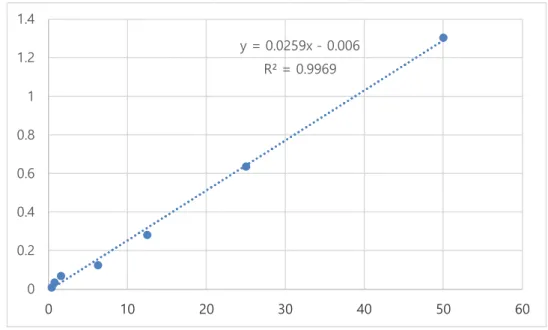
To quantify the total concentration of polyphenol in antler water extract, fermented bacterial broth and in fermented bacterial broth after protease enzyme reaction, gallic acid in different concentrations and 50% Folin and ciocaltue’s phenol reagent were added into each solutions. After colouring, the absorbance was measured at 750 nm using microplate reader. As shown in figure 1, standard calibration curve was made to determine the concentration of polyphenol
Table 2. Measurement of the number of lactic acid bacteria after fermentation of antler extract.
Culture strain name Culture substrate Number of viable cells
Bifidobacterium(B.) longum* Distilled water Lactobacillus was not detected
Lactobacillus(LB.) plantatarum* Distilled water Lactobacillus was not detected
Lactobacillus acidophilus* Distilled water 2.52 x 10⁴(cfu/ml)
Mixture of 8 types of lactic bacteria* Distilled water Lactic bacteria was not detected
Bifidobacterium longum* Antler water extract (AWE) 2.04 x 10⁷cfu/ml
Lactobacillus acidophilus* Antler water extract (AWE) 2.56 x 10⁷cfu/ml
Mixture of 8 types of lactic bacteria* Antler water extract (AWE) 5.0 x 10⁷cfu/ml
Protease and B. longum** AWE after protease reaction*** 9.54 x 10⁷cfu/ml
Protease and Lb. plantatarum** AWE after protease reaction 2.84 x 10⁷ cfu/ml
Protease and Lb. acidophilus** AWE after protease reaction 3.00 x 10⁷ cfu/ml
Protease and 8 types of lactic bacteria** AWE after protease reaction 1.97 x 10⁸cfu/ml
* Fermentation of lactic acid bacteria for 2 days at 37℃.
** Fermentation of lactic acid bacteria for 2 days at 37℃ after protease reaction with Maxazyme NNPs DS for 1 days at 50℃.
Figure 1. Standard calibration curve of gallic acid for determining total polyphenols.
3.3.2 Determination of Polyphenol Concentration
The total concentration of polyphenol in the antler extract control group was 8.47 mg/mL. But, when each of the four bacterial types were fermented in the antler extract, total polyphenol concentration was 4.82 ~ 6.26 mg/mL, which was lower than the control. The total concentration of polyphenol can be considered to have decreased during the fermentation process of this experiment. The increasing rate of the total polyphenol concentration in the fermented bacterial broth was 4.82~6.26 mg/mL, while it was 14.27 ~ 20.58 mg/mL in the fermented bacterial broth after the protease reaction. Therefore, the process of protease enzyme reaction during bacterial fermentation was considered to be essential in increasing the total polyphenol concentration (Table 3).
Table 3. Total polyphenol Content of lactic acid fermentation of deer antler water extract.
Samples Amounts
(mg/ml) Remarks
Antler water extract(AWE) 8.47 ± 0.32 Water extract of Korea deer antler
AWE with B. longum 5.40 ± 0.19 lactic fermentation*
y = 0.0259x - 0.006 R² = 0.9969 0 0.2 0.4 0.6 0.8 1 1.2 1.4 0 10 20 30 40 50 60
Amount of gallic acid standard (ug/1ml)
A b so rb an ce a t 75 0 n m
AWE with Lb. Plantarum 5.79 ± 0.11 lactic fermentation*
AWE with Lb. acidophius 6.26 ± 0.11 lactic fermentation*
AWE with 8 types of lactobacillus 4.82 ± 0.12 lactic fermentation*
AWE with Maxazyme NNP DS (M**) 20.51 ± 0.68 Protease reaction of Maxazyme NNP DS(M**)
AWE with M** and B. longum* 15.13 ± 0.43 M** and lactic fermentation*
AWE with M** and Lb. Plantarum* 14.27 ± 0.52 M** and lactic fermentation*
AWE with M** and Lb. acidophius* 20.58 ± 0.62 M** and lactic fermentation*
AWE with M** and 8 types of lactic bacteria* 16.86 ± 0.64 M** and lactic fermentation*
* Fermentation of lactic acid bacteria for 2 days at 37℃. ** Protease reaction with Maxazyme NNP DS for 1 day at 50℃.
3.4 Determination of Total Flavonoid Concentration
3.4.1 Quercetin Standard Calibration Curve Determination
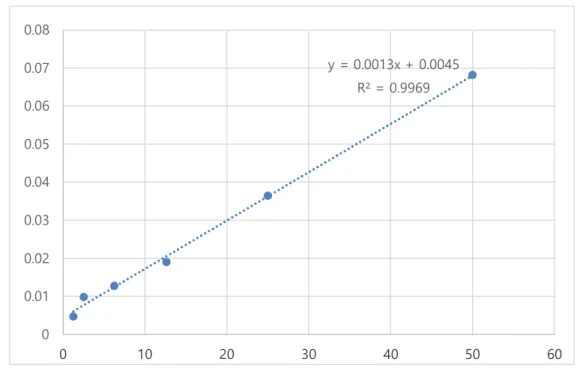
To quantify the total concentration of flavonoid in the antler water extract, fermented bacterial broth, and in fermented bacterial broth after the protease enzyme reaction, quercetin solution at different concentrations and aluminum cloride reagents were added into each solutions. After colouring, absorbance was measured at 430 nm using microplate reader. As shown in Figure 2, standard calibration curve was determined to measure the total concentration of flavonoid.
3.4.2 Determination of Total Flavonoid Concentration
The total concentration of Flavonoid in the antler water extract control group was 2.51 mg/mL. In the broth containing each of four bacterial types after the fermentation, it was 1.76~ 2.42 mg/mL, which was considered as either a little or no change. Therefore, the total concentration of flavonoid was not shown to be affected by the fermentation process in antler water extract, but rather can be decreased. Meanwhile, the total flavonoid concentration in fermented bacterial broth after protease enzyme reaction was 5.72 mg/mL, which was double the value of the control group. In addition, the total flavonoid concentration increased to 5.82~ 8.33 mg/mL after the protease enzyme reaction. Therefore, total flavonoid concentration can either show a slight decrease or no change in fermented bacterial broth, but show an increase with protease enzyme reaction during fermentation. This suggests that bacterial growth was accelerated by hydrolysis reaction of complicated proteins into more water-soluble products. In conclusion, the flavonoid could not be increased by solely fermenting the bacteria in the antler water extract. Rather, there was a clear tendency for increased level of flavonoid after the protease enzyme reaction in the fermented bacterial broth. Therefore, it was confirmed that culturing bacteria in the antler water extract via fermentation method and after protease enzyme reaction was more effective in increasing the total concentration of flavonoid.
Figure 2. Standard calibration curve of quercetin for determining total flavonoids.
3.5 Determination of DPPH Radical Scavenging Activity
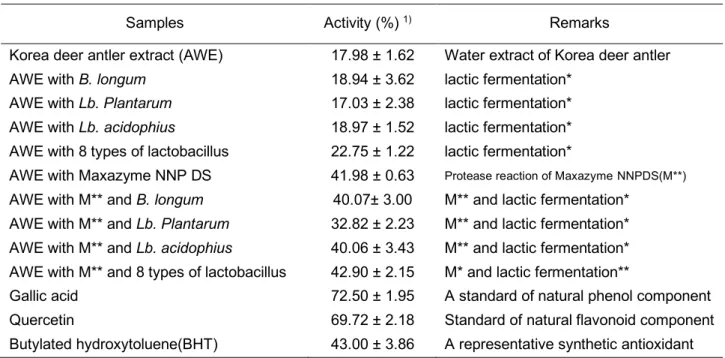
DPPH radical scavenging activity in the control group was 17.98%. Of the treatment groups, B. longum, Lb.
Plantarum and Lb. acidophius, DPPH radical scavenging activity was 18.94%, 17.03% and 18.97%,
respectively. It was increased to 22.75% when 8 different types of Lactobacilus were mixed and cultured together. In the broth containing Maxazyme NNP DS protease enzyme, the activity remarkably increased to 41.98%. Of the treatment groups, B. longum, Lb. acidophius and Lb. acidophius showed similar activity of 40.06 ~ 42.90%, but Lb. Plantarum showed decreased activity of 32.82%. Overall, compared to 17.98% of DPPH radical scavenging activity in the antler water extract control group, treatment groups with protease enzyme reaction showed a significant increase in the activity of 41.98%. Therefore, it was confirmed that undertaking protease enzyme reaction during the bacterial fermentation is essential in order to increase the DPPH radical scavenging ability. In this experiment, DPPH radical scavenging activity was lower than the control groups containing gallic acid and quercetin, but it was generally similar to that of BHT, a synthetic antioxidant permitted for use in proceed meat products.
Table 4. Total flavonoids Content of lactic acid fermentation of deer antler water extract.
Samples Amounts
(mg/ml) Remarks
Korea deer antler extract (AWE) 2.31 ± 0.22 Water extract of Korea deer antler
AWE with B. longum 2.05 ± 0.18 lactobacillus fermentation*
AWE with Lb. Plantarum 2.21 ± 0.23 lactobacillus fermentation*
AWE with Lb. acidophius 1.52 ± 0.23 lactobacillus fermentation*
AWE with 8 types of lactobacillus 1.68 ± 0.06 lactobacillus fermentation*
AWE with Maxazyme NNP DS(M 5.61 ± 0.31 Protease reaction of Maxazyme NNPDS(M**)
AWE with M** and B. longum* 5.71 ± 0.05 M** and lactic fermentation*
y = 0.0013x + 0.0045 R² = 0.9969 0 0.01 0.02 0.03 0.04 0.05 0.06 0.07 0.08 0 10 20 30 40 50 60
Amount of quercetin standard (ug/1ml)
A
b
so
rb
a
n
ce
a
t
4
3
0n
m
AWE with M** and Lb. Plantarum* 7.22 ± 0.09 M** and lactic fermentation*
AWE with M** and Lb. acidophius* 8.31 ± 0.14 M** and lactic fermentation*
AWE with M** and 8 types of lactic bacteria* 7.12 ± 0.05 M** and lactic fermentation*
* Fermentation of lactic acid bacteria for 2 days at 37℃.
** Fermentation of lactic acid bacteria for 2 days at 37℃ after protease reaction with Maxazyme NNP DA for 1day at 50℃.
Table 5. DPPH radical sacavenging activity of lactobacillus fermentation of deer antler water extract.
Samples Activity (%) 1) Remarks
Korea deer antler extract (AWE) 17.98 ± 1.62 Water extract of Korea deer antler
AWE with B. longum 18.94 ± 3.62 lactic fermentation*
AWE with Lb. Plantarum 17.03 ± 2.38 lactic fermentation*
AWE with Lb. acidophius 18.97 ± 1.52 lactic fermentation*
AWE with 8 types of lactobacillus 22.75 ± 1.22 lactic fermentation*
AWE with Maxazyme NNP DS 41.98 ± 0.63 Protease reaction of Maxazyme NNPDS(M**)
AWE with M** and B. longum 40.07± 3.00 M** and lactic fermentation*
AWE with M** and Lb. Plantarum 32.82 ± 2.23 M** and lactic fermentation*
AWE with M** and Lb. acidophius 40.06 ± 3.43 M** and lactic fermentation*
AWE with M** and 8 types of lactobacillus 42.90 ± 2.15 M* and lactic fermentation**
Gallic acid 72.50 ± 1.95 A standard of natural phenol component
Quercetin 69.72 ± 2.18 Standard of natural flavonoid component
Butylated hydroxytoluene(BHT) 43.00 ± 3.86 A representative synthetic antioxidant
* Fermentation of lactic acid bacteria for 2 days at 37℃.
** Fermentation of lactic acid bacteria for 2 days at 37℃ after protease reaction with Maxazyme NNP DS for 1 day at 50℃.
3.6 Determination
3.6.1 Evaluation of Antioxidant Activity via Determination of TBA Values
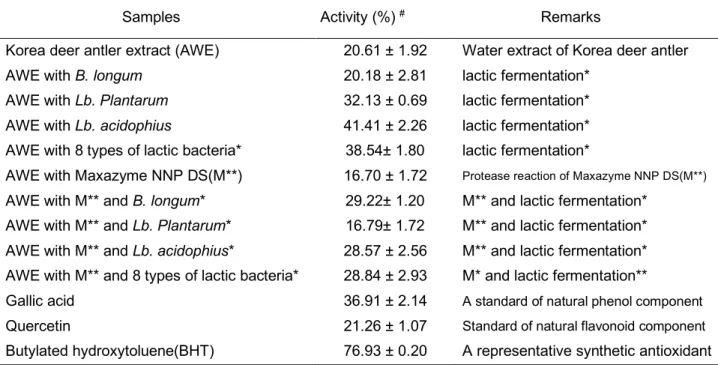
The antioxidant activity of the control group against linoleic acid/phosphate buffer in TBA value was 20.61%. Of the treatment groups, Lb. acidophius 41.41% > 8 different types of lactobacillus 38.54% > Lb.
Plantarum 32.13% > B. Longum 20.18% showed increasing antioxidant activity in the respective order. There
was a difference in the activity based on the type of bacteria, but the effect of enhancing antioxidant activity was remarkable. On the other hand, the antioxidant activity of maxazyme NNP DS protease enzyme reaction group was 16.70%, which was slightly lower than that of 20.61% of the control group. However, of the treatment groups, B. longum 29.22%, 8 types of lactobacillus 28.84% and Lb. acidophius 28.57% showed increase in the activity after protease enzyme reaction. Overall, compared to the antioxidant activity of 20.61% in the antler water extract, antioxidant activity of 20.18~ 41.41% existed in each of the four types of bacteria fermented in antler water extract. However, after the protease enzyme reaction, antioxidant activity was 16.79~29.22%, which was shown to have decreased compared to fermented bacterial broth without protease enzyme reaction. The antioxidant activity of antler extract in comparison to the activity of standard ingredients, BHT 76.93%>gallic acid 36.91%>quercetin 21.26%, was shown to be high. In the case of BHT, a synthetic antioxidant, DPPPH radical scavenging activity was lower than that of gallic acid and quercetin, but TBA value was remarkably high (Table 6).
Table 6. Antioxidant activity of lactic acid fermentation products using water extract of antler as a substrate.
Samples Activity (%) # Remarks
Korea deer antler extract (AWE) 20.61 ± 1.92 Water extract of Korea deer antler
AWE with B. longum 20.18 ± 2.81 lactic fermentation*
AWE with Lb. Plantarum 32.13 ± 0.69 lactic fermentation*
AWE with Lb. acidophius 41.41 ± 2.26 lactic fermentation*
AWE with 8 types of lactic bacteria* 38.54± 1.80 lactic fermentation*
AWE with Maxazyme NNP DS(M**) 16.70 ± 1.72 Protease reaction of Maxazyme NNP DS(M**)
AWE with M** and B. longum* 29.22± 1.20 M** and lactic fermentation*
AWE with M** and Lb. Plantarum* 16.79± 1.72 M** and lactic fermentation*
AWE with M** and Lb. acidophius* 28.57 ± 2.56 M** and lactic fermentation*
AWE with M** and 8 types of lactic bacteria* 28.84 ± 2.93 M* and lactic fermentation**
Gallic acid 36.91 ± 2.14 A standard of natural phenol component
Quercetin 21.26 ± 1.07 Standard of natural flavonoid component
Butylated hydroxytoluene(BHT) 76.93 ± 0.20 A representative synthetic antioxidant
# Antioxidant activity of lactobacillus fermentation products determined by TBA value on the linoleic acid/phosphate buffer substrate.
* Lactic fermentation** : culture for 2 days at 37℃.
** M: Protease reaction of Maxazyme NNP DS for 1 day at 50℃.
5. Conclusion
The four bacterial types approved by were grown in antler water extract. The estimated number of bacteria was 2.04 x 10⁷ ~ 5.0 x 10⁷, which was considered as generally good. Therefore, the process of protein hydrolysation into water-soluble substances or amino acids in the antler water extract during the process of bacterial cultivation may be helpful in digestion of food when consumed by humans. The total concentration of polyphenol in the four bacterial types fermented in the antler extract was 4.58~ 6.02 mg/mL, which was lower than 8.24 mg/mL of the control groups. The increasing rate of the total polyphenol concentration in the fermented bacterial broth was 4.58~ 6.02 mg/mL, while it was 14.03 ~ 20.34 mg/mL in the fermented bacterial broth after the protease reaction. Therefore, the process of protease enzyme reaction during bacterial fermentation was considered to be essential in increasing the total polyphenol concentration. The total concentration of Flavonoid in the antler water extract control group was 2.51 mg/mL. In the broth containing each of four bacterial types after the fermentation, it was 1.76~ 2.42 mg/mL, which was considered as either a little or no change. The total flavonoid concentration increased to 5.82~ 8.33 mg/mL after the protease enzyme reaction. Therefore, total flavonoid concentration can show either a slight decrease or no change in fermented bacterial broth, but an increase with protease enzyme reaction during fermentation. DPPH radical scavenging activity of the control group was 17.98% and the four treatment groups was 17.03~ 22.75%. In a sample containing Maxazyme NNP DS protease enzyme, the activity was 41.98%, while the three treatment groups (B. longum, Lb. acidophius and Lb. acidophius) showed similar activity of 40.06 ~ 42.90% with Lb. Plantarum showing decreased activity of 32.82%. Therefore, to increase DPPH radical scavenging activity, protease enzyme reaction was considered as necessary during fermentation process. The antioxidant activity of the control group in TBA value was 20.61%. Of the treatment groups, Lb. acidophius 41.41% > 8 different types of lactobacillus 38.54% > Lb. Plantarum 32.13% > B. Longum 20.18% showed increasing antioxidant activity in the respective order. There was a difference in the activity based on the type of bacteria, but the effect of
enhancing antioxidant activity was remarkable. Sample containing protease enzyme was 16.70% and activity in fermented bacterial broth after protease enzyme reaction was 16.79~ 29.22%, which was an increase in comparison to the control group but a decrease in comparison to the bacterial medium. Deer antler extract can facilitate bacterial growth during the fermentation process and carries an antioxidant activity. However, to accelerate bacterial growth and to increase and strengthen the efficacy of total polyphenols, total flavonoids and DPPH radical scavenging ability, it is necessary that the extract undergoes protease enzyme reaction.
Acknowledgments
This study was supported by the Ministry of SMEs and Startups(MSS) under the support of the Regional Main Business Project of assignment number S2911947.
References
[1] H. K. Kim, “Physiological functionalities and anti-oxidant activity of heated radish extract,” International Journal of advanced smart convergence(IJASC), Vol. 7, No. 2, pp. 38-46, June 2018.
DOI: https://dx.doi.org/10.7236/IJASC.2018.7.2.38.
[2] H. K. Kim, “The Effects of Reducing Skin Wrinkles and Improving Skin Elasticity from Korean Radish Extract,” International Journal of advanced smart convergence(IJASC), Vol. 8, No. 1, pp. 113-125, June 2019.
DOI: https://dx.doi.org/10.7236/IJASC.2019.8.1.113.
[3] H. K. Kim, “Hair Growth Promoting Effect of Radish Crude Saponin Extract on Athymic Nude Mice,” International Journal of advanced smart convergence(IJASC), Vol. 8, No. 1, pp. 184-195, June 2019. DOI: https://dx.doi.org/10.7236/IJASC.2019.8.1.184.
[4] Y. N. Han, K. O. Kim and K. H. Hwang, “Effect of the water extract of pilose antler of Cervus nippon var. mantchuricus on acute-phase proteins in rat blood,” Journal. Appl. Phamacol, Vol. 2, pp. 59-64, 1994.
[5] L. W. Son, M. G. Shin and H. I. Lee, “Effect of deer antler on the phagocytic activity of reticuloendothelial system in starved mice,” The Journal of K.O.M.S. Vol. 7, pp.174-183, 1986.
[6] D. H. Kang and K. H. Row, “Fractionation of soybean phospholipids by preparative high-performance liquid chromatography with sorbents of various particle size,” J. Chromatog. A. Vol. 949, pp.217-223, March 2002. DOI:https://doi.org/10.1016/S0021-9673(01)01477-7.
[7] P. J. Park, Y. J. Jeon, S. H. Moon, S. M. Lee, C. H. Lee, B. T. Jeon and D. K. Ahn, “Free radical scavenging activity of nokjoongtang prepared from antler and various oriental medicinal materials,” Kor. J. Food Sci. Ani. Resour. Vol. 25, pp. 344-349, 2005.
[8] H. Y. Chung, B. Sung, K. J. Jung, Y. Zou and B. P. Yu, “The molecular inflammatory process in aging,”
Antioxid. Redox Sign. Vol. 8, pp. 572-581, March 2006. DOI : http://dx.doi.org/10.5851/kosfa.2010.30.6.989
[9] S. H. Lee, L. J. Hong, H. G. Park, S. S. Ju and G. T. Kim, “Functional characteristics from the barley leaves and its antioxidant mixture,” J. Korean Soc. Agric. Chem. Biotechnol. Vol. 46, pp. 333-337, March 2003.
DOI : http://dx.doi.org/10.9721/KJFST.20003.46.3.337
[10] Y. Christen, “Oxidative stress and Alzheimer disease,” Am. J. Clin. Nutr. Vol. 71, pp. 621-629, 2000. DOI : http://dx.doi.org/10.14478/ace.2016.1027.
[11] E. K. Han, E. J. Jung, J. Y. Lee, Y. X. Jin and C. K. Chung, “Antioxidative activity of ethanol extracts from
different parts of Taraxacum officinale,” J. Korean. Soc. Food. Sci. Nutr. Vol. 40, pp.56-62, January 2011. DOI: http://dx.doi.org/10.14478/ace.2016.1027.
[12] J. H. Lee and J. W. Jhoo, “Antioxidant activity of different parts of Lespedeza bicolor and isolation of antioxidant compound,” Korean. J. Food. Sci. Technol. Vol.44, pp. 763-771, September 2012.
DOI: https://doi.org/10.9721/KJFST.2012.44.6.763.
[13] H. I. Kang, J. Y. Kim, S. J. Kwon, K. W. Park, J. S. Kang and K. I. Seo, “Antioxidative effects of peanut sprout extracts,” J. Korean. Soc. Food. Sci. Nutr. Vol. 39, pp. 941-946, March 2010.
[14] Y. Lu and L. Y. Foo, “Antioxidant and radical scavenging activities of polyphenols from apple pomace,” Food Chem. Vol. 68, pp. 81-85, January, 2000.
DOI: https://doi.org.10.1016/S0308-8146(99)00167-3.
[15] J. Y. Cha, H. J. Kim, C. H. Chung and Y. S. Cho, “Antioxidative activities and contents of polyphenolic compound of Cudrania tricuspidata,” J. Korean Soc. Food Sci. Nutr. Vol. 28, pp.1310-1315, November 1999.
[16] R. Tsao, “Chemistry and biochemistry of dietary polyphenols,” Nutrients. Vol. 2, No. 12. pp. 1231-1246, December, 2010.
DOI: https://doi.org.10.3390/nu2121231.
[17] K. E. Heim, A. R. Tagliaferro and D. J. Bobilya, “Flavonoid antioxidants: Chemistry, metabolism, and structure-activity relationships,” J. Nutr. Biochem. Vol. 13, pp. 572-584, October 2002.