© Korean Powder Metallurgy Institute 1259
-1. Introduction
CIP process can be classified into the Wet-bag process and the Dry-bag process. The Wet-bag process, has been used for the manufacture of very large products like carbon blocks or for an experimental technique to prepare samples with uniform density1). Dry-bag process, on the contrary, has been used for the large volume production of small or medium size products, like spark plugs.
In recent years, the demand for the application of the Dry-bag process for the production of ball-shaped products or for the process using non-granulated powder with poor flowability has been growing in ceramics industries. To meet the requirements from these industries, the Off-line type Dry-bag CIP process and equipment have been developed. Here, powder material is charged into the rubber mold outside of the pressure vessel and the rubber mold is transferred into the pressure vessel with a specially designed manipulator or robot.
The achieved dimensional accuracy of the green comp acts, the developed criteria for the selection of the proc ess type and the latest concept of Off-line Dry-bag CIP equipment are described.
2. Mold Design Technology to Achieve Higher Dimensional Accuracy
The most important technological issue is the dimen-sional accuracy. The dimensions after pressing mainly depend on the powder properties and the elastic properties of rubber mold materials. By combining theFEM simulations during pressing with several trial tests,the variation in dimensions has become +/- 1.5 to 2% per a
typical dimension of green compacts.
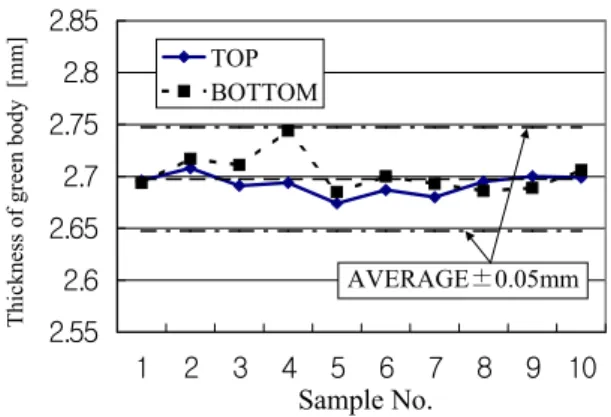
In the case of tube shaped products, the variation in thickness of the green compacts is often a critical concern. One of such examples is the β-alumina tubes for NaS solid electrolyte secondary battery. One end of this tube is closed and the dimensions of this tube are about 60 mm in outer diameter, 600 mm long and 2.7 mm thick. The variations in thickness obtained for ten samples prepared by In-line Dry-bag CIP equipment are shown in Fig. 1.
Fig. 1. Variation in thickness of β-alumina tubes processed by In-line Dry-bag CIP.
The data scatter is within +/-0.05mm, which corre- sponds to +/-1.85% of the thickness, or +/-0.08% of the tube diameter. This result seems excellent, taking into consideration that the large variations only appeared along the end portion of the tube, which is a peculiar portion of this tube2). 2006 POWDER METALLURGY World Congress PD02-W-01 2.55 2.6 2.65 2.7 2.75 2.8 2.85 1 2 3 4 5 6 7 8 9 10 Sample No.
Thickness of green body [mm]
TOP BOTTOM
AVERAGE±0.05mm
Recent Advances in Dry-bag CIP Equipment
Yoshikazu Kishia, Yasuhide Miyashitab , Yasuo Manabec and Takao Fujikawa d Engineering Section, Heavy Machinery Department
Machinery & Engineering Company, Kobe Steel, Ltd. Takasago City, Hyogo Prefecture, Japan a
[email protected], [email protected], c
[email protected], [email protected] Abstract
Intensive technological research on the Dry-bag CIP equipment was carried out to improve the dimensional accur acy and the productivity. The rubber mold design technology using FEM simulation during pressing was introduce d, in order to achieve higher dimensional preciseness, and criteria for the selection of the In-line type or Off-line type, were established based on the powder flowability index proposed by Carr. Based on these research results, high productivity Off-line Dry-bag CIP equipment, which can realize good dimensional accuracy with high product ivity, was developed even for non-granulated powders with poor packing density.
© Korean Powder Metallurgy Institute 1260 -3. Criteria for the Selection of Process
The factors which affect the selection of an appropriate process for a given powder material and resulting products are powder material properties such as powder's bulk density, flowability, the desired product density, the size and shape of the product and the desired tact time. Among them, the powder flowability is technologically very important as well as the bulk density of the powder, because it directly affects the uniformity of the bulk density when the powder is charged into the rubber mold. In Table 1, criteria for the selection of In-line or Off-line process by the authors are summarized.
As for the evaluation of the flowability of powders, methods using the angle of repose, spatular angle, compressibility, etc. have been proposed. To find the critical point in powder flowability, namely, the border between good and bad in Table 1, several experiments have been carried out and using the Carr's compressibility index was found to be the most practical method. The critical value was about 80 of Carr's flowability index, that is, larger than 80 in the flowability index means the powder has very good flowability which requires no special counter measures to avoid the bridging phenomenon3). Also, this Carr's flowability index was found very useful for deciding if vibrational tapping of rubber mold is necessary, when powder is charged into the rubber mold.
In the case that the flowability index is smaller than 80, the vibrational tapping should be adopted to realize a uniform powder packing density in the rubber mold. This means that for powders which have Carr's flowability index smaller than 80, In-line type process can not be adopted and Off-line type process should be selected. In the case of the Off-line process, the authors have found that non-granulated powders like carbon or molybdenum powders can be charged automatically into rubber molds with a special vibrator unit. The Carr's flowability indices are 50 and 35 for these carbon and molybdenum powders respectively.
4. Development of Off-line Dry-bag CIP System Another important factor is the productivity. In the case of poor flowability powders, Wet-bag process has been used
because of the powder-handling problems. There, manual powder-filling into rubber molds has been common. In order to enhance the productivity, fully automated operation technology of filling powder into rubber mol d
has been developed based on the above research result s.
In Fig.2, the appearance of such Off-line Dry-bag CIP equipment developed for molybdenum powder is shown. The green compact size is about 25 mm in diameter and 600 mm in length and the powder material to be pressed is molybdenum, which is usually not granulated before CIPing.
Fig. 2. Fully automated Off-line Dry-bag CIP system for non-granulated metal.
5. Summary
Fully automated Off-line Dry-bag CIP equipment for large volume production using non-granulated metal or fine carbon powders has been developed based on the newly developed powder evaluation criteria.
References
1. Y.Manabe and Y.Kishi, "Isostatic Pressing Technologies for Powder Compaction", Proc. 2000 Powder Metallurgy World Congress - PM2000, Kyoto, Japan(2000).
2. Y, Kishi, Y. Manabe and Y. Miyashita, "CIP Technologies for Powder Compaction", Proc. PM2TECH 2003, held in Las Vegas, Nevada, (2003).
3. Y Manabe, Y. Kishi and Y. Miyashita, "Development of High-productivity Off-line Dry-bag CIP Equipment", Proc. JSPM Fall Meeting 2003, Kyoto (In Japanese), p153(2003).
Table 1. Criteria for Selection of In-line or Off-line Shape Flowability Powder Size (Diameter) Type rod, tube good <=100mm In-line
good >=100mm Off-line
bad <=101mm Off-line
ball good/bad Off-line
cup good/bad Off-line
dome good/bad Off-line
Conveyer CIP unit Rubber mold Handling unit Powder filling unit Handling robot