Vol. 13, No. 3, 2010, 157-162 DOI:10.5229/JKES.2010.13.3.157
− 157 −
High Performance of Nano-sized LiFePO
4Positive Electrode Using Etched Al Current Collector
Gil-Won Lee, Ji Heon Ryu†, and Seung M. Oh*
Department of Chemical and Biological Engineering and Research Center for Energy Conversion & Storage, Seoul National University, Seoul, 151-744 ,Korea
†Graduate School of Knowledge-Based Technology and Energy, Korea Polytechnic University, Siheung, Gyeonggi, 429-793, Korea
(Received March 22, 2010 : Accepted April 5, 2010)
Abstract : The electrodes comprising nano-sized LiFePO4, carbon black and binder are prepared with two different Al current collectors. One is the generally used normal Al foil and the other is the chemically etched Al foil. Surface characteristics of each Al foil and electrochemical per- formance of the cathodes using each foil are investigated. The electrode from the etched Al foil exhibits better physical and electrochemical properties as compared to those of the normal Al foil because the etched Al foil has rough surface with sub-micron pores which improve the adhesion between the electrode materials and the substrate. The electrode on the etched Al foil has such a strong peel strength that the impedance is smaller than that of normal one. Indeed the LiFePO4 electrode from the etched Al foil exhibits a better rate capability and remains intact even after storage for 1 week at the charged state at the elevated temperature 60oC.
Keywords : Lithium ion batteries, LiFePO4, Etched aluminum current collector, Peel strength, Area- specific impedance
1. Introduction
Olivine structured LiFePO4 has been extensively studied due to its advantages of high thermal stability, low cost and low toxicity.1-2) However, LiFePO4-based electrodes show the poor high rate performances because of the low electronic conductivity (~10−8S cm−1) and low ionic diffusivity (~10−16cm2 s−1).3-4) In order to overcome these disadvantages, many researchers have successfully performed the reduction of particle size to shorten transport path, the coating of the particles with carbon to improve the conductivity and the doping with other elements to enhance the electrical conductivity.5-10) As the primary particle size of LiFePO4 has been reduced to nano-scale, it has caused the difficulties of electrode fabrication process, which are inhomogeneous mixing of the electrode slurry and peeling off the electrode materials from the current collector. To increase the peel strength between the electrode materials and current
collector, K. Striebel and her coworkers11) reported that the electrodes made by casting the electrode slurry onto a carbon-coated Al current collector, which is prepared with very thin coatings of carbon black and polymer binder from the same type of slurry, exhibit good electrochemical performance. According to their report, the very thin carbon layer on the current collector appears to greatly reduce the contact resistance between the elec- trode layer and current collector. But this method must be added one step, coating carbon on the Al current col- lector, in the electrode fabrication process. M. Yao et al.12) proposed a new methodology using a three-dimensional porous current collector made from nickel-chromium alloy. The cell using the three-dimensional current col- lector exhibited a superior rate capability and the size reduction of a semicircle for the charge-transfer resis- tance as compared to the conventional-type cell fabricated with a normal Al current collector.
In this work, we propose the etched Al foil as a new current collector to improve the electrochemical perfor- mances of the nano-sized LiFePO4 electrode. The use of
*E-mail: [email protected]
etched Al current collector is a simple and convenient method compared to the carbon-coated Al current col- lector or three-dimensional porous current collector. To investigate the properties of the two current collectors, the images of surface and the cross section were obtained to compare the two current collectors and the surface was analyzed using X-ray photoelectron spectroscopy (XPS). After the electrode fabrication with the two cur- rent collectors, we measured the peel strength between the electrode material and the current collector. Electro- chemical performances of the resulting LiFePO4 elec- trodes were compared in terms of cell resistances and rate capability.
2. Experimental
The two current collectors, the normal Al current collector (Sam-A Aluminum Co., Korea, 20µm, more than 99.4 % purity) and the etched Al current collector (JCC Co., Korea, 20µm, more than 99.7% purity, made by chemical etching), were crosscut using an argon ion beam (Cross Section Polisher (CP) SM-09010, JEOL) and their field-emission scanning electron microscope (FE-SEM) images were obtained by using a JEOL JSM-7000F.
To investigate the chemical compositions of the two current collectors, the XPS data were collected in an ultra- high vacuum multipurpose surface analysis system (Sigma probe, Thermo, U.K.) operating at a base pressure of < 10−10 mbar. The photoelectrons were excited by an Al Kα (1486.6 eV) anode operating at a 100 W con- stant power (15 kV and 10 mA), and the spot size of X-ray was 400µm. During data acquisition, the con- stant-analyzer-energy mode was used at a pass energy of 30 eV and a step of 0.1 eV. The binding energy was calibrated by the C 1 s peak at 285 eV obtained from hydrocarbon contamination.
The slurries were prepared with a carbon-coated nano- sized LiFePO4 power (EIG2, Korea, primary particle size = 100~200 nm), Denka Black (Denka, average particle size = 35 nm) as the conductive additive, and polyvinylidenefluoride (PVdF, Kureha KF-1100) as the binder (90 : 3 : 7 wt. ratio). The PVdF and N-methylpyr- rolidinone (NMP, Aldrich) as the solvent were mixed for 30 min by homogenizer (2000 rpm), into which the LiFePO4 and Denka Black powders pre-mixed in an agitated mortar were added, and mixed for additional 2 h at the same condition. The prepared slurries were coated onto the two current collectors by using an auto-
matic doctor blade. The electrodes were dried at 120oC in convection oven for 1 h to evaporate the solvent and pressed through a roll press. Before cell assembly, the electrodes were further dried in a vacuum oven at 120oC for 12 h.
To investigate of the interface between the electrode materials and the current collector, the cross sectional images of the composite electrodes were obtained by the same method above.
For the purpose of measuring the peel strength between the electrode materials and the current collector, the 180o peel test (MultiTest-i, Mecmesin Co., E.U.) was used. The peel strength was tested with a peel test using an ISO 8510 1 standard. The electrodes uniformly attached to a slice glass plate with a width of 25 mm and a length of 50 mm. It was measured the requiring force to peel off the electrode material from the current collector.
Coin-type cells were assembled with the composite electrode, Li foil as a counter electrode, and polypropy- lene film as a separator. The used electrolyte was 1.0 M LiPF6 dissolved in a mixture of ethylene carbonate (EC) and ethylmethyl carbonate (EMC) (1 : 1 vol. ratio), where 1.0 wt.% of vinylene carbonate (VC) was added.
The cells were fabricated in a dry room (dew point =
−50oC). The cells were charged at a constant current at 0.2 C to 4.0 V (vs. Li/Li+) and discharged at 0.2, 1, 2, 3, 5 and 10 C to 2.4 V (vs. Li/Li+), respectively.
Electrochemical measurements were made at room temperature using a Wonatech (Model WBC-3000).
In order to measure the area-specific impedance (ASI) as a function of depth of discharge, the hybrid pulse power characterization (HPPC) test was performed, in which the 10-second discharge-pulse and the 10-second charge-pulse resistance at each 10% depth-of-discharge (DOD) increment were obtained.13) The test was made up of single repetitions, separated by 10% DOD con- stant current discharge segments, each followed by 1 h rest period to allow the cell to return to an electrochemi- cal and thermal equilibrium condition before applying the test profile. The test began with a fully charged state after 1 h rest and terminated after completing the final profile at 90% DOD.
To compare the degradation of the electrodes at the severe state, the storage test was accomplished. The cells charged to 4.0 V (vs. Li/Li+) were stored for a week at 60oC oven. Before and after the storage, AC imped- ance of the cells was measured. AC impedance measure- ment was made at the fully charged state in the frequency range of 0.005 Hz-100 kHz with an AC amplitude of
10 mV. And then, the composite electrodes from dis- mantled the cells were compared to the state of the electrode degradation.
3. Results and Discussion
Fig. 1 shows the surface and cross sectional images of the normal Al current collector and the etched Al current collector. The thickness of the two current col- lectors is about 20µm. The comparison for Fig. 1(a) and Fig. 1(b) reveals that the normal Al current collector has a clean and smooth surface but the etched Al cur- rent collector has the pores evenly throughout the surface.
As seen from the cross sectional images, the normal Al current collector is densely packed without empty space (Fig. 1(c)). However, the etched Al current collector is etched to a thickness of about 4~5µm up and down (Fig. 1(d)). It is likely that the large surface area due to the pore structures can improve the current collecting ability of the substrate.
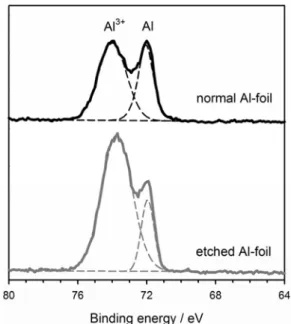
Fig. 2 shows the XPS spectra for the two current col- lectors. The Al 2p photoelectron spectra show a presence of Al2O3 on the Al current collector surface. From these spectra, it can be seen that the surface of the two current collectors is covered with Al2O3. The Al2O3 layer
on the etched Al current collector surface is thickly distributed compared to the normal Al current collector.
Fig. 1. FE-SEM images of the current collectors: the upper side (a) normal Al-foil, and (b) etched Al-foil; cross section (c) normal Al-foil, and (d) etched Al-foil.
Fig. 2. XPS spectra of Al 2p for the normal Al-foil and the etched Al-foil. The fitted curves, by using the defined model peak shapes (30% Gaussian/Lorentzian algorithm), are indicated by the dotted lines.
As the etched Al current collector has larger surface area, the more Al2O3 exist on the surface. It was also reported that Al2O3 layer works to strengthen the connection of the electrode materials with the substrate surface.14) The passive aluminum oxide layer on the current col- lector surface provides more suitable sites for the depo- sition of the electrode materials.
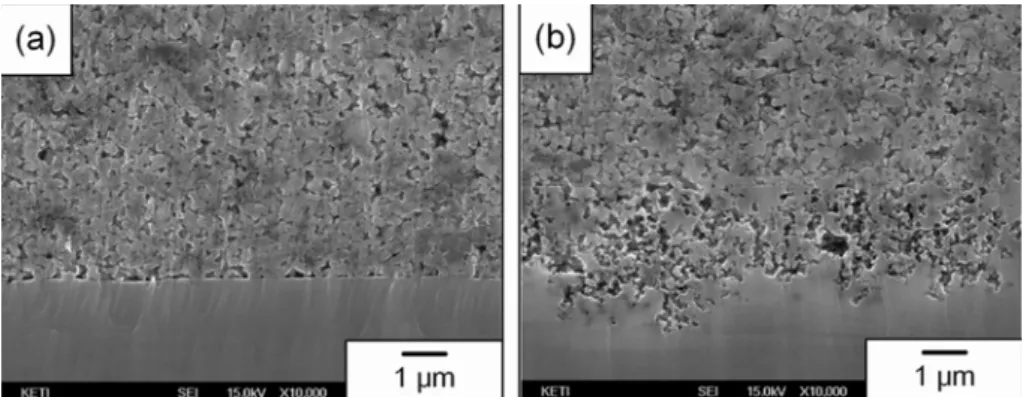
Fig. 3 shows the cross sectional FE-SEM images of the electrode layers after roll-pressing. In the electrode from the normal Al current collector, it is identified the narrow gap between the electrode materials and the cur- rent collector (Fig. 3(a)). On the other hand, the elec- trode from the etched Al current collector is hard to distinguish interface since the electrode materials can be filled uniformly in the inner pores of the etched Al current collector. It is thus very likely that the use of etched Al current collector can improve the adhesion properties of the electrode. To ascertain this, the peel strength between the electrode materials and the cur- rent collector was measured by the 180o peel test. As shown in Fig. 4, the peel strength of the electrode using the etched Al current collector is more than three times greater than using the normal Al current collector. The peel strength is more important than almost any other electrode property, because the electrochemical perfor- mances are not achievable if the peel strength is insuffi- cient to endure repeated charge-discharge cycling.15)
The rate capability of two electrodes is compared in Fig. 5. As the discharge C-rate increases, a larger capacity loss is observed with the electrode prepared on the normal Al current collector. In this electrode, only 30% of the capacity at 0.2 C-rate is retained at 10 C-rate, which is lower than that observed with the electrode prepared by the etched Al current collector (75%).
The reason why the electrode using the etched Al cur-
rent collector shows a better rate capability can be accounted for by comparing the evolution of cell resis- tances. The cell resistances for discharging and charging
Fig. 3. Cross-sectional SEM images of the composite electrodes: (a) normal Al-foil and (b) etched Al-foil.
Fig. 4. Peel strength between the electrode materials and the current collector measured by the 180o peel test.
Fig. 5. Rate capability observed with Li/LiFePO4 cells using the normal Al-foil and the etched Al-foil at 25oC. The C-rate is indicated in the inset.
were monitored as a function of depth of discharge (DOD) (Fig. 6). The area-specific impedances (ASI) were determined using a ∆V/I calculation for each iteration employing the HPPC test protocol. Two features should be noted in Fig. 6. First, the discharge resistance (lithi- ation) becomes larger at the end of discharge due to the lacks of the available Li+ storage sites. The second obser- vation in Fig. 6 is that both the discharge and charge resistance are smaller in the electrode fabricated by using the etched Al current collector. Therefore, since the elec- trode from the etched Al current collector has larger adhe- sion strength between the electrode material and the substrate, the cell impedance is smaller.
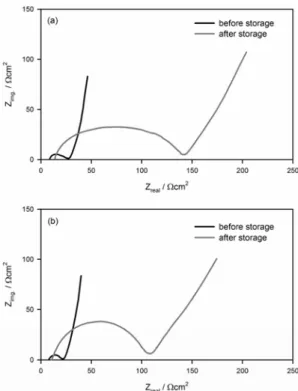
To investigate the electrode degradation that may be caused by a high-temperature exposure, AC impedance spectra were taken before and after the storage at the charged state at 60oC for one week. The evolution of cell resistances is compared for two electrodes in Fig. 7.
The cell resistances before storage are similar, whereas
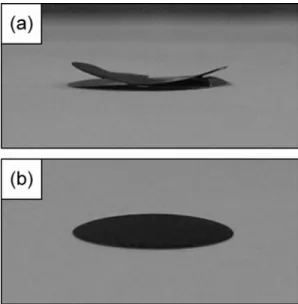
after storage are larger differences. The electrode from the normal Al current collector shows a larger increase in the cell resistances as compared to that from the etched Al current collector. This difference results from the peel strength between the electrode materials and the current collectors. After storage, when the two cells are disman- tled and investigated the states of the electrodes, the electrode from the normal Al current collector is peeled off the electrode material from the substrate (Fig. 8(a)).
However, the electrode from the etched Al current col- lector remains intact (Fig. 8(b)).
Owing to these favorable features such as increasing the peel strength, both the contact resistance between the electrode material and the current collector, and the charge transfer resistance for lithiation/de-lithiation are smaller in the electrode made with the etched Al current collector. The smaller internal resistance leads to a better rate capability (Fig. 5).
4. Conclusions
A comparative study on the electrochemical perfor- mances was made for two LiFePO4 positive electrodes Fig. 6. Area-specific impedances (ASI) for discharging and
charging that were traced as a function of depth of discharge (DOD).
Fig. 7. AC impedances before and after storage for 1 week at 60oC that were obtained at the fully charged state.
using normal and etched Al foils. The electrode perfor- mance was correlated with the contact area and adhesion stability between electrode material and current collec- tor. The following points of value are summarized.
i) While the normal Al foil has a smooth surface, an etched Al foil has a rough surface with sub-micron pores.
As these pores are filled by nano-sized LiFePO4 positive electrode materials during the electrode fabrication pro- cess, the contact area between active materials and current collector increases and the more electronic pathways are provided.
ii) Excellent electrochemical performance is shown in the electrode using the etched Al current collector.
Better rate capability and lower impedance are achieved by increase of electronic pathways. Cell degradation dur- ing the high temperature storage is also restricted by adhesion stability of the etched foil.
iii) The etched Al foil shows better adhesion strength than that of normal one. Moreover, the contact between electrode materials and etched Al foil is maintained after storage during one week at elevated temperature while the electrode is detached from the normal Al foil.
Acknowledgements
This work was supported by the WCU program through the National Research Foundation of Korea funded by the Ministry of Education, Science and
Technology (R31-10013). The authors also wish to acknowledge the Research Center for Energy Con- version and Storage for financial support.
References
1. A. K. Padhi, K. S. Nanjundaswamy, and J. B. Goodenough,
‘Phospho-olivines as positive-electrode materials for rechargeable lithium batteries’ J. Electrochem. Soc., 144, 1188 (1997).
2. A. Yamaha, S. C. Chung, and K. Hinokuma, ‘Optimized LiFePO4 for lithium battery cathodes’ J. Electrochem. Soc., 148, A224, (2001).
3. V. Srinivasan, and J. Newman, ‘Discharge model for the lithium iron-phosphate electrode’ J. Electrochem. Soc., 151, A1517 (2004).
4. S. -Y. Chung, J. T. Bloking, and Y. -M. Chiang, ‘Electr- onically conductive phospho-olivines as lithium storage electrodes’ Nat. Mat., 1, 123 (2002).
5. H. Huang, S. -C. Yin, and L. F. Nazar, ‘Approaching theoretical capacity of LiFePO4 at room temperature at high rates’ Electrochem. Solid-State Lett., 4, A170 (2001).
6. D. Choi, and P. N. Kumta, ‘Surfactant based sol-gel approach to nanostructured LiFePO4 for high rate Li-ion batteries’ J. Power Sources, 163, 1064 (2007).
7. N. Ravet, Y. Chouinard, J. F. Magnan, S. Besner, M.
Gauthier, and M. Armand, ‘Electroactivity of natural and synthetic triphylite’ J. Power Sources, 97-98, 503 (2001).
8. C. R. Sides, F. Croce, V. Y. Young, C. R. Martin, and B.
Scrosati, ‘A high-rate, nanocomposite LifePO4/Carbon cathode’ Electrochem. Solid-State Lett., 8, A484 (2005).
9. Y. Lin, M. X. Gao, D. Zhu, Y. F. Liu, and H. G. Pan,
‘Effects of carbon coating and iron phosphides on the electrochemical properties of LiFePO4/C’ J. Power Sources, 184, 444 (2008).
10. P. S. Herle, B. Ellis, N. Coombs, and L. F. Nazar, ‘Nano- network electronic conduction in iron and nickel olivine phosphates’ Nat. Mat., 3, 147 (2004).
11. K. Striebel, J. Shim, A. Sierra, H. Yang, X. Song, R.
Kostecki, and K. McCarthy, ‘The development of low cost LiFePO4-based high power lithium-ion batteries’ J.
Power Sources, 146, 33 (2005).
12. M. Yao, K. Okuno, T. Iwaki, M. Kato, S. Tanase, K. Emura, and T. Sakai, ‘LiFePO4-based electrode using micro-porous current collector for high power lithium ion battery’ J.
Power Sources, 173, 545 (2007).
13. Idaho National Laboratory, “Battery test manual for plug-in hybrid electric vehicles”, INL/EXT-07-12536, pp. 3-42, (2008).
14. A. Eftekhari, ‘Aluminum oxide as a multi-function agent for improving battery performance of LiMn2O4 cathode’
Solid State Ionics, 167, 237 (2004).
15. J. -H. Lee, U. Paik, V. A. Hackley, and Y. -M. Choi, ‘Effect of poly(acrylic acid) on adhesion strength and electro- chemical performance of natural graphite negative electrode for lithium-ion batteries’ J. Power Sources, 161, 612 (2006).
Fig. 8. The images of electrodes from dismantled cells after storage for 1 week at 60oC.