Article https://doi.org/10.14478/ace.2017.1083
1. 서 론
1)
질소산화물(NOx)은 대기 중에 배출되어 중위도 및 고위도 지역의 오존층을 파괴시키며 산성비의 원인 물질일 뿐만 아니라[1,2] perox- yacetylene nitrates (PAN)을 형성하여 광화학스모그를 일으키는 등 [2-4] 환경에 대한 영향으로 대기오염물질로 지정되어 관리되고 있다.
또한 NOx는 세포 및 폐의 인접한 모세 혈관과 폐포 구조를 손상시키 고 기관지염, 폐렴과 같은 호흡기 알레르기를 일으키는 등 인체에 해
† Corresponding Author: Material Technology Center, Korea Testing Laboratory, 10 Chungui-ro Jinju-si, Gyeongsangnam-do 52852, Korea
Tel: +82-55-791-3535 e-mail: [email protected]
pISSN: 1225-0112 eISSN: 2288-4505 @ 2017 The Korean Society of Industrial and Engineering Chemistry. All rights reserved.
로운 물질이기도 하다[3,5]. 이러한 NOx를 저감하기 위해 여러 가지 공정이 개발된 가운데, 고정상 오염원에서 배출되는 NOx는 효율과 경제성 등을 고려하여 NOx와 환원제를 촉매상에서 반응시켜 제거하 는 선택적 촉매 환원(selective catalytic reduction, SCR) 공정이 가장 널리 적용되고 있다[6-9]. SCR 공정에 사용되는 촉매의 조성은 V2O5-WO3(or MoO3)/TiO2가 일반적이며[10,11] 그 honeycomb 및 plate type 형상의 촉매가 많이 사용되고 있다[12,13]. 특히 honeycomb type의 V2O5-WO3(or MoO3)/TiO2 monolith 촉매는 높은 열/물질 전달 율, 높은 접촉면적 등의 장점을 지니고 있어 꾸준히 사용되어 왔다 [14]. 일본의 촉매사인 HITACHI에서 발간한 ‘Comparison of plate type catalyst with honeycomb and corrugated catalyst for ash pluggage potential’에 따르면 촉매가 큰 수리학적 직경을 가질 경우, 가스 내 ash가 촉매 channel을 보다 쉽게 통과하여 촉매의 막힘(plugging) 현상
Plate-type V
2O
5-WO
3/TiO
2SCR 촉매의 열적 비활성화 특성
차진선⋅박진우*⋅정보라**⋅김홍대**⋅박삼식*⋅신민철†
한국산업기술시험원 재료기술센터, *(주)나노, **한국생산기술연구원 울산지역본부 친환경재료공정그룹 (2017년 8월 19일 접수, 2017년 8월 21일 심사, 2017년 8월 24일 채택)
Thermal Deactivation of Plate-type V
2O
5-WO
3/TiO
2SCR Catalyst
Jin-Sun Cha, Jin-Woo Park*, Bora Jeong**, Hong-Dae Kim**, Sam-Sik Park*, and Min-Chul Shin†
Material Technology Center, Korea Testing Laboratory, 10 Chungui-ro Jinju-si, Gyeongsangnam-do 52852, Korea
*Nano Co., Ltd., 60 Magong_gongdan-ro, Cheongni, Sangju, Gyeongsangbuk-do 37257, Korea
**Green Materials & Processes Group, Ulsan Regional Division, Korea Institute of Industrial Technology, 55, Jongga-ro, Jung-gu, Ulsan 44413, Korea
(Received August 19, 2017; Revised August 21, 2017; Accepted August 24, 2017)
초 록
본 연구에서는 plate-type의 V2O5-WO3/TiO2 SCR 촉매의 열적 비활성화 특성을 고찰하였다. 이를 위하여 plate type의 촉매를 500~800 ℃의 온도에서 3 h 동안 열처리하였다. 촉매의 특성 변화를 고찰하기 위하여 XRD, N2 adsorption-de- sorption에 의한 비표면적과 기공특성, SEM-EDS 등을 측정하였으며, 열처리 온도에 따른 NOx 전환율을 측정하였다.
NOx 전환율은 열처리 온도가 증가함에 따라 감소하였는데 700 ℃ 이상인 경우에 크게 감소하였다. 이는 TiO2의 결정 상이 anatase에서 rutile로 변하고, TiO2의 입성장 및 CaWO4와 같은 결정상이 생성되어 촉매의 비표면적과 기공부피가 감소하였기 때문이다. 또한 700 ℃ 이상의 온도에서는 촉매 활성물질인 V2O5가 승화/기화되었으며, 촉매의 담지체로 사용되는 금속 지지체는 Cr 탄화물 형성에 따른 입계 부식과 산화가 발생하는 것으로 나타났다.
Abstract
In the present paper, the thermal deactivation characteristics of plate-type commercial V2O5-WO3/TiO2 SCR catalyst were investigated. For this purpose, the plate-type catalyst was calcined at different temperatures ranging from 500 ℃ to 800 ℃ for 3 hours. Structural and morphological changes were characterized byXRD, specific surface area, porosity, SEM-EDS and also NOx conversion with ammonia according to the calcine temperature. The NOx conversion decreased with increasing cal- cine temperature, especially when the catalysts were calcined at temperatures above 700 ℃. This is because the crystal phase of TiO2 changed from anatase to rutile, and the TiO2 grain growth and CaWO4 crystal phase were formed, which reduced the specific surface area and pore volume. In addition, V2O5, which is a catalytically active material, was sublimated or va- porized over 700 ℃, and a metal mesh used as a support of the catalyst occurred intergranular corrosion and oxidation due to the formation of Cr carbide.
Keywords: deNOx, SCR, V2O5-WO3/TiO2, plate type catalyst, thermal deactivation
을 감소시킬 수 있다고 보고하였다. 해당 보고서에 따르면 Figure 1과 Table 1에 나타낸 바와 같이 촉매의 pitch가 6.9 mm인 honeycomb type 촉매의 수리학적 직경은 pitch가 5.7 mm인 plate type의 촉매보다 33% 작다고 보고하였다.
이러한 이유로 최근 들어 ash 함량이 높은 발전소 등에 plate type 촉매를 적용하는 사례가 증가하고 있다. Plate type 촉매는 stainless steel net 또는 천공 판에 촉매물질을 담지시켜 제조하는 것으로 촉매 지지체가 금속으로 되어있어 honeycomb 촉매보다 강도가 높은 장점 도 있다.
Honeycomb type의 V2O5-WO3/TiO2 SCR 촉매는 오랜 적용 기간으 로 열적 비활성화에 대한 연구 발표 사례가 있으나[15-17], plate type 촉매의 열적 비활성화에 대한 연구는 아직 미미한 실정이다. 따라서 본 연구에서는 plate type의 상용화 V2O5-WO3/TiO2 SCR 촉매를 대상 으로 열화에 의한 촉매 물질 및 지지체인 metal mesh의 특성변화를 고찰하고자 한다.
2. 실 험
2.1. 촉매 시료의 제조
SCR 촉매의 열적 비활성화 특성을 고찰하기 위하여 본 연구에서는 STS430J1L를 금속지지체로 적용한 plate type의 V2O5 (1.0 wt%)-WO3
(4.0 wt%)/TiO2 촉매를 사용하였다. 일정 크기로 절단한 촉매를 fur- nace에 넣고 상온에서 500, 600, 700, 800 ℃까지 1 ℃/min의 속도로 승온하였으며 최종온도에서 3 h 동안 열처리하여 촉매 시료를 준비하 였다. 본 연구에서는 해당 시료를 T-x로 표기하였으며 x는 열처리한 온도를 뜻한다.
2.2. 촉매 특성분석
촉매 물질의 결정상과 입자크기 변화, 금속지지체의 특성 변화를 고찰하기 위하여 X선 회절기(X-ray diffraction, X’pert PRO, Panalytical) 를 이용하여 결정상 분석을 진행하였다. XRD 분석은 Cu Kα radia- tion, 2θ = 10~90°의 조건으로 분석하였으며, 촉매물질의 입자 크기
는 Scherrer equation을 적용하여 계산하였다.
촉매의 비표면적과 기공특성은 N2 adsorption-desorption method (3Flex version 3.02, Micromeritics)를 적용하여 분석하였다. 해당 결과 로부터 비표면적은 BET (Brunaure-Emmett-Teller) 식을 적용하여 계 산하였으며, 기공크기와 부피는 BJH (Barrett-Joyner-Halenda) method 의 desorption plot으로부터 결과를 도출하였다.
촉매와 금속지지체의 표면 형상 및 성분 변화를 측정하기 위하여 SEM (scanning electron microscopy, MIRA 3 XMU, TESCAN)과 EDS (energy-dispersive X-ray spectroscopy, X-act, OXFORD)로 분석을 수 행하였으며, 촉매의 활성물질은 XRF (X-ray fluorescence, Rigaku, ZSX 100e)로 함량을 분석하였다.
2.3. 촉매 활성 평가
열처리 온도에 따른 촉매의 효율변화를 측정하기 위하여 micro scale reactor를 이용하여 촉매의 효율을 측정하였다. 촉매 효율 측정 을 위한 분석 조건은 VGB Guideline의 round robin test 조건을 참고 하여 inlet 가스의 조성을 NOx 300 ppm, NH3 300 ppm, SO2 500 ppm, O2 6 vol%, H2O 10 vol%으로 하였으며 온도는 350 ℃, AV (area ve- locity) = 25 m/h로 설정하였다. 각 가스의 농도는 NOx analyzer (T200H, T-API)와 SO2 analyzer (T100H, T-API), O2 analyzer (OXITEC-5000, ENOTEC)를 이용하여 분석하였으며, 아래의 식을 적 용하여 NOx 전환율을 계산하였다.
×
CNO,in : 반응기 유입 전의 NOx 농도
CNO,out : 반응기 유입 후의 NOx 농도
3. 결과 및 고찰
3.1. 결정상 분석
Figure 2에는 plate type의 촉매에서 촉매층만을 분리하여 XRD를 측정한 결과를 나타내었다. 그림을 통해 T-600까지는 TiO2의 anatase 상만 측정되었으나 T-700와 T-800에서는 TiO2 rutile 상과 CaWO4가 검출되었다. CaWO4와 관련하여 Nova 등[15]은 WxOy polymeric spe- cies와 촉매의 기계적 강도 향상을 위해 첨가되는 bentonite 내 Ca 이 온과의 solid state reaction에 의해 생성되는 것이라고 보고하였다. 또 한 700 ℃ 이상에서 열처리한 촉매에서는 TiO2 rutile peak이 검출되 었는데 Hanaor[18] 등의 연구진은 ‘anatase to rutile phase trans- formation’연구를 통해 anatase상의 TiO2가 rutile상의 TiO2보다 비표면
classification plate type honeycomb type
nominal pitch (mm) 5.7 6.9
a (mm) 5.0 6.2
b (mm) 62 6.2
Dh (mm)1) 9.25 6.2
difference vs. plate hydraulic diameter - -33%
1) Dh (hydraulic diameter, mm) = 4 × cross sectional area (mm2)/perimeter (mm)
Table 1. Comparison of Plate and Honeycomb Type Catalyst Hydraulic Diameter
Figure 1. Geometry of plate and honeycomb type catalyst.
적이 높아 높은 촉매효율을 나타낸다고 보고하였다. 따라서 XRD 상 에서의 rutile peak의 검출은 촉매 비표면적 감소를 뜻하며 이를 통해 촉매의 활성이 감소할 수 있을 것으로 판단된다.
열처리 온도에 따른 촉매 결정의 크기 변화를 알아보기 위하여 scherrer equation을 적용하여 결정 크기를 측정하였으며 그 결과는 Table 2와 같다. 열처리 온도가 증가함에 따라 TiO2 결정 크기가 증가 하는 것을 알 수 있으며, 특별히 결정구조의 변화가 나타나는 T-700에 서 입자크기가 크게 증가하였음을 알 수 있다. Park[19]의 논문에서는 TiO2에 담지된 WO3는 입계에 석출되어 800 ℃까지는 TiO2의 입자성 장을 방해하여 촉매분말의 비표면적 감소를 억제하지만 800 ℃ 이상 에서는 입자성장 및 상전이를 촉진한다고 보고하였다. 본 연구에서는 이러한 입자성장 및 상전이 온도가 700 ℃인 것으로 나타났으며 이러 한 특성 변화가 촉매 성능에 영향을 미칠 수 있을 것으로 판단된다.
3.2. 비표면적 및 기공특성
Table 2에는 열처리 온도에 따른 촉매물질의 비표면적과 기공특성 측정 결과를 나타내었다. 열처리 온도가 증가함에 따라 촉매물질의 비표면적과 기공부피는 감소하고 기공크기는 증가하는 것으로 나타 났다. 열처리 온도가 700 ℃인 T-700의 경우 비표면적이 신규촉매 비 표면적의 1/10 수준으로 감소하였으며 기공부피도 크게 감소하였다.
이는 XRD 분석 결과에서 나타난 바와 같이 TiO2의 결정상이 anatase 에서 rutile로 변하였을 뿐만 아니라 TiO2의 입자성장 및 CaWO4와 같 은 결정상이 형성되어 미세기공을 막은 결과인 것으로 판단된다.
3.3. 촉매물질의 성분분석
열처리 온도가 촉매의 활성 성분인 V2O5에 미치는 영향을 알아보 기 위하여 금속지지체에서 촉매물질만 분리하여 XRF 분석을 수행하 였으며 그 결과는 Table 3에 나타낸 바와 같다. 결과를 통해 T-600까 지는 V2O5의 함량이 일정한 수준으로 유지되었으나 T-700에서는 감 소하였으며, T-800에서는 검출되지 않았다. Farber 등은 V2O5의 분해 및 승화 생성물 연구를 통해 V2O5은 다음 식 (1)과 (2)와 같이 승화 및 기화한다고 보고하였다[20].
2V2O5 (s or ℓ) → V4O10 (g) (1) 2V2O5 (s or ℓ) → V4O8 (g) + O2 (g) (2)
MSDS(Material Safety Data Sheet)에서 확인되는 V2O5의 melting 온도는 690 ℃이다. 따라서 700 ℃ 이상에서 열처리한 시료에서 V2O5
함량이 감소된 것은 활성물질로 담지되어있던 V2O5가 승화 또는 기화 되었기 때문인 것으로 판단된다.
3.4. 표면형상 및 미소부위 성분분석
Figure 3과 Figure 4에는 열처리 온도별 촉매 표면과 금속지지체의 SEM 측정결과를 나타내었다. 촉매 표면의 SEM 사진을 통해 T-600은 신규촉매와 유사한 표면 형상을 나타내었으나 열처리 온도가 600 ℃ 에서 700 ℃로 증가함에 따라 촉매 물질의 결정화가 나타나는 것을 확인할 수 있다. 이러한 결과는 XRD의 촉매 결정크기 측정결과와 일 치한다고 할 수 있다.
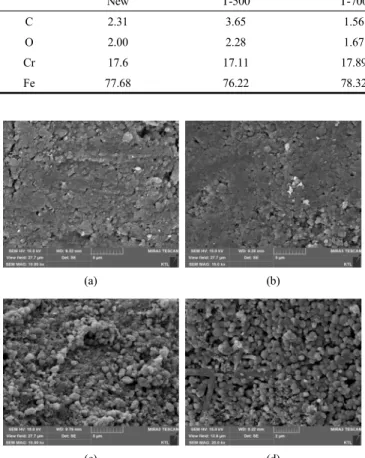
금속지지체의 형상 측정을 위해 지지체로부터 촉매물질을 물리적 으로 탈리시킨 후, 초음파를 이용하여 표면의 촉매물질을 추가로 제 거하여 측정하였다. 600 ℃까지는 금속지지체의 표면의 큰 변화가 보 이지 않았으나 700 ℃ 이상의 온도에서 열처리를 한 경우에는 금속지 지체의 grain boundary에 석출물이 형성된 것을 확인할 수 있다. 이를 확인하기 위하여 금속지지체 및 석출물에 대하여 EDS 분석을 수행하 였으며 그 결과는 Table 4와 같다. 결과에 따르면 열처리 온도에 따라 금속지지체의 주요 성분에는 큰 변화가 나타나지 않았으나 700 ℃ 이 상에서 형성된 석출물은 Cr와 O의 농도가 금속지지체보다 높은 것으 로 측정되었다.
Xun-zeng HUANG 등이 발표한 연구에 따르면 430 ferritic stainless steel은 700 ℃ 이상일 때 grain boundary에 Cr23C6의 석출물이 생성되 Particle size (nm) BET surface area (m2/g) pore volume (cm3/g) pore size (nm)
New 13.1 73.79 0.260 10.80
T-500 16.6 71.51 0.256 12.06
T-600 28.6 52.75 0.243 16.77
T-700 60.9 7.15 0.032 24.58
T-800 80.7 2.50 0.008 30.26
Table 2. Particle Size, Specific Surface Area and Porosity of Plate Type Catalyst at Different Calcined Temperature
New T-500 T-600 T-700 T-800
V2O5 (wt%) 1.10 1.11 1.08 0.76 N.D.2)
2) N.D. : not detected
Table 3. Vanadium Contents of Plate Type Catalyst at Different Calcined Temperature
Figure 2. XRD patterns of plate type catalyst at different calcined temperature.
는 입계부식(intergranular corrosion)이 발생한다고 보고하였다[21]. 본 연구에서도 700 ℃ 이상에서 Cr-C의 석출물이 생성되는 입계 부식이 발생하여 해당 석출물의 Cr 함량에 높은 것으로 판단된다.
또한 금속의 부동태 피막은 고온의 열에 의해 파괴되기도 하는데 이러한 경우 금속은 산화에 대한 저항성을 잃고 공기 중의 산소와 반
응하여 산화된다[22]. Cr 탄화물의 생성은 부동태 피막이 파괴되었음 을 뜻하며 이로 인해 grain boundary에서의 산화작용으로 산소의 농도 가 증가한 것으로 판단된다. 금속지지체가 산화되면 금속 표면에 부 착되어 있는 촉매물질의 산화 속도를 증가시키며, 금속지지체 자체의 수명을 단축시켜 촉매의 수명을 단축시키는 결과를 가져올 수 있을 것으로 판단된다.
3.5. 촉매 활성
Figure 5에는 열처리 온도별 촉매의 NOx conversion 측정 결과를 나타내었다. T-500과 T-600은 비활성화 이전의 신촉매와 거의 유사한 전환율을 나타내었으나 T-700에서부터 전환율이 크게 감소하는 것으 로 나타났다. 신촉매의 NOx 전환율은 76%이었으나 T-700에서는 40.1%, T-800에서는 32.9%로 700 ℃ 이상에서는 열처리 온도가 증가 함에 따라 효율이 크게 감소하는 것을 알 수 있다. T-700에서의 전환 율 감소는 XRD와 BET 측정 결과에 나타낸 바와 같이 TiO2의 결정구 조가 anatase에서 rutile로 변할 뿐만 아니라 TiO2의 입성장 및 CaWO4
와 같은 결정상이 형성되어 촉매의 비표면적과 기공부피가 크게 감소 하였기 때문인 것으로 판단된다. 또한 Table 3에 나타낸 바와 같이 V2O5가 승화 및 기화되어 NOx 전환을 위한 활성물질의 함량이 감소 하였기 때문인 것으로 판단된다.
4. 결 론
본 연구에서는 plate type의 상용화 V2O5-WO3/TiO2 SCR 촉매를 대 상으로 500~800 ℃에서의 열적 비활성화 특성을 고찰하였다. 촉매를 700 ℃ 이상의 온도에서 열처리를 한 경우에 NOx 전환율이 급격히 감소하는 것으로 나타났다. 이는 XRD 분석결과 TiO2의 결정상 구조 가 anatase에서 rutile로 변하고, TiO2의 입성장 및 CaWO4와 같은 결 정상의 생성으로 촉매의 비표면적과 기공부피가 크게 감소하였기 때
(a) (b)
(c) (d)
Figure 3. Microstructure of catalysts surface at different calcined temperature : (a) New, (b) T-600, (c) T-700, (d) T-800.
(a) New (b) T-500 (c) T-600
(d) T-700 (e) T-800
Figure 4. Microstructure of metal support at different calcined temperature : (a) New, (b) T-500, (c) T-600, (d) T-700, (e) T-800.
Metal support Precipitate
New T-500 T-700 T-800 T-700 T-800
C 2.31 3.65 1.56 1.49 1.35 1.84
O 2.00 2.28 1.67 2.13 6.75 15.08
Cr 17.6 17.11 17.89 17.63 20.26 30.42
Fe 77.68 76.22 78.32 78.20 70.62 50.44
Table 4. Analysis of Components of Metal Supports and Precipitates at Different Calcined Temperatures
Figure 5. NOx conversion of plate type SCR catalyst at different calcined temperature.
문이다. 또한 700 ℃ 이상의 온도에서는 촉매 활성물질인 V2O5가 승 화/기화되어 촉매의 NOx 전환율이 감소된 것으로 판단된다. 촉매를 담지하고 있는 금속지지체도 700 ℃ 이상에서는 Cr-C 형성에 따른 입 계 부식과 부동태 피막 파괴에 따른 산화반응이 발생하는 것으로 나 타났다. 이러한 금속지지체의 부식은 향후 촉매의 수명에 영향을 미 칠 수 있을 것으로 판단된다.
감 사
본 연구는 산업통상자원부 산하 한국산업기술평가관리원의 재원으 로 수행한 우수기술연구센터사업(과제번호 : 10045846)으로 수행하였 으며, 이에 감사드립니다.
References
1. F. Gao, X. Tang, H. Yi, S. Zhao, C. Li, J. Li, Y. Shi, and X.
Meng, A review on selective catalytic reduction of NOx by NH3
over Mn-based catalysts at low temperatures: Catalysts, mecha- nisms, kinetics and DFT calculations, Catalysts, 7, 199-231 (2017).
2. Z. Liu, Y. Liu, Y. Li, H. Su, and L. Ma, WO3 promoted Mn-Zr mixed oxide catalyst for the selective catalytic reduction of NOx with NH3, Chem. Eng. J., 283, 1044-1050 (2016).
3. S. Roy, M. S. Hegde, and G. Madras, Catalysis for NOx abate- ment, Appl. Energy, 86, 2283-2297 (2009).
4. P. Granger and V. I. Parvulescu, Catalytic NOx abatement systems for mobile sources: From three-way to lean burn after-Treatment technologies, Chem. Rev., 111, 3155-3207 (2011).
5. T. Boningari and P. G. Smirniotis, Impact of nitrogen oxides on the environment and human health: Mn-based materials for the NOx abatement, Curr. Opin. Chem. Eng., 13, 133-141 (2016).
6. F. Nakajima and I. Hamada, The state-of-the-art technology of NOx control, Catal. Today, 29, 109-115 (1996).
7. G. Busca, L. Lietti, G. Ramis, and F. Berti, Chemical and mecha- nistic aspects of the selective catalytic reduction of NOx by am- monia over oxide catalysts: A review, Appl. Catal. B, 18, 1-36 (1998).
8. F. Castellino, S. B. Rasmussen, A. D. Jensen,. J. E. Johnsson, and R. Fehrmann, Deactivation of vanadia-based commercial SCR cat- alysts by polyphosphoric acids, Appl. Catal. B, 83, 110-122 (2008).
9. Z. M. Liu and S. I. Woo, Recent advances in catalytic deNOx sci-
ence and technology, Catal. Rev. Sci. Eng., 48, 43-89 (2006).
10. L. J. Alemany, F. Berti, G. Busca, G. Ramis, D. Robba, G. P.
Toledo, and M. Trombetta, Characterization and composition of commercial V2O5-WO3-TiO2 SCR catalysts, Appl. Catal. B, 10, 299-311 (1996).
11. P. Forzatti, I. Nova, E. Tronconi, A. Kustov, and J. R. Thøgersen, Effect of operating variables on the enhanced SCR reaction over a commercial V2O5-WO3/TiO2 catalyst for stationary applications, Catal. Today, 184, 153-159 (2012).
12. R. M. Heck, Catalytic abatement of nitrogen oxides-stationary ap- plications, Catal. Today, 53, 519-523 (1999).
13. E. Hums, Is advanced SCR technology at a standstill? A provoca- tion for the academic community and catalyst manufacturers.
Catal. Today, 42, 25-35 (1998).
14. S. Y. Joshi, M. P. Harold, and V. Balakotaiah, Overall mass trans- fer coefficients and controlling regimes in catalytic monoliths, Chem. Eng. Sci., 65, 1729-1747 (2010).
15. I. Nova, L. dall’Acqua, L. Lietti, E. Giamello, and P. Forzatti, Study of thermal deactivation of a de-NOx commercial catalyst, Appl. Catal. B, 35, 31-42 (2001).
16. G. Madia, M. Elsener, M. Koebel, F. Raimondi, and A. Wokaun, Thermal stability of vanadia-tungsta-titania catalysts in the SCR process, Appl. Catal. B, 39, 181-190 (2002).
17. P. G. W. A. Kompio, A. Brückner, F. Hipler, O. Manoylova, G.
Auer, G. Mestl, and W. Grünert, V2O5-WO3/TiO2 catalysts under thermal stress: Responses of structure and catalytic behavior in the selective catalytic reduction of NO by NH3, Appl. Catal. B, 217, 365-377 (2017).
18. D. A. H. Hanaor and C. C. Sorrel, Review of the anatase to rutile phase transformation, J. Mater. Sci., 46, 855-874 (2011).
19. S. S. Park, Thermal Degradation Behavior and Reaction Efficiency with Different Cell Density for TiO2-based High Efficiency Honeycomb Type SCR Catalyst, PhD Dissertation, Gyeongsang National University, Jinju, Korea (2010).
20. M. Faber, O. M. Uy, and R. D. Srivastava, Effusion-mass spectro- metric determination of the heats of formation of the gaseous mol- ecules V4O10, V4O8, VO2, and VO*, J. Chem. Phys., 56, 5312-5315 (1972).
21. X.-Z. Huang, D. Wang, and Y.-T. Yang, Effect of precipitation on intergranular corrosion resistance of 430 ferritic stainless steel, J.
Iron Steel Res. Int., 22, 1062-1068 (2015).
22. D. W. Huh and S. Rhee, A study on anti-oxidation of stainless steel spot weld, J. Korean Weld. Joining Soc., 29, 556-560 (2011).