• 검색 결과가 없습니다.

From Blemish to Decoration: the Landscape of Municipal Facilities in Urban Green Space

N/A
N/A
Protected

Academic year: 2021

Share "From Blemish to Decoration: the Landscape of Municipal Facilities in Urban Green Space"

Copied!
6
0
0

로드 중.... (전체 텍스트 보기)

전체 글

(1)

ORIGINAL ARTICLE

From Blemish to Decoration: the Landscape of Municipal Facilities in Urban Green Space

Dong-ming Yu, Yong-ji Piao

1)

, Tae-Dong Cho

2)*

, Gab-Soon Park

3)

Department of Landscape Architecture, Shandong Agricultural University, Taian 271018, China

1)

Horticultural Science and Engineering College,Forestry College, Shandong Agricultural University, Tai'an 271000, China

2)

Department of Environmental Landscape Architecture, Gangneung-Wnoju National University, Gangneung 210-320, Korea 3) Department of Horticultural Science Kongju National Univeristy, Chungnam 340-702, Korea

Abstract

As the combination of technique and art, environmental facilities have the function to improve the image of urban green space. Among these facilities, some can be designed and arranged reasonably. But to the facilities of sewage, electricity and sanitation and so on, are usually ignored and become the blemish in the green space. Based on the analysis of the status, taking the design of well cover of sewage as an example, the landscape approaches are discussed from form, material, color and artistic technique and so on.

Key words : Landscape, Green space, Municipal facility, Local culture

1. Introduction 1)

Green space is not only the primary place for leisure and recreation for residents, but more of an important window to display urban economics, culture and environment. It also reflects the inhabitants’

ideological status and cultural demands. As essential material bodies for urban public environment and places, environmental facilities named as “street furniture, outdoor props, urban” and so on, receive broad attentions from the designers and urban constructors(Wu et al., 2009; Tao and Zhang, 2004;

Wang et al., 2009; Chen et al., 2009). However, there are some unsatisfactory effects on these facilities,

such as being blindly eager for novelty or taken as

“standardized parts” or arranged casually. The municipal facilities, as part of the environmental facilities, are more concerned with the layout and optimization of their basic functions yet tended to be neglected with landscaping.

2. Classification and Characteristics of Municipal Facilities in Green Space

According to Code for Classification of Urban Land Use and Planning Standards of Development Land (GB 50137-2011), the development land use for public facilities is divided into 4 medium kinds

Received 2 October, 2013; Revised 25 October, 2013;

Accepted 16 January, 2014

*
Corresponding author : Tae-Dong Cho, Department of Environmental Landscape Architecture, Gangneung-Wnoju National University, Gangneung 210-320, Korea

Phone: +82-33-640-2358 E-mail: [email protected]

ⓒ The Korean Environmental Sciences Society. All rights reserved.

This is an Open-Access article distributed under the terms of the Creative Commons Attribution Non-Commercial License (http://

creativecommons.org/licenses/by-nc/3.0) which permits unrestricted

non-commercial use, distribution, and reproduction in any medium,

provided the original work is properly cited.

(2)

that are supply (water, electric, gas and post etc.), environment (sewage, environmental sanitation and protection), security (fire and flood control) and others which traditionally called municipal facilities.

Correspondingly, the municipal facilities in the park are mainly connected with the water and power supply, rainwater and wastewater as well as fire and flood control, such as various types of wells and covers, transformer (distribution) box (cabinet), trash can, pumping stations etc., which have large intersection with the public facilities and management facilities of regular facilities as defined in Code for design of parks ( CJJ48-92).

Compared with the regular facilities in green space, the municipal facilities have two remarkable characteristics: one is their intimate correlation with the touring routes, for these facilities and their pipelines are mostly arranged along the paths and inseparable with the park users; another is non-friendliness. Both the alert symbols of transformer and peculiar smell emitted by the sewage well and dustbins etc. show certain hazard and repellency.

3. Major Problems of Municipal Facilities in Green Space

(1) The lack of some facilities: Due to insufficient consideration of designers or the limitation of construction cost, some facilities tend to be neglected or taken into the scope of deduction. For example, the drainage system is mostly designed as surface drainage, regardless of whether the vertical design being suitable or not, for many designers would avoid the tedious spot investigation and survey. The lack of necessary drainage facilities results in local water accumulation and the poor growth of vegetations.

(2) Lower standard design and lack of regional features: The beautiful green spaces are mostly cooperated by designers of multi-specialties. Despite the prosperous landscape design in China, some

projects are designed with more speed than quality.

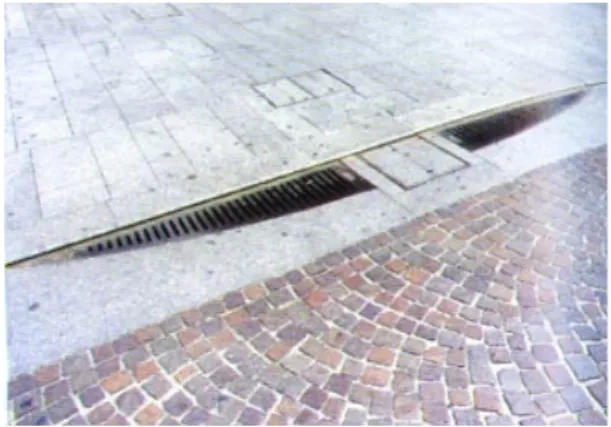
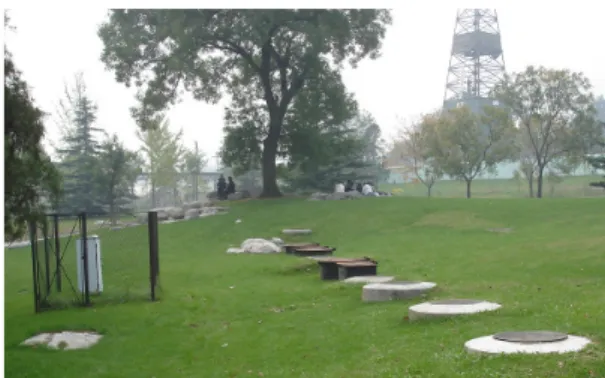
These “point” shaped facilities are designed mostly with their basic using functions. They often use the existing drawings or ready-made products. As shown in fig.1, the transformer and various well covers have become blemishes in the green space.

Fig. 1. Well Covers in the Green Space.

(3) Problems during construction and management:

Construction is the re-creation of the design. At current stage, the low threshold for landscape companies has prevented the thorough implementation of design plans, let alone giving the designers timely feedbacks of the complex conditions of the spots for the search of better solutions. The malposition of “Construction First, Management Second” is easy to produce a quite different works.

(4) The attitude of “Technology First, Art Second”

in product development: The factory production has provided us with convenience while resulted in similarity and posing as a characteristic crisis. The panda-shaped dustbin is a common scene in green space in the past years.

4. The Landscaping of Municipal Facilities in Green Space

4.1. Principles for Planning and Design 4.1.1. The Integration Principle

Each facility is surrounded by certain environment.

(3)

And it is not the facility alone that attracted people’s attention, but the overall artistic effect formed by the facility and its surrounding environment. Due to the differences of expression technique, material used and processing technology, the characteristics and using functions vary from facility to facility. Thus, the whole should reflect parts while the parts reflect the whole.

4.1.2. Principle of Coordination Between Practicality and Artistry

As an important component of the park, the various facilities should be taken as important media to illustrate the landscape while extend its basic practicality.

Based on the transformation of size, style, material, color, texture etc., we should combine the objective

“environment” with the subjective “meaning” together, integrate artistry and culture with spiritual connotations.

Respect traditions and inherit cultural context, as well as displaying time characteristics.

4.1.3. The “Human- Oriented” Principle

Among the municipal facilities in the park, many are related to “wells” or attached with a warning symbol which have a deterrent force or a sense of insecurity. Therefore, the choice of positions of the corresponding facilities, viewing field and isolation and protection etc. should be taken into overall consideration. Appropriate measures should be taken to change people’s perceptions of them so as to make people feel safe, comfortable and funny while using.

4.1.4. The Applicable Principle

Most of the green space municipal facilities (mainly refers to the pipelines) are underground hidden constructions with simple structures. While considering the landscaping of the revealed parts, the feasibility of the technology level, construction technology, maintenance and management etc. should be arranged with balance and the standardization of the scale of facilities, the similarity of structures, the versatility and exchangeability of the components as well as the

identifiability of facilities, so as to lower as much cost as possible.

4.2. The Landscaping Method of the Green Space Municipal Facilities

Function is the primary factor for municipal facilities, but it would not prevent us from exploring for their aesthetic and humanity potentials(Yu, 1990).

The key point for the realization of municipal facilities is the grasp, usage and improvement of the present

“structure” and achievement of “organic integration of appreciation and usage”.

From the level of “function”, in accordance with varied facility forms to select appropriate material, technology as expression; from the level of “artistry”, use consonance method to stress on the integration;

besides, the practice of comparison could produce certain variation of the order. It could achieve diversity and unification by highlighting the center and the distinction between the primary and the secondary.

This practice should be properly used with combination of “Right place, right time, with people”. In a short, the landscaping methods of the green space municipal facilities could be summed up as follows: First, shading, weakening, containing and restraining; second, originating and publicizing, and both finally represents in the forms, materials, colors and techniques etc.

4.2.1. Form

The morphological composition of environmental facilities is the combined features of the shape and internal structure as displayed. It can be divided into three aspects: external structure, appearance and meaning. External structure includes forms, groups and the association with other environmental elements.

Appearance is the first view feelings and usage is its

first characteristic. The external structure and meaning

are expressed by its appearance. The meaning is the

affiliated function of environmental facilities and the

complicated expression of facility details combined

with the former elements on spirit and cultural values.

(4)

No matter what form the facility is, the perfect combination of form with function is the design goal.

4.2.2. Material

Each kind of material has its own language. For example, stone, brick and wood etc. display a natural and classic sense; glass, steel and aluminum etc. give us a modern, sophisticated and technological sense;

various material has varied effects due to the difference of texture, color and construction techniques. For example, mushroom rock gives a rough and dignified sense, while polished stone has a smooth, light and fashionable sense. The combination of various material and texture highlights the comparison of material and enrich the modeling language of the environmental facilities and cause strong visual impact.

4.2.3. Color

Color is a key factor of plastic arts. It couldn’t exit alone without physical form, space, location, size, texture etc. Color tends to be the first impression to people. It has more powerful visual impact than modeling. And color is not only an important means to shape visual characteristics, but also a key constituent element to render landscape atmosphere and display regional cultural arts. For example, the warmth of red, the peace of blue, the mystery of purple and the simplicity of gray etc. Besides the above meanings of colors, the temperature of colors give a sense of contraction and expansion and the lightness of color gives a sense of weight. People’s feelings towards colors are also affected by the time, society, culture, regions, lifestyle and customs.

4.2.4. Technology

Various technologies affect the characteristics of facilities. Choose appropriate processing techniques, including the polishing, axing and firing etc. of stone, with the combination of specific functions, application environments, cost and service life on the basis of ensuring corresponding facility structures and resisting loads. With the application of various techniques

such as the sandblasting processing and GRC etc., the stones produced give people a sense of real ones and stronger sense of wholeness.

4.3. Landscaping Analysis of Typical Municipal Facilities in Green Space: Taking the Well Cover as an Example

There are various kinds of pipelines (for example, electricity, telecommunication, rainwater, sewage, gas, water, heat etc.) under the beautiful and comfortable green land. They safeguard the health of the green land to maintain its performance of versatile functions like the blood vessel in a human’s body. In order to guarantee the use and maintenance of these pipelines, the inspection well, valve shaft or connection well should be set at “joints” every certain distance, which present as well covers in the green land.

4.3.1. The Shape of Well Covers

There are a variety of shapes of well covers, such as round, square, rectangular and irregular ones.

Since the round ones are popular due to their advantages in size, bearing capacity and being not liable to slip from the wellhead or affected by the placement angle. Therefore, the appearance of irregular-shaped one tends to give people a fresh feeling (fig. 2).

Fig. 2. Willow-Shaped Rainwater Well Cover.

(5)

4.3.2. The Materials of Well Covers

Currently, the materials that make the well covers are developing rapidly: From traditional heavy yet durable cast iron to stone, concrete, rubber, stainless steel, aluminum and other new composite materials or the combination of above materials. These reflects the technological development and creates conditions for the diversity and locality of well cover landscapes. Thus, the ecological friendliness, easy maintenance and management and low cost have become criteria in judging and selecting materials.

4.3.3. The Artistic Treatment of the Surface of Well Covers

As for the well covers which require the treatment of “shading, weakening, containing and restraining”, we could adopt the following methods on the facilities on major touring routes according to the different environments:

① Use rocks and vegetation etc. as shielding.

Locate the natural stone or artificial plastic stone together with flowers, shrubs, hedge or bamboos on the side of main viewing to shield the vision.

② Use portable or movable landscape structures as cover. For example, the plastic stone, imitating stumps, various types of flowerpots with low brackets, potted flowers. Some could be covered by pebbles or various colors of artificial turf.

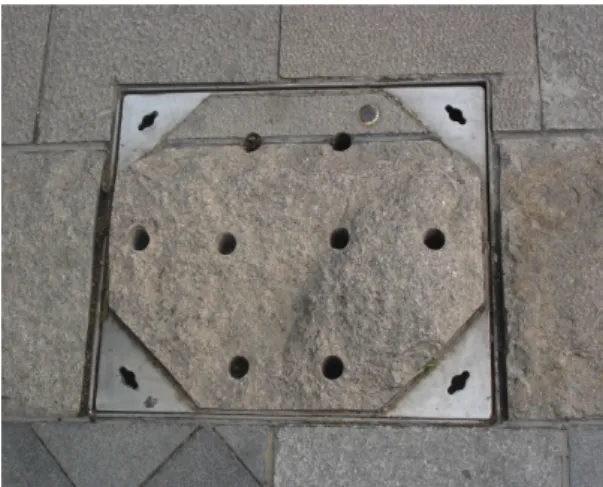
③ Adopt the same or similar materials to be in harmony with the surrounding environment. As shown in fig.3, use stainless steel or alloy to make structural framework, overlay it with stone and insert the mark types of corresponding well covers. With the delicate construction, it would become integrated with the surrounding pavement.

As for the treatment of “maverick and explicit”

type, we could adopt the means of comparison.

Highlight it through the changes of materials, colors and patterns etc. Converge the distinctiveness, sensuality and operability by the design of the product Logo.

For instance, the rainwater inspection well cover in the May 4

th

Square in Qingdao is made of cast iron which have symbols related to the sea: waves, sailboats and seagulls etc. With blue as its main color and red and yellow as decoration, it has distinctive regional feature. Meanwhile, the bright colors and patterns are sharply contrasted with gray granite pavement. These well covers are “bright decoration”

on the ground.

Fig. 3. The Well Covers Integrated With the Pavement.

4.3.4. Vertical Processing

The relations between all types of well covers vary

in accordance with the base levels of locations and

their different environments: soft landscape (green

space) or hard landscape (pavement). In soft landscape,

the rainwater well cover should be slightly lower than

the base level or at the same level, so as to ensure the

collection and rapid drainage of rainwater. As for

other types of well covers, they could be slightly

higher than (bellow 3 cm) or at the same level with

the datum to reduce the leakage of water; in the hard

pavement, the well covers should be mainly at the

same level with the datum and the rainwater well

could be slopes and be slightly lower.

(6)

5. Conclusion

The Percentage Art Policy in Philadelphia, the U.S., stipulated that all municipal construction must take out 1% of the expenditure for artistic works in 1959. It is the first American city which makes legislation to carry out the “percentage art construction”.

The municipal facilities in green space are often disdained or ignored by designers. Reversely, the tiny flaw in a piece of white jade is extremely noticeable.

Landscaping is not the production of scenic spots separated with forms, but integrations of artistry with science and function and form. Therefore, the application according to local conditions and the application of artistry according to landscapes as well as the realization of landscaping, locality, ecology, humanization and saving is an urgent topic for our future research.

Reference

Wu, X. K., Mao, Y. X., Song, C. Y., 2009, Cultural Content and Development Trend for Facilities in Urban Landscape Design, J. Modern Landscape Architecture, 4, 41-43.

Tao, R., Zhang, F. C., 2004, A Brief Talk of the Urban Environmental Facilities Functions, J. Furniture, Interior Design, 6, 20-22.

Wang, Z. X., Zhang, F. Y., Liang, H., 2009, Thoughts on Ecological Design in Urban Environmental Facilities, J. Art and Design, 6, 115-117.

Chen, L. B., Li, B. H., Huang, L., 2009, Discuss on Experience and Revelation of Seoul Urban Landscape Construction, Journal of Huazhong University of Science and Technology, 3, 49-53.

Yu, Z. L., 1990, Urban Environmental Art: Landscape

and Facilities, M. Press of Tianjin University.

수치

Fig. 1. Well Covers in the Green Space.
Fig. 2. Willow-Shaped Rainwater Well Cover.
Fig. 3. The Well Covers Integrated With the Pavement.

참조

관련 문서

Fourth, as a result of analyzing the difference of motivation for sports participation among the participants using sports facilities in the daily life, it

• Select one of the elemental technologies of Smart City and describe the current level of this technology, the direction of future technology development, and the urban space to

As the table above shows, art galleries invest majority of their space real estate to the space for exhibition (58.86%). This means they need to reconsider

• Robert Krier, Stadtsraum in Theories und Praxis (Theory and Practice of Urban Space), 1975. • Urban space is defined as 'covering all types of space between buildings and

Unfulfilled urban planning facilities increase due to expansion of urban planning zones and downtowns and its rate is higher in place with low urgency

The index is calculated with the latest 5-year auction data of 400 selected Classic, Modern, and Contemporary Chinese painting artists from major auction houses..

The “Asset Allocation” portfolio assumes the following weights: 25% in the S&P 500, 10% in the Russell 2000, 15% in the MSCI EAFE, 5% in the MSCI EME, 25% in the

1 John Owen, Justification by Faith Alone, in The Works of John Owen, ed. John Bolt, trans. Scott Clark, "Do This and Live: Christ's Active Obedience as the