• 검색 결과가 없습니다.

Analysis of the Performance and Change of Resident Consciousness of the Fishing Village Specialization Capacity Enhancement Project through Surveys - Focusing on the Comparative Analysis of Consciousness of Inland Water and Coastal Residents -

N/A
N/A
Protected

Academic year: 2021

Share "Analysis of the Performance and Change of Resident Consciousness of the Fishing Village Specialization Capacity Enhancement Project through Surveys - Focusing on the Comparative Analysis of Consciousness of Inland Water and Coastal Residents -"

Copied!
13
0
0

로드 중.... (전체 텍스트 보기)

전체 글

(1)

어촌특화 역량강화사업의 성과 및 주민의식 변화분석

Analysis of the Performance and Change of Resident Consciousness of the Fishing Village Specialization Capacity Enhancement Project through Surveys

- Focusing on the Comparative Analysis of Consciousness of Inland Water and Coastal Residents -

양민호

a

⋅김기성

b,†

⋅고진영

c

Yang, Min-Ho⋅Kim, Ki-Sung⋅Koh, Jin-Young

ABSTRACT

The Ministry of Maritime Affairs and Fisheries has been promoting the ‘Fishing Village Specialization Capacity Enhancement Project’ to pursue sustainable development of villages such as income generation by using local tangible and intangible resources led by local residents at the village level since 2013. For the fishing village-Specialization capacity enhancement project, six training sessions (mainly in the village unit) are selected by the public offering method, and the project (income generating business, village development project, etc.) is developed for the selected village residents.

It has a process of establishing a village project plan (a preliminary plan for village development or a sixth preliminary industrialization plan) based on the training of experts 5 times, practice or excursion 1 time). In this study, four villages in Gangwon-do fishing villages (two coastal villages and two inland water villages) were surveyed on the perception and satisfaction of fishing village development projects before and after training. The survey analysis was conducted by dividing the analysis of resident capacity and satisfaction into personal, interpersonal, and social dimensions. The survey was conducted by distributing a survey before and after training, and a 1:1 survey was conducted according to the residents’ cognitive status. Based on the survey, factor analysis, reliability analysis, and analysis using the corresponding sample t-test showed an increase of 0.02 for Yangyang Mulchi fishing village, 0.11 for Samcheok Jangho fishing village, and 0.36 for Hongcheon River fishing industry, but Yanggu Jinmok fishing industry was -0.29, unlike other regions. As a result of this analysis, it has been empirically proven that provision of training projects through resident participation is a very important factor for the success of the fishing village project. Therefore, rather than fostering local leaders, training and community activities to strengthen personal capacities of residents participating in the project, it is necessary to operate the software business with a focus.

Keywords: Local capacity enhancement; resident education; consciousness change; empirical analysis; factor analysis

Ⅰ. Introduction

Today, fishing villages serve as a source of seafood and a national recreational space, but their self-sustainability is insufficient due to stagnant production and lack of residents’

capacities. In order to overcome this situation, the Special Act on Support for Specialization Development in Fishing Villages was enacted in 2013, raising expectations for new fishing village development. Furthermore, a change in the fishing village policy has recently appeared due to a paradigm shift in new regional

policies such as the future industrialization of traditional industries or the 6th industrialization.

However, due to the problems of fishing villages such as population decline, aging, poor facilities and poverty, and the simple income structure centered on the fishery industry, they are vulnerable to external shocks, and frequent conflicts between residents and lack of community capacity exist (Statistics Korea, 2015). Moreover, due to the simple income structure centered on the fishing industry (including short meals), it is a reality that is vulnerable to climate change and changes in the external environment. Even stability is under threat. Rural villages are traditionally a cooperative society that shares labor power, while fishing villages are a competitive society that lives with limited natural resources and is a place with relatively strong exclusivity. In order to solve these special circumstances and problems of fishing villages, the Ministry of Maritime Affairs and Fisheries has been operating the ‘Fishing Village Specialization Support Center’, an on-site dedicated

a

Team Leader, Korea Rural Community Corporation

b

Professor, Department of Regional Infrastructure Engineering, Kangwon National University

c

Associate Director, Korea Rural Community Corporation

† Corresponding author

Tel.: +82-33-250-6466, Fax: +82-33-259-5560 E-mail: [email protected]

Received: November 10, 2020

Revised: January 19, 2021

Accepted: January 25, 2021

(2)

organization for the self-sustaining development of the fishing village, and has been conducting diverse projects to solve the fishing village problem.

Among them, a Fishing Village Specialization Capacity Enhancement Project is being promoted at the village level so that local residents can use the tangible and intangible resources of the region to pursue sustainable village development, such as generating income. The “Fishing Village Specialization Capacity Enhancement Project” is promoted through a public offering method, aims to strengthen the project promotion capacities of selected village residents, and is being carried out step by step through capacity evaluation. Research through capacity change and satisfaction survey targeting participants in the Fishing Village Specialization Capacity Enhancement Project is a diagnosis of the current fishing village specialization capacity enhancement project, suggesting a desirable business direction and efficiency improvement plan, and enhancement the fishing village specialization capacity. It will be an important basic data in preparing the necessity and logical basis for expanding the project (Business in progress).

In this study, two villages on the inland water and two coastal villages were selected among the fishing villages in Gangwon-do, the target area of the Fishing Village Specialization Capacity Enhancement Project. Therefore, a questionnaire was conducted before and after the residents’

competency reinforcement education, and a corresponding t-test was conducted (156 person before training, 150 person after training). Through this, for the purpose of surveying the satisfaction level of training and analyzing the performance, the theoretical analysis and consideration of the effect on the status of ownership and the change of residents’ capacities through training was conducted.

Ⅱ. Previous Research

The rural development project has been carried out with a focus on hardware maintenance such as infrastructure expansion and landscape improvement. However, the importance of the software (S/W) project is gradually increasing as the regional capacity enhancement project is included in the comprehensive maintenance project such as the comprehensive maintenance project for the eup-myeon location and the comprehensive maintenance project for each region.

On the other hand, looking at the research on the enhancement of local capacity, Kang (2004) reinforced village capacity through case studies of rural village communities in Chungnam, and in order to succeed, village leaders (human), local conditions (space), and time conditions (time). It is said that it is possible only when the three elements of achieve harmony (the holy trinity). The most important factor among them is that it is necessary to establish a policy direction for sustainable development of the local community so that the local community can develop and leap forward by fostering leaders who have both innovation and ethics as innovative and trusted leaders.

Park (2007) introduces the concept of capacity enhancement and domestic and foreign cases, and, in order to cultivate capacity in rural areas, the capacity enhancement support project (practical learning project) that allows residents to creatively utilize resources and conditions and training for local leaders He said the project was urgent. Park et al. (2013) noted the importance of residents’ cooperation and regional capacity for project operation management, as there were limitations in project operation management and insufficient improvement efforts due to residents’ willingness to participate in rural area development projects and limitations of local capacity. By verifying, the direction of future business operation management was suggested.

Seo (2014) re-established the concept of the Regional Capacity Enhancement Project, and said that the current problem is the local government and the Korea Rural Community Corporation. The reason was the lack of understanding of region development officials’ ability to strengthen the region and formal projects to win orders for rural region development projects.

However, less than 10 years have passed since the introduction of the regional capacity enhancement project, many difficulties have arisen in the business operation process due to the lack of understanding of the project implementers and excessive workload of the implementation plan and execution standards in the area of regional capacity enhancement. In some cases, a question is raised about the expertise and experience of a project operator, and one person performs tasks in several regions, thereby performing a project that is more uniform than the characteristics of each region.

In the case of coastal areas, the characteristics of general

(3)

fishing villages are well represented, but in the case of inland waters, the characteristics of fishing villages and rural villages are intermediate, so it is difficult to regard it as a general fishing village.

There are few studies related to the enhancement of regional capacity in fishing villages since the previous studies were reviewed, and there are few studies on inland waters. The Ministry of Agriculture and Food has conducted a capacity enhancement project and research, but the Ministry of Oceans and Fisheries is just about to start a capacity enhancement project for fishing villages. Previous studies so far have been limited to the concept of local capacity enhancement and improvement of projects, and there are few studies on project management and change of residents’ consciousness. Therefore, in light of the trend of the times and the importance of the business, it is judged that a study that can establish systematic standards and actualize project management is necessary for the efficient promotion of local capacity in fishing villages. It is necessary to systematically organize the capacity enhancement project that meets the needs and characteristics of the village according to the capacity enhancement project of the fishing village residents.

Ⅲ. Materials and Methods 1. Location of study Area A. Location of study Area

Location of study Area of the survey is the 2019 fishing

village specialization capacity enhancement project district conducted by the Gangwon Fishing Village Specialization Support Center. There are 2 villages on the inland water and 2 villages on the coast. The fishing villages belonging to the coast are Yangyang Mulchi fishing village and Samcheok Jangho fishing village. The project was carried out with 4 training sessions and 1 excursion for these 4 villages. Fig. 1 shows the location of study area.

B. Study Area Characteristics

Location of study Area of this study were in inland waters (Yanggu, Hongcheon) and coastal (Yangyang, Samcheok).

Looking at the meaning of legal coast and inland water, coast refers to a place connecting land and sea, and the boundary between sea and land is generally called coast, but the term coast is a large area affected by the various actions that occur at this boundary. Inland waters refer to the water flow or surface of freshwater or brackish water artificially created in rivers, dams, lakes, swamps, reservoirs, and their parks.

In general, the coastal fishing village represents the life of a generally known fishing village, and the inland water fishing village has limited fishery work by fishing in rivers and lakes, and basically has many similarities with daily life in rural villages. Although there may be differences in terms of setting and comparing the coastal and inland waters, the study was conducted by selecting two sites for each coastal and inland waters, as it was judged that it could be compared with a fishing village and a rural village.

2. Research and investigation method

In order to measure residents’ perceptions, capacity change, and survey residents’ satisfaction, a survey was conducted targeting participants in the capacity enhancement project training conducted by the Gangwon Fishing Village Specialization Center.

The survey was conducted by dividing it into before and after the start of the training, and it was possible to respond by itself considering the age and situation of the residents living in the target area. 252 copies of the distributed survey were collected before training, and 246 copies were collected and analyzed after training.

The contents of the survey consisted of 8 items on the actual

Fig. 1 Location of study area

(4)

condition of residents’ perception of the Gangwon Fishing Village Specialization Support Project, and 12 questions on a 5-point Likert scale as an item to evaluate residents’ capacity and satisfaction. In addition, 4 questions were composed of basic personal matters, and the survey was prepared with 12 factors related to resident capacity as discussed in the theoretical review, and the survey measurement items of resident capacity factors are as follows. As a method of setting the evaluation index, among the existing projects included in the fishing village development project group, which is the scope of this study, the evaluation index development cases and actual evaluation cases of the projects that are conducting evaluation were surveyed and analyzed to select the index candidate group.

Table 1 shows the detailed items of survey investigation, and Table 2 shows the resident capacity factor measurement items.

3. Analysis method

The collected survey was first subjected to basic statistics to determine the basic personal information and residents’

perceptions, and secondly, to measure the change in resident capacity, factor analysis was first performed on the survey response and then reliability was analyzed. In addition, the outcome of education was analyzed by comparing the results of the initial questionnaire and the questionnaire after training.

In order to compare the averages of several groups before and after training, an corresponding sample t-test was performed on each of the four villages. SPSS 24.0 was used for statistical processing of the survey results, and the statistical significance level was determined as 0.05. t-test was performed using the average value of the questionnaire survey before and after

Classification Detailed items Note Reference

Resident awareness (8 questions)

Recognition of Gangwon Fishing Village Specialization Support

Project/Image/Most Important Subject/Persistence in the Future Nominal scale Jeon (2014)

Resident capacity and satisfaction

(12 questions)

Change Consciousness/Self-utility, Presence, Self-esteem/Self-reliance

5 points Likert scale

Huh (2018) Participation Awareness/Mutual Dialogue/Problem Solving/Sense of

Control/Centered Participation/Problem Awareness/Information/Reasonable Thinking/Assertion/Self-development

Kim (2018) Lee (2013) Na (2010) Yoo et al. (2009) Basic personal

information (4 questions)

Gender/Age/Occupation/Residence Years Nominal scale

Table 1 Detailed items of survey investigation

Resident capacity factors Questions

Personal dimension

Change consciousness Our village needs change.

Self-utility, presence, self-esteem I am the person who is needed in the change of the village.

Self-reliance I am always working hard to develop the village.

Participation consciousness I am willing to participate in a project to develop the village.

Interpersonal dimension

Interactive A lot of dialogue between residents is needed for the development of the village.

Problem solving I am communicating with other people to solve problems in the village.

Sense of control I am making concessions for the development of the village.

Central participation I am willing to participate as a leader (centered person) for the development of the village.

Social dimension

Problem awareness In order to develop the village, it is necessary to introduce a new business.

Intelligence I know the direction or the way to develop the village.

Rational thinking and assertion I am thinking positively about the future development of our village.

Self-development Willing to participate in projects (training, field trips, etc.) for village development.

Table 2 Resident capacity factor measurement items

(5)

training for each item, and it was interpreted that a significant difference was indicated when the p value of the significance probability indicated as a result was less than 0.05.

Ⅳ. Result and Consideration

1. Survey on residents’ awareness and participation (primary training)

At the first training session, 51 out of 84 respondents 4 villages (60.7%) were aware of the Fishing Village Specialization Support Project to the question ‘Do you know the Gangwon Fishing Village Specialization Support Project?’

There were many answers saying that they did not know and except in special cases, more than half of the villagers were aware of the Fishing Village Specialization Support Project.

Table 3 shows the results of the survey.

2. Analysis of resident consciousness A. Residents’ preference

1) Preference

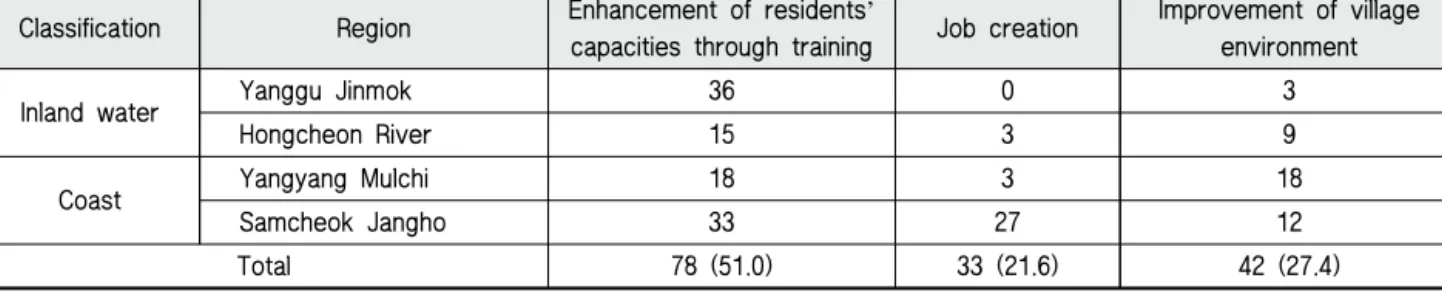
As for the preference of residents of the Gangwon Fishing Village Specialization Support Project, only those who knew the project among the respondents to the first survey surveyed the preference. Table 4 and Fig. 2 shows the results of the first survey. Of the 153 respondents in the inland waters and coast, 147 (96%) showed positiveness of the project.

The positive reasons were surveyed for reinforcing residents’

capacities through training, creating jobs, etc., and the people who are the center of the village business were identified as village residents.

2) Reasons for preference

There were no negative responses in all four villages, but it was surveyed that residents who had disagreements and conflicts between village residents due to disagreement between

Classification Yanggu Jinmok Hongcheon River Yangyang Mulchi Samcheok Jangho Total

Know 15 27 39 72 153 (60.7)

Don’t know 3 12 27 57 99 (39.3)

Table 3 Awareness of gangwon fishing village specialization support Unit: No. of people (%)

Classification Region Very positive Positive Average Negative

Inland water Yanggu Jinmok 3 12 0 0

Hongcheon Hongcheon River 6 18 3 0

Coast Yangyang Mulchi 21 18 0 0

Samcheok Jangho 45 24 3 0

Total 75 (49.0) 72 (47.1) 6 (3.9) 0 (0)

Table 4 Recognition of gangwon fishing village specialization support project Unit: No. of people (%)

Fig. 2 Residents’ preference for gangwon fishing village specialization support project

(6)

village indigenous people with returnees and noble villagers did not benefit from the Gangwon Fishing Village Specialization Support Project. Table 5 shows the reasons of the positive results.

B. The most important subject

The most important actors in Gangwon’s Fishing Village Specialization Project were 60% of residents, 40% of village leaders, 55.6% of residents in Hongcheon River, 22.2% of administration, and 11.1% of village leaders and experts in the total response of Jinmok in Yanggu. Yangyang fish in the coastal area were found in the order of 53.8% of residents, 38.5% of village leaders, and 7.7% of experts. Like other villages, Jangho of Samcheok was surveyed with 79.2% of residents, 12.5% of village leaders, and 8.3% of experts. Table 6 shows the survey results.

C. Future sustainability

Regarding the continuity of the Gangwon Fishing Village Specialization Support Project, 153 respondents (92.2%) responded to both inland water and coastal waters, with 141 respondents (92.2%) saying that it must be maintained. Six respondents said they were not sure, and six were not interested.

Table 7 shows the results of the questionnaire on future sustainability.

3. Survey on residents’ perception and participation (4th training)

A. Awareness

There may be a slight difference from the residents who surveyed during the first training, but the difference in perception after the fourth training and the first excursion increased from 60.7% of the first to 91.5% of the fishing village specialization support project. Table 8 and Table 9 shows the

Classification Region Enhancement of residents’

capacities through training Job creation Improvement of village environment

Inland water Yanggu Jinmok 36 0 3

Hongcheon River 15 3 9

Coast Yangyang Mulchi 18 3 18

Samcheok Jangho 33 27 12

Total 78 (51.0) 33 (21.6) 42 (27.4)

Table 5 Positive reasons for gangwon fishing village specialization support project Unit: No. of people (%)

Classification Region Administration Resident Village leader Expert

Inland water Yanggu Jinmok 0 9 6 0

Hongcheon River 6 15 3 3

Coast Yangyang Mulchi 0 21 15 3

Samcheok Jangho 0 57 9 6

Total 6 (3.9) 96 (32.7) 33 (21.6) 12 (7.8)

Table 6 An important subject of gangwon fishing village specialization support Unit: No. of people (%)

Classification Region Must be maintained Don’t know Not interested

Inland water Yanggu Jinmok 15 0 0

Hongcheon River 24 0 3

Coast Yangyang Mulchi 33 6 0

Samcheok Jangho 69 0 3

Total 141 (92.2) 6 (3.9) 6 (3.9)

Table 7 Future sustainability of gangwon fishing village specialization support project Unit: No. of people (%)

(7)

survey results after the 4th training.

B. Number of participation in training and field trips For the purpose of most of Gangwon’s Fishing Village Specialization Support Projects, four training sessions and one excursion were conducted in all four regions. The participation rate was higher in the coastal area than in the coastal area, but

the total number of participants was higher in the coastal area.

Table 10 and Table 11 shows the current status and number of participation in training and excursion of Gangwon fishing village.

In the case of Samcheok Jangho, it is judged that the participation of residents was higher than that of other regions, as they have experienced several village projects apart from the

Classification Region Village training Municipality Internet Other

Inland water Yanggu Jinmok 27 3 0 3

Hongcheon River 15 12 0 6

Coast Yangyang Mulchi 33 9 0 0

Samcheok Jangho 108 15 3 6

Total 183 39 3 15

Table 9 Motivation to learn about gangwon fishing village specialization support project Unit: No. of people (%)

Classification Region Respondent Training participant

Inland water Yanggu Jinmok 33 33 (100.0)

Hongcheon River 33 24 (72.7)

Coast Yangyang Mulchi 48 36 (75.0)

Samcheok Jangho 132 102 (77.2)

Table 10 Current status of participation in training and excursion of gangwon fishing village Unit: No. of people (%)

Classification Region No. of participation Total

Inland water

Yanggu Jinmok

Training 1 Training 1, Excursion 1

Training 2,

Excursion 1 Training 4 Training 4,

Excursion 1 33

12 3 6 3 9

Hongcheon River

None Training 1,

Excursion 1

Training 2,

Excursion 1 Training 4 Training 4,

Excursion 1 33

9 3 3 6 12

Coast

Yangyang Mulchi

None Training 3 Training 3,

Excursion 1 Training 4 Training 4,

Excursion 1 58

12 3 6 3 24

Samcheok Jangho

None Excursion 1 Training 2 Training 3 Training 3

Excursion 1 Training 4 Training 4,

Excursion 1 132

30 9 6 6 6 15 60

Table 11 Number of participation in training and excursion of gangwon fishing village specialization support project

Unit: No. of people (%)

Classification Inland water Coast

Total Yanggu Jinmok Hongcheon River Yangyang Mulchi Samcheok Jangho

Know 33 30 45 117 225 (91.5)

Don’t know 0 3 3 15 21 (8.5)

Table 8 Awareness of gangwon fishing village specialization support Unit: No. of people (%)

(8)

ongoing Gangwon Fishing Village Specialization Support Project. In addition, it is judged that there was not much participation in the village due to the monthly (seasonal) characteristics of the village during the period during which the training of inland water was in progress.

C. Residents’ preference 1) Preference

As for the preference of residents of the Gangwon Fishing Village Specialization Support Project, only those who said they knew the project among the respondents to the 4th survey were surveyed, and 76 out of 82 respondents (90.7%) in the inland and coastal waters showed positiveness of the project. Table 12 shows the survey results.

The positive reason was similar to that of primary training, but the proportion of reinforcing residents’ capacities through training was slightly higher, and the people who became the center of the village project were indicated as village residents.

It was found that the village’s interests (important) were placed.

In addition, it was investigated that village leaders such as the

chairman, secretary, and head of the village should lead the village project as the subject, rather than relying on experts to follow passively.

2) Reasons for preference

The reason for the residents’ preference for the Gangwon Fishing Village Specialization Support Project was positive, in order of enhancement of residents’ capacities through training 62.2%, village environment improvement 24.4%, and job creation 13.4%. It was found that all of the four village residents in the inland water and coastal areas prefer to strengthen residents’ capacities through training. Table 13 shows the reasons of the positive results.

D. The most important subject

The most important actors in Gangwon’s Fishing Village Specialization Support Project were 81.8% of residents, 9.1%

of village leaders, 63.6% of residents in Hongcheon, and 9.1%

of village leaders and experts in the total response of Jinmok in Yanggu. Yangyang Mulchi in the coastal area was found to

Classification Region Administration Resident Village Leader Expert

Inland water Yanggu Jinmok - 27 3 3

Hongcheon River - 21 6 6

Coast Yangyang Mulchi 3 21 21 3

Samcheok Jangho 15 63 42 12

Total 18 (7.3) 132 (53.7) 72 (29.3) 24 (9.7)

Table 14 An important subject of gangwon fishing village specialization support Unit: No. of people (%)

Classification Region Very positive Positive Average Negative

Inland water Yanggu Jinmok 3 12 0 0

Hongcheon River 6 18 3 0

Coast Yangyang Mulchi 21 18 0 0

Samcheok Jangho 45 24 3 0

Total 75 (49.0) 72 (47.1) 6 (3.9) 0 (0.0)

Table 12 Recognition of gangwon fishing village specialization support project Unit: No. of people (%)

Classification Region Enhancement of residents’

capacities through training Job creation Improvement of village environment

Inland water Yanggu Jinmok 21 - 12

Hongcheon River 27 6 -

Coast Yangyang Mulchi 27 12 9

Samcheok Jangho 78 15 39

Total 153 (62.2) 33 (13.4) 60 (24.4)

Table 13 Positive reasons for gangwon fishing village specialization support project Unit: No. of people (%)

(9)

be 38.5% of residents and village leaders, and Samcheok Jangho, like other villages, showed 47.7% of residents, 31.8%

of village leaders, and 9.1% of experts. Table 14 shows the survey results.

E. Future sustainability

Regarding the continuity of the Gangwon Fishing Village Specialization Support Project, 225 respondents (92.2%) responded to both inland water and coastal waters, with 210 respondents (92.2%) being the most and saying it ‘must be sustained.’ 3 said they didn’t know and 12 said they were not interested. Table 15 shows the results of the questionnaire on future sustainability.

4. Resident capacity analysis A. Factor Analysis

Table 16 shows the results of the factor analysis of capacity details. As a result of performing the factor analysis, it can be

seen that the total component was extracted and the grouped items accounted for 79.25% of the total variation by three components. As a result of factor analysis, based on the previous theoretical considerations, factors grouped into component 3 were classified into personal level capacities, factors grouped into component 1 were classified into personal level capacities, and factors grouped into component 2 were classified into social level capacities.

B. Reliability analysis

As a result of factor analysis, the reliability of the personal-level capacity, interpersonal capacity, and social-level capacity sub-factors showed relatively high reliability, with a cronbach’s α value of 0.8 or higher. In terms of capacity in the social dimension, cronbach’s α value was 0.9 or higher, indicating very high reliability. Table 17 shows the results of the reliability analysis.

Classification Region Must maintain. Don’t know. Not interested.

Inland water Yanggu Jinmok 30 3 -

Hongcheon River 27 - 3

Coast Yangyang Mulchi 45 - -

Samcheok Jangho 108 - 9

Total 225 (93.4) 3 (1.3) 12 (5.3)

Table 15 Future sustainability of gangwon fishing village specialization support project Unit: No. of people (%)

Classification Capacity details Substance

1 2 3

Personal dimension

Change consciousness .014 .258 .853

Self-utility, presence, self-esteem .231 .057 .788

Self-reliance .561 .271 .623

Participation consciousness .442 .256 .598

Inter personal dimension

Interactive .894 .354 -.093

Problem solving .835 .280 .349

Sense of control .812 .171 .352

Central participation .802 .322 .236

Social dimension

Problem awareness .185 .868 .133

Intelligence .232 .812 .335

Rational thinking and assertion .439 .786 .046

Self-development .282 .625 .507

Eigenvalue 4.752 3.741 3.395

% Dispersion 31.683 24.938 22.630

% Accumulation 31.683 56.620 79.250

Table 16 factor analysis of capacity details

(10)

C. Comparison before and after training for capacity enhancement project

1) Comparison of before and after training in inland water fisheries

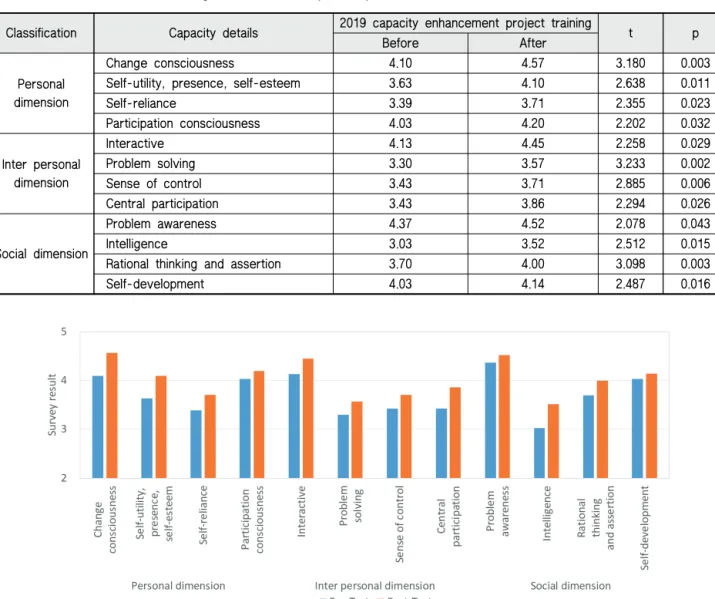
A t-test was conducted to compare before and after training between the Yanggu Jinmok fishing industry and the Hongcheon River fishery industry before and after training. As a result of the analysis, the significance probability p value of

all competency subcategories was less than 0.05 and t value was greater than 1.96, and through this, it was confirmed that there is a correlation between education and performance. The personal, interpersonal, and social level of competency details showed greater results after education than before, indicating that capacity-building education contributed positively to the improvement of residents’ capacity. Table 18 and Fig. 3 shows the results of the t-test.

Classification Cronbach’s α No. of items

Personal capacity 0.886 4

Interpersonal capacity 0.922 4

Social capacity 0.918 4

Table 17 Reliability analysis for each dimension

Classification Capacity details 2019 capacity enhancement project training t p

Before After

Personal dimension

Change consciousness 4.10 4.57 3.180 0.003

Self-utility, presence, self-esteem 3.63 4.10 2.638 0.011

Self-reliance 3.39 3.71 2.355 0.023

Participation consciousness 4.03 4.20 2.202 0.032

Inter personal dimension

Interactive 4.13 4.45 2.258 0.029

Problem solving 3.30 3.57 3.233 0.002

Sense of control 3.43 3.71 2.885 0.006

Central participation 3.43 3.86 2.294 0.026

Social dimension

Problem awareness 4.37 4.52 2.078 0.043

Intelligence 3.03 3.52 2.512 0.015

Rational thinking and assertion 3.70 4.00 3.098 0.003

Self-development 4.03 4.14 2.487 0.016

Table 18 t-test before and after training in the inland fishery industry

Fig. 3 Comparison of average values of survey results before and after training (inland water fisheries industry)

(11)

2) Comparison before and after training of coastal fishing villages

A t-test was conducted to compare before and after training between Yangyang Mulchi fishing villages and Samcheok Jangho fishing villages. As a result of the analysis, the significance probability p value of all competency subcategories was less than 0.05 and t value was greater than 1.96, and through this, it was confirmed that there is a correlation between education and performance. The personal, interpersonal, and social level of capacity details were higher than before after training, and comparing the results of these tests, it is understood that the willingness to develop in coastal fishing villages is higher than in inland fishing villages. Table 19 and Fig. 4 shows the results of the t-test.

3) Comparison of results before and after training of inland water fisheries and coastal fishing communities Changes in performance from capacity enhancement training and excursions in the four villages changed in a positive direction. In terms of participation in training, the willingness to develop villages was higher in coastal fishing villages than in the inland waters, and the results of training were also positive. In addition, the performance change due to training is relatively low in terms of personal performance, except for the Hongcheon fishery industry, so it is considered that additional training is needed. Table 20 shows the results of the survey before and after training, and Fig. 5 shows the results of comparing training results.

Classification Capacity details 2019 capacity enhancement project training

t p

Before After

Personal dimension

Change consciousness 4.04 4.50 2.565 0.016

Self-utility, presence, self-esteem 3.55 3.98 2.460 0.021

Self-reliance 3.67 4.07 2.486 0.020

Participation consciousness 3.93 4.20 2.486 0.020

Inter personal dimension

Interactive 4.05 4.39 2.284 0.031

Problem solving 3.52 3.95 2.461 0.021

Sense of control 3.30 3.93 2.216 0.041

Central participation 3.51 3.88 2.759 0.010

Social dimension

Problem awareness 4.03 4.40 2.513 0.018

Intelligence 3.08 3.86 2.223 0.035

Rational thinking and assertion 3.85 4.58 2.214 0.039

Self-development 3.91 4.13 2.388 0.027

Table 19 t-test before and after training for coastal fishing villages

Fig. 4 Comparison of the average value of survey results before and after training (coastal fishing village)

(12)

Ⅴ. Conclusion

This study investigated and analyzed changes in the perception and capacity of the Gangwon Fishing Village Specialization Support Center’s project targeting 2 villages in the inland water fishing industry, 2 villages in coastal fishing villages, and a total of 4 fishing village members. It was analyzed how the training for coastal fishing village residents had the effect on the actual condition of residents’

consciousness and the change of residents’ capacities, and showed satisfactory results for the development of fishing villages.

As a result of conducting a response sample t-test by synthesizing the survey results of residents before and after education, the p value of significance probability was less than 0.05 and the t value was greater than 1.95 in each t-test. It was confirmed that it had an effect on. Changes in resident competencies were comprehensively judged through the results of the survey. Yangyang showed an increase of 0.32, and Samcheok, Yanggu, and Hongcheon showed an increase of 0.41, 0.01 and 0.66, respectively. This shows that the training for reinforcing residents’ competency in the fishing village

specialization project has been successful, and as a result, residents’ perception has changed positively.

Comprehensive research results show that the outcomes of coastal fishing community training are higher than those of the inland water fisheries industry, and the recognition of development was positive, and it was investigated that it should be continued. In addition, as can be seen from the results of the overall survey, when comparing before and after training, it can be seen that the outcome of the change of residents after training rather than before training is clearly displayed.

Based on these research results, an alternative for more successful fishing village development was derived. Based on this study, a follow-up study should be followed to systematically organize the training and capacity enhancement projects required by the village by continuing to monitor the capacity enhancement projects of the residents of the fishing village and the fishing industry and categorizing them according to the characteristics of the village.

REFERENCES

1. Huh, W., 2018. Analysis of resident participation effect of rural area development project: focusing on mediating effect of project execution parameters. University of Korea Master’s Thesis (in Korean).

2. Jeon, I. C., 2014. A Study on the social responsibility of residents for public support for rural development.

University of Seoul Ph.D. Thesis (in Korean).

3. Kang, Y. B., 2004. Case study on capacity enhancement of rural village community. Journal of the Korean Society for Policy Science 8(4): 5-26 (in Korean). doi:10.22636/

KCI.1996.8.4.5.

4. Kim, D. S., 2018. Three thesises on the rural community capacity. Kongju National University Ph.D. Thesis (in Korean).

Classification Performance change analysis comparison

Increase Rank according to the increase or decrease width

Before After

Coast Yangyang Mulchi 3.60 3.92 0.32 3

Samcheok Jangho 3.74 4.15 0.41 2

Inland water Yanggu Jinmok 3.77 3.78 0.01 4

Hongcheon River 3.65 4.31 0.66 1

Table 20 Comparison of survey results before and after training in inland water fishing industry and coast fishing villages

Fig. 5 Comparison of inland water fisheries and coast fisheries

training results

(13)

5. Lee, W. J., 2013. A Study on the effects and satisfaction of creating a rural village through enhancement of residents’ capacity by stage - for Jinan-gun, Jeollabuk-do -.

Pusan National University Master’s Thesis (in Korean).

6. Na, R. H., 2010. Analysis of residents’ consciousness and performance of rural traditional theme village project.

Gyeongsang National University Master’s Thesis (in Korean).

7. Park, G., 2007. Regional capacity enhancement plan for rural development. Open Chungnam 39: 33-59 (in Korean).

8. Park, S. j., J. M. Na, and I. S. Song, 2013. A study on the operation management capacity and order cooperation

of rural region development Project. Region Development Research 45(1): 67-95 (in Korean).

9. Seo, J. M., 2014. Policy for enhancement rural region capacity. Let’s Change the Way of Agriculture and Rural (in Korean).

10. Statistics Korea, 2015. Agriculture, forestry and fisheries general survey.

11. Yoo, H. Y., Y. J. Cho, and H. Y. Jung, 2009.

Implementation status and new construction plan of human capacity enhancement project in chungnam rural area.

Chungnam Development Institute (in Korean).

수치

Table  1  shows  the  detailed  items  of  survey  investigation,  and  Table 2 shows the resident capacity factor measurement items.
Table 3 Awareness of gangwon fishing village specialization support Unit: No. of people (%)
Table  7  shows  the  results  of  the  questionnaire  on  future  sustainability.
Table 11 Number of participation in training and excursion of gangwon fishing village specialization support project
+6

참조

관련 문서

After choosing the type of bike, the next step is the right bike size. the right size for you from

44 글의 첫 번째 문장인 The most important thing in the Boat Race is harmony and teamwork.을 통해 Boat Race에서 가장 중요한 것은 조 화와 팀워크임을

Now that you have the right bike for you, it is important to learn the right riding position.. A poor riding position can lead to injuries

She wanted to return to the paddy of Hamu Janah in the village of Yok Yang (for the Vietnamese: the village of Bình Thủy). After the Cham and Bani, the Vietnamese were in this

and fisheries Council Decision of 16 December 2013 on the signing, on behalf of the European Union, and provisional application of the Protocol setting out

웹 표준을 지원하는 플랫폼에서 큰 수정없이 실행 가능함 패키징을 통해 다양한 기기를 위한 앱을 작성할 수 있음 네이티브 앱과

_____ culture appears to be attractive (도시의) to the

- quadriceps tendon 이 슬개골 하연에서 tibial tuberocity에 부착.