DOI: https://doi.org/10.14579/MEMBRANE_JOURNAL.2017.27.4.328
1. Introduction
1)
There are upsurge of interests in membrane for in- dustrial wastewater treatment[1,2]. However, significant
amount of contaminants could still merely be separated from the water, requiring additional treatment process for the removal of them[3-5]. Photocatalytic membrane reactor (PMR) combines the benefits of membrane sep-
†
Corresponding author(e-mail: [email protected], http://orcid.org/0000-0002-4252-6153)
광촉매 반응기용 세라믹 막에의 TiO2 층 형성과 성능평가
리즈완 아마드⋅김 진 규*⋅김 종 학*⋅김 정 환†
인하대학교 환경공학과, *연세대학교 화공생명공학과 (2017년 6월 23일 접수, 2017년 8월 17일 수정, 2017년 8월 28일 채택)
In-situ TiO
2Formation and Performance on Ceramic Membranes in Photocatalytic Membrane Reactor
Rizwan Ahmad, Jin Kyu Kim * , Jong Hak Kim * , and Jeonghwan Kim
†Department of Environmental Engineering, Inha University, Inharo-100, Namgu, Incheon, Republic of Korea
*Department of Chemical and Biomolecular Engineering, Yonsei University, 50 Yonsei-ro, Seodaemun-gu, Seoul 03722, Republic of Korea
(Received June 23, 2017, Revised August 17, 2017, Accepted August 28, 2017)
요 약: 메조포러스 공극구조를 갖는 광촉매 멤브레인은 다양한 환경기술에 적용될 수 있다. 본 연구에서는 TiO
2층을 형 성시킨 광촉매 반응기용 세라믹 멤브레인을 개발하고 이를 염색용액 처리에 적용하였다. 높은 공극률과 균질성을 지닌 TiO
2광촉매층을 그라프트 공중합체를 사용하여 제조하였다. 멤브레인은 광촉매 반응기와 멤브레인 여과를 결합시킨 하이브리드 광촉매 반응기에 성공적으로 적용하였다. 실험결과 정렬된 구조의 TiO
2층이 Al
2O
3지지체에 형성되었다. TiO
2층 형성 후 제조된 세라믹 분리막의 순수 투과도는 형성된 광촉매 층 저항으로 감소하였다. 정렬된 구조의 TiO
2층은 UV 결합 시 5시간 안에 완벽한 염색용액 분해를 달성시킬 수 있었다. 광촉매 멤브레인의 염색용액 분해는 Langmuir-Hinshelwood 흡착 모델로 잘 설명할 수 있었다. 또한 TiO
2층이 고정화된 세라믹 멤브레인의 model Congo Red에 대한 1차 속도상수는 Al
2O
3지지체 단독인 경우에 비해 약 6배 정도 큰 값을 나타내었다(0.0081 vs. 0.0013 min
-1).
Abstract: Fabricating photocatalytic composite membrane with a mesoporous and tailored morphological structure would have significant implication for environmental remediation. In this study, we reported hybrid TiO
2immobilized photo- catalytic membrane and its application for the treatment of dye solution. Photocatalytic film with high porosity and homoge- neity was fabricated by graft copolymer as polymer template. Hybridization of membrane filtration with photocatalysis was successfully achieved by photocatalytic membrane reactor developed. Result showed that membrane permeability was sig- nificantly reduced after immobilizing the TiO
2film on bare Al
2O
3support. The membrane characterization indicated that well organized TiO
2film was successfully formed on Al
2O
3support. Benefiting from the controlled morphology of TiO
2film, the composite membrane exhibited almost complete degradation of organic dye within 5 h of filtration under UV illumination. Langmuir-Hinshelwood model explained degradation of organic dye. First-order rate constant was approximately six times with TiO
2immobilized composite ceramic membrane, higher than the one with the bare Al
2O
3support (0.0081 vs.
0.0013 min
-1).
Keywords: Photocatalytic membrane reactor, TiO
2film, catalytic reactions, organic dye, photocatalysis
The PMR containing photocatalyst (i.e., TiO
2) in sus- pension has been widely studied[6,7]. The suspended type configuration has been successfully adopted for degradation of carcinogenic dyes in wastewater treat- ment[8]. Congo Red dye is an azo dye which is capa- ble to cause allergic reaction and can be metabolized to benzidine, known as a human carcinogen[9]. Although the suspended type configuration gained much attention of researchers, however complete recovery of the pho- tocatalyst from the treated water is a big hurdle. In ad- dition, the photocatalyst in suspension can act like fou- lants on membrane surface, thereby reducing membrane reactivity[10].
Functional membrane immobilized with photocatalyst exhibits both physical separation and degradation of or- ganic contaminants simultaneously under reaction pro- moters[11-13]. Combining nanocrystalline TiO
2film on macroporous metal oxide support such as alumina (Al
2O
3) has been extensively studied for photocatalytic ceramic membrane applications due to their excellent physical and chemical properties[13-17]. In general, nano-TiO
2particles are coated on membrane surface to improve surface reactivity by dipping method, but they can be released easily during membrane filtration. In addition, it is difficult to achieve homogenous coating layer on the membrane. The TiO
2layer immobilized onto a macroporous inorganic support provides benefi- cial effects such as confinement of photocatalyst in the membrane, improvement of membrane hydrophilicity or in-situ degradation of the contaminants on membrane surface[7,18]. Intrinsic properties of inorganic support against chemical reagent enable the photocatalytic membrane to withstand the concomitant attack of strong oxidants produced by photocatalytic activity such as hydroxyl radicals[13]. As such, the structural characteristics of immobilized photocatalyst film need considerable attention because the well-organized pho- tocatalytic film should be related closely with photo- catalytic membrane activity.
better control over structural characteristics of photo- catalytic membranes. The Pluronic block copolymer based photocatalytic membrane with fine-tuned and po- rous structure showed higher removal efficiency of or- ganic dye compound[15]. Well-organized photocatalyst film with enhanced catalytic activity was also fab- ricated by using self-assembled block copolymer[19].
The photocatalytic membranes typically based upon Pluronic block copolymer have been investigated widely. However, applying graft copolymer for devel- oping photocatalytic membranes still requires further studies.
In this paper, we reported the development and the ap- plication of TiO
2immobilized photocatalytic composite membrane using TiO
2precursor and the poly(vinyl chlor- ide)-graft-poly(oxyethylene methacrylate) (PVC-g-POEM) graft copolymer as polymeric template. The prepared membrane was characterized and their photocatalytic activity was evaluated by using Congo Red dye compound.
2. Experimental
2.1. Fabrication of composite membrane The TiO
2immobilized hybrid photocatalytic compo- site membranes were prepared as described in our pre- vious study[13]. Briefly, the poly(vinyl chloride)-graft- poly(oxyethylene methacrylate)(PVC-g-POEM) graft co- polymer as surface directing agent for photocatalytic film was first synthesized via atom transfer radical graft polymerization (ATRP). The prepared graft co- polymer was diluted in tetrahydrofuran (THF, J.T.
Baker) and then precipitated in methanol for the purification. The purification cycle was carried three times. The purified (PVC-g-POEM) graft copolymer precipitates were completely dried in an oven at 50°C.
For the fabrication of composite membranes, poly(vi- nyl pyrrolidone) (PVP, average molecular weight:
40,000 g mole
-1, Sigma Aldrich) was first pre-coated
on bare Al
2O
3support (nominal pore size 100 nm).
The TiO
2precursor solution with molar ratio of TTIP : H
2O : HCL = 2 : 1 : 1, was prepared. A 0.1 mL ali- quot of as prepared TiO
2precursor solution was added to polymer solution (0.03 g of PVC-g-POEM graft co- polymer in 1.5 mL of THF) and stirred for 3 h.
Finally, the resulting polymer and precursor solution was spin coated on PVP pre-coated Al
2O
3support fol- lowed by calcination at 450°C for 30 min.
2.2. Membrane characterization and performance In order to confirm the successful fabrication of hy- brid photocatalytic composite ceramic membranes, the surface of membranes was analyzed using field emission scanning electron microscopy (FE-SEM, SUPRA 55VP, Carl Zeiss, Germany). The performance of the mem- branes was evaluated by using a photocatalytic mem- brane reactor developed in this study, as illustrated in Fig. 1. The specially designed reactor equipped with cir- cular type membrane (effective surface area : 4.5 cm
2) was operated in dead-end filtration mode. The mem- brane surface was directly irradiated by a UV lamp (254 nm, Philips TUV 4W SLM, Poland) which was placed 2 cm above the membrane. The feed solution containing 100 mg/L of Congo Red dye (Showa Chemical, Japan) solution in organic-free water was placed in pressure vessel and oxygen gas was supplied at constant pressure of 1.5 bar to derive feed solution towards membrane module. The permeation through membranes was investigated by measuring the weight of water permeated through membrane using data acquis-
ition system. Prior to investigating photocatalytic mem- brane reactivity, the membranes were pre-adsorbed by the dye solution first by filtering the feed solution under dark condition (without UV irradiation). The adsorption capacity of bare membrane was also completely satu- rated with dye compound until its concentration in membrane permeate was equal to the feed solution.
The effect of photolysis on membrane fouling and dye adsorption efficiency was also studied. For this ex- periment, 1 L of feed solution containing 100 mg/L of Congo Red dye solution was illuminated during 12 h followed by membrane filtration for 30 h under dark conditions. The concentration of Congo Red in mem- brane permeate was measured at wavelength of 510 nm using UV visible spectrophotometer (SCINCO, S-3100, South Korea).
3. Results and Discussions
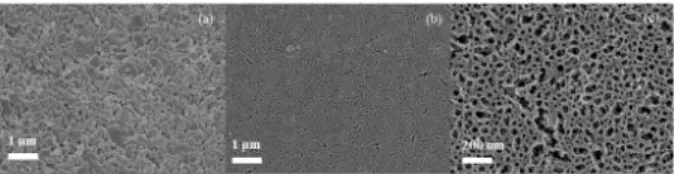
3.1. Structural characteristics of membrane Fig. 2 compares the surface morphology of bare and TiO
2immobilized hybrid composite ceramic membrane.
The pore of bare Al
2O
3support as provided from the supplier (Nano Pore Materials Co., Ltd.) was 100 nm.
A uniform, mesoporous and well organized TiO
2film with 50-70 nm pore size was immobilized on bare Al
2O
3support as demonstrated in Fig. 2 (b and c). The pre-coating of PVP on bare Al
2O
3support provided a flat platform for the development of photocatalytic film with least pore-infiltration, hence homogenous surface coverage was observed as shown in Fig. 2 (b).
Meanwhile, the amphiphilic PVC-g-POEM copolymer helped to form mesoporous TiO
2structure during sol-gel and calcination process.
Fig. 1. Schematics of experimental set-up of photocatalytic membrane reactor.
Fig. 2. Surface SEM images of (a) bare Al
2O
3membrane,
(b) TiO
2immobilized hybrid composite membrane, and (c)
magnified image of (b).
3.2. Water permeation and photocatalytic activities Before the treatment of feed solution, the perme- ability of bare Al
2O
3support and TiO
2immobilized hybrid composite ceramic membranes was compared.
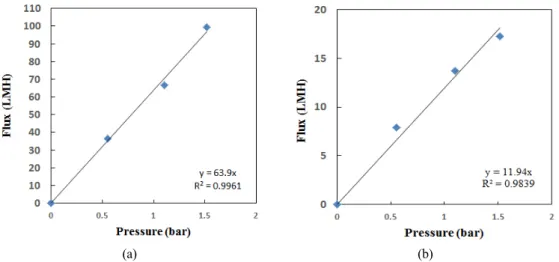
As shown in Fig. 3, the permeability of bare Al
2O
3support was decreased significantly after the immobili- zation of TiO
2film on it. The permeability of bare Al
2O
3support was observed to be 63.9 L m
-2h
-1bar
-1, but it decreased to 11.9 L m
-2h
-1bar
-1with TiO
2im- mobilized hybrid composite membrane. The corre- sponding values of membrane resistances for bare and TiO
2immobilized hybrid composite membrane were 6.2 × 10
12and 4.9 × 10
13m
-1, respectively. The mem- brane resistance was calculated using Darcy’s equation as given below[20] :
R
mJ P
(1)
Our SEM observation confirmed that the pore size of membranes decreased from 100 nm to 50-70 nm for the bare Al
2O
3and TiO
2composite ceramic membrane, respectively. This result indicates that the pore size re- duction should provide resistance against permeate flow through membrane[21].
The influence of photolysis with organic dye com- pound on membrane fouling and its removal efficiency
through membrane was investigated by filtering the Congo Red solution after 12 h photolysis. Results are shown in Fig. 4. The membrane filtration under dark conditions (without UV illumination) revealed that the ratio of J/J
0was slightly higher after photolysis of dye compound than before it, as shown in Fig. 4 (a).
Approximately 21% and 26% flux decline was ob- served by the filtration of dye solution before and after photolysis, respectively. The same trend was observed that the removal of dye compound through TiO
2com- posite ceramic membrane was slightly increased after the photolysis of dye compound. The removal effi- ciency of dye compound increased from 43% (before photolysis) to 54% (after photolysis). Possible ex- planation is that the intermediate products during pho- tolysis of dye compound should be formed and they may competitively adsorb in the membrane due to their smaller size[22,23]. The intermediate product may also form by the photolysis of water molecules, producing reactive radicals such as HO
., H
., and the hydrate elec- tron[24]. The interaction of these strong radicals with Congo Red dye molecules has found to produce hy- droxyl and naphthalene intermediate compounds[25].
Further works in analyzing intermediate after photol- ysis of dye compound through membrane are required.
In order to examine the photocatalytic activity only of TiO
2immobilized composite ceramic membrane de-
(a)(b)
Fig. 3. Comparison between the permeability of (a) bare Al
2O
3support and (b) TiO
2immobilized hybrid composite
membrane.
veloped in this study, the photocatalytic degradation of the organic dye through the pre-adsorbed membranes was observed. Fig. 5 demonstrates the significance of TiO
2film with respect to the degradation efficiency of organic compound. During the 5 h membrane filtration under UV illumination, degradation of dye compound was achieved almost completely with TiO
2immobilized composite ceramic membrane. However there was only 28% of organic removal efficiency with the bare Al
2O
3support as shown in Fig. 5 (a). The higher removal ef- ficiency of organic compound through TiO
2immobi-
lized composite ceramic membrane can be attributed to the photocatalytic degradation of dye compound on the membrane under UV illumination[26]. To further eluci- date the photocatalytic degradation rate of the mem- branes towards Congo Red, the kinetic study was car- ried out using Langmuir-Hinshelwood pseu- do-first-order kinetic model[27]. The Langmuir- Hinshelwood model equation has been proven to ap- propriate model to estimate the simple photodecom- position rate as shown in eq. 2[28].
(a)
(b)
Fig. 4. Effect of filtering feed solution through TiO
2immobilized hybrid composite membrane after 12 h photolysis on (a) membrane fouling, and (b) organic dye removal (without UV; filtration time: 30 h), J
0is initial permeate flux and J is per- meate flux after 30 hr filtration.
(a)
(b)
Fig. 5. (a) Photocatalytic degradation profile of Congo Red and (b) kinetic linear fitting curves of Congo Red degradation
through bare Al
2O
3support and TiO
2immobilized hybrid composite membrane under UV illumination.
l n
(2)
Where C
o(mg/L) represents the initial concentration of Congo Red tested, C (mg/L) denotes the concen- tration of Congo Red in membrane permeate at time t (min) and k is the rate constant (min
-1).
Table 1 provides the comparison of rate constant be- tween the bare Al
2O
3support and TiO
2hybrid compo- site ceramic membrane. The rate constants were 0.0013 (min
-1) and 0.0081 (min
-1) for the bare Al
2O
3support and TiO
2hybrid composite ceramic membrane, respectively. The associated correlation coefficients (R
2) were found to be 0.86 and 0.97 in the case of bare and composite membrane, respectively. This result confirms the beneficial aspect of TiO
2immobilized composite ceramic membrane fabricated with graft co-polymer combined with UV irradiation for the treat- ment of organic dye compounds.
4. Conclusion
The TiO
2immobilized hybrid composite ceramic membrane was successfully fabricated using PVC-g- POEM graft copolymer as polymeric template. The permeability of the membrane was reduced by the for- mation of TiO
2film on Al
2O
3support. The evaluation of membrane characterization revealed that the pore size of the Al
2O
3support decreased after TiO
2immobilization. The TiO
2immobilized composite ce- ramic membrane showed excellent photocatalytic activ- ity and almost complete dye degradation was achieved within 5 h of filtration under UV illumination. The ki- netic degradation was consistent with the Langmuir- Hinshelwood model and rate constant with TiO
2immo-
bilized hybrid composite membrane was approximately 6 times higher than with the bare Al
2O
3support (0.0081 vs. 0.0013 min
-1). Future works in analyzing intermediates through membrane filtration and observ- ing performance of the TiO
2immobilized composite ceramic membrane developed by other types of graft copolymer are needed.
Acknowledgements
This research was supported by the project titled
“Manpower training program for ocean energy” funded by the Ministry of Oceans and Fisheries, Korea.
Reference
1. J. Guo, A. Sotto, A. Martín, and J. Kim,
“Preparation and characterization of polyethersulfone mixed matrix membranes embedded with Ti- or Zr-incorporated SBA-15 materials”, J. Ind. Eng.
Chem., 45, 257 (2017).
2. M. Aslam, A. Charfi, G. Lesage, M. Heran, and J.
Kim, “Membrane bioreactors for wastewater treat- ment: A review of mechanical cleaning by scour- ing agents to control membrane fouling”, Chem.
Eng. J., 307, 897 (2017).
3. H. Zhao, H. Li, H. Yu, H. Chang, X. Quan, and S. Chen, “CNTs-TiO
2/Al
2O
3composite membrane with a photocatalytic function: Fabrication and en- ergetic performance in water treatment”, Sep.
Purif. Technol., 116, 360 (2013).
4. H. Zhang, X. Quan, S. Chen, and H. Zhao,
“Fabrication and characterization of silica/titania nanotubes composite membrane with photocatalytic capability”, Environ. Sci. Technol., 40, 6104 (2006).
Bare Al2O3 support 0.0013 0.86
TiO2 composite ceramic membrane 0.0081 0.97