DAEHAN HWAHAK HWOEJEE
(Journal of the Korean Chemical Society) Vol. 13, Number 4, 1969
Printed in Republic of Korea
Graftpolymerization of Methacrylamide onto Silk
by
Jyong Sup Shim* and Young Duk Kim**
* Department of Chemical Engineering, College of Engineering, Seoul National University, Seoul
* * Tong Yang Nylon Co., Ltd.
(Received November 25, 1969)
絹에 對한 Methacryl 이 nide 의 그라프트 重合에 關한 硏究
서울大學校 工科大學 化學工學科
沈 貞 燮
東洋 나일롱 工業株式會社
金 英 德
(1969. 11. 25 接受)
요 약
Ceric salt 를 觸媒로 使用하여 여 러 가지 反應條件下에 서 絹布上에 Methacrylamide 를 grafting 시키 고, Schweitzer 試藥에 依한 溶解性및 赤外線吸收 스펙트럼을 比較檢討하여 그라프트重合物의 生成을 確認하였다. 그라프트率은
溫度, 反應時間 및 Monomer 濃度가 增加함에 따라 增加하였으며 그라프트率을 極大化하는 最適의 pH 値가 있음
을 알았다. 그라프트率에 關한 理論式을 誘導하고 그 結果를 檢討하였다.
1. INTRODUCTION
It is well known that tetravalent ceric salts form very effective redox system with alcohol, glycol, aldehyde, amine etc., and a number of studies have been made on the mechanism of the reactions.⑴■⑴ jn the case of alcohols, the mechanism of initiation is
(Ce gJ+RCHQH^Bgg—fCe11 + H+ + CHOH (or CHQ •)
where X is OH- or NO厂 or HQ, Bcomplex is ceric- alcohol complex.
In the reaction above, if reducible high polymer is used in place of alcohols, free radicals formed on it can initiate graft polymerization in the presence of vinyl monomers.
Since G. Mino and S. Kaizerman found that acry
lonitrile and acrylamide can be 흥rafted onto polyvinyl alcohol by this mothod, there were many studies on grafting vinyl monomers to polyvinyl alcohol7^ cotton,
paper。'),silk <12\ starch <13) etc.
But, as no experiments has been made using metha
crylamide (MAA) as monomer, the authors grafted it to silk by ammonium ceric nitrate(ACN); the effects of monomer and initiator concentration, reaction time, temperature and pH of reactants are investigated.
Silk is a sort of polypeptides mainly comprised of glycine, alanine and thyrosine; when the secondary
NH+Ce"二=%3睥”—*-N- +Ce"' CO- M 디 2=C<양
--- ;Graft polymer
365
366 沈貞變•金英德 amides of silk react with ceric salts, free radicals can
be formed and in the presence of vinyl monomers, it is supposed that graft polymers can be occurred as follows.
2. EXPERIMENTAL (1) Materials
MAA (EASTMAN) was recrystallized twice from benzene solution and dried in vacuum desiccator for 48 hours (m. p. 103°C).
ACN (MERCK) was used without further purifica
tion.
Silk fabric (white, plain, density; warp 120 ends/
inch, weft 120 picks/inch, 50 denier) was scoured in boiling water dissolved 8 parts of monogen and 2 parts of soda ash for 100 parts of silk by weight for 2. 5 hours. After sericine was removed, silk was washed with hot and cold water sufficiently, dried at 105°C until the weight is constant, then weighed;
it was made the weight of silk untreated.
Schweitzer's reagent was prepared as follows; 50g.
of copper sulfate was dissolved in 300 ml of hot distilled water and cooled. Copper hydroxide was precipitated by adding ammonium hydroxide dropwise, and stopped adding it just before copper hydroxide formed was dissolved again, when the colour of solution changes to blue. The precipitate was filtered off, washed with water and dissolved in 25% ammo
nium hydroxide.
(2) Grafting procedure
About 0. 5 g of silk, accurately weighed was placed in a 500 ml of erlenmeyer with 휴q・ s시ution of monomer, the pH of which was adjusted with dil.
HN03 and warmed to 50°C in a water bath. Nitrogen gas washed twice with potassium pyrogallate was passed through the reaction apparatus at the rate of 2 1/min for 5 min. Stock solution of ACN was added and total volume of the solution was adjusted to be 100 ml. Nitrogen was passed for further 3 min, and graft polymerization was proceeded for a predeterm
ined time. The grafted silk was taken out of the reaction vessel and washed with hot and cold water in turns to remove homopolymer and dried at 105°C until the weight is constant. Percent graft was
defined as percentage of the weight increased by grafting per weight of silk untreated.
(3) Infrared spectrophotometry
Silk and 9.5% grafted silk were cutted as small as possible with scissors''。〉and dried at 105°C to be anhydrous. Spectra from pellets made of KBr and powdered silk were recorded with Perkin-Elmer infr
ared spectrophotometer model 137 B.
(4) Ultraviolet absorption spectra of ceric- amide complexes
Ultraviolet spectra of aq. solution of ACN(0. 01%), acetamide (0. 2%) and ACN-acetamide mixture were recorded with Beckman spectrophotometer model DK-2 respectively. Aq. solution of ACN-acetamide mixture was made by dissolving acetamide into aq. solution of ACN (0. 01%) so that the concentration of aceta
mide was to be 0- 2%. As reference solutions, disti
lled water was used for aq. solution of ACN and acetamide; for ACN-acetamide mixture, aq. solution of ACN and acetamide was used respectively. HN03 concentration of each solution was 1.3x10" M/1.
(5) Determination of ceric ion concentration The concentration of ceric ion in 1% acetamide aq.
solution was measured at 400m^ with color-Eye model C(Instrument Development Lab. Inc.). At this wave length the absorption of acetamide was found to be negligible by preliminary examination.
3, RESULTS AND DISCUSSION (1) Effect of grafting time on percent graft Effect of 홍rafting time on percent graft was shown in Fig. 1. The reactions were carried out at 50°C and the increase in percent 응raft with time was observed.
The cone, of ACN, MAA and HN03 used was 2. 5x ML, 1, 1. 3x 10-s M/1 respectively.
It was found by preliminary experiments that proper temperature of reaction was 50°C. At lower temperature than 30°C little graft polymer is produced and at higher temperature than 60°C ACN is reporte치y unstable. (ll)
On this condition, it is ascertained by blank test that thermal polymerization is not occurred, though
Jgmal of the Kern끄 Chemical Society
絹에 대한 Methacrylamide그라프트 重合에 關한 硏究 367
homopolymer of MAA is produced in the presence of ceric salt.
As the reaction proceeds, the rate of grafting decr
eased. The reasons are the cone, of ACN, MAA and the amounts of amides on the silk decreases with time. <ll>
of using amides as a reducing materials, the optimum HNQi concentration seems to be 1. 3 x 10⁻²M/l.
=e uj
®d
고二 °
듷
1.5 2.0 2.5 3.0
2k •
°o---so 60 志 120 150
Time (min)
Fig. 1 Effect of Reaction Time아 Gracing,새AA = 1 서/L ACN=2.5xlO~m너/], 小네。3=L2xl(厂2 "I, Temp.=50°C
(2)Effect of HN03 concentration
Fig. 2 illustrates the effect of HN03 concentration on grafting. Percent graft reaches maximum at HN03 concentration of L3xlO"M/l and decreases with increasing HN03 but at hi흥her concentration than 2. 1
x 10-2 lvi/1 the amount of grafting decreases little.
It is supposed that the oxidizing rate of amide by ceric salt depends on the pH of the solution<4),(5) and the amounts of free radicals produced on the silk in a definite time depends on HN03 concentration; the ma
ximum amount of grafting is obtained at optimum condition of pH. If it is true, the rate of reduction of ACN must be maximum at identical pH value, because the amounts of free radicals formed are directly proportional to the amounts o£ ACN decreased.
In order to ascertain this fact, the concentration of ACN in 1% acetamide aq. solution of different pH value was measured at proper time intervals (see table I); the results show that the rate of reduction of ACN was maximum at 1. 3x IO-2 M/1 too, although the sorts of amides are different; this causes possibly the maximum percent graft in Fig. 2 and in the case
[HNO3] X102(M/l)
Fig. 2. Effect of HNO3 Concentrationon Grafting, Ni샤*、= ' M/1, ACN=2. 5x I。-' M/1, Time = l hr., Temp.
=50°C
TABLE 1. Effect of HNO3 Concentration on the R하e*
of Reduction of Ceric Saif in \% Acetamide Solution (Reaction Temp, =50°C)
、Cone, of VjINOsxl02 ReaF"巴D Time(Min.5、
Concentration of Ce x 103 (M/1)
0* 0.8 1.3 2.2
0 2. 50 2. 50 2. 50 2. 50
10 2. 50 1.83 1.37 1.73
20 2. 50 1.60 1.25 1.60
30 2. 50 1.54 1. 20 1.46
60 2. 50 1.49 1.14 1.37
* In distilled water without amide
(3) Effect of monomer concentration
The effect of monomer concentration on grafting is shown in Fig, 3. At higher concentration than 5%, slight increases in percent graft occurred.
In all cases, homopolymer was produced as a bypro
duct, but the amount was considerably decreased at lower conentration of monomer than 2%. Homopol
ymer was precipitated by adding methanol in the solution and its presence was confirmed.
(4) Effect of ACN concentration on 흥rafting Grafting was performed at various concentration of ACN from 0. lxlO-3 to 3xl0~3 M/1. As can be Vol. 13, No. 4, 1969
338 沈貞安•金英徳
MAA (%)
Fig. 3 Effect of 새AA Concentration on Grafting, ACN — 2.5X10⁻³ M/1, HNO3 =L3X 10~2、시、、Tin由 =1 hr. , Temp. ==50°C
observed in Fig. 4, percent graft was increased with increasing ACN concentration up to 0. 3x 10~3 M/1.
But at higher concentration it was decreased until ACN concentration was 1 x 10~3 M/1, thereafter in
creased again. When more than 2x IO-3 M/1 of ACN was used, it increased sharply. This experimental result is a little strange. For comparison, grafting was performed at fixed ACN concentration of 0. 5x IO-3 M/1, while the amount of silk to be grafted was varied from 0.1 to 1. 0 g. The results are shown in Fig.
5, where the amount of grafting reached maximum when 0.74 g of silk was used; when the ratio of ACN to silk was nearly equal to that of local maxi-
[ACN]XIO3 (M/1)
fig. 4 Effect of ACN Concentration on Grafling, MAA=]
M/1, HNO3=1.3 X10⁻² M/1, Reaction Time=l hr. , Temp. —50°C
Ol---1____ I_____I 1 " I____ 1 I_________ L_
0 1 23456789
Wt. of Silkx10(g)
Fig. 5 Effect ofthe Weight of Silk on Grafting at Cansta하 ACN Concentration, 새AA = 1 M/1, HNO3 =1.3x 10~2 t시'、Time=l hr. Temp. =50°C
mum in preceding experiments(Fig. 4). This indicates that there exists optimum ratio between the weight of ACN and silk for a maximum percent graft.
The mechanism of initiation by ceric salts may be written as follows;
〜CO—NH 〜+piex~—R(> + CeH + H*
…,…:... (a) where R。is〜CO—is ceric-amide complex.
Since tetravalent cerium has coordination number of six, there is a possibility that six sorts of ceric- amide complexes can be formed. But at lower conce
ntration of amide and ACN, it is supposed that 1 : 1 complex is formed exclusively as in the case of alcohols.
Generally the mechanism of propagation and term- indiation can be written as follows:
as follows:
propagation; + 쓰...
R”+M上成宀...(c) termination; R’ + Cb 스fPr+C/+H+...(d) R『 +R'r一一*已+P'『...(小)
%+町一一>P“...愛) where M, R and P represent monomer, growing side chain and dead polymer (sidechain) respectively.
C. Mino⑵ and R. A. Wallace(17) have shown that in the presence of ceric salt termination is occurred exclusively by the reaction (d).
Journal cf the Korean Chemical Society
絹에 대 한 Methacrylamide 의 그라프트 重合에 關한 硏究
The equations for reactions are therefore -d^/dt=k^TC^ ...(1) 一日[Cat[/d,=^[N兀Cat] + &[R][Ca口 ……(2) where [N] is the concentration of accessible secondary amides of silk and is the overall rate constant of initiation.
一幻/d捉m臨:RJ:M] ...(3)
』口履/我=妇不兀Cat] —"RHCat] ...(4) At steady state,
(汇R:/出=0 and = 辰)[NJ ...(5) Substitution of eq. (5) into (2) and (3) gives
一就Cat]/S=2 虹 N:兀 Cat]...(6)
—亦M]/出=(&岛/,妃汇N冗M] ... (7) from eq. (6) and (7), we obtain
dM/t瓦 Cat]=0>/2妃汇MMZCat]
or
where [M]。and [Cat]。is initial concentration of monomer and ACN respectively.
Then, from the definition of percent graft, Percent Graft=([M]0-[MJ)/Wx 100
=g〔M([Cat]/[CatW心〕冲
x 100...(8) where W is the weight of silk ungrafted.
Eq. (8) shows that percent graft in a definite reaction
369 time reaches local maximum with increasing [N]。,
at the range of 2[N^j0> (Cat)0 ([NJ。is the initial conc
entration of [Nj and [Cat% <1), if the reaction time is chosen adequately and kp<^kt (which is the general case); on these conditions, the plot of eq. (8) is coinci
dent with Fig. 5 in shape. Since eq. (8)is based on an assumption that growing side chain is terminated by ceric salt, we think, the above coincidence shows our assumption is right.
In the polymerization procedure, homopolymer is produced a little.
But since monomer consumed for grafting is little comparing to its initial amount, homopolymer may be disregarded in the derivation of eq. (8); on this condition the amount of homopolymer produced as a byproduct is nearly constant throughout the experiments of Fig- 5.
(5) Solubilities and infrared spectra of silk and grafted silk
Silk and grafted silk were immersed in Schweitzer's reagent at room temperature; untreated silk was disso
lved within 5 minutes, while grafted silk was not dissolved in 12 hours, but swollen.
0
2000 1500 1000 900
Wave number, cm-1 Fig. 6 Infrared Spectrum of 山Ure하ed Sillc
Vol. 13, No. 4, 1969
370 沈貞燮•金英德
o
o
o
c 8
6
4
2 (次 )S U E 은으
』
u• u° q§ qv
.10 C
4000 3000 2000 1500
Wave number, cm-1
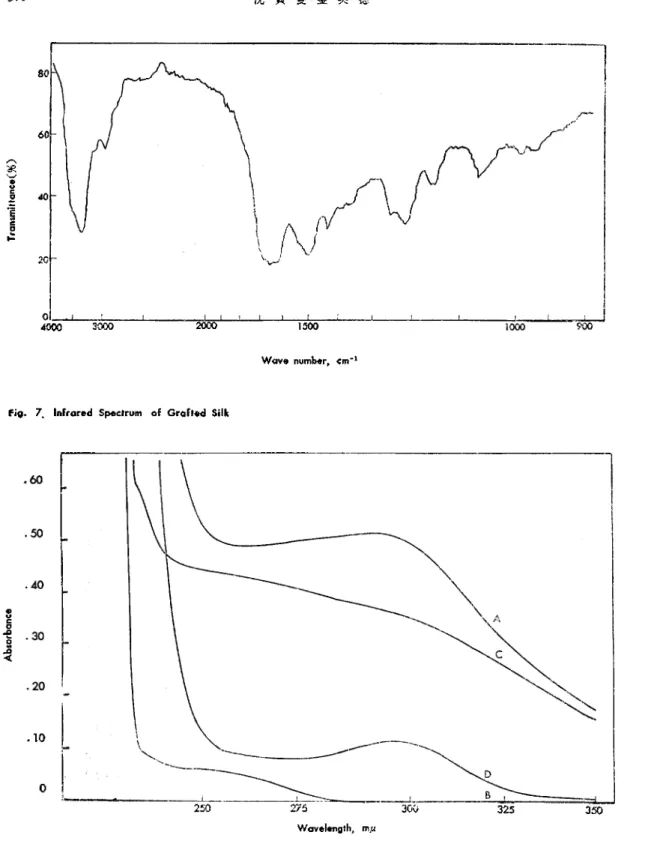
Fig. 7. Infrared Spectrum of Grafted Silk
250 275 300 325 350
0
Wavelength, rn “
Fig. 8. Ultra Viotet Abs이•기ion Spectra A=ACN, 됴=Acetan詩de, D = ACN-Acetamide Mixture (Reference Solution:A)
C=ACN-Acelamide Mixture (Reference Sofution:B)
Journal of the Korean Chemical Society
絹에 대 한 Methacrylamide 의 그라프트 重合에 關한 硏究 The infrared spectra of silk and grafted silk are
shown in Fig. 6 and 7. Grafted silk shows much less absorption at 3400 cm-1 assigned to N-H stretching vibration of secondary amides and at 1256 cm-1 prob
ably due to amide III absorption than does untreated silk. From these results, the occurrence of true graft polymer can be certified and the sites o£ grafting are supposed to be the secondary amides on the silk.
(6) Ultraviolet absorption spectrum of ceric- amide complex
Duke⑶ and G. Mino(6) have shown that ceric salts form complexes with alcohols, and that free radicals are formed by the disproportionation of the complexes.
As the nitrogen atom of amides has one unshared pair of electrons, it can possibly form complex with ceric salts; it is supposed that amides of silk are oxidized through disproportionation of the complexes. To prove this, UV spectra were investigated (Fig. 8);
in Fig. 8, curve A and C, B and D must be coincident each other respectively according to Lambert-Beers' law, if there is no chemiai reaction between amide and ACN. But since they are not coincident each other, it is proved that ceric-amide complex is really occurred.
From these results, it can be proved indirectly in that amides of silk form complexes with ACN.
4, REFERENCES 1) M. Arden, J. Chem. Soc., 1811(1959)
2) G. Mino, S. Kaizerman, J. Am. Chem. Soc., 81, 1494 (1959)
3) F. R. Duke and R. F. Bremer, J. Am. Chem.
Soc., 73, 5179(1951)
371 4) G. Hargreaves and L. H. Sutcliffe, Trans. Farad
ay Soc.、51, 1105 (1955)
5) G. Mino, S. Kaizerman and E. Rasmussen, J.
Poly. Sci., 38, 393 (1959)
6) G. Mino and S. Kaizerman, J. Poly. Sci., 31, 242 (1958)
7) M. Negishi, Y. Nakamura and R. Z. Kimura, J.
Appl. Poly. Sci., 5, 563 (1961)
8) G. Mino, S. Kaizerman and L. F. Meinhold, Textile Research J., 32, 137 (1962)
9) G. N. Richard, J. Appl. Poly. Sci., 5, 539 (1961)
10) H. Kamagawa, T. Sekiya, Textile Research J., 31, 585 (1961)
11) E. Schwab, V. Stannet, D. H. Rakowitz and J. K.
Margrane, Tappy., 45, 390 (1962)
12) H. Sugiyama, R. Murase, Biclletin of the Textile Research Inst. (Japan), 70, 37, (1964)
13) Z. Reyes, C. E. Rist, and C. R. Russel, J. Poly.
Sci. A., 4, 1031 (1966)
14) R. H. Wiley, W. E. Waddy, Org. Sym, 29, 61(1949)
15) I. Fumoto, J. of 아M Society of Fibre Sci. and Technologyt Japan, 21, 590 (1965)
16) G. C. Tesoro, J. Appl. Poly. Sci., 5, 721 (1961) 17) R. A. Wallace, D. G. Young, J. Poly. Sci. A,
4, 1179 (1966)
The authors are grateful to Tae Ok Shong of textile section, National Industrial Research Institute for her good advices through。느t this work.
Vol. 13, No. ‘4, 1969

![fig. 4 Effect of ACN Concentration on Grafling, MAA=]](https://thumb-ap.123doks.com/thumbv2/123dokinfo/5035948.553521/4.918.390.760.264.509/fig-effect-acn-concentration-grafling-maa.webp)