플랜트 PRM (Project Risk Management) 체크리스트 항목 선정을 위한 연구
최두회1·방홍순1·이태형1·김옥규*
1충북대학교 건축공학과
A Study for Selecting the Plant Project Risk Management Check List
Choi, Doo-hoi1, Bang, Hong-soon1, Lee, Tae-hyeong1, Kim, Ok-kyue*
1Department of Architectural Engineering, Chungbuk University
Abstract :
Currently, as construction businesses develop and diversity, risk became one of the most crucial considerations.Risks are potential and difficult to predict by nature. Also, they are important as they influence delay in construction period and increase of project costs. In construction projects in South Korea and elsewhere, the importance of risk management widely recognized and relevant research is being conducted continuously. The companies use PRM checklist but apply different criteria and items. For efficient risk management in plants, plant PRM checklist is necessary. This study analyzed risk factors that are taken into account in construction projects and proposed a plant PRM checklist based on case analysis and opinions of experts. Also, it rated the frequency and importance of each risk.
Keywords :
Risk, Project Risk Management, Check List1. 서론
1.1 연구의 배경 및 목적 1.1.1 연구의 배경
건설사업의 발전으로 인하여 대형화·복잡화·첨단화 가 이루어지면서 관심을 가져야할 분야 중 하나가 리스크이 다. 리스크들은 잠재적인 성격을 가지고 있으며, 예측하기 가 어렵다. 사업기간의 지연, 사업비 초과 등 사업의 성패를 크게 좌우하게 되며, 사업 진행과정 중 발생할 수 있는 수많 은 리스크 요인들에 대한 방지대책이 필요하다. 국내·외 건 설 사업에서는 리스크 관리에 대하여 중요성을 인지하고 있 으며, 리스크에 관한 분석, 기법 등 다양한 연구가 지속적으 로 이루어지고 있다. 리스크관리가 필요한 만큼 각 건설사에 서는 리스크 방지를 위해 각 회사별로 노력을 한다. 리스크 발생 사전대비를 위해 사용 하는 방식 중 체크리스트가 중요 성을 가지고 있다. 그에 따라 각 건설회사에서는 리스크의
요인을 분석하여 미리 방지하기 위하여 PRM (Project Risk Management)체크리스트를 작성 및 사용한다. PRM 체크리 스트란 사업 하나에서 발주부터 완공까지의 전체적인 부분에 서 대분류부터 소분류까지 분류를 하여 리스크의 요인들을 만든 체크리스트로써, 사업의 성패를 크게 좌우 하는 요인 중 하나이다. 허나, 각 건설회사별에서 중요시 하는 리스크의 요 인은 다르며, PRM 체크리스트 항목조차 다르다. 따라서 합 리적인 PRM 체크리스트의 항목을 제시하기위해 실제로 일 어난 리스크요인별 현장사례와 리스크 관련 업종의 전문가들 의견을 종합하는 것이 매우 중요하다.
1.1.2 연구의 목적
본 연구에서는 PRM 체크리스트의 항목선정을 목적으로 하며, 선행연구인 ‘PRM 체크리스트항목 선정을 위한 기초연 구’
1)의 체크리스트 개선을 제안하여 플랜트 PRM 체크리스 트를 수립하고자 한다. 기존연구는 문헌에 관하여 논문조사 를 통해 진행이 되었으며, 실제적인 플랜트 회사에서 사용하 는 리스크 요인을 분석하여 선정된 항목들을 가지고 논문을 진행함으로써, 회사에서 실제적으로 적용할 수 있는 체크리
* Corresponding author: ok-kyue, Department of Architectural Engineering, Chungbuk University, Chungbuk 135-080, Korea E-mail: [email protected]
Received July 5, 2017: revised October 16, 2017 accepted December, 14, 2017
1)PRM(ProjectRiskManagement)체크리스트항목선정을위한기 초연구(Bangetal,.2017).
스트를 만들자 한다. 이를 위해 플랜트 현장사례의 리스크데 이터를 수집하고, 그에 따라 실제 현장사례의 리스크요인별 로 분석을 하고, 발생빈도와 리스크 요인별 중요도 파악을 실 시한다. 또한, 리스크 관련 전문가 종합설문조사를 통하여 각 리스크별 중요도 분석을 통한 체크리스트를 제안 하고자 한다.
1.2 연구의 범위 및 방법
본 연구는 플랜트사업에서 고려되는 위험요인을 분석 하여 PRM 체크리스트의 항목선정을 함으로써, 플랜트 현장사례 와 전문가 의견을 종합을 하여 체크리스트를 완성 시키는 것 을 <Fig. 1>과 같이 연구의 범위와 목표로 한다.
Fig. 1. Research methods and procedures
<Fig. 2>와 같이 선행연구 및 플랜트 전문회사의 리스크요 인을 도출하여, PRM 체크리스트를 작성한 것을 현장사례 적 용 및 설문조사를 통하여 플랜트 PRM 체크리스트 작성을 목 표로 한다.
Fig. 2. Risk factor derivation diagram
연구는 다음과 같은 단계로 진행한다.
첫째, 리스크관련 선행연구, 서적, 보고서 등의 자료를 분 석하여 리스크관련 모든 위험요인을 조사한다.
둘째, 조사된 위험요인을 통합 정리 후, 각 단계별로 위험 요인을 도출한다.
셋째, 그에 맞는 선행연구를 선정 후, 분석하여 리스크요인 을 도출 및 정리한다.
넷째, 플랜트 전문회사 A의 리스크요인을 정리 후, 선행연 구에서의 요인과 통합한다.
다섯째, 플랜트 현장사례 적용 및 분석을 통하여, 리스크 요인을 재정리 후, 설문조사 및 전문가 의견을 통합하여 플랜 트 PRM 체크리스트를 제안한다.
1.3 선행연구 1.3.1 선행연구고찰
오늘날의 리스크는 건설분야가 발전할수록 관심을 가져할 큰 분야중 하나이다. 각 건설회사에서는 리스크의 방지를 위 해 PRM(프로젝트 리스크 매니지먼트) 체크리스트를 작성한 다. 허나, 각 건설회사별로 PRM 체크리스트 의 기준이 다르 고, 또한 목록조차 다르다는 것을 확인 할 수 있다. 이에 본 연구에서는 각 건설회사별 PRM 체크리스트 항목 선정을 위 해 기준을 만드는 것을 개발하고자 하며, 이에 대한 선행연구 로써 건설회사의 PRM 체크리스트 기준을 개발하였다.
1.3.2 선행연구 분석 및 리스크요인도출
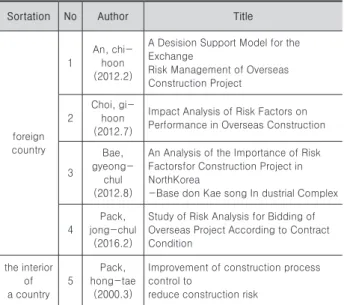
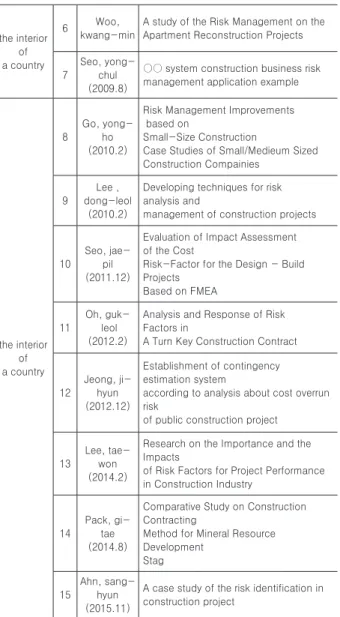
선행연구의 리스크 요인 도출을 위하여 각종 리스크 관련 15개의 선행연구를 국·내외로 분류하여 다음 <Table 1>과 같이 정리 하였다.
Table 1. Advanced research selection
Sortation No Author Title
foreign country
1
An, chi- hoon (2012.2)
A Desision Support Model for the Exchange
Risk Management of Overseas Construction Project
2
Choi, gi- hoon (2012.7)
Impact Analysis of Risk Factors on Performance in Overseas Construction
3
Bae, gyeong-
chul (2012.8)
An Analysis of the Importance of Risk Factorsfor Construction Project in NorthKorea
-Base don Kae song In dustrial Complex
4
Pack, jong-chul
(2016.2)
Study of Risk Analysis for Bidding of Overseas Project According to Contract Condition
the interior of a country
5
Pack, hong-tae
(2000.3)
Improvement of construction process control to
reduce construction risk
the interior of a country
6 Woo,
kwang-min
A study of the Risk Management on the Apartment Reconstruction Projects
7
Seo, yong- chul (2009.8)
○○ system construction business risk management application example
the interior of a country
8
Go, yong- ho (2010.2)
Risk Management Improvements based on
Small-Size Construction
Case Studies of Small/Medieum Sized Construction Compainies
9
Lee , dong-leol
(2010.2)
Developing techniques for risk analysis and
management of construction projects
10
Seo, jae- pil (2011.12)
Evaluation of Impact Assessment of the Cost
Risk-Factor for the Design - Build Projects
Based on FMEA
11
Oh, guk- leol (2012.2)
Analysis and Response of Risk Factors in
A Turn Key Construction Contract
12
Jeong, ji- hyun (2012.12)
Establishment of contingency estimation system
according to analysis about cost overrun risk
of public construction project
13
Lee, tae- won (2014.2)
Research on the Importance and the Impacts
of Risk Factors for Project Performance in Construction Industry
14
Pack, gi- tae (2014.8)
Comparative Study on Construction Contracting
Method for Mineral Resource Development
Stag
15
Ahn, sang- hyun (2015.11)
A case study of the risk identification in construction project
각 선행연구별로 리스크 요인들을 도출하여 다음과 같은
<Table 2>에 표현하였다. 크게 4가지 기획관리, 설계관리, 시 공관리, 유지관리로 분류를 하고 그에 맞는 소분류로 리스크 요인을 정리하였다.
Table 2. Risk factors of prior research
Sortation Risk factor
Planning Manage- ment
Project case review, economic feasibility study, barrier identification, project marketability assessment, importance of the construction, level of competition, review of potential complaint, political stability, payment and scope of technology tax, preparation for claims/lawsuits, understanding of contract type/procedure, project cost plan/review, etc
Design manage- ment
Unclear detail design, suitability of the design time, possibility of purpose change, lack of expertise in client, lack of experience in designer, awareness of the client, awareness of the designer, lack of project management consignment, etc.
Construction manage- ment
Lack of specifications and standard, environmental issues, climate, construction permission, safety issues during construction, inadequate drawing review, lack of communication, etc.
Maintenance
Inappropriate subcontract, subcontractor qualification review, lack of organization and human resources, construction contract method, quality assurance and maintenance, possibility of natural disasters, other Force Majeure, on-site complaint management, etc.
<Table 2>에는 선행연구 15가지의 리스크요인을 정리하였 다. 플랜트 전문회사 A로 부터 리스크 체크리스트 정리하여 요청하였고, 플랜트 전문회사 A는 이에 따라 <Table 3>과 같 이 체크리스트를 작성하여 제안하였다.
Table 3. A proposal of a checklist on plant experts according to the literature review
Large category
Middle
category Low category
LocationRisk
Physical Risk
Topography, geological conditions Site conditions (local delivery, temporary jetty
required)
On-site construction license and permit
Labor - percentages of 3rd nationals and
locals
Differences in design conditions and site
conditions
Soil Investigation- including ground reinforcement
Yard supply conditions
Country Risk
Feasibility of local material supply - Pile,
reinforced concrete, concrete
:
Execution Risk
Commissioning performance risk
Etc
플랜트 전문회사 A에서 제시한 체크리스트 리스크요인은
95가지였으며, 통합된 리스크 요인을 도출하기 위하여 앞서
정리한 선행연구 15가지의 리스크 요인과 플랜트전문회사 A
에서 제안한 체크리스트의 내용을 다음 <Table 4>와 같이 통
합정리를 하였다. 종류는 크게 대분류, 중분류, 소분류로 구
분하였으며, 선행연구의 리스크요인과 플랜트 전문회사 A의
리스크 요인 체크리스트를 기반으로 정리를 진행하였다.
Table 4. Plant company A and a study on the analysis of 15 leading researches
Large category
Middle
category Low category Lntegration A 1 2
·
·
· 15
Location Risk
Physical Risk
Topography, geological conditions
4 1 1
Site conditions (local delivery, temporary jetty
required)
7 1 1
On-site construction
license and permit
7 1
Labor - percentages of
3rd nationals and locals
4 1 1
Differences in design conditions and site conditions
3 1
:
Etc Etc
Separate maintenance
method no dependence on
my nine year old
1
1.3.3 PRM 체크리스트 초안 제시
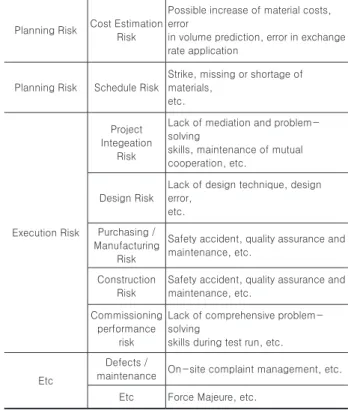
플랜트전문회사 A 체크리스트와 선행연구 15가지의 리스 크 요인들을 분석 및 분류를 진행하여 다음과 같은 리스크 분 류를 위 <Table 5>같이 정리 하였다. 요인들 중 5가지이상 겹 치는 요인들을 대분류 6가지, 중분류 14가지, 소분류 31가지 로 정리하여 PRM 체크리스트 초안을 제시하였다.
Table 5. PRM preliminary draft checklist
Large category
Middle
category Low category
Location Risk
Physical Risk
Site conditions, on-site construction license and permit, environmental issues,
etc.
Country Risk
Feasibility of local material supply, social
structure, relevant laws, market situation,
etc.
Financial Risk Financial Risk
Exchange rate fluctuation, questions on
funding or cash flow, etc.
Contract and Negotiation Risk
Contractual Risk
Contract discrepancy, dispute over ambiguity in contract scope, etc.
Project Requirement
Risk
Excessive demand of client, requirement
for excessive documents
Planning Risk Cost Estimation Risk
Possible increase of material costs, error
in volume prediction, error in exchange rate application
Planning Risk Schedule Risk
Strike, missing or shortage of materials,
etc.
Execution Risk
Project Integeation
Risk
Lack of mediation and problem- solving
skills, maintenance of mutual cooperation, etc.
Design Risk
Lack of design technique, design error,
etc.
Purchasing / Manufacturing
Risk
Safety accident, quality assurance and maintenance, etc.
Construction Risk
Safety accident, quality assurance and maintenance, etc.
Commissioning performance
risk
Lack of comprehensive problem- solving
skills during test run, etc.
Etc
Defects /
maintenance On-site complaint management, etc.
Etc Force Majeure, etc.
2. 본론
2.1 플랜트 PRM 체크리스트 작성 2.1.1 플랜트 현장사례 적용
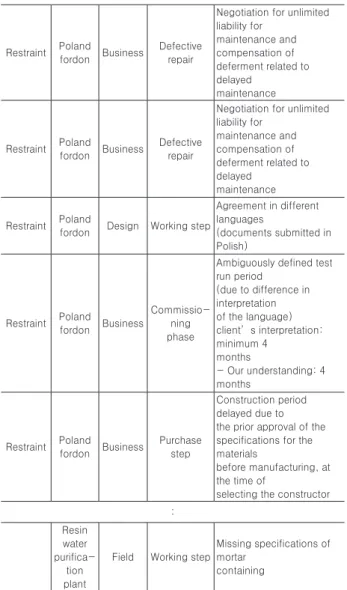
선행연구에서는 각종 15가지의 선행연구와 플랜트 전문회 사 A의 리스크 요인들을 기점으로 31가지의 소분류를 가진 PRM 체크리스트 초안을 제시하였다. 허나, 이 PRM 체크리 스트 초안은 현장에 적용 할 수 있는지의 근거와 동시에 전문 가의 의견이라고 하기엔 부족함이 있는 체크리스트라 판단된 다. PRM 체크리스트 초안의 리스크 요인들의 필요성에 대한 확신과 추가적인 사례를 나타내기 위해 먼저, 플랜트 현장사 례를 적용하기 위해서 선행연구에서 제시한 PRM 체크리스 트 초안을 현장사례에 적용하고자 하였다. 실제 리스크 발생 시점에 관여할 수 있는지를 파악하기위해, 플랜트 전문회사 A의 플랜트 현장사례를 파악하고, 그에 따른 내용을 다음과 같은 <Table 6>에 정리하였다.
Table 6. Plant site example
Sortation Project Process Detail
phase Risk factor
Restraint Poland
fordon Business Working step Outstanding receivables
Restraint Poland
fordon Business Defective repair
Negotiation for unlimited liability for
maintenance and compensation of deferment related to delayed
maintenance
Restraint Poland
fordon Business Defective repair
Negotiation for unlimited liability for
maintenance and compensation of deferment related to delayed
maintenance
Restraint Poland
fordon Business Defective repair
Negotiation for unlimited liability for
maintenance and compensation of deferment related to delayed
maintenance
Restraint Poland
fordon Design Working step
Agreement in different languages
(documents submitted in Polish)
Restraint Poland fordon Business
Commissio- ning phase
Ambiguously defined test run period
(due to difference in interpretation of the language) client’s interpretation:
minimum 4 months
- Our understanding: 4 months
Restraint Poland
fordon Business Purchase step
Construction period delayed due to the prior approval of the specifications for the materials
before manufacturing, at the time of
selecting the constructor
: Resin
water purifica-
tion plant
Field Working step
Missing specifications of mortar
containing
다음과 같은 <Table 6>는 플랜트 전문회사 A의 플랜트 관 련 현장사례 231가지를 나타낸 표이다. 플랜트 관련 현장사 례에 PRM 체크리스트 초안에 적용함으로써, 추가적인 리스 크요인과 중요한 리스크 요인을 구분 할 수 있다.
Table 7. Case study of plant site Unique
number Project Process Detail
phase Risk factor
9 Poland
fordon Business working step Outstanding receivables
38 Poland
fordon Business Defective repair
Negotiation for unlimited liability for
maintenance and compensation of deferment related to delayed
maintenance
38 Poland
fordon Business Defective repair
Negotiation for unlimited liability for
maintenance and compensation of deferment related to delayed
maintenance
38 Poland
fordon Business Defective repair
Negotiation for unlimited liability for
maintenance and compensation of deferment related to delayed
maintenance
32 Poland
fordon Design Defective repair
Agreement in different languages
(documents submitted in Polish)
32 Poland
fordon Business
Commissio- ning phase
Ambiguously defined test run period
(due to difference in interpretation of the language) client’s interpretation:
minimum 4 months
- Our understanding: 4 months
40 Poland
fordon Business Purchase step
Construction period delayed due to the prior approval of the specifications for the materials
before manufacturing, at the time of
selecting the constructor
:
27
Resin water purificat ion plant
Field working step
Missing specifications of mortar
containing
체크리스트 초안에 각 리스크요인(소분류) 별로 고유번호
를 매김으로 플랜트 관련 현장사례에 적용을 진행 하고자 한
다. 총 231가지의 플랜트 관련 현장사례에 고유번호를 입력
한 선행연구의 PRM 체크리스트 초안의 내용을 입력하여 다
음 <Table 7>과 같은 표로 정리 하였다. 선행연구의 PRM 체
크리스트 초안의 리스크 요인 31가지로써, 231가지의 플랜트
관련 현장사례에 해당되는 리스크 요인은 27가지다. PRM 체
크리스트 초안의 약 87%의 리스크요인이 해당됨을 확인 할
수 있으며, 플랜트 관련 현장사례를 통해 필요 리스크요인이
10가지 추가되었다. 플랜트 관련 현장사례를 통하여 선행연
구의 PRM 체크리스트 초안 31가지의 리스크 요인에서 41가
지의 리스크요인을 갖춘 PRM 체크리스트가 만들어 진다. 41
가지의 리스크 요인을 갖춘 PRM 체크리스트는 대분류 6가
지, 중분류 14가지, 소분류 41가지로 구성이 되어있으며, 플
랜트 관련 현장사례에서 추가적으로 생긴 리스크요인이 있는
반면, 플랜트 전문회사 A와 선행연구에서 걸러진 리스크요인
을 추가하여, 다음과 같은 <Table 8>에 정리하였다.
Table 8. Checklist for PRM after application of plant sites
Large category
Middle
category Number Low category
Location Risk
Physical Risk
1 Site conditions (local delivery, temporary jetty required)
2 On-site construction license and permit
3 Environmental issues
Country Risk
4
Feasibility of local material supply - Pile,
reinforced concrete, concrete
5 Social structure - security, racial issues, etc.
6 Relevant laws, market situation 7 Language communication problem
:
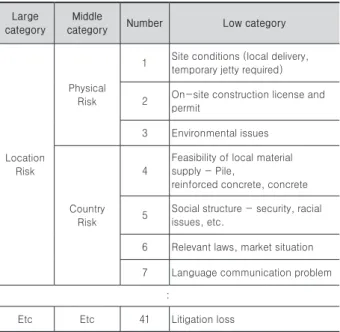
Etc Etc 41 Litigation loss
다음 <Table 8>은 플랜트 사례적용 후 만들어진 PRM 체 크리스트로써, 41가지의 리스크 요인(소분류)을 정리하였다.
<Table 8>의 체크리스트를 사례에 적용을 할 경우, 41가지 중 37가지 약 90.2% 의 리스크요인이 사례에서 발견 되었다.
2.1.2 전문가 의견 종합
지금까지 41가지의 요소를 가진 사례적용 후 PRM 체크리 스트를 정리하였다. 사례적용 후 PRM 체크리스트의 완성도 를 높이기 위해 리스크관련 전문가 31명에게 설문조사와 인 터뷰를 실시한다.
Table 9. Survey (a) How much work have you had?
①4 years or less
②4 to 8
years ③8 to 12 years ④12 to16 years
⑤More than 16 years What are your responsibilities and responsibilities?
①Sales /
Quotation ②Design ③Purchase
④Business management /Construction
⑤Business Support
Do you use risk checklists at this place?
①Yes ②No
How well do you know the content of the risk checklist?
①There are
so many. ②Many ③Usually ④Little ⑤Very few
기본적인 설문내용으로 경력, 분야 및 업무, 리스크 체크리 스트 사용유무와 숙지여부를 확인함으로써, 다양한 방면에서 의 결과를 나올 수 있게 진행한다.
Table 10. Survey (b)
Large category
Middle
category Low category Very
need Need Mid -dle
Need- less
Very Need-
less
Location Risk
Physical Risk
Site conditions (local delivery, temporary jetty required)
① ② ③ ④ ⑤
On-site construction license and permit
① ② ③ ④ ⑤
Environmental
issues ① ② ③ ④ ⑤
Country Risk
Feasibility of local material supply - Pile, reinforced concrete, concrete
① ② ③ ④ ⑤
Social structure - security, racial issues, etc.
① ② ③ ④ ⑤
Relevant laws,
market situation ① ② ③ ④ ⑤
Language communication problem
① ② ③ ④ ⑤
:
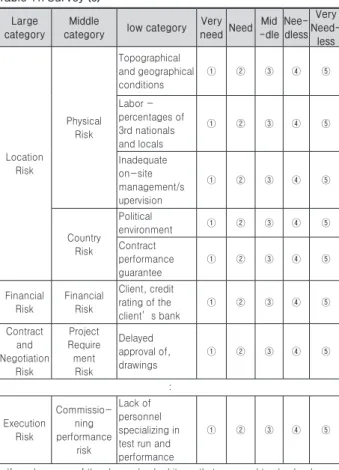
Etc Etc Litigation loss ① ② ③ ④ ⑤
플랜트 현장사례 적용 후의 PRM 체크리스트 리스크요인
을 조사함으로써, 어떤 리스크요인이 가장중요한지 판단이
될 기준이 되며, 불필요한 리스크요인이 있는 경우 리스크요
인을 제외시킬 수 있게 진행을 한다.
Table 11. Survey (c) Large
category
Middle
category low category Very
need Need Mid -dle
Nee- dless
Very Need-
less
Location Risk
Physical Risk
Topographical and geographical conditions
① ② ③ ④ ⑤
Labor - percentages of 3rd nationals and locals
① ② ③ ④ ⑤
Inadequate on-site management/s upervision
① ② ③ ④ ⑤
Country Risk
Political
environment ① ② ③ ④ ⑤
Contract performance guarantee
① ② ③ ④ ⑤
Financial Risk
Financial Risk
Client, credit rating of the client’s bank
① ② ③ ④ ⑤
Contract and Negotiation
Risk
Project Require ment
Risk
Delayed approval of, drawings
① ② ③ ④ ⑤
:
Execution Risk
Commissio- ning performance
risk
Lack of personnel specializing in test run and performance
① ② ③ ④ ⑤
If you have any of the above checked items that you need to check, please write down the reason.
다음과 같은 <Table 11>은 PRM체크리스트 초안이 작성이 되었을 때, 겹치는 부분이 5가지 이상이 되지못해 PRM 체크 리스트 초안에서 제외되었던 리스크 요인 10가지이다. 제외 되었던 체크리스트의 추가여부를 확인하여, 플랜트 PRM 체 크리스트에 필요한 요인일 경우, 추가를 시킬 수 있게 진행하 였다.
Fig. 3. Research methods and procedures
다음과 같은 <Fig. 3>은 설문조사 대상자의 경력사항을 질 문 한 것으로써, 4~8년 3명, 8~12년 7명, 12년~16년 8명, 16 년 이상 13명으로 설문조사대상자의 경력을 확인할 수 있다.
Fig. 4. Responsibility part
다음과 같은 <Fig. 4>은 설문조사 대상자의 담당분야를 질 문 한 것으로써, 영업/견적 6명, 설계 9명, 구매 6명, 사업관 리/시공 5명, 경영지원 5명으로 각종 파트의 전문가에게 조 사하였으며, 설문조사 대상자의 업무에서는 체크리스트 사용 유무를 조사한 것으로써, 27명이 사용을 한다 응하였고, 4명 이 사용하지 않다는 것을 파악할 수 있다.
Fig. 5. Risk check list familiarity status
다음과 같은 <Fig. 5>은 설문조사 대상자의 체크리스트 숙 지유무를 질문한 것으로써, 아주 많다 4명, 많다 8명, 보통 13 명, 적다 4명, 아주 적다 2명으로 파악할 수 있다.
2.1.3 리스크 요인별 중요도 평가
설문조사를 통하여 플랜트 전문회사에서 근무하고 있는 전
문가 31명을 대상으로 리스크 요인별 중요도를 조사를 하였
다. 매우필요 5점, 필요 4점, 보통 3점, 불필요 2점, 매우불필
요 1점을 기준으로 하여, 설문조사 대상자들의 투표 결과를
다음과 같이 중요도 점수로 평가하여 기입을 하여 전문가들
의 중요한 리스크요인을 정리 할 수 있다. 설문조사 및 플랜
트 현장사례의 발생빈도를 조사하여, 순위에 맞는 점수를 매
기고, 그에 따른 중요도 평가를 실시하고자 한다.
Table 12. Survey risk factors for survey risk
Import- ance ranking
Risk factor
Very
need Need Mid -dle
Need- less
Very Need-
less Impor-
tance score 1 Contract
discrepancy 24 6 1 147
2
Dispute over ambiguity in contract
scope
22 8 1 145
3
On-site construction
license and permit
20 10 1 143
4
Improper air / duration
21 8 1 1 142
5
Site conditions
(local delivery, temporary
jetty required)
19 9 2 1 139
6
Feasibility of local material supply -
Pile, reinforced concrete, concrete
17 12 2 139
7
A number of deferred provisions not agreed upon during the contract negotiation process
16 13 2 138
:
51 Force
Majeure 1 9 15 4 2 96
플랜트 전문회사 A의 설문조사를 전체적으로 정리하여, 41 가지의 체크리스트부터 시작하여 10가지의 추가예상 리스크 요인까지 총 51가지의 리스크 요인을 매우 필요에서부터 매 우불필요가지의 내용을 정리하여, 다음과 같은 <Table 12>에 정리 하였다. 설문조사의 리스크요인들을 점수로 평가하여 중요도 순서로 51가지의 순서를 정리하여 나타낸 표로써, 그 에 따라 등수를 평가할 수 있다.
Table 13. Case frequency generation frequency significance
Import- ance ranking
Unique number
Repetition
rate Risk factor Importan-
ce score
1 37 31
Lack of comprehensive problem-solving skills during
test run, etc.
130
2 34 30 Quality assurance and
maintenance 129
3 19 26 Missing or shortage of
materials, etc. 121
4 28 21 Design error 132
5 16 19
Possible increase of material costs, error in volume prediction, error in exchange
rate application
124
6 35 17 Add / change / error / unplug
construction 125
7 17 13 Add / change materials 120
:
37 41 1 Force Majeure 112
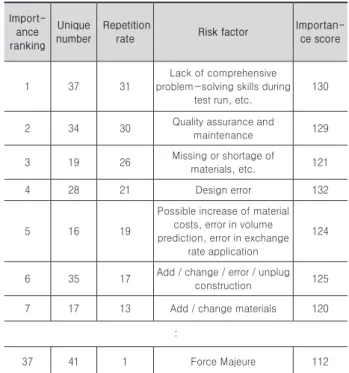
다음과 같은 <Table 13>은 플랜트 현장사례 231가지의 리 스크 원인을 발생빈도의 순서에 따라 중요도를 평가하여 정 리한 표이다. 전문가들의 설문조사와 발생빈도의 중요도는 서로 리스크요인의 중요성이 다른 것을 확인 할 수 있으며, 각 리스크의 점수를 평가를 하여 표를 만들어 리스크의 요인 을 정리 할 수 있다.
Fig. 6. Risk factor importance calculation
<Fig. 6>은 리스크 요인의 중요도 산출하는 방법을 정리한 식이다. Rlfs은 리스크 요인으로써 총 51가지 요인을 가지며 동일 점수를 계산하여, 51~23점의 점수를 주었다. Cpfs는 발 생빈도로써 총 37가지의 발생빈도 요인을 가지며 동일 점수 를 계산하여 37점~24점의 점수를 주었다. Ifs는 Rlfs의 점수 와 Cpfs의 점수를 더함으로써, 중요한 요인을 점수화하여 정 리한다.
Rlsk = Riterature factors score Cpfs = Case plant factors score Ifs = Importance factors score
R
lfs + Cpfs = Ifs
Table 14. Risk evaluation by risk factors
Ran- king
Unique
number Risk factor Survey Rifs Repet-
ition rate
Cpfs Ifs
1 37
Lack of comprehensive
problem- solving skills
during test run, etc.
130 42 31 37 79
2 28 Design error 132 44 21 34 78
3 12
Dispute over ambiguity in contract
scope
145 50 6 28 78
4 11 Contract
discrepancy 147 51 3 27 78
5 34
Quality assurance and
maintenance
129 41 30 36 77
6 20 Improper air /
duration 142 48 3 27 75
7 2
on-site construction
license and permit
143 49 2 26 75
:
51 45 Political
environment 109 24 0 24 48
다음과 같은 <Table 14>은 플랜트 현장사례 231가지와 플 랜트 전문가 설문조사의 결과를 가지고 중요도를 점수별로 평가하여 나타낸 표이다. <Fig. 6>의 산출식에 대입하여 진행 하였으며, 그에 따라 같은 점수에 해당하는 점수는 동점 표기 로 하였다. 발생빈도가 0인 리스크요인은 24점으로 최하점으 로 기준을 잡고 진행하였다. 리스크요인은 예비 리스크요인 10가지까지 포함하여 총 51가지로 구성되었다. 시운전 시 복 합적 문제 해결능력 미흡 리스크요인이 Ifs 79점으로 가장 중 요한 리스크요인으로 뽑히며, 정치 환경 리스크요인이 Ifs 48 점으로 가장 미미한 리스크 요인으로 뽑힐 수 있다. 시운전 시 복합적 문제 해결능력 미흡, 설계오류, 계약 Scope 모호분 쟁, 계약서 불일치 사항 등이 중요도 점수가 가장 높았으며, 그만큼 리스크가 일어날 수 있는 확률이 높고, 금액이 많이 발생하는 요인이라고 볼 수 있다. 플랜트 PRM 체크리스트의 본 목적으로 이러한 리스크 요인들을 방지함으로써 피해를 줄이는 것을 목표로 한다.
2.1.4 플랜트 PRM 체크리스트 제안
앞서 리스크요인별 중요도 평가를 진행하였다. 중요도 점 수를 기반으로 플랜트 PRM 체크리스트를 제안한다.
Table 15. Plant PRM checklist suggestion
Large category
Middle
category number low category
Location Risk
Physical Risk
1 Site conditions (local delivery, temporary jetty required) 2 On-site construction license and
permit
3 Environmental issues
Country Risk
4
Feasibility of local material supply - Pile,
reinforced concrete, concrete 5 Social structure - security, racial
issues, etc.
6 Relevant laws, market situation 7 Language communication problem
financial Risk
financial Risk
8 Contract performance guarantee 9 Exchange rate fluctuation
10 Sudden price increase or market change
11 Questions on funding or cash flow
12 Client, credit rating of the client’s bank
Contract and Negotiation
Risk
Contractual Risk
13 Contract discrepancy
14 Dispute over
ambiguity in contract scope
15
A number of deferred provisions not agreed upon during the contract negotiation process
Contract and Negotiation
Risk
Project Requirement
Risk
16 Excessive demand of client 17 Requirement for excessive documents 18 Delayed approval of drawings
Planning Risk
Cost Estimation
Risk 19
Possible increase of material costs, error
in volume prediction, error in exchange
rate application 20 Add / change materials
Schedule Risk
21 Missing or shortage of materials, etc.
22 Improper air / duration
23 Delays in production, construction and transport accidents
24 Lack of purchase / production period
:
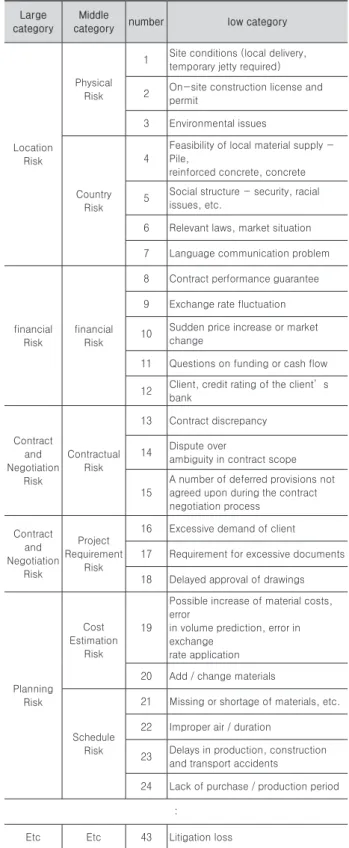
Etc Etc 43 Litigation loss
※ As a result of this study, Table 15. was not filled out entirely. If you can contact the corresponding author, I will send you an email.
앞서 리스크요인별 중요도 평가를 진행하여, 각 리스크요
인 다음과 같은 <Table 15>은 중요도 평가를 중심으로 정리
된 51가지의 리스크 요인에서 설문조사 30점 이하와 동시
에 231가지의 플랜트 현장사례 발생빈도가 0인 24점의 리스 크 요인을 제외한 체크리스트를 제안한 표이다. 선행연구의 PRM 체크리스트의 고유번호 18번 파업 부분을 제외하였으 며, 231가지의 현장사례에서 발생했던 리스크요인을 기준으 로 10가지를 추가하였다. 또한, 예비 리스크요인 10가지 중 계약 이행 보증, 도서/도면 승인 지연, 발주처/발주처 거래 은행 신용도 3가지의 리스크요인을 추가하였다. 플랜트 PRM 체크리스트는 플랜트 현장사례 231가지 사례 중 86% 의 리스 크요인을 포함하고 있으며, 리스크 전문가 31명에게 설문한 51가지의 리스크 요인 중 84%의 리스크 요인을 해당하고 있 다. 이에 따라 총 43가지의 리스크 요인을 체크 할 수 있는 플 랜트 PRM 체크리스트를 제안한다.
3. 결론
현재 건설 분야에서 리스크란 피해갈 수 없는 중요한 요인 이다. 선행연구 ‘PRM 체크리스트 항목 선정을 위한 기초연 구’의 PRM 체크리스트 초안을 후속 연구로써 개선하는 것을 목표로 진행을 하였다. 플랜트 관련 현장사례와 전문가 의견 종합을 통하여 각 리스크별의 발생빈도 및 중요도 점수를 평 가하여, 플랜트 PRM 체크리스트를 제안을 하였다. 리스크요 인의 중요성을 강조하며, 현장에서 발생할 수 있는 리스크를 줄이는 것을 목표로 하였다.
첫째, 리스크관련 선행연구, 서적, 보고서 등의 자료를 분 석하여 리스크관련요인을 조사 후, PRM 체크리스트 초안을 제안하였다.
둘째, PRM 체크리스트 초안을 플랜트 현장사례에 적용을 하여, 사례 적용 후 PRM 체크리스트를 만들고, 리스크 전문 가의 설문조사를 통하여 중요도 평가를 진행하였다.
셋째, 플랜트 현장사례와 리스크 전문가의 설문조사를 통 하여 중요도 평가의 점수를 기점으로 플랜트 PRM 체크리스 트를 제안하였다.
후속연구에서는 본 연구에서 제안된 플랜트 PRM 체크리 스트를 활용하여, 플랜트 건설시 발생하는 리스크를 줄이기 위한 상세한 프로세스를 구축하고자 한다.
References