time in the remaining 5%
1. Latent tuberculosis infection (LTBI) is the state in which humans are infected with M. tuberculosis without any clinical symptoms, radiological abnormality, or microbiological evidence
1. One-third of the world’s population is infected with TB, and the prevalence rate of LTBI in low- or middle-income countries is estimated to be as high as 51.5%, while that in high-income countries is 28.1%
2.
Active TB has a greater burden of TB bacilli than latent TB, and acts as an infection source for contacts. Preventing TB infection by bacillus Calmette–Guérin vaccination, and de- tecting and treating early-stage TB in high-burden countries through an active case-finding strategy are used as the main strategies for eradicating TB. Conversely, an active treatment strategy for LTBI is used in low TB-burden countries. Human immunodeficiency virus–infected patients or household TB contacts <6 years of age are candidates for LTBI treatment in high TB-burden countries
2. However, the main candidates for LTBI treatment in low TB-burden countries are immigrants from TB-endemic areas
2,3. Moreover, it has been reported that most new TB diagnoses originate from progression of recent LTBI rather than remote TB reactivation
4,5. Diagnosis and treatment for LTBI is a major strategy for reducing TB preva- lence, but it must be pursued on the precondition that active TB is not missed. Investigation of close household contacts is supposed to reduce TB prevalence by 2% per year
2. This review will cover the principles of TB infection and transmis-
Introduction
Tuberculosis (TB) is an infectious disease that has existed throughout human history. However, Mycobacterium tuber- culosis was confirmed as the causative pathogen by Robert
Koch only in the early 19th century, and the airborne nature of TB infection was proved objectively even later, in the 1950s.
TB develops in only 10% of humans exposed to M. tubercu- losis. Moreover, TB generally develops within 1–2 years of M.
tuberculosis infection in 5% of those infected, and at any other
Tuberculosis Infection and Latent Tuberculosis
Seung Heon Lee, M.D., Ph.D.
Division of Pulmonary, Sleep, and Critical Care Medicine, Department of Internal Medicine, Korea University Ansan Hospital, Korea University College of Medicine, Ansan, Korea
Active tuberculosis (TB) has a greater burden of TB bacilli than latent TB and acts as an infection source for contacts.
Latent tuberculosis infection (LTBI) is the state in which humans are infected with Mycobacterium tuberculosis without any clinical symptoms, radiological abnormality, or microbiological evidence. TB is transmissible by respiratory droplet nucleus of 1–5 μm in diameter, containing 1–10 TB bacilli. TB transmission is affected by the strength of the infectious source, infectiousness of TB bacilli, immunoresistance of the host, environmental stresses, and biosocial factors.
Infection controls to reduce TB transmission consist of managerial activities, administrative control, engineering control, environmental control, and personal protective equipment provision. However, diagnosis and treatment for LTBI as a national TB control program is an important strategy on the precondition that active TB is not missed. Therefore, more concrete evidences for LTBI management based on clinical and public perspectives are needed.
Keywords: Tuberculosis; Infection; Transmission; Infection Control; Latent Tuberculosis
Copyright © 2016
The Korean Academy of Tuberculosis and Respiratory Diseases.
All rights reserved.
Address for correspondence: Seung Heon Lee, M.D., Ph.D.
Division of Pulmonary, Sleep, and Critical Care Medicine, Department of Internal Medicine, Korea University Ansan Hospital, Korea University College of Medicine, 123 Jeokgeum-ro, Danwon-gu, Ansan 15355, Korea
Phone: 82-31-412-4973, Fax: 82-31-412-5604E-mail: [email protected] Received: Jan. 9, 2016 Revised: Feb. 18, 2016 Accepted: Mar. 9, 2016
cc
It is identical to the Creative Commons Attribution Non-Commercial
License (http://creativecommons.org/licenses/by-nc/4.0/).
sion from basic and clinical perspectives as well as the broad outlines for TB infection control to reduce TB transmission.
Transmission of TB
TB bacilli can be transmitted as droplet nuclei that are resi- dues of dried respiratory droplets. Droplet nucleus that con- tain 1–10 TB bacilli is 1–5 μm in diameter. These droplets can remain in the air for several hours and can be inhaled into the alveoli. On the other hand, respiratory droplets that are >100 μm in diameter will fall to the ground within 1 m of the origin, and will be impacted to the upper airway. Typical droplet nuclei-derived infections are measles and TB, while respira- tory droplets cause staphylococcus and respiratory syncytial virus infections. Fluid lining the respiratory tract and TB ba- cilli contained in it may become aerosolized by high-velocity airflow during coughing or sneezing. Moreover, implantation of TB bacilli from droplet nuclei can occur after aerial trans- portation, even though the infectiousness of TB is relatively weaker than that of measles. Respiratory secretions surround- ing droplet nuclei variably protect TB bacilli from dehydration, oxygen injury, natural irradiation, and other environmental stresses. Experiments have revealed that the half-life of aero- solized TB bacilli is about 6 hours
6.
Laboratory experiments using guinea pigs as quantita- tive air samplers for human TB in TB wards with six single rooms proved the following five important facts about TB transmission
7: (1) TB is a true airborne infection, requiring only air contact for transmission, (2) TB patients vary greatly in infectiousness, (3) infectiousness is rapidly reduced by ef- fective treatment, (4) the average concentration of infectious
droplet nuclei is low, and (5) ultraviolet irradiation is a highly effective method of air disinfection. TB bacilli are engulfed by alveolar macrophages, and infection appears to be aborted without immunological stigma if the organisms are destroyed before they replicate to 10–15 generations
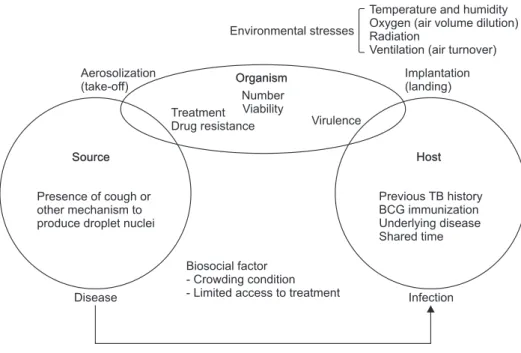
8. Transmission of TB bacilli is influenced by strength of the infectious source, infectiousness of virulent TB bacilli, immunoresistance of the host, environmental stresses, and biosocial factors, as shown in Figure 1
8.
Mathematical Models of Transmission
The most representative quantitative study for airborne in- fection through droplet nuclei is the school measles outbreak study. However, Edward Riley modified Wells’s use of the Soper mass balance equation
9for TB ward experiments
10as follows, while TB infectiveness through casual contact was as- sumed to be relatively lower than that of measles:
C=S(1–e
-Iqpt/Q)
, where, C=Number of new cases, S=Number of susceptibles exposed, e=Natural logarithm, I=Number of infectious sources, q=Number of quanta (infectious doses) generated per unit min, p=Human ventilation rate (L/min), t=Exposure duration, Q=Infection-free ventilation (L/sec) (assumption: uniform susceptibility of exposed persons to infection, uniform viru- lence of organisms from one outbreak to another).
According to experiments using guinea pigs and inbred rab- bits, it was reported that a single droplet nucleus containing more than three TB bacilli is enough to cause TB infection
11.
Environmental stresses
Temperature and humidity Oxygen (air volume dilution) Radiation
Ventilation (air turnover) Aerosolization
(take-off)
Source
Presence of cough or other mechanism to produce droplet nuclei
Disease Infection
Biosocial factor - Crowding condition - Limited access to treatment
Host
Previous TB history BCG immunization Underlying disease Shared time
Implantation (landing) Organism
Number Viability Treatment
Drug resistance Virulence
Figure 1. Schematic presentation of fac- tors determining the likelihood of trans- mitting tuberculosis (TB) infection
8. BCG:
bacillus Calmette–Guérin.
Although TB susceptibility varies among different human races and individuals, it is estimated to be nearly the same as in the animal experiments.
TB Outbreaks and Infection Control
Recently, TB outbreaks have been reported frequently in middle and high schools, military locations, work places, and dormitory settings in South Korea
12. Therefore, LTBI treat- ment has become an important policy for reducing the TB prevalence rate in South Korea, and LTBI control guidelines have been strengthened by the revision of the 2014 Korean guidelines for TB
13. Many guidelines for TB infection control have been published internationally as follows: Guidelines for
Preventing the Transmission of Mycobacterium tuberculosis in Health-Care Settings (US Centers for Disease Control and Prevention, CDC)
14; World Health Organization (WHO) Policy on TB Infection Control in Health-Care Facilities, Congregate Settings, and Households (WHO)
15; Guidelines for Design and Construction of Health-Care Facilities (American Institute of Architects)
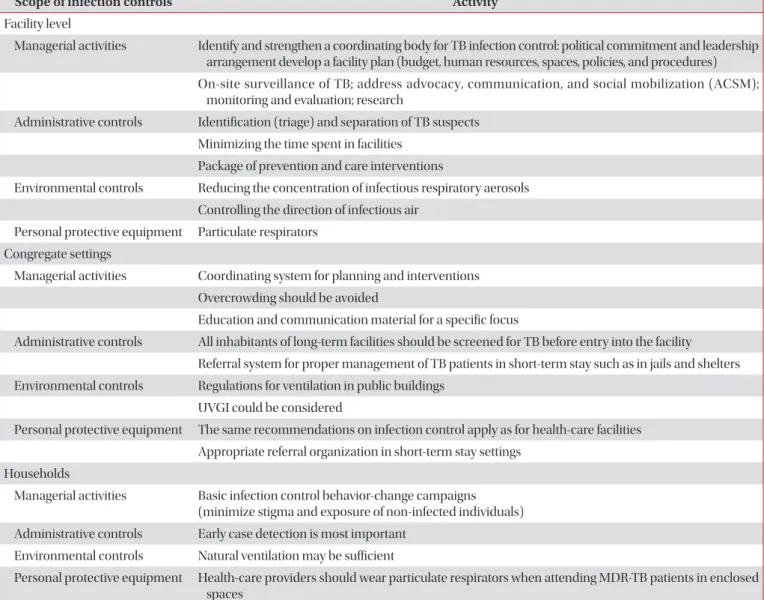
16; and additional updates for personal protective equipment guidelines (US Occupational Safety and Health Administration, 2003). WHO guidelines for TB infection con- trol describe national and subnational activities as managerial activities, administrative control, engineering control, environ- mental control, and personal protective equipment provision for the implementation of TB infection control in health-care facilities, congregate settings, and households, respectively (Table 1)
15.
Table 1. Activities to reduce the transmission of TB
15Scope of infection controls Activity
Facility level
Managerial activities Identify and strengthen a coordinating body for TB infection control: political commitment and leadership arrangement develop a facility plan (budget, human resources, spaces, policies, and procedures) On-site surveillance of TB; address advocacy, communication, and social mobilization (ACSM);
monitoring and evaluation; research
Administrative controls Identification (triage) and separation of TB suspects Minimizing the time spent in facilities
Package of prevention and care interventions
Environmental controls Reducing the concentration of infectious respiratory aerosols Controlling the direction of infectious air
Personal protective equipment Particulate respirators Congregate settings
Managerial activities Coordinating system for planning and interventions Overcrowding should be avoided
Education and communication material for a specific focus
Administrative controls All inhabitants of long-term facilities should be screened for TB before entry into the facility Referral system for proper management of TB patients in short-term stay such as in jails and shelters Environmental controls Regulations for ventilation in public buildings
UVGI could be considered
Personal protective equipment The same recommendations on infection control apply as for health-care facilities Appropriate referral organization in short-term stay settings
Households
Managerial activities Basic infection control behavior-change campaigns (minimize stigma and exposure of non-infected individuals) Administrative controls Early case detection is most important
Environmental controls Natural ventilation may be sufficient
Personal protective equipment Health-care providers should wear particulate respirators when attending MDR-TB patients in enclosed spaces
TB: tuberculosis; UVGI: ultraviolet germicidal irradiation; MDR: multi-drug resistant.
Guidelines regarding managerial activities provide policy makers at the national and subnational levels with a com- prehensive framework that can support and facilitate the implementation, operation, and maintenance of TB infec- tion control in health-care facilities, congregate settings, and households. Administrative controls mean activities that are intended to reduce the risk of exposure to persons with infec- tious TB. These controls include policies and procedures for the early identification, evaluation, isolation, and treatment of patients likely to have TB. Environmental controls mean the use of engineering technologies to reduce the concentration of airborne infectious droplet nuclei to prevent the spread of TB. Personal protective equipment is the last level of TB control and concerns the use of respiratory protection that can reduce the risk of exposure to infectious droplet nuclei for health-care workers. The U.S. Centers for Disease Control and Prevention propose guidelines for inpatient settings (patient rooms, emergency departments, intensive care units, surgical suites, laboratories, bronchoscopy suites, sputum induction or inhalation therapy rooms, autopsy suites, and embalming rooms), outpatient settings (TB treatment facilities, medical offices, ambulatory-care settings, dialysis units, and dental- care settings), and nontraditional facility-based settings (med- ical settings in correctional facilities, long-term care settings, and emergency medical services)
14. Homeless shelters should follow the same TB infection control measures, but LTBI screening for homeless people is not recommended because of concerns about cost-effectiveness and compliance
17. New immigrants from countries with a high TB incidence must also be screened for active TB
18.
Clinical Perspective of the Infectiousness of TB
Patients with pulmonary, laryngeal, or endobronchial TB are highly contagious, and the infectiousness is increased
in the following conditions: (1) presence of lung cavities, (2) positive acid-fast bacillus smear or culture for sputum, and (3) presence of respiratory symptoms like cough. On the other hand, infectiousness is rapidly reduced by anti-TB chemother- apy. TB bacilli burden is reduced to 1/25th of the initial level within 2 days of anti-TB chemotherapy, and to 1/100th within 2–3 weeks of anti-TB chemotherapy in drug-sensitive TB patients
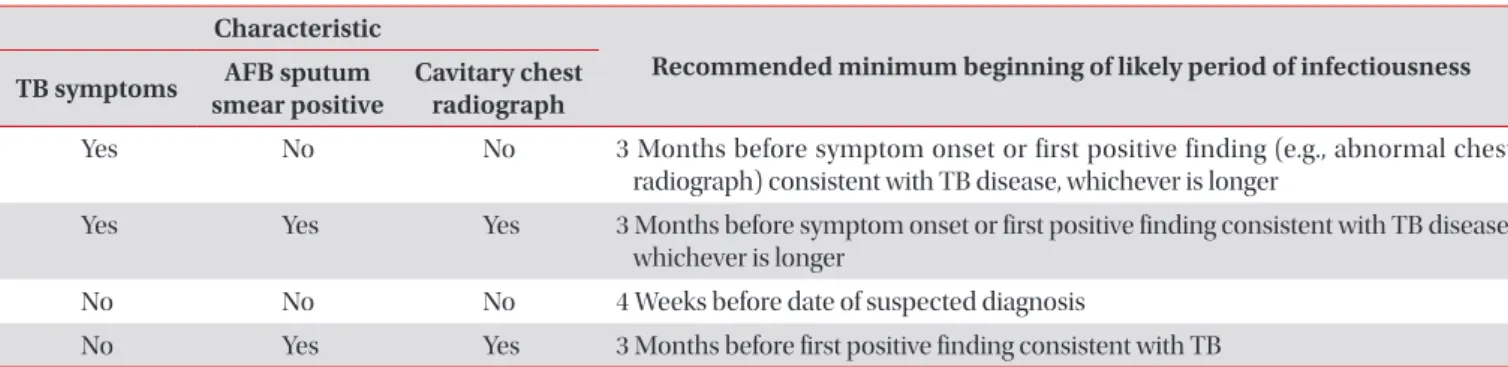
19,20. The infectious period is over when the following criteria are satisfied: (1) effective treatment (as demonstrated by M. tuberculosis susceptibility results) for >2 weeks, (2) diminished symptoms, and (3) mycobacteriologic response (e.g., decrease in grade of sputum smear positivity detected on sputum-smear microscopy). Even though the start of the infectious period cannot be determined with precision, an assigned start that is 3 months before a TB diagnosis is recom- mended based on the characteristics of an index TB patient (Table 2)
20.
TB Infection of Contacts and Risk of Active TB Development
The risk of TB infection of contacts is different depending on the proximity and duration of contact. TB contacts are clas- sified as close and casual contacts according to the intensity of contact. Close contacts are those who spend a long time (more than 8 hours) with infectious TB patients in a closed space
18; they are further divided into close household and close non-household contacts. Close household contacts are those who share the patient’s breathing space daily (bedroom, kitchen, bathroom, or living room) and live with infectious TB patients. Close non-household contacts are those who share breathing space with an index TB patient outside the house- hold (e.g., workplace, school, etc.). In contact investigation, higher priority is given to close contacts including household contacts as well as to risk groups; casual contacts are the next priority. When M. tuberculosis is inhaled, alveolar macro-
Table 2. Guidelines for estimating the beginning of the infectious period of TB patients according to index characteristics
20Characteristic
Recommended minimum beginning of likely period of infectiousness TB symptoms AFB sputum
smear positive Cavitary chest radiograph
Yes No No 3 Months before symptom onset or first positive finding (e.g., abnormal chest radiograph) consistent with TB disease, whichever is longer
Yes Yes Yes 3 Months before symptom onset or first positive finding consistent with TB disease, whichever is longer
No No No 4 Weeks before date of suspected diagnosis
No Yes Yes 3 Months before first positive finding consistent with TB
Source: California Department of Health Services Tuberculosis Control Branch; California Tuberculosis Controllers Association. Contact investigation guidelines. Berkeley: California Department of Health Services; 1998.
TB: tuberculosis; AFB: acid-fast bacilli.
phages kill the TB bacilli. When humans are infected with M.
tuberculosis, 10% of infected hosts progress to active TB and the remaining 90% sustain LTBI. High-risk groups such as hu- man immunodeficiency virus–infected patients and contacts
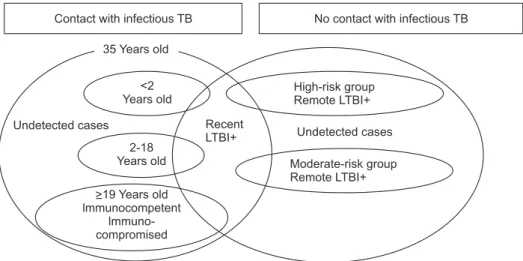
<2 years old, and moderate-risk groups such as children and adolescents between 2–18 years of age and patients with end- stage renal disease or diabetes mellitus can easily progress to active TB if exposed to infectious TB. Therefore, these groups must have higher priority for the diagnosis of LTBI (Figure 2)
21.
Active TB Progression and LTBI Treatment
Cell-mediated immune response develops 2–10 weeks af- ter infection by M. tuberculosis and is identified by tuberculin skin test conversion; this accelerates granuloma formation in the body
22. The infected person can show no clinical manifes- tation or mild respiratory symptoms including febrile sensa- tions. In primary TB disease (recent infection), some young children can show infiltration on chest radiographs suggesting active TB, but this manifestation is frequently spontaneously resolved leaving calcified scar lesions. In contrast, reactiva- tion of latent TB caused by a weakened immune status and presenting as cavities in the lung apex or superior segment of the lower lobe is known as secondary TB disease (remote infection). However, according to recent reports, different presentations of primary TB disease, which shows pulmonary infiltration at the lower lobe, and secondary TB disease, which presents as pulmonary cavities in the apex or superior seg- ment, seem to be related to the host’s immune status rather than time
23. It seems that active TB generally develops within a year after LTBI, and the rate of active TB cases decreases sharply after the first year and continues to decrease slowly thereafter in the following 10 years
24. Meanwhile, pleural TB, meningeal TB, and military TB seem to be reactivated in the earlier period. In addition, it was reported that previous TB ex- posure provides protective immunity against further infection
(reinfection) in 16%–40% of cases
25.
There is a subclinical borderline phase with uncertain ra- diological manifestations prior to symptomatic presentation
26. In this obscure subclinical phase, which can last for months between latent and active clinical TB, molecular diagnostic methods or computerized tomography scans can be used to prevent infectious TB from going unnoticed
27, but cost- effectiveness must also be considered. To reduce the TB prev- alence rate effectively, the range of candidates for LTBI treat- ment must be expanded. However, treatment interruption and overtreatment for unnecessary candidates must be avoided.
In other words, shorter treatments with fewer adverse events must be performed and the number of candidates needed to be treated for preventing one additional active TB progression from latent TB must be minimized by mutual agreement be- tween policymakers and clinicians
26.
Conclusion
TB can be transmitted by respiratory droplet nuclei. The factors that influence the transmission of TB bacilli are the strength of the infectious source, infectiousness of virulent TB bacilli, immunoresistance of the host, environmental stresses, and biosocial factors. Infection controls to reduce TB trans- mission consist of national and subnational activities, which include managerial activities, administrative control, engi- neering control, environmental control, and personal protec- tive equipment provision, in health-care facilities, congregate settings, and households, respectively. Active TB progression from LTBI is influenced by the age and immune status of the host. To reduce the TB prevalence rate, the range of can- didates for LTBI treatment, including those in the high-risk group, needs to be expanded. However, consensus between clinical and public aspects must be achieved based on definite domestic evidences.
Figure 2. Schematic diagram for latent tuberculosis infection (LTBI) screening in tuberculosis (TB) contacts and non- contacts in Korea
21.
Contact with infectious TB No contact with infectious TB 35 ears oldY
<2 Years old
ears old2-18 Y Undetected cases
>19 ears old lmmunocompetent
lmmuno- compromised
Y
Recent LTBI+
High-risk group Remote LTBI+
Undetected cases Moderate-risk group Remote LTBI+