1. Introduction
1.1. Background and goal of research
Educational environment is crucial for academic achievement and character formation of students. However, criteria for maintaining educational facilities tend to be ambiguous and not standardized. Since 2000, there has been incresing interest in maintenance for and supply of educational facilities via increased social interest in eduction and educational process. Moreover, with continuous aging of existing educational facilities, the cost is increasing for functional enhancement and repair/maintenance.
Educational facilities provide students with living and educational space. It is a basic element of forming educational environment. Compared to general-purpose residences, there are differences in use hours, use area and frequency. It is a space used by many students and used intensively during academic terms. On the other hand, repair and maintenance in the field remain at ad hoc level and systematic decision-making process is lacking.
Systematic repair and maintenance programs and basic data for technical facility management are severely lacking today. The
pISSN 2288-968X, eISSN 2288-9698 http://dx.doi.org/10.12813/kieae.2014.14.5.005
current maintenance criteria for educational facilities is mostly based on information suggested by long-term repair plan for common residences. On the other hand, applying the maintenance guideline used for common residences to school facilities is problematic in reality because of the differences in building types, use hours and users.
The priority in building maintenance and management is to predict service life of parts and materials that compose a building.
Ideally, repair life cycle and its scope and rate should be planned based on predicted service life period. In this paper, we determined service life cycle for rooftop waterproofing and floor furnishings in educational facilities. The research results will be used as basic information for making plans for repair and maintenance performed for a given service period.
1.2. Research method and description
Parts or materials that compose a building are diverse. Their service life could be defined as the period during which their usefulness is exhausted. In this research, we focused service life of rooftop waterproofing and floor finishing of educational facilities.
The following research methods were used.
First, repair history of each elementary, middle and high school
KIEAE Journal
Korea Institute of Ecological Architecture and Environment 69
1)
Establishment of Service Life of Educational Facilities
- Focused on the rooftop waterproofing and floor finishing - Lee, KangHee*⋅Chae, ChangU**
* Dept. of Architectural Eng., Andong National Univ., South Korea ([email protected])
** Corresponding author, Korea Institute of Construction and Technology, South Korea ([email protected])
A B S T R A C T K E Y W O R D
Building has been deteriorated gradually owing to geographic, physical complex and other factors. School living condition has a key role to improve the learning ability, life attitude and qualifications to adopt to social life. Therefore, it is important for school environment to keep the living condition. Repair time and scope of school facilities are required to maintain the function and performance to plan the long term repair. But there are little information about the school maintenance such as repair time and function.
In this paper, it aimed at providing the service life to suggest the repair time and scope in the roof-proofing and floor finishing which used the three estimation method in probabilistic approach. The service life has a key role to decide the repair time and to make the plan for the repair maintenance. Results of this study are as follows ; First, the 1st repair time were taken through three methods in probabilistic and deterministic functions to eliminate the estimation bias. Second, the service life is suggested 36 years of an elementary school, 34 years of a middle school and 41 years of a high school.
Third, the service life of a floor finishing is 43 years of an elementary, 39 years of a middle school and 41 years of a high school. The above study could not include the detailed information about the materials and repair works. Therefore it needs a further study to reflect the detailed information and to make a repair strategy.
ⓒ 2014 KIEAE Journal
service life, apartment, maintenance, repair scope, repair cycle, repair rate
A C C E P TA N C E IN F O Received July 17, 2014
Final revision received October 9, 2014 Accepted October 13, 2014
is based on repair and maintenance history since their respective completion date. Data was obtained from ___ Office of Education.
Then, time series data on period, method, scope and cost of repair for rooftop waterproofing and floor finishing was collected and summarized. However, document retention period was set for 5 years and therefore it was difficult to collect repair history before then.1). Accordingly, data before retention period was collected from school after an interview with school facility manager.
Second, in terms of service period, primary service period is first determined, which is then used to determine recovery rate to perform analysis. There are three methods for determining primary service period: use normal distribution of the period when first repair occurs since completion; use 3-D model for repair period and cost; use probabilistic theory on when repair should be done first. In order to remove bias caused by different calculation results, primary service period was determined by calculating the average of the values obtained from the three methods described above.
Then, recovery rate was calculated based on function and performance before the first repair was done to complete calculation of final service period.
1.3. Scope of research
The scope was the research was limited to rooftop waterproofing and floor finishing in educational facilities. The schools were divided into elementary, middle and high schools. Table 1 shows the sample count of elementary, middle and high schools by rooftop waterproofing and floor finishing used in analysis. The sample count for rooftop waterproofing includes 15 elementary schools, 48 middle schools and 13 high schools. The sample count of rooftop waterproofing includes 28 elementary school, 13 middle school and 21 high school.
Service period was analyzed first for each elementary, middle and high school 2). The results from analysis of each school were used to suggest average service period for rooftop waterproofing and floor finishing each elementary, middle and high schools.
A difference arises between monetary value of a building when it is completed and after time passes. In order to remove such differences in monetary value, discount rate in this research was set at 2.6%. Discount rate was calculated based on consumer price
1) It was learned that most schools retained information on previous repair history in order to request reimbursement for repair cost.
2) Such method is a bottom-up approach and is effective for analyzing both individual and overall characteristics of school.
index and savings deposit rate from 1993 to 2011.
2. Investigating repair period of rooftop water- proofing and floor finishing
It is rare to find a research that suggests service period for materials, parts and facilities that compose educational facilities.
Most of researches are on repair cycle and repair rate and propose analysis of questionnaire survey data. Son SeKwan (2010) categorized parts and materials of educational facilities in terms of structure, exterior finishing, interior finishing and facilities and suggested repair rate and cycle for each.3) Here, repair rate and cycle are being proposed as a tool to calculate life cycle cost. The result of analyzing repair cycle and rate shows that it is difficult to calculate repair and maintenance cost. Also, it was learned that, when it is difficult to define standard for repair cycle and rate, uncertainty associated with repair rate and cycle was high. In this research, statistical analysis was conducted on a questionnaire survey on parts, materials and facilities that compose school facilities, based on which we tried to propose more concrete repair cycle and rate. In case of cement liquid water-proof, repair cycle was 4 years at minimum and 8 years at maximum. Repair rate here was 3% and 10%, respectively.
Lee MiHye et. al. (2009) used the result of questionnaire survey on educational facilities to suggest repair and maintenance cost.4) Analysis of repair and maintenance cost survey on government workers at educational facilities showed that, with common residence as 100, elementary schools required 126%, the middle school 127% and high school 139%. The figures were calculated based on repair cycle and rate for common residences. Repair and maintenance cost were estimated based on comparison to educational facilities. In addition, he uses the example of Belgium to suggest that retention period of overseas educational facilities were 30% shorter compared to common residences.5)
Seo ChiHo et. al. (2001) analyzed the aging process of parts and materials using repair and maintenance of elementary school facilities. This research focuses on identifying current status on repair and maintenance of aging educational facilities, compositional materials, and problems associated with construction method and finding a way to enhance performance. Accordingly, we conducted an investigation to analyze the deterioration condition of parts and materials.
3) Son SeKwan (2010), Study on Estimating Educational Facility Repairing Cycle/Rate and Improving Reliability Using BSI, Doctoral Dissertation in Hong Ik University 4) Lee, M. Jung, M and Park, T.(2009), “ A Study on the Establishment of Maintenance
Standards(Repair Periods and Rates) of Educational Facilities”, AIK J. in Structural Area25(29), pp145~152)
5) Lee, MiHye (2009), A Study on the Establishment of Maintenance Standards(Repair Periods and Rates) of Educational Facilities, Mokwon University, Ph.D. Dissertation roof-proof floor finishing
Number of school
elementary(15 schools) elementary(28 schools) middle(48 schools) middle(13 schools) high school(13 schools) high school(21 schools) Table 1. Number of School according to analyzed contents
This research also points out problems associated with post-repair method in which repair is made after total functional paralysis occurs and suggests a need for facility management method that requires an overhauling of compositional materials.
Also, we suggest need for repair cycle that is different from expected service life in order to remove possibility of functional paralysis.
Kim Songwha et. al. (2007) proposed a method in which space and parts are included in addition to parts and materials to implement facility classification system for repair and maintenance of existing educational facilities. In this research, we concluded that use of classification system based on space or parts could enhance effectiveness in calculating repair and maintenance cost and proposing repair cycle.
Lee ChoonKyung (2007) has studied status of repair and maintenance of school facilities and problems associated with them. He conducted an interview with facility managers of elementary and the middle schools. The results show that it is urgent to revise a manual for repair and maintenance of school facilities and develop and allocate professional resources. In addition, he suggests need for standardized repair and maintenance process, accumulation of repair and maintenance data, etc.6)
6) Lee ChunKyung et.al. (2007), “A Study on the Support System for Maintenance Efficiency of Educational Facilities”, AIK J. of Structural Area23(8), pp191~199)
In addition, the analysis results of rooftop waterproofing, repair cycle of floor finishing, repair rate and service life were collected.
We can use the information to study service life of root water-proof and floor finishing in the following ways. Table 2 is the result of studying repair cycle and repair rate related to rooftop waterproofing. According to Table 2, repair cycle for rooftop waterproofing in Japan was about 20 years for complete overhaul.
In case of asphalt water-proof, replacement period was set for about 25-30 years.
type repair scope repair time(yr) repair rate(%) mortar finishing partly
fully 5
15(10,winter) 15 100 tile partly 10(5, winter) 15 mortar block partly 8(5, winter) 10 asphalt proofing partly
fully 7
20 16(15) mortar proofing partly
fully 5
10 14
100
asphalt proofing 10 10 30
expansion joint 10 10 30
floor clinker tile 5 15 15
floor mortar painting 10 10 30 clinker tile and mortar paingting 10 15 30
asphalt proofing partly
fully 10
25(20) 15 100 expansion joint partly
fully 3
25 15
100 clinker tile partly, fully 10(5) 15
100 mortar block partly
fully 8(5)
25 15
100
mortar finishing partly
fully 5
15 15
100
repair 5 15
tile partly 10 5
asphalt proofing partly
fully 10
25 10
100 polymer screen proofing partly
fully 5
15 10
100 polymer sheet proofing partly
fully 10
20 20
100 source) BELCA(1998), Report on the Service Life Survey of the Building Structure and Facilities, 49~63
Table 2. Repair time &scope of the roof-proofing in Japan
type service life(yr)
PVC 26
high performed polyester 23
asphalt 36
composite rubber 24
tile 63
cement 36
source) BCIS(2006), Life Expendency of Building Components, RICS, pp41~77.
Table 3. Repair time &scope of the roof-proofing in UK
type repair scope repiar
time(yr) repair rate mortar finishing partly
fully 5
20 15
100
tile partly
fully 7
30 14
100 terrazzo partly
fully 8
30 15
100 flooring block partly
fully 7
25 15
100 linoleum partly
fully 6
18 14
100 lignoid
mortar coating partly
fully 4
15 16
100 rubber tile partly
fully 5
18 15
100
tile 10 30
mortar coating 5 30
vinyl sheet 10 25
vinyl tile 10 20
synthetic resin coating 10 30 mortar coating partly
fully 5
25 15
100
tile partly
fully 7
30 10
100 terrazzo partly
fully 10
30 15
100 linoleum partly
fully 10
25 10
100 vinyl sheet, asphalt tile,
linoleum tile partly
fully 6
20 10
100 mortar finishing partly
fully 5
20 5
100
tile partly
fully 10
30 10
100 terrazzo partly
fully 15
30 10
100 flooring block partly
fully 10
25 15
100
carpet partly
fully 5
15 10
100 rubber tile partly
fully 10
20 10
100 source) BELCA(1998), Report on the Service Life Survey of the Building Structure and Facilities, 49~63
Table 4. Repair time &scope of the floor finishing in Japan
Table 3 is a study on service life for rooftop waterproofing in the UK. According to this data, service life for asphalt, synthetic rubber and tile is 36 years, 24 years and 63 years, respectively.
Table 4 shows the result of studying repair cycle and rate for floor finishing materials in Japan. The cycle for complete overhaul/replacement of finishing for imitation stone is about 30 years; for linoleum, 18 years; for mortar finishings, about 20 years;
tile, 30 years; vinyl sheet, 25 years.
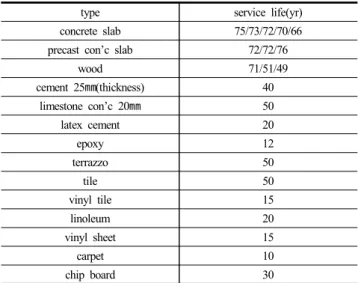
Table 5 is the result of service life for floor finishing in the UK.
According to this data, service life for concrete floor slabs is about 75 years. According to this data, service life for tile is around 50 years; vinyl sheet, around 15 years; latex cement, around 20 years;
and wood finishing, around 50 years.
3. Service life calculation method
As component of school facilities, rooftop waterproofing and floor finishing have unique properties according to materials, shapes and location of use. Accordingly, ideally, service life should be calculated by reflecting attributes of parts.
Service life for rooftop water-proofing and floor finishing can be estimated based on evaluation of construction materials, construction techniques, the competence level of construction technicians, etc. In addition, early performance of construction materials, the level of construction technique and the competence level of construction technician should be comprehensively evaluated. Also, geographical conditions of building;
environmental conditions such as humidity and illumination; and artificial conditions such as air pollution, user requirement and automobile exhaust must be considered at the same time. As such, service life is determined by the building's various internal
conditions as well as external environmental conditions. However, there is a limitation in securing relevant information needed to explain a relationship to service life as well as conditions of individual influence. In addition, in order to reflect the requirements described above or other environmental factors, technical information related to construction and design-related technical materials must continue to accumulate.7). Also, even if the service life calculated based on such information is accurate, there is a limitation in reality in terms of securing accumulated relevant information on construction-related techniques, repair and maintenance and design. Therefore, if accumulated time series data on construction technique and repair and maintenance are not available in systematic ways, statistical techniques can be used instead. This way, we can explain individual factors from the perspective of past history. Assuming that the repair and maintenance history from past to present will continue to exhibit the same pattern in the future, we can make predictions using statistical techniques.
We can use statistical techniques to estimate service life for rooftop water-proofing and floor finishing based on three different approaches. First, normal distribution can be used. Second, choice probability can be used based on repair cycle and repair history.
Finally, a cubic function model based on repair cost and elapsed years can be developed.8)
Standard normal distribution takes the shape of bell-type curve with mean of 0 and standard deviation of 1. Population mean of standard normal distribution is located inside a certain interval of sample mean. The interval is determined by population mean according to confidence level.
-
≤ ≤ +
- (1)
Here,
Repair history can be identified in the time series data of elapsed years from completion of construction of school facilities. The occurrence of repair in the time series can be described as making a choice for repair. This can be analyzed using choice probability model for repair behavior based on elapsed years. The model based on repair time and the repair occurrence is shown in equation 2 below.
Pt ∑expt
expt
(2)
7) If we can accumulate information on finishing materials requirement or technical data on construction and design for environment from the period of construction, we can systematically analyze and evaluate how various factors influenced service life.
8) Lee KangHee and Chae ChangWoo.(2006), “ A Study on the Analysis of the Service life in the Office Building Finishings”, AIK J. in Structural Area22(11), pp139~148) type service life(yr)
concrete slab 75/73/72/70/66 precast con’c slab 72/72/76
wood 71/51/49
cement 25㎜(thickness) 40
limestone con’c 20㎜ 50
latex cement 20
epoxy 12
terrazzo 50
tile 50
vinyl tile 15
linoleum 20
vinyl sheet 15
carpet 10
chip board 30
source) BCIS(2006), Life Expediency of Building Components, RICS, pp31~39
Table 5. Repair time &scope of the floor finishing in UK
The relationship between service period and cost can be described in two ways. First, accumulated repair cost increases over time and to reach the potential maximum. Second, accumulated repair cost continues to increase over time. In the first case, repair cost continues to increase until the cumulative cost reaches the potential maximum and then gradually starts declining.
Here, we take advantage of the inflection point where change in increase rate in cumulative repair cost occurs. This can be expressed using a cubic equation (Equation 3) as below.
(3)
Here, : cumulative repair cost, : elapsed years
The value calculated by averaging the first repair occurrence using the three approaches described above can be set as the average first repair period (t1). In order to calculate service life for rooftop waterproofing and floor finishing based on t1, it is necessary to establish recovery rate for function and performance enhanced by maintenance activities such as repair and replacement.
Even if rooftop waterproofing and floor finishing have certain recovery rate, considering natural deterioration rate according to time flow, it naturally flows down to right. This means the shape of deterioration rate curve continues to decrease at the size of recovery rate. If repair occurs continuously according to time elapsed, it will ultimate reach the point (t3) when its function is completely removed.
Assuming a given recover rate, service life years (equation 4) when function of rooftop waterproofing and floor finishing is completely removed can be calculated in the following ways.
(4)
However, using the equation 4 as calculation method has a short-coming of the rooftop waterproofing function, etc.
completely deteriorating to the extent where they are unable to
support living environment. Therefore, it is important to conduct analysis based on certain functional performance (fk) while considering repair action and recovery rate. Thus, performance recovery rate can be used to establish the period until repair occurs as service life of rooftop waterproofing and floor finishing for school facilities by taking living environment into account. This can be expressed as described in Fig. 1
The time range during which rooftop waterproofing and floor finishing maintains a given level of performance can be used to establish service life. That is, when performance level required for parts is established at 60%, the time range in which this performance level is maintained can be explained as service life (0~t3).
4. Result of service life calculation
4.1. Rooftop waterproofing
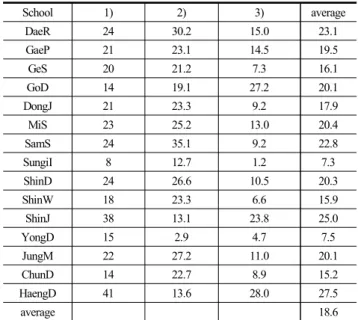
Data from ○○ Office of Education was used to calculate service life. The analysis result of the first repair period needed to calculate service life is as follows. The results of calculating the first repair rate for rooftop waterproofing of elementary school are as shown in Table 6.
The first repair rate of rooftop waterproofing of elementary school came out to be 18.6 years. Using this result and taking 60%
as recovery rate after the first repair, service life can be calculated.
The service life calculated came out to be 36.5 years.
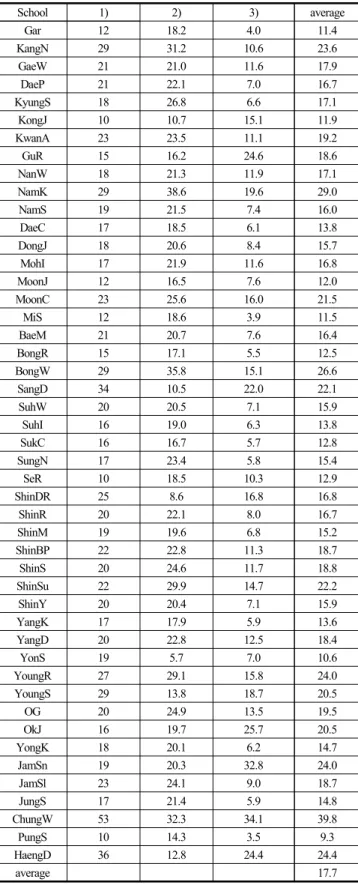
The results of calculating the first repair period for rooftop waterproofing for the middle school are shown in Table 7. The first
School 1) 2) 3) average
DaeR 24 30.2 15.0 23.1
GaeP 21 23.1 14.5 19.5
GeS 20 21.2 7.3 16.1
GoD 14 19.1 27.2 20.1
DongJ 21 23.3 9.2 17.9
MiS 23 25.2 13.0 20.4
SamS 24 35.1 9.2 22.8
SungiI 8 12.7 1.2 7.3
ShinD 24 26.6 10.5 20.3
ShinW 18 23.3 6.6 15.9
ShinJ 38 13.1 23.8 25.0
YongD 15 2.9 4.7 7.5
JungM 22 27.2 11.0 20.1
ChunD 14 22.7 8.9 15.2
HaengD 41 13.6 28.0 27.5
average 18.6
1) average year of the 1st repair after constructed 2) choice of repair according to elapsed year 3) cumulative cost function
Table 6. 1st repair time calculation of the roof-proofing in the elementary school
Fig. 1 Relation of the deterioration and service life under the 60%
of the recovery rate
repair period for rooftop waterproofing for the middle school came out to be 17.7 years. Service life can be calculated by using this result and taking 60% as recovery rate after the first repair. The
resulting service life is about 34.7 years.
The results of calculating the first repair period for rooftop waterproofing for high schools are shown in Table 8. The first repair period for rooftop waterproofing for high schools came out to be 18.6 years. Service life can be calculated by using this result and taking 60% as recovery rate after the first repair. The resulting service life is about 36.5 years.
4.2. Floor finishing
Data from ○○ Office of Education was used to calculate service life. The analysis result of the first repair period needed to calculate service life is as follows. The results of calculating the first repair rate for floor finishing of elementary school are as shown in Table 9.
The first repair period for floor finishing for elementary schools came out to be 22.0 years. Service life can be calculated by using this result and taking 60% as recovery rate after the first repair. The resulting service life is about 43.1 years.
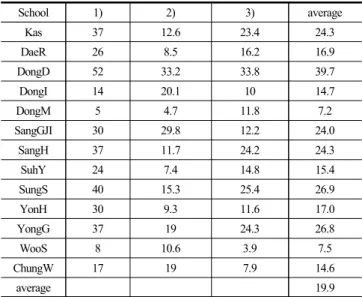
The results of calculating the first repair period for floor finishing for the middle schools are shown in Table 10. The first repair period for floor finishing for the middle schools came out to be 19.9 years. Service life can be calculated by using this result and taking 60% as recovery rate after the first repair. The resulting service life is about 39 years.
The results of calculating the first repair period for floor finishing for high schools are shown in Table 11. The first repair period for floor finishing for high schools came out to be 21.0 years. Service life can be calculated by using this result and taking 60% as recovery rate after the first repair. The resulting service life is about 41.2 years.
School 1) 2) 3) average
Gar 12 18.2 4.0 11.4
KangN 29 31.2 10.6 23.6
GaeW 21 21.0 11.6 17.9
DaeP 21 22.1 7.0 16.7
KyungS 18 26.8 6.6 17.1
KongJ 10 10.7 15.1 11.9
KwanA 23 23.5 11.1 19.2
GuR 15 16.2 24.6 18.6
NanW 18 21.3 11.9 17.1
NamK 29 38.6 19.6 29.0
NamS 19 21.5 7.4 16.0
DaeC 17 18.5 6.1 13.8
DongJ 18 20.6 8.4 15.7
MohI 17 21.9 11.6 16.8
MoonJ 12 16.5 7.6 12.0
MoonC 23 25.6 16.0 21.5
MiS 12 18.6 3.9 11.5
BaeM 21 20.7 7.6 16.4
BongR 15 17.1 5.5 12.5
BongW 29 35.8 15.1 26.6
SangD 34 10.5 22.0 22.1
SuhW 20 20.5 7.1 15.9
SuhI 16 19.0 6.3 13.8
SukC 16 16.7 5.7 12.8
SungN 17 23.4 5.8 15.4
SeR 10 18.5 10.3 12.9
ShinDR 25 8.6 16.8 16.8
ShinR 20 22.1 8.0 16.7
ShinM 19 19.6 6.8 15.2
ShinBP 22 22.8 11.3 18.7
ShinS 20 24.6 11.7 18.8
ShinSu 22 29.9 14.7 22.2
ShinY 20 20.4 7.1 15.9
YangK 17 17.9 5.9 13.6
YangD 20 22.8 12.5 18.4
YonS 19 5.7 7.0 10.6
YoungR 27 29.1 15.8 24.0
YoungS 29 13.8 18.7 20.5
OG 20 24.9 13.5 19.5
OkJ 16 19.7 25.7 20.5
YongK 18 20.1 6.2 14.7
JamSn 19 20.3 32.8 24.0
JamSl 23 24.1 9.0 18.7
JungS 17 21.4 5.9 14.8
ChungW 53 32.3 34.1 39.8
PungS 10 14.3 3.5 9.3
HaengD 36 12.8 24.4 24.4
average 17.7
1) average year of the 1st repair after constructed 2) choice of repair according to elapsed year 3) cumulative cost function
Table 7. 1st repair time calculation of the roof-proofing in the middle school
School 1) 2) 3) average
KyungD 36 11.3 21.1 22.8
KwanA 34 11.3 21.3 22.2
DangK 21 6.1 8.2 17.0
DaeS 20 6.1 7.9 16.7
MokD 13 2.5 4.5 16.5
BoS 14 4.2 5.2 12.2
SoeulBS 11 2.8 4.4 9.8
SeM 30 9.1 17.9 27.3
YangJ 12 3.9 4.7 12.2
YoungD 33 10.1 20.8 21.3
YoungR 20 6.1 9.1 16.9
YoungM 31 9.3 24.2 21.5
HaeSKC 28 8.7 15.8 26.1
average 18.6
1) average year of the 1st repair after constructed 2) choice of repair according to elapsed year 3) cumulative cost function
Table 8. 1st repair time calculation of the roof-proofing in high school
5. Conclusion and future researches
All buildings undergo process of deterioration caused by various factors after being constructed. However, it is necessary to provide students with school facility environment that is pleasant and convenient. As such, as school facilities go through deterioration, it is crucial to provide pleasant study environment for students.
In this research, we proposed repair period for rooftop waterproofing and floor finishing, two of the components that constitute school facilities. The summary of our conclusion from our research is as follows.
First, quantitative approach was used to calculate service life for rooftop waterproofing and floor finishing. Deterioration process is not caused by one simple reason but various reasons in complex ways. Using elapsed years from construction that could encompass complex workings of deterioration process such as geographic and environmental factors, we calculated the first repair period based on average of results obtained from three methods: average of the first repair period; the relationship between elapsed years from construction and cumulative repair cost; and probability function model on the occurrence of repair. By taking the average of the first repair period obtained from three different approaches, we were
School 1) 2) 3) average
KangS 22.0 26.0 15.8 21.3
GeaN 27.0 35.4 18.3 26.9
KoY 37.0 12.6 23.4 24.3
GongJ 11.0 13.7 19.8 14.8
KwangH 15.0 15.6 6.3 12.3
KuS 30.0 9.6 19.3 19.6
KeumS 22.0 22.1 8.9 17.7
NamS 29.0 9.6 18.0 18.9
DangS 24.0 30.3 15.3 23.2
DongJ 24.0 12.4 16.0 17.5
MokD 29.0 31.5 17.2 25.9
MooH 20.0 21.0 8.2 16.4
MooB 22.0 25.7 17.0 21.6
SangS 20.0 21.3 12.4 17.9
SukK 41.0 23.0 26.1 30.0
SuhBK 51.0 25.2 34.0 36.7
SuhJ 17.0 18.8 7.0 14.3
SungW 22.0 25.0 13.6 20.2
ShinK 20.0 23.5 14.1 19.2
ShinW 15.0 19.2 9.9 14.7
YangK 22.0 27.5 13.3 20.9
YangM 27.0 35.6 17.3 26.6
YeukC 32.0 10.1 20.4 20.8
YonS 26.0 35.6 18.1 26.6
YoungR 20.0 25.8 15.8 20.5
ORN 26.0 38.5 15.7 26.7
JangC 47.0 22.7 30.3 33.3
ChungP 42.0 14.0 28.0 28.0
average 22.0
1) average year of the 1st repair after constructed 2) choice of repair according to elapsed year 3) cumulative cost function
Table 9. 1st repair time calculation of the floor finishing in elementary school
School 1) 2) 3) average
Kas 37 12.6 23.4 24.3
DaeR 26 8.5 16.2 16.9
DongD 52 33.2 33.8 39.7
DongI 14 20.1 10 14.7
DongM 5 4.7 11.8 7.2
SangGJI 30 29.8 12.2 24.0
SangH 37 11.7 24.2 24.3
SuhY 24 7.4 14.8 15.4
SungS 40 15.3 25.4 26.9
YonH 30 9.3 11.6 17.0
YongG 37 19 24.3 26.8
WooS 8 10.6 3.9 7.5
ChungW 17 19 7.9 14.6
average 19.9
1) average year of the 1st repair after constructed 2) choice of repair according to elapsed year 3) cumulative cost function
Table 10. 1st repair time calculation of the floor finishing in middle school
School 1) 2) 3) average
DaeK 8 9.8 18.6 12.1
DaeDS 8 9.8 18.6 12.1
DaeW 30 14.7 19.2 21.3
RiRA고 40 19.6 26 28.5
MiRS 9 12.9 4.1 8.7
SoeulKK 38 12.5 24 24.8
SunI 24 30.3 14.8 23.0
SungB 22 25 9.9 19.0
SeMC 34 13.7 21.6 23.1
SeW 29 7.9 11.7 16.2
SongK 20 23.9 12.8 18.9
SoongM 25 14.4 15.9 18.4
ShinL 24 14.1 15.1 17.7
ShinJJ 41 10.2 18.2 23.1
YoungSK 21 22.9 12.8 18.9
YaleID 22 25 13.9 20.3
OS 44 26.9 28.4 33.1
WooS 26 30.4 21.9 26.1
JaeH 31 15.9 19.9 22.3
ChungW 22 8.8 13.7 14.8
HwanI 49 30.4 32.7 37.4
average 21.0
1) average year of the 1st repair after constructed 2) choice of repair according to elapsed year 3) cumulative cost function
Table 10. 1st repair time calculation of the floor finishing in high school
able to remove bias from the result. We calculated service life by using the average of the first repair period and recovery rate. That is, we determined as service life the period between the average first repair period (t1) and the second repair period (t2).
Second, the result of calculating service life for rooftop waterproofing and floor finishing in school facilities is as follows.
For rooftop waterproofing, service life for elementary school, the middle school and high schools was 36 years, 34 years and 36 years, respectively. Overall, expected service life is around 35 years. For floor finishing, service life for elementary school, the middle school and high schools was 43 years, 39 years and 41 years, respectively. Overall, expected service life is around 4 years.
The data used in this research was repair history provided by ○
○ Office of Education. Although the repair history included information on repair and maintenance done after construction, it did not include accurate history of materials and construction techniques used. Accordingly, this research has a limitation in terms of proposing materials used and repair period based on construction techniques. Repair history since construction should be studied and summarized in detail in the future. Using this information, we will also be able to explain the relationship between how various factors influenced each service life.
Also, in order to determine performance level, it is necessary to empirically verify physical phenomenon. Therefore, it is necessary to develop a quantitative model that can compare deterioration process and status during service life. Consequently, a research that can make quantitative prediction on deterioration process and verify the result empirically must be conducted.
Acknowledgement
“This paper is a result of 'Improvement of Building Maintenance System in Korea' which is a project of 2014 Basic Research Program of KICT”.
Reference
[1] Kim, S.(2007), “A Study on Classification Standard for Efficient Maintenance System of Educational Facilities”, Proceedings of Construction Management(2007-11), pp404~422.
[2] Suh, C, Choi, M., Choi, S., Oh, S. and Kwan, Y.(2001), “Evaluation Method of Deterioration Grade for Remodeling Old Educational Facilities”, J. of Korean Institute of Educational Facilities, vol8(3), pp7~14
[3] Son, s.(2010), “Study on Estimating Educational Facility Repairing Cycle/
Rate and Improving Reliability Using BSI”, Doctoral Diossertation in Hong Ik Univ.
[4] Lee, K., Chang, J. and Chae, C.(2005), “A Study on the Service life of the Building Components in the Apartment Housing”, J. of Housing 16(5), pp67~74
[5] Lee, K.. and Chae, C.(2006), “A Study on the Analysis of the Service life in the Office Building Finishings”, AIK J. in Structural Area 22(11), pp139~148
[6] Lee, M. Jung, M and Park, T.(2009), “A Study on the Establishment of Maintenance Standards(Repair Periods and Rates) of Educational Facilities”, AIK J. in Structural Area 25(29), pp145~152
[7] Lee, C.,, Jun, Y. and Park, T.(2007), “A Study on the Support System for Maintenance Efficiency of Educational Facilities”, AIK J.
of Structural Area 23(8), pp191~199
[8] KICT(1994), Development of the Optimal Maintenance Model(Ⅱ) [9] Cho, C. and Lee, W.(2008), “A Survey Study on the Maintenance &
Operations Costs of Elementary, Middle and High School Facilities”, AIK J. of Architectural Area 24(4), pp87~96
[10] AIJ(1988), Consideration of the Building Durability Strategies
[11] BELCA(1998), Report on the Service Life Survey of the Building Structure and Facilities, 49~63
[12] Land Development Tech. Center(1986), Economic Assessment Techniques of the Conservation and Durability Improvement, Kibodang..
[13] BCIS(2006), “Life Expediency of Building Components- Surveyors’
experiences of buildings in use”, Connelly-Marton.