• 검색 결과가 없습니다.

Vanity Furniture as A New Type of Furniture in Modern Era - Focused on Patented Art Deco Vanity Furniture in the Cooper-Hewitt National Design Museum -

N/A
N/A
Protected

Academic year: 2021

Share "Vanity Furniture as A New Type of Furniture in Modern Era - Focused on Patented Art Deco Vanity Furniture in the Cooper-Hewitt National Design Museum -"

Copied!
9
0
0

로드 중.... (전체 텍스트 보기)

전체 글

(1)

Vanity Furniture as A New Type of Furniture in Modern Era

- Focused on Patented Art Deco Vanity Furniture in the Cooper-Hewitt National Design Museum-

Seong Ah Kim

1

ABSTRACT

The study of Lurelle Van Arsdale Guild (1898- 1986)’s vanity table and stool in the Cooper- Hewitt National Design Museum is essential to understand how the stylistic change was made on industrial design in the 1930s caused by economic necessity. The vanity furniture expresses in such relatively inexpensive image transformations that would attract new customers in the Depression.

The objects are donated from a collector and became one of CHM’s collections in 1997. In curatorial file, other than the designer’s and manufacturer’s names there is nothing specified for these objects.

Therefore, this study is aimed for researching the exact date for these valuable objects for understanding American Art Deco furniture in the 1930s. Moreover, studying social aspect of these objects gives clear vision for the background. Especially, the History of American Standard (Rodengen, 1999) gives great over view to the history of the manufacturer, C. F. Church Company.

The record in Fortune of 1934 suggests the designer, Lurelle Guild’s position among other industrial designers at that time. And Profoundly, the objects were assigned design patents.

Therefore, the vanity furniture set in the CHM was a significant symbol of early modernism rising from functional areas after the Depression.

Keywords: Lurelle Van Arsdale Guild, American Art Deco, Streamlined Design, Vanity furniture.

1. INTRODUCTION

1-1 The Purpose of Study

The vanity furniture set (Accession No. 1997-117-1, 2) by Lurelle Van Arsdale Guild (1898- 1986) in the Cooper-Hewitt National Design Museum in New York are donated from a collector to the museum in 1997. In the curatorial file, there is nothing specified other than the designer and the manufacturer’s name for these objects. In addition, a copy of a contemporary advertisement for these objects was filed.

From a formal analysis, an abstract composition of the geometric forms and the contrast of black and white apparently represent the aesthetic of the 1930s. However, there is no record for the exact production date is listed. It is marked inside of the table by C. F. Church Company in New York which is relatively unknown firm either. Therefore, this research was focused on finding exact date for the objects and finding significance of the objects especially vanity furniture in general in the history of modern furniture design.

Received for publication: Jun 03, 2009 ; Reviewed: Jun 30, 2009 ; Accepted: Nov 19, 2009.

1) Professor, Dept of Architectural Interior Design, Kaywon School of Art and Design, Euiwang-shi,

Kyunggi-Do, Republic of Korea, 437-712. Email: [email protected].

(2)

1-2 Study Methods

Since the museum record does not offer details on this furniture, formal analysis of the piece is essential in the first step of this research. Next step is searching for secondary sources relate to these objects. However, there is no secondary sources for describe this furniture. Most secondary sources give great over view for cultural and social aspect on this piece. However, in terms of researching for the manufacturer, The History of American Standard (Rodengen, 1999) gives great over view to the history of the manufacturer, C.

F. Church Company. The record in Fortune of 1934 and Decorators Digest of 1935 suggests the designer, Lurelle Guild’s position among other industrial designers at that time. Primary sources as New York City directory and such periodicals as House and Garden, House Beautiful and Good Furniture and Decoration from 1930 to 1940 did not offer helpful information. However, patent record search for Lurelle Guild’s furniture gave the direction to this paper.

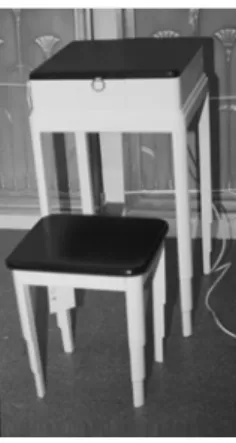
2. Formal Analysis- Design for the Mass in the Depression Era The vanity furniture set (Accession No. 1997-117-1, 2) by Lurelle Van Arsdale Guild (1898- 1986) in the Cooper-Hewitt National Design Museum in New York exemplifies a new machine aesthetic in the 1930s America (fig.

1). The objects are donated from a collector to the museum in 1997. In the curatorial file, other than the designer and the manufacturer’s name, there is nothing specified for these objects. In addition, a copy of a contemporary advertisement for these objects was filed (fig 2).

Fig. 1. Lurelle Van Arsdale Guild,

Vanity Table and Matching Stool,

Collection of Cooper- Hewitt Museum, C. F.

Church Co.

From a formal analysis, an abstract composition of the geometric forms and the contrast of black and white apparently represent the aesthetic of the 1930s. However, there is no record for the exact production date. It is only marked inside of the table by C. F. Church Company in New York which is relatively unknown firm either. Therefore, this research was focused on finding exact date for the objects and finding significance

of the objects especially vanity furniture in general in the history of modern furniture design.

Fig. 2. Advertisement of C.

F. Church Co. Curatorial file at the department of applied art in the Cooper-Hewitt National Design Museum.

Fig. 4.Brand Mark of Vanity Table (Detail of Fig. 3.).

Fig. 3.Inside Detail of Vanity Table.

Therefore formal analysis of the piece was essential in the first the first step of this research. This vanity set clearly shows the aesthetics designed for boosting sales in the Depression era.

Furniture design in the modern period was based on simple geometric shapes and emphasized the highly finished surface mainly focusing on the edge treatment and the use of rigorously simplified shapes. The composition of geometric shapes on these pieces is evidence of a design for mass production.

It is clear that Guild’s furniture was

designed for the mass consumption after

(3)

the Depression.

The Guild furniture is a relatively small piece, but practical for the small space. The furniture contains practical elements on the inside of the table. The function of furniture is a part of a unity. On the Guild’s furniture, the tabletop with rounded edges in a square shape covers the functions of the pieces. A piano hinge makes the tabletop open up like a chest and has five small sections inside for organizing small items. There are two switches, one on the outside of the body and the other on the inside. As the tabletop opens, the tabletop touches the outside switch, and vice versa.

As Henry Luce defined Guild in Fortune as “closer than many other designers to the art industries, especially furniture and decorative metal work....,” the main consideration for the modern designer was simplifying the factory process and cutting down costs of the products(Luce, February 1934). However, not many industrial designers had knowledge of the process of industry(Meikle 1979). Guild was one of the only few exceptions (Meikle 1979). His interests in craft made possible to understand the machine process of manufacture (Luce, February 1934). Furthermore, he made presentation models in final materials (Luce, February 1934).

Especially on these pieces, the legs were turned on a lathe with three step patterns and the cylinder shape piece cut horizontally to make four pieces of the same shape. Eventually, the leg shapes have two flat sides for the joints and one round side for the outside curve. This process reduces excess materials and saves time; the other elements are done in the same way. For instance, the decorative panel which was attached to the rectangular body of the table, shows rows of half cylinders. Corner blocks on the inside of the table, the same as a cross section of the legs, add strength and make a transition to rounded edges of the exterior and the legs.

Fig. 5. Inside of Guild’s vanity furniture.

Eliminating a surface decoration, the design mainly referred to the machine. The appearance of furniture represents what the machine can most readily and effectively produce. For example the step form is the simple machine aesthetic created by repeating geometric shapes. Rounded corners and the use of parallel lines of the step pattern as a decorative motif are associated with mechanical shapes, which can easily be created by repeating a machine process.

The step patterns around the table body were simply done by a rabbeting router bit on the conventional table shape; the legs and stretchers connected with mortise and tenons joints. Also, simply using a different shape of a router bit made the round edged top for the table and the stool.

The step pattern repeated on the inside mirror. The mirror shape on the inside was still designed within a rectangular shape. Instead of cutting the mirror in shape, creating step-patterned frame simplified the process of this piece.

The use of step forms on this piece recalls the setback of the skyscrapers. The setback skyscrapers were initiated and decorative arts heavily influenced by the step form (Phillips and Hanks 1985). The similarity between them is easily found on the architecture in this period of time.

For instance, in the Chrysler Building in New York City in 1929 (fig. 2), the slender form of a geometric composition shows the zigzag moderne of step forms the same as the Guild furniture.

Other than Guild, many designers designed furniture based on the setback skyscraper shape. Guild’s was use of zigzag pattern for the decoration and the slender legs captured the verticality of the skyscrapers.

Another example of the use of machine aesthetics on Guild’ furniture is streamlining. The rounded corners and the use of the parallel lines of the step on this vanity furniture exemplifies the use of streamlining, which was one of the most popular machine aesthetics in the 1930s.

Streamlining is first represented by airplanes and trains which spread widely to architecture,

(4)

commercial buildings, appliances, and interiors.

At first, streamlining gave the appearance of efficiency and speed for transportation design.

However, whether the object was related to speed or not, streamlining was soon adapted to many objects. Streamlining is the most popularly used machine aesthetic, such as Kem Weber’s clock (fig. 7) and the Coca- Cola bottling plant in Los Angeles (fig. 8). The machine aesthetic is the style of a combination of art and industry. In the machine age, a new production for consumption was essential.

Manufacturers and industrial designers produced to the new look of clean and functional lines that could stimulate sales.

The new abstract design for a machine was widely used; a special type of design suited to the machine process developed such as the efficiency of a machine, step patterns, and streamlines. The design approach was focused on the

stylization of objects for mass consumption. Guild said, “Beauty alone does not sell (Luce, February 1934).” His design is essentially practical and quite genuinely contributed to the engineering improvement for the manufacturer.

Fig. 7. Kem Weber, Clock, 1934.

Fig. 8. Robert Derrah,

Coca- Cola Bottling Plant and Office. Los Angeles,

1936.

Fig. 6. William Van.

Alen,

Chrysler Building. New York,

1928-1931.

The Depression made it inevitable that the decline of handcrafts, which replaced by mass production (Kardon 1995). As Charles Richards in House Beautiful, said, “We have long appreciated the art of the craftsman. We are slowly and with some difficulty coming to appreciate the art appropriate to the machine (Richard, January 1930).” Precious materials of French Art Deco were replaced by inexpensive industrial materials in America (Kardon 1995). Also, machine-made streamlined forms were replaced it, which emphasized the cleanness and simplicity of design replaced the ornamental surfaces in the earlier period. Paul Frankl mentions in his book, New Dimensions in 1928 that, “Meaningless ornaments should be avoided as much as possible. Restraint is a very important factor in modern design (Frankl 1928). There are very few ornaments and embellishments which have much meaning to us, and therefore when there is any doubt they should be omitted.” He did not deny the decorative element itself but he insist that modern furniture should simple and restrained.

3. C. F. Church Company, the Manufacturer C. F. Church was not listed in the city directory of New York City around the 1930s. It was difficult to search the information for the company.

In turn, The History of American Standard (Rodengen, 1999) gives great over view to the history of the manufacturer, C. F. Church Company. C. F.

Church Company, founded by Charles F. Church, had been produce invented parts for beds and later manufactured wooden toilet seats for New York Hotels (Jeffrey 1999) The company became a subsidiary brand of American Radiator & Standard Sanitary Corporation, now American Standard, from 1929 until the Second World War. In the advertisement (fig. 2) Church Company introduces as “makers of Church Seats.” In this sense, Church

Fig. 9. Raymond Hood,

American Radiator Building, 1924.

(5)

Company was well known for Church Seats rather than furniture design at that time. The company was located in 40 W. 40

th

Street American Radiator Building (fig. 9) which was built in 1924 in Art Deco style.

There is a bathroom model with the other type of Guild vanity furniture on the advertisement in the 1930s magazine (fig. 2) (Curatorial file at the department of applied art in the CHM). The model shows the sleek surface with streamlined furniture, which has a similar shape with the Guild furniture in the Cooper- Hewitt Museum.

The advertisement also indicates that the piece in the CHM is one of seven bright colors that produced by C. F. Church. Also Guild designed hampers, towel stands, brackets, and shelves.

The head of Design Development of American Radiator and Standard Sanitary Corporation, George Sakier designed pre-fabricated

bath unit from 1934 (fig. 10). The bathrooms of Sakier’s and the one in the advertisement are apparently similar in style. Also, a bathroom in the same period for example represents the setback patterns on the prefabricated assemblage surfaces. The prefabricated units show a step-patterned mirror with two lighting fixtures on the both sides. Those examples show the typical bathroom interior in the machine age. Therefore, Guild’s vanity furniture might be produced around the same time.

Fig. 10. George Sakier, Bathroom for American Radiator and Standard Sanitary Co.

4. The Rise of Modernism in Functional Areas

Since a Bauhaus designer, Magarete Schutte-Lihotzky first designed built-in system kitchen in 1926 for Frankfurt, modernism first had a great effect on a kitchen and a bathroom where is the most functional places in a house.

The early stage of American Art Deco was influenced by French. However, after the Depression, the market had been changed fast. As Raymond Lowey said “the goal of design is to sell,” the importance of industrial designers in the market glowed quickly. Thus, American Art Deco after the Depression heavily influenced by modern design from Bauhaus.

However, some people still preferred antique furniture for their living room and bedrooms. The 1930s was a kind of transitional time of slow change of life style. Pilgrim mentioned in The Machine Age that, “an inspection of almost any house from the late

1920s and 1930s shows a dichotomy between the historical façade and period furnishings and the new machine-made service area (Pilgrim, Tashjian, and Wilson 1986). It was reflected in the illustrations of the contemporary interior design and decoration magazines, which featured period room furniture and modern sleek kitchens and bathrooms.

Fig. 11. Magarete Schutte-Lihotzky,

built-in system kitchen, 1926.

Another aspect on the effects of the Depression is the change of

life style in a house which became compact in size (Phillips and Hanks

1985; Kardon 1995). House Beautiful of 1935 declares that, “It

[modern house] will also be simpler, since ornament has almost

reached the vanishing point in the small house.... The picturesque,

romantic, medieval, hand-wrought character has been replaced by the

more precise and machinelike, with emphasis upon proportion and

mass rather than detail (House Beautiful 77).” The house needed the

(6)

furniture to fit into the new life style. Living in a small apartment in an urban living required space saving and multi- purpose furniture. Therefore, during this period, it was important to consider how the furniture would function in terms of space saving. Indeed, the built-in furniture and modular furniture became essential.

As the 1925 Paris exposition showed, the French interior was still dominated by the traditional cabinetwork. However in America, with the development of urban living and influence of the Depression, built-in furniture became essential. Therefore, the development of built-in furniture was influenced by the functionalist aspect of German and Austrian design. Indeed, this new style of furniture was more appropriate for the modern house because of the Depression.

5. Patent

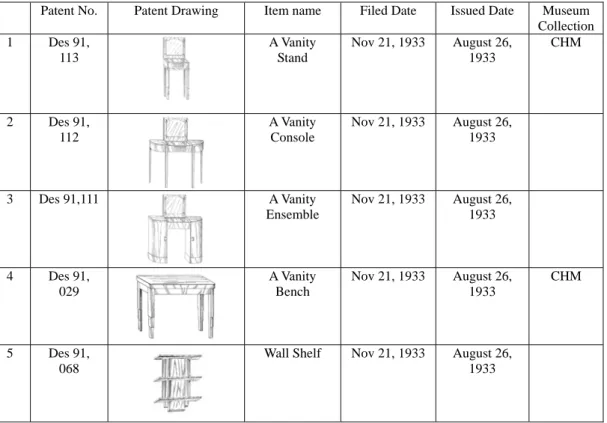
The U. S. patent record gives me a key to this research and the exact design date for the collection. The patent for the furniture in the CHM (Design patent no. 91, 113 and 91, 029) was applied in August 1933 and assigned in November of the year. Other than the design related to the CHM collection, there were eight other design patents as an ensemble. Some of designs were advertised through contemporary magazines (Fig. 2). Therefore, to the all of Church Ensemble, design patents were assigned from 1933 to 1934.

Table 1. List of Patent Assigned Design

Patent No. Patent Drawing Item name Filed Date Issued Date Museum Collection

1 Des 91,

113

A Vanity Stand

Nov 21, 1933 August 26, 1933

CHM

2 Des 91,

112

A Vanity Console

Nov 21, 1933 August 26, 1933

3 Des 91,111 A Vanity

Ensemble

Nov 21, 1933 August 26, 1933

4 Des 91,

029

A Vanity Bench

Nov 21, 1933 August 26, 1933

CHM

5 Des 91,

068

Wall Shelf Nov 21, 1933 August 26,

1933

(7)

6 Des 49,117 Tilt Front Hamper

Nov 21, 1933 August 26, 1933

7 Des 91,

067

A Wall Shelf Nov 21, 1933 August 26, 1933

8 Des 91,

026

A Towel Stand Nov 21, 1933 August 26, 1933

9 Des 92,028 A Towel Stand Nov 21, 1933 August 26, 1933

10 Des 91,268 Neo-Classic

Bathroom Chair

Aug 26, 1933 Jan 2, 1934

11 Des 91, 818

A Beauty Box August 26, 1933

March 27, 1934

12 Des 91, 819

A Wall Vanity August 26, 1933

March 27, 1934

Vanity furniture was clearly a new type of furniture in modern space. According to U.S. patent record, patent for vanity furniture and utility were tremendously increased around the 1930s.

According to patent record search, before Guild’s design assigned patents, there was only two

patented vanity furniture in 1931 and 1932 (Fig 12, 13). However, there were both in historical

styles. Consequently, Guild’s furniture design in the CHM was the first vanity furniture set assigned

patent in modern design. Other vanity set produced around 1931 by Lord and Taylor was heavily

influenced by French example by Leon Jallot in 1928 (Fig 14, 15). Therefore, vanity set by Lurelle

Guild in CHM is the pioneering form of vanity furniture design in American modern.

(8)

Fig. 15. Vanity Furniture, c.1931. Manufactured by Lord & Taylor.

Fig. 14. Leon Jallot, Vanity furniture, 1928.

Fig. 12. J. Kerr,

Console Vanity Table,

1931. U. S. Patent Des 83, 903.

Fig. 13. M. M.

Wheeler,

Vanity Dressing Table,

1932. U. S. Patent Des 87, 821

6. Conclusion

This research was about the relatively unknown vanity furniture set in the Cooper-Hewitt National Design Museum. As a result, the exact date for the furniture and the information on C. F.

Church Co. were explored. However, the advertisement of C. F. Church Company filed in the museum was not found from periodicals. Based on the advertisement of the company, vanity furniture in the Cooper-Hewitt Museum is one of seven bright colors of Church Ensemble. Other examples were not found in any place yet.

These objects were profoundly related to the development of early modernism in the 1930s America. Since the modern bathroom rises in American home at the turn of the twentieth century, vanity furniture began to design in the 1930s. In this milieu, the vanity set in CHM was innovatively designed in American own modern aesthetic of streamlined style. Moving away from French influence, the pieces represent purely American aesthetics of streamlined design. The significance of this furniture in design history summarize as below.

1. Represents modernism rising from functional area

Modernism began from such functional areas as a bathroom and a kitchen. The objects represent the rise of modernism in the functional area. C. F. Church was one of subsidized brand in American Sanitary and Standard from 1929 to 1967. Therefore, this furniture symbolizes the rises of modernism from functional areas.

2. Represents the first American vanity furniture in purely American aesthetics of streamlining 3. Assigned First patented modern vanity furniture set

In conclusion, Guild designed vanity furniture set in the CHM designed in 1933 indicates

the movement away from highly elaborate and expensive objects after the Depression toward

unique and manufactured works that embodied modernist aesthetics: simplicity of sleek lines,

informality of materials, and practicality of contents. The furniture by Guild suggested a practical

piece suitable for the new way of life, which was appropriate to a small space and created an

environment that gave harmony to a modern interior.

(9)

7. REFERENCES

Anderson, Harry V. 1935. “Contemporary American Designers.” Decorators Digest 4: 42- 43, 82, 84.

Battersby, Martin. 1975. The Decorative Thirties. New York.

Cheney, Sheldon and Martha. 1992. Art and the Machine. New York.

Craig, Miller. 1980. Modern Design in the Metropolitan Museum of Art 1890-1990. New York.

Davies, Karen. 1983. At Home Manhattan: Modern Decorative Arts, 1925 to the Depression [exh.

cat., Yale University Art Gallery] New Haven, CT.

Duncan, Alastair. 1986. America Art Deco. New York.

Frankl, Paul T. 1928. New Dimensions. New York.

Heskett, David. 1980. Industrial Design. London.

Joyce, Ernest. 1987. Encyclopedia of Furniture Making. New York.

Kaplan, Wendy. 1995. Designing Modernity: The Arts of Reform and Persuasion 1885- 1945 [exh.

cat., the Wolfsonian]

Kardon, Janet. 1995. Craft in the Machine Age 1920-1945 [exh. cat., American Craft Museum] New York: 28, 29-30..

Luce, Henry. ed. 1934. “Industrial Designers.” Fortune IX: 90.

Meikle, Jeffrey L. 1979. Twentieth Century Limited. Philadelphia: 40.

Miller, R. Craig. 1990. Modern Design: in the Metropolitan Museum of Art 1890- 1990. New York.

Museum of Modern Art. 1934. Machine Art [exh. cat., Museum of Modern Art] New York.

Pile, John. 1990. Furniture: Modern + Postmodern, Design + Technology. New York.

Pilgrim, Dianne. 1986. Dichran Tashjian, and Richard Guy Wilson. The Machine Age in America:

1918-1941 [exh. cat., Brooklyn Museum of Art] New York: 38.

Phillips, Lisa and David Hanks. 1985. High Styles: twentieth-century American design. New York:

45, 90.

Puols, Arthur J. 1983. American Design Ethic: a history of industrial design to 1940. Cambridge and London.

Richard, Charles. 1930. “Design for the Craftsman and Design for the Machine.” House Beautiful, 72: 60.

Rodengen, Jeffrey L., 1999. The History of American Standard. Fort Lauderdale, Fl.

Smith, Terry. 1993. Making the Modern: Industrial, Art and Design in America. Chicago and London.

Weingartner, Fannia. 1986. Streamline in America. Dearborn.

“Contemporary Art in Current Exhibition.” Good Furniture and Decoration, 32 (May 1929):

241-247.

“The House Goes Marching On.” House Beautiful 77 (April 1935): 53.

수치

Fig. 1. Lurelle Van  Arsdale Guild,  Vanity Table and  Matching Stool,  Collection of Cooper-  Hewitt Museum, C
Fig. 5. Inside of  Guild’s vanity  furniture.
Fig. 7. Kem Weber, Clock,  1934.
Fig. 10. George Sakier,  Bathroom for American  Radiator and Standard  Sanitary Co.
+3

참조

관련 문서

Nonetheless, allowing for a patent premium in the speci…cation of the market value equation has almost no e¤ect on the other coe¢ cients in the model –in particular, the coe¢

and an improvement set of extragradient-type iteration methods in [5], we in- troduce new iteration algorithms for finding a common of the solution set of an equilibrium problem

2재화 2요소 헥셔-올린 모형에서는 어느 한 경제에서 어느 한 요소의 양이 증가하면, 그 요소를 집약적으로 사용하는 산업의 생산량은 증가하고 다른

including a standing solution and multiple coffee table heights—our Tucker Tables offer minimalist design for every room in your office..

Ross: As my lawfully wedded wife, in sickness and in health, until

glen plaids 글렌 플레이드와 캐시미어 카디건, 캐리지 코트, 그리고 케이프 -> 격자무늬의 캐시미어로 된 승마용 바지, 마부용 코트, 말 그림이 수

다양한 번역 작품과 번역에 관한 책을 읽는 것은 단순히 다른 시대와 언어, 문화의 교류를 넘어 지구촌이 서로 이해하고 하나가

The index is calculated with the latest 5-year auction data of 400 selected Classic, Modern, and Contemporary Chinese painting artists from major auction houses..