Korean Journal of Microbiology (2019) Vol. 55, No. 4, pp. 432-435 pISSN 0440-2413
DOI https://doi.org/10.7845/kjm.2019.9136 eISSN 2383-9902
Copyright ⓒ 2019, The Microbiological Society of Korea
Complete genome sequence of probiotic Lactobacillus johnsonii IDCC9203 isolated from infant feces
Tae-Yoon Kim, Byeonghun Lee, Hyuk-Sang Kwon, Jin Seok Moon* , and Sung Ku Choi Research Laboratories, ILDONG pharmaceutical Co., Ltd., Hwaseong 18449, Republic of Korea
유아 분변에서 분리한 프로바이오틱 Lactobacillus johnsonii IDCC9203의 유전체 염기서열 해독
김태윤 ・ 이병훈 ・ 권혁상 ・ 문진석* ・ 최성구 일동제약 중앙연구소
(Received November 4, 2019; Revised November 13, 2019; Accepted November 13, 2019)
*For correspondence. E-mail: [email protected];
Tel.: +82-31-371-2896; Fax: +82-31-371-2900
Lactobacillus johnsonii IDCC9203 (= KCTC 10923BP) is a probiotic with anti-inflammatory properties, both in vitro and in vivo. Here, we report the complete genome sequence of the IDCC9203 strain, which was isolated from infant feces. The genome was determined using PacBio and Illumina sequencing.
This strain comprises a circular chromosome of 1,898,461 bp, and its guanine-cytosine (GC) content is 34.70%. These results will provide an understanding of this strain’s functional properties and safety assessments.
Keywords: Lactobacillus johnsonii, anti-inflammatory, infant feces, probiotics
Lactobacillus johnsonii (Lb. johnsonii) is one of the many microorganisms that resides in the human intestine. Its beneficial properties, which include immune-modulation (Kingma et al., 2011) pathogen inhibition (La Ragione et al., 2004), enhancement of the epithelial barrier function (Liu et al., 2015), and have been extensively reported. Lb. johnsonii IDCC9203 was isolated from infant feces. This strain substantially inhibit the release of inflammatory mediators such as tumor necrosis factor-α (TNF-α), Interleukin-6 (IL-6), and IL-1β stimulated the treatment of
RAW 264.7 macrophages with lipopolysaccharide (LPS) (Moon et al., 2017) and improved the symptoms of dextran sodium sulfate (DSS) - induced colitis in mice (Je et al., 2018). Despite the above biotechnological applications of IDCC9203, the genome sequence of this strain is unknown. Thus, we analyzed the genome sequence of IDCC9203, and investigated the genetic characteristics of this strain.
Lb. johnsonii IDCC9203 was grown in Man, Rogosa, and Sharpe (MRS, Difco Laboratory) broth or agar medium at 37°C for 18 h. The culture was maintained in 30% glycerol solution at -70°C until needed. The genomic DNA of IDCC9203 was extracted from cells after cultivation in MRS medium at 37°C using a Wizard Genomic DNA Purification Kit (Promega), following standard protocol recommended by the manufacturer.
Sequencing was performed at the Macrogen using the Pacific
Biosciences (PacBio) RSII SMRT and Illumina sequencing
technologies. First, the PacBio RS II sequencing was used to
generate a 20-kb SMRTbell library. Assembly of the library
using the HGAP3 pipeline yielded one contig. Subsequently,
Illumina sequencing was performed using an Illumina HiSeq
sequencer, and the Canu software (version 1.4) (Koren et al.,
2017) was used to assemble the Illumina library. After assembly,
HiSeq reads were subjected to final polishing to ensure genome
Genome sequence of Lb. johnsonii IDCC9203 ∙
433
Korean Journal of Microbiology, Vol. 55, No. 4
Fig. 1. Chromosome map of Lactobacillus johnsonii IDCC9203. Marked characteristics are shown from outside to the center; CDS on forward strand, CDS on reverse strand, tRNA, rRNA, GC content, and GC skew.sequence accuracy using a tool called Pilon (version 1.21) (Walker et al., 2014). The consensus sequence with depth of coverage was generated, by mapping the subread against the assembled contig. Errors in the single contig were manually corrected. Finally, the genome sequence of IDCC9203 was annotated by the Prokka pipeline (version.1.22). Genomic similarities between the strain IDCC9203 and the type strains of the genus Lactobacillus were calculated, using the average nucleotide identity (ANI) calculator at the EZBioCloud website (www.ezbiocloud.net) (Yoon et al., 2017). Virulence factors and antibiotic resistance genes were expected using IslandViewer3 (Dhillon et al., 2015) against the virulence factor database (VFDB) (Chen et al., 2012) and the comprehensive antibiotic resistance database (CARD) (McArthur et al., 2013).
A total of 141,448 high-quality reads and 1,321,784,216 bp were generated with an average read length of 9,344 bp.
Assembly of the PacBio library using the HGAP3 pipeline yielded contig of 1.8 Mb. The assembly results from HiSeq
reads obtained by Canu were mapped against the assembled PacBio contigs and errors in the single contig, which likely arose from the higher error rate of PacBio, were manually corrected. Consequently, this strain has a circular chromosome (plasmid-free) of 1,898,461 bp with a G + C content of 34.72%
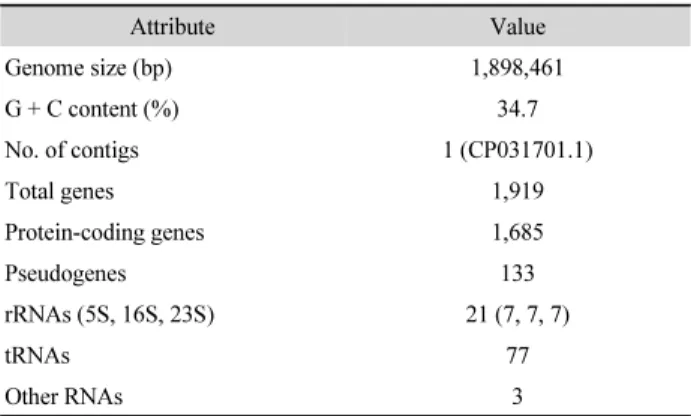
(Fig. 1). The genomic features of strain IDCC9203 are summarized in Table 1. The ANI value for Lb. johnsonii IDCC9203 and Lb.
johnsonii DSM 33200
Twas > 99.00%, indicating that the two strains are genetically similar; the proposed cut-off for species boundary is 95.00 –96.00% (Yoon et al., 2017). Lb. johnsonii IDCC9203 harbored many genes (D0Y49_00589, D0Y49_01 323, and D0Y49_01725) that codes for choloylglycine hydrolase and Nhac gene that codes for the Na
+: H
+antiporter (D0Y49_
01787). These proteins are associated with tolerance to low pH
and bile salts in the human intestine. IDCC9207 contained
genes to encode a few involved in transcriptional regulation,
including 76 transcriptional regulators and the sigma factor
(D0Y49_00488, D0Y49_00626, D0Y49_00878, D0Y49_00879,
434
∙ Kim et al.미생물학회지 제55권 제4호
Table 1. Genome features of Lactobacillus johnsonii IDCC9203
Attribute Value
Genome size (bp) 1,898,461
G + C content (%) 34.7
No. of contigs 1 (CP031701.1)
Total genes 1,919
Protein-coding genes 1,685
Pseudogenes 133
rRNAs (5S, 16S, 23S) 21 (7, 7, 7)
tRNAs 77
Other RNAs 3
D0Y49_00880, and D0Y49_01382). Additionally, genes involved in cell adhesion, such as fibronectin binding protein (D0Y49_
01808), several chaperonins (D0Y49_00940, D0Y49_00941, and D0Y49_01070) were identified. IDCC9203 also carried diverse genes encoding heat shock proteins HtpX (D0Y49_
00171 and D0Y49_01299), molecular chaperones DnaJ (D0Y 49_00609), DnaK (D0Y49_00610), GrpE (D0Y49_00611), GroEL (D0Y49_00612), and Hsp33 (D0Y49_01070). These proteins are associated with tolerance of the freezing-dry process for production probiotics. Also, no remarkable virulence- associated and antibiotic resistance genes were found. The genomic data on to Lb. johnsonii IDCC9203 provides a genetic basis to further elucidate its mechanism of anti-inflammatory activity and will facilitate its application in the functional food industry.
Nucleotide sequence accession number(s)
Lb. johnsonii IDCC9203 has been deposited in the Korean Collection for Type Cultures under accession number KCTC 10923BP, and its complete genome sequence has been deposited in GenBank under accession number CP031701.1.
적 요
Lactobacillus johnsonii 그람양성, 비 운동성이고, 인체의 다양한 환경에서 서식하고 있다. Lb. johnsonii IDCC9203은 항염증 효과가 우수한 균주로서, 유아 분변에서 분리되었다.
IDCC9203 균주의 유전체 길이는 1,898,461 염기쌍, G + C 함 량은 34.7%이었으며, 특징적으로 독성 및 항생제 내성 관련
유전자는 없었다. 이 결과를 기초로 IDCC9203 균주의 프로바 이오틱 및 안전성 관련 유전자를 확인할 수 있었다.
Acknowledgements
This work was supported by Korea Institute of Planning and Evaluation for Technology in Food, Agriculture, Forestry and Fisheries (IPET) through High Value-added Food Technology Development Program, funded by Ministry of Agriculture, Food and Rural Affairs (MAFRA) (116017032SB010).
References
Chen L, Xiong Z, Sun L, Yang J, and Jin Q. 2012. VFDB 2012 update:
toward the genetic diversity and molecular evolution of bacterial virulence factors. Nucleic Acids Res. 40, 641–645.
Dhillon BK, Laird MR, Shay JA, Winsor GL, Lo R, Nizam F, Pereira SK, Waglechner N, McArthur AG, Langille MG, et al. 2015.
IslandViewer 3: more flexible, interactive genomic island discovery, visualization and analysis. Nucleic Acids Res. 43, 104–108.
Je IG, Lee DG, Jeong DG, Hong D, Yoon JM, Moon JS, and Park S.
2018. The probiotic, ID-JPL934, attenuates dextran sulfate sodium- induced colitis in mice through inhibition of proinflammatory cytokines expression. J. Med. Food 21, 858–865.
Kingma SDK, Li N, Sun F, Valladares RB, Neu J, and Lorca GL. 2011.
Lactobacillus johnsonii N6.2 stimulates the innate immune response through Toll-like receptor 9 in Caco-2 cells and increases intestinal crypt Paneth cell number in biobreeding diabetes-prone rats. J. Nutr. 141, 1023–1028.
Koren S, Walenz BP, Berlin K, Miller JR, Bergman NH, and Phillippy AM. 2017. Canu: scalable and accurate long-read assembly via adaptive k-mer weighting and repeat separation. Genome Res.
27, 722–736.
La Ragione RM, Narbad A, Gasson MJ, and Woodward MJ. 2004. In vivo characterization of Lactobacillus johnsonii FI9785 for use as a defined competitive exclusion agent against bacterial pathogens in poultry. Lett. Appl. Microbiol. 38, 197–205.
Liu HY, Roos S, Jonsson H, Ahl D, Dicksved J, Lindberg JE, and Lundh T. 2015. Effects of Lactobacillus johnsonii and Lactobacillus reuteri on gut barrier function and heat shock proteins in intestinal porcine epithelial cells. Physiol. Rep. 3, e12355.
McArthur AG, Waglechner N, Nizam F, Yan A, Azad MA, Baylay AJ, Bhullar K, Canova MJ, De Pascale G, Ejim L, et al. 2013. The comprehensive antibiotic resistance database. Antimicrob. Agents Chemother. 57, 3348–3357.
Moon JS, Kang DJ, and Kang JH. 2017. Lactobacillus johnsonii
Genome sequence of Lb. johnsonii IDCC9203 ∙
435
Korean Journal of Microbiology, Vol. 55, No. 4
IDCC9203 having effect of preventing and improving inflammation,and uses thereof. Vol. KR1020170143914, Republic of Korea.
Walker BJ, Abeel T, Shea T, Priest M, Abouelliel A, Sakthikumar S, Cuomo CA, Zeng Q, Wortman J, Young SK, et al. 2014. Pilon:
An integrated tool for comprehensive microbial variant detection
and genome assembly improvement. PLoS One 9, e112963.
Yoon SH, Ha SM, Lim J, Kwon S, and Chun J. 2017. A large-scale evaluation of algorithms to calculate average nucleotide identity.
Antonie van Leeuwenhoek 110, 1281–1286.