https://doi.org/10.5468/ogs.2020.63.2.126 pISSN 2287-8572 · eISSN 2287-8580
Introduction
A history of prior preterm delivery is a well-known risk factor for preterm delivery in subsequent pregnancies [1]. Preterm delivery can be divided into spontaneous preterm delivery (SPTD) and medically indicated preterm delivery caused by maternal, fetal, or placental conditions. Spontaneous pre- term labor (PTL) with intact membranes, preterm premature rupture of membranes (PPROM), and acute cervical insuffi- ciency are included in the major causes of SPTD.
Intra-amniotic infection (isolation of microbes in the amni-
Subsequent pregnancy outcomes according to the
presence of acute histologic chorioamnionitis in women with spontaneous preterm delivery
Nam-Kyeong Kim, MD 1 , Yae Ji Choi, MD 1 , Subeen Hong, MD 1,2 , Jee Yoon Park, MD 1,2 , Kyung Joon Oh, MD, PhD 1,2 , Joon-Seok Hong, MD, PhD 1,2
Department of Obstetrics and Gynecology,
1Seoul National University Bundang Hospital, Seongnam,
2Seoul National University College of Medicine, Seoul, Korea
Objective
To compare subsequent pregnancy outcomes according to the presence of acute histologic chorioamnionitis (HCA) in women with spontaneous preterm delivery (SPTD).
Methods
Among 1,706 women who gave birth twice or more at our institution, 138 women delivered spontaneously at preterm (<37.0 weeks). Subsequent deliveries occurred at our institution and placental biopsy results were available.
The study population was categorized into 2 groups based on the presence of acute HCA at the time of SPTD:
HCA group (n=52) and non-HCA group (n=86). The primary outcome measures were gestational age at delivery, birthweight, and frequency of preterm delivery in subsequent pregnancies.
Results
The median gestational age at the time of SPTD was 34.0 weeks (interquartile range [IQR], 28.9–35.3 weeks), and the frequency of acute HCA was 52/138 (38%). There were no differences in gestational age at delivery, birthweight, and frequency of preterm delivery between the HCA group and non-HCA group (median gestational age at delivery, 38.0 weeks (IQR, 36.7–38.8 weeks) in the HCA group vs. 37.9 weeks (IQR, 35.7–39.0 weeks) in the non-HCA group;
frequency of preterm delivery, 14/52 (27%) in the HCA group vs. 33/86 (38%) in the non-HCA group; and median birthweight, 3.14 kg (IQR, 2.64–3.45 kg) in the HCA group vs. 2.95 kg (IQR, 2.44–3.36 kg) in the non-HCA group; P>0.1 for all.
Conclusion
The presence of acute HCA in women at prior SPTD did not significantly affect their subsequent pregnancy outcomes.
Keywords: Acute histologic chorioamnionitis; Preterm delivery; Recurrent preterm delivery; Placenta; Funisitis
Received: 2019.05.10. Revised: 2019.07.25. Accepted: 2019.08.16.
Corresponding author: Kyung Joon Oh, MD, PhD Department of Obstetrics and Gynecology, Seoul National University Bundang Hospital, 82 Gumi-ro 173-beon-gil, Bundang- gu, Seongnam 13620, Korea
E-mail: [email protected]
https://orcid.org/0000-0002-4558-7947
Articles published in Obstet Gynecol Sci are open-access, distributed under the terms of the Creative Commons Attribution Non-Commercial License (http://creativecommons.
org/licenses/by-nc/3.0/) which permits unrestricted non-commercial use, distribution, and reproduction in any medium, provided the original work is properly cited.
Copyright © 2020 Korean Society of Obstetrics and Gynecology
otic fluid) and sterile intra-amniotic inflammation (condition accompanied by increased pro-inflammatory cytokines in the amniotic fluid without isolation of microbes) are generally considered to be mechanisms of acute histologic chorioamni- onitis (HCA) [2] and are known to be associated with SPTD [3].
It has been reported that the frequency of HCA was more than 50% in women with preterm delivery [4,5]. The rate of HCA in patients with PPROM was 37.5–42% in the group without intra-amniotic infection/inflammation, 50–85% in the group with sterile inflammation, and 93% in the group with infection [6,7]. The rate of HCA in PTL patients with intact membranes was 21–27% in the group without intra- amniotic infection/inflammation, 58–86% in the group with sterile inflammation, and 79–83% in the group with infec- tion [8,9]. HCA is related to an increase in neonatal compli- cations such as intraventricular hemorrhage, cerebral palsy, sepsis, pneumonia, necrotizing enterocolitis, and death [4,5].
Because acute HCA is associated with an earlier preterm delivery and a poorer prognosis for neonates [2,7,9-11], it is important to evaluate whether acute HCA in a prior preterm delivery is associated with poor outcomes of subse-
quent pregnancy. The results of the analysis will be helpful to clinicians when counseling pregnant women with a prior preterm birth and acute HCA. Previous studies have shown that acute inflammatory lesions of the placenta increased the risk of recurrent preterm delivery in women who have a past preterm delivery [12,13]. However, these studies included all preterm deliveries due to spontaneous labor and iatrogenic causes. Therefore, it is not clear whether the increased risk of recurrent preterm delivery is directly or indirectly associated with acute inflammatory lesions in the placenta. There are no studies evaluating the relationship between the presence of acute HCA in prior preterm delivery and the recurrence of SPTD in patients with a history of SPTD. The objective of this study was to compare subsequent pregnancy outcomes ac- cording to the presence of acute HCA in women with SPTD.
Materials and methods
We conducted a retrospective cohort study that included all women who had given birth 2 or more times in our institu-
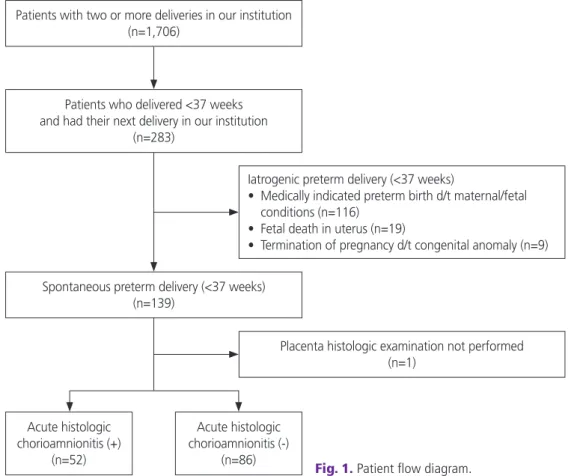
Fig. 1. Patient flow diagram.
Patients with two or more deliveries in our institution (n=1,706)
Patients who delivered <37 weeks and had their next delivery in our institution
(n=283)
Spontaneous preterm delivery (<37 weeks) (n=139)
Acute histologic chorioamnionitis (+)
(n=52)
Acute histologic chorioamnionitis (-)
(n=86)
Placenta histologic examination not performed (n=1)
Iatrogenic preterm delivery (<37 weeks)
• Medically indicated preterm birth d/t maternal/fetal conditions (n=116)
• Fetal death in uterus (n=19)
• Termination of pregnancy d/t congenital anomaly (n=9)
tion from May 2003 to March 2018. Of the 1,706 women, 139 delivered spontaneously at preterm (<37.0 weeks of gestation) and had their subsequent delivery at our institu- tion (Fig. 1). SPTD was defined as preterm birth caused by PTL with intact membranes, PPROM, or acute cervical insuf- ficiency. The exclusion criteria were as follows: 1) medically indicated preterm delivery caused by maternal or fetal condi- tions (n=116), 2) fetal death in utero (n=19), and 3) termina- tion of pregnancy due to a congenital anomaly (n=9). The study population was categorized into 2 groups based on the presence of acute HCA from their preterm delivery: group 1, patients with HCA from their preterm delivery; and group 2, patients without HCA from their preterm delivery (Fig. 1).
The institutional review board of our institute approved this research. We followed the ethical standards for human ex- perimentation established in the Declaration of Helsinki.
The diagnosis of acute HCA was made by using criteria previously published [2,5,14,15]. Acute HCA was defined as the presence of acute inflammatory lesions by infiltration of neutrophils into the chorion-decidua and amnion. Acute funisitis was defined as the infiltration of neutrophils into the walls of umbilical vessels or Wharton’s jelly. The subsequent pregnancies were managed similarly for patients with and without previous HCA. Clinical characteristics of the study population including parity, maternal age at previous preterm delivery, gestational age at delivery, cause of SPTD, neona- tal birthweight, amniotic fluid analysis if amniocentesis was performed, and the interval between SPTD and subsequent delivery were reviewed. Primary outcome measures were the rate of SPTD and gestational age at subsequent deliveries.
Continuous variables and categorical variables were ana- lyzed by the Mann-Whitney U-test and the Fisher’s exact test, respectively. Continuous variables are presented as the me- dian and interquartile range (IQR). Categorical variables are expressed as the percentage and number of patients in each group. Probability values less than 0.05 were considered sta- tistically significant. All statistical analyses were carried out using SPSS 22.0 for Windows (IBM, Armonk, NY, USA).
Results
During the study period, 139 women delivered spontane- ously at preterm and had a subsequent delivery at our institution (Fig. 1). One woman who was unavailable for pla-
centa histology was excluded. Therefore, this study included 138 women. Clinical characteristics of the study population are summarized in Table 1. The median gestational age at preterm delivery was 34.0 weeks (IQR, 28.9–35.3 weeks).
The causes of preterm delivery were PTL (82/138 [59%]), PPROM (47/138 [33%]), and cervical insufficiency (10/138 [7%]). The frequency of preterm delivery in the subsequent pregnancy was 47/138 (34%). The frequencies of acute HCA and funisitis were 52/138 (38%) and 29/138 (21%), respectively. Among the 66 women who had transabdominal amniocentesis, the rate of a positive result in amniotic fluid culture was 18/66 (27%).
Table 2 presents the clinical characteristics of the study population according to the presence or absence of acute HCA at the time of preterm delivery. The median gestational age and birthweight at prior SPTDs were significantly lower in the HCA group than in the non-HCA group (median gestational age: 28.5 weeks (IQR, 22.9–34.0 weeks) vs.
34.7 weeks (IQR, 33.4–35.9 weeks), P<0.001; median ges- tational birthweight: 1.25 kg (IQR, 0.57–2.01 kg) vs. 2.38 kg (IQR, 2.00–2.65 kg), P<0.001). Acute cervical insufficiency
Table 1. Demographic and clinical characteristics of the study population at the time of preterm delivery
Clinical characteristics Value (n=138)
Maternal age (yr) 30 (28–32)
Nulliparity 109 (79)
Gestational age at preterm delivery (wk) 34.0 (28.9–35.3)
20.0–27.9 26 (19)
28.0–31.9 23 (17)
32.0–36.9 89 (64)
Birth weight (kg) 2.11 (1.28–2.58)
Cause of preterm delivery
Preterm labor 82 (59)
Preterm rupture of membranes 46 (33)
Cervical insufficiency 10 (7)
Preterm delivery at subsequent pregnancy 47 (34) Delivery mode
Vaginal delivery 93 (67)
Cesarean delivery 45 (33)
Acute histologic chorioamnionitis 52 (38)
Funisitis 29 (21)
Positive amniotic fluid culture 18/66 (27)
Data are median (interquartile range) or number (%).
was significantly higher in the HCA group than the non-HCA group (9/52 [17%] vs. 1/86 [1%], P<0.001). The culture- proven amniotic fluid infection rate was higher in the HCA group, as expected (HCA group, 15/36 [42%] vs. non-HCA
group, 3/30 [10%], P=0.005).
Table 3 shows the subsequent pregnancy outcomes of the study population. The frequency of preterm delivery in the subsequent pregnancy was 14/52 (27%) in the HCA group
Table 2. Clinical characteristics of study population according to the presence of histologic chorioamnionitis (HCA) at the time of preterm delivery
Clinical characteristics Acute HCA
Yes (n=52) No (n=86) P-value
Maternal age (yr) 31 (28–33) 30 (27–32) 0.048
Nulliparity 37 (71) 72 (84) 0.089
Gestational age at previous spontaneous preterm delivery (wk) 28.5 (22.9–34.0) 34.7 (33.4–35.9) <0.001
Birth weight (kg) 1.25 (0.57–2.01) 2.38 (2.00–2.65) <0.001
Cause of preterm delivery
Preterm labor 29 (56) 53 (62) 0.592
Preterm rupture of membranes 14 (27) 32 (37) 0.265
Cervical insufficiency 9 (17) 1 (1) 0.001
Delivery mode 0.268
Vaginal delivery 38 (73) 55 (64)
Cesarean delivery 14 (27) 31 (36)
Positive amniotic fluid culture 15/36 (42) 3/30 (10) 0.005
Data are median (interquartile range) or number (%).
Table 3. Subsequent pregnancy outcome of study population according to the presence of histologic chorioamnionitis (HCA) in previous preterm delivery
Characteristics HCA
Yes (n=52) No (n=86) P-value
Gestational age at delivery (wk) 38.0 (36.7–38.8) 37.9 (35.7–39.0) 0.313
Birth weight (kg) 3.14 (2.64–3.45) 2.95 (2.44–3.36) 0.100
Interval between pregnancies (mon) 23 (17–37) 30 (22–47) 0.002
Progesterone use
a)19 (37) 18 (21) 0.050
Cervical length at level II ultrasound (mm)
b)36.5 (31.0–40.0) 35.3 (31.6–39.0) 0.462
Delivery mode 0.852
Vaginal delivery 30 (58) 51 (59)
Cesarean delivery 22 (42) 35 (41)
Preterm delivery (<37 wk) 14 (27) 33 (38) 0.197
Spontaneous preterm delivery 12 (23) 24 (28) 0.556
Medically indicated preterm delivery 2 (4) 9 (11) 0.208
20.0–27.9 wk 1 (2) 2 (2) 1.000
28.0–31.9 wk 0 (0) 3 (4) 0.442
32.0–36.9 wk 13 (25) 28 (33) 1.000
Data are median (interquartile range) or number (%).
a)