Cognitive Function and Self-care in Patients with Heart Failure:
A Pilot Study from Korean Patients
Kim, Jin Shil
1· Shin, Joon-Han
21RN, PhD, Assistant Professor, Department of Nursing, Sunchon National University, Suncheon
2MD, Department of Cardiology, Ajou University Medical Center, Suwon, Korea
Purpose: Despite poor cognitive function in heart failure (HF), few studies have examined cognition and its prob- able implication in self-care among Korean HF patients. The purposes of this study were (1) to describe cognition in the domains of global, memory, and executive functions, (2) to explore the relationship between cognition and self-care, and (3) to determine the amount of dietary sodium intake among Korean HF patients. Methods: A pilot study was conducted: 7 HF patients (3 men, mean age 68 years) completed face-to-face interviews for neuro- psychological tests of cognition and self-care including dietary sodium intake. Results: More than half of the pa- tients had impaired global cognition, memory, or executive function; patients with more severe HF were at higher risk of poor cognitive function. Korean HF patients exhibited poor self-care, with a high dietary sodium intake (5.6 g/day), approximately twice more than the suggested guideline of 2~3 g/day for patients with stable HF.
Conclusion: Cognitive dysfunction and inadequate self-care with noncompliance with dietary sodium restriction were evident in Korean HF patients. More studies are warranted that examine the prevalence of cognitive impair- ment and areas of deficit using neuropsychological tests in a larger sample and that examine how cognition affects self-care and compliance in salt-intake.
Key Words: Cognition, Self-care, Sodium, Dietary
Corresponding author: Kim, Jin Shil
Department of Nursing, Sunchon National University, 255 Jungang-ro, Suncheon 540-950, Korea.
Tel: +82-61-750-3882, Fax: +82-61-750-3880, E-mail: [email protected] - Ajou University Mentorship Grant Award (for graduate nursing student).
- The effect of cognitively tailored self-care intervention for patients with heart failure.
- This paper was also supported by (in part) Sunchon National University Research Fund in 2012.
투고일 2012년 6월 10일 / 심사완료일 2012년 6월 21일 / 게재확정일 2012년 6월 24일
INTRODUCTION
Approximately 7 million people in South Korea live with chronic illnesses, of which cardiovascular diseases are among the leading diagnoses at discharge and rank third in length of admission (Health Insurance Review &
Assessment Service, 2010). In Korea, hypertension and ischemic heart disease - the major etiologies of heart fail- ure (HF) - have increased by 40% and 55% in preva- lence, respectively, over the last 5 years (Health Insu- rance Review & Assessment Service, 2010). With ad- vanced medical treatment increasing longevity, Koreans will experience prolonged exposure to the threat of car- diovascular disease, which will increase the risk of de- veloping HF in older people.
Multidisciplinary efforts have yielded substantial pro-
gress in management of a complex HF syndrome, in which self-care has been documented as a critical be- havioral strategy (Hummel, DeFranco, Skorcz, Montoye,
& Koelling, 2009; Riegel, 2008). However, an intricate
cognitive decisional process that is involved in self-care
prevents more than half of HF patients in engaging in
various self-care activities (Bennett et al., 1998; Riegel,
Vaughan Dickson, Goldberg, & Deatrick, 2007). Approxi-
mately 25% to 50% of HF patients have cognitive dys-
function due to structural and functional brain changes
(Pressler, 2008). Such dysfunction may interfere with
compliance with complex self-care regimens, in partic-
ular, dietary sodium restriction. Noncompliance with di-
etary sodium restriction has been reported as a major
problem, leading to frequent hospitalization due to fluid
volume overload associated with excessive sodium re-
tention (Bennett et al., 1998; Hummel et al., 2009; Jur- gens, Hoke, Byrnes, & Riegel, 2009). Sodium restriction may present a further challenge to Korean patients be- cause of their traditional dietary pattern. South Koreans consume 8.8 g of sodium per day, approximately 4 times more than the suggested World Health Organization limit (<2 g/day of sodium)for general populations (Elliott,& Brown, 2006; World Health Organization, 2007).
Despite poor cognitive function inHF and high salt in- take among Korean HF patients, few studies have exam- ined cognitive dysfunction among these patients and its probable implication in overall self-care and compliance with dietary sodium restriction. Therefore, this study presents preliminary data from Korean HF patients who participated in face-to-face interviews for cognitive func- tion and self-care, which also involved recording a 3- day food diary for identification of the amount of dietary sodium intake. The specific objectives were to (1) de- scribe cognitive function in domains of global cognition, memory, and executive function; and (2) explore the re- lationship between cognitive function and self-care. An additional research question is (3) how much dietary so- dium do Korean HF patients consume per day?
METHODS
1. Design and Procedures
This study was a pilot test, using a descriptive study design, in which cognitive function and self-care includ- ing dietary sodium intake were evaluated with HF pa- tients recruited from a university-affiliated outpatient clinic. This study was approved by the institutional re- view board of the university. After obtaining written in- formed consent from participants, the investigator con- ducted face-to-face interviews for neuropsychological tests of cognition and self-care. After the interview, all- participants were informed of how to record a 3-day food diary for the assessment of dietary sodium intake.
2. Sample
The participants were (a) ≥18 years of age, and had (b) current medical diagnosis of systolic HF (ejection fraction≤40%) ≥6 months before entry. Patients were excluded if they (a) were scheduled to receive cardiac surgery or had documented cardiac events3 month- sprior to enrollment (hospitalization or emergency visits for HF exacerbation); (b) had severe visual or hearing
impairments;(c) had documented cognitive impairment, such as dementia and/or stroke or a psychiatric diag- nosis that precludes providing informed consent or the ability to follow instructions.
3. Measurements 1) Self-care
The Self-Care of Heart Failure Index v.6 (SCHFI) is a measure of self-care (Riegel, Lee, Dickson, & Carlson, 2009). The SCHFI consists of 22 items in 3 subscales:
self-care maintenance (10 items), self-care management (6 items), and self-care confidence (6 items). The scores in each subscale are transformed to 100 points with weighted values, in which higher scores indicate greater self-care (Riegel et al., 2009). The cut-off score less than 70 was used to determine poor self-care adequacy in maintenance, management, and confidence (Riegel et al., 2009).
2) Dietary sodium intake
The diet record from the 3-day food diary was ana- lyzed using the computer software, Computer Aided Nutritional Analysis program version 3.0 (CAN-Pro 3.0) for the amount of dietary sodium intake (The Korean Nutrition Society, 2010). The accuracy and feasibility of the program has been established using nutrient intakes of 4,091 participants of 2007 Korean National Health and Nutrition Examination Survey (Shim&Paik, 2009).
3) Cognitive function
The Seoul Neuropsychological Screening Battery (SNSB) was administered to measure cognitive function in do- mains of global cognition (Korean-Mini-Mental State Exa- mination, K-MMSE), memory (Seoul Verbal Learning Test, SVLT), and executive function (Controlled Oral Word Association, COWA)(Kang &Na, 2003). Neuropsy- chological test variables were scored according to au- thors’ instructions and manual guidelines. The SNSB has documented validity and reliability for altered cognitive function that is associated with cognitive disorders, such as vascular dementia or Alzheimer's disease (Kang &Na, 2003).
The K-MMSE consists of 30 items with possible scores
ranging from 0 to 30, in which higher scores indicate
greater general cognition. In the SVLT, a list of 12 words
were orally presented to the patients over 3 trials, who
were asked to repeat the words, irrespective of order,
after each trial (total list learning, range 0~36). The pa-
tients were then asked to recall the 12 words again, 20
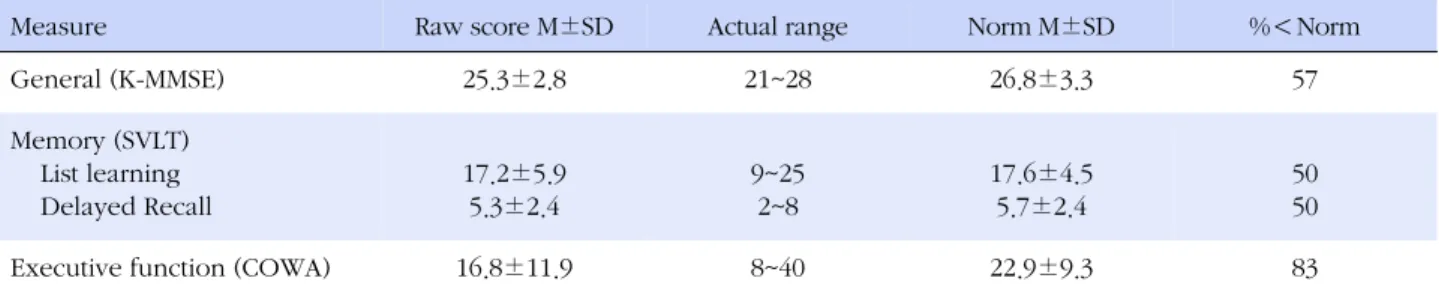
Table 1. Descriptive Statistics for Neuropsychological Test Scores (N=7)
Measure Raw score M±SD Actual range Norm M±SD %<Norm
General (K-MMSE) 25.3±2.8 21~28 26.8±3.3 57
Memory (SVLT) List learning Delayed Recall
17.2±5.9 5.3±2.4
9~25 2~8
17.6±4.5 5.7±2.4
50 50
Executive function (COWA) 16.8±11.9 8~40 22.9±9.3 83
K-MMSE=Korean-mini-mental state examination; SVLT=Seoul verbal learning test; COWA=controlled oral word association.
min after completing the third trial (delayed recall, range 0~12). In the COWA test, 3 letters are presented to the patients who are then asked to generate as many words as they can, beginning with each letter, over a 60-s period. The score is determined by the number of words generated for the 3 letters (higher scores indicate better executive function).
4) Heart failure severity
The New York Heart Association (NYHA) classi- fication is a measure of functional limitation imposed by HF severity in clinical practice and research. The NYHA classes range from asymptomatic class Ito symptomatic classes II, III, and IV, with no (I), slight (II), or marked (III) limitations of physical activity, and unable to con- tinue physical activity without symptoms (IV)(Hunt et al., 2005).
4. Statistical Analyses
Descriptive statistics were completed for all study var- iables, including frequency, means and standard devia- tions, and ranges, appropriate to the level of measure- ment.
RESULTS
Seven HF patients (3 men) participated in this study.
Their ages ranged 54~80 years (mean age 68.0±8.0 years). Two men and 2 women were married, and oth- ers were widowed or divorced. The mean years of edu- cation were 8.6±4.8 years. The length of time since HF diagnosis ranged from 0.6 to 15.7 years. Four patients had HF with unknown etiology, 2 had HF associated with hypertension, and 1 had ischemic HF. The mean left ventricular ejection fraction was 28.6±7.8% (range 20~ 39). All participants were on optimal medication, in- cluding angiotensin II receptor blockers (57%), be- ta-blockers (71%), angiotensin-converting-enzyme in-
hibitor (43 %), digoxin (86%), or diuretics (57%). One patient had the NYHA class I, 4 had class II, and 2 had class III.
1. Cognitive Function
Heart failure patients had poor cognitive function in global cognition (25.3±2.8), list learning (17.2±5.9), delayed recall memory (5.3±2.4), and executive func- tion (16.8±11.9)(Table 1). Compared to the published Korean norms, 57%, 50%, and 83% exhibited lower scores on global cognition, memory, and executive function, respectively. Using a cut-off point of 23/24 (Kang, Na, & Hahn, 1997), 2 patients indicated mild cog- nitive impairment on the K-MMSE. The patients with NYHA Class I or II had higher scores than those with the NYHA class III on the K-MMSE (26.8 vs. 21.5), SVLT total list learning (17.8 vs. 14.0) and delayed recall (5.4 vs.
5.0), and COWA (17.0 vs. 16.0), indicating those with NYHA Class I or II having better cognitive function.
2. Self-care, Dietary Sodium Intake, and Cognitive Function
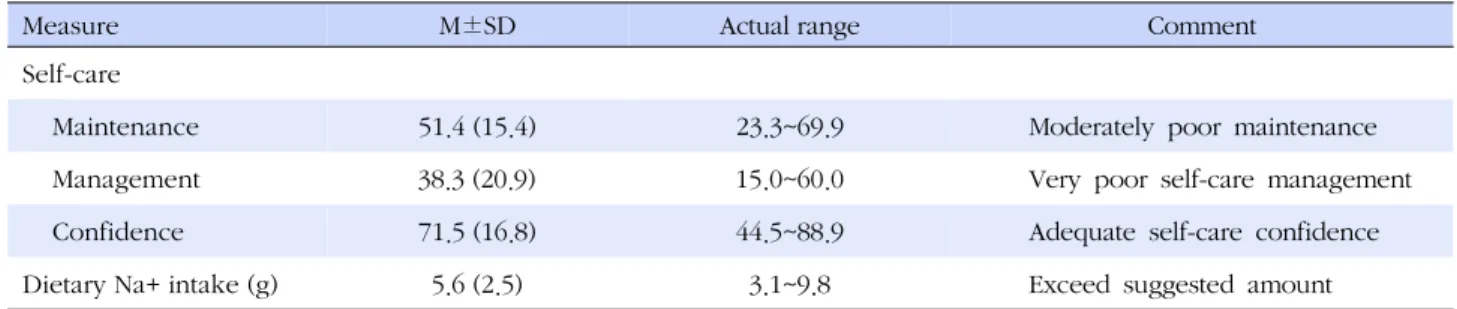
All patients had poor self-care maintenance (51.4±
15.4) and very poor self-care management (38.3±20.9), compared to the cut-off score of less than 70 (Table 2).
Poor self-care adequacy may also lead to the HF patients failing to adhere to dietary sodium restriction, while con- suming approximately 3 times more dietary sodium than the suggested guideline (5.6±2.5 g/day).
Cognitive dysfunction was found in Korean HF pa-
tients who had poor self-care adequacy (Table 3). Com-
pared with patients who had poor self-care confidence
(score < 70), those with adequate self-care confidence
had greater cognitive function in all 3 domains of global
cognition (25.8 vs. 24.7), list learning (18.8 vs. 14.0), de-
layed recall (5.8 vs. 4.5), and executive function (21.3
vs. 8.0).
Table 2. Descriptive Statistics for Self-care and Dietary Sodium Intake (N=7)
Measure M±SD Actual range Comment
Self-care
Maintenance 51.4 (15.4) 23.3~69.9 Moderately poor maintenance
Management 38.3 (20.9) 15.0~60.0 Very poor self-care management
Confidence 71.5 (16.8) 44.5~88.9 Adequate self-care confidence
Dietary Na+ intake (g) 5.6 (2.5) 3.1~9.8 Exceed suggested amount
Table 3. Cognitive Function by Self-care Adequacy (N=7)
Variables Categories Global cognition Memory
Executive function List learning Delayed recall
M±SD M±SD M±SD M±SD
Self-care Maintenance ≥70 (n=0)
<70 (n=7)
- 25.3 (3.1)
- 16.8 (6.5)
- 6.0 (2.0)
- 18.6 (12.4) Management ≥70 (n=0)
<70 (n=6)
- 25.2 (3.1)
- 17.8 (6.4)
- 5.8 (2.4)
- 17.4 (13.2) Confidence ≥70 (n=4)
<70 (n=3)
25.8 (3.3) 24.7 (2.5)
18.8 (5.6) 14.0 (7.1)
5.8 (2.2) 4.5 (3.5)
21.3 (12.5) 8.0 (0.0)
Dietary Na+ (g) <2 (n=0)
≥2 (n=6)
- 25.8 (2.6)
- 17.1 (5.9)
- 5.3 (2.4)
- 16.8 (11.8)
DISCUSSION
This is one of the first studies that have examined cog- nitive function using a neuropsychological test battery in Korean HF. These neuropsychological tests provide a more comprehensive evaluation of cognitive function and are often used to determine areas of deficits. An ad- ditional strength of the neuropsychological tests is the ability to make comparisons using the age-gender-edu- cation matched published norms. Despite a small sam- ple, important results were obtained. Korean HF pa- tients had poor cognitive function that might be asso- ciated with cerebral hypoperfusion (Pressler, 2008; Pres- sler et al., 2010). More importantly, Korean HF patients exhibited very poor self-care adequacy. In particular, their dietary sodium intake was almost twice more than the suggested daily guideline of 2~3 g for Americans with stable HF (Lindenfeld et al., 2010).
Compared to the published norms derived from 447 healthy older adults (189 men, age=67.6±5.9 years, ed- ucation=7.9±5.1 years), more than half of the Korean HF patients had lower cognitive function in all domains, particularly in executive function (16.8 vs. 22.9). Fur- ther, Korean HF patients with NYHA class III had worse
cognitive function than those with NYHA class I or II, which is consistent with recent empirical evidence.
One-fourth of 249 HF patients have substantial losses in memory (p <.005), psychomotor speed (p <.001), and executive function (p =.05); those with more advanced HF of NYHA classes II, III, or IV had significantly poorer cognitive function than those with NYHA class I, as a reference (Pressler et al., 2010). From a Korean HF liter- ature search, a study evaluating cognitive function in 121 HF patients was obtained. Twenty-nine patients (24%) had a high risk for cognitive impairment as de- termined by a single screening measure of the Mini- Mental State Examination-Korean (MMSE-K)(defined as a MMSE-K score< 20)(Son, Kim, &Song, 2010).
Poor cognitive function in Korean HF patients might
have an impact on very poor self-care in the current
study, with all having inadequate self-care maintenance
and management using a cut-off point of≥70 (Riegel et
al., 2009). Poor self-care adequacy may also lead to a
high dietary sodium intake of 5.6 g per day, which is ap-
proximately 2 times more than the suggested 2~3-g diet-
ary sodium restriction for HF patients (Lindenfeld et al.,
2010). Koreans eat soup or stew and kimchi (a fer-
mented Korean dish, made of vegetables with varied
seasonings) at almost every meal, which all contain high sodium. Heart failure patients may be as likely to con- sume high levels of dietary sodium as the general pop- ulation in Korea, as Koreans have rarely changed their dietary behaviors relating to high sodium intake (Kim, Paik, Lee, Shim, & Kim, 2007). Poor self-care might be attributable to cognitive dysfunction, which prevents in- tricate cognitive decisional processes in self-care on many levels, such as recognizing symptoms of worsen- ing HF or performing self-care strategies, including re- striction of salt intake (Riegel & Dickson, 2008). In a study examining cognitive influence on self- care in Korean HF patients, cognitive function was a significant predictor of adherence to self-care, with a lower cogni- tive function being associated with poorer adherence to self-care (
β=.209, p =.03)(Son et al., 2010).
CONCLUSION
Cognitive dysfunction and poor self-care adequacy were evident in Korean HF patients. More importantly, dietary sodium intake in HF patients is likely to be high due to the traditional dietary pattern. As this study only described several cases of cognitive function and self- care in HF, the priorities in research will be addressed instead of the study limitations.
First, prevalence of cognitive impairment and areas of deficit should be evaluated using a neuropsychological test battery in a larger sample.
Second, prospective studies that examine the dietary patterns (salt use, food preparation method, sources of high/low sodium food), are warranted to establish the dietary sodium guidelines for Korean HF patients and assist patients with the development of strategies aimed at improving compliance behaviors in salt-intake.
REFERENCES
Bennett, S. J., Huster, G. A., Baker, S. L., Milgrom, L. B., Kirch- gassner, A., Birt, J., et al. (1998). Characterization of the precipitants of hospitalization for heart failure decompen- sation. American Journal of Crititical Care, 7 (3), 168-174.
Elliott, P., & Brown, I. (2006). Sodium intakes around the world.
Background document prepared for the forum and techni- cal meeting on reducing salt intake in populations (Paris 5-7th October 2006). Retrieved May 16, 2012, from the World Health Organization Web site: http://whqlibdoc.- who.int/publications/2007/9789241595935_eng.pdf.
Health Insurance Review & Assessment Service. (n.d.). Chronic disease summary statistics in South Korea. Retrieved April
16, 2010, from the Health Insurance Review & Assessment Service. Web site: http://www.hira.or.kr/cms/rd/helhinf/
index.html.
Hummel, S. L., DeFranco, A. C., Skorcz, S., Montoye, C. K., &
Koelling, T. M. (2009). Recommendation of low-salt diet and short-term outcomes in heart failure with preserved systolic function. American Journal of Medicine, 122 (11), 1029-1036.
Hunt, S. A., Abraham, W. T., Chin, M. H., Feldman, A. M., Francis, G. S., Ganiats, T. G., et al. (2005). ACC/AHA 2005 guideline update for the diagnosis and management of chronic heart failure in the adult: A report of the american college of car- diology/American Heart Association task force on practice guidelines (Writing committee to update the 2001 guide- lines for the evaluation and management of heart failure):
Developed in collaboration with the American College of Chest Physicians and the International Society for Heart and Lung Transplantation: Endorsed by the Heart Rhythm Soc- iety. Circulation, 112(12), e154-235.
Jurgens, C. Y., Hoke, L., Byrnes, J., & Riegel, B. (2009). Why do elders delay responding to heart failure symptoms? Nursing Research, 58(4), 274-282.
Kang, Y., Na, D., & Hahn, S. (1997). A validity study on the Korean mini-mental state examination (K-MMSE) in dementia pati- ents. Journal ofthe Korean Neurological Association, 15, 300- 308.
Kang, Y. W., & Na, D. (2003). Seoul neuropsychological screen- ing battery. Incheon: Human Brain Research & Consulting.
Kim, H. J., Paik, H. Y., Lee, S. Y., Shim, J. E., & Kim, Y. S. (2007).
Salt usage behaviors are related to urinary sodium excretion in normotensive Korean adults. Asia Pacific Journal of Clinical Nutrition, 16 (1), 122-128.
Lindenfeld, J., Albert, N. M., Boehmer, J. P., Collins, S. P., Ezeko- witz, J. A., Givertz, M. M., et al. (2010). HFSA 2010 Com- prehensive heart failure practice guideline. [Practice guide- line]. Journal of Cardiac Failure, 16(6), e1-194.
Pressler, S. J. (2008). Cognitive functioning and chronic heart fail- ure: a review of the literature(2002-July 2007). Journal of Cardiovascular Nursing, 23(3), 239-249.
Pressler, S. J., Subramanian, U., Kareken, D., Perkins, S. M., Gradus-Pizlo, I., Sauve, M. J., et al. (2010). Cognitive defi- cits in chronic heart failure. Nursing Research, 59(2), 127- 139.
Riegel, B. (2008). Foreword: Self-care of heart failure: What is the state of the science? Journal of Cardiovascular Nursing, 23(3), 187-189.
Riegel, B., & Dickson, V. V. (2008). A situation-specific theory of heart failure self-care. Journal of Cardiovascular Nursing, 23(3), 190-196.
Riegel, B., Lee, C. S., Dickson, V. V., & Carlson, B. (2009). An up-
date on the self-care of heart failure index. Journal of Cardi- ovascular Nursing, 24(6), 485-497.
Riegel, B., Vaughan Dickson, V., Goldberg, L. R., & Deatrick, J.
A. (2007). Factors associated with the development of ex- pertise in heart failure self-care. Nursing Research, 56(4), 235-243.
Shim, Y., & Paik, H. Y. (2009). Reanalysis of 2007 Korean National Health And Nutrition Examination Survey (2007 KNHANES) Results by CAN-Pro 3.0 nutrient database. Korean Journal of Nutrition, 42(6), 577-595.
Son, Y., Kim, S. H., & Song, E. K. (2010). The influences of cogni-
tive function on adherence to self-care in elderly patients with heart failure. Korean Journal of Health Promotion, 10, 61-70.
The Korean Nutrition Society. (2010). Computer aided nutritional analysis program version 3.0. Seoul: The Korean Nutrition Society.
World Health Organization. (2007). Salt as a vehicle for forti- fication - Report of a WHO expert consultation. Retrieved May 16, 2012, from the World Health Organization Web site: http://www.who.int/dietphysicalactivity/LUXsaltreport 2008.pdf