• 검색 결과가 없습니다.

Renal Dysfunction in Korean Acute Heart Failure Patients

N/A
N/A
Protected

Academic year: 2022

Share "Renal Dysfunction in Korean Acute Heart Failure Patients"

Copied!
2
0
0

로드 중.... (전체 텍스트 보기)

전체 글

(1)

692 https://e-kcj.org

Acute heart failure (AHF) is a common cause of hospitalization, and the prognosis of affected patients is poor.

1)

AHF usually coexists with a number of comorbidities, of which declining renal function is of particular importance. Both worsening kidney function and chronic kidney disease can result in further dysfunction of both systems, which was defined as a cardio-renal syndrome.

2)

Renal dysfunction is common in patients with heart failure and is associated with high morbidity and mortality.

3)

Given the high prevalence of renal dysfunction and its potential consequences, there is substantial interest in the actual prevalence and prognostic implication of renal dysfunction in Korean AHF patients.

Park et al.

4)

reported in this issue of Korean Circulation Journal the prevalence and the prognostic value of renal dysfunction in 1,932 AHF patients with preserved ejection fraction (HFpEF) and with reduced left ventricular ejection fraction (HFrEF) using data from the Korean Heart Failure Registry, which is a prospective multicenter registry designed to reflect the ‘real-world’ clinical data of Korean patients admitted for AHF. The authors demonstrated that the prevalence of renal dysfunction (defined as glomerular filtration rate [GFR]<60 mL/min/1.73 m

2

) was common and did not differ between HFpEF and HFrEF (49% vs. 52%, p=0.210). In addition, renal dysfunction was independent of left ventricular systolic function, but dependent on N-terminal prohormone of brain natriuretic peptide (NT-proBNP) level. They also showed that renal dysfunction could predict all-cause mortality in patients with HFrEF (log-rank p<0.001) and that with HFpEF (log-rank p=0.010) in Kaplan-Meier analysis. The prognostic implication changed in the multivariate analysis after adjustment for significant covariates including age, sex, diastolic blood pressure, and diabetes. Although renal dysfunction retained its prognostic value (hazard ratio [HR], 2.43; 95% confidence interval [CI], 1.52–3.89) in HFrEF patients, its prognostic value was no longer significant in HFpEF patients (HR, 1.46; 95% CI, 0.66–3.21).

The overall results of this study are in line with previous meta-analysis

3)

that renal dysfunction is common and is associated with high mortality in patients with AHF. But, they showed a differential prognostic impact of AHF type in that renal dysfunction is an independent predictor of 12-month mortality in HFrEF patients, while its impact seems to be attenuated in HFpEF patients. These observations implied that HFpEF patients present with a different clinical and biochemical profile than HFpEF patients and possibly a different reason Korean Circ J. 2017 Sep;47(5):692-693

https://doi.org/10.4070/kcj.2017.0201 pISSN 1738-5520·eISSN 1738-5555

Editorial

Received: Aug 29, 2017 Accepted: Sep 15, 2017 Correspondence to Jang Young Kim, MD, PhD

Division of Cardiology, Department of Internal Medicine, Yonsei University Wonju College of Medicine, 20, Ilsan-ro, Wonju 26426, Korea.

Tel: +82-33-741-0905 Fax: +82-33-741-1219 E-mail: [email protected]

Copyright © 2017. The Korean Society of Cardiology

This is an Open Access article distributed under the terms of the Creative Commons Attribution Non-Commercial License (https://

creativecommons.org/licenses/by-nc/4.0) which permits unrestricted noncommercial use, distribution, and reproduction in any medium, provided the original work is properly cited.

ORCID iDs Jang Young Kim

https://orcid.org/0000-0002-0813-7082 Conflict of Interest

The author has no financial conflicts of interest.

The contents of the report are the author's own views and do not necessarily reflect the views of the Korean Circulation Journal.

Jang Young Kim , MD, PhD

Division of Cardiology, Department of Internal Medicine, Yonsei University Wonju College of Medicine, Wonju, Korea

Renal Dysfunction in Korean Acute Heart Failure Patients

See the article “Relation of Renal Function with Left Ventricular Systolic Function and NT-proBNP

Level and Its Prognostic Implication in Heart Failure with Preserved versus Reduced Ejection Frac-

tion: an analysis from the Korean Heart Failure (KorHF) Registry” in volume 47 on page 727.

(2)

for a lower GFR.

The authors provide a hypothesis regarding the differential prognostic impact of renal dysfunction according to AHF type in this study.

4)

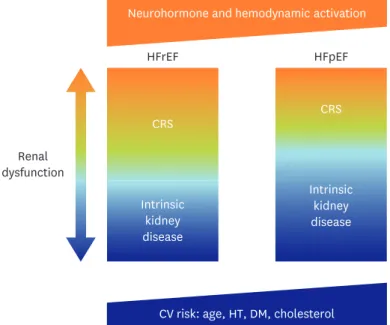
It is of note that renal dysfunction in AHF comprises both cardiorenal syndrome and intrinsic kidney disease. Considering 1) the same prevalence of renal dysfunction, 2) but different levels of brain natriuretic peptide (BNP) between patients with HFrEF and those with HFpEF, and 3) the different prevalence of baseline comorbidities, the authors hypothesized that HFpEF and HFrEF have different proportions of intrinsic nephropathy and cardiorenal syndrome. This might explain the phenomenon that HFrEF and HFpEF patients have the same prevalence of renal dysfunction, but different prognostic values (Figure 1). This is an interesting and hypothesis-generating concept. Future research is needed to examine these relationships, especially in HFpEF.

REFERENCES

1. Lee SE, Lee HY, Cho HJ, et al. Clinical characteristics and outcome of acute heart failure in Korea: results from the Korean Acute Heart Failure Registry (KorAHF). Korean Circ J 2017;47:341-53.

PUBMED | CROSSREF

2. Ronco C, Haapio M, House AA, Anavekar N, Bellomo R. Cardiorenal syndrome. J Am Coll Cardiol 2008;52:1527-39.

PUBMED | CROSSREF

3. Damman K, Valente MA, Voors AA, O'Connor CM, van Veldhuisen DJ, Hillege HL. Renal impairment, worsening renal function, and outcome in patients with heart failure: an updated meta-analysis. Eur Heart J 2014;35:455-69.

PUBMED | CROSSREF

4. Park CS, Park JJ, Oh IY, et al. Relation of renal function with left ventricular systolic function and NT-proBNP level and its prognostic implication in heart failure with preserved versus reduced ejection fraction: an analysis from the Korean Heart Failure (KorHF) registry. Korean Circ J. 2017;47:727-41.

CROSSREF

693 https://e-kcj.org https://doi.org/10.4070/kcj.2017.0201

Renal Function in Heart failure

Neurohormone and hemodynamic activation

CV risk: age, HT, DM, cholesterol CRS

Intrinsic kidney disease

CRS

Intrinsic kidney disease Renal

dysfunction

HFrEF HFpEF

Figure 1. The possible explanation for the different prognostic values of renal dysfunction between HFrEF and HFpEF.

CRS = cardio-renal syndrome; CV = cardiovascular; DM = diabetes mellitus; HFpEF = heart failure with preserved

ejection fraction; HFrEF = heart failure with reduced ejection fraction; HT = hypertension.

수치

Figure 1. The possible explanation for the different prognostic values of renal dysfunction between HFrEF and HFpEF

참조

관련 문서

Prevalence of sleep-disordered breathing in acute ischemic stroke as determined using a portable sleep apnea monitoring device in Korean subjects.. Obstructive

• Given similar degrees of hyperglycemia only a third of patients with diabetes develop clinically important renal disease  genetic determinantQ. • Relatively increased

Risk factors related to fixed airway obstruction in patients with asthma after antiasthma treatment. Identification of sub- types of refractory asthma in Korean patients by

The index is calculated with the latest 5-year auction data of 400 selected Classic, Modern, and Contemporary Chinese painting artists from major auction houses..

Nephrotic syndrome Renal insufficiency Heart

“Characteristics of Meteorological Variables in the Leeward Side associated with the Downslope Windstorm over the Yeongdong Region.” Journal of the Korean

1 John Owen, Justification by Faith Alone, in The Works of John Owen, ed. John Bolt, trans. Scott Clark, &#34;Do This and Live: Christ's Active Obedience as the

Intermittent hemodialysis(IDH) and Continuous renal replacement therapy (CRRT) has been used widely for treating critically ill patients with acute renal failure, We