Factors Affecting Adherence to Self-care Behaviors among Outpatients with Heart Failure in Korea
Ok, Jong Sun
1· Choi, Heejung
21Division of Cardiology, Hallym University Dongtan Sacred Heart Hospital, Hwaseong
2Department of Nursing, Konkuk University, Chungju, Korea
Purpose: To evaluate heart failure knowledge and adherence to self-care behaviors, and to identify factors affect- ing adherence to self-care behaviors among Korean patients with heart failure. Methods: Correlational research using the European Heart Failure Self-care Behavior Scale, the Duke Activity Status Index, the Dutch Heart Failure Knowledge Scale, the New York Heart Association Functional Classification, and the Medical Outcomes Study Social Support Survey was conducted. A total of 280 outpatients with heart failure responded to the five questionnaires. Results: The mean scores for self-care adherence and heart failure knowledge were 31.98 ± 6.81 and 8.78 ± 2.53, respectively, indicating lower adherence and knowledge than those previously reported. Subjects with lower functional status, more social supports, and greater knowledge of heart failure are more likely to adhere to prescribed regimens. Conclusion: Nurses should focus on patient education and support to improve their adher- ence to self-care behaviors.
Key Words: Heart failure, Self-care, Patient adherence
Corresponding author: Choi, Heejung
Department of Nursing, Konkuk University, 268 Chungwon-daero, Chungju 380-701, Korea.
Tel: +82-43-840-3954, Fax: +82-43-840-3929, E-mail: [email protected] - This article is a revision of the first author's master's thesis from Konkuk University.
Received: Jan 28, 2015 / Revised: Mar 25, 2015 / Accepted: Mar 26, 2015
This is an open access article distributed under the terms of the Creative Commons Attribution Non-Commercial License (http://creativecommons.org/licenses/
by-nc/3.0), which permits unrestricted non-commercial use, distribution, and reproduction in any medium, provided the original work is properly cited.
INTRODUCTION
Due to changes in lifestyle, the prevalence and mortal- ity rate of cardiovascular disease has reached a high rate in Korea. Although the survival rate of ischemic heart dis- ease is high, if patients cannot effectively control or man- age their disease, they suffer from heart failure; thus, the prevalence and mortality rate of heart failure has in- creased[1]. In addition, heart failure is closely related to age, and Korea is becoming an aging society; therefore, the prevalence of heart failure is thought to be increasing rapidly, especially among persons aged 75 years and older. However, there is no accurate information on the prevalence, health care costs, and admission or readmis-
sion rates due to heart failure in Korea[2].
Heart failure can cause physical, emotional, and func- tional impairment and result in a low quality of life and a substantial medical burden on the patient and his or her family members[3]. In previous studies, the adherence of patients with heart failure to self-care prevented the ag- gravation of symptoms and influenced whether they were admitted or readmitted to a hospital[4,5]. Another study reported that participation in heart failure self-care pro- grams reduced hospitalization durations[6]. Therefore, heart failure self-care is considered vital[6-8], but it is not fully understood yet.
Self-care is an active and cognitive process in which
persons engage in maintaining their health or managing
their disease and illness[9]. Therefore, the self-care be-
haviors consist of maintenance and management catego- ries. Self-care maintenance involves compliance with po- sitive health practices, including a proper diet, exercise, and taking medications as prescribed. Self-care manage- ment includes recognizing subtle changes in health sta- tus, evaluating the importance of signs and symptoms, taking actions to treat those changes, and monitoring the effectiveness of those actions. Self-care for patients with heart failure includes taking medication, adhering to pre- scribed dietary and exercise regimens (maintenance), mo- nitoring heart failure symptoms, and dealing with symp- toms effectively (management)[10].
Although, adherence to self-care can make the con- dition of patients with heart failure more stable and pre- vent aggravation, self-care does not seem easy to adhere to, especially for the elderly. Nurses are able to help pa- tients with heart failure, and their families, with health education and social support systems[7]. Furthermore, education and support to enhance adherence should be based on information on influencing factors on adhe- rence. However, there have only been a few studies con- ducted on the adherence to self-care behaviors in Kore- an patients with heart failure.
Previous studies conducted in other countries have reported varying factors such as demographic variables (e.g., gender[11], age[11], and education level[10]); phy- sical or disease-related variables (e.g., symptom severity [10,11], comorbidity[11], and functional status[12]); and cognitive, emotional., and social variables (e.g., heart failure knowledge[13], sense of control[12], social sup- port[14,15], and depressive symptoms[15,16]) affected compliance in patients with heart failure. However, the results have showed inconsistency and the need for re- petitive studies.
The purpose of this study was to identify factors affect- ing adherence to self-care behaviors of Korean patients with heart failure. Among various factors affecting adher- ence identified in previous studies, this study includes some demographic factors; symptom severity, and func- tional status as disease and physical factors; heart failure knowledge as a cognitive factor; and social support as a social factor. Demographic and physical factors affecting adherence could show a high risk of noncompliance, and cognitive and social factors could provide a focus for nursing interventions. Furthermore, the results would improve the quality of life of patients with heart failure and their family members and could contribute to re- ducing the health care costs of these patients, as well.
METHODS
1. Study Design
This study employed a correlational design to identify influencing factors on adherence to self-care behaviors among Korean heart failure outpatients.
2. Study Sample and Setting
Participants were patients with heart failure who vis- ited the outpatient cardiology clinics of three tertiary hos- pitals in a metropolitan area. The sample size was calcu- lated using G*Power 3.1 program [17] for a multiple re- gression analysis based on the nine independent varia- bles, ⍺= .05, .80 of power, and medium effect size (f
2=0.15); at least 114 samples were needed. However, due to the lack of study results regarding factors influencing adherence to self-care behaviors among Korean patients with heart failure, the effect size should be considered smaller than medium.
Inclusion criteria included 1) outpatients aged 18 years and older with a primary diagnosis of heart failure, 2) no diagnosis of psychiatric or cognitive problems, and 3) New York Heart Association Functional classification (NYHA Fc) I to III. Patients with NYHA Fc IV were ex- cluded in this study because most got admitted into hos- pitals. Through consecutive sampling, 315 outpatients met the eligibility criteria over a three-month period.
Among them, 300 were recruited and participated in this survey and 20 patients were excluded from the analysis due to missing data.
3. Ethical Considerations
The Institutional Review Board granted approval pri- or to initiation of the study (KUH 1010249). In addition, interviewers explained the purpose of this study, ano- nymity policy, and right to withdrawal to each partic- ipant and obtained written informed consent from all involved.
4. Measurements
Patients were requested to fill out a self-administered questionnaire. However, patients who had visual distur- bances, fatigue, or general weakness completed the sur- vey questionnaire with the help of an interviewer. It took 15 to 20 minutes to complete this questionnaire.
1) Adherence to heart failure self-care
The European Heart Failure Self-care Behavior Scale
(EHFScBS)[18] was used. This is a 12-item, 5-point Likert- type scale with a score ranging from 12~60; a higher score indicates poorer adherence to self-care. This in- strument can discriminate good adherence and bad ad- herence in each item. It contains self-care maintenance (weighing the body, limiting fluid intake, resting, eating a low salt diet, taking medicines, receiving a flu shot, and exercising) and self-care management (contacting health care providers when they experience symptom aggravation, such as dyspnea, edema, weight gain, and fatigue). Researchers translated the original English ver- sion of this questionnaire into Korean and then it was re- verse translated by a native speaker. The equivalence of these two English versions was identified by the resear- cher who developed this measurement. Cronbach's ⍺ was .81 when this scale was developed[18] and .66 in this study.
2) Heart failure knowledge
The Dutch Heart Failure Knowledge Scale was used to assess heart failure knowledge[19]. The knowledge scale consists of 15 multiple-choice items, including heart failure in general (four items), heart failure treatment (six items on diet, fluid restriction, and activity), and symp- toms and symptom recognition (five items). The score ranges from 0~15. Each item has three options, with one of the options being the correct answer. A higher score indicates better knowledge of heart failure. Researchers also translated the English version of this questionnaire into Korean and then a panel of 10 experienced cardiol- ogy nurses and two cardiologists assessed the face val- idity of the translated Korean scale.
3) Social support
The Medical Outcomes Study (MOS) Social Support Survey[20,21] was used to assess social support. This is a 20-item, 5-point Likert-type scale with a total score rang- ing from 0~100, and a higher score indicating better so- cial support. The Korean version was used in this study.
The Cronbach's ⍺ was .97 in another study[21] and .94 in this study.
4) Symptom severity
The New York Heart Association Functional classi- fication (NYHA Fc)[22] was used for assessment of sym- ptom severity. The NYHA classification, introduced in 1928 and updated in 1994, could measure heart failure symptoms by medical staff by analyzing dyspnea, angi- na, and physical activity limitations. According to the characteristics of each group, symptom severity worsens
from class I to class IV. The information about NYHA Fc was collected from patients' medical records in the cur- rent study.
5) Functional status
The Duke Activity Status Index (DASI)[23] was used to assess functional status. This has been commonly used to measure heart failure patients' physical functioning [12,23]. It is a 12-item scale assessing the abilities to per- form specific daily activities, such as dressing, shower- ing, walking, doing household tasks (e.g., washing up, vacuuming), exercising (e.g., swimming, skiing, and ten- nis). Each item is weighted based on the known meta- bolic range of an activity in metabolic equivalent units (METs). The possible range of this measure is from 0~
58.2, with a higher score indicating better functional sta- tus. Researchers translated the original English version of this questionnaire into Korean and two cardiologists confirmed the face validity. In a previous study[23], the Cronbach's ⍺ was .82; it was .85 in this study.
5. Data Analysis
The sample size of 280 in this regression analysis with 9 independent variables showed an effect size of 0.06 (small and medium effect sizes are 0.02 and 0.15, re- spectively). SPSS/WIN 17.0 program was used, and de- tailed statistical analysis consisted of the following: 1) descriptive data analyses, such as means, standard devi- ations, and percentages were used to describe the dem- ographic characteristics of the participants, adherence to self-care behaviors, and knowledge on heart failure;
2) an ANOVA was used to identify the differences in ad- herence according to demographic and disease related characteristics; and 3) multiple regression analysis was performed to identify factors affecting adherence to self-care behaviors.
RESULTS
1. Characteristics of Participants
Characteristics of the participants are shown in Table 1. The mean age of the participants was 59.5±13.83 years; of note was the fact that 27.1% and 26.1 % were in their 50s and 60s, respectively. Sixty-five percent were men, most patients were married (73.6%), and most had completed high school or more formal education (71.4
%). Roughly half of the participants had retired (55.7%).
The mean number with comorbidities was 1.82±1.55,
Table 1. Demographic and Clinical Characteristic of the Participants (N=280)
Characteristics Categories n (%) or M±SD
Gender Male
Female
182 (65.0) 98 (35.0) Age
20's 30's 40's 50's 60's 70's Over 80
59.5±13.83 11 (3.9) 15 (5.4) 31 (11.1) 76 (27.1) 73 (26.1) 61 (21.8) 13 (4.6) Marital status Married
Single Bereavement Divorce Other
206 (73.6) 26 (9.3) 35 (12.5)
10 (3.6) 3 (1.1) Education Illiterate
Elementary school Middle school High school
≥University
21 (7.5) 47 (16.8) 40 (14.3) 86 (30.7) 86 (30.7)
Occupation Yes
No
124 (44.3) 156 (55.7) The number of
comorbid disease
1.82±1.55
The type of comorbid disease
Cardiovascular Diabetes mellitus Cancer
Others
166 (59.3) 56 (20.0) 19 (6.8) 121 (43.2)
Symptom severity
NYHA Fc I NYHA Fc II NYHA Fc III
142 (50.7) 111 (39.6) 27 (9.6) NYHA Fc=New York Heart Association Functional Classification.
and the type of comorbidity varied. Regarding symptom severity, 50.7% of patients were classified NYHA Fc I and 39.6% were classified NYHA Fc II.
2. Adherence to Self-care Behaviors and Knowledge about Heart Failure
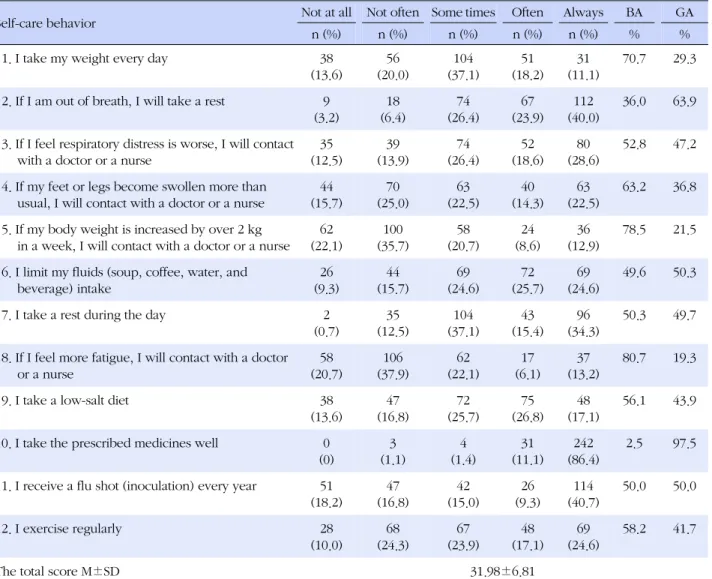
The total mean score of adherence to self-care behav- iors was 31.98±6.81. Adherence to each self-care be- havior is shown in Table 2. To identify which self-care behavior has good or bad adherence, good adherence was defined operationally as a score of 1 or 2 (often or always), and poor adherence as a score of 3, 4, or 5 (sometimes, not often, or not at all)[24]. Self-care behav-
iors reported as having poor adherence included deal- ing with fatigue (80.7%), weight gain (78.5%), leg edema (63.2%), and daily weight measurement (70.7%). Whe- reas, self-care behaviors classified as good adherence included taking prescribed medication (97.5%), resting during dyspnea (63.9%), limiting fluid intake (50.3%), and receiving the flu shot (50.0%).
The mean score for heart failure-related knowledge of the participants was 8.78±2.53. Percentages of the cor- rect answer are shown in Table 3. Patients showed a particularly low rate (below 50%) of correct answers on six items including: the cause of worsening heart failure (30.3%), leg edema (35.7%), frequency of weighing (34.6
%), the reason for weighing regularly (45.0%), low salt diet (37.1%), and the acceptable amount of fluid intake (49.6%). The highest correct rate was 90% on the ques- tion about medications and 88.9% on the question about exercising at home.
3. Adherence to Self-care Behaviors with Characteris- tics of Patients
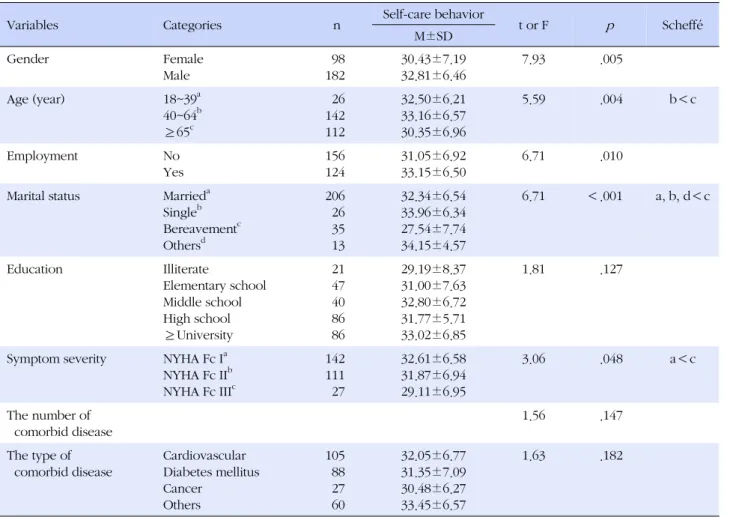
The mean differences of adherence to self-care be- haviors according to demographic and disease charac- teristics are shown in Table 4. Women had lower scores for adherence to self-care behavior than men (t=7.93, p=
.005). Patients aged 40~64 years showed higher scores of adherence than patients aged 65 years and older (F=
5.59, p =.004). Unemployed patients (t=6.71, p =.010), and bereaved spouses (F=6.71, p <.001) also showed lower scores of adherence to self-care behaviors. In ad- dition, NYHA Fc III patients, representing higher symp- tom severity, had lower scores for adherence to self-care behaviors (F=3.06, p =.048). The lower score indicates better adherence, thus, the results show that female pa- tients, aged 65 years and older, who are bereaved and unemployed, with higher symptom severity, had better adherence to self-care behaviors.
4. Factors Affecting Adherence to Self-care Behaviors Functional status, NYHA Fc, heart failure knowledge, social support, and demographic characteristics, includ- ing sex, age, marital status, and employment were ana- lyzed as independent variables. Demographic variables were specifically selected according to the results of the ANOVA indicating participants' characteristics that were significantly associated with self-care behavior (p <.05).
The means and standard deviations of functional status,
heart failure knowledge, and social support were 36.26
Table 2. Adherence to Heart Failure Self-care Behaviors (N=280)
Self-care behavior Not at all Not often Some times Often Always BA GA
n (%) n (%) n (%) n (%) n (%) % %
1. I take my weight every day 38
(13.6)
56 (20.0)
104 (37.1)
51 (18.2)
31 (11.1)
70.7 29.3
2. If I am out of breath, I will take a rest 9 (3.2)
18 (6.4)
74 (26.4)
67 (23.9)
112 (40.0)
36.0 63.9
3. If I feel respiratory distress is worse, I will contact with a doctor or a nurse
35 (12.5)
39 (13.9)
74 (26.4)
52 (18.6)
80 (28.6)
52.8 47.2
4. If my feet or legs become swollen more than usual, I will contact with a doctor or a nurse
44 (15.7)
70 (25.0)
63 (22.5)
40 (14.3)
63 (22.5)
63.2 36.8
5. If my body weight is increased by over 2 kg in a week, I will contact with a doctor or a nurse
62 (22.1)
100 (35.7)
58 (20.7)
24 (8.6)
36 (12.9)
78.5 21.5
6. I limit my fluids (soup, coffee, water, and beverage) intake
26 (9.3)
44 (15.7)
69 (24.6)
72 (25.7)
69 (24.6)
49.6 50.3
7. I take a rest during the day 2
(0.7)
35 (12.5)
104 (37.1)
43 (15.4)
96 (34.3)
50.3 49.7
8. If I feel more fatigue, I will contact with a doctor or a nurse
58 (20.7)
106 (37.9)
62 (22.1)
17 (6.1)
37 (13.2)
80.7 19.3
9. I take a low-salt diet 38
(13.6)
47 (16.8)
72 (25.7)
75 (26.8)
48 (17.1)
56.1 43.9
10. I take the prescribed medicines well 0 (0)
3 (1.1)
4 (1.4)
31 (11.1)
242 (86.4)
2.5 97.5
11. I receive a flu shot (inoculation) every year 51 (18.2)
47 (16.8)
42 (15.0)
26 (9.3)
114 (40.7)
50.0 50.0
12. I exercise regularly 28
(10.0)
68 (24.3)
67 (23.9)
48 (17.1)
69 (24.6)
58.2 41.7
The total score M±SD 31.98±6.81
BA=bad adherence: participant's response of (not at all+not often+sometimes); GA=good adherence: participant's response of (often+always).
±17.12, 8.78±2.53 and 74.21±19.72, respectively.
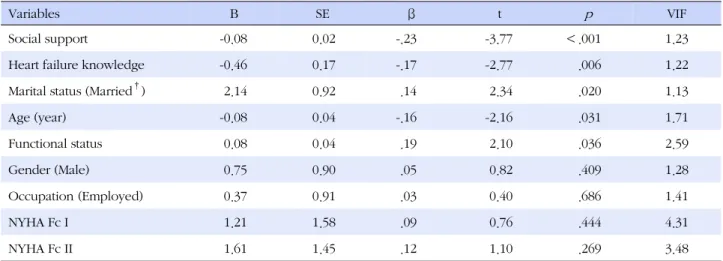
Results of the multiple regression analysis are shown in Table 5. In this model, each variable was independent as the Durbin Watson statistic was 1.83 for residual anal- ysis and there was no problem of multicolinearity, as the variance inflation factor (VIF) ≤ 10.
The model explained 15.9% of adherence to self-care behavior and was statistically significant (F=5.09, p <
.001). Significant independent variables were heart fail- ure knowledge (
β=-.17, p=.006), social support (
β=-.23, p <.001), functional status (
β=.19, p =.036), marital sta- tus (
β=.14, p =.020), and age (
β=-.16, p =.031). Those indicate that married patients showed lower adherence, whereas, those with worse functional status, better heart failure knowledge, better social support, and older were more likely to adhere to self-care behaviors.
DISCUSSION
The mean score of adherence to self-care behaviors for heart failure in this study was similar to the results of a Japanese study[24], but higher than the scores of Euro- pean studies[18,25], indicating lower adherence than European patients. In particular, there was lower adher- ence to self-care management behaviors shown after feeling fatigue, weight gain, and edema than in other studies[18,24]. Among the self-care maintenance behav- iors, weighing daily was the behavior with the least com- pliance.
This low adherence might reflect a lack of knowledge
on heart failure pathophysiology or no recognition of
signs and symptoms of worsening disease[9]. This result
might be associated with a low rate of correct answers
on the items on symptoms of worsening heart failure,
Table 3. Heart Failure Knowledge (N=280)
Items PCA
n (%) 1. How often does a patient with severe heart failure need to take his or her own weight? 97 (34.6) 2. Why is it important for a heart failure patient to take his or her own weight regularly? 126 (45.0)
3. How much water intake is allowed for a day? 139 (49.6)
4. Which of the following statements is correct regarding medicine intake? 252 (90.0) 5. What action should the patient take if he or she is out of breath or the legs are swollen? 221 (78.9) 6. Which of the followings can increase the symptoms of heart failure? 84 (30.3)
7. What dose 'heart failure' mean? 194 (69.3)
8. Why are the legs swollen when there is heart failure? 100 (35.7)
9.What is the function of the heart? 156 (55.7)
10. Why should a heart failure patient follow low-salt diet? 104 (37.1)
11. What is the main cause of heart failure? 198 (70.7)
12. Which of the following statements is correct regarding the physical exercise for a heart failure patient at home? 249 (88.9)
13. Why should a heart failure patient take diuretics? 162 (57.9)
14. Which of the following statements is correct regarding the relationship between heart failure and weight increase? 164 (58.6)
15. What is the best when feeling thirsty? 212 (75.7)
PCA=percentage of correct answer.
Table 4. Heart Failure Self-care Behavior according to the Participants' Characteristics (N=280)
Variables Categories n Self-care behavior
t or F p Scheffé
M±SD
Gender Female
Male
98 182
30.43±7.19 32.81±6.46
7.93 .005
Age (year) 18~39a
40~64b
≥65c
26 142 112
32.50±6.21 33.16±6.57 30.35±6.96
5.59 .004 b<c
Employment No
Yes
156 124
31.05±6.92 33.15±6.50
6.71 .010
Marital status Marrieda Singleb Bereavementc Othersd
206 26 35 13
32.34±6.54 33.96±6.34 27.54±7.74 34.15±4.57
6.71 <.001 a, b, d<c
Education Illiterate
Elementary school Middle school High school
≥University
21 47 40 86 86
29.19±8.37 31.00±7.63 32.80±6.72 31.77±5.71 33.02±6.85
1.81 .127
Symptom severity NYHA Fc Ia NYHA Fc IIb NYHA Fc IIIc
142 111 27
32.61±6.58 31.87±6.94 29.11±6.95
3.06 .048 a<c
The number of comorbid disease
1.56 .147
The type of comorbid disease
Cardiovascular Diabetes mellitus Cancer
Others
105 88 27 60
32.05±6.77 31.35±7.09 30.48±6.27 33.45±6.57
1.63 .182
Table 5. Regression Analysis of Adherence to Self-care Behaviors (N=280)
Variables B SE β t p VIF
Social support -0.08 0.02 -.23 -3.77 <.001 1.23
Heart failure knowledge -0.46 0.17 -.17 -2.77 .006 1.22
Marital status (Married†) 2.14 0.92 .14 2.34 .020 1.13
Age (year) -0.08 0.04 -.16 -2.16 .031 1.71
Functional status 0.08 0.04 .19 2.10 .036 2.59
Gender (Male) 0.75 0.90 .05 0.82 .409 1.28
Occupation (Employed) 0.37 0.91 .03 0.40 .686 1.41
NYHA Fc I 1.21 1.58 .09 0.76 .444 4.31
NYHA Fc II 1.61 1.45 .12 1.10 .269 3.48
NYHA Fc=New York Heart Association Functional Classification; †Currently married state.
frequency of weighing, and the reason for weighing regularly. For example, adherence to weighting daily is significantly associated with knowledge on the frequen- cy and reason of weighing, respectively (
x2=26.33, p <
.001;
x2=7.11, p =.006). Good adherence to managing edema and weight gain was also associated with know- ing what to do to deal with leg swelling and weight gain, respectively (
x2=17.34, p<.001;
x2=10.31, p=.001). These low levels of knowledge and adherence indicated the areas to focus on in education.
One of the self-care maintenance behaviors showing good adherence was flu shots, which was similar to the adherence of European patients with heart failure[18].
However, participants with this answer did not know much about flu as a risk factor for worsening heart fail- ure. Therefore, the relatively high adherence rate might be due to the unique health insurance system and easy accessibility of hospitals in Korea. In other words, health centers were offering free influenza vaccinations for people aged 65 years and older in Korea, therefore, most of the elderly received a flu shot without knowl- edge of the importance of influenza vaccinations for pa- tients with heart failure.
The score on knowledge about heart failure in these participants was lower than that in Western patients with heart failure[19, 26]. Considering that the participants are outpatients of tertiary health care center cardiology clin- ics in a metropolitan area that offer frequent education about self-care, a more systematic and specific plan con- sidering participants' health literacy is needed in order to achieve educational goals and to consider the educa- tion effective[13]. Evaluation of adherence using an ob- jective method following educational interventions is al-
so needed. However, these results should be interpre- ted with caution because this study was not a popula- tion-based study using a probabilistic sampling method and thus, it may not have been representative of the Korean population.
Earlier studies showed that female[27], older [11,24,27], unemployed[27], and functionally less able[10] patients with heart failure adhere to self-care behaviors more.
This study also showed older and functionally less able patients were more adhere to self-care behaviors. How- ever, bereaved spouses had better adherence to self-care behaviors in this study; that may be because they were mostly elderly (F=48.77, p <.001) and female (
x2=45.43, p <.001).
Among demographic variables, adherence to self-care was not statistically different according to education lev- el, which was inconsistent with the findings reported in earlier studies[10,28]. Thus, specific knowledge on heart failure was more important than the level of education.
And another study[29] have identified that advance- ments in adherence to self-care behaviors can be made with nursing interventions, regardless of the education level of the patient.
Multiple regression analysis showed patients with
heart failure who had better social support[14] and more
heart failure knowledge[13,29], as well as lower func-
tional status[12] had higher adherence to self-care beha-
vior. These results supported those reported in previous
studies. Social support may facilitate adherence to self-
care through cognitive and affective mechanisms such
as self-efficacy of control over heart failure[15]. How-
ever, symptom severity using the NYHA Fc was not a
significant predictor of adherence to self-care behaviors.
The possible causes might be that the NYHA Fc is based partly on the limitation of physical activity, which con- ceptually overlaps with functional status, and perceived functional status might have a greater effect on adher- ence to self-care than symptom severity as evaluated by medical staff.
This study had several limitations. First, there may have been selection bias. Adherence to self-care behav- iors and heart failure knowledge might vary under dif- ferent health center systems. Since the accessible pop- ulation was restricted to university hospitals in a city, this point must be taken into consideration when inter- preting the results. The samples in this study were also predominantly patients with NYHA functional class I or II. Therefore, it makes difficult to draw inferences from this study sample to all heart failure patients. Even though most patients with NYHA functional class IV and many with class III were hospitalized mainly due to dy- spnea in reality, self-care behaviors are still important for outpatients with NYHA functional class III. There- fore, a study including more participants with NYHA functional class III may be needed.
Second, this regression model explained only 15.9%
of the variance in adherence to self-care behaviors. This meant that 84.1% of the variance in adherence to self- care behavior remains unexplained by this model and non-selected various predictors could affect adherence to self-care behaviors. As a result, other variables need to be studied in order to develop more effective nursing interventions, which could improve an understanding of adherence to self-care behaviors and thus promote bet- ter adherence.
CONCLUSIONS
The results of this study provided general information about heart failure knowledge and adherence to self-care behaviors among Korean outpatients with heart failure.
In addition, this study was significant in that it may serve to help identify high risk groups of patients who are noncompliant with self-care and guide possible nursing interventions to increase adherence such as social sup- ports and patient education programs.
REFERENCES
1. The Korean Society of Heart Failure. Heart failure manual. Se- oul: The Korean Society of Heart Failure; 2007. p. 18-21.
2. Choi D, Han S, Jeon E, Cho M, Kim J, Yoo B, et al. Character- istics, outcomes and predictors of long-term mortality for pa-
tients hospitalized for acute heart failure: a report from the Korean heart failure registry. Korean Circulation Journal. 2011;
41:363-71. http://dx.doi.org/10.4070/kcj.2011.41.7.363 3. Yancy C, Jessup M, Bozkurt B, Butler J, Casey D Jr, Drazner
M, et al. 2013 ACCF/AHA guideline for the management of heart failure: executive summary: a report of the american college of cardiology Foundation/American heart association task force on practice guidelines. Circulation. 2013;128:1810- 52. http://dx.doi.org/10.1161/CIR.0b013e31829e8807 4. Michalsen A, Konig G, Thimme W. Preventable causative fac-
tors leading to hospital admission with decompensated heart failure. Heart. 1998;80:437-41.
http://dx.doi.org/10.1136/hrt.80.5.437
5. Happ M, Naylor M, Roe-Prior P. Factors contributing to re- hospitalization of elderly patients with heart failure. Journal of Cardiovascular Nursing. 1997;11:75-84.
6. Krumholz H, Amatruda J, Smith G, Mattera J, Roumanis S, Radford M, et al. Randomized trial of an education and sup- port intervention to prevent readmission of patients with heart failure. Journal of the American College of Cardiology. 2002;
39:83-9. http://dx.doi.org/10.1016/S0735-1097(01)01699-0 7. Riegel B, Moser D, Anker S, Appel L, Dunbar S, Grady K, et al.
State of the science: promoting self-care in persons with heart failure: a scientific statement from the American Heart Associ- ation. Circulation. 2009;120:1141-63.
http://dx.doi.org/10.1161/CIRCULATIONAHA.109.192628 8. Heart Failure Society of America. Executive summary: HFSA
2006 comprehensive heart failure practice guideline. Journal of Cardiac Failure. 2006;12:10-38.
http://dx.doi.org/10.1016/j.cardfail.2005.12.001
9. Carlson B, Riegel B, Moser D. Self-care abilities of patients with heart failure. Heart & Lung. 2001;30:351-9.
http://dx.doi.org/10.1067/mhl.2001.118611
10. Rockwell J, Riegel B. Predictors of self-care in persons with heart failure. Heart & Lung. 2001;30:18-25.
http://dx.doi.org/10.1067/mhl.2001.112503
11. Chriss P, Sheposh J, Carlson B, Riegel B. Predictors of suc- cessful heart failure self-care maintenance in the first three months after hospitalization. Heart & Lung. 2004;33:345-53.
http://dx.doi.org/10.1016/j.hrtlng.2004.03.004
12. Heo S, Moser D, Lennie T, Riegel B, Chung M. Gender differ- ences in and factors related to self-care behaviors: a cross-sec- tional, correlational study of patients with heart failure. Inter- national Journal of Nursing Studies. 2008;45:1807-15.
http://dx.doi.org/10.1016/j.ijnurstu.2008.05.008
13. Chen A, Yehle K, Albert N, Ferraro K, Mason H, Murawski M, et al. Relationships between health literacy and heart failure knowledge, self-efficacy, and self-care adherence. Research in Social & Administrative Pharmacy. 2014;10:378-86.
http://dx.doi.org/10.1016/j.sapharm.2013.07.001
14. Sayers S, Riegel B, Pawlowski S, Coyne J, Samaha F. Social support and self-care of patients with heart failure. Annals of Behavioral Medicine. 2008;35:70-9.
http://dx.doi.org/10.1007/s12160-007-9003-x
15. Maeda U, Shen B-J, Schwarz ER, Farrell KA, Mallon S. Self-effi- cacy mediates the associations of social support and depres- sion with treatment adherence in heart failure patients. Inter- national Journal of Behavioral Medicine. 2013;20:88-96.
http://dx.doi.org/10.1007/s12529-011-9215-0
16. van der Wal M, Jaarsma T, van Veldhuisen D. Non-complian- ce in patients with heart failure; how can we manage it? Euro- pean Journal of Heart Failure. 2005;7:5-17.
http://dx.doi.org/10.1016/j.ejheart.2004.04.007
17. Faul F, Erdfelder E, Buchner A, Lang A. Statistical power anal- yses using G*Power 3.1: test for correlation and regression ana- lyses. Behavior Research Methods. 2009;41:1149-60.
http://dx.doi.org/10.3758/BRM.41.4.1149
18. Jaarsma T, Stromberg A, Martensson J, Dracup K. Develop- ment and testing of the European heart failure self-care beha- viour scale. European Journal of Heart Failure. 2003;5:363- 70. http://dx.doi.org/10.1016/S1388-9842(02)00253-2 19. van der Wal M, Jaarsma T, Moser D, van Veldhuisen D. Deve-
lopment and testing of the Dutch heart failure knowledge scale. European Journal of Cardiovascular Nursing. 2005;4:
273-7.
http://dx.doi.org/10.1016/j.ejcnurse.2005.07.003
20. McDowell I. Measuring health: a guide to rating scales and questionnaires. 3rd ed. New York: Oxford University Press;
2006. p. 165-7.
21. Sherbourne C, Stewart A. The MOS social support survey.
Social Science & Medicine. 1991;32:705-14.
http://dx.doi.org/10.1016/0277-9536(91)90150-B
22. Bennett J, Riegel B, Bittner V, Nichols J. Validity and reliability of the NYHA classes for measuring research outcomes in pa- tients with cardiac disease. Heart & Lung. 2002;31:262-70.
http://dx.doi.org/10.1067/mhl.2002.124554
23. Arena R, Humphrey R, Peberdy M. Using the Duke Activity Status Index in heart failure. Journal of Cardiopulmonary Rehabilitation. 2002;22:93-5.
24. Kato N, Kinugawa K, Ito N, Yao A, Watanabe M, Imai Y, et al.
Adherence to self-care behavior and factors related to this be- havior among patients with heart failure in Japan. Heart &
Lung. 2009;38:398-409.
http://dx.doi.org/10.1016/j.hrtlng.2008.11.002
25. Hwang B, Moser D, Dracup K. Knowledge is insufficient for self-care among heart failure patients with psychological di- stress. Journal of Health Psychology. 2014;33:588-96.
http://dx.doi.org/10.1037/a0033419
26. van der Wal M, Jaarsma T, Moser D, Veeger N, van Gilst W, van Veldhuisen D. Compliance in heart failure patients: the importance of knowledge and beliefs. European Heart Jour- nal. 2006;27:434-40.
http://dx.doi.org/10.1093/eurheartj/ehi603
27. Cocchieri A, Riegel B, D'Agostino F, Rocco G, Fida R, Alvaro R, et al. Describing self-care in Italian adults with heart failure and identifying determinants of poor self-care. European Jour- nal of Cardiovascular Nursing. 2015;14:126-36.
http://dx.doi.org/10.1177/1474515113518443
28. Chen A, Yehle K, Albert N, Ferraro K, Mason H, Murawski M, et al. Health literacy influences heart failure knowledge at- tainment but not self-efficacy for self-care or adherence to self- care over time. Nursing Research & Practice. 2013; ID 353290:
1-8. http://dx.doi.org/10.1155/2013/353290
29. Baker D, Asch S, Keesey J, Brown J, Chan K, Joyce G, et al.
Differences in education, knowledge, self-management ac- tivities, and health outcomes for patients with heart failure cared for under the chronic disease model: the improving chronic illness care evaluation. Journal of Cardiac Failure.
2005;11:405-13.
http://dx.doi.org/10.1016/j.cardfail.2005.03.010