* Corresponding author : Hyung Soo Park National Institute of Animal Science RDA, Cheonan 330-801, Korea. Tel: +82-41-580-6753, E-mail: [email protected]
Research Article
Comparison of Forage Production and Nutritional Value of Italian ryegrass, Rye and Whole Crop Barley as Winter Forage Crops in Southern Region
of Korea
Min Jeong So
1, Hyeon Shup Kim
1, Ji Hye Kim
1, Sang-Hoon Lee
1, Ki-Won Lee
1, Jeong Sung Jung
1, Kyung-Il Sung
2, Jing lun Peng
2and Hyung Soo Park
1*
1
National Institute of Animal Science, Cheonan, 330-801, Korea,
2
Department of Feed Science and Technology, Kangwon National University
ABSTRACT
This study was conducted from October 2014 to May 2015 to explore forage production and feed values of Italian ryegrass, Rye and whole crop barley as winter forage crops in the Southern region of Korea. The experimental location was over 10 points for each species and each sampling point area was 1 m2(Width: 1 m × Length: 1 m). Air mean temperature and rainfall in the Southern region of Korea during the experimental period was 6.95 ± 5.75 and 70.45 ± 54.68 mm, respectively. Fresh forage yield of Italian ryegrass, the most cultivated forage in the Southern region of Korea, was 44.4 ± 7.0 ton/ha. The percentage of dry matter for whole crop barley was 28.9 ± 7.0%. Crude protein (CP) was higher in Italian ryegrass (10.7 ± 5.3%) while total digestible nutrient (TDN) had the highest value in whole crop barley. Crude protein was not significantly different by location.
However, the neutral detergent fiber (NDF), acid detergent fiber (ADF) and total digestible nutrient value of forage from Jeonbuk province were higher than in forage from Gyeongnam province.
(Key words : Forage production, Italian ryegrass, Nutritive value, Rye, Southern region of Korea, Whole crop barley)
. INTRODUCTION
The livestock industry in Korea is facing difficulties due to high production cost and worldwide competition. For these reasons, the government has offered a variety of national policies in order to reduce the production cost of farm. Despite efforts of the government, forage self- sufficiency stopped at 82%. The main causes were problem of equal quality forage production by four seasons, competition with economic crops and high price of machine.
In this background, the livestock industry has been continuously depending on the import of hay. In order to increase self-sufficiency and a stable production. Therefore, the study of roughage is required about forage production and domestic forage database. Recently, studies have been carried out a cold-tolerant and early-heading Italian ryegrass (Choi et al., 2006), cultivation and utilization barley as the
main winter crop in paddy field (Kim and Seo, 2006) in Korea.
Winter type forages have optimum growth temperature at 15~21 , although it occurs summer depression when the air temperature rises more than over 25 (Kim, 1992). In addition, even rainfall conditions are optimal conditions for its growth.
Annual average air temperature of Southern province in
Korea is higher than central province. The range of average
annual air temperature has 0 to 10 and range of annual
average rainfall has 1,000 to 1,800 mm. Variation of winter
temperature in climate of Southern provinces in Korea was
lower than compared to central province, Southern province
climate in Korea is characterized better on winter type
forage optimal growth conditions because of the high
rainfall compared to central province. Based on climate
conditions and policies for domestic forage, studies were
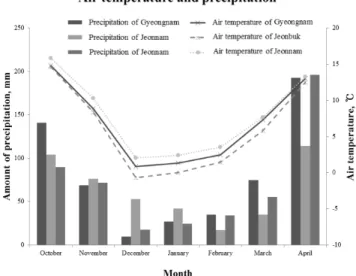
Fig. 1. Air mean temperature and rainfall data of experimental sites during experimental period (Location indicated average of latitude and longitude at research areas in 2015; Gyeongnam province, 35º28’23.1”N 127º41’36.5”E; Jeonbuk province, 35º36’33.3”N 126º35’31.8”E; Jeonnam province, 34º41’42.9”N 127º27’19.5”E).
conducted that evaluation of characteristics, winter survival and forage production for warm season grass in the mid-Southern regions of Korea (Park et al., 2014). Evaluated characteristics and forage production for Bermudagrass (Cynodon dactylon) and Bahiagrass (Paspalum notatum) in Jeju (Park et al., 2012) and summer crops research by province for grasses mapping in Korea. However, studies of winter type grasses on Southern province have been not performed that compared to summer type grasses.
Therefore, the purpose of the present study was performed to evaluate the forage production and nutritive value of Italian ryegrass, Rye and Whole crop barley and to utilize as a basis database in Korea Southern province.
. MATERIALS AND METHODS
This experiment was performed from October 2014 to May 2015 at field and paddy field in Gyeongnam, Jeonbuk and Jeonnam provinces, Korea. The experiment species were winter type graminae grasses (Italian ryegrass, Rye and Whole crop barley) and the experiment was conducteded planting grasses in October 2014 as a target. The sampling place and weight were over 10 places, over 2 kg each grass, respectively and each sampling plot was 2 m
2(1.5 × 4 m). Fresh plant weight was calculated after cutting each sampling plot and it was converted to the number per ha. Dry matter yield was measured collecting 300 to 500 g per 2 kg each treatment, all dry matter rates of samples were calculated by oven drying at 68 for more than 72 hours. Then these samples were used for chemical composition analysis after crushing and filtered using 20 mesh sieves. The crude protein (CP) was analyzed according to AOAC (1990) method using KjeltecTM 2400 auto- sampler system (FOSS, Hillerød, Denmark). Neutral detergent Fiber (NDF) and acid detergent fiber (ADF) were analyzed by Goering and Van Soest (1970) using Ankom fiber analyzer (Ankom technology, New York, USA) (Ankom, 2005a; 2005b). Data were analyzed using the MIXED procedure of SAS Institute (ver. 9.1) (Littell et al., 2006) as a completely randomized design. Model was,
Y = µ + T
i+ E
ijWhere, µ is average value, T
iis treatment value, E
ijis the error value. The fixed effect was supplement effect; random
effect was not considered in procedure. Significant differences among the treatments were determined at p<0.05 whereas a trend was expressed when p<0.10 using Duncan’s multiple comparisons. All means presented were least square means.
. RESULT AND DISCUSSION
1. Climate characteristics
Air mean temperature and rainfall data of experimental sites during experimental period were presented in Fig. 1.
Air mean temperature showed higher in the following order,
Jeonnam > Gyeongnam > Jeonbuk province. Air mean temper-
ature of each province such as Gyeongnam was 6.95 ± 5.64
, Jeonbuk was 6.02 ± 6.11 , Jeonnam was 7.86 ± 5.49°C,
respectively. The average rainfall of each province Gyeongnam
was 78.40 mm, Jeonbuk was 69.10 mm, Jeonnam was 69.86
mm, respectively. Murata and Iyama (1963) reported that
winter type grasses have more photo synthesis rate at 10 to
15 and gradually reduced at 35 . The respiration and
growth characteristics of winter type grasses were no
significant difference between 0 and 15 . As range of air
Table 1. Plant height and dry matter yield of Italian ryegrass, Rye, Whole crop barley in south province of Korea
Item
Italian ryegrassRye Whole crop barley
Plant height, cm 115.2 ± 15.9 123.0 ± 21.7 78.6 ± 13.5
Dry matter yield, t/ha 10.9 ± 3.2 9.0 ± 3.9 6.7 ± 1.4
Dry matter, % 24.5 ± 5.0 24.7 ± 3.5 28.9 ± 3.5
Table 2. Plant height and dry matter yield of Italian ryegrass by location
Item Location
SEM p-value
Gyeongnan Jeonbuk
Plant height, cm 121.6 107.5 2.48 <.0001
Dry matter yield, t/ha 12.9 8.6 0.42 <.0001
Dry matter, % 27.1 21.4 0.75 <.0001
Location indicated average of latitude and longitude in research areas; Gyeongnam province, 35º26’9.0”N 127º45’43.0”E; Jeonbuk province, 35º31’31.5”N 126º46’28.8”E
Standard error of the mean between location.
temperature on Southern province in Korea showed within 0 to 15 . Air temperature was not considered to inhibit the growth of winter type grasses. As range of air temperature on Southern province in Korea 1.5 to 20.2 (Average, 9.58 ± 7.13 ), it was considered suitable temperature for growth of winter type grasses.
2. Forage productivity
Forage productivity of Italian ryegrass, Rye and Whole crop barley in Korea Southern province was shown in Table 1. Winter type grasses used for the experiment were reported that have high cold resistance. Dry matter percentage was higher in whole crop barley (28.9 ± 7.0%) compared to other plants. In this result, Italian ryegrass was considered as most grown winter type grass in the Southern Korea.
Dry matter rate of Rye produced in Korea Southern province showed 24.7%, it was higher than value of previous studies (Alibes et al., 1990; Djouvinov et al., 1998) as 16.8%. Dry matter rate of whole crop barley produced in Korea Southern province showed 28.9%, in previous studies showed that range of dry matter rate was 15.0 to 41.5% (Ait Amar, 2005; Carr et al., 2003; Chow et al., 2008).
Forage productivity of Italian ryegrass between Gyeongnam and Jeonbuk province was shown in Table 2. Forage
productivity of Italian ryegrass in Gyeongnam province was higher than Jeonbuk province (P<0.05). This result was considered that due to air mean temperature, rainfall and soil temperature were higher in Gyeongnam province than Jeonbuk province. However, because of the result considered only cultivation location, this result was considered to require no further studies in consideration of the manure information and additional cultivation environment.
Forage productivity of Rye between Gyeongnam and Jeonbuk province was shown in Table 3. Forage productivity of Rye in Gyeongnam province was higher than Jeonbuk province except for plant height (P<0.05). In dry matter rate, it considered that air mean temperature, rainfall and soil temperature of Gyeongnam province were higher than Jeonbuk province, for the same reason as Italian ryegrass.
Forage productivity of whole crop barley between Jeonbuk and Jeonnam province was shown in Table 4. The results showed no significant difference between Jeonbuk and Jeonnam province on plant height and dry matter rate.
However, dry matter yield of whole crop barley in
Jeonbuk province was higher than Jeonnam province
(P<0.05). These results were considered that whole crop
barley cultivation amount in Jeonbuk province was higher
than Jeonnam province. In plant height and dry matter
result, although variation of cultivation environment shown
in Fig. 1 by location was considered have low effect on
whole crop barley growth, it considered to required further
Table 5. Crude protein, acid detergent fiber, neutral detergent fiber and hemicellulose of Italian ryegrass, Rye and whole crop barley
Item Chemical composition
CP NDF ADF Hemicellulose
%DM
Italian ryegrass 10.7 ± 5.3 54.9 ± 3.9 35.0 ± 2.5 19.9 ± 1.9
Rye 10.2 ± 2.4 61.4 ± 5.2 38.7 ± 4.0 22.7 ± 2.1
Whole crop barley 8.7 ± 2.0 55.5 ± 4.0 33.4 ± 4.1 22.1 ± 1.5
DM, dry matter; CP, crude protein; NDF, neutral detergent fiber; ADF, acid detergent fiber; TDN, total digestible nutrient.
Table 6. Crude protein, acid detergent fiber, neutral detergent fiber and hemicellulose of rye by location Chemical composition Location
SEM p-value
Gyeongnan Jeonbuk
CP, DM% 10.2 10.2 1.09 0.997
NDF, DM% 63.9 58.3 1.91 0.067
ADF, DM% 40.7 36.3 1.46 0.064
Hemicellulose, DM% 23.2 22.0 0.50 0.333
Location indicated average of latitude and longitude in research areas; Gyeongnam province, 35º28’23.1”N 127º41’36.5”E; Jeonbuk province, 35º36’33.3”N 126º35’31.8”E
DM, dry matter; CP, crude protein; NDF, neutral detergent fiber; ADF, acid detergent fiber; TDN, total digestible nutrient.
Table 3. Plant height and dry matter yield of rye by location
Item Location
SEM p-value
Gyeongnan Jeonbuk
Plant height, cm 125.5 117.6 6.15 0.285
Dry matter yield, t/ha 10.1 4.6 0.67 <.0001
Dry matter, % 26.0 20.9 0.71 <.0001
Location indicated average of latitude and longitude in research areas; Gyeongnam province, 35º30’37.2”N 127º37’30.0”E; Jeonbuk province, 35º36’33.6”N 127º17’39.6”E
Standard error of the mean between location.
Table 4. Plant height and dry matter yield of whole crop barley by location
Item Location
SEM p-value
Jeonbuk Jeonnam
Plant height, cm 77.9 85.3 4.53 0.2810
Dry matter yield, t/ha 7.3 5.0 0.21 <.0001
Dry matter, % 28.6 27.9 1.27 0.7246
Location indicated average of latitude and longitude in research areas; Jeonbuk province, 35º43’34.9”N 127º42’27.2”E; Jeonnam province, 34º41’42.9”N 127º27’19.5”E
Standard error of the mean between location.
studies in consideration of additional environment.
3. Forage nutritive values of Italian ryegrass, Rye and Whole crop barley by location
Forage nutritive values of Italian ryegrass, Rye and whole
crop barley were shown in Table 5. In CP content of
Italian ryegrass and Rye were similar, whole crop barley
showed lowest CP value as 8.7%. The NDF and ADF of
Rye were 61.4% and 38.7%, respectively, NDF and ADF content of Italian ryegrass and whole crop barley were similar. Hemicellulose was no difference among the grass species. Although, CP of Italian ryegrass, Rye and whole crop barley showed similar value, that showed lower values than the imported grasses by previous studies (CIRAD, 1991; AFZ, 2011; NRC, 2000). In NDF and ADF value, domestic winter type grasses were similar compared to the imported winter type grasses. Forage nutritive values of Rye between Gyeongnam and Jeonbuk province were shown in Table 6. The CP and hemicellulose were showed no difference between Gyeongnam and Jeonbuk province.
Although NDF and ADF value was exhibited no difference between Gyeongnam and Jeonbuk province, result of Gyeongnam province tend to higher tendency than Jeonbuk province (P<0.10).
. CONCLUSION
This study was conducted to evaluate forage production and nutritive value of winter type grasses (Italian ryegrass, Rye and Whole crop barley) in Korea Southern province in October 2014 while May 2015. The Italian ryegrass is a winter type grasses produced more amount in Korea Southern province. The higher dry matter rate showed in Whole crop barley. Forage production was higher than Gyeongnam province compared to other province, There is no difference between Jeonbuk and Jeonnam province. In CP although, content of Italian ryegrass and Rye were similar, CP content standard deviation of Italian ryegrass was higher than Rye. In NDF and ADF, contents of Italian ryegrass and whole crop barley were similar, content of Rye was higher than others. Although, nutritive value of Rye in Gyeongnam and Jeonbuk province on Rye was exhibited no significantly difference, The nutritive value of Gyeongnam was tend to higher than Jeonbuk province.
These results were considered that forage production and nutritive value by location difference were insignificant. In dry matter yield, whole crop barley have advantage than others. In CP content, Rye have advantage than others, based on the content of CP standard deviation. However, in NDF, ADF and hemicellulose, Italian ryegrass and whole crop barley has advantage than Rye. These results were
considered that each forage have specific characteristic based on the results. Therefore, overall, these results were considered that potential of winter type grasses productivity was sufficient in Southern regions of Korea.
. ACKNOWLEDGEMENT
This work was carried out with the support of “Cooperative Research Program for Agriculture Science and Technology Development (Project No. PJ009766042015)” Rural Development Administration, Republic of Korea.
. REFERENCES
AFZ, 2011. io - La Banque de données de l'Alimentation Animale / French feed database. Association Française de Zootechnie.
Alibes, X. and Tisserand, J.L. 1990. Tables of the nutritive value for ruminants of Mediterranean forages and by-products. Options Méditerranéennes : Série B Etudes et recherches; numero 4.
CIHEAM 152 p.
Ait Amar, B. 2005. Production, utilisation et caractérisation de la valeur nutritive des fourrages et sous produits des cultures au Maroc. Mémoire. Institut Agronomique et Veterinaire Hassan II, Rabat (Morocco), 112 p.
Ankom Technology. 2005a. Method for determining neutral detergent fiber. ANKOM Technology, Fairport, NY. http://www.ankom.
com/09_procedures /procedures2.shtml. Accessed May 8, 2005.
Ankom Technology. 2005b. Method for determining acid detergent fiber. ANKOM Technology, Fairport, NY. http://www.ankom.
com/09_procedures /proceduresl.shtml. Accessed May 8, 2005.
AOAC. 1990. Official Methods of Analysis, 15th ed. Association of Official Analytical Chemists, Washington, DC.
Carr, P.M., Horsley, R.D. and Poland, W.W. 2003. Forages: barley, oat, and cereal pea mixtures as dryland forages in the Northern Great Plains. Agronomy Journal. 96 (3):677-684.
Choi, G.J., Lim, Y.C., Rim, Y.W., Sung, B.R., Kim, M.J., Kim, K.Y.
and Seo, S. 2006. A Cold-Tolerant and Early-Heading Italian Ryegrass New Variety, ‘Kogreen’ Journal of The Korean Society of Grassland and Forage Science. 26:9-14.
Chow, L.O., Baron, V.S., Corbett, R. and Oba, M. 2008. Effects of planting date on fiber digestibility of whole-crop barley and productivity of lactating dairy cows. Journal of Dairy Science. 91 (4):1534-1543.
CIRAD, 1991. Laboratory data 1963-1991. CIRAD.
Djouvinov, D.S., Nakashima, Y., Todorov, N. and Pavlov, D. 1998.
In-situ degradation of feed purines. Animal Feed Science and Technology. 71 (1-2):67-77.
Goering, H.K. and Van Soest, P.J. 1970. Forage fiber analysis. Ag.
Handbook. No. 379. ARS. USDA: Washington DC.
Kim, D.A. 1992. Factors required to sustain pastoral farming systems and forage supply in winter cold zones in Korea.
Journal of The Korean Society of Grassland and Forage Science.
12:30-40.
Kim, W.H. and Seo, S. 2006. Cultivation and Utilization Barley as the Main Winter Crop in Paddy Field. Journal of The Korean Society of Grassland and Forage Science. 37-57.
Littell, R.C., Milliken, G.A., Stroup, W.W., Wolfinger, R.D. and Schbenberger, O. 2006. SAS for Mixed Models, Second Edition.
SAS Institute.
Murata, Y. and Iyama, J. 1963. Studies on the Photosynthesis of Forage Crops: II. Influence of air-temperature upon the photosynthesis of some forage and grain crops. National Institute of Agricultural Science. 31:315-322.
National Research Council, 2000. Clean Coastal Waters: Under- standing and Reducing the Effects of Nutrient Pollution. National Academies Press, Washington, DC.
Park, H.S., Hwang, K.J., Park, N.G., Choi G.J., Lee, J.K., Cheon, D.W. and Ko, M.S. 2008. Comparison of forage production and feed value of winter forage crops in Jeju. Journal of The Korean Society of Grassland and Forage Science. 37-57. 32:131-138.
(Received August 26, 2015 / Revised September 4, 2015 / Accepted September 6, 2015)