ISSN 2287-8130(Online) Particle and Aerosol Research
Part. Aerosol Res. Vol. 11, No. 4: December 2015 pp. 107-113 http://dx.doi.org/10.11629/jpaar.2015.11.4.113
Polymerization of fibrous and high molecular weight polyethylene using MgCl 2 /SBA-16/TiCl 4
Salinla Panpoom. Sujitra Klinsrisuk. Surangkhana Martwiset and Choosak Poonsawat*
1)
Materials Chemistry Research Center, Department of Chemistry, Faculty of Science, Khon Kaen University, Khon Kaen, Thailand
(Received 3 August 2015; Revised 11 December 2015; Accepted 27 December 2015)
Abstract
SBA-16 (Santa Barbara Amorphous) was synthesized over supported TiCl
4/MgCl
2. Due to its high surface area and excellent morphological performance, it was expected to form the bi-supported catalytic system and be used for ethylene polymerization. Polymerization of ethylene was carried out at atmospheric pressure using hexane as solvent and triethylaluminium as cocatalyst. ICP, FTIR, DSC, TG-DTA were used to characterize polyethylene and catalyst product. Optimum conditions for ethylene polymerization were found to be 100 mL hexane, Al/Ti molar ratio of 160 and 1 h polymerization at 60 ºC. The activity of 396.76 kg PE/ mol Ti.h.atm was achieved. Melting point of the obtained polymer was in the range of 132-135 ºC and the highest degree of crystallization was 46%.
Keywords:Ethylene polymerization, MgCl
2/SBA-16/TiCl4, Ziegler-Natta catalyst, Supported catalyst.
* Corresponding author.
Tel:+66-8961-7773-9, E-mail:[email protected]
1. Introduction
Polyethylene (PE) is a major plastic used in daily live and in polymeric material industry. It represents approximately 60 % of all thermoplastic market and becomes a fast continuous growth because of its many useful properties, such as low weight, abrasion resistance, corrosion resistance, high impact resistance and superior flexibility [1-2]. With a proper choice of catalyst system and reaction conditions, it is possible to produce materials with several applications such as packaging, containers, film, pipes and automobile parts [2]. Each year 10 million tons of polyethylene (PE) is being produced throughout the world with the supported Ziegler–Natta catalyst
Ziegler-Natta catalyst has played an important effect on the production of polyolefins. The ability of the catalysts to replicate their morphology into the morphology of resulting polymer (shape and particle size distribution) is an important feature of the heterogeneous Ziegler-Natta catalyst polymerization [3-7]. The Ziegler-Natta catalysts can be improved in different ways, such as changing internal electron donors, external electron donors and/or several combinations of both. Modification of support is one of choices to improve performance of catalyst [8].
Inorganic oxides such as silica are extensively used as a common support for many catalysts because of its high surface area and porosity, and its stability under reaction and processing conditions.
SBA-16 is one type of mesoporous silica. It shows important advantages, such as thickness, open frameworks, small crystals of primary particles, perfect porosity, stable at high temperatures and mass transfer better than unidirectional hexagon mesoporous material due to the connection of the three dimensions. The latter property is very important since SBA-16 reduces the mass transfer of the large-sized substrate and product, which may be found in the other mesoporous silica materials [9].
The geometrical shape of the nanochannels can serve as nanoscale polymerization reactors, these affecting
the pattern of a monomer insertion and controlling polymer chain structure and morphology [10].
In the present work, MgCl
2/SBA-16/TiCl
4was synthesized for ethylene polymerization. The effect of cocatalyst concentration on catalytic activities of the catalyst, molecular weight, transition temperature, crystallinity and morphology of the resulting polyethylene was investigated.
2. Materials and Methods
2.1 Materials
The chemicals including polymerization grade of ethylene and purified nitrogen gas, titanium (IV) chloride 99.9% (TiCl
4), triethylaluminium 93% (TEA), butylmagnesium chloride (BuMgCl) and pluronic F127 (C
3H
60.C
2H
4O)
X; F127) were purchased from Aldrich.
Tetraethyl orthosilicate (TEOS) was purchased from Merck. n-Hexane was completely dried and all the manipulations involving air and/or water sensitive compounds were performed under Ar atmosphere using glove box.
2.2 Preparation of SBA-16
8.0 g of NaCl was dissolved in 100 ml of 0.5 M HCl. After stirring at 700 rpm until it was completely dissolved, 3.74 g of Pluronic F127 and 8 g of TEOS were added and stirred for 2 h at 40 °C. SBA 16 was centrifuged and washed three times with DI water, then was dried at 80 °C. To remove the organic template, the calcinations was carried out by slowly increasing temperature from room temperature to 500
°C in 8 h and and maintain at 500 °C for 6 h.
2.3 Preparation of supported catalyst
3.0 g of SBA-16 was added to the mixture of 50 mL of n-hexane, then stirred under nitrogen atmosphere for 30 min before addition of 10 mmol of BuMgCl (2 M in THF). After stirring for 4 h at 50
°C, solution was filtrated and washed three times with
20 mL n-hexane. The obtained solid was added to a mixture of 50 mL n-hexane and 5 mL TiCl
4, and stirred for 1 h at 50 °C. 2 mL of TEA was added and stirred for 2 h. The supported catalyst was filtrated and washed three times with 20 mL of n-hexane, then dried under vacuum to give a brownish powder.
2.4 Polymerization of ethylene
Ethylene polymerization was carried out in a 1 L jacket reactor equipped with a mechanical stirrer and a temperature controller. A speed of 500 rpm was used.
100 mL of n-hexane was introduced into the flask under a nitrogen atmosphere and was heated to 60 °C.
An ethylene monomer pressure of 1 atm was applied and kept for 15 min to reach equilibrium. Catalyst and TEA cocatalyst were charged into the reactor. After 1h, the polymerization was terminated. The obtained polymer was precipitated by ethanol, filtrated and dried under vacuum to yield a constant weight.
2.5 Characterization of SBA-16, Catalyst and Polyethylene
Surface areas, pore volume, and average pore diameter of SBA-16 and catalyst were characterized by N
2absorption/desorption isotherms (Quantachrome instruments)
The loading of titanium and magnesium in the supported catalyst was determined by AES-ICP using an “Optima 4300 DV” spectrometer.
Structure of polyethylene samples was measured directly by the Perkin Elmer spectrum 1 FTIR. The scan range was used from 600 cm
-1to 4000 cm.
-1Thermal stability/decomposition of polyethylene was determined by thermogravimetric analysis (Perkin-Elmer Pyris Diamond TG/DTA) under N
2atmosphere from 30-700 °C with a heating rate of 10°C/min.
Melting points and degree of crystallinity of the polyethylene samples was determined by differential scanning calorimetric analysis (PerkinElmer, Pyris I).
The rate of heating and cooling of the samples will be identical at 10°C/min.
Molecular weights of the resulting polymers were
determined by intrinsic viscosity measurements. The analyzes were performed at 135 °C using decahydronaphtalene as a solvent [9].
The morphologies of polyethylene were observed by a scanning electron microscope (LEO 1450VP, UK) after sputtering the samples with gold for 2 min.
3. Results and Discussion
3.1 Characterization of support and supported catalyst
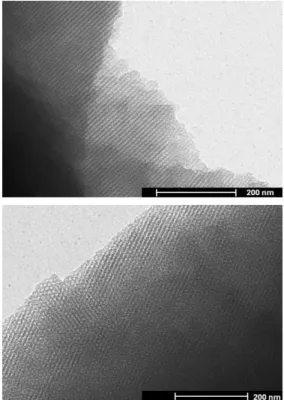
TEM image of SBA-16 structure was shown in Fig.
1, it showed similar and typical TEM image of SBA-16 [10] indicating the three-dimensional porous (body-centered cubic) of SBA-16.
Figure 1. TEM images of SBA-16 structure
Surface areas, pore volume, and average pore
diameter of SBA-16 and catalyst were characterized by
N
2absorption/desorption isotherms. The results were
shown in Table 1. The supported catalyst showed low surface area comparing to its SBA-16 template. The pore size distributions for SBA-16 and catalyst were shown in the Fig.2. An addition of titanium and BuMgCl caused a decrease in pore volume and pore size of the catalyst however the narrow pore size distribution was still obtained. The results indicated that the Ti was immobilized on the mesopore surface of SBA-16.
Table 1. Structure parameters for support and catalyst
Sample S
BETa(m
2g
-1) V
pb(mLg
-1) d
pc(nm)
SBA-16 205 0.24 4.7
Catalyst 150 0.30 8.0
S
BETis BET specific surface area; V
pis specific pore volume; d
p, is pore diameter;
adata fromBET equation;
bdata from adsorption;
cdata from BJH calculation
Figure 2. BJH pore size distributions of SBA-16 and catalyst
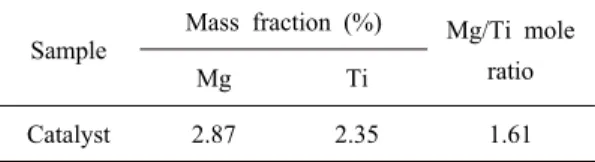
The result of loading titanium and magnesium in the MgCl
2/SBA-16/TiCl
4catalyst was determined by AES-ICP measurement, shown in Table 2. Mg/Ti mole ratio for MgCl
2/SBA-16/TiCl
4catalyst was 1.61. The Mg/Ti ratio of nearly 2.0 was reported to be an optimum ratio for high polymerization activity [11].
Table 2. Ti and Mg contents of catalyst Sample
Mass fraction (%) Mg/Ti mole ratio
Mg Ti
Catalyst 2.87 2.35 1.61
3.2 Ethylene polymerization and characterization
3.2.1 FTIR Spectra of Polyethylene
The FTIR spectra of the polyethylene were shown in Fig. 3. Spectra (a)-(d) showed polyethylene at different Al/Ti mole ratios.
Figure 3. FTIR spectra of ethylene at different Al/Ti (a) 40, (b) 80, (c) 160, (d) 250
It revealed two sharp peak at 2850-2960 cm
-1(C-H streching of CH
2) and 1462-1471 cm
-1(C-H bending of CH
2) which proved to be Polyethylene.
3.2.2 Thermal Behaviors
The TGA thermograms of polyethylene at different
Al/Ti mole ratios were shown in Fig. 4. Polyethylene
degraded at 200-600 °C. A broad degradation arised
from a broad molecular weight distribution of
polyethylene product. With an increasing TEA
concentration, degradation temperature was steep. This
may result from a narrow molecular weight distribution
of polyethylene product.
Figure 4. TGA thermograms of Polyethylene with different Al/Ti mole ratios.
3.2.3 Effect of TEA concentration on catalytic activity and properties of polyethylene.
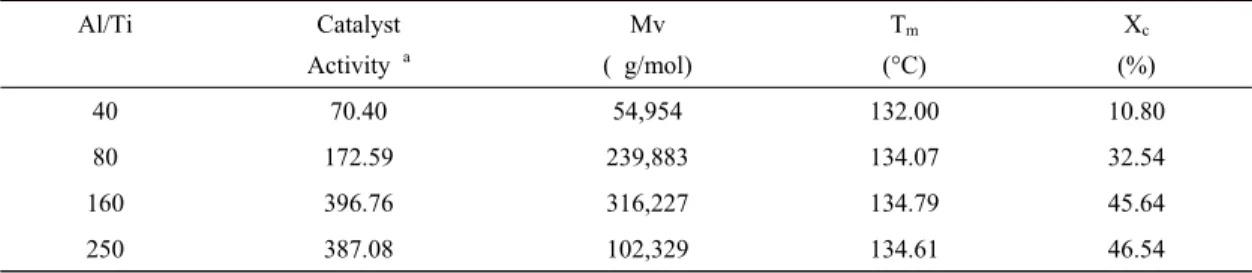
Activity of MgCl
2/SBA-16/TiCl
4catalyst was shown in Table 3. The Al/Ti ratio of 160 yielded the highest activity. The catalytic activity increased with an increasing TEA concentration. This due to the fact that TEA was eliminating impurity in the polymerization system. However, at higher concentration of TEA, Ti
4+was over-reduced to Ti
2+resulting in a lower active site and lower activity.
Polyethylene with high molecular weight of 316,227 g/mol, high crystallinity of 46% and high melting point of 135 °C were obtained when using MgCl
2/SBA-16/TiCl
4catalyst. They could be explained by a restrain of Ti active site within a small cavity of
SBA-16 mesopores, hence preventing a chain transfer of polymer in polymerization process.
3.2.4 Morphology of polyethylene
The morphology of polyethylene obtained with various Al/Ti mole ratios were observed by scanning electron microscope and shown in Fig. 5. All samples showed similar nanofibrous morphology. This due to a controlled direction and dimension of polyethylene chains propagation [11].
4. Conclusions
The nanofibrous and high molecular weight polyethylene was successfully synthesized using MgCl
2/SBA-16/TiCl
4catalysts under atmospheric pressure and TEA as cocatalyst. The high activity of 396.76 kg PE/molTi.h.atm was obtained from the optimum Al/Ti mole ratio of 160. The molecular weight was 316,227 g/mol. Melting point of the obtained polymer was in the range of 132-135 ºC and the highest degree of crystallization was 46%.
Acknowledgements
The authors appreciate the Center of Excellence for Innovation in Chemistry (PERCH-CIC) and the Materials Chemistry Research Unit for financial
Al/Ti Catalyst
Activity
aMv ( g/mol)
T
m(°C)
X
c(%)
40 70.40 54,954 132.00 10.80
80 172.59 239,883 134.07 32.54
160 396.76 316,227 134.79 45.64
250 387.08 102,329 134.61 46.54
a