
인공관절용 초고분자량폴리에틸렌의 가교결합 공정변수와 기계적 특성과의 상관관계
김현묵 † ․김성곤 * ․이종대 ** ․윤인식 ***
Relationship between Crosslinking Processes and Mechanical Properties of UHMWPE for Artificial Joint
H. M. Kim, S. K. Kim, J. D. Lee, I. S. Yun
Key Words: UHMWPE(초고분자량폴리에틸렌), Artificial Joint(인공관절), Liner(라이너), Gamma-ray(감마선), Crosslink(가교결합)
Abstract
Various mechanical test were conducted on conventional and crosslinked ultra-high molecular weight polyethylene(UHMWPE) all prepared from the same lot of medical grade GUR 1050 for artificial joint. The conventional materials were not irradiated and treated by heating. The cosslinked materials were irradiated with 25kGy~200kGy by gamma-ray andthen annealed or remelted. Gamma-ray irradiation and heat treatment process were found to significantly impact the crystallinity, and hence the mechanical behavior, of the highly crosslinked UHMWPE. The radiation dose and heating conditions were key predictors of the uniaxial yielding, plastic flow, and failure properties of conventional and highly crosslinked UHMWPE. The correlation model from experiments would be the basic information to enhance the were resistance of artificial joint liner.
1. 서 론
초고분자량 폴리에틸렌(UHMWPE;ultra-high molecular weight polyethylene)은 1960년대부터 인공관절과 같은 정형외과 의료기기의 라이너로 사용되고 있으며 [1], 최근에는 방사선과 열처리를 통해 가교결합 을 달리하여 UHMWPE 라이너의 기계적 특성을 향상시키는 연구가 진행되고 있다[2].
UHMWPE에 감마선을 조사하면 기계적 특성이 달리 나타나게 된다[3]. 이러한 원인은 UHMWPE 의 미세조직에서 결정도를 향상시키는 crystalline lamella와 tie molecular가 증가되기 때문이다[4].
그러나 이러한 미세조직의 변화는 Fig. 1과 같이
†
회원, (주)오티스바이오텍 인공관절연구소 E-mail : [email protected] TEL : (031)319-0406 FAX : (031)411-1076 * 고려대학교 의과대학 정형외과** 경기공업대학 정밀기계과 *** 경기공업대학 메카트로닉스과
탄소의 가교결합과 함께 분자단위의 수소가 프리 래디컬(free radical)로 발생된다. UHMWPE 조직 내부에 존재하는 프리래디컬은 주위 산소와의 반 응을 촉진시켜 UHMWPE가 산화되는 원인이 된 다. 따라서 장시간 산화반응이 지속되면 재료가 부스러지는 현상이 나타나게 된다. 이러한 산화 반응은 UHMWPE의 마모저항성을 크게 떨어뜨릴 뿐만 아니라 기계적 성질을 감소시키게 된다.
Free Radical
Fig. 1 Mechanism of cross‐linked UHMWPE and occurring free radicals
대한기계학회 2008년도 추계학술대회 논문집
따라서 프리래디컬을 감소 또는 제거하기 위한 다양한 연구가 진행되고 있으며, 대표적인 방법 으로 아닐링이나 리멜팅과 같은 열처리가 적용된 다. 따라서 본 연구에서는 100kGy로 감마선 조사 된 UHMWPE를 열처리 조건을 달리하고 기계적 특성변화를 정량적으로 평가하고자 한다.
2. UHMWPE의 아닐링과 리멜팅
Fig. 2는 인공관절을 생산하고 있는 해외업체의 열처리 방법을 대략적으로 나타내고 있다. 그림 에서와 같이 감마선이나 전자빔을 조사한 후에 프리래디컬을 감소 또는 제거시킬 목적으로 어닐 링(annealing)이나 리멜팅(remelting)과정과 같은 열 처리를 수행하게 된다. 일반적으로 감마선 조사 된 UHMWPE를 어닐링하면 약간의 기계적 성질 이 감소하게 되고 프리레디컬(free radical)의 양은 급격히 감소하는 반면, 리멜팅은 프리래디컬을 완전히 제거할 수는 있으나 기계적 성질이 상당 히 떨어지게 된다[4].
일반적으로 UHMWPE의 용융점은 135℃이며, 용융점 아래에서 수행되는 열처리를 어닐링이라 하고 용융점 이상에서 수행되는 열처리는 리멜팅 이라 한다. Table 1은 실험에 적용된 열처리 조건 을 나타낸다.
100kGy에서 감마선 조사된 UHMWPE Rod를 90~160℃까지 2시간 동안 열처리하였다.
UHMWPE의 용융점이 약 135℃ 정도이므로 90℃
부터 130℃의 범위는 어닐링 조건에 해당되고, 140~160℃범위는 리멜팅 조건이 된다.
Fig. 2 Comparison of starting stock materials and processing conditions used to produce contemporary thermally treated and highly crosslinked UHMWPE materials for TKA and THA[1]
Table 1 Heat treatment conditions of UHMWPE
Irradiation dose Time Duration
Temperature [℃]
Heat Treatment Type
100kGy 2hours
90
Annealing 100
110 120 130 140
Remelting 150
160
열처리를 위해 Convection Oven(DCF‐150L)이 이용되었으며, 열처리된 후 기계가공으로 각각의 인장시험편과 경도시험편을 제작하였다.
3. UHMWPE의 기계적특성 시험
3.1 시료 및 시험편
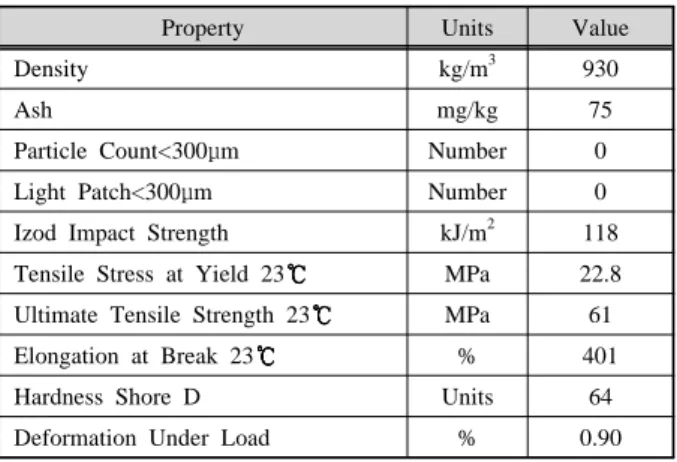
사용된 UHMWPE는 영국의 Orthoplastics社에서 Extruded Rod형태로 제조된 의료용 등급의 GUR1050으로 기본적인 물성은 Table 2와 같다.
(주)소야그린텍의 감마선 조사센터에서 Co-60의 선원으로 100kGy로 조사된 후 열처리 공정 변화 에 따른 기계적 특성변화를 평가하기 위해 Virgin 재료를 열처리 후에 Fig. 3과 같이 인장시험편과 압축시험편으로 기계 가공하였다. UHMWPE에 조사되는 방사선은 전자파 에너지로서 태양광선, 마이크로웨이브, X선과 같은 종류의 방사선으로 강력한 투과력을 이용하여 제품 내부의 유해한 미생물이나 해충을 멸균하는데 이용되고 있다.
Table 2 Material properties of GUR1050
Property Units Value
Density kg/m
3930
Ash mg/kg 75
Particle Count<300μm Number 0
Light Patch<300μm Number 0
Izod Impact Strength kJ/m
2118
Tensile Stress at Yield 23 MPa 22.8
Ultimate Tensile Strength 23 MPa 61
Elongation at Break 23 % 401
Hardness Shore D Units 64
Deformation Under Load % 0.90
Base on ASTM D 638-03
W, width of narrow section = 3.18±0.03mm L, length of narrow section = 9.53±0.08mm W0, width of overall = 9.53±3.18mm L0, length of overall = 63.5mm(no max.) G, gage length = 7.62±0.02mm D, distance between grips = 25.4±5mm R, radius of fillet = 12.7±0.08mm T, thickness of the specimen = 2mm


![Fig. 8 Effect of temperatures on hardness[HRR]](https://thumb-ap.123doks.com/thumbv2/123dokinfo/5197977.352474/4.892.106.425.475.711/fig-effect-of-temperatures-on-hardness-hrr.webp)