Particle and Aerosol Research
Part. Aerosol Res. Vol.11, No. 3: September 2015 pp. 87-92 http://dx.doi.org/10.11629/jpaar.2015.11.3.087
Polymerization of Polyethylene Using Bimodal TiCl
4/MgCl
2/SBA-15/MCM-41
Mattanawadee Moonyakmoon, Sujitra Klinsrisuk and Choosak Poonsawat*
Materials Chemistry Research Center, Department of Chemistry, Faculty of Science, Khon Kaen Universit (Received 3 August 2015; Revised 21 September 2015; Accepted 21 September 2015)
Abstract
MCM-41 (Mobil Composition of Matter) and SBA-15 (Santa Barbara Amorphous) were used as a supported catalyst for ethylene polymerization due to their combination of large surface area and wide range of pore size distribution.
The morphology of supports was used to control the morphology of the resulting polymer. Different molar ratios of Al/Ti were used for ethylene polymerization at 60℃ under atmospheric pressure. The effect of different mass ratios of MCM-41/SBA-15 and 1-hexene concentration on polymerization activity and polymer properties was investigated.
The catalytic activity and the crystallinity reached the highest value at Al/Ti of 480. Upon incorporation of MCM-41 and SBA-15 into MgCl2/TiCl4 catalyst, the molecular weight and crystallinity of polyethylene were enhanced. The obtained polyethylene showed melting temperature between 130 and 135℃. The polyethylene with replication structure of support and bimodal MWD was expected.
Keywords:Ethylene polymerization, MCM-41 and SBA-15, Bimodal MWD, Ziegler-Natta catalyst.
* Corresponding author.
Tel:+66-8961-7773-9, E-mail:[email protected]
1. Introduction
Today, materials for packaging, films, house-wares, coating and electronics are mainly made by plastics.
Polyethylene (PE) has a basic and common structure, chemical stability and wide range of physical properties that made it suitable for broad applications. These prop- erties are good chemical resistance, non-toxicity, bio-ac- ceptability, good physical and mechanical properties, low cost, good raw material availability and low environ- mental impact.
The most widely used Ziegler-Natta (ZN) catalysts for ethylene polymerization with a high performance and high catalytic activity was Mg-based catalyst. MgCl2 was used to enhance catalytic activity of ZN catalyst system.
Other porous materials, such as mesoporous molecular sieves, having well-defined pore structures with narrow pore size distributions, was also reported as a potential ethylene polymerization catalysts. Mesoporous silicates, such as Mobil Composition of Matter(MCM-41) and Santa Barbara Amorphous (SBA-15), have hexagonal or- dered pores forming an array of uniform mesopores (2–
50 nm). The geometrical structure of the nanochannels can serve as nanoscale polymerization reactors to affect the pattern of a monomer insertion and to control poly- mer chain structure and morphology[Patthamasang S. et al. (2011)-Kageyama K. et al. (1999)].
The properties and applications of polymers are main- ly dependent on their microstructures. Mechanical and rheological properties of polymers depend on molecular weight (MW) and molecular weight distribution (MWD).
Polyethylene with bimodal molecular weight (BMPE) distribution has advantages over general polyethylene on good mechanical properties, processability, toughness and stiffness. PE with bimodal MWD has both high and low molecular weight fractions. The obtained PE with high MW has strength and toughness and PE with low MW has good flow and extrudability.
Generally, BMPE is synthesized by two methods: i.
cascade process, ii. batch process using a single or hy- brid catalytic system. Most researchers choose method ii to prepare BMPE because of its high efficiency and low
cost [Zhao Y. et al. (2014)].
In this research, synthesis of bimodal ethylene using TiCl4/SBA-15/MCM-41wasstudied.Bimodalsupportprepa redbysolidandsolutionmixingofSBA-15andMCM-41wasi nvestigated.The effect of cocatalyst and 1-hexene con- centration on catalytic activities, molecular weight, mo- lecular weight distributions, transition temperature, crys- tallinity and morphology of the resulting polyethylene was investigated. Broad MWD or bimodal MW of PE, resulting from bimodal catalyst was investigated.
2. Methodology
2.1 Materials
Ethylene gas was purified before using by sequentially passing through columns of molecular sieve and KOH.
Nitrogen gas (technical grade 99.999%) and n-hexane (Qrec) were used for catalyst preparation and ethylene polymerization. 1-hexene (Aldrich) was used as a comonomer. TiCl4 (Aldrich), TEOS (Merck), CTAB (APS), Pluronic P123 (Aldrich), NH4OH (CarloErba), NaCl (CarloErba), HCl (CarloErba), BuMgCl (Aldrich) and TIBA (Aldrich) were used with out purification.
2.2.1 Preparation of mesoporous supports
MCM-41 was synthesized according to the procedure described by Melendez-Ortiz H.I. et. al [Melendez-Ortiz H. I. (2012)]. CTAB was dissolved in DI water before an addition of ethanol and ammonia solution. TEOS was then added slowly into the solution under stirring for 3 h at room temperature. The obtained product was fil- trated and dried at room temperature overnight. The CTAB template was removed from material by calcina- tion at 550℃.
SBA-15 was synthesized according to the procedure described by Sayari A. et. al [Sayari, A. and Yang, Y.
(2005)]. Pluronic P123 and NaCl were dissolved in HCl and distilled water at 35℃ and kept overnight under stirring. After that, TEOS was added slowly into the sol- ution under stirring and maintained for 8 minute. The system was then stopped and kept under static condition
for 48 h. The obtained product was filtrated and dried at 80 ℃ overnight. The template was removed from ma- terial by calcination at 550℃.
2.2.2 Preparation of bimodal mesoporous supports The bimodal support, Bimodal1, was prepared by mixing of MCM-41 and SBA-15 solid with a mass ra- tio of 1:1.
The bimodal support, bimodal2, was prepared by com- bination of MCM-41 and SBA-15 solution according to the procedure described by Mareno J. et al [Moreno J.
et al. (2011)]. CTAB was dissolved in DI water at room temperature under stirring. TEOS was then added drop- wise into the solution. Pluronic P123 was dissolved in HCl at room temperature under stirring. The solution was heated up to 40 ℃ and TEOS was then added dropwise. Both CTAB and Pluronic P123 solutions were maintained under stirring at 40 ℃ for 20 h before mix- ing and the solution gel was kept under static condition at 110 ℃ for 36 h. The obtained product was filtrated and kept at room temperature overnight. The CTAB and Pluronic P123 templates were removed by calcination at 550 ℃.
2.2.3 Preparation of supported Ziegler-Natta catalysts The supported catalyst was carried out in Schlenk flask, equipped with a mechanical stirrer and a temper- ature controller. The slurry of support and n-hexane was stirred for 30 min under nitrogen atmosphere. BuMgCl was added to the solution and heated up to 50 ℃, stirred for 4 h. The solution was washed by n-hexane for three times. TiCl4 was slowly added into the solution, stirred for 1 h under nitrogen atmosphere. After that, TEA was added to the solution and stirred for 3 h [Zohuri G. et al. (2003)]. The supported catalyst was filtrated and washed by n-hexane for three times. The obtained prod- uct was kept under nitrogen atmosphere for further polymerization. In this work, two catalyst systems were investigated. One is ZN catalyst using bimodal1 support (BC-1), another is that using bimodal2 (BC-2)
2.2.4 Polymerization of ethylene.
Ethylene polymerization was carried out in a closed reactor equipped with 120 mL n-hexane, a mechanical stirrer and a temperature controller under atmospheric pressure at 60℃. Cocatalysts (TMA and TIBA) were added to the system. 1-hexene was used as a como- nomer. After 1 h of polymerization, reaction was quenched with ethanol. The obtained polymer was fil- trated and dried under vacuum to give a constant weight.
2.3 Characterization of support, catalyst and PE Contents of titanium, magnesium and aluminum in the supported catalysts were determined by AES-ICP using an Optima 4300 DV.
Thermal stability and decomposition of polyethylene were determined by thermal gravimetric analysis (TGA), Perkin-Elmer Pyris Diamond TG/DTA under N2atmos- pherefrom50-800℃withaheatingrateof10℃/min.
Thermal transition of polymer samples was carried out by DSC PerkinElmer, Pyris I. The samples were heated between 50-200 ℃ with a heating rate of 10 ℃/min un- der N2atmosphere.Themeltingpoint(Tm) was obtained from the thermograms.
The molecular weight of polyethylene was determined by Ubbelohde viscometer using decahydronaphthalene at 135 ℃ as a solvent.
The morphology of catalyst and polymer was observed by scanning electron microscopy (LEO 1450VP).
3. Results and Discussions
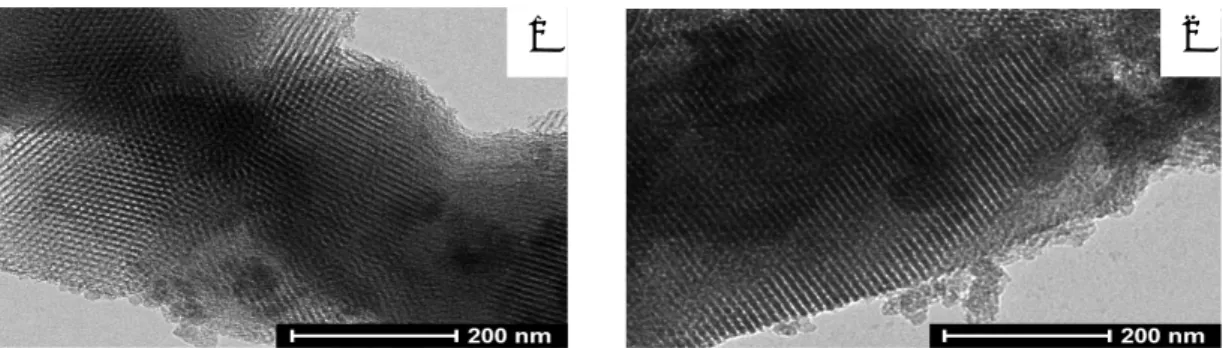
3.1 Characterization of supports and catalysts Fig. 1. presents TEM images of bimodal1 (a) and bi- modal2 (b) mesoporous material. It indicates an obvious ordered hexagonal of parallel silica tube and hexagonal unit cell. Higher degree of ordered structures was found in bimodal1 than bimodal2. Results were similar to that reported by Moreno J. et al[Moreno J. et al. (2011)]. It confirms that bimodal porous can be prepared via both
a b
Fig. 1. Transmission electron micrographs of bimodal supports (a) bimodal1 (b) bimodal2.
Catalyst Al/Ti 1-hexene
(mol/L)
Polymerization Activity (kgPE·(molTi·atm·h)-1))
Mv
(g/mol)
Tmb (℃) BC-1
BC-2
35 70 70 140 360 480 480
0 0 0 0 0 0 0.08
3.66 5.56 7.20 15.07 19.43 24.89 17.85
Not detected Not detected
58,613 61,801 46,666 88,512 32,877
Not detected Not detected
133.16 132.67 133.34 133.00 129.00 Table 2. Effect of TIBA and 1-hexene concentration on polymerization activity, MW and Tm of PE.
methods.
Sample Mass fraction (%) Mg/Ti mole ratio
Mg Ti
BC-1 BC-2
13.18 7.03
0.05 0.57
0.07 0.16 Table 1. Ti and Mg contents of BC-1 and BC-2.
The contents of titanium, magnesium and aluminum in BC-1 and BC-2 were determined by ICP-AES meas- urements and results were listed in Table 1. Mg/Ti ratios of BC-1 and BC-2 were 0.07 and 0.16 respectively.
3.2 Ethylene polymerization and PE characterization
3.2.1 Effect of Al/Ti molar ratio on activity Ethylene polymerization was carried out using BC-1 and BC-2 catalyst and TIBA as cocatalyst. Results in Table2 showed that polymerization using BC-2 had high- er catalytic activity than BC-1. It indicated that higher Al/Ti molar ratio give higher activities. Some researchers reported that high activities can be carried out using
Mg/Ti ratio of up to 2 with an activity of 830 kgPE/gTi.h.[Kim I. et al. (1990), Li D. et al. (2012)]
3.2.2. Effect of TIBA concentration
Table 2 shows that polymerization activities of BC-1 and BC-2 increased with an increasing Al/Ti ratio. BC-2 gave the highest activities of 24.89 kgPE/molTi·atm·h with Al/Ti ratio of 480. Due to the large amount of TIBA used, resulting in an excess built-up pressure in the reactor, the researchers decided not to carry out a polymerization using TIBA of more than 480 in Al/Ti ratio. It was found that the excessive amount of Al will eventually reduce polymerization activities. TIBA can re- duce Ti4+toTi2+causingadeactivationofcatalyst.
MW of PE using BC-2 catalyst increased with an in- creasing Al/Ti ratio. MW of PE reached the highest val- ue of 88,512 g/mol with Al/Ti ratios of 480.
3.2.3 Effect of 1-hexene concentration
Results in Table 2 show that upon an addition of 1-hexene caused a reduction in polymerization activities,
a b
c d
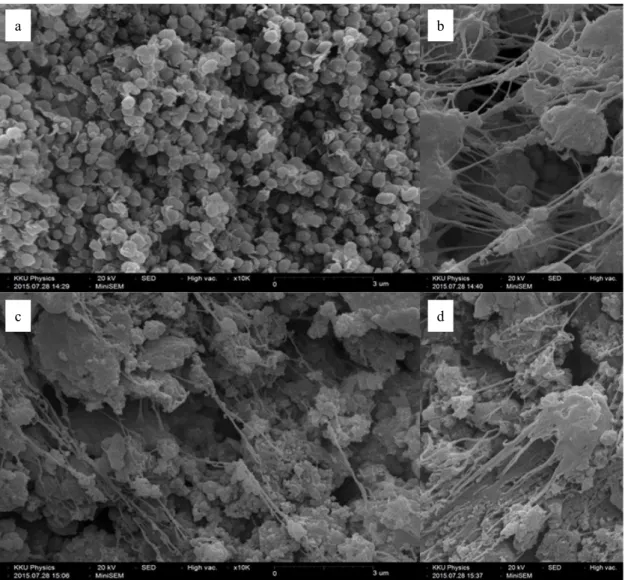
Fig. 2. SEM pictures of polyethylene using BC-1 and BC-2 catalyst with different Al/Ti mole ratios; (a) BC-1, Al/Ti = 70, (b) BC-2, Al/Ti = 70, (c) BC-2, Al/Ti = 480, (d) BC-2 with 1-hexene, Al/Ti = 480 MW and Tm of PE. 1-hexene promoted irregularity of
chain branching, hence Tm was reduced significantly. PE polymerized using bimodal (BC-1 and BC-2) catalysts showed higher activity than unimodal support in both homopolymerization and copolymerization. Mareno J.et.al reported a high activity of 9 x 10⁶gPE/molZr.h when bimodal catalyst was used.[Moreno J. et al. (2011)]
3.3 Morphology of PE
Fig. 2. shows morphology of PE using BC-1 and BC-2 catalysts using SEM. It was observed that BC-2 showed
fibrous structure of PE, while BC-1 showed a uniform and rounded structure. It may presume that propagation of PE into a small and ordered hexagonal tube was high- ly controlled. Addition of 1-hexene also produced fi- brous structure of PE.
4. Conclusions
Polyethylene was successfully synthesized using bi- modal TiCl4/MgCl2/SBA-15/MCM-41 and TIBA as cocatalyst. Catalysts (BC-1), prepared by mixing of solid
SBA-15 and MCM-41 possess an orderly hexagonal structure, yielding a highly controllable and rounded PE.
Whereas catalysts (BC-2) prepared by mixing of solution SBA-15 and MCM-41 yielded fibrous structure PE with higher MW. The obtained polyethylene using BC-2 with Al/Ti ratio of 480 gave the highest activity and MW of 24.89kgPE/molTi.atm.h and 88,512 g/mol respectively.
Addition of 1-hexene promoted irregularity of chain branching, hence Tm of PE was reduced significantly.
Acknowledgements
This work was supported by the Materials Chemistry Research Center, Department of Chemistry, Faculty of Science, Khon Kaen University, Khon Kaen, Thailand.
The authors would also like to thank the Thai Polyethylene Co.,Ltd., SCG Chemical Co.,Ltd. for the TiCl4 and TEA chemicals.
Reference
Kageyama K. et al. (1999). Extrusion polymerization: cata- lyzed synthesis of crystalline linear polyethylene nanofibers within a mesoporous silica. Science, 285, 2113-2115.
Kim I. et al. (1990). Kinetic study of ethylene polymer- ization by highly active silica supported TiCl4/MgCl2catalysts.J.Appl.Polym.Sci, 39, 837-854.
Li D. et al. (2012). Nanofibrous ultrahigh molecular weight polyethylene synthesized using TiCl4 as catalyst supported on MCM-41 and SBA-15. Polym.
Bull, 68, 1565-1575.
Melendez-Ortiz H. I. (2012). Preparation of spherical MCM-41 molecular sieve at room temperature:
influence of synthesis conditions in the structural properties. Ceram. Int, 38, 6353-6358.
Moreno J. et al. (2011). Ethylene polymerization by metal- locene catalysts supported over siliceous materi- als with bimodal pore size distribution.
Macromol. Symp, 302, 198-207.
Paredes. B. et al. (2011). Ethylene/1-hexene copolymers
produced with MAO/(nBuCp2)2ZrCl2supportedonSBA-15mate
rialswithdifferentporesizes.Macromol.Chem.Ph ys, 212, 1590-1599.
Patthamasang S. et al. (2011). Synthesis of ultrahigh molec- ular weight polyethylene using traditional hetero- geneous Ziegler-natta catalyst system.
Molecules, 16, 8332-8342.
Sayari, A. and Yang, Y. (2005). SBA-15 templated meso- porous carbon: new insights into the SBA-15 pore structure. Chem. Mater, 17, 6108-6113.
Zhao Y. et al. (2014). Facile preparation of bimodal poly- ethylene with tunable molecular weight dis- tribution from ethylene polymerization catalyzed by binary catalytic system in the presence of diethyl zinc. J. Polym. Res, 21, 470.
Zohuri G. et al. (2003). Slurry polymerization of ethylene using bisupported ziegler-natta catalyst of SiO2/MgCl2(EthoxideType)/TiCl4/TEASystem.I ran.Polym.J,12,31-36.