Article https://doi.org/10.14478/ace.2018.1052
1)
1. Introduction
Metallocene catalysts are single-site catalysts that form one active site per catalyst particle; these active sites have identical properties.
However, due to instability of the catalyst during polymerization, de-
† Corresponding Author: Kongju National University, Department of Chemical Engineering, Chungnam 31080, Korea Tel: +82-10-6412-1469 e-mail: [email protected]
pISSN: 1225-0112 eISSN: 2288-4505 @ 2018 The Korean Society of Industrial and Engineering Chemistry. All rights reserved.
crease in catalytic activity and fouling of the reactor may occur. To address this, metallocene catalysts were heterogenized through immobi- lization on supports such as silica, alumina, magnesium compounds, cyclodextrin, and polymers[1,2]. For olefin polymerization, MgCl 2 and SiO 2 are mainly used.
In the case of supported catalyst, the activity and mechanical proper- ties of the supported catalyst are affected by the chemical composition and particle shape of the support[3,4]. Recrystallization of MgCl 2 by dissolving it in alcoholic hydrocarbon improves the polymerization ac-
SiO 2 /MgCl 2 이원 담체에 담지된 (n-BuCp) 2 ZrCl 2 합성과 에틸렌-1-헥센 공중합
안채리시 카리니요⋅박상준⋅고영수
†
공주대학교 화학공학과
(2018년 5월 9일 접수, 2018년 5월 16일 심사, 2018년 5월 16일 채택)
Preparation of (n-BuCp) 2 ZrCl 2 Catalyst Supported on SiO 2 /MgCl 2 Binary Support and its Ethylene-1-hexene Copolymerization
Ann Charise Cariño, Sang Jun Park, and Young Soo Ko †
Department of Chemical Engineering, Kongju National University, Chungnam 31080, Korea (Received May 9, 2018; Revised May 16, 2018; Accepted May 16, 2018)
초 록
본 연구에서는 (n-BuCp) 2 ZrCl 2 를 SiO 2 /MgCl 2 이원 지지체에 담지시켰다. 촉매를 담지하기 전, SiO 2 /MgCl 2 이원 지지체
를 3종의 알킬알루미늄 화합물, 트리메틸알루미늄, 트리에틸알루미늄 또는 에틸알루미늄 세스퀴클로라이드로 표면
처리 하였다. 합성된 표면 처리된 SiO 2 /MgCl 2 에 담지된 메탈로센 촉매로 에틸렌 및 1-헥센의 공중합을 하였다. 촉매 특성 및 성능을 BET, XPS 분석, ICP-AES 분석 및 FE-SEM을 통해 비교 분석하였다. 생성된 공중합체를 DSC 분석, GPC 분석, 13C-NMR 분석 및 FE-SEM을 통해 비교 분석하였다. 합성된 SiO 2 /MgCl 2 담지된 메탈로센 촉매의 분석은 이들 촉매의 Zr 함량이 SiO 2 에 담지된 촉매에 비해 상대적으로 낮다는 것을 보여 주었다. 이것은 재결정된 MgCl 2 및 알킬알루미늄의 존재로 인한 SiO 2 의 표면적 감소에 기인할 수 있다. 또한, SiO 2 /MgCl 2 담지된 메탈로센 촉매는 SiO 2 에 담지된 메탈로센 촉매보다 활성이 높았으며 이 중 EASC-표면 처리 이원 지지체에 담지된 메탈로센촉매가 1.9 kg PE/(mmol-Zr*hr)의 가장 높은 활성을 보였다. 이것은 EASC가 강한 루이스 산으로 작용하기 때문이다. 또한, 사용된 알킬알루미늄의 리간드가 클수록 생성된 중합체의 입자 표면이 더 거칠었다.
Abstract
In this study, (n-BuCp) 2 ZrCl 2 , was supported on SiO 2 /MgCl 2 binary support. Before supporting the catalyst, the SiO 2 /MgCl 2
binary support was surface treated with three different alkyl aluminum compound, namely trimethylaluminum, triethylalumi- num, and ethylaluminum sesquichloride. The synthesized surface-treated SiO 2 /MgCl 2 supported metallocene catalysts were used for the copolymerization of ethylene and 1-hexene. Their catalytic properties and performances were analyzed through BET, XPS analysis, ICP-AES analysis, and FE-SEM. While the resulting copolymers were analyzed through DSC analysis, GPC analysis, 13C-NMR analysis, and FE-SEM. The analysis of synthesized surface-treated SiO 2 /MgCl 2 supported metal- locene catalysts showed that the Zr content of these catalysts is relatively lower compared to that of the catalyst supported on SiO 2 . This could be attributed to the reduction in the surface area of SiO 2 due to the presence of recrystallized MgCl 2
and alkyl aluminum. Furthermore, they exhibited a better copolymerization activity compared to that of SiO 2 supported cata- lyst, particularly the EASC-surface treated binary support, which has the highest activity of 1.9 kg PE/(mmol-Zr*hr) because EASC acts as a strong Lewis acid. It could also be observed that the larger the ligand of alkyl aluminum used, the rougher the particle surface of the resulting polymer.
Keywords: metallocene catalyst, SiO 2 /MgCl 2 binary support, alkyl aluminum, ethylene copolymerization
tivity of the catalyst through changes in its chemical composition and crystal structure. On the other hand, SiO 2 is advantageous in that it has a spherical shape with a large surface area[5]. To combine the advan- tages of these two supports, binary support was synthesized by re- crystallizing MgCl 2 into a hydrocarbon solution and then supporting it on SiO 2 . Sensarma et al. reported that when a Zr- or Ti-based metal- locene catalyst supported on a binary support synthesized with MgCl 2
and SiO 2 dissolved in THF then subjected to ethylene polymerization, a higher activity and a narrower molecular weight distribution than the catalysts supported on MgCl 2 or SiO 2 was observed[6]. Patthamasang et al. synthesized a SiO 2 /MgCl 2 /TiCl 4 catalyst by dissolving MgCl 2 in various molar ratios of [EtOH]/[MgCl 2 ]. The catalyst with [EtOH]/[MgCl 2 ] molar ratio 7 has high activity, large surface area and spherical particles[5]. Cho et al. synthesized a hybrid catalyst with metallocene catalyst and a Ziegler-Natta catalyst supported on either MgCl 2 or SiO 2 . This hybrid catalyst has two active sites and can pro- duce polymer blends, and it is reported that MW and MWD can be controlled by changing the ratio of metallocene catalyst to Ziegler-Natta catalyst[7].
In this study, metallocene catalyst was supported on SiO 2 /MgCl 2 bi- nary support. SiO 2 /MgCl 2 binary support was synthesized by dissolving in the molar ratio of [EtOH]/[MgCl 2 ] then supporting on SiO 2 . After surface treatment with various alkyl aluminum compounds, metallocene catalyst was loaded on the synthesized binary support. The synthesized bi-supported metallocene catalyst were compared and analyzed accord- ing to the kind of alkyl aluminum compound used in the surface treat- ment and was used on ethylene polymerization and ethylene-1-hexene copolymerization.
2. Experimental Method
2.1. Reagents
All experiments were carried out in a nitrogen atmosphere using schlenk technique. Magnesium chloride (MgCl 2 , Aldrich) was used without any additional treatment. Silica (SP948) was purchased from Grace Davision Company and calcined at 500 ℃ for 10 hours.
Heptane (Aldrich, 99%) and ethanol (Aldrich, 95%) used in MgCl 2 re- crystallization were used without further treatment. The metallocene cat- alyst bis-(n-butylcyclopentadienyl) zirconium dichloride ((n-BuCp) 2 ZrCl 2 , Aldrich) was used without further treatment. The structure of the met- allocene catalyst is shown in Figure 1. Trimethylaluminum (TMA,
Aldrich), triethylaluminum (TEAL, Aldrich), methylaluminoxane (MAO, Albemarle), ethylaluminum sesquichloride (EASC, Acros organics) were used without further processing. The structure and molecular weight of the alkyl aluminum compounds are shown in Table 1.
Ethylene (SK energy, Korea, 99.999%) and nitrogen (Air Products, Korea, 99.999%) were passed through Fisher REDOX Oxygen Removal Column and 5A/13X molecular sieve to remove moisture and oxygen. Toluene (J.T Baker) and hexane (J.T Baker), which were used as a solvent, were prepared by refluxing over sodium metal and benzo- phenone in a nitrogen atmosphere.
2.2. Catalyst synthesis
2.2.1. SiO 2 /MgCl 2 binary support synthesis
1 g of MgCl 2 was suspended in 10 mL of heptane then 4.3 mL of ethanol was added. After stirring at 89 ℃ for 1 hour, 2 g of SiO 2 sus- pended in 30 mL heptane at 89 ℃ was added. The reaction proceeded at 89 ℃ for 1 hour with vigorous stirring. After completion of the re- action, the reaction mixture was washed four times with heptane at 70
℃ then vacuum-dried at 40 ℃ for 1 hour to synthesize a SiO 2 /MgCl 2
binary support.
2.2.2. Surface treatment of binary support using alkyl aluminum compound
1 g of SiO 2 /MgCl 2 binary support was suspended in 30 mL of tol- uene, maintained at 0 ℃ with water and ice, and then an appropriate amount of cocatalyst alkyl aluminum compound was injected. The re- action proceeded with vigorous stirring at 0 ℃ for 2 hours. After com- pletion of the reaction, the catalyst was washed with toluene five times then vacuum dried at 40 ℃ for 1 hour to synthesize a SiO 2 /MgCl 2 / alkyl aluminum support.
2.2.3. Supporting the catalyst
1 g of SiO 2 /MgCl 2 /alkyl aluminum support was suspended in 30 mL of toluene then a solution of 0.35 mmol of (n-BuCp) 2 ZrCl 2 catalyst and Trimethylalumium Triethylalumium Ethylaluminum sesquichloride
Abb. TMA TEAL EASC
Molecularstructure
Molecularweight (g/mol) 72.09 114.16 247.51
Table 1. Property of Alkyl Aluminum Compounds
Figure 1. Structure of bis(n-butylcyclopentadienyl) zirconium dichloride
((n-BuCp) 2 ZrCl 2 ).
8 mmol of MAO was injected. The reaction proceeded at 70 ℃ for 3 hours with vigorous stirring. After completion of the reaction, the cat- alyst was washed five times with toluene and vacuum-dried at 40 ℃ for 1 hour to synthesize SiO 2 /MgCl 2 /alkyl aluminum/(n-BuCp) 2 ZrCl 2
catalyst.
2.3. Polymerization
The ethylene polymerization was carried out in a 500 mL high pres- sure steel reactor with a magnetic stirrer for stirring. 280 mL hexane and 2 mmol cocatalyst TEAL were injected into the reactor then tem- perature was increased to 70 ℃. A certain amount of catalyst was add- ed in a slurry state with 5 mL of hexane. The polymerization was ini- tiated with agitation after the reactor was saturated with monomers and a pressure of 7 bar was achieved. This pressure was maintained during the reaction. After polymerization, the resulting polymer was vacuum filtered, washed with ethanol, and dried. The concentration of ethylene and 1-hexene in the liquid phase of hexane was calculated by PRO/II.
2.4. Characterization
The surface area of the supports and catalysts used in the experi- ments was measured by Micromeritics ASAP 2010 instrument. The sample was dried before measurement and then outgassed under vac- uum at 150 ℃ for 12 hours. The surface area of the support was cal- culated by the BET (Brunauer-Emmett-Teller) equation. The binding energies of Mg and Zr supported on the support were measured by X-ray photoelectron spectroscopy (XPS). The Mg, Al, and Zr contents in the supported catalysts were measured by inductively coupled plas- ma atomic emission spectroscopy (Perkin-Elmer, Optima 200DV) respectively. The melting point of the resulting polymer was measured by differential scanning calorimetry (DSC, TA 2010) at a rate of 10
℃/min at 25 ℃ to 180 ℃ to obtain DSC curves. The comonomer con- tent of the copolymer was measured by 13 C-NMR (Bruker AMX-300 FT NMR spectrometer). The molecular weight and molecular weight distribution of the resulting polymer were determined by GPC (Waters Associates Chromatograph, Model ALC-GPC-150C) analysis. The par- ticle shape of the support, catalyst, and resulting polymer was observed through a Field Emission Scanning Electron Microscope (FE-SEM, TESCAN, MIRA LMH).
3. Results and Discussion
3.1. Characterization of support and supported catalyst
In this study, MgCl 2 suspended in heptane was dissolved in ethanol and supported on SiO 2 to synthesize SiO 2 /MgCl 2 binary support.
Surface treatment of the support with various alkyl aluminum com- pounds was carried out to investigate the influence of the type of alkyl aluminum compound to catalytic performance and copolymer properties. The molar ratio of [Al]/[EtOH] was fixed to 2. The TGA results of the synthesized binary supports and catalyst are shown in Figure 2. SiO 2 showed mass reduction before 125 ℃ due to the re- moval of CO 2 and H 2 O. On the other hand, 35.7% mass reduction for SiO 2 /MgCl 2 binary support was observed. This is due to the removal of residual ethanol present in the binary support. When MgCl 2 is re- crystallized with alcohol, the alcohol remaining in the support poisons the metallocene catalyst. Therefore, to prevent deactivation of the cata- lyst, it is necessary to remove the remaining alcohol in the support by introducing an appropriate alkyl aluminum compound[8,9].
Figure 3 shows the results of the XPS Mg 2p analysis of the SiO 2 /MgCl 2 binary support and the supported catalyst. The binding en- ergy of Mg 2p of MgCl 2 is known to be around 52.3 eV[10,11]. Mg 2p binding energies of SiO 2 /MgCl 2 binary support and supported cata- lysts ranged from 51.3 eV to 52.5 eV. The Zr 3d spectrum of (n-BuCp) 2 ZrCl 2 , a metallocene catalyst, is shown in Figure 4. The Zr binding energy peaks of (n-BuCp) 2 ZrCl 2 were found to be 184.7 eV (Zr 3d 5/2 ) and 182.3 eV (Zr 3d 3/2 ). Zr binding energy of the metal- locene catalyst supported on SiO 2 /MgCl 2 /alkyl aluminum was measured in the range of 183.0~185.9 eV (Zr 3d 5/2 ) and 185.3~185.9 eV (Zr 3d 3/2 ).
The Zr binding energy of the metallocene catalyst supported on SiO 2 /MgCl 2 /alkyl aluminum is slightly lower than the Zr binding en- ergy of (n-BuCp) 2 ZrCl 2 , which is the metallocene catalyst. This is due to the change in electronic environment.
Table 2 shows the results of BET and ICP analysis of SiO 2 /MgCl 2
binary support and supported catalyst. The SiO 2 /MgCl 2 binary support has less surface area, and pore volume and size compared to the con- ventional SiO 2 due to the presence of recrystallized MgCl 2 on it. It could also be seen that the surface area of the SiO 2 /MgCl 2 binary sup- port is reduced upon surface treatment with the alkyl aluminum com- Figure 2. TGA curves of (a) MgCl 2 , (b) SiO 2 , (c) SiO 2 /MgCl 2 , (d)
SiO 2 /MgCl 2 /TEAL and (e) SiO 2 /MgCl 2 /TEAL/(n-BuCp) 2 ZrCl 2 .
Figure 3. XPS Mg 2p spectra of (a) SiO 2 /MgCl 2 , (b) SiO 2 /MgCl 2 /
TMA and (c) SiO 2 /MgCl 2 /TMA/(n-BuCp) 2 ZrCl 2 .
pound and metallocene catalyst loading. Furthermore, ICP analysis shows that the Zr content of catalysts supported on SiO 2 /MgCl 2 /alkyl aluminum is relatively lower compared to the catalyst supported on
SiO 2 . This could be attributed to the reduction in surface area of SiO 2
due to the presence of recrystallized MgCl 2 and alkyl aluminum.
SiO 2 /MgCl 2 /TMA/(n-BuCp) 2 ZrCl 2 , which has larger surface area compared to most catalyst on SiO 2 /MgCl 2 /alkyl aluminum support, has more Al content and Zr content. Likewise, SiO 2 /MgCl 2 /TEAL/
(n-BuCp) 2 catalyst, which has the smallest surface area, has least Zr content. As shown in Table 2, SiO 2 /MgCl 2 /EASC/(n-BuCp) 2 catalyst has the highest Al content. This is because Al of EASC is strongly fixed to Cl and Mg-O-(Et).
Figure 5 shows the particle formation of SiO 2 /MgCl 2 binary support and catalysts. It could be seen that the catalyst has rough surface but retained the spherical morphology of SiO 2 . In the case of SiO 2 /MgCl 2
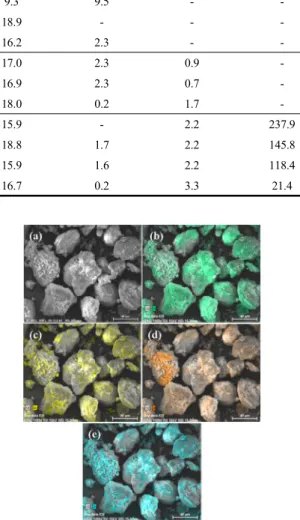
binary support, recrystallized MgCl 2 accumulates on the surface of SiO 2 . Through surface treatment with alkyl aluminum, agglomerated MgCl 2 on SiO 2 surface was removed. Figure 6 shows the distribution of Si, Mg, Al, and Zr atoms by SEM-EDX analysis of the supported Sample
BET analysis ICP analysis
Surface Area (m
2/g)
Pore Volume (cm
3/g)
Pore Size (nm)
Mg content (mmol/g-cat)
Al content (mmol/g-cat)
Zr content (µmol/g-cat)
MgCl
23 0.02 9.3 9.5 - -
SiO
2274 1.63 18.9 - - -
SiO
2/MgCl
2188 1.02 16.2 2.3 - -
SiO
2/MgCl
2/TMA 164 0.90 17.0 2.3 0.9 -
SiO
2/MgCl
2/TEAL 181 0.97 16.9 2.3 0.7 -
SiO
2/MgCl
2/EASC 214 1.34 18.0 0.2 1.7 -
SiO
2/(n-BuCp)
2ZrCl
2216 1.1 15.9 - 2.2 237.9
SiO
2/MgCl
2/TMA/(n-BuCp)
2ZrCl
2177 0.96 18.8 1.7 2.2 145.8
SiO
2/MgCl
2/TEAL/(n-BuCp)
2ZrCl
2154 0.78 15.9 1.6 2.2 118.4
SiO
2/MgCl
2/EASC/(n-BuCp)
2ZrCl
2208 1.17 16.7 0.2 3.3 21.4
Table 2. Physical Properties and Chemical Compositions of SiO 2 /MgCl 2 Supported Catalyst
Figure 4. XPS Zr 3d spectra of (a) (n-BuCp) 2 ZrCl 2 , (b) SiO 2 /MgCl 2 / TMA/(n-BuCp) 2 ZrCl 2 , and (c) SiO 2 /MgCl 2 /TEAL/(n-BuCp) 2 ZrCl 2 .
Figure 5. SEM images of (a) SiO 2 , (b) MgCl 2 , (c) SiO 2 /MgCl 2 , (d) SiO 2 /MgCl 2 /TEAL and (e) SiO 2 /MgCl 2 /TEAL/(n-BuCp) 2 ZrCl 2 .
Figure 6. SEM images and elemental distribution on SiO 2 /MgCl 2 /
TEAL/(n-BuCp) 2 ZrCl 2 ; (a) SEM image, (b) Si distribution, (c) Mg
distribution, (d) Al distribution and (e) Zr distribution.
catalysts. Al and Zr atoms are uniformly distributed on the Mg and Si surfaces. The process of supporting the metallocene catalyst on the SiO 2 /MgCl 2 binary support is shown in Figure 7.
3.2. Copolymerization Activity
The activity of the catalyst supported on the SiO 2 /MgCl 2 binary sup- port can be determined by the following equation: SiO 2 /MgCl 2 /TMA/
(n-BuCp) 2 ZrCl 2 > SiO 2 /MgCl 2 /TEAL/(n-BuCp) 2 ZrCl 2 > SiO 2 /MgCl 2 /EASC/
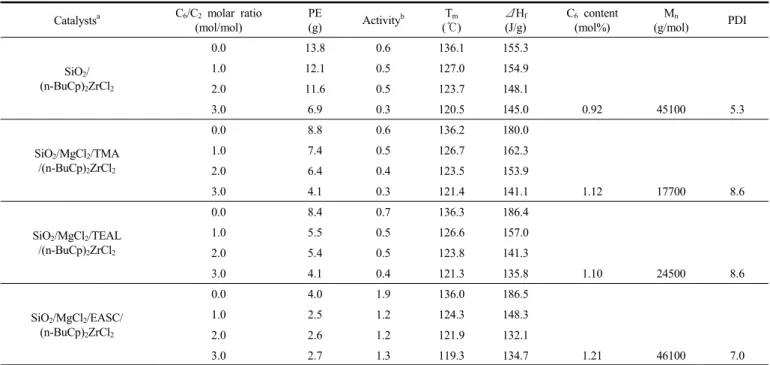
(n-BuCp) 2 ZrCl 2 . Alkyl aluminum compound used in the surface treat- ment of SiO 2 /MgCl 2 binary support causes a steric hindrance to the diffusion of ethylene monomer as the size of the alkyl ligand increases [12]. The catalysts supported on SiO 2 /MgCl 2 /EASC has the lowest Zr content while having the highest activity of 1.9 kg-PE/(mmol-Zr*h) as seen in Table 3. Additionally, its copolymerization activity slightly in- creases with increasing C 6 /C 2 ratio while the rest shows a decrease in activity with increasing C 6 /C 2 ratio as shown in Figure 8. It is believed that, unlike other alkyl aluminum compounds, EASC acts as a strong Lewis acid which improves the polymerization activity.
3.3. Copolymer Characterization
Among the SiO 2 /MgCl 2 /alkyl aluminum supported catalysts, catalyst
supported on SiO 2 /MgCl 2 /EASC produced the copolymer with the highest 1-hexene content as seen in Table 3. On the other hand, the melting point of the copolymers produced using the SiO 2 /MgCl 2 /alkyl aluminum supported catalysts showed a decrease as C 6 /C 2 molar ratio increases as seen in Table 3. This means that concentration of 1-hex- ene inserted into the polyethylene chain changes as the C 6 /C 2 molar ra- tio changes. The molecular weight and distribution curve, and poly- dispersity index (PDI) of the resulting polymer are shown in Figure 9 and Table 3. The molecular weight of the resulting polymer increased as the alkyl ligand size of the alkyl aluminum compound used in the surface treatment of the SiO 2 /MgCl 2 binary support increased. This is because the larger the volume of the alkyl ligand in the aluminum Catalysts a C
6/C
2molar ratio
(mol/mol)
PE
(g) Activity
bT
m(℃)
ΔH
f(J/g)
C
6content (mol%)
M
n(g/mol) PDI
SiO
2/ (n-BuCp)
2ZrCl
20.0 13.8 0.6 136.1 155.3
1.0 12.1 0.5 127.0 154.9
2.0 11.6 0.5 123.7 148.1
3.0 6.9 0.3 120.5 145.0 0.92 45100 5.3
SiO
2/MgCl
2/TMA /(n-BuCp)
2ZrCl
20.0 8.8 0.6 136.2 180.0
1.0 7.4 0.5 126.7 162.3
2.0 6.4 0.4 123.5 153.9
3.0 4.1 0.3 121.4 141.1 1.12 17700 8.6
SiO
2/MgCl
2/TEAL /(n-BuCp)
2ZrCl
20.0 8.4 0.7 136.3 186.4
1.0 5.5 0.5 126.6 157.0
2.0 5.4 0.5 123.8 141.3
3.0 4.1 0.4 121.3 135.8 1.10 24500 8.6
SiO
2/MgCl
2/EASC/
(n-BuCp)
2ZrCl
20.0 4.0 1.9 136.0 186.5
1.0 2.5 1.2 124.3 148.3
2.0 2.6 1.2 121.9 132.1
3.0 2.7 1.3 119.3 134.7 1.21 46100 7.0
a
Polymerization condition : Cat. = 80 mg, TEAL in feed = 2 mmol, ethylene pressure = 7 bar, temperature = 70 ℃, time = 1 h.
b