DOI: https://doi.org/10.7473/EC.2020.55.4.263
Synthesis of Terpolymers and Dependence of Their Characteristics on Types and Content of High α-olefin
Jung Soo Kim and Dong Hyun Kim †
Human Convergence Technology R&D Department, Korea Institute of Industrial Technology (KITECH), Republic of Korea
(Received August 24, 2020, Revised August 26, 2020, Accepted September 1, 2020)
Abstract: Novel flexible terpolymers with a reactive moiety were synthesized by coordination polymerization with a metallocene catalyst and a cocatalyst system. C2-symmetric rac-Et(Ind)
2ZrCl
2and tri-iso-butylaluminum/dimethylanilinium tetrakis (pentafluorophenyl) borate were employed as the catalyst and cocatalyst, respectively. We synthesized reactive ter- polymers consisting of ethylene, a high α-olefin content (1-hexene, 1-octene, 1-decene, and 1-dodecene), and divinylben- zene. The structure and composition of the terpolymers were characterized by
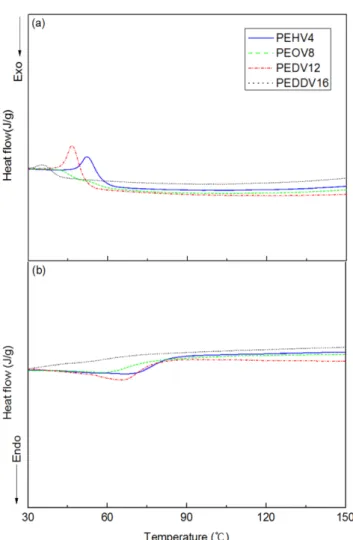
1H-nuclear magnetic resonance analysis. The catalytic activity, polymer yield, molecular weight, and molecular weight distribution were measured as functions of the chain length and high content of α-olefins. Furthermore, the thermal properties and crystallinity of the terpolymers were determined by differential scanning calorimetry and wide-angle X-ray scattering.
Keywords: funtionalization of polymers, metallocene catalysts, polyolefins, plastomer, terpolymer
Introduction
Research on polymerization using metallocene catalysts has begun since the discovery of ferrocene by Wilkins and Fischer in 1952, and was further developed by Kaminsky in the 1980s.
Synthesis of polymers with a narrow molecular weight distribution, high stereo-regularity, and uniform comonomer incorporation is much easier when copolymerization is performed using metallocene catalysts than when using the conventional Ziegler-Natta catalyst. For this reason, many coordination polymerization studies have been conducted using metallocene catalysts.
1Many studies on copolymerization have been pursued for the goal of improving the physical properties of the homopolymers.
Chung et al. reported the copolymerization of poly(ethylene- co-p-methylstyrene) using a metallocene catalyst.
2,3Park et al.
synthesized a copolymer of ethylene and propylene using a constrained geometry catalyst.
4Quijada et al. prepared a copolymer of ethylene and 1-octadecene using a bridged metallocene, and studied the effect of the comonomer on the catalytic activity.
5As mentioned above, many researchers have studied the
catalytic activity, structure, composition, and properties of copolymers under various polymerization conditions. However, most of the studies have been limited to the copolymerization of ethylene and comonomers such as propylene, high α-olefin, diene monomer, cycloolefin, and styrene. There are very few studies on terpolymerization, which can result in various functionalities.
6-10In this study, we synthesized the functional terpolymer, poly(ethylene-ter-high α-olefin-ter-divinylbenzene), which contains a reactive vinyl group. rac-Et(Ind)
2ZrCl
2and tri-iso- butylaluminum (TIBA)/dimethylanilinium tetrakis (pentafluoro- phenyl) borate (DATB) were used as the metallocene catalyst and cocatalyst system, respectively.
Experimental
1. Materials
We used pure nitrogen gas (Dae-myung Gas Co.) after passing it through a molecular sieve (4 Å)/manganese (II) oxide column during all the process. 1-hexene (Aldrich, 97%), 1-octene (Aldrich, 94%), 1-decene (Aldrich, 94%), 1-dodecene (Aldrich, 95%), n-hexane (Samchun pure chemical co., 99.5%), and toluene (Samchun pure chemical co., 99.5%) were distilled
†
Corresponding author E-mail: [email protected]
through the filter. Inhibitor of divinylbenzene (Aldrich 80%, DVB) was eliminated by washing it with NaOH solution. And then, DVB was distilled under reduced pressure in the presence of CaH
2after performing a standard purification procedure. A solution of rac-Et(Ind)
2ZrCl
2(Sigma Aldrich) and dimeth- ylanilinium tetrakis (pentafluorophenyl) borate (Acros) in tol- uene was also prepared in a glove box. Tri-iso-butylaluminium (Aldrich) was handled under nitrogen atmosphere using a man- ifolder equipment.
2. Terpolymerization
All manipulations were carried out in an inert nitrogen atmo- sphere. A glove box was used to prevent the contamination of catalysts. All of terpolymerization reaction were carried out in a 300 mL stainless steel autoclave with a mechanical stirrer and a temperature of 50
oC. The terpolymerization reaction was ini- tiated by the injection of toluene, high α-olefin, DVB, and solution of cataly sts. After 20 minutes, the poly mer solution was poured into a dilute HCl/MeOH solution. The resultant polymer was washed with MeOH and dried in vacuo. Each sol-
uble copolymer or terpolymer was separated from the insoluble polyethylene (some types of by-product) using a soxhlet appa- ratus with n-hexane solvent.
3. Characterization
1
H-nuclear magnetic resonance (
1H-NMR, Bruker AVANCE) analysis was carried out in 60°C at a frequency of 400 and 500 MHz. The sample solutions of the terpolymers were prepared in CDCl
3. The deuterated solvent was used to provide an internal lock signal. We calculated the compositions of the terpolymers using
1H-NMR spectra.
The number-averaged molecular weight, weight-averaged molecular weight, and molecular weight distribution of the terpolymers were measured by high-temperature gel permea- tion chromatography (GPC, Polymer Laboratories Co. PL- GPC210) fitted with Styragel (olesis guard column) HT-type columns. The analyses were performed at 140°C and 1.0 mL/
min with 1,2,4-trichlorobenzene as the solvent.
The catalytic activity of the terpolymers was calculated as following equation:
Figure 1. Synthetic procedures for the terpolymers: PEHV, PEOV, PEDV, and PEDDV.
Catalytic activity =
Differential scanning calorimetry (DSC) data for the ter- polymer were recorded by means of a DSC7 (PERKIN ELMER Co.). Samples were heated from 0°C to 150°C and then cooled down at 10°C/min to 0°C. Following this, they were reheated at 10°C/min to 150°C. The crystallization temperature (T
c) and melting temperature (T
m) were derived from the second and third run curves, respectively.
Wide-angle X-ray Scattering (WAXS) patterns were record- ed in reflection mode at room temperature using D/MAX- 2200V X-ray Diffractometer (Rigaku, Tokyo, Japan) connected to a computer. The instrument used the Cu source and performed measurements at 40 kV and 40 mA. The diffraction scans were collected over a period of 20 min between 2θ values from 3.0 to 40.0° at a scan rate of 2°/min.
Results and Discussion
Figure 1 shows the synthetic scheme for the preparation of poly(ethylene-ter-1-hexene-ter-divinylbenzene) (PEHV), poly- (ethylene-ter-1-octene-ter-divinylbenzene) (PEOV), poly(ethyl- ene-ter-1-decene-ter-divinylbenzene) (PEDV), and poly(ethyl- ene-ter-1-dodecene-ter-divinylbenzene) (PEDDV) in the pre-
sence of a metallocene catalyst and cocatalyst system. The C2 symmetric rac-Et(Ind)
2ZrCl
2, was used as the metallocene cat- alyst. TIBA and DATB were used as cocatalysts. In this sys- tem, the active site of the metallocene catalyst is formed via alkylation by TIBA and is activated by the metal ion complex.
Polymer chain growth occurs when the metal cationic complex forms a coordinate valence with monomer. The cation of the core metal of the metallocene is also stabilized by interaction with the non-coordinating anion of the bulky cocatalyst con- taining the borate group.
11Table 1 summarizes the results of the terpolymerization with different input content of high α-olefins from 0.2 to 0.8 mol/
L, while the input content of ethylene and DVB fixed at 0.4 mol/L and 0.2 mol/L, respectively.
Figure 2 shows the catalytic activities of the terpolymers as a function of the input content of high α-olefins. The catalytic activity in the terpolymerization tended to increase with increasing input content of the high α-olefins. This result can be explained by the “comonomer effect” that is well known in coordination copolymerization research.
5,12The high α-olefins incorporated into the main chain reduce its crystallinity, and thus allow for easy diffusion of ethylene through the polymer matrix to the active sites. Incorporation of the comonomer can also change the charge density of the cationic metal ion active kg of polymer
mol hr ---
Table 1. Results of Terpolymerization as a Function of Input Content of High α-olefins No. Run
aHigh α-olefin (mol/L) Yield Before
Soxhlet (g)
Yield After Soxhlet
(g)
Catalytic
Activity
bMw
c(×10
3) M
nc(×10
3) MWD
c1
1-Hexene
0.2 7.00 0.32 384 153 49 3.1
2 0.4 7.12 1.30 1560 147 45 3.2
3 0.6 8.74 4.23 5076 115 36 3.2
4 0.8 8.13 3.94 4728 136 40 3.4
5
1-Octene
0.2 7.11 0.41 492 203 67 3.0
6 0.4 6.87 2.02 2424 180 58 3.1
7 0.6 7.32 2.68 3216 142 41 3.5
8 0.8 7.66 4.21 5052 131 41 3.2
9
1-Decene
0.2 5.18 2.12 2544 266 78 3.4
10 0.4 7.56 5.46 6552 251 83 3.0
11 0.6 9.21 7.89 9468 197 59 3.3
12 0.8 14.33 11.75 14100 161 52 3.1
13
1-Dodecene
0.2 6.42 0.94 1308 210 60 3.5
14 0.4 9.27 3.21 3852 214 63 3.4
15 0.6 8.26 5.34 6408 205 60 3.4
16 0.8 9.81 4.62 5544 190 59 3.2
a
Polymerization conditions: ethylene=0.4 mol/L, DVB=0.2 mol/L, 50℃, 20 min, 500 rpm, 300 mL stainless autoclave, rac-Et(Ind)
2ZrCl
2=2.5 μmol, Al/Zr=500, and B/Zr=1.5.
b
Kg of polymer/(mol of catalyst·h.).
c
Determined by GPC data.
site. As a result, the active sites with higher electrophilicity bring about stronger ion pairing between the active site and monomers, which in turn can enhance the catalytic activity and molecular weight. Moreover, comonomers can prevent aggre- gation around the active site and the cocatalyst.
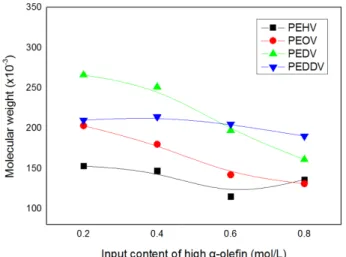
9Figure 3 illustrates changes in the weight-average molecular weight of the terpolymers with the input content of high α- olefins. The molecular weight tended to decrease with increas- ing input content of high α-olefins. It can be reasonably inferred that the number of reaction sites increased due to the improved solvency of the polymerization system owing to the comonomer effect, thereby resulting in a decrease in the molecular weight of the terpolymers.
Figure 4 shows the catalytic activity and weight-average molecular weight of various terpolymers having different lengths of incorporated high α-olefins. As the side chain length
of the incorporated high α-olefin increased, the catalytic activity and molecular weight increased due to the comonomer effect, which has been mentioned. However, there existed a critical point at which the catalytic activity in the terpoly- merization dramatically decreased, i.e., in the case of PEDDV.
We assumed that this phenomenon is due to the steric hindrance caused by the very long side chain and increased viscosity around the active metal center.
13These results seem similar to the tendencies observed with our previous study on poly(ethylene-ter-high α-olefin-ter-p-methylstyrene).
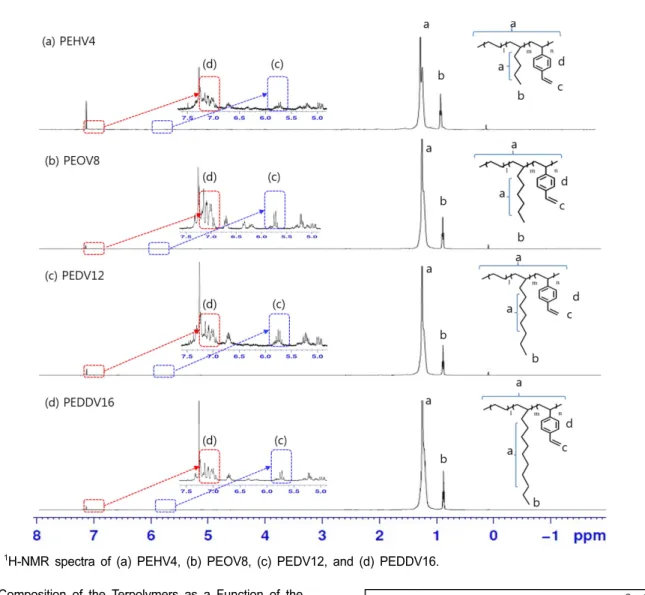
14,15Figure 5 shows the
1H-NMR spectra of the terpolymers, which have different side chain lengths of high α-olefins. The CH
2peaks of ethylene and high α-olefins appeared at 1.00-1.30 ppm. The peaks at 1.00 and 1.50 ppm were attributed to the CH
3group of ethylene and high α-olefins, respectively. Multiple CH peaks attributed to the aromatic ring in DVB appeared at around 7.08 and 7.22 ppm. The vinyl peaks of DVB at around 5.8 ppm confirmed that DVB was successfully incorporated into the terpolymers.
Table 2 shows the composition of the terpolymers depending on the type of high α-olefins and their input amounts. The high α-olefin compositions of PEHV and PEOV gradually increased as the input amounts of the corresponding high α-olefins increased. The DVB compositions of PEHV and PEOV were less than 1.2%, and did not show any clear trend. The monomer composition in the case of PEDV showed no clear trends with the input amount of the high α-olefin. On the other hand, the high α-olefin composition of PEDDV decreased despite the increase in 1-dodecene content, while the composition of ethylene increased, and that of DVB showed no notable trend.
We assume that 1-dodecene makes insertion of ethylene easier Figure 2. Catalytic activity of the terpolymers as a function of the
input content of high α-olefins.
Figure 3. Change in weight-average molecular weight of the terpolymers versus input content of high α-olefins.
Figure 4. Catalytic activity and weight-average molecular weight as functions of the terpolymers having different high α-olefins:
PEHV4=Run no. 4, PEOV8=Run no. 8, PEDV12=Run no. 12, and
PEDDV16=Run no. 16.
by reducing the crystallinity around the active sites of the catalysts.
Figure 6 shows WAXS data for the terpolymers. Amorphous peaks were observed around 19.5-20.0°, and crystallization Figure 5.
1H-NMR spectra of (a) PEHV4, (b) PEOV8, (c) PEDV12, and (d) PEDDV16.
Table 2. Composition of the Terpolymers as a Function of the Input Amount of High α-olefins
No. Run
aHigh α-olefin (mol/L)
Composition
b(%) Ethylene High α-olefin DVB 1
1-Hexene
0.2 94.0 4.2 0.4
2 0.4 93.8 5.1 1.1
3 0.6 83.4 16.1 0.5
4 0.8 82.2 17.3 0.5
5
1-Octene
0.2 88.7 10.7 0.6
6 0.4 87.8 12.0 0.2
7 0.6 85.4 14.1 0.5
8 0.8 83.8 15.0 1.2
9
1-Decene
0.2 81.9 18.2 0.9
10 0.4 77.9 21.4 0.7
11 0.6 77.5 21.6 0.9
12 0.8 78.1 21.1 0.8
13
1-Dodecene
0.2 77.5 22.1 0.4
14 0.4 78.0 21.3 0.7
15 0.6 83.8 15.3 0.9
16 0.8 84.8 14.6 0.6
a
Polymerization conditions: ethylene=0.4 mol/L, DVB=0.2 mol/L, 50
℃, 20 min, 500 rpm, 300 mL stainless autoclave, rac-Et(Ind)
2ZrCl
2=2.5 μmol, Al/Zr=500, and B/Zr=1.5.
b