https://doi.org/10.15429/jkomor.2019.19.1.56 JKOMOR
pISSN 1976-9334, eISSN 2288-1522 Review Article
폐경 여성의 비만에 응용되는 한방치료에 대한 문헌 고찰
남은영
가천대학교 한의과대학 한방부인과학교실
The Systematic Review on Clinical Studies of Traditional Korean Medicine Treatment for Obesity in Menopausal Women
Eun Young Nam
Department of Korean Obstetrics and Gynecology, College of Korean Medicine, Gachon University
Received:
Revised:
Accepted:
May 7, 2019 May 28, 2019 June 5, 2019
Objectives: The purpose of this study is to review clinical studies of herb medicine and acu- puncture treatment on obesity in menopausal women.
Methods: Key words "Obesity", "Menopause", "Herb medicine", "Acupuncture", "Moxibustion",
"Catgut embedding" were searched on 9 database systems (PubMed Central, Cochrane Controlled Register of Trials, Embase, China Academic Journals, Korean Traditional Knowledge Portal, Oriental Medicine Advanced Searching Integrated System, Korean Studies Information Service System, National Digital Science Library, DBpia) on April 30th 2019.
Results: 1 case report and 17 clinical trials were collected in accordance with the selection and exclusion criteria. Among the 17 trials, 6 were randomized controlled trials, 1 was con- trolled clinical trial, and 10 were single-arm trials. The types of intervention were herb medi- cine, electroacupuncture, acupuncture, auricular acupuncture, warm needle acupuncture, moxibustion, laser acupuncture, and catgut embedding. The study design, study results and method of intervention were analyzed.
Conclusions: 1 case report described the effectiveness of pharmacopuncture, 4 trials de- scribed the effectiveness of herbal medicine, 2 of electroacupuncture, 1 of laser acu- puncture, and 2 of catgut embedding. Among the 17 trials, 2 studies showed that herbal medicine treatment was more effective than no treatment or selective serotonin reuptake inhibitors, and 1 study showed that electroacupuncture was more effective than hormone therapy. All of 18 selected studies reported the effectiveness of weight reduction and ab- dominal obesity reduction after the traditional Korean medicine treatment for obesity in menopausal women.
Key Words: Systematic review, Obesity, Menopause, Herbal medicine, Acupuncture Correspondence to: Eun Young Nam
Department of Korean Obstetrics and Gynecology, College of Korean Medicine, Gachon University, 21, Keunumul-ro, Jung-gu, Incheon 22318, Korea Tel: +82-32-770-1292 Fax: +82-32-764-9990 E-mail: [email protected]
Copyright © 2019 by The Society of Korean Medicine for Obesity Research
서론
폐경은 여성에게 생식 능력의 종결뿐만 아니라 대사 및 내분비적 변화를 가져온다. 폐경이 되면 에스트로겐/
안드로겐 비율에 변화가 일어나면서 복부 내 지방축적이 일어난다. 폐경기에는 에스트로겐 결핍으로 복부 내 지방 축적이 가속화되고 중심성 비만의 경향성이 증가한다1). 에스트로겐은 둔부에 지방을 증가시키고 안드로겐은 복
부 비만을 유발하는데, 피하와 내장 지방세포에 있는 호 르몬 수용체의 종류나 작용이 다르기 때문이다2,3). 또한 폐경은 체중 증가에 영향을 미치는데 폐경을 전후해서 체 중 증가가 더 급속하게 일어난다. 폐경기에 체중이 증가 하는 기전으로는 신체 활동이 줄어들어 에너지 소비가 감 소하며, 근육과 같은 제지방량이 감소하고 월경 중지에 따른 황체기 에너지 소비가 소실되어 기초대사율이 감소 하고, 탄수화물이나 단백질에 비하여 지방질을 섭취할 때
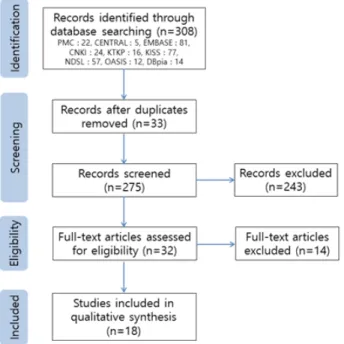
Fig. 1. Flow chart of trial selection process. PMC: PubMed Central, CENTRAL: Cochrane Controlled Register of Trials, CNKI: China Academic Journals, KTKP: Korean Traditional Knowledge Portal, KISS: Koreanstudies Information Service System, NDSL: National Digital Science Library, OASIS: Oriental Medicine Advanced Searching Integrated System.
열 생성이 더욱 감소되어 에너지 섭취가 증가한다. 따라 서 전체적인 1일 에너지 소비를 구성하는 세 가지 요소가 모두 감소하여 이로 인해 폐경기의 체지방 및 체중 증가 가 뒤따르는 것이다3). 폐경 여성은 1일 230 kcal의 에너지 소비가 감소된다4). 따라서 폐경기 여성의 비만 치료는 폐 경기의 에너지 소비와 신체활동 감소로 폐경 전과 비교하 여 대사율이 저하되기 때문에 치료 반응이 더디게 되어5), 비만에 대해 보다 집중적인 치료가 필요하다. 이에 기존 에 보고된 연구결과를 토대로 폐경 여성의 비만 치료의 특징을 분석하고자 하였다.
현재 한방 비만치료법에는 한약 복용, 침구치료, 저주파 전기자극 침치료, 약침, 매선침, 이침요법, 부항요법, 행동 수정요법, 식이 및 운동지도, 초음파 치료, 고주파 열 치료 등이 있다. 임상에서는 환자의 상태와 치료 목표에 따라 다양한 치료방법을 조합하여 전신 및 국소 비만에 대한 치료를 진행하는 것이 일반적이다6,7). 따라서 기존에 선행 되는 한방 비만치료들 중에서 폐경기 여성의 비만 치료에 유효하게 작용하는 치료방법을 확인하고자 하였다.
이에 국내외 데이터베이스를 검색 도구로 하여 논문을 선정한 다음, 치료 종류 및 경혈 선택, 치료 과정 등에 대한 기본 자료를 제공하고, 이후에 임상적 근거자료 마련 및 임상연구 방향 설정에 도움이 되고자 일련의 문헌고찰을
진행하였다.
방법
1. 연구 대상 및 검색 방법
이 연구는 폐경 상태의 비만 환자에게 한약과 침을 기 본으로 한의학 치료를 중재로 사용한 임상연구를 대상으 로 하였다. 2019년 4월 30일까지 발표된 논문을 대상으로 9개의 국내외 검색엔진(PubMed Central [PMC; http://ww w.ncbi.nlm.nih.gov/pubmed], Cochrane Controlled Register of Trials [CENTRAL; http://www.thecochranelibrary.com], Embase [http://ovidsp.tx.ovid.com/], China Academic Journals [CNKI; http://www.cnki.net], 한국전통지식포탈[KTKP {Korean Traditional Knowledge Portal}; http://www.koreantk.com], 전통의학정보포털[OASIS {Oriental Medicine Advanced Searching Integrated System}; http://oasis.kiom.re.kr], 한국 학술정보[KISS {Koreanstudies Information Service System};
http://kiss.kstudy.com/], 과학기술정보통합서비스[NDSL {National Digital Science Library}; http://scholar.ndsl.kr], 디비피아 [DBpia; http://www.dbpia.co.kr])을 이용하였다. 검색어는
‘폐경(menopause, 绝经, 更年)’, ‘비만(obesity, 肥胖)’, ‘한약 (herb medicine, 药, 中药, 中草药, 汤, 散, 丸, 方, 颗粒, 㬵囊)’,
‘침(acupuncture, 针)’, ‘뜸(moxibustion, 灸)’, ‘매선(catgut embedding, 埋线, 埋针, 药线, 埋植)’ 등으로 설정하여 논문 을 검색 및 수집하였다(Fig. 1).
2. 문헌의 선정, 배제 기준 및 선별 방법
검색된 논문에서 중복된 문헌을 제외하고, 문헌의 제목 및 초록을 검토하여 선정 및 제외 기준에 따라 선별하였다.
문헌의 선정기준은 ① 한약, 침 등의 한의학치료가 중재인 연구, ② 한국표준질병⋅사인분류에서 폐경 및 폐경 후 부 인과 질환들을 대상으로 한 연구, ③ 증례 연구 및 임상연 구 등이며, 제외 기준은 ① 원저가 아닌 문헌, ② 중복 출판 된 연구, ③ 폐경 및 폐경 후 여성 대상이 아닌 연구 등이다.
3. 최종 논문 선정
폐경 비만 관련 논문은 총 308편이 검색되었다. 이 중 중복된 문헌을 제외한 275편의 제목 및 초록을 검토하였 다. 이 중 실험 및 고찰 논문을 제외한 임상연구 논문은 32편이었다. 32편의 논문 중 선정 및 제외 기준을 적용하 였을 때 이에 부합하는 문헌은 18편이었다. 이 가운데 1편 은 증례 보고였고 17편은 임상시험연구였다. 총 17편의 임상시험연구 중 6편은 무작위 대조 임상시험(randomized controlled trials), 1편은 대조 임상시험(controlled clinical trial), 10편은 단일군 임상시험(single-arm trials)이었다.
4. 자료수집 및 분석
선정된 논문들의 연구 설계, 대상 질환, 연구대상자 수, 적용된 중재시술, 치료기간, 대조군, 평가지표, 결과 등을 분석하고 Table 1~4에 정리하였다.
결과
1. 증례보고8) 1) 일반적 특성
2016년 한방비만학회지에 보고된 증례논문으로 폐경기 복부 비만 치험 2예를 다루었다. 2예 모두 2주 이내에 총 5회의 온열 요법을 결합한 산삼비만약침 치료가 시행되었 으며 체중감량과 관련된 약물 처방은 병행하지 않았다.
2) 시술 방법
남상천한의원 원외탕전실에서 제조된 산삼비만약침을
사용하여 氣海(CV6), 關元(CV4), 양쪽 天樞(ST25), 水道 (ST28), 大橫(SP15), 服闋(SP14) 등 총 10곳의 혈위에 각 0.5 mL씩 회당 총 5 mL를 시술하였다. 약침 시술 전 15분, 약침 시술 후 15분간 메디스톤(SM Medical, Daejeon, Korea) 을 이용하여 온열 요법을 시행하였다. 시술 전후로 식이와 활동량은 평소와 동일하게 유지하도록 하였다.
3) 유효성 평가 방법 및 결과
치료 전과 5회 치료 후에 체성분(체중, 체질량지수, 복부 지방률, 체지방률, 내장 지방), 허리 둘레, 피하지방 두께를 측정하여 치료 전후를 비교하였다. 증례 1은 시술 전보다 체중 0.6 kg 감량, 허리 둘레 6.0 cm, 복부 피하지방 두께 18.0 mm 감소하였고, 증례 2는 시술 전보다 체중 0.4 kg 감 량, 허리 둘레 4.6 cm, 복부 피하지방 두께 12.0 mm가 감소 하였다.
2. 임상시험연구
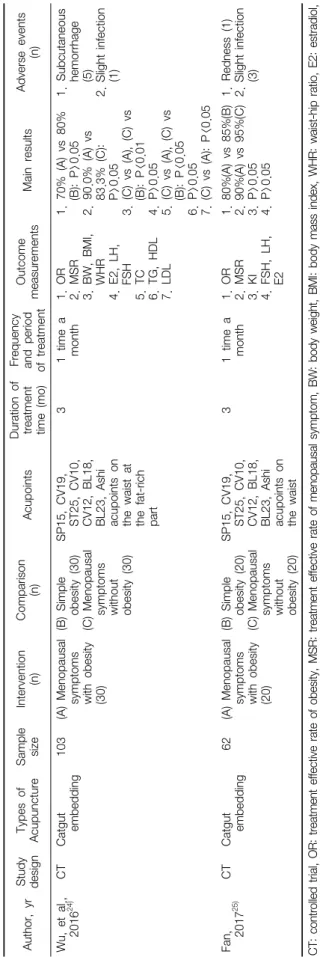
총 17편의 임상시험연구 중 6편은 무작위 대조 임상시험 (randomized controlled trials), 1편은 대조 임상시험(controlled clinical trial), 10편은 단일군 임상시험(single-arm trials)이 었다. 중재 방법에 따라 분류하면 한약치료가 4편, 전침치 료가 2편, 침, 온침(溫針), 이침(耳針) 등의 침치료가 8편, 레이저침이 1편, 매선(埋線)이 2편이었다. 연구 설계 및 적용된 중재시술에 따라 유사한 연구들을 분류하고 연구 대상자 수, 치료기간, 대조군, 평가지표, 결과 등을 분석 하였다.
1) 한약치료
한약치료와 관련된 연구는 모두 4편이었으며, 모두 무 작위 대조 연구였다. 한약 단독치료군과 무처치 대조군을 비교한 연구 1편9), 한약 단독치료군과 위약과, 세로토닌 재흡수억제제(selective serotonin reuptake inhibitors, SSRI) 및 침구요법을 사용한 병행치료군 비교 연구 1편10), 그리고 한약과 침치료를 사용한 병행치료군과 한약단독치료군을 비교한 연구 2편11,12)이었다(Table 1). 補腎健脾方을 이용한 한약 대상 연구9)에서는 3개월간 한약 복용 후에 비만 폐경 여성에서 체중, 허리-엉덩이 둘레비 등의 비만 지표와, FSH (follicle stimulating hormone), LH (luteinizing hormone), E2 (estradiol) 등의 호르몬수치에서 무처치군에 비해 유의하게 감소하였다(P<0.01). 한약 단독요법과 호르몬병행요법의
Author, yrStudy designSample sizeIntervention (n)Com
Duration of parison (nMain acupointstreatment time ) (min)
Frequency and period of treatment Outcome measurementsMain results Shi, et al., 20159) RCT120Bushen Jianpi recipe† (60)Control (60)--3 months1. BMI, WHR 2. E2, LH, FSH1. P<0.01 2. P<0.01 Hao, et al., 201710) RCT 70Shugan Pill‡ combined with Fangfeng Tongsheng Pill§ (35)
Placebo (Starch pills), fluoxetine (SSRI), acupuncture, moxibustion (35)
CV4, CV6, HT5, LI4, SP6, ST44、GV26, HT7
30Once every other day, 3 months1. MSR 2. BMI, BW, HAMD score 3. FSH, E2
1.
P<0.05 (0.012)
2. P<0.05 3. P<0.01 Gao, 201011) RCT108Danggui Siwu Decoction, acupuncture (51)
Danggui Siwu Decoction (49)CV12, CV6, CV4, SP6, BL23, BL17
303 times a week (total 30 times), 3 mo
1. BMI 2. MSR1. 22.5 vs 24.25* 2. 82.4 vs 85.7* Zhang, 201612) RCT 98Siwu Decoction∥ , acupuncture (49)Siwu Decoction (49)GV14, CV4, CV6, CV12, BL23, EX-CA1, LI11, ST36, SP6
20Total 42 times, 3 months1. BMI 2. KI1. P>0.05 2. P>0.05 RCT: randomized controlled trial, BMI: body mass index, WHR: waist-hip ratio, E2: estradiol, LH: luteinizing hormone, FSH: follicle stimulating hormone, SSRI: selective serotonin reuptake inhibitors, MSR: treatment effective rate of menopausal symptom, BW: body weight, HAMD score: Hamilton depression score, KI: Kupperman index. *P-value was not reported;† Composition of Bushen Jianpi recipe: Cooked Rehmannia glutinosa 20 g, Raw Rehmannia glutinosa 20 g, Radix Scrophulariae 20 g, Parasitic mulberry 15 g, Dipsacus 20 g, Astragalus 30 g, Polygonatum 15 g, Poria cocos 10 g, Fried Atractylodes macrocephala 10 g, yam 10 g, Coix seed 30 g, plantain 10 g, Fructus aurantii 12 g, orange peel 12 g, Pinellia ternata 9 g, Atractylodes macrocephala 10 g, Rhizoma Cyperi 10 g, Saponin horn thorn 10 g, Alisma orientalis 10 g, Salvia miltiorrhiza 20 g;‡ Composition of Shugan Pill: Melia chinensis, Corydalis yanhusuo, Paeonia lactiflora, slices of turmeric, woody fragrance, aloes, nutmeg kernel, Magnolia officinalis, Orange peel, Fructus Aurantii, Cinnabar; § Composition of Fangfeng Tongsheng Pill: Fangfeng, Schizonepeta tenuifolia, Mint, Ephedra, rhubarb, Mirabilite, gardenia, Talc, Platycodon grandiflorum, Gypsum, Chuanxiong, Angelica, Paeonia root, Scutellaria baicalensis, Forsythia suspense, Licorice, Atractylodes macrocephala;∥ Composition of Siwu Decoction: Angelica sinensis, Ligusticum chuanxiong, Paeonia lactiflora, Rehmannia glutinosa.
Table 1. Clinical Trials of Herb Medicine and Acupuncture Application Author, yrStudy designSample sizeIntervention (n)Comparison (n)AcupointsTypes of electro-waveTypes of acupuncture and depth
Duration of treatment time (min)
Frequency and period of treatmentOutcome measurementsMain resultsAdverse events Zhang, et al., 201813)RCT108EA (30)Nilestriol (synthetic estrogen) (30)
ST25*, SP15*, CV12, CV10, ST24, CV6, LI11, HT7, ST36, ST40, SP6, KI3, LR3
2.5 Hz, contin
uous wave
75 mm at abdomen and 40 mm at extreme, depth was not mentioned
303 times a week, 3 months
1. MSR 2. OR 3. KI 4. BMI, WHR 5. SHBG
1. P=0.01 2. P<0.01 3. P=0.004 4. P<0.01 5. P=0.004
Not reported Bai, 200914)RCT 98(A) EA at abdomen (6)
(B) EA at back, AA (6)
(A) CV12, CV10, ST25*, KI16, CV9, CV6 (B) BL25*, BL15, BL23, BL20, BL18
2 Hz, contin
uous wave
0.30×40 mm, stainless needle, 15~20 mm depth
253 times a week, 4 weeks
1. BW, WC, HC, fat mass 2. KI 3. SAS index
1. P>0.05 2. P>0.05 3. P<0.05
No adverse events RCT: randomized controlled trial, EA: electroacupuncture, AA: auricular acupuncture, MSR: treatment effective rate of menopausal symptom, OR: treatment effective rate of obesity, KI: Kupperman index, BMI: body mass index, WHR: waist-hip ratio, SHBG: sex hormone binding hormone, BW: body weight, WC: waist circumference, HC: hip circumference, SAS: self-rating anxiety scale. *Electroacupuncture point.
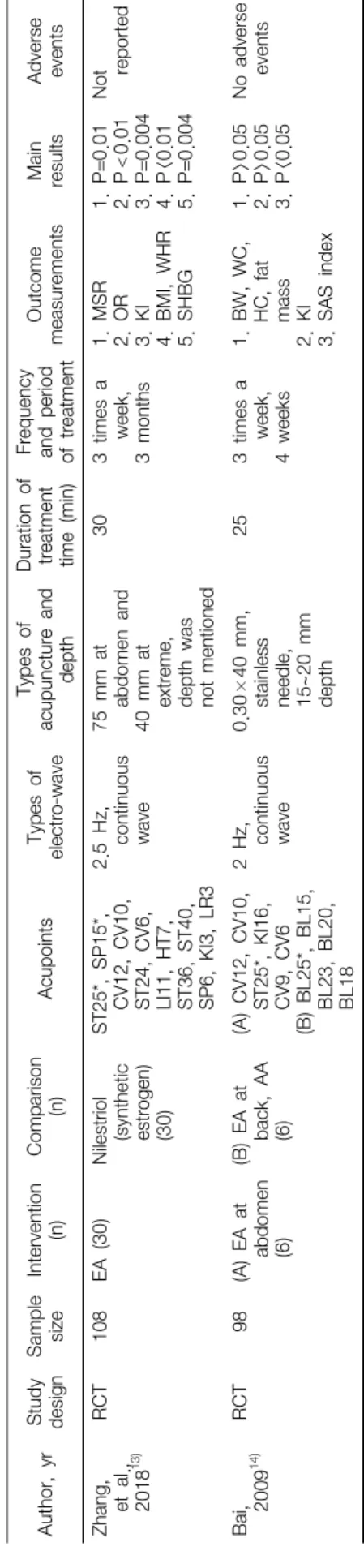
Table 2. Clinical Trials of Electroacupuncture Application
비교 연구10)에서는 한약을 단독으로 사용한 치료군과 위 약, 세로토닌 재흡수 억제제(fluoxetine), 침구요법을 사용한 호르몬병행치료군과 비교하였다. 한약치료군은 舒肝丸과 防風通聖丸을 함께 복용하였다. 대조군의 침치료는 關元 (CV4), 氣海(CV6), 通里(HT5), 合谷(LI4), 三陰交(SP6), 內 庭(ST44), 印堂(GV26), 神門(HT7)을 기본 혈위로 사용하였 으며, 水分(CV9), 太衝(LR3), 百會(GV20), 带脉(GB26), 命 門(GV4) 등의 혈위를 추가 배합하였다. 3개월의 치료기간 후 대조군에 비해 폐경 관련 증상에 대한 유효율이 유의 하게 증가하였으며(P<0.05), 체중과 체질량지수의 유의한 감소(P<0.05), 헤밀턴 우울척도 점수의 개선(P<0.05), 호 르몬수치(FSH, E2)의 유의한 개선(P<0.01)을 보였다. 2건
의 연구11,12)는 실험군과 대조군 모두 한약치료를 하되 실
험군에서는 한약치료에 침치료를 병행하였으며, 한약치 료에 침치료를 추가하였을 때 기존 한약치료와 비교하여 유효한지 알아보고자 하였다. 2개 연구 모두 한약치료에 四物湯을 이용하였으며, 四物湯을 기본처방으로 하되 환 자의 변증에 따라 가감하여 투약하도록 하였다. 즉, Gao11) 의 연구에서는 痰濕阻滞型에서 二陳湯과 溫膽湯을, 脾虛 濕阻型에 苓桂朮甘湯에 澤瀉를 추가하였으며, 肝鬱氣滞型 에 逍遥散을, 脾腎陽虛型에 右歸飮을 추가하였고, Zhang12) 의 연구에서는 변증이 腎陰虛症인 경우 左歸丸을 추가하고, 腎陽虛症인 경우에는 右歸丸을 추가하였다. 또한 침치료 에서도 기본 혈위 외에 환자의 변증과 주 증상에 따라 혈 위를 추가하였다. Gao11)의 연구에서는 환자의 변증에 따 라 腎陰虛證에 肝俞, 太溪를, 腎陽虛症에 脾俞, 豊隆을 추가 하였으며, Zhang12)의 연구에서는 中脘、氣海, 그리고 아시 혈에 전기침을 연결하였으며, 耳針을 병행하여 肝, 肾, 内 分泌, 卵巢, 交感을 기본 혈위를 정하여 시술하고, 식이 지 도와 매일 30분 경보 운동을 하도록 지도하였다. Gao11)의 연구 결과에서는 체질량지수와 폐경기 관련 증상 유효율 이 대조군에 비해 치료군에서 유의하게 개선되었다고 보 고하고 있으나, 수치의 변화에 따른 비교만 시행하고 통 계학적인 유의성은 검증하지 않았다. Zhang12)의 연구결과 에서는 체질량지수와 쿠퍼만 지수(Kupperman Index)를 이 용한 폐경기 관련 증상을 평가하였을 때 치료 후 두 군간 에 유의한 차이가 없었다. 한약치료의 중재가 시행된 4편의 연구 모두 부작용에 대한 언급은 없었다.
2) 전침치료
전침치료 대상 연구는 2편으로 모두 무작위 대조 연구 로 설계되었다. 1편의 연구13)는 전침치료군과 호르몬치료 군을 비교하였으며, 다른 1편의 연구14)는 치료부위 및 혈 위를 달리했을 때의 치료효과를 비교하기 위한 것으로 전 침치료를 복부치료군과 배부치료군으로 나누어 비교하였 다(Table 2). 전침치료군과 호르몬치료군의 비교연구에서 는 복부에 75 mm, 사지에 40 mm 길이의 호침을 사용하 였으며, 자입 시 득기(得氣)를 유발하였다. 치료부위에 따 른 치료효과를 비교한 연구에서는 0.30×40 mm, stainless 호침을 사용하였으며 15-20 mm 깊이로 자입하고 득기를 유발하지 않았다. 두 연구 모두 치료주기는 주 3회로 동 일하였으나, 치료기간은 3개월과 1개월로 달랐다.
2편의 연구에서 모두 이침(耳針)요법을 병행하였다. Zhang 등13)의 연구에서 이침부위는 神門, 肝, 内分泌를 한쪽 귀에 적용하였다. Bai14)의 연구에서는 왕불유행(王不留行)을 이 용하였으며, 이침부위는 饑点, 渴点, 内分泌, 神門, 三焦, 口, 大腸, 脾, 胃, 子宫을 사용하였고, 환자에게 식사 시작 30분 전에 이침부위를 압진하도록 하였으며 한쪽 귀를 압 진하고 다음날은 반대쪽 귀로 바꿔서 압진하도록 교육하 였다. 또한 주 1회 괄사요법을 침구치료 전에 시행하였다.
전침치료와 호르몬치료의 치료결과를 비교한 결과, 전침 치료군에서 폐경관련 증상 및 비만관련 증상의 유효율이 모두 유의한 차이를 보였으며(P=0.01. P<0.01), 쿠퍼만 지수 와 체지방률, 허리-엉덩이 둘레비, 성호르몬결합단백 수치 에서 유의한 차이를 보였다(P<0.01). 치료부위에 따른 비교 연구에서 복부침치료군과 배부침치료군을 비교한 결과, 비 만 관련 지표 및 쿠퍼만 지수, 자기보고식 불안척도(self-rat- ing anxiety scale) 지수에서 유의한 차이가 없었다(P>0.05).
즉 복부 및 배부 등 침의 치료부위에 따른 치료효과의 차이 는 없었다.
3) 침치료
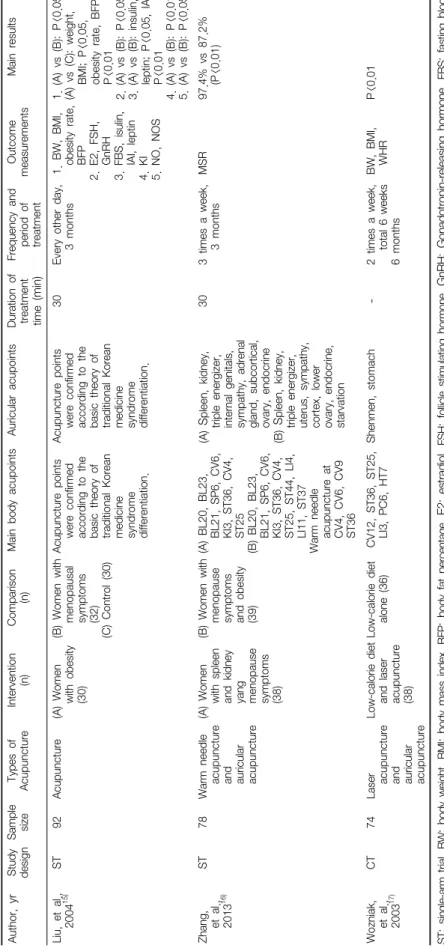
총 9편의 침치료 대상 임상시험에서 2편은 동일 중재 에 대한 비교연구, 1편은 대조군 연구, 6편은 단일군 임상 연구였다(Table 3-1, 3-2).
동일 중재에 대한 비교 연구 2편15,16)은 대상자에게 모 두 같은 중재 요법을 적용하고 폐경 증상, 비만의 유무에 따라 비교 분석하였다. 2편의 연구 모두 치료 횟수 주 3회, 치료기간 3개월로 동일하였으며 침치료에 이침요법을 병
Author, yrStudy designSample sizeTypes of AcupunctureIntervention (n)Comp arison (n)
Main body acupointsAuricular acupointsDuration of treatment time (min)
Frequency and period of treatment
Outcome measurementsMain results Liu, et al., 200415)ST92Acupuncture(A) Women with obesity (30)
(B) Women with menopausal symptoms (32) (C) Control (30)
Acupuncture points were confirmed according to the basic theory of traditional Korean medicine syndrome differentiation.
Acupuncture points were confirmed according to the basic theory of traditional Korean medicine syndrome differentiation.
30Every other day, 3 months 1. BW, BMI, obesity rate, BFP 2. E2, FSH, GnRH 3. FBS, isulin, IAI, leptin 4. KI 5. NO, NOS
1. (A) vs (B): P<0.05 (A) vs (C): weight, BMI; P<0.05, obesity rate, BFP; P<0.01 2. (A) vs (B): P<0.05 3. (A) vs (B): insulin, leptin; P<0.05, IAI; P<0.01 4. (A) vs (B): P<0.01 5. (A) vs (B): P<0.05 Zhang, et al., 201316)ST78Warm needle acupuncture and auricular acupuncture
(A) Women with spleen and kidney yang menopause symptoms (38)
(B) Women with menopause symptoms and obesity (39)
(A) BL20, BL23, BL21, SP6, CV6, KI3, ST36, CV4, ST25 (B) BL20, BL23, BL21, SP6, CV6, KI3, ST36, CV4, ST25, ST44, LI4, LI11, ST37 Warm needle acupuncture at CV4, CV6, CV9 ST36
(A) Spleen, kidney, triple energizer, internal genitals, sympathy, adrenal gland, subcortical, ovary, endocrine (B) Spleen, kidney, triple energizer, uterus, sympathy, cortex, lower ovary, endocrine, starvation
303 times a week, 3 months MSR97.4% vs 87.2% (P<0.01) Wozniak, et al., 200317)CT74Laser acupuncture and auricular acupuncture
Low-calorie diet and laser acupuncture (38)
Low-calorie diet alone (36) CV12, ST36, ST25, LI3, PC6, HT7Shenmen, stomach-2 times a week, total 6 weeks 6 months
BW, BMI, WHRP<0.01 ST: single-arm trial, BW: body weight, BMI: body mass index, BFP: body fat percentage, E2: estradiol, FSH: follicle stimulating hormone, GnRH: Gonadotropin-releasing hormone, FBS: fasting blood sugar, IAI: insulin sensitive index, KI: Kupperman index, NO: nitric oxide, NOS: nitric oxide synthase, MSR: treatment effective rate of menopausal symptom, CT: controlled trial, WHR: waist-hip ratio.
Table 3-1. Clinical Trials of Acupuncture Application
Author, yrStudy designSample sizeMain body acupointsAuricular acupointsTypes of moxibustionDuration of treatment time (min)Frequency and period of treatmentOutcome measurements Main results Liu, and Liu, 201418)ST 91GV26, HT5, HT7, CV6, CV4, SP6, KI3, ST44, LI4, LI11, ST37
Spleen, kidney, triple energizer, endocrine, sympathy, uterus, adrenal, subcortical, ovary, starvation point
Warm needle moxibustion at CV4, CV6, CV9, ST36
303 times a week, 3 months1. KI, FSH, E2 2. BW, obesity rate, BMI, BFP
1. P<0.05 2. P<0.05 Chen, 201619) ST 68CV6,CV4, LI4, HT5, ST44, SP6, HT7, GV26
Spleen, kidney, triple energizer, sympathy, adrenal, subcortical, ovary
Warm needle moxibustion at ST36, CV4, CV9
303 times a week, 3 months1. BMI 2. FSH, E2, KI 3. MSR
1. P<0.05 2. P<0.05 3. 97.06%† Geng, 201620)ST121BL20, CV12, BL23, CV3,SP3, ST40, KI3, BL58, SP6, CV4, GV4, GB34
-Warm needle moxibustion at BL20, CV12, BL23, CV3, CV4, GV4
30Every other day, 3 months1. KI, FSH, E2 2. BW, BMI, obesity rate, BFP
1. P<0.01 2. P<0.01 Geng, 201721)ST 42CV6, GV26, LI11, HT5, HT7, CV4, KI3, ST44, LI4, SP6, ST37
Spleen, kidney, triple energizer, endocrine, uterus, ovary, sympathy, starvation point, adrenal gland, subcortical
Moxibustion at CV6, CV4, CV9, ST36 in 20 min TDP irradiation
353 times a week (total 15 times), 1 month
1. BW, obesity rate, BMI, BFP 2. KI, FSH, E2
1. P<0.05 2. P<0.05 Ren, et al., 201222)ST151LI11, CV12, ST25, SP15, ST36, ST37, SP6, ST44*
Shenmen, sympathy, endocrine, stomachNot mentioned30Every other day, 3 months1. BW, BMI, obesity rate, BFP 2. KI, FSH, E2
1. P<0.01 2. P<0.05 Chen, et al., 201423)ST 64LI4, LI11, CV4, CV12, SP15, ST25, CV6, CV9, SP10, ST29, ST36, GB34, SP6, ST37, ST44, LR3
Shenmen, starvation point, endocrine, sympathy, stomach
Not mentioned30Every other day, 2 months1. BW, BMI, obesity rate, BFP 2. KI, FSH, E2
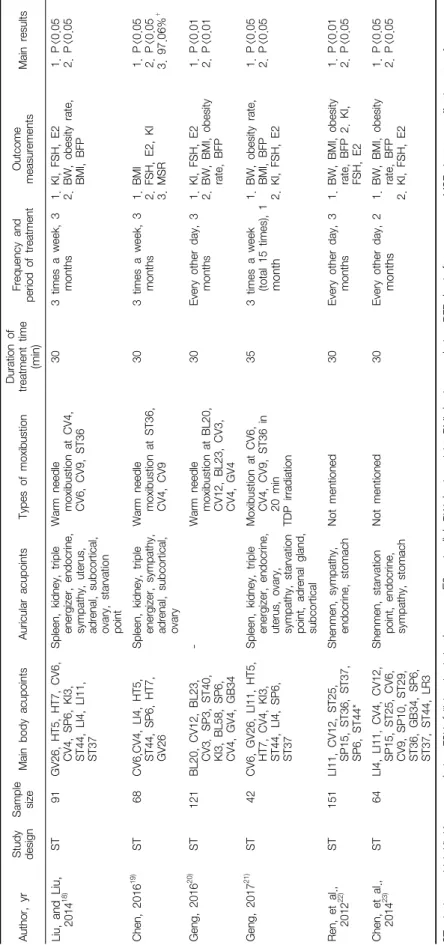
1. P<0.05 2. P<0.05 ST: single-arm trial, KI: Kupperman index, FSH: follicle stimulating hormone, E2: estradiol, BW: body weight, BMI: body mass index, BFP: body fat percentage, MSR: treatment effective rate of menopausal symptom. *Additional acupoints were added according to the basic theory of traditional Korean medicine syndrome differentiation;† P-value was not reported.
Table 3-2. Clinical Trials of Acupuncture Application