Background and Purpose The objective of this study was to determine if the MOXO visual- and vocal-distractors-based continuous performance test distinguishes patients with attention deficit hyperactivity disorder (ADHD) and neurofibromatosis type 1 (NF1) from those without NF1.
Methods Thirty-five patients (16 males; mean age 9.91 years) attending a multidisciplinary NF1 clinic completed the MOXO test. The findings were compared to 532 healthy age-matched standardized control subjects (285 males) without ADHD.
Results The overall performance in the MOXO text was significantly worse in the NF1 group than in controls (p<0.01), but no group-specific pattern was identified. Impulsivity and hyperactivity were significantly more prominent in males than females (p<0.01). Compared to controls, the NF1 group exhibited significantly more failures to respond to target stimuli in the presence of visual distractors.
Conclusions MOXO scores are abnormal in patients with NF1, but the test cannot differenti- ate between NF1 with ADHD characteristics and ADHD. The test highlights sex differences in ADHD characteristics in NF1. Overreactivity to visual distractors may form part of the attention deficit in NF1.
Key Words attention deficit hyperactivity disorder, neurofibromatosis type 1, continuous performance test, MOXO.
Attention Deficit Hyperactivity Disorder in Neurofibromatosis Type 1: Evaluation with a Continuous Performance Test
INTRODUCTION
Neurofibromatosis type 1 (NF1) is a genetic disorder with an autosomal dominant pattern of inheritance. It is characterized clinically by multiple café-au-lait macules, axillary and/
or inguinal freckling, iris Lisch nodules, and tumors of the nervous system such as neuro- fibromas and optic pathway gliomas.1 The disease is caused by mutations in NFI that en- codes for neurofibromin, a GTPase-activating protein for Ras. Loss of function of neurofi- bromin leads to an overall increase in the active GTP-Ras complex and a consequent risk of tumor formation.2
NF1 is often associated with learning, cognitive, and behavioral disabilities which ac- count for a significant proportion of the disease-related morbidity and can have a pro- found impact on quality of life.3 The incidence of attention deficit hyperactivity disorder (ADHD) in patients with NF1 ranges between 33% and 49.5%,4 with no sex difference. Ac- cording to the Centers for Disease Control and Prevention (CDC) report from 2011–2013, the percentage of ADHD ever diagnosed among children age 4–17 was 11.5%, and by sex:
13.3% in males and 5.6% in females.5
The ADHD-like symptoms in NF1 appear to involve complex impairments in cognitive Rony Cohena,b,c*
Ayelet Halevyb,c* Sharon Aharonb,c Avinoam Shupera,b,c
a Neurofibromatosis Clinic,
Schneider Children’s Medical Center of Israel, Petach Tikva, Israel
b Department of Pediatric Neurology and Epilepsy Center,
Schneider Children’s Medical Center of Israel, Petach Tikva, Israel
c Sackler Faculty of Medicine, Tel Aviv University, Tel Aviv, Israel
pISSN 1738-6586 / eISSN 2005-5013 / J Clin Neurol 2018;14(2):153-157 / https://doi.org/10.3988/jcn.2018.14.2.153
Received February 2, 2017 Revised April 26, 2017 Accepted April 26, 2017 Correspondence Rony Cohen, MD
Neurofibromatosis Clinic and Department of Pediatric Neurology and Epilepsy Center, Schneider Children’s Medical Center of Israel,
14 Kaplan Street, Petach Tikva 4920235, Israel
Tel +972-3-925-3615 Fax +972-3-925-3871 E-mail [email protected]
*These authors contributed equally to this work.
cc This is an Open Access article distributed under the terms of the Creative Commons Attribution Non-Com- mercial License (http://creativecommons.org/licenses/by-nc/4.0) which permits unrestricted non-commercial use, distribution, and reproduction in any medium, provided the original work is properly cited.
JCN
Open Access ORIGINAL ARTICLEEvaluation of NF1-ADHD Continuous Performance Test
JCN
processes, visuospatial function, and executive function that may operate through mechanisms that probably differ from those responsible for ADHD in individuals without NF1.6 Researchers have suggested that impaired reactivity to visu- al signals plays a role.7
The aim of the present study was to determine if the MOXO test for ADHD (Neurotech Solutions, Nes Ziona, Is- rael), which is a visual- and vocal-distractors-based continu- ous performance test, can distinguish between patients with ADHD with and without NF1, and if attention deficits in pa- tients with NF1 are related to abnormal visual responses.
METHODS
The study was approved by our Local Ethics Committee (approval number: 0192-11-RMC).
Population
Thirty-five children and adolescents aged 6–17 years with NF1 were recruited for the study from the multidisciplinary NF1 clinic of a large pediatric tertiary referral, university- affiliated medical center. The diagnosis of NF1 was based on the 1988 guidelines of the National Institutes of Health.8 Parents provided written informed consent for their chil- dren/adolescents to participate in the study, and the children/
adolescents provided verbal assent.
Study procedure
Background data on the children/adolescents were collected from computerized patient medical files. In addition, par- ents and teachers completed the Conners Comprehensive Behavior Rating Scales,9 which measures learning problems and executive functioning, and the questionnaire for ADHD in the fourth edition of the Diagnostic and Statistical Man- ual of Mental Disorders (DSM-IV). All 35 children com- pleted the MOXO continuous performance test for ADHD (Neurotech Solutions), which is a standardized computerized test designed to diagnose the following four ADHD-related symptoms: inattention, timing, impulsivity, and hyperactivi- ty.10,11 The test was administered in a quiet room in the pedi- atric neurology clinic. The results were analyzed, together with the parent and teacher reports, and the conclusions and implications of the findings were presented to the patients and parents at the next clinic visit.
For purposes of the study, the results of the patients with NF1 (experimental group) were compared with those of an age-matched standardized group of children without NF1 who participated in the original studies validating the MOXO and were found not to have ADHD (control group).10,11 The conditions of administration of the MOXO were identical
in both groups.
MOXO procedure
In brief, subjects are seated in front of a computer screen and presented with a series of stimuli, some of which are desig- nated as target stimuli. Subjects are asked to respond as quickly as possible to the target stimuli by pressing the space bar on the keyboard. In each trial, a stimulus (target or non- target) is presented for 500, 1,000, or 4,000 milliseconds. The target remains on the screen for the full duration of the des- ignation time, whether or not a response was given. This is followed by a rest period of the same duration. In this manner, it is possible to determine both the timing of the response, if it occurred (during stimulus presentation or the rest period), as well as its accuracy. Participants are instructed to press the space bar once and only once when they see the target, to not press any key other than the space bar, and to ignore any stimulus other than the target stimulus.
The test includes eight distractors (neither target nor non- target stimuli) that take the form of short video clips. Dis- tractors may be visual, auditory, or both (e.g., an animated barking dog, the background sound of a barking dog, or an animated dog with background barking), and they are pre- sented simultaneously with the target/nontarget stimuli. The number and type of distractors presented during the test vary, as follows: levels 1 and 8, no distractor; levels 2 and 3, simple and complex visual distractors only; levels 4 and 5, simple and complex auditory distractors only; and levels 6 and 7, combined simple visual and auditory distractors and complex combined distractors.12,13 The levels of the distrac- tors are always presented in numerical order. The total test includes 8 trials and 262 targets, and total duration of the test is 15 min.
Statistical analysis
BMDP statistical software14 was used for the statistical analysis.
Discrete variables were analyzed with Pearson’s test, the chi- squared test, or Fisher’s exact test, as appropriate, and continu- ous variables were analyzed with one-way analysis of variance or the nonparametric Mann-Whitney U-test. A p value of ≤0.01 was considered statistically significant. The z-test was applied to each significance level.
RESULTS
The experimental group comprised 16 males and 19 females aged 9.91±3.72 years (mean±SD). Thirteen patients (37.2%) had a first-degree relative with NF1. All 35 children were at- tending mainstream schools and were considered to have a normal IQ according to the school records. The control group
Cohen R et al.
JCN
comprised 285 males and 247 females aged 10.14±2.75 years.
Significant differences were found for all four ADHD pa- rameters evaluated by the MOXO test between the experi- mental and control groups (p<0.01). The z-scores for the ex- perimental group are listed in Table 1. Analysis by sex showed that while the males performed better than the females in at- tention (correct responses to the targets, early or late) and timing (correct responses to the targets before the rest peri- od), they exhibited worse scores for impulsivity and hyper- activity (responding to nontarget stimuli, failing to respond to target stimuli, and pressing keys other than the space bar, as presented in Table 2). Older children (those aged 13–18 years) showed a tendency toward higher impulsivity and hyperactivity than younger children (those aged 6–12 years), but the difference did not reach statistical significance (Fig. 1).
The errors of omission (failures to respond to target stim-
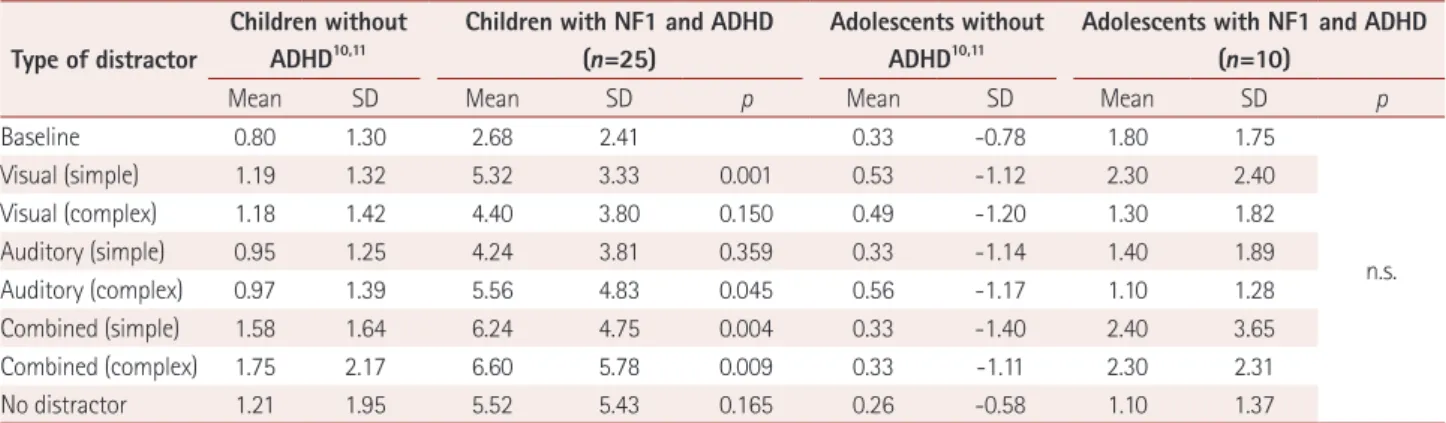
uli) in the absence of distractors (levels 1 and 8) did not dif- fer over time (i.e., between the beginning and end of the test). The number of omission errors increased significantly in the younger group when simple visual distractors or com- bined visual and auditory distractors were presented relative to no distractor (p<0.01) (Table 3). The increase in the num- ber of omission errors in the older group when combined distractors were present was not statistically significant (Ta- ble 3).
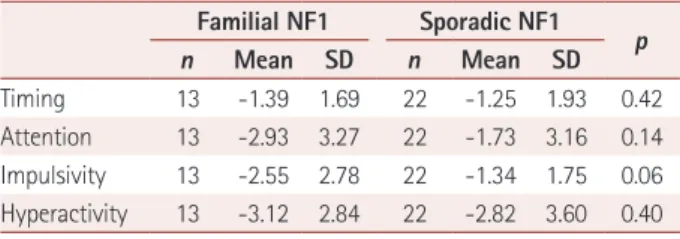
Patients with a family history of NF1 had more impulsivity than patients with sporadic NF1 (Table 4). None of the chil- dren with NF1 incorrectly responded to a non-target stimu- lus on the MOXO.
Parental responses on the DSM-IV questionnaire were available for 32 children. Two children (6%) had an atten- tion deficit only and 15 (47%) had combined attention defi- cit and hyperactivity, with abnormal results found for 9 chil- dren (28%) on the Connors Parent Rating Scale. Teacher responses on the DSM-IV questionnaire were available for 26 children. Four children (15%) had an attention deficit only and 6 (23%) had combined attention deficit and hyperactiv- ity, with abnormal results found for 6 children (23%) on the
Table 2. Neurofibromatosis type 1 score for each index according to sex
Timing Attention Impulsivity Hyperactivity Males
n 16 16 16 16
Mean 179.69 234.94 23.19 50.25
SD 49.01 29.38 9.07 40.94
Females
n 19 19 19 19
Mean 175.47 232.11 18.21 38.42
SD 44.90 30.45 11.51 39.73
Table 1. Mean z-scores for attention deficit hyperactivity disorder pa- rameters in patients with neurofibromatosis type 1 compared to nor- mal values
Timing Attention Impulsivity Hyperactivity
Normal 35 35 35 35
Mean -1.30 -2.17 -1.79 -2.93
SD 1.82 3.21 2.23 3.30
p <0.01 <0.01 <0.01 <0.01
Table 3. Differences in omission errors between children and adolescents with NF1 and ADHD and a standardized control group of children with- out ADHD10,11
Type of distractor
Children without ADHD10,11
Children with NF1 and ADHD (n=25)
Adolescents without ADHD10,11
Adolescents with NF1 and ADHD (n=10)
Mean SD Mean SD p Mean SD Mean SD p
Baseline 0.80 1.30 2.68 2.41 0.33 -0.78 1.80 1.75
n.s.
Visual (simple) 1.19 1.32 5.32 3.33 0.001 0.53 -1.12 2.30 2.40
Visual (complex) 1.18 1.42 4.40 3.80 0.150 0.49 -1.20 1.30 1.82
Auditory (simple) 0.95 1.25 4.24 3.81 0.359 0.33 -1.14 1.40 1.89
Auditory (complex) 0.97 1.39 5.56 4.83 0.045 0.56 -1.17 1.10 1.28
Combined (simple) 1.58 1.64 6.24 4.75 0.004 0.33 -1.40 2.40 3.65
Combined (complex) 1.75 2.17 6.60 5.78 0.009 0.33 -1.11 2.30 2.31
No distractor 1.21 1.95 5.52 5.43 0.165 0.26 -0.58 1.10 1.37
ADHD: attention deficit hyperactivity disorder, NF1: neurofibromatosis type 1.
6–12 yrs 13–18 yrs (%)90
80 70 60 50 40 30 20 10 0
T A I H
Fig. 1. Percentage of neurofibromatosis type 1 patients with z-scores of ≤1.65 according to age. A: attention, H: hyperactivity, I: impulsivity, T: timing.
Evaluation of NF1-ADHD Continuous Performance Test
JCN
Conners Teacher Rating Scale.
DISCUSSION
The present study has shown that patients with NF1 pro- duce abnormal results on the MOXO test, but that the test cannot distinguish them from patients with ADHD without NF1. However, the test identified important sex differences in this population, with males tending to have more impul- sivity and hyperactivity than females but better attention and timing. This contrasts with reports of there being more overall ADHD symptoms in males than females,15 and males having more emotional and prosocial behavior problems.16 A previous study using the Strengths and Difficulties Ques- tionnaire produced similar results.17 Importantly, the MOXO test revealed impairment in reactivity in the presence of visual distractors in children and adolescents with NF1.
Several studies suggest that the cognitive, motor, learning, and social problems often identified in patients with NF1 are not a distinct comorbidity of the disease but rather a di- rect consequence of NF1 pathology.18 Koth et al.19 compared the ADHD status of children with NF1 to that of their healthy siblings and biological parents. They found a significant con- nection between NF1 and ADHD, suggesting that ADHD occurs as a component of the underlying disease. While the mechanism has not been established, researchers seeking a candidate gene for ADHD are focusing on genes involved in cellular growth.20 Accordingly, imaging studies have found cognitive dysfunction, learning disabilities, and attention deficit to be associated with T2 hyperintensities in the thal- amus and other brain areas in children with NF1 but not in children with ADHD.21,22
These findings are consistent with the high rate of omis- sion errors in the presence of visual distractors in our chil- dren/adolescents with NF1. In a related study, Michael et al.23 asked patients with NF1 to locate a target as quickly and as accurately as possible while ignoring any potential dis- tractor that could appear before, simultaneously with, or af- ter the target. They found that during attentive processing, patients with NF1 tended to overreact to or overinspect vi-
sual signals occurring outside the focus of attention. Even though we found an increase in omission errors rather than commission errors in our test, it seems that the visuospatial analysis abilities of NF1 patients are deficient. Other authors have suggested that the poor performance of children with NF1 on visuospatial tasks indicates a deficiency in informa- tion processing in the early visual areas.24 This notion is sup- ported by a functional magnetic resonance imaging (MRI) study of both children and adults with NF1 finding deficient activation of the early visual cortex pathways in response to low-level visual stimulation compared to healthy controls, which was not ameliorated with age.25
Ribeiro et al.26 used encephalography/event-related po- tentials to evaluate the neural mechanism involved in impaired visual responses in children and adolescents with NF1. Ab- normalities were identified in later stages of visual processing in addition to enhanced alpha oscillations, which appears to point to deficits in basic sensory processing. Although the cause of the abnormal alpha rhythm in NF1 was unclear, its possible association with thalamic dysfunction is supported by the known strategic role that the thalamus plays in the gen- eration of normal alpha rhythms27 and the abnormal structure and metabolism of the thalamus in patients with NF1.21,22,28 In the present study, the age-related differences in the visuospatial performance in the MOXO trials could have been due to a maturation delay, as previously suggested in otherwise healthy patients with ADHD,29,30 or it may be related to previously reported reductions over time in T2 hyperintensities in the thalamus and other brain areas.22
In conclusion, patients with NF1 and characteristics of ADHD cannot be distinguished from otherwise healthy chil- dren with ADHD using the MOXO test. However, this test does reveal the significant impairment in response to visual distractors, which improves slightly with age. This might con- stitute part of the attention problem experienced by patients with NF1.
Further investigations are needed in larger numbers of NF1 patients and including comparing these results with MRI findings.
Conflicts of Interest
The authors have no financial conflicts of interest.
REFERENCES
1. Williams VC, Lucas J, Babcock MA, Gutmann DH, Korf B, Maria BL. Neurofibromatosis type 1 revisited. Pediatrics 2009;123:124-133.
2. Rauen KA. The RASopathies. Annu Rev Genomics Hum Genet 2013;
14:355-369.
3. Acosta MT, Bearden CE, Castellanos FX, Cutting L, Elgersma Y, Gioia G, et al. The Learning Disabilities Network (LeaDNet): using neurofi- bromatosis type 1 (NF1) as a paradigm for translational research. Am J Med Genet A 2012;158A:2225-2232.
Table 4. z-scores for attention deficit hyperactivity disorder param- eters according to type of NF1
Familial NF1 Sporadic NF1
n Mean SD n Mean SD p
Timing 13 -1.39 1.69 22 -1.25 1.93 0.42
Attention 13 -2.93 3.27 22 -1.73 3.16 0.14 Impulsivity 13 -2.55 2.78 22 -1.34 1.75 0.06 Hyperactivity 13 -3.12 2.84 22 -2.82 3.60 0.40 NF1: neurofibromatosis type 1.
Cohen R et al.
JCN
4. Payne JM, Hyman SL, Shores EA, North KN. Assessment of execu- tive function and attention in children with neurofibromatosis type 1: relationships between cognitive measures and real-world behavior.
Child Neuropsychol 2011;17:313-329.
5. Centers for Disease Control and Prevention (US). Attention Deficit Hy- peractivity Disorder (ADHD) [Internet]. Atlanta (GA): CDC/National Center for Health Statistics; 2017 [cited 2018 Feb]. Available from:
https://www.cdc.gov/nchs/fastats/adhd.htm.
6. Miguel CS, Chaim-Avancini TM, Silva MA, Louzã MR. Neurofibro- matosis type 1 and attention deficit hyperactivity disorder: a case study and literature review. Neuropsychiatr Dis Treat 2015;11:815-821.
7. Descheemaeker MJ, Plasschaert E, Frijns JP, Legius E. Neuropsycho- logical profile in adults with neurofibromatosis type 1 compared to a control group. J Intellect Disabil Res 2013;57:874-886.
8. Neurofibromatosis. Conference statement. National Institutes of Health Consensus Development Conference. Arch Neurol 1988;45:575-578.
9. Conners CK. Conners Comprehensive Behavior Rating ScalesTM. New York: Multi-Health Systems Inc., 2008.
10. Berger I, Goldzweig G. Objective measures of attention-deficit/hy- peractivity disorder: a pilot study. Isr Med Assoc J 2010;12:531-535.
11. Berger I, Slobodin O, Cassuto H. Usefulness and validity of continu- ous performance tests in the diagnosis of attention-deficit hyperac- tivity disorder children. Arch Clin Neuropsychol 2017;32:81-93.
12. Berger I, Cassuto H. The effect of environmental distractors incorpo- ration into a CPT on sustained attention and ADHD diagnosis among adolescents. J Neurosci Methods 2014;222:62-68.
13. Cassuto H, Ben-Simon A, Berger I. Using environmental distractors in the diagnosis of ADHD. Front Hum Neurosci 2013;7:805.
14. Dixon WJ. BMPD Statistical Software Manual. Berkeley: University of California Press, 1990.
15. Ramtekkar UP, Reiersen AM, Todorov AA, Todd RD. Sex and age dif- ferences in attention-deficit/hyperactivity disorder symptoms and di- agnoses: implications for DSM-V and ICD-11. J Am Acad Child Ado- lesc Psychiatry 2010;49:217-228.
16. Nøvik TS, Hervas A, Ralston SJ, Dalsgaard S, Rodrigues Pereira R, Lorenzo MJ; ADORE Study Group. Influence of gender on attention- deficit/hyperactivity disorder in Europe--ADORE. Eur Child Adolesc Psychiatry 2006;15 Suppl 1:I15-I24.
17. Cohen R, Steinberg T, Kornreich L, Aharoni S, Halevy A, Shuper A.
Brain imaging findings and social/emotional problems in Israeli chil- dren with neurofibromatosis type 1. Eur J Pediatr 2015;174:199-203.
18. Lidzba K, Granström S, Lindenau J, Mautner VF. The adverse influence
of attention-deficit disorder with or without hyperactivity on cognition in neurofibromatosis type 1. Dev Med Child Neurol 2012;54:892-897.
19. Koth CW, Cutting LE, Denckla MB. The association of neurofibroma- tosis type 1 and attention deficit hyperactivity disorder. Child Neuro- psychol 2000;6:185-194.
20. Huijbregts S. Cognitive-behavioral phenotype or comorbid disorder?
The case of attention-deficit-hyperactivity disorder in neurofibroma- tosis type 1. Dev Med Child Neurol 2012;54:873-874.
21. Denckla MB, Hofman K, Mazzocco MM, Melhem E, Reiss AL, Bryan RN, et al. Relationship between T2-weighted hyperintensities (un- identified bright objects) and lower IQs in children with neurofibro- matosis-1. Am J Med Genet 1996;67:98-102.
22. Hyman SL, Gill DS, Shores EA, Steinberg A, North KN. T2 hyperin- tensities in children with neurofibromatosis type 1 and their relation- ship to cognitive functioning. J Neurol Neurosurg Psychiatry 2007;78:
1088-1091.
23. Michael GA, Garcia S, Herbillon V, Lion-François L. Reactivity to vi- sual signals in neurofibromatosis type 1: is everything ok? Neuropsy- chology 2014;28:423-428.
24. Clements-Stephens AM, Rimrodt SL, Gaur P, Cutting LE. Visuospa- tial processing in children with neurofibromatosis type 1. Neuropsy- chologia 2008;46:690-697.
25. Violante IR, Ribeiro MJ, Cunha G, Bernardino I, Duarte JV, Ramos F, et al. Abnormal brain activation in neurofibromatosis type 1: a link between visual processing and the default mode network. PLoS One 2012;7:e38785.
26. Ribeiro MJ, d’Almeida OC, Ramos F, Saraiva J, Silva ED, Castelo-Bran- co M. Abnormal late visual responses and alpha oscillations in neuro- fibromatosis type 1: a link to visual and attention deficits. J Neurodev Disord 2014;6:4.
27. Hughes SW, Crunelli V. Just a phase they’re going through: the com- plex interaction of intrinsic high-threshold bursting and gap junctions in the generation of thalamic alpha and theta rhythms. Int J Psycho- physiol 2007;64:3-17.
28. Payne JM, Moharir MD, Webster R, North KN. Brain structure and function in neurofibromatosis type 1: current concepts and future di- rections. J Neurol Neurosurg Psychiatry 2010;81:304-309.
29. Berger I, Slobodin O, Aboud M, Melamed J, Cassuto H. Maturational delay in ADHD: evidence from CPT. Front Hum Neurosci 2013;7:691.
30. Shaw P, Malek M, Watson B, Sharp W, Evans A, Greenstein D. Devel- opment of cortical surface area and gyrification in attention-deficit/
hyperactivity disorder. Biol Psychiatry 2012;72:191-197.