Introduction
CP (Cerebral palsy) is caused by posture disorders in daily life and brain malformation or damage during early development [1]. CP is associated with motor impairment and disability throughout life [2]. CP is accompanied by cognitive, motor, and sensory disorders [3]. Movement disorders are often accompanied by cognitive, sensory, and perceptual deficits and communication [4]. Treatment options include physiotherapy; occupational therapy;
hippotherapy; orthotics/casting, and postural manage- ment [5]. Appropriate evaluation and treatments can
favorably influence prognostic outcomes; thus, several techniques have been developed to evaluate gait function and efficiency [6].
Difficulty with walking is considered the important consequence of CP [7]. Gait speed, stride length, step length, and cadence are important indicators of quality of life and functional mobility [8]. Gait training using the principle of improving neuroplasticity in task-specific training is effective in the rehabilitation process [9]. The gait rehabilitation method in patients with neurological disorders relies on technical devices to induce gait in patients with weight support and emphasizes the
Received: Feb 2, 2021 Revised: Mar 15, 2021 Accepted: Mar 16, 2021
Corresponding author: Sukmin Lee (ORCID https://orcid.org/0000-0002-6062-956X)
Department of Physical Therapy, College of Health and Welfare, Sahmyook University, Cheongnyangni P.O.Box 118 Seoul 130-650 Republic of Korea Tel: (82 for International)-02-3399-1632 Fax: 02-3399-1639 E-mail: [email protected]
This is an Open-Access article distributed under the terms of the Creative Commons Attribution Non-Commercial License (http://creativecommons.org/licenses/
by-nc/4.0) which permits unrestricted non-commercial use, distribution, and reproduction in any medium, provided the original work is properly cited.
Copyright © 2021 Korean Academy of Physical Therapy Rehabilitation Science
Electromechanically assisted walking in patients with cerebral palsy: A meta-analysis
Kwonhoi Kim
a, Sukmin Lee
b4)aTeam of physical therapy, Catholic University Uijeongbu ST Mary’s Hosipital, Uijeongbu, Republic of Korea bDepartment of Physical Therapy, College of Health and Welfare, Sahmyook University, Seoul, Republic of Korea
Objective: This review aims to analyze the effects of electromechanically assisted walking in patients with cerebral palsy(CP).
Design: A systematic review and meta-analysis.
Methods: We reviewed systematically using the PRISMA (Preferred Reporting Items for Systematic Reviews and Meta-Analyses) checklist guidelines. The inclusion criteria for this study were all CP patients. The intervention was electromechanically assisted walking. The outcome measures included gait parameters, function, spasticity. Studies excluded from this review were excluded from the review if they were non-English languages and if the study was not published as a full report, and if they were not randomized controlled trials (RCTs) designs. The RevMan 5.4 program was used to evaluate and explain the results. The risk of bias was evaluated independently by two reviewers. The quantitative meta-analysis, including mean differences (MD) and associated standard deviations (SD) from baseline and follow-up assessments, were recorded.
Results: A total of 634 articles were searched. Two hundred eighty-nine duplicate articles were excluded, and 345 of 634 originals were left for selection. Of these 74 papers, 44 were out of topic, and 19 reported no mean or standard deviation values.
And one was a non-experimental study. Finally, ten studies were included. All 10 RCTs of electromechanically assisted walking were analyzed. The meta-analysis showed a significant improvement in gait cycle (95% CI (confidence intervals), 0.09 to 0.19, I2=0%), Gross Motor Function Measure (GMFM) D (95% CI, 3.27 to 13.17, I2=0%) and GMFM E (95% CI, 0.22 to 6.41, I2=0%).
Conclusions: Electromechanically assisted training helps in walking in patients with CP.
Key Words: Cerebral palsy, Walking, Meta-analysis, Electromechanical pISSN 2287-7576
eISSN 2287-7584
2021, 10(1), 22-31 www.jptrs.org
beneficial role of repetitive exercises [10].
In recent years, robotic systems have been used as part of rehabilitation, developing stance, balance, and movement and promoting cortical reorganization through concentration, control, repetition, and motor learning [11]. The potential benefit of the robotic device is that the robotic walker moves the patient's posture and supports the posture, so there is less risk to users and trainers, and the treatment time can be used more efficiently [12]. There is also robotic equipment, as well as a variety of other mechanical approaches to assisting gait. For example, neuromuscular electrical stimulation (NMES) assisted gait is a development technique that demonstrates its potential as an effective and cost- effective treatment for gait disorders in patients with spastic CP [13].
A meta-analysis of robot gait training in patients with cerebral palsy [14] and a systematic review of robot- assisted gait training for pediatric gait disorders have been previously reported [15]. However, a meta-analysis of the use of robots and other mechanical assistive approaches has not been reported. This review aims to analyze the effects of electromechanically assisted walking in patients with CP.
Methods
Selection of Studies
We reviewed systematically using the PRISMA (Preferred Reporting Items for Systematic Reviews and Meta-Analyses) checklist guidelines [30]. The study was approved by the Research Ethics Committee of Sahmyook University (2-7001793-AB-N-012019082HR).
The inclusion criteria for this study were all CP patients. The intervention used in the study was electromechanically assisted walking. The outcome measures included gait parameters, function, spasticity.
Studies excluded from this review were excluded from the review if they were non-English languages and if the study was not published as a full report, and if they were not randomized controlled trials (RCTs) designs.
The protocol has been pre-registered with PROPERO (CRD42020140076). We searched for studies in EMBASE, PubMed, and Cochrane databases. The search was conducted in April 2019. In EMBASE, ('Cerebral palsy') AND ('Robotics' OR 'Automation' OR 'gait' OR
'walking' OR 'locomotion') AND ('randomized controlled trial') PubMed and Cochrane Library CENTRAL databases were made using the MeSH keywords. See the Appendix for a detailed example of search strategies for EMBASE and Cochrane Library CENTRAL databases.
Quality assessment
The risk of bias was evaluated independently by two reviewers. We independently assessed the risk of bias of individual studies. We assessed by using the Cochrane’s Risk of Bias tool (random sequence generation, allocation concealment, blinding of participants and personnel, blinding of outcome assessment, incomplete outcome data, selective reporting, and other forms of bias) [29]. The RevMan 5.4 program was used to evaluate and explain the results.
Data extraction
We used a search strategy to search and select to include titles and abstracts of studies from additional sources. The deduplication was removed and reviewed concerning the inclusion and exclusion criteria. Two reviewers cross-checked the included studies. The quantitative meta-analysis, including mean differences (MD) and associated standard deviations (SD) from baseline and follow-up assessments, were recorded; any disagreements over study selection and data extraction were discussed by both reviewers.
Data Analysis
Meta-analysis was performed using the Cochrane Library's RevMan 5.4 program. To evaluate the effect estimates for the selected RCTs, the mean and standard deviation values were. A random-effects model was used. Homogeneity was confirmed with the I
2test. An I
2value of 0% indicates no heterogeneity, 30–60%
indicates moderate heterogeneity, and 75% indicates severe heterogeneity[29]. The meta-analysis were gait parameters, MAS (Modified Ashworth Scale), and GMFM (Gross Motor Function Measure) dimensions D and E.
Results
Study Selection
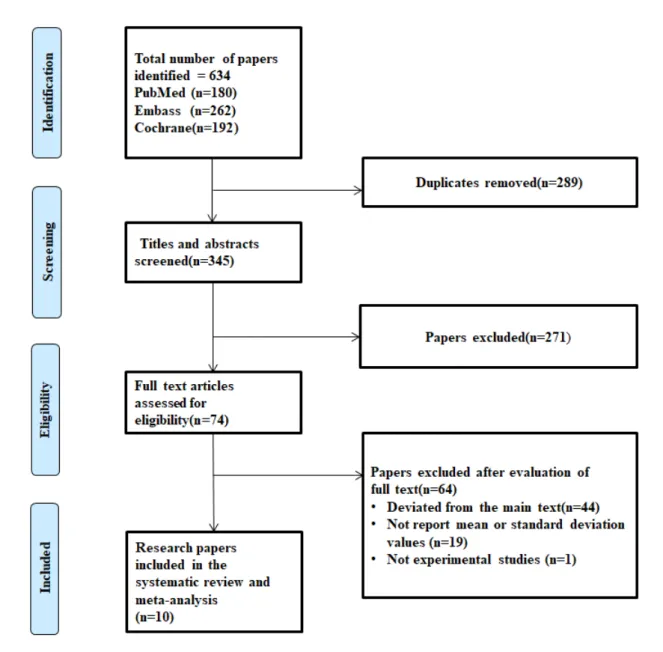
A total of 634 articles were searched in the PubMed,
EMBASE, and Cochrane databases. Two hundred eighty-
nine duplicate articles were excluded, and 345 of 634 originals were left for selection. Of these 74 papers, 44 were out of topic, and 19 reported no mean or standard deviation values. And one was a non-experimental study.
Ten studies were finally selected. Ten studies have met all inclusion and exclusion criteria (Figure 1).
Assessment of quality
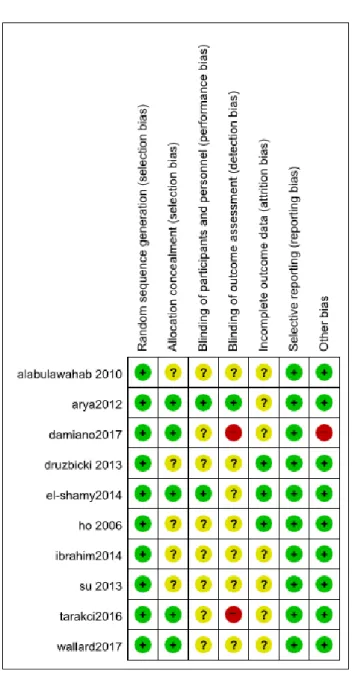
In five studies, the allocation concealment was described, and in two papers, blinding of the participants and personnel was considered low. Concerning the blinding of outcome assessment data, two articles were shown to have a high bias. Other biases were shown to have a high degree of bias. All ten studies had a low risk
of reporting bias (Figure 2).
Study characteristics
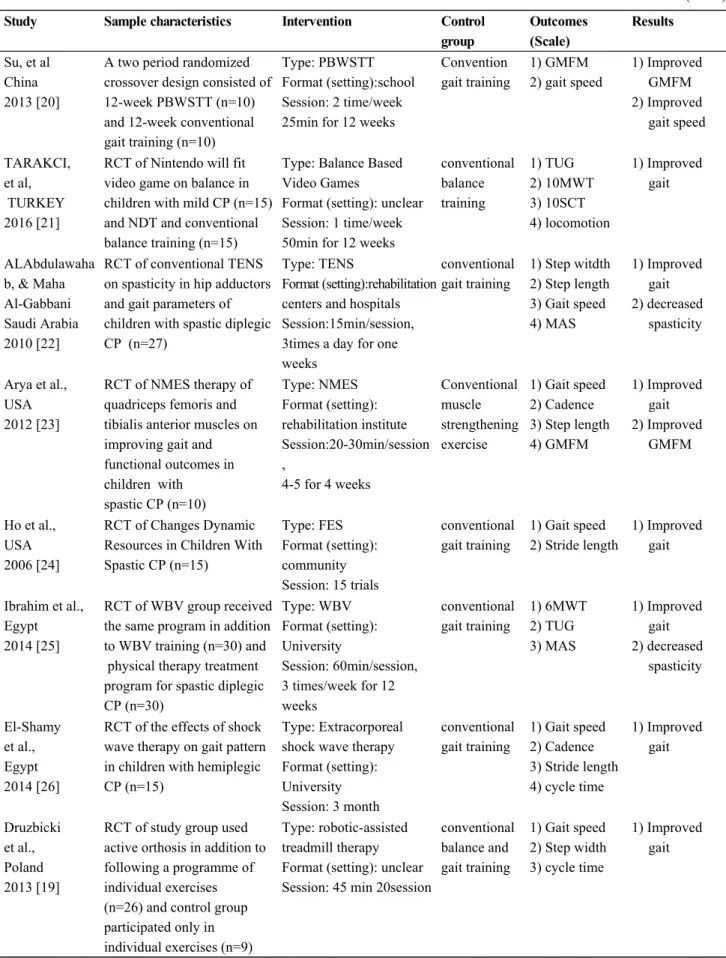
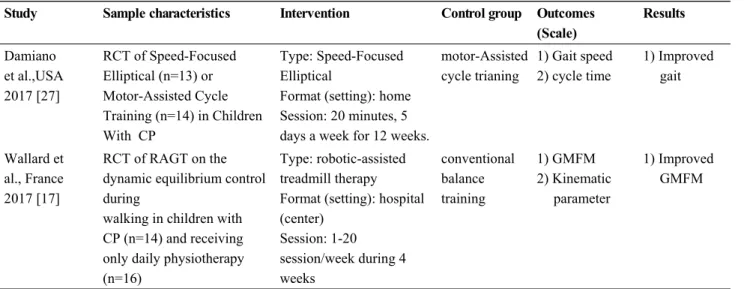
In this study, all 10 RCTs [17, 19-27] of electrome- chanically assisted w alking w ere analyzed. T he interventions used in the electromechanical device:
robotic-assisted treadmill, NMES, Partial body weight- supported treadmill training (PBWSTT), balance-based video gam es, Transcutaneous Electrical N erve Stimulation (TENS), Functional Electrical Stimulation (FES), whole-body vibration (WBV), extracorporeal shock wave, and speed-focused elliptical (Table 1). [17, 19-27]
Figure 1. PRISMA flow diagram
Figure 2. Methodological evaluation
Meta-analysis
In this study, all 10 RCTs [17, 19-27] of electrome- chanically assisted walking in patients with cerebral palsy were analyzed.
Gait parameters
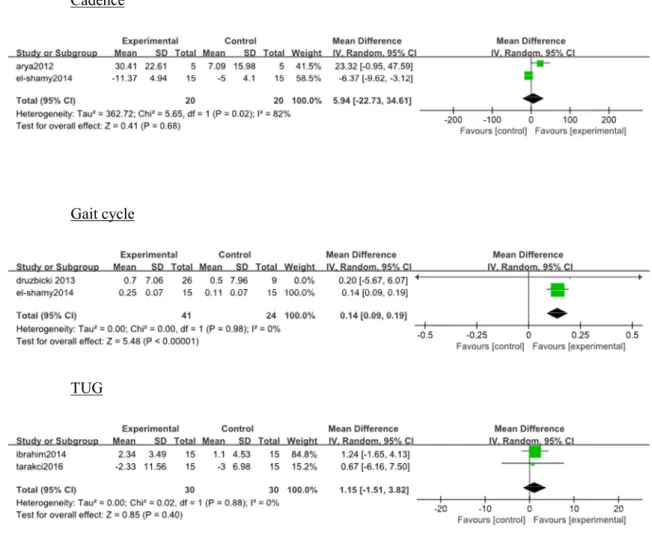
Gait parameters were reported in nine studies.
[19-27] For seven parameters, a meta-analysis could be performed The meta-analysis showed a significant improvement in gait cycle (95% CI, 0.09 to 0.19, I
2=0%). The meta-analysis showed on walking speed (95% CI, -0.09 to 0.22, I
2=58%), step length (95% CI, -2.41 to 6.75, I
2=60%), cadence (95% CI, -22.73 to
34.61, I
2=82%), Timed Up and Go Test (95% CI, -1.51 to 3.82, I
2=0%), step width (95% CI, -1.00 to 1.54, I
2=35%), or stride length (95% CI, -0.15 to 0.38, I
2=70%) (Figure 3).
GMFM
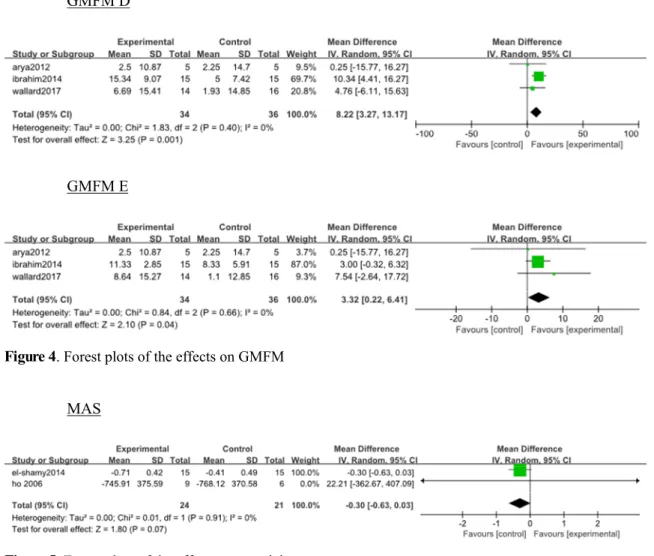
The GMFM was reported in three studies [17, 23, 25], with a total of eight different gait parameters. For two dimensions of the GMFM, a meta-analysis could be performed. The meta-analysis revealed significant improvements in GMFM D (95% CI, 3.27 to 13.17, I
2=0%) and GMFM E (95% CI, 0.22 to 6.41, I
2=0%) (Figure 4).
Spasticity
Spasticity was reported in two studies. [24, 26] The meta-analysis showed in the MAS (p=0.07, I
2=0%) (Figure 5).
Discussion
This review aims to analyze the effects of electro- mechanically assisted walking in patients with CP and the first meta-analysis.
One previous meta-analysis analyzed RAGT (robot-assisted gait training) effect on pediatric gait disorders patients. RAGT may help children with gait impairment, especially those with CP [15]. In another meta-analysis, RAGT benefits people with cerebral palsy, specifically by increasing walking ability [14].
However, unlike previous studies, we focused on electromechanically assisted walking, including RAGT, as well as other approaches. A meta-analysis of electromechanically assisted walking following stroke found aid walking [28]. Our results were also shown to aid walking in Electromechanically assisted training.
Walking in cerebral palsy is impaired by the effects of the disease on constant movement and posture [16].
Electromechanically assisted training has great
advantages in aiding posture and walking and moves
similar to typical walking patterns [17]. To improve
walking ability, one can train patients efficiently with
repeated electromechanically assisted training. However,
electromechanically assisted training needs to walk with
equipment, leading to limitations related to cost and
locations where the equipment can be used [18].
Study Sample characteristics Intervention Control group
Outcomes (Scale)
Results
Su, et al China 2013 [20]
A two period randomized crossover design consisted of 12-week PBWSTT (n=10) and 12-week conventional gait training (n=10)
Type: PBWSTT Format (setting):school Session: 2 time/week 25min for 12 weeks
Convention gait training
1) GMFM 2) gait speed
1) Improved GMFM 2) Improved
gait speed
TARAKCI, et al, TURKEY 2016 [21]
RCT of Nintendo will fit video game on balance in children with mild CP (n=15) and NDT and conventional balance training (n=15)
Type: Balance Based Video Games
Format (setting): unclear Session: 1 time/week 50min for 12 weeks
conventional balance training
1) TUG 2) 10MWT 3) 10SCT 4) locomotion
1) Improved gait
ALAbdulawaha b, & Maha Al-Gabbani Saudi Arabia 2010 [22]
RCT of conventional TENS on spasticity in hip adductors and gait parameters of children with spastic diplegic CP (n=27)
Type: TENS
Format (setting):rehabilitation centers and hospitals Session:15min/session, 3times a day for one weeks
conventional gait training
1) Step witdth 2) Step length 3) Gait speed 4) MAS
1) Improved gait 2) decreased
spasticity
Arya et al., USA 2012 [23]
RCT of NMES therapy of quadriceps femoris and tibialis anterior muscles on improving gait and functional outcomes in children with
spastic CP (n=10)
Type: NMES Format (setting):
rehabilitation institute Session:20-30min/session ,
4-5 for 4 weeks
Conventional muscle strengthening exercise
1) Gait speed 2) Cadence 3) Step length 4) GMFM
1) Improved gait 2) Improved
GMFM
Ho et al., USA 2006 [24]
RCT of Changes Dynamic Resources in Children With Spastic CP (n=15)
Type: FES Format (setting):
community Session: 15 trials
conventional gait training
1) Gait speed 2) Stride length
1) Improved gait
Ibrahim et al., Egypt 2014 [25]
RCT of WBV group received the same program in addition to WBV training (n=30) and physical therapy treatment program for spastic diplegic CP (n=30)
Type: WBV Format (setting):
University
Session: 60min/session, 3 times/week for 12 weeks
conventional gait training
1) 6MWT 2) TUG 3) MAS
1) Improved gait 2) decreased
spasticity
El-Shamy et al., Egypt 2014 [26]
RCT of the effects of shock wave therapy on gait pattern in children with hemiplegic CP (n=15)
Type: Extracorporeal shock wave therapy Format (setting):
University Session: 3 month
conventional gait training
1) Gait speed 2) Cadence 3) Stride length 4) cycle time
1) Improved gait
Druzbicki et al., Poland 2013 [19]
RCT of study group used active orthosis in addition to following a programme of individual exercises (n=26) and control group participated only in individual exercises (n=9)
Type: robotic-assisted treadmill therapy Format (setting): unclear Session: 45 min 20session
conventional balance and gait training
1) Gait speed 2) Step width 3) cycle time
1) Improved gait
Table 1. Characteristics of Included Studies (n=10)
Study Sample characteristics Intervention Control group Outcomes (Scale)
Results