Brief Report
Vol. 29, No. 4, 2017
519
Received August 5, 2016, Revised August 18, 2016, Accepted for publication August 22, 2016
*These authors contributed equally to this work and should be considered co-corresponding authors.
Corresponding author: Hye One Kim, Department of Dermatology, Hallym University Kangnam Sacred Heart Hospital, 1 Singil-ro, Yeongdeungpo-gu, Seoul 07441, Korea. Tel: 82-2-829-5221, Fax: 82-2-832-3237, E-mail:
Chun Wook Park, Department of Dermatology, Hallym University Kangnam Sacred Heart Hospital, 1 Singil-ro, Yeongdeungpo-gu, Seoul 07441, Korea. Tel: 82-2-829-5221, Fax: 82-2-832-3237, E-mail: dermap@
hanmail.net
This is an Open Access article distributed under the terms of the Creative Commons Attribution Non-Commercial License (http://creativecommons.
org/licenses/by-nc/4.0) which permits unrestricted non-commercial use, distribution, and reproduction in any medium, provided the original work is properly cited.
Copyright © The Korean Dermatological Association and The Korean Society for Investigative Dermatology
https://doi.org/10.5021/ad.2017.29.4.519
A Case of Eccrine Spiradenoma: A Rarely Seen Soft Tissue Tumor on the Extensor Surface of Arm
Jee Hee Son, Yong Won Choi, Yong Se Cho, Yun Sun Byun, Bo Young Chung, Hee Jin Cho
1, Hye One Kim*, Chun Wook Park*
Department of Dermatology, Hallym University Kangnam Sacred Heart Hospital, Seoul, 1Department of Dermatology, Hallym University Chuncheon Sacred Heart Hospital, Chuncheon, Korea
Dear Editor:
A 40-year-old man presented with a nodule on the ex- tensor surface of his left forearm. He couldn’t remember when it formed. Initially, it showed no symptoms but with time, became painful. Physical examination revealed a slightly bluish to skin colored, hard mobile nodule on the left forearm measuring 1×1 cm in size (Fig. 1A). The ini- tial clinical suspicion was epidermal cyst, trichilemmal cyst, or lipoma; thus, ultrasonography (US) was done. US results indicated a well-defined oval isoechoic mass in the subcutaneous fat layer, with moderate hyperemia (Fig.
1B). A complicated epidermoid cyst, or other hypervascular mass, such as vascularized leiomyoma or (least likely) a sarcoma (e.g., malignant fibrous histiocytoma) was suspected.
Excisional biopsy was performed. Microscopic examina- tion showed a deep, well-defined tumor with basophilic lobules, encapsulated by thick connective tissue in the dermis and subcutaneous layer. A trabecular arrangement of basophilic cells was present (Fig. 1C). Two types of
cells (small, dark, basaloid cells with hyperchromatic nu- clei, and cells with large, pale, ovoid nuclei) were seen (Fig. 1D). The diagnosis was confirmed as eccrine spi- radenoma (ES). The tumor was completely excised.
ES is a rare benign soft tissue tumor first described by Kersting and Helwig (1956). It may occur at any age, but typically affects young adults aged 15∼35 years, with no sexual predilection
1. It presents as a solitary mass lo- calized in the skin and subcutaneous tissue, smaller than 1 cm in size. Paroxysmal pain and tenderness may often present
2. It tends to arise on the upper part of the body;
head, neck, and trunk, especially ventral portion
1. Rarely, it may be located on the upper and lower extremities, es- pecially dorsal portion
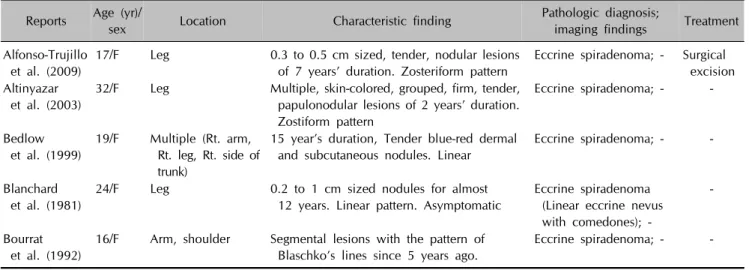
3. The summarization of the pre- viously reported cases on extremities was described in Table 1. ES lesions are mostly solitary, but rarely multiple, linear, blaschkoid, or grouped. The pathogenesis is thought to be related to differentiation, mainly of the se- cretory portion of the secretory coil of eccrine sweat glands
2,4. The presence of myoepithelial cells and phos- phorylase, demonstrate the eccrine origin of the tumor.
However, several evidences suggest its origin is apocrine
rather than eccrine
4. It is sometimes associated with tri-
choepithelioma and cylindroma, tumors of apocrine or
folliculosebaceous-apocrine origin. US study revealed a
well-demarcated mass with lobulated contours, which
didn’t have any relation with the epidermis and didn’t ex-
tend into the neighboring muscular tissues. It was lo-
calized in the superficial part of the subcutaneous tissue
3,5.
When the mass shows well-defined hypoechogenicity, hy-
pervascularity, no cystic portion, no hypoechoic scar, and
when it is deeply located, an ES can be highly consid-
ered
5. The essential histologic features include sharply de-
marcated nodules of basaloid cells in the dermis or in sub-
cutaneous tissue (blue balls)
5. Basaloid cells are composed
of two types which might not be so apparent: one is paler,
Brief Report
520
Ann DermatolFig. 1. (A) A solitary, mild bluish to skin-colored, hard mobile nodule on the extensor surface of the left forearm measuring 1×1 cm (black arrow). (B) Using ultrasonography, a well-defined oval isoechoic mass of about 10×7×10 mm, with moderate hyperemia, was determined in the subcutaneous fat layer on the left forearm. (C) Deep well-defined multinodular tumor with basophilic lobules encapsulated by thick connective tissue in the dermis and subcutaneous layer. A trabecular arrangement or clusters of deep basophilic cells were present (H&E, ×40). (D) In the nodule, two types of cells (small, dark, basaloid cells with hyperchromatic nuclei, and cells with large, pale, vesicular, and ovoid nuclei) were seen. The center of the lesions was composed of pale cells and duct like structures. The mitotic activity was low and there was no necrosis (H&E, ×200).
Table 1. Reported cases with eccrine spiradenoma developed on extremities Reports Age (yr)/
sex Location Characteristic finding Pathologic diagnosis;
imaging findings Treatment Alfonso-Trujillo
et al. (2009)
17/F Leg 0.3 to 0.5 cm sized, tender, nodular lesions of 7 years’ duration. Zosteriform pattern
Eccrine spiradenoma; - Surgical excision Altinyazar
et al. (2003)
32/F Leg Multiple, skin-colored, grouped, firm, tender, papulonodular lesions of 2 years’ duration.
Zostiform pattern
Eccrine spiradenoma; - -
Bedlow et al. (1999)
19/F Multiple (Rt. arm, Rt. leg, Rt. side of trunk)
15 year’s duration, Tender blue-red dermal and subcutaneous nodules. Linear
Eccrine spiradenoma; - -
Blanchard et al. (1981)
24/F Leg 0.2 to 1 cm sized nodules for almost 12 years. Linear pattern. Asymptomatic
Eccrine spiradenoma (Linear eccrine nevus with comedones); -
-
Bourrat et al. (1992)
16/F Arm, shoulder Segmental lesions with the pattern of Blaschko’s lines since 5 years ago.
Eccrine spiradenoma; - -
Brief Report
Vol. 29, No. 4, 2017
521
Table 1. ContinuedReports Age (yr)/
sex Location Characteristic finding Pathologic diagnosis;
imaging findings Treatment Brahim
et al. (2009)
75/M Rt. shoulder A well-defined, motile, firm 5.0×4.0 cm sized nodule. Tender in pressure.
A 6-year history of a recurrent mass that was removed 2 years ago
Eccrine spiradenoma, recurrent malignant eccrine spiradenoma; -
Surgical resection
Braun-Falco et al. (2003)
23/F Multiple (Lt. lower leg)
1.5 cm sized multiple nodules almost covering the frontal aspects of lower leg for almost 8 years without obvious change. Linear. Occasionally tender
Eccrine spiradenoma (focal malignant transformation); -
Surgical resection
Criton et al. (1996)
11/M Multiple (Lt. arm, Lt. leg, chest)
0.4 to 1.0 cm sized painful tender skin colored papule of duration of 4 years. Zostiform pattern
Eccrine spiradenoma; - -
Englander et al. (2011)
55/M Multiple
(Rt. chest, Rt. arm)
0.5 to 6.0 cm sized multiple, well-circumscribed, subcutaneous, blue-grey nodules in dermatomal distribution of 20 years’ duration.
Painful
Eccrine spiradenoma; - Surgical resection
Fahy et al. (1987)
37/F Rt. hand A 3.5×2.0 cm sized firm, non-tender swelling, of two years’ duration, situated just distal to the right anatomical snuff-box
Eccrine spiradenoma; - Surgical excision
Han
et al. (2007)
24/F Multiple
(face, neck, chest, extremities)
0.3∼2.0 cm sized well-defined nodules. Zosteriform. Painless
Eccrine spiradenoma;
MRI, low SI in T1WI, high SI in STIR
-
Hashimoto et al. (1966)
15/F Forearm Segmental patterned lesions with 7 years’ duration. Asymptomatic
Eccrine spiradenoma; - - Hemalatha
et al. (2015)
80/F Rt. upper thigh A 1.75×0.75 cm sized painless raised blue to blackish lesion on thigh.
Non-tender with smooth surface
Eccrine spiradenoma; - Surgical excision Ikeya
et al. (1987)
37/F Face, trunk, arm 0.1 to 0.8 cm sized multiple papular lesions of 30 years’ duration. Linear pattern
Eccrine spiradenoma; - -
Jin
et al. (2008)
34/F Lt. upper arm A 1.8×1.7×1.1 cm sized firm nodular mass on the distal portion of the left upper arm, of approximately 5 years’ duration. Painful
Eccrine spiradenoma; US, well-defined lobulating mass, vascularity(+), heterogeneous hypoechogenicity
Surgical excision
Laura et al. (2011)
55/M Multiple
(Rt. arm, Rt. chest)
0.5 to 6 cm sized multiple, well-circumscribed, subcutaneous, blue-grey nodules of 20 years’
duration. Painful
Eccrine spiradenoma; - Surgical excision
Martinez et al. (1992)
48/F Multiple (Lt. leg)
0.2 to 0.6 cm sized multiple papulonodular blue-pink colored lesions appeared 18 years earlier.
Asymptomatic. Tender with a firm, elastic consistency
Multiple linear cylindromas overlapping features with eccrine spiradenoma; -
Regular follow-up
Nath et al. (2009)
14/M Rt. lower leg A 0.5 to 1.0 cm sized multiple nodules on the posterior aspect of the entire length of the right lower limb since 2 years of age. Linear pattern (Blashkoid distribution).
Painful
Eccrine spiradenoma with chondroid syringoma;
US, dermal tumors, normal vessels of the lower limb, no connection with the underlying vessels and the tumors
Surgical excision
Brief Report
522
Ann Dermatol Table 1. ContinuedReports Age (yr)/
sex Location Characteristic finding Pathologic diagnosis;
imaging findings Treatment Noto
et al. (1994)
16/F Multiple (Rt. leg, Rt. face, Rt. neck, Rt. trunk)
0.5 to 5.0 cm sized nodules, observed since birth. Bluegray to bright red colored painful papulonodular lesions. Linear nevoid pattern. Painful
Linear eccrine spiradenoma; - -
Ohtsuka et al. (2002)
47F Multiple (Rt. finger, Rt. hand, Rt.
forearm)
0.7 to 2.0 cm sized linear, nontender lesions of 30 years’ duration.
Localized pattern
Eccrine spiradenoma; - Surgical excision Shaikh-Naidu
et al. (2003)
34/F Multiple (Rt.
forearm)
10×2 cm area of 12 subcutaneous nodules with overlying cutaneous scar and bluish discoloration. Previously sustained a superficial abrasion.
Linear. Mild discomfort
Eccrine spiradenoma; - Surgical excision
Siegel et al. (2008)
40/M Rt. hand A 6.0×4.0 cm sized slightly mobile, painless mass of 20 years’ duration.
No lymphadenopathy
Giant eccrine spiradenoma; MRI, high heterogenous
SI in T1WI
Surgical resectio n Tsur
et al. (1981)
35/M Multiple (Lt. arm) 1 to 5 cm size. 26 years of duration.
Bluish and shiny with congested blood vessels. Some tumors attached by short broad stalk. Linear pattern.
Painful
Eccrine spiradenoma; - Surgical resectio n
Yamakoshi et al. (2008)
76/M Rt. upper arm A 5.0×3.4×2.6 cm sized pale red pedunculated tumor with erosive surface. No symptom except for bleeding
Giant vascular eccrine spiradenoma; Enhanced CT, high-density nodules in the peripheral region and the central region with low density and no enhancement
Surgical excision
F: female, M: male, Rt.: right, Lt.: left, -: absent or not available, MRI: magnetic resonance imagning, SI: signal intensity, WI: weighted image, STIR: short tau inversion recovery, US: ultrasonography, CT: computed tomography.
with more cytoplasm than in the darker cells
1. Malignant change is rare
2. However, in cases with incomplete surgi- cal removal, a high risk of local recurrence has been re- ported
2,5. Early and complete surgical excision is the diag- nostic tool and curative treatment option for ES
2.
ACKNOWLEDGMENT
This study was supported by grants of the National Research Foundation of Korea (NRF), funded by the Ministry of Science, ICT & Future Planning (NRF- 2017R1A2B4006252), Korea Healthcare technology R&D project, funded by Ministry of Health & Welfare, Republic of Korea (HI17C0597), and the Hallym University Resear- ch Fund (HURF-2017-35).
CONFLICTS OF INTEREST
The authors have nothing to disclose.
REFERENCES
1. Park YS, Lee HE, Bang DS. A Case of Eccrine Spiradenoma.
Korean J Dermatol 1983;21:483-487.
2. Ishikawa M, Nakanishi Y, Yamazaki N, Yamamoto A.
Malignant eccrine spiradenoma: a case report and review of the literature. Dermatol Surg 2001;27:67-70.
3. Balaban M, Idilman IS, Unal O, Dumlu EG, Yazgan A, Ipek A. Sonographic and sonoelastographic findings of a rarely seen soft tissue tumor: eccrine spiradenoma. J Med Ultrason (2001) 2015;42:587-590.
4. Kim MH, Cho E, Lee JD, Cho SH. Giant vascular eccrine spiradenoma. Ann Dermatol 2011;23(Suppl 2):S197-S200.
5. Jin W, Kim GY, Lew BL, Yang DM, Kim HC, Ryu JK, et al.
Sonographic findings of an eccrine spiradenoma: case report and literature review. J Ultrasound Med 2008;27:813-818.