Journal of the Korean Chemical Society 2011, Vol. 55, No. 2
Printed in the Republic of Korea DOI 10.5012/jkcs.2011.55.2.153
-153-
속 보
우수한 항균 활성을 나타내는 aryl phenyl ether pyrazole 계 화합물의 합성
Jagdamba Singh, Pankaj Kumar Verma, Kamleshwar Tiwari, and Shyam Babu Singh*
Environmentally Benign Synthesis Lab, Department of Chemistry, University of Allahabad, Allahabad-211002 India (접수 2010. 8. 21; 수정 2010. 10. 18; 게재확정 2010. 11. 6)
Synthesis of Novel Pyrazole Derivative Containing Aryl Phenyl Ether as Potential Antifungal Agent
Jagdamba Singh, Pankaj Kumar Verma, Kamleshwar Tiwari, and Shyam Babu Singh* Environmentally Benign Synthesis Lab, Department of Chemistry, University of Allahabad, Allahabad-211002 India
*E-mail: [email protected]
(Received August 21, 2010; Revised October 18, 2010; Accepted November 6, 2010)
주제어: 피라졸, 이미다졸, aryl phenyl ether, 살균제
Keywords: Pyrazole, imidazole, aryl phenyl ether, fungicides
The incidence of invasive fungal infections caused by opportunistic pathogens, often characterized by high mor- tality rates, has been increasing over the past two decades.
Patients that become severely immunocompromised because of underlying diseases such as leukemia or, recently, acquired immunodeficiency syndrome or patients who undergo cancer chemotherapy or organ transplantation are particularly susceptible to opportunistic fungal infec- tions.1 A matter of concern in the treatment of fungal infections is the limited number of efficacious antifungal drugs. Many of the currently available drugs are toxic, produce recurrence because they are fungistatic and not fungicides or lead to the development of resistance due in part to the prolonged periods of administration of the available antifungal drugs. There is, therefore, a clear need for the discovery of new structures with antifungal prop- erties, which could lead to the development of new drugs for the management of fungal infections and treatment of systemic mycoses.2
Up to only 30 years ago the choice of systemically available antimycotics was between two drugs, amphot- ericin B and flucytosine, neither of which was satisfac- tory. Then a series of inhibitors of the biosynthesis of ergosterol, the major sterol of the fungal cell membrane, were found to have excellent antifungal activity, improved safety, and some were also active after oral or parenteral application. Starting with miconazole and ketoconazole, and improving through fluconazole and itraconazole, the imidazole and triazole inhibitors of lanosterol l4α-adem-
ethylation have been the most successful. Although the use of a new generation of triazoles, the available poly- enes in lipid formulations, the use of echinocandins or the combination therapy have been introduced as alternatives in the last 10 years, the number of available preparations to treat systemic fungal infections is still limited and more alternatives are needed, particularly with improved effi- cacy against emerging pathogens with limited suscepti- bility to the available preparations.3
We find out that the imidazole derivatives have shown potent antifungal activity associated with good antimy- cobacterial activity.4 In addition, aryl phenyl ether group is a widely used in pesticide and drug molecular design.5 With the reference to above information and help of bio- isoterism, we have synthesized a series of compounds in which the imidazole moiety is directly linked at position 4 and aryl phenyl ether at the position 3 of pyrazole ring to improve antifungal activity.
RESULTS AND DISCUSSION
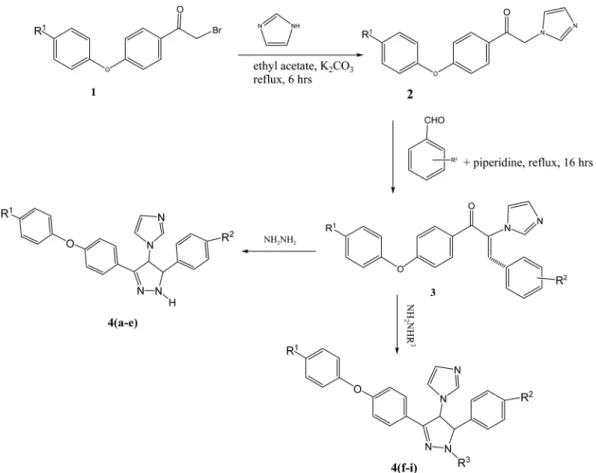
The synthesis of compound 4 (a-i) was carried out via a three step reaction which involves an N-alkylation of imi- dazole with the substituted bromoacetopheone 1 (a-i).
This affords the corresponding 1-[4-(4-Chloro-phenoxy)- phenyl]-2-imidazol-1-yl-ethanone, 2 (a-i), in accordance with literature6 procedure. Compound 2 (a-i) on conden- sation with substituted benzaldehyde gave α,β-unsatur- ated ketones 3 (a-i). These compounds, when treated with
Journal of the Korean Chemical Society 154 Jagdamba Singh, Pankaj Kumar Verma, Kamleshwar Tiwari, and Shyam Babu Singh
hydrazine or substituted hydrazine, gave titled compounds 4 (a-i) (Scheme 1).
In vitro antifungal activity was measured by means of the minimal inhibitory concentrations (MIC) using the serial dilution method in 96-well micro test plates. Fungal strains used in test were obtained from the ATCC or clinical isolates. The MIC determination was performed according
to the national committee for clinical laboratory standards (NCLCC) recommendations. The results of antifungal activities of the target compounds in vitro are listed in Table 1.
The antifungal activity of compounds 4c, 4d, 4h, and 4i were remarkable reaching MIC values of 0.06 µg/mL even at 48 hrs for C. albicans. and 1.00 µg/mL even at 48 hrs Scheme 1.
Table 1. Activity of compound 4 (a-i) against A. Niger and C. Albicans
Compounds R1 R2 R3 A. niger (MIC µg/mL) C.albicans (MIC µg/mL)
24 hrs 48 hrs 24 hrs 48 hrs
Miconazole - - - 1.00 2.00 0.06 0.12
Amphotericin B - - - 4.00 6.00 1.00 1.00
4a Cl OCH3 H 8.00 32.00 4.00 20
4b Cl NHCH3 H 20 64 16 >64
4c Cl Br H 1.00 3.00 0.06 0.06
4d Cl Cl H 1.00 1.00 0.06 0.06
4e Cl CH3 H 10 20 8 16
4f Cl OCH3 CH3 14 64 8 64
4g Cl NHCH3 CH3 20 64 2 64
4h Cl Br CH3 1.00 3.00 0.06 0.06
4i Cl Cl CH3 1.00 1.00 0.06 0.06
우수한 항균 활성을 나타내는 aryl phenyl ether pyrazole 계 화합물의 합성 155
2011, Vol. 55, No. 2
for A. niger. Their activities were superior to that of the reference drug Amphotericin B and Miconazole. From the obtained data it seems that the presence of the electron- withdrawing group chloro or bromo groups at the para position in the phenyl residue enhances the activity. More- over, synthesized compounds show better activity for C.
albicans. Finally, concluded that by introduction of aryl phenyl ether group in imidazole derivatives, a new type of fungicidal candidate was synthesized and activity is enhanced.
EXPERIMENTAL
To a solution of 2-Bromo-1-[4-(4-chloro-phenoxy)- phenyl]-ethanone (0.1 mol) and imidazole (0.12 mol) in ethyl acetate (70 mL) was added potassium carbonate (0.12 mol), the resulting mixture was refluxed for 6 hours and the filterate was condensed. The residue was recrys- tallized with ethyl acetate to give compound 2.
To a solution of compound 2 (10 mmol), 80 mL of toluene, 4-substituted benzaldehyde (13 mmol) and piperidine were added. The reaction mixture was stirred under reflux for 16 hrs. The solvent was removed under reduced pres- sure and the residue was extracted with CHCl3 (300 mL) and the organic phase was washed with distilled water.
The collected organic phase were dried over sodium sul- phate, filtered and evaporated under reduced pressure.
The residue was crystallised from diethyl ether.
To an ethanolic solution of compound 3 (5 mmol), hydra- zine (6 mmol) or methyl hydrazine sulphate (6 mmol) was added with stirring. The reaction was allowed to stirring at room temperature and monitored by T.L.C. The solvent was evaporated under reduced pressure and solid obtained was recrystallized from diethyl ether.
4a: mp 173-175 ºC; yield 54%, 1H NMR (CDCl3, TMS):
δ 3.73 (s, 3H, OCH3), 4.80 (d, 1H, CH, H5 pyrazole, JH5-H4
= 6.10 Hz), 5.54 (d, 1H, CH, H4 pyrazole, JH5-H4 = 6.10 Hz), 6.41 (s, broad signal, 1H, NH, disappearing on deu- teration), 6.86-7.60 (m, 15H, 12H arom. and 3H imida- zole). 13C NMR (CDCl3, TMS): δ 56.0, 70.0, 73.2, 117.4, 118.7, 126.4, 126.9, 127.2, 128.6, 129.2, 129.5, 129.7, 130.7, 131.8, 134.4, 136.8, 139.4, 145.7, 154.2.
4b: mp 177-178 ºC; yield 61%, 1H NMR (CDCl3, TMS):
δ 2.78 (d, 3H, NCH3), 4.0 ( q, NHCH3), 4.80 (d, 1H, CH, H5 pyrazole, JH5-H4 = 6.10 Hz), 5.54 (d, 1H, CH, H4 pyra- zole, JH5-H4 = 6.10 Hz), 6.41 (s, broad signal, 1H, NH, dis- appearing on deuteration), 6.86-7.60 (m, 15H, 12H arom.
and 3H imidazole). 13C NMR (CDCl3, TMS): δ 35.3, 70.0, 73.2, 117.4, 118.7, 126.4, 126.9, 127.2, 128.6, 129.2, 129.5,
129.7, 130.7, 131.8, 134.4, 136.8, 139.4, 145.7, 154.2.
4c: mp 159-161 ºC; yield 59%, 1H NMR (CDCl3, TMS): δ 4.79 (dd, 1H, CH, H5 pyrazole, JH5-H4 = 5.86 Hz; JH5-NH = 2.20 Hz), 5.54 (d, 1H, CH, H4 pyrazole, JH5-H4 = 5.86 Hz), 6.46 (d, 1H, NH, disappearing on deuteration; JNH-H5 = 2.20Hz), 6.94-7.61 (m, 15H, 12H arom. and 3H imida- zole). 13C NMR (CDCl3, TMS): δ 70.0, 73.2, 116.9, 118.7, 125.8, 126.4, 126.9, 127.8, 128.6, 129.5, 129.7, 130.7, 131.8, 136.8, 139.4, 145.7, 154.2.
4d: mp 170-171 ºC; yield 49%, 1H NMR (CDCl3, TMS):
δ 4.80 (d, 1H, CH, H5 pyrazole, JH5-H4 = 6.10 Hz), 5.54 (d, 1H, CH, H4 pyrazole, JH5-H4 = 6.10 Hz), 6.41 (s, broad sig- nal, 1H, NH, disappearing on deuteration), 6.86-7.60 (m, 15H, 12H arom. and 3H imidazole). 13C NMR (CDCl3, TMS): δ 70.0, 73.2, 117.4, 118.7, 126.4, 126.9, 127.2, 128.6, 129.2, 129.5, 129.7, 130.7, 131.8, 134.4, 136.8, 139.4, 145.7, 154.2.
4e: mp 175-177 ºC; yield 56%, 1H NMR (CDCl3, TMS):
δ 2.35 (s, 3H, CH3), 4.80 (d, 1H, CH, H5 pyrazole, JH5-H4 = 6.10 Hz), 5.54 (d, 1H, CH, H4 pyrazole, JH5-H4 = 6.10 Hz), 6.41 (s, broad signal, 1H, NH, disappearing on deutera- tion), 6.86-7.60 (m, 15H, 12H arom. and 3H imidazole).
13C NMR (CDCl3, TMS): δ 20.0, 70.0, 73.2, 117.4, 118.7, 126.4, 126.9, 127.2, 128.6, 129.2, 129.5, 129.7, 130.7, 131.8, 134.4, 136.8, 139.4, 145.7, 154.2.
4f: mp 149-151 ºC; yield 58%, 1H NMR (CDCl3, TMS):
δ 2.96 (s,3H, CH3), 3.73 (s, 3H, OCH3), 4.16 (d, 1H, CH, H5 pyrazole, JH5-H4 = 10.98Hz), 5.55 (d, 1H, CH, H4 pyra- zole, JH5-H4 = 10.98Hz), 6.92-7.60 (m, 15H, 12H arom.
and 3H imidazole). 13C NMR (CDCl3, TMS): δ 41.5, 56.0, 71.3, 80.7, 117.3, 118.7, 125.8, 126.3, 126.9, 127.7, 128.6, 128.7, 129.5, 130.9, 131.9, 136.7, 139.4, 145.9, 154.2.
4g: mp 143-145 ºC; yield 69%, 1H NMR (CDCl3, TMS):
δ 2.78 (d, 3H, NHCH3), 2.96 (s,3H, CH3), 4.0 (q,1H, NH), 4.16 (d, 1H, CH, H5 pyrazole, JH5-H4 = 10.98Hz), 5.55 (d, 1H, CH, H4 pyrazole, JH5-H4= 10.98Hz), 6.92-7.60 (m, 15H, 12H arom. and 3H imidazole). 13C NMR (CDCl3, TMS):
δ 35.3, 41.5, 71.3, 80.7, 117.3, 118.7, 125.8, 126.3, 126.9, 127.7, 128.6, 128.7, 129.5, 130.9, 131.9, 136.7, 139.4, 145.9, 154.2.
4h: mp 148-150 ºC; yield 73%, 1H NMR (CDCl3, TMS): δ 2.96 (s, 3H, CH3), 4.16 (d, 1H, CH, H5 pyrazole, JH5-H4 = 10.98 Hz), 5.55 (d, 1H, CH, H4 pyrazole, JH5-H4 = 10.98 Hz), 6.92-7.60 (m, 15H, 12H arom. and 3H imidazole). 13C NMR (CDCl3, TMS): δ 41.5, 71.3, 80.7, 117.3, 118.7, 125.8, 126.3, 126.9, 127.7, 128.6, 128.7, 129.5, 130.9, 131.9, 136.7, 139.4, 145.9, 154.2.
4i: mp 136 ºC; yield 51%, 1H NMR (CDCl3, TMS): δ 2.95 (s, 3H, CH3), 4.17 (d, 1H, CH, H5 pyrazole, JH5-H4 =
Journal of the Korean Chemical Society 156 Jagdamba Singh, Pankaj Kumar Verma, Kamleshwar Tiwari, and Shyam Babu Singh
10.98 Hz), 5.54 (d, 1H, CH, H4 pyrazole, JH5-H4 = 10.98 Hz), 6.84-7.60 (m, 15H, 12H arom. and 3H imidazole). 13C NMR (CDCl3, TMS): δ 41.5, 71.6, 80.7, 117.4, 118.7, 126.4, 126.9, 127.0, 128.6, 129.3, 129.5, 129.7, 130.7, 121.9, 134.5, 136.8, 139.9, 145.8, 154.2.
Acknowledgement. We sincerely thank SAIF, Punjab University, Chandigarh for providing micro analyses and spectra. We are also thankful to Botanical Survey of India, Allahabad for providing us antifungal activities of syn- thesized compounds. K. T., P. K. V. and S. B. S. are grate- ful to UGC, New Delhi for the award of Junior Research Fellowship (JRF).
REFERENCES
1. Kontoyannis, D.; Mantadakis, E.; Samonis, G. J. Hosp.
Infect. 2003, 53, 243.
2. Fostel, J. M.; Lartey, P. A. Drug Discovery Today 2000, 5, 25.
3. (a) White, T. C.; Marr, K. A.; Bowden, R. A. Clin. Micro-
biol. Rev. 1998, 11, 382. (b) Denning, D. W.; Kibler, C.
C.; Barnes, R. A. Lancet Infect. Dis. 2003, 3, 230.
4. (a) Mamolo, M. G.; Zampieri, D.; Falagiani, V.; Vio, L.;
Fermeglia, M.; Ferrone, M.; Pricl, S.; Banfi, E.; Scialino, G. Arkivoc 2004, V, 231. (b) Zampieri, D.; Mamolo, M.
G.; Vio, L.; Banfi, E.; Scialino, G.; Fermeglia, M.; Fer- rone, M.; Pricl, S. Bioorg. Med. Chem. 2007, 15, 7444.
(c) Fioravanti, R.; Biava, M.; Porretta, G. C.; Artico, M.;
Lampis, G.; Deidda, D.; Pompei, R. Med. Chem. Res.
1997, 7, 87. (d) Biava, M.; Fioravanti, R.; Porretta, G. C.;
Sleiter, G.; Ettorre, A.; Deidda, D.; Lampis, G.; Pompei, R. Med. Chem. Res. 1997, 7, 228.
5. (a) Hubele, A.; Riebli, P. Arylphenyl ether derivatives, com- positions containing these compounds and use thereof.
U.S. Patent 5266585, 1993. (b) Hubele, A.; Riebli, P. Novel microbicidal arylphenyl ether derivatives. GB 2098607, 1982. (c) Xu, L. Z.; Wu, H. L.; Hu, Z. Q.; Zhu, Q.; Yu, G. P.; Bi, W. Z. Synthesis ditriazole compounds contain- ing aromatic ether group and use. CN 1923819, 2006. (d) Jian, F. F.; Xu, L. Z.; Hu, Z. Q.; Zhu, Q.; Yu, G. P. Syn- these and biological activities of novel triazole com- pounds containing a aromatic ether group. CN 101225074, 2007.