
Printed in the Republic of Korea DOI 10.5012/jkcs.2010.54.4.395
요약. [M(L/L’)(NO3)n].mH2O 및 [VO(L/L’)(SO4)].2H2O (여기서 L/L’는 Schiff 염기로 thiocarbohydrazide (TCH), benzilmono- hydrazone (BMH)/diacetylmonohydrazone (DMH) 및 carbon disulphide에서 유도된 “3,4,10,11-tetraphenyl/tetramethyl-1,2,5, 6,8,9,12,13-octaazacyclotetradeca-2,4,9,11-tetraene-7,14-dithione”)의 분자식을 갖는 일련의 거대고리 착물을 (M = UO2(VI), Th(IV) and ZrO(IV), n = 2, 4, m = 2, 3)을 금속이온 주형법으로 합성하였다. 이들 착물의 특성을 원소분석, 열분석, 몰 전기전 도도, 자기모멘트 그리고 전자, 적외선 및 1H-NMR로 조사하였다. 바나딜 착물의 경우 ESR 및 순환 전압전류법을 사용하였 다. 그 결과, VO(IV) 이온은 5배위의 상자기성 착물을 이루며, UO2(VI) 및 ZrO(IV)는 6배위 그리고 Th(IV)는 8배위를 가지나 공통적으로 위의 조성을 갖는 반자기성임을 알았다.
주제어: Shiff 염기, 주형합성, 구조 및 열적 성질, 분광분석, 순환 전압전류법
ABSTRACT. A series of macrocyclic complexes of the type [M(L/L’)(NO3)n].mH2O and [VO(L/L’)(SO4)].2H2O, where L/L’ is a Schiff base “3,4,10,11-tetraphenyl/tetramethyl-1,2,5,6,8,9,12,13-octaaza cyclotetradeca-2,4,9,11-tetraene-7,14-dithione” deriv- ed from thiocarbohydrazide (TCH), benzilmonohydrazone (BMH)/diacetylmonohydrazone (DMH) and carbon disulphide, M = UO2
(VI), Th(IV) and ZrO(IV), n = 2, 4, m = 2, 3, have been synthesized via metal ion template methods. The complexes are chara- cterized on the basis of elemental analysis, thermal analysis, molar conductivity, magnetic moment, electronic, infrared and 1H- NMR spectral studies. The ESR and cyclic voltammetry studies of the vanadyl complexes have been carried out. The results indicate that the VO(IV) ion is penta-coordinated yielding paramagnetic complexes; UO2(VI) and ZrO(IV) ions are hexa- coordinated where as Th(IV) ion is octa-coordinated yielding diamagnetic complexes of above composition.
Keywords: Schiff base, Template synthesis, Structure and thermal properties, Spectral analysis, Cyclic voltammetry
Schiff-염기인 옥타아자-거대고리 리간드의 UO
2(VI), Th(IV), ZrO(IV) 및 VO(IV) 착물 합성 및 특성
Ranjan Kumar Mohapatra* and Dhruba Charan Dash†
Department of Chemistry, Orissa School of Mining Engineering (Degree Stream), Keonjhar-758001, Orissa, India
†School of chemistry, Sambalpur University, Jyoti Vihar, Burla, Sambalpur-768019, Orissa, India (접수 2009. 8. 30; 수정 2010. 1. 9; 게재확정 2010. 5. 20)
Synthesis and Characterization of UO
2(VI), Th(IV), ZrO(IV) and VO(IV) Complexes with Schiff-Base Octaazamacrocyclic Ligands
Ranjan Kumar Mohapatra* and Dhruba Charan Dash†
Department of Chemistry, Orissa School of Mining Engineering (Degree Stream), Keonjhar-758001, Orissa, India
*E-mail:[email protected]
†School of chemistry, Sambalpur University, Jyoti Vihar, Burla, Sambalpur-768019, Orissa, India (Received August 30, 2009; Revised January 9, 2010; Accepted May 20, 2010)
INTRODUCTION
Schiff bases are popular ligands in coordination chemistry due to their ease of synthesis and their ability to be readily modified both electronically and sterically. Mixed donor Schiff bases have been used extensively in catalysis. The design and synthesis of macrocyclic lanthanide complexes is currently attracting considerable attention since they can be used as supramolecular devices and sensors,1,2 contrast
agents in magnetic resonance imaging,3-5 potential radiop- harmaceuticals,6 as possible bioinorganic models for the active sites in metallobiomolecules,7,8 as synthetic nucleases for in vivo application.9
The chemistry of macrocyclic complexes has attracted the interest of both inorganic and bioinorganic chemists in recent years.10 The field of macrocyclic chemistry of metals is developing very rapidly because of its importance in the area of coordination chemistry.11 Macrocyclic compounds
and their derivatives are interesting ligand systems because they are good hosts for metal anions, neutral molecules and organic cation guests.12 The metal ion and host-guest chemi- stry of macrocyclic compounds are very useful in funda- mental studies (in phase transfer catalysis and biological studies).13 Template condensation reactions lie at the heart of the macrocyclic chemistry.14 Therefore template reactions have been widely used for synthesis of macrocyclic com- plexes.15 The family of complexes with aza-macrocyclic ligands has remained a focus of scientific attention for many decades.16
Schiff base polyazamacrocyclic complexes have under gone a phenomenal growth during the recent years because of the versatility offered by these complexes in the field of industries, catalysis and in biological systems17-22 etc. Se- veral reports deal with the template synthesis of metal com- plexes of octaaza macrocyclics.23 However studies on the complexes involving macrocyclic ligands synthesized from thiocarbohydrazide and benzilmonohydrazone/diacetyl- monohydrazone in presence of ring closure reagents like CS2, especially with UO2(VI), Th(IV), ZrO(IV) and VO (IV) ions having unusual coordination behavior has not been studied as yet, which prompted us to carry out such type of investigation keeping in view of interesting stereo chemical possibilities, enhanced stabilities and their wide applications in the above mentioned fields. The present paper reports 14-membered octaaza-5:6:5:6-annulated macrocyclic complexes involving the template reaction of the correspond- ing oxo/dioxo metal cations mentioned above. This is our continuing investigation on the coordination chemistry of multidentate ligands containing NOS donors.24-26
EXPERIMENTAL Materials
All the chemicals used of AR grade. The solvents were purified before use by standard procedures.
Preparation of thiocarbohydrazide
Thiocarbohydrazide was synthesized according to litera- ture method of Audrieth et al.27
Preparation of benzilmonohydrazone/
diacetylmonohydrazone
The analytical monohydrazones were synthesized accord- ing to literature method.28 As the Schiff base ligand isolation proved futile, all the metal complexes were synthesized (in an identical method) in situ by taking different amount of metal salts, thiocarbohydrazide and benzilmonohydrazone/
diacetylmonohydrazone.
Preparation of the complexes
An ethanolic solution of hydrated metal nitrates/vanadyl sulphate (1 mmol in 10 mL) was added to a hot ethanolic solution of the mixture of thiocarbohydrazide (1 mmol in 10 mL) and benzilmonohydrazone/ diacetylmonohydra- zone (2 mmol in 20 mL). The resulting mixture was refluxed on a water bath for 3 - 4 hours. To this carbon disulphide in excess (2 mmol) was added drop wise at room temperature.
It was kept for half an hour, after which it was refluxed for another 2 hours. till the evolution of H2S ceases, during which a coloured complex was precipitated out in each case. It was filtered off, washed several times with ethanol followed by ether and finally dried over anhydrous CaCl2.
The reaction profile is given below:
(TCH) (BMH/DMH)
However, attempt to prepare the complexes of same composition by the reaction of hydrated metal nitrates/
vanadyl sulphates (1 mmol in 10 mL) with mixture of thio- carbohydrazide (2 mmol in 20 mL) and benzyl/diacetyl (2 mmol in 20 mL) failed, indicating the formation of macro- cyclic ligand is possible due to presence of metal cations/
oxo cations providing proper orientation for condensation due to coordination template effect governing the steric course of the reaction.
(TCH) (Benzil/Diacetyl) (2 Mole) (2 Mole)
Analysis and Physical Measurements
The metal contents in the complexes were determined gravimetrically following standard procedures.29 A weighed quantity of the compound (0.2 - 0.3 g) was treated with a few drops of concentrated H2SO4 and 1 cc. of concentrated HNO3. It was heated till all the organic matter decomposed and sulphur trioxide fumes came out. The same process was repeated two to three times to decompose the sub- stance completely. Then it was dissolved in water and the resulting solution was used for analysis of metal ions. Urani-
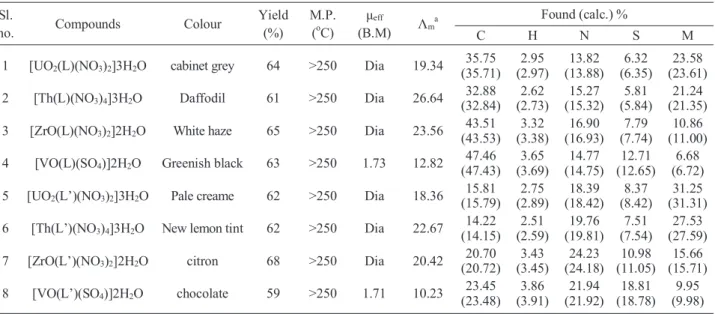
Table 1. Analytical and physical data of the complexes Sl.
no. Compounds Colour Yield
(%)
M.P.
(oC) µeff
(B.M) Λma Found (calc.) %
C H N S M
1 [UO2(L)(NO3)2]3H2O cabinet grey 64 >250 Dia 19.34 35.75 (35.71) 2.95
(2.97) 13.82 (13.88) 6.32
(6.35) 23.58 (23.61) 2 [Th(L)(NO3)4]3H2O Daffodil 61 >250 Dia 26.64 32.88
(32.84) 2.62
(2.73) 15.27 (15.32) 5.81
(5.84) 21.24 (21.35) 3 [ZrO(L)(NO3)2]2H2O White haze 65 >250 Dia 23.56 43.51
(43.53) 3.32
(3.38) 16.90 (16.93) 7.79
(7.74) 10.86 (11.00) 4 [VO(L)(SO4)]2H2O Greenish black 63 >250 1.73 12.82 47.46
(47.43) 3.65
(3.69) 14.77
(14.75) 12.71 (12.65) 6.68
(6.72) 5 [UO2(L’)(NO3)2]3H2O Pale creame 62 >250 Dia 18.36 15.81
(15.79) 2.75
(2.89) 18.39 (18.42) 8.37
(8.42) 31.25 (31.31) 6 [Th(L’)(NO3)4]3H2O New lemon tint 62 >250 Dia 22.67 14.22
(14.15) 2.51
(2.59) 19.76 (19.81) 7.51
(7.54) 27.53 (27.59) 7 [ZrO(L’)(NO3)2]2H2O citron 68 >250 Dia 20.42 20.70
(20.72) 3.43
(3.45) 24.23
(24.18) 10.98
(11.05) 15.66 (15.71) 8 [VO(L’)(SO4)]2H2O chocolate 59 >250 1.71 10.23 23.45
(23.48) 3.86
(3.91) 21.94
(21.92) 18.81 (18.78) 9.95
(9.98)
aOhm-1 cm2 mole-1
um, thorium, zirconium and vanadium were precipitated as ammonium diuranate, thorium oxalate, zirconium mandelate and ammonium vanadate followed by subsequent ignition to their respective oxides as U3O8, thoria (ThO2), zirconia (ZrO2) and V2O5. Sulphur was estimated29 as BaSO4. Room temperature magnetic susceptibilities were measured by Gouy method30 using Hg[Co(NCS)4] as the calibrant. The molar conductance measurements were carried out at room temperature with a Toshniwal conductivity Bridge (Model CL-01-06, cell constant 0.5 cm-1) using 1 × 10⁻³ M solution of the complexes in DMSO. Carbon, hydrogen and nitrogen contents of the complexes were estimated by using a MLW- CHN microanalyser. FTIR specra in KBr pellets were re- corded on a varian FTIR spectrophotometer, Australia. The electronic spectra of the complexes were recorded on a Per- kinElmer* spectrophotometer. Thermogravimetric analysis was done by Netzch-429 thermoanalyser. The 1H-NMR spec- tra of the complexes were recorded in DMSO-d6 medium on JEOL GSX-400 model equipment. The ESR spectra of the vanadyl complexes were recorded in solid state on Varian Associate spectrophotometer using 100 KHz, X-band (RT), scan rang 2.0 × 1 KG and field set 3200. Electrochemical studies of vanadyl complexes in DMSO at 300 oC were carri- ed out using EG&G Princeton Applied Research Postento- stat/Galvanostat Model 273A, controlled by M270 soft- ware, scan rate 100 mVs-1.
RESULTS AND DISCUSSION
The complexes were formulated from the analytical data
and molar conductance data support the suggested formulae (Table 1). The complexes are highly coloured and insoluble in water and common organic solvents such as ethanol, methanol, acetone, CCl4, CHCl3, benzene and ether but moderately soluble in highly coordinating solvents such as DMF and DMSO. They are highly stable under normal conditions and all of them decompose above 250 oC. The molar conductance data values in DMSO for the com- plexes indicate them to be non-electrolyte in nature. How- ever, the conductivity value is higher than as expected for non-electrolytes probably due to partial solvolysis of the complexes in DMSO medium.31
IR spectra
As the Schiff base ligands could not be isolated, the spectra of the complexes were compared with spectra of the starting materials and other related compounds. The bands observed in the spectra of metal complexes at ~1490,
~1310, ~1080, ~770 cm-1 are assigned to thioimide I, II, III, IV bands respectively of TCH skeleton.32 These bands have contributions from v(C-N) + δ(N-H), v(C=S) + v(C-N) + δ (N-H), v(C-N) + v(C-S) and v(C=S) modes of vibrations, respectively. All the above bands appear nearly at the same position as found in the free TCH implying non co-ordina- tion of thioimide sulphur or nitrogen atom to the metal ion.
The appearance of another band at ~1630 cm-1 compara- tively at lower frequency region than usually free v(C=N) value (~1650 cm-1)33-35 lead us to suggest that azomethaine nitrogen atom have taken part in complexation as evidenced from the appearance of bands in the region ~470 cm-1 assign-
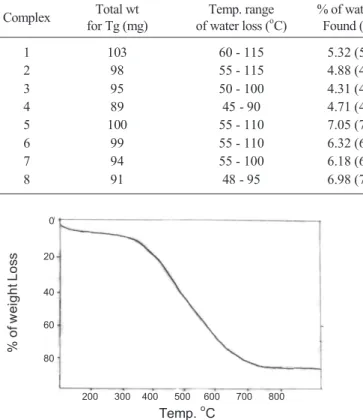
Table 2. Thermal characteristics of the complexes (TGA) Complex Total wt
for Tg (mg)
Temp. range of water loss (oC)
% of water loss Found (calc.)
Decomposition temp. (oC)
% wt of residue found (calc.)
Composition of the residue
1 103 60 - 115 5.32 (5.35) 370 - 750 27.78 (27.84) U3O8
2 98 55 - 115 4.88 (4.93) 400 - 780 24.04 (24.08) ThO2
3 95 50 - 100 4.31 (4.35) 380 - 760 14.81 (14.87) ZrO2
4 89 45 - 90 4.71 (4.74) 350 - 750 11.95 (11.99) V2O5
5 100 55 - 110 7.05 (7.10) 365 - 750 36.85 (36.92) U3O8
6 99 55 - 110 6.32 (6.36) 400 - 760 31.08 (31.13) ThO2
7 94 55 - 100 6.18 (6.21) 360 - 750 21.19 (21.24) ZrO2
8 91 48 - 95 6.98 (7.04) 340 - 740 17.73 (17.80) V2O5
200 300 400 500 600 700 800
Temp. oC
0 20 40 60
% of weight Loss 80
Fig. 1. Thermogram of [VO(L’)(SO4)].2H2O
able to v(M-N).36 In the lower frequency region of the spectra provides a wealth of information on the mode of co-ordina- tion of the ligand with the metal. The uranyl complexes exhibit a strong band at ~920 cm-1 and the medium intensity band at ~822 cm-1 assignable to vas (O=U=O) and vs(O=U=O) mode respectively. This observation indicates that the line- arity of the O=U=O group is maintained in the com- plexes.37 The band at 1015 cm-1 is assigned to the ν2 mode of the NO3 group. The bands at 1470 and 1370 cm-1 are the two split bands ν4 and ν1, respectively, of the coordinated nitrate ion. The magnitude of ∆ν = (ν4 - ν1) = 100 cm-1 shows the unidentate coordination of the nitrate ion.38 The zirconyl complexes exhibit one strong band in the region
~880 cm-1 which can be attributed to the ν(Zr=O) as re- ported earlier37 indicating the presence of (Zr=O)2+ moiety in the complexes. In the oxovanadium polychelates a strong bands at ~950 cm-1 are assigned to ν(V=O) mode.39 However in vanadyl complexes, an additional series of four bands appeared at ~1165, ~1110, ~865, ~655 cm-1 indicating the coordination of sulphate group in unidentate manner through oxygen atom;40 Besides the bands observed at ~3420 cm-1 may be assigned to ν(O-H) of coordinated or lattice water.
However all the complexes lose water when heated to ~100 oC
indicating the presence of lattice water molecules which has been conformed by thermal analysis.
Thermal analysis
All these complexes follow the same pattern of thermal decomposition. Weight loss was encountered at ~50 oC to
~115 oC with a broad endothermic peak at the same tem- perature corresponding to two and three molecules of water of crystallization.41 The complexes remain almost unaffect- ed upto ~50 oC. After this a slight depression upto ~115 oC is observed. The weight loss at this temperature range is equivalent to two for the complexes (3), (4), (7) and (8) and three for the complexes (1), (2), (5) and (6) water molecules in the complexes indicating them to be lattice water in conformity with our earlier observations from analytical and IR spectral investigations. Once the lattice water was eliminated, the anhydrous complexes remain stable upto
~350 oC and thereafter the complexes show rapid degradation presumably due to decomposition of organic constituents of the complex molecules as indicated by the steep fall in the percentage weight loss. The decomposition continues upto ~750 oC and reaches to a stable product in each com- plex as indicated by the consistency in weight in the plateau of the thermogram. This corresponds to the composition of their stable oxides. The decomposition temperature varies for different complexes as shown in Table 2. The repre- sentative thermogram of [VO(L’)(SO4)].2H2O complex is shown in Fig. 1.
The thermal stability of the complexes decreases in the order:
(L) complexes: Th(IV) > ZrO(IV) > UO2(VI) > VO(IV) (L’) complexes: Th(IV) > UO2(VI) > ZrO(IV) > VO(IV) Electronic spectra and magnetic moment
The electronic spectra of the UO2(VI) complexes are quite similar. The complexes display mainly one weak band at
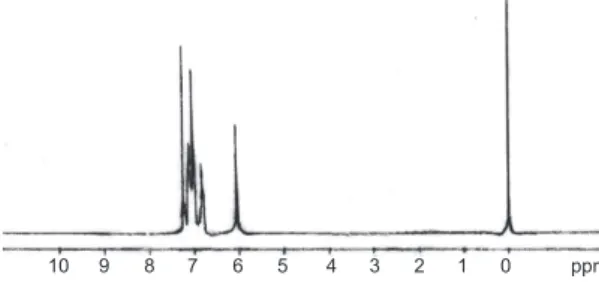
10 9 8 7 6 5 4 3 2 1 0 ppm
Fig. 2. 1H NMR spectrum of [UO2(L)( NO3)2].3H2O
DPPH Fig. 3. ESR spectrum of [VO(L)(SO4)].2H2O
Table 3. ESR spectral data of VO(IV) complexes
Complexes g║ g┴ gav A║ A┴ Aav
4 2.01 1.96 1.98 180 101 127.3
8 2.03 1.97 1.99 177 98.5 124.6
~450 nm and a highly intense band in the range 270 - 290 nm, which may be due to 1∑g+→3Πu transitions and charge trans- fer transitions respectively.42 The first one of the transition is typical of the O=U=O symmetric stretching frequency of the first excited state.43 It may be noted that the band occurr- ing at 370 nm is due to uranyl moiety because of apical oxygen →f 0(U) transition44 is being merged with the ligand band due to n→π* transition as evident from broadness and intensity. The electronic spectra of ZrO(IV) complexes exhibit only one extra highly intensive band in the region 350 - 380 nm which may be due to charge transfer band be- sides the ligand bands. However, the electronic spectra could not provide structural details of these complexes. The electronic spectra of VO(IV) complexes show three bands at ~12340, ~18450 and ~25875 cm-1 corresponds to transi- tions, dxy(b2)→dxzdyz(e), dxy(b2)→dx2-y2(b1) and dxy(b2)→
dz2(a1) respectively, indicating the complexes to be in distort- ed octahedral environment under C4V symmetry.45 The ob- served magnetic moments of VO(IV) polychelates with one unpaired electron lie in the range 1.70 - 1.75 B.M. and the other complexes are diamagnetic.
1H NMR spectra
The 1H NMR spectra of the diamagnetic complexes are recorded in DMSO-d6 medium. The complexes (1), (2) and (3) show a broad multiplet at δ 6.96 - 7.35 ppm corresponding to aromatic (C6H5-C=N; 20H) protons46 of four phenyl groups and the complexes (5), (6) and (7) show a sharp signal at δ 2.31 - 2.40 ppm corresponding to imine methyl (CH3-C=N; 12H) protons.47,48 Besides, the signals due to (-NH-N=; 4H) protons appear at δ 6.12 - 6.22 ppm for all the complexes. The representative spectrum of [UO2(L)( NO3)2].
3H2O complex is shown in Fig. 2.
ESR spectra
The X-band ESR spectra of oxovanadium(IV) com- plexes are not so resolved at room temperature to exhibit all the eight hyperfine lines as expected for 51V (I=7/2). The
ESR spectra of the vanadyl complexes exhibited anisotropic signals in parallel and perpendicular 51V region. The mag- netic and bonding parameters deduced from the spectra are shown in Table 3. This suggests that the unpaired electron to be in dxy orbital localized on the metal, thus excluding any possibility of its direct interactions with the incoming ligands and the complexes have less covalent character in bonding involving the metal ion and ligand.49,50 The coval- ency parameter α2 as calculated from g║, g┴ and A║ values was found to be ~0.50. The observed data show that g║ and g┴ values are closer to 2 and g║ > g┴. This suggests major distortion in the complexes from Oh symmetry. The repre- sentative spectrum of [VO(L)(SO4)].2H2O complex is shown in Fig. 3.
Electrochemical study
The cyclic voltammogram for the vanadyl complexes was recorded in DMSO solution. The nature of cyclic voltammogram is similar for both the complexes. Hence the representative VO(IV) (4) is discussed here. A cyclic voltammogram of VO(IV) (4) (Fig. 4) displays one reduc- tion peak at Epc = 0.53 V with a corresponding oxidation peak at Epa = 0.62 V. The peak separation(∆Ep) is 0.09 V at 100 mVs-1. The most significant feature of the VO(IV) complex is it shows two well defined one-electron transfer redox peaks, corresponding to the formation of the VO(IV)/
VO(V) and VO(IV)/VO(III) couples.51,52 The peak current function of both waves in complexes are different which indicate the involvement of two different electroactive species in solution,53,54 corresponding to VO(V) and VO(III).
The representative Cyclic voltammogram of [VO(L)(SO4)].
2H2O complex is shown in Fig. 4.
1.1 0.0 ‒1.2
Potential (V)
Current (µA)
Fig. 4. Cyclic voltammogram of [VO(L)(SO4)].2H2O
Fig. 5
Fig. 6
M = UO2(VI), ZrO(IV) and Th(IV) X = NO3- for Th(IV)
X = 0 for UO2(VI)and ZrO(IV) R = C6H5, CH3
Based on the foregoing observations the following tenta- tive structures have been proposed for the present com- plexes (Figs. 5 and 6).
Acknowledgments. The authors gratefully acknowledge the services rendered by Director, Regional Sophisticated Instrumentation Center, I.I.T., Madras, for recording the spectra.
REFERENCES
1. Sabbatini, N.; Guargigli, M.; Manet, I.; Ungaro, R.; Casnati, A.; Ziessel, R.; Ulrich, G.; Asfari, Z.; Lehn, J.-M. Pure Appl.
Chem. 1995, 67, 135.
2. Oude Wolbers, M. P.; Van Veggel, F. C. J. M.; Snellick-Ru, B.
H. M.; Hofstraat, J. W.; Guerts, F. A. J.; Reinhoudt, D. N. J.
Am. Chem. Soc. 1997, 119, 138.
3. Geze, C.; Mouro, C.; Hindre, F.; Le Plouzennec, M.; Moinet, C.; Rolland, R.; Alderighi, L.; Vacca, A.; Simmonneaux, G.
Bull. Chem. Soc. Chim. Fr. 1996, 133, 267.
4. Choppin, G. R.; Schaab, K. M. Inorg. Chim. Acta. 1996, 252, 299.
5. Sessler, J. L.; Moody, T. D.; Hemmi, G. W.; Lynch, V.; Young, S. W.; Miller, R. A. J. Am. Chem. Soc. 1993, 115, 10368.
6. Jurisson, S.; Berning, D. Wei, J.; Dangshe, M. Chem. Rev.
1994, 93, 1137.
7. Evans, C. H. Biochemistry of Lanthanides, ed.; Frieden E.
Plenum Press: New York, 1990, Ch. 9.
8. Tweedle, M. F. Lanthanide Probes in Life, Chemical and Earth Sciences, Bunzli, J.-C., Choppin, G. R., Eds.; Elsevier: Ams- terdam, 1989, Ch. 5.
9. Amin, S.; Morrow, J. R.; Lake, C. H.; Churchill, M. R. Angew.
Chem. Int. Ed. Engl. 1994, 33, 773.
10. Fernandez, M. C.; Basitida, R.; Macias, A.; Valencia, L.; Lou- rida, P. P. Polyhedron 2006, 25, 783.
11. Ilhan, S.; Temel, H. Transition Met. Chem. 2007, 32, 1039.
12. Chandra, S.; Gautum, A.; Tyagi, M. Transition Met. Chem.
2007, 32, 1079.
13. Bozic, L. T.; Marotta, E.; Traldi, P. Polyhedron 2007, 26, 1663.
14. Niasari, M. S.; Bazarganipour, M.; Ganjali, M. R.; Norouzi, P. Transition Met. Chem. 2007, 32, 9.
15. Niasari, M. S.; Daver, F. Inorg. Chem. Commun. 2006, 9, 175.
16. Lindoy, L. F. The Chemistry of Macrocyclic Ligand Com- plexes; Cambridge University Press: Cambridge, 1989.
17. Alexander, V. Chem. Rev. 1995, 95, 273 and references therein.
18. Ito, I.; Kato, M.; Yamashita, M.; Ito, H. Coord. Chem. 1986, 15, 29.
19. Mertes, M. P.; Mertes, K. B. Acc. Chem. Res. 1990, 23, 413.
20. Bencini, A.; Bencini, C.; Caneschi, A.; Carlin, R. C.; Deiand, A.; Gatteschi, D. J. Am. Chem. Soc. 1995, 107, 8128.
21. Zhong, Z. J.; Tamaki, H.; Matsumoto, N.; Kida, S.; Koikwa, M.; Achiva, N.; Hasimoto, Y.; Okawa, H. J. Am. Chem. Soc.
1992, 114, 6974.
22. Wherland, S.; Gray, H. B. Biological aspects of Inorganic Che- mistry; Wiley Eastern: New York. 1977; p 289.
23. Dash, D. C.; Mohapatra, R. K.; Ghosh, S.; Naik, P. J. Indian Chem. Soc. 2009, 86, 121.
24. Dash, D. C.; Mahapatra, A.; Mohapatra, R. K.; Ghosh, S.; Naik, P. Indian J. Chem. 2008, 47A, 1009.
25. Dash, D. C.; Mahapatra, A.; Naik, P.; Naik, S. K.; Mohapatra, R. K.; Ghosh, S. J. Indian Chem. Soc. 2008, 85, 595.
26. Dash, D. C.; Mohapatra, R. K.; Ghosh, S.; Naik, P. J. Korean Chem. Soc. 2008, 52(5), 468.
27. Audrieth, I. F.; Scotts, E. S.; Kippur, P. S. J. Org. Chem. 1954, 19, 733.
28. Holm, R. H.; Everestt(J), G. W.; Chakrabarty, A. Progress in Inorganic Chemistry, Interscience, 1966, 7, 83.
29. Vogel, A. I. A Hand Book of Quantitative Inorganic Analysis, 2nd ed.; Longman: ELBS, London, 1966.
30. Figgis, B. N.; Lewis, J. Modern Coordination Chemistry; Lewis, J., Wilkinson, R. O., Eds.; Interscience: New York, 1960.
31. Dash, K. C.; Mansingh, P. S.; Mohanty, R. R.; Jena, S. Indian J. Chem. 1996, 35A, 480.
32. Bellamy, L. J. Advances in Infrared Group Frequencies; Me- thuen: London, 1968; p 214, 357.
33. Rana, V. B.; Singh, P.; Singh, D. P.; Teotia, M. P. Trans. Met.
Chem. 1982, 7, 174.
34. Chandra, S.; Sharma, K. K. Trans. Met. Chem. 1983, 8, 1.
35. Rao, C. N. R. Chemical Application of IR Spectroscopy; Aca- demic Press: New York and London, 1963.
36. Ferraro, J. R. Low Frequency Vibrations of Inorganic and Co- ordination Compounds; Plenum Press: New York, 1971.
37. Maurya, R. C.; Jayaswal, M. N.; Verma, R. Synth. React. Inorg.
Met.-Org. Chem. 1998, 28, 1265.
38. Yadava, H. D. S.; Sengupta, S. K.; Tripathi, S. C. Inorg. Chem.
Acta 1987, 128, 1.
39. Xiu, R. B.; Mintz, F. L.; You, X. Z.; Wang, R. X.; Yue, Q.; Meng, Q. J.; Lu, Y. J.; Derveer, D. V. Polyhedron 1996, 15, 4585.
40. Rani, D. S.; Ananthalakshmi, P. V.; Jayatyagaraju, V. Indian J. Chem. 1999, 38, 843.
41. Nikolaev, A. V.; Lagvienko, V. A.; Myachina, I. Thermal Anal- ysis; Academic Press: New York, 1969; p 2, 9.
42. Chandra, R. Synth. React. Inorg. Met.-Org. Chem. 1990, 20, 645.
43. Maurya, R. C.; Maurya, M. R. Rev. Inorg. Chem. 1995, 15, 1.
44. Saha, M. C.; Roy, R.; Ghosh, M. K.; Roy, P. S. Indian J. Chem.
1987, 26A, 48.
45. Lever, A. B. P. Inorganic Electronic Spectroscopy; Elsevier:
New York, 1968; p 258.
46. Zimmer, M.; Tocher, D. A.; Patra, G. K.; Naskar, J. P.; Datta, D. Indian J. Chem. 1999, 38A, 1087.
47. Shakir, M.; Varkey, S. P. Trans. Met. Chem. 1994, 19, 606.
48. Khan, T. A.; Hasan, S. S.; Jahan, N.; Mohamed, A. K.; Islam, K.
S. Indian J. Chem. 2000, 39A, 1090.
49. Goodman, B. L.; Raynor, J. B. Adv. Inorg. Chem. Radiochem.
1970, 13, 135.
50. Drago, R. S. Physical Methods in Inorganic Chemistry; Affili- ated East-West: New Delhi, 1991; p 215.
51. Dutton, K. G.; Fallon, G. D.; Murray, K. S. Inorg. Chem. 1988, 27, 34.
52. Knopp, P.; Weighardt, K.; Nuber, B.; Weiss, J.; Sheldrick, W.
S. Inorg. Chem. 1990, 29, 363.
53. Nawi, M. A.; Riechel, T. L. Inorg. Chem. 1981, 20, 1974.
54 Matsubayashi, G.; Akiba, K.; Tanaka, T. Inorg. Chem. 1988, 27, 4744.
![Fig. 4. Cyclic voltammogram of [VO(L)(SO 4 )].2H 2 O](https://thumb-ap.123doks.com/thumbv2/123dokinfo/5299602.154693/6.892.105.417.147.330/fig-cyclic-voltammogram-vo-l-h-o.webp)
