Breast cancer is a disease that manifests itself in various ways in terms of therapeutic reaction or survival rates, and is reported to be the most common form cancer among women not only in the West but also in Korea. Such a change in health trends in Korea may be the result of economic growth as well as the Westernization of lifestyles.1,2
With regard to surgical treatment of breast can-
cer, the radical mastectomy first presented by Meyer and Halsted in 1894 was widely performed in the past, after which modified radical mastec- tomy, which produces almost no difference in survival rates but reduces complications as much as possible, has been used often. After the release of three independent research papers in the 1980s reporting that there are no differences in survival rates between patients receiving radi-
Original Article
Comparison of survival outcomes between modified radical mastectomy and breast conserving surgery in early breast cancer patients
Yoon Seok Kim1, Dong Won Ryu2, Chung Han Lee2
1Department of Surgery, Busan adventist Hospital, Busan, Korea
2Department of Surgery, College of Medicine, Kosin University, Busan, Korea
Objectives: Breast conserving surgery (BCS) for early breast cancer is now an accepted treatment, but there are controversies about its comparability with mastectomy. Thus, we investigated the survival outcomes who underwent BCS and modified radical mastectomy (MRM).
Methods: In this retrospective review, we analyzed the survival outcomes of 618 patients with early breast cancer who underwent two different surgery from January 2002 to December 2009. Postoperative pathologic difference, disease free survival period, overall survival period, recurrence pattern, recurrent rate and site were compared. In addition, preoperative patients data are also collected.
Results: Disease free survival period of MRM and BCS was 108.46 months and 80.82 months, respectively (P < 0.01). However, there was no significant correlation between overall survival period and operative methods (P = 0.67). In addition, recurrence pattern (P = 0.21), recurrent rate (P = 0.36) and site (P = 0.45, P = 0.09) were not associated with operative method.
Conclusions: In this study, we can suggest that early breast cancer patients could improve their disease free survival if they underwent MRM. So, when we operate high risk breast cancer patients, MRM could be considered for their disease free life. Further studies may be required to establish appropriate strategy of surgery for early breast cancer.
Key Words: Breast conserving surgery, Disease free survival, Early breast cancer, Modified radical mastectomy
Corresponding Author: Chung Han Lee, Department of Surgery, Kosin University Gospel Hospital, 262, Gamcheon-ro, Seo-gu, Busan, 49267, Korea
Tel: +82-51-990-6462 Fax: +82-51-246-6093 E-mail: [email protected]
Received:
Revised:
Accepted:
Jul. 08, 2013 Oct. 21, 2013 Oct. 26, 2013
cal mastectomy and breast conserving surgery, the frequency of surgical methods has been in- creasing in Korea as well as the world.3-5
In the B-06 study in 1973, the National Surgical Adjuvant Breast and Bowel Project (NSABP) re- vealed that there is no difference in survival rates for breast conserving surgery regardless of whether radiotherapy is undertaken compared to mastectomy for patients with stages 1 and 2 breast cancer that tumor is less than 4㎝. In 1979, the National Cancer Institute (NCI) stated that there is no difference in survival rates and disease-free survival rates in a comparative re- search on mastectomy and breast conserving sur- gery for patients with stages 1 and 2 breast cancer.
In 1995, the Early Breast Cancer Trialists' Collaborative Group (EBCTCG) also announced that there is no difference in survival rates and disease-free survival rates between the two surgi- cal methods: radical mastectomy and breast con- serving surgery.6-8
Comparing the treatment results and survival rates of breast cancer patients according to ther- apeutic methods, it is discovered that there is not much different between modified radical mastectomy and breast conserving surgery in the same stages of cancer; but for the frequency of locoregional recurrences was higher for breast conserving surgery.3
Thus, the survival outcomes of patients that
received modified radical mastectomy and breast conserving surgery were we comparatively ana- lyzed based on a clinical study on patients diag- nosed with early breast cancer in post-operative pathological examination among those who had received surgery for breast cancer.
MATERIALS AND METHODS
1. MATERIALS
Among patients who received surgery for breast cancer from January 2002 to December 2009, a total of 618 of them were early breast cancer patients diagnosed as stages 1 and 2 in terms of post-operative pathology. Ninety three of them received modified radical mastectomy, and 527 received breast conserving surgery.
Those who received surgery or chemotherapy due to primary cancers occurring in organs other than the breasts, and those who received neo- adjuvant chemotherapy or radiotherapy to lower the stages of breast cancer were excluded. The subjects were divided into the group that received modified radical mastectomy and the group that received breast conserving surgery for com- parative analysis. Diagnosis of breast cancer be- fore surgery was done by fine needle aspiration and gun biopsy. A retrospective review was con- ducted on inpatient and outpatient medical re-
cords of all 618 patients.
For demographic factors and histological re- sults, the following were examined: age, estrogen receptor (ER), progesterone receptor (PR), HER-2 protein, blood vessel invasion, lymphovascular invasion, histological grade, T stage, N stage, and molecular subtype. The average survival pe- riod and disease-free survival period of patients after surgery, as well as recurrence rates and aspects of recurrence were comparatively analyzed.
2. METHODS
1) Definition of terms and postoperative follow-up study
A postoperative follow-up study was con- ducted at 6-month intervals, and it consisted of breast ultrasonography, mammography, chest radiograph, abdominal ultrasonography and bone scan. PET-CT (positive emission tomog- raphy-computed tomography) was also taken at a one-year interval. If there seemed to be a focus of a lesion in the basic examination, additional radiological or histological examinations were conducted.
The disease-free survival period is defined as the period until the first recurrence of breast cancer in postoperative follow-up study regard- less of its location in the body, and the average survival period is defined as the average period
from breast cancer surgery to death. Aspects of recurrence are divided into local recurrence and distant recurrence, and part of recurrence is de- fined as the part where recurrence first occurred in the postoperative follow-up study. Local re- currence is defined as recurrence in nearby areas where the breast cancer first occurred, such as surgery scars, chest wall and ipsilateral axillary lymph nodes, supraclavicular lymph nodes, sub- clavian lymph nodes and internal mammary lymph nodes. Distant recurrence is defined as recurrence in other organs beyond the range of local recurrence.
2) Surgical procedure and post-operative treatment
Patients who do not want breast conserving surgery, have extremely small breasts in pre-op- erative examination and thus cannot receive conserving surgery, or who have difficulty receiv- ing post-operative radiotherapy received modi- fied radical mastectomy according to the operat- ing surgeon’s judgment. Those without these re- strictions received breast conserving surgery.
Axillary lymph nodes dissection was performed on all patients that received modified radical mastectomy, while sentinel lymph node biopsy was first performed on patients that received breast conserving surgery, after which axillary lymph nodes dissection was performed on those
manifesting some kind of cancer invasion in the frozen section examination. Chemotherapy was omitted for patients aged 35 or above whose tumors are 2cm or smaller in post-operative bi- opsy, and who also satisfied all requirements of histological grade 1, negative axillary lymph node metastasis, and positive hormone receptor, while all other patients received chemotherapy.
All patients that received breast conserving sur- gery also received radiotherapy.
3) Analysis method
For patients that received modified radical mastectomy or breast conserving surgery due to breast cancer, the followings were compared;
T stage, N stage, hormone receptor expression, HER-2 protein expression, blood vessel invasion, lymphovascular invasion, histological grade and molecular subtype through post-operative biopsy. Also the differences were comparatively analyzed according to surgical procedure by comparing post-operative disease-free survival period, average survival period, aspects of re- currence, recurrence rates, and parts of recurrence. ER and PR are considered positive when at least 10% is expressed on the im- munohistochemical test, and HER-2 protein ex- pression is when it is 3+ on the im- munohistochemical test or is positive on FISH (fluorescence in situ hybridization). It is classified
into four molecular subtypes based on post-op- erative biopsy, and luminal A is when ER or PR is positive, and luminal B is when ER or PR and HER-2 protein are positive. HER-2 positive breast cancer is when HER-2 protein is expressed without ER and PR expression, and when all three are not expressed, the cancer is classified as triple-negative breast cancer.
4) Statistical analysis
The clinicopathologic characteristics of the patients were analyzed by χ2(chi-square) test.
The survival rates of the patients were tested by the Kaplan–Meier estimator, log rank test and Cox proportional hazard model. All statistical analysis was conducted by multivariate analysis using the SPSS version 16.0 (SPSS Inc, Chicago, IL, USA) program, and the results were considered statistically significant if P-value was below 0.05.
RESULTS
1. Analysis on differences according to the characteristics of patients and surgical pro- cedures
All patients were female, and 92 were below age 40 and 526 were age 40 and above before surgery. For post-operative T stage and N stage, 324 patients were in T1 and 294 in T2, and 539
were in N0 and 79 in N1. 336 patients showed ER expression, and 299 showed PR expression.
336 patients showed HER-2 protein expression.
For histological grade, 119 patients were in Grade 1, 221 in Grade 2, and 278 in Grade 3. 171 showed lymphatic duct invasion and 175 showed blood vessel invasion. There were no statistical differ- ences in age distribution, molecular subtype and
post-operative pathology according to surgical procedure, but histological grade tended to show borderline significance (P = 0.07)(Table 1).
2. Comparative analysis on disease-free sur- vival period and average survival period As a result of comparatively analyzing the dis- ease-free survival period and average survival
No. (%) MRM (%) BCS (%) P-value
Total 618 (100) 91 (100) 527 (100)
Age (year) 0.63
<40 92 (14.9) 15 (16.5) 77 (14.6)
≥40 526 (85.1) 76 (83.5) 450 (85.4)
T stage 0.82
T1 324 (52.4) 49 (53.8) 275 (52.2)
T2 294 (47.6) 42 (46.2) 252 (47.8)
N stage 1.00
N0 539 (87.2) 80 (87.9) 459 (87.1)
N1 79 (12.8) 11 (12.1) 68 (12.9)
Estrogen receptor 0.14
(+) 336 (54.4) 56 (61.5) 280 (53.1)
(-) 282 (45.6) 35 (38.5) 247 (46.9)
Progesterone receptor 0.31
(+) 299 (48.4) 49 (53.8) 250 (47.4)
(-) 319 (51.6) 42 (46.2) 277 (52.6)
HER-2 expression 0.11
(+) 336 (54.4) 42 (46.2) 294 (55.8)
(-) 272 (45.6) 49 (53.8) 233 (44.2)
Histologic grade 0.07
I 119 (19.2) 22 (24.2) 97 (18.4)
II 221 (35.8) 38 (41.7) 183 (34.7)
III 278 (45.0) 31 (34.1) 247 (46.9)
Lymphatic invasion 0.45
(+) 171 (27.7) 22 (24.2) 149 (28.3)
(-) 447 (72.3) 69 (75.8) 378 (71.7)
Vascular invasion 1.00
(+) 175 (28.3) 26 (28.6) 149 (28.3)
(-) 443 (71.7) 65 (71.4) 378 (71.7)
Molecular subtype 0.18
Luminal A 204 (33.0) 38 (41.8) 166 (31.5)
Luminal B 205 (33.2) 29 (31.9) 176 (33.4)
HER-2+ 131 (21.2) 13 (14.3) 118 (22.4)
Triple negative 78 (12.6) 11 (12.1) 67 (12.7)
BCS=Breast conserving surgery, MRM= Modified radical mastectomy Table 1. Clinicopathologic characteristics
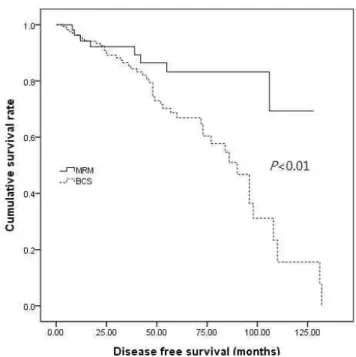
period according to surgical procedure, it turned out that the disease-free survival period of pa- tients that received modified radical mastectomy was 108.46 months, showing a significant differ- ence from 80.82 months of patients that received breast conserving surgery (P < 0.01)(Fig. 1).
However, the average survival period of patients that received modified radical mastectomy was 119.25 months and the 10-year survival rate was 76%, showing no statistically significant differ- ence from patients that received breast conserv- ing surgery with the average survival period of 121.96 months and the 10-year survival rate of 67% (P = 0.67)(Fig. 2, Table 2).
3. Comparative analysis on recurrence rates, aspects of recurrence, and parts of re- currence
Fifty nine out of total 618 patients showed post-operative recurrence, consisting of 10 (11.0%) out of 91 patients that received modified radical mastectomy and 49 (9.3%) out of 527 pa- tients that received breast conserving surgery;
but there was no statistically significant differ- ence (P = 0.36).
Among patients that received modified radical mastectomy, one showed local recurrence and 9 showed distant recurrence; among patients that received breast conserving surgery, 14 showed local recurrence and 35 showed distant re-
currence, but there was no statistical difference (P = 0.21). There was also no difference in the parts of recurrence between patients showing Fig. 1. Disease free survival curves between MRM and BCS.
Fig. 2. Overall survival curves between MRM and BCS.
local and distant recurrences according to surgi- cal procedure (P = 0.23, P = 0.09)(Table 3).
DISCUSSION
Breast cancer incidence rates in Korea are still lower than the West, but the number of patients is constantly increasing, recently becoming the most common cancer for women. According to
a report by the Korean Breast Cancer Society in 1998, patients in their 40s accounted for the biggest proportion at 37.9%, which indicates that the incidence age of breast cancer patients in Korea is about 10 years younger than the U.S.
For surgical treatment of breast cancer, modified radical mastectomy was presented by Patey and Dyson in 1948 after radical mastectomy had been made common by Moore in 1867. The National Institute of Health (NIH) consensus conference
MRM (%) BCS (%) P-value
Total 10 (100) 49 (100) 0.36
Recurrence pattern 0.21
Local recurrence 1 (10.0) 14 (28.6)
Systemic recurrence 9 (90.0) 35 (71.4)
Local recurrent site 0.23
Ipsilateral chest wall 1 (10.0) 2 (4.1)
Ipsilateral breast 0 (0) 3 (6.1)
Supraclavicular node 0 (0) 6 (12.2)
Ipsilateral axillary node 0 (0) 3 (6.1)
Systemic recurrent site 0.09
Bone 7 (70.0) 10 (20.4)
Contralateral breast 1 (10.0) 8 (16.3)
Lung 1 (10.0) 6 (12.2)
Brain 0 (0) 6 (12.2)
Liver 0 (0) 5 (10.2)
BCS=breast conserving surgery, MRM=modified radical mastectomy
Table 3. Postoperative recurrence pattern, recurrent rate site between MRM and BCS group
Mean time (month) 95% CI HR P-value
Disease free survival 0.36 <0.01
MRM 108.46 96.32-120.61
BCS 80.82 71.75-89.89
Overall survival 0.71 0.67
MRM 119.25 108.27–130.24
BCS 121.96 110.76–133.15
BCS=breast conserving surgery, CI=confidence interval, HR=hazard ratio, MRM=modified radical mastectomy
Table 2. Disease free survival period and overall survival period between MRM and BCS group
in 1990 concluded that breast conserving surgery is a surgical procedure with equal survival rates as total mastectomy.1
The study by van Dongen et al.4 on recurrence and survival rates in early breast cancer accord- ing to surgical procedure discovered that patients that received total mastectomy and breast con- serving surgery showed no difference in 10-year survival rates as well as 10-year survival rates without distant metastases, but stated that pa- tients that received breast conserving surgery show approximately 1.64 times higher local recurrence. Moreover, McCready et al.5 argued that local recurrence after mastectomy is found in 80% of patients within 5 years of surgery, but it is found in only 59.3% of patients that received breast conserving surgery. Also, the time when local recurrence is diagnosed was within 2.4 years of mastectomy, and within 3.9 years of breast conserving surgery.
Van der Sangen et al.9 comparatively studied the 5-year and 10-year recurrence rates after breast cancer surgery and discovered that re- currence frequency of mastectomy was low, and thus young early breast cancer patients must re- ceive mastectomy. However, multiple studies have reported that while local recurrence rates are higher for breast conserving surgery than mastectomy, there are no differences in distant recurrence and survival rates, and that mortality
risks are not increased in the case of local re- currence on ipsilateral breasts.7,10-13 This study also revealed that among the patients who re- ceived breast conserving surgery 5 cases of local recurrences in ipsilateral chest wall occurred, 6 cases in supraclavicular lymph nodes, and 3 cases in ipsilateral axillary lymph nodes, which indicates no statistical difference in comparison to modified radical mastectomy and no differ- ence in terms of overall survival rates. Moreover, as a result of examining the recurrence rates of modified radical mastectomy and breast con- serving surgery, each showed recurrences in 10 patients (11.0%) and 49 patients (9.3%) re- spectively with no statistical significance, and no statistical difference in the aspects and parts of recurrence.
Surgical procedures and therapies for breast cancer are showing remarkable development, but still 25~30% of patients without lymph node metastasis and 50~60% of those with lymph node metastasis are facing difficulties due to post-op- erative recurrence. 60~70% of breast cancer re- currences are in distant organs, and 10~30% in local parts, with 10~30% showing both local and distant recurrences.3,14-16 Son et al.17 stated that the average period of local and distant recur- rences is similar after mastectomy, which implies that local and distant recurrences appear at sim- ilar times.
Breast conserving surgery entails a smaller range or area of surgery than modified radical mastectomy and is thus more effective in post-operative cosmetic aspects, and manifests no differences compared to mastectomy in terms of post-operative survival period and recurrence rates. After tracking the outcomes after surgery of early breast cancer patients, this study also demonstrated that patients who received modi- fied radical mastectomy revealed an approx- imately 28 months longer disease-free survival period, which was a statistically significant difference. Therefore, there is a need to engage the patient in full discussions about the surgical procedure before surgery. In particular, patients with high recurrence risks such as high-risk pa- tients or those showing signs of axillary lymph node metastasis may consider modified radical mastectomy as more effective for disease-free survival. When performing breast conserving surgery, it is necessary to conduct thorough tracking and observation after performing sur- gery under stricter standards. However, this study was conducted only on early breast cancer pa- tients in stages 1 and 2 after surgery, and the limited number of patients precludes providing any general therapeutic principles; thus, it is not adequate to apply the results uniformly to all breast cancer patients. Therefore, it is neces- sary to apply surgical procedures based on
post-operative survival analysis of various stages and comparative research on a large base of patients.
REFERENCES
1. Lee JS, Bae YT. Clinical Analysis of breast cancer patients treated with surgery. J Korean Breast Cancer Soc 2004;7:174-9.
2. Natarajan L, Pu M, Parker BA, Thomson CA, Caan BJ, Flatt SW, et al. Time-varying effects of prognostic factors associated with dis- ease-free survival in breast cancer. Am J Epidemiol 2009;169:1463-70.
3. Lee JB, Kim DH, Min BW, Ryu KW, Um JW, Kim AR, et al. Factors influencing the recurrence of breast cancer following modified radical mastectomy. J Korean Breast Cancer Soc 2001;4:128-35.
4. van Dongen JA, Voogd AC, Fentiman IS, Legrand C, Sylvester RJ, Tong D, et al. Long-term results of a randomized trial comparing breast-conserving therapy with mastectomy: European Organization for Research and Treatment of Cancer 10801 Trial.
J Natl Cancer Inst 2000;92:1143-50.
5. McCready D, Holloway C, Shelly W, Down N, Robinson P, Sinclair S, et al. Surgical management of early stage invasive breast cancer: a practice guideline. Can J Surg 2005;48:185-94.
6. Fisher B, Anderson S, Bryant J, Margolese RG, Deutsch M, Fisher ER, et al. Twenty-year follow-up of a randomized trial comparing total mastectomy, lumpectomy, and lumpectomy plus irradiation for the treatment of invasive breast cancer. N Engl J Med 2002;347:1233-41.
7. Arriagada R, Lê MG, Guinebretière JM, Dunant A, Rochard F, Tursz T. Late local recurrences in a randomised trial comparing conservative treat- ment with total mastectomy in early breast cancer patients. Ann Oncol 2003;14:1617–22.
8. Poggi MM, Danforth DN, Sciuto LC, Smith SL, Steinberg SM, Liewehr DJ, et al. Eighteen-year results in the treatment of early breast carcinoma with mastectomy versus breast conservation ther- apy:: the National Cancer Institute Randomized Trial. Cancer 2003;98:697-702.
9. Van der Sangen MJ, Van de Wiel FM, Poortmans PM, Tjan-Heijnen VC, Nieuwenhuijzen GA, Roumen RM, et al. Are breast conservation and mastectomy equally effective in the treatment of young women with early breast cancer?
Long-term results of a population-based cohort of 1,451 patients aged ≤40 years. Breast Cancer Res Treat 2011;127:207-15.
10. Chan A, Pintilie M, Vallis K, Girourd C, Goss P.
Breast cancer in women < or = 35years : Review of 1002 cases from a single institution. Ann Oncol 2000;11:1255-62.
11. Veronesi U, Cascinelli N, Mariani L, Greco M,
Saccozzi R, Luini A, et al. Twenty-year follow-up of a randomized study comparing breast-con- serving surgery with radical mastectomy for early breast cancer. N Engl J Med 2002;347:1227-32.
12. Brooks JP, Danforth DN, Albert P, Sciuto LC, Smith SL, Camphausen KA, et al. Early ipsilateral breast tumor recurrences after breast conservation af- fect survival: an analysis of the national cancer institute randomized trial. Int J Radiat Oncol Biol Phys 2005;62:785-9.
13. Fodor J, Toth J, Major T, Polgar C. Incidence and time of occurrence of regional recurrence in stage I-II breast cancer: value of adjuvant irradiation. Int J Radiat Oncol Biol Phys 1999;44:281-7.
14. Bland KI, Copeland III EM. Breast. In Schwartz SI, Shires GT, Spencer FC. Principles of surgery.
6th ed. New York: McGraw-Hill Inc.; 1994.
p.554-7.
15. Valagussa P, Bonadonna G, Veronesi U. Patterns of relapse and survival following radical mastectomy. Analysis of 716 consecutive patients.
Cancer 1978;41:1170-8.
16. Lee SJ, Hwang SO, Jung JH, Park HY, Lee JH, Eun YA. Prognosis of isolated local recurrence after modified radical mastectomy for early breast cancer. J Korean Surg Soc 2009;76:293-300.
17. Son BH, Lee PC, Yoon HS, Kwak HS, Lee KC, Kim CS, et al. Patterns of locoregional and sys- temic failure after a mastectomy in breast cancer
and risk factors predicting failure. J Korean Surg Soc 2000;59:305-12.