• 검색 결과가 없습니다.

Impact of Trastuzumab on Ipsilateral Breast Tumor Recurrence for Human Epidermal Growth Factor Receptor 2-Positive Breast Cancer after Breast-Conserving Surgery

N/A
N/A
Protected

Academic year: 2021

Share "Impact of Trastuzumab on Ipsilateral Breast Tumor Recurrence for Human Epidermal Growth Factor Receptor 2-Positive Breast Cancer after Breast-Conserving Surgery"

Copied!
14
0
0

로드 중.... (전체 텍스트 보기)

전체 글

(1)

ABSTRACT

Purpose: Trastuzumab is effective in early and advanced human epidermal growth factor receptor 2 (HER2)-positive breast cancer. However, few studies have reported the effect of trastuzumab on ipsilateral breast tumor recurrence (IBTR), whose incidence is higher in the HER2-positive subtype than in other subtypes.

Methods: We retrospectively investigated 959 patients who underwent breast-conserving surgery (BCS), chemotherapy, and radiotherapy for HER2-positive breast cancer between 2000 and 2017. IBTR was compared between the patients who received neoadjuvant or adjuvant trastuzumab (Tmab group) for a total duration of 1 year and those who received no trastuzumab (N-Tmab group).

Results: Propensity score matching designated 426 and 142 patients in the Tmab and N-Tmab groups, respectively. The median follow-up period for all patients after matching was 73.79 months. The IBTR-free survival rate was significantly higher in the Tmab group than in the N-Tmab group (10-year IBTR-free survival rate, 92.9% vs. 87.3%; p = 0.002). The multivariate analysis showed a significant association between the N-Tmab and Tmab group (hazard ratio, 3.03; 95% confidence interval, 1.07–8.59) and IBTR in addition to close or positive resection margin and hormone receptor (HR) positivity. The subgroup analysis showed that adjuvant treatment with trastuzumab significantly reduced IBTR among the patients with HR-negative or lymph node-negative breast cancer.

Conclusion: Significantly reduced IBTR after BCS was observed in the patients who received 1 year of adjuvant/neoadjuvant trastuzumab treatment for HER2-positive breast cancer.

Keywords: Breast neoplasms; Local neoplasm recurrence; Trastuzumab

Original Article

Received: Jan 17, 2021 Revised: Apr 6, 2021 Accepted: Apr 19, 2021 Correspondence to Han-Byoel Lee

Department of Surgery, Seoul National University College of Medicine, 101 Daehak-ro, Jongno-gu, Seoul 03080, Korea.

E-mail: [email protected]

© 2021 Korean Breast Cancer Society This is an Open Access article distributed under the terms of the Creative Commons Attribution Non-Commercial License (https://

creativecommons.org/licenses/by-nc/4.0/) which permits unrestricted non-commercial use, distribution, and reproduction in any medium, provided the original work is properly cited.

ORCID iDs Jong-Ho Cheun

https://orcid.org/0000-0001-9986-5597 Jiyoung Won

https://orcid.org/0000-0002-6751-2284 Ji Gwang Jung

https://orcid.org/0000-0001-7859-5380 Hong-Kyu Kim

https://orcid.org/0000-0003-4425-972X Wonshik Han

https://orcid.org/0000-0001-7310-0764 Han-Byoel Lee

https://orcid.org/0000-0003-0152-575X

Jong-Ho Cheun

1

, Jiyoung Won

2

, Ji Gwang Jung

1

, Hong-Kyu Kim

1

, Wonshik Han

1,2,3

, Han-Byoel Lee

1,2,3

1

Department of Surgery, Seoul National University College of Medicine, Seoul, Korea

2

Biomedical Research Institute, Seoul National University Hospital, Seoul, Korea

3

Cancer Research Institute, Seoul National University, Seoul, Korea

Impact of Trastuzumab on Ipsilateral

Breast Tumor Recurrence for Human

Epidermal Growth Factor Receptor

2-Positive Breast Cancer after Breast-

Conserving Surgery

(2)

Funding

This research was supported by the Institute for Information and Communications Technology Promotion (IITP) grant funded by the Korea government (MSIT) (2018-0-00861 to HBL) and by the Korea Health Technology R&D Project through the Korea Health Industry Development Institute (KHIDI), funded by the Ministry of Health & Welfare, Republic of Korea (grant number: HC19C0110 to WH).

Conflict of Interest

Han-Byoel Lee and Wonshik Han report being a member on the board of directors of and holding stock and ownership interests at DCGen, Co., Ltd., not relevant to this study.

Other authors declare no competing interests.

Author Contributions

Conceptualization: Cheun JH, Han W, Lee HB; Data curation: Cheun JH, Won J, Jung JG; Formal analysis: Cheun JH, Kim HK, Han W, Lee HB; Funding acquisition: Han W, Lee HB; Investigation: Cheun JH; Writing - original draft: Cheun JH, Han W, Lee HB; Writing - review & editing: Cheun JH, Jung JG, Kim HK, Han W, Lee HB.

INTRODUCTION

Human epidermal growth factor receptor 2 (HER2) is overexpressed in approximately 20%–30% of breast cancers. This HER2-positive subtype is known to be aggressive and more resistant to standard chemotherapy than other subtypes [1]. However, it is much more likely to respond to treatments that target the HER2 protein [2,3].

Trastuzumab (Herceptin

®

, Genentech Corporation, US/Hoffman-Roche, Basel, Switzerland) is a monoclonal antibody that targets HER2 on the surface of cancer cells. It inhibits growth signals being delivered into the cell and also activates the immune system to destroy cancer cells [4]. Clinical trials have shown that the addition of trastuzumab to standard therapy improves the outcomes of metastatic and early HER2-positive breast cancer. Since the US Food and Drug Administration approved the use of trastuzumab in 1998, it is currently recommended in the major clinical practice guidelines [5,6].

Although the systemic effect of trastuzumab is well established, there are few reports of its local control on the ipsilateral breast. This is important because HER2-positive breast cancers have been reported to have a higher ipsilateral breast tumor recurrence (IBTR) rate after breast- conserving surgery (BCS) and radiotherapy (RT) than other breast cancer subtypes in studies conducted before the trastuzumab era [7]. Kim et al. [8] reported that especially in young patients, the HER2-positive subtype had a higher IBTR rate than the luminal type.

In this retrospective study, we aimed to investigate the effect of trastuzumab on IBTR by comparing between trastuzumab-treated and non-treated patients. We conducted propensity score matching (PSM) to reduce confounding factors and minimize selection bias.

METHODS

Patients

We obtained data on the baseline and clinicopathologic characteristics of patients who underwent curative surgery for invasive breast cancer between January 2000 and December 2017 from the database of Seoul National University Hospital Breast Care Center [9]. To minimize selection bias, we used the following inclusion criteria: (1) history of BCS and completion of scheduled RT following surgery and (2) tumor size of > 1 cm without axillary lymph node (LN) metastasis or > 0.5 cm with axillary LN metastasis according to the Korean National Health Insurance coverage criteria for trastuzumab use in early breast cancer, and exclusion criteria: history of neither neoadjuvant nor adjuvant chemotherapy for any reason, bilateral breast cancer, synchronous or metachronous malignancies in other organs, male breast cancer, and recurrent breast cancer.

Intravenous trastuzumab was administered every 3 weeks (8 mg/kg loading dose, and 6 mg/kg maintenance dose) for a total duration of 1 year, including neoadjuvant and/

or adjuvant settings. Patients taking other HER2-targeted agents, such as pertuzumab,

lapatinib, neratinib, or trastuzumab-emtansine, were excluded to evaluate the pure effect of

trastuzumab. Initial breast cancer was pathologically staged according to the 7th American

Joint Committee on Cancer staging criteria [10]. Surveillance after primary treatment followed

the protocol of our institution. This study was approved by the institutional review board (IRB)

of Seoul National University Hospital (IRB No. H-2006-114-1133). The protocol was reviewed

(3)

and approved by our institution, and the study followed the Declaration of Helsinki and good clinical practice guidelines. The requirement for informed consent was waived.

Definition of HER2-positive breast cancer

The primary test for HER2 overexpression in the cancer cells of the patients was immunohistochemistry (IHC). Results of 0 or 1+ were considered HER2-negative, while results of 3+ were considered HER2-positive. In case of equivocal results (2+) on IHC, the specimen was re-evaluated via fluorescence in situ hybridization (FISH) by quantifying the number of copies of the HER2 gene in the tumor cells using the PathVysion HER2 DNA Probe Kit

TM

(Abbott Molecular, Des Plaines, USA). When the HER2/chromosome enumeration probe 17 (CEP17) ratio was > 2.0 on FISH, cancer was regarded as HER2-positive according to the manufacturer's criteria referencing the American Society of Clinical Oncology/College of American Pathologists guideline [9]. In this study, patients with HER2 2+ results on IHC with missing FISH results were excluded.

Definition of recurrence and recurrence-free survival (RFS)

IBTR was defined as the first recurrence in any quadrant of the ipsilateral breast after BCS, including that concurrent with any regional or distant metastasis (DM). Skin metastases were excluded. Regional recurrence (RR) included the first recurrence in the ipsilateral chest wall, mastectomy scar, skin of the ipsilateral breast, and ipsilateral regional LNs, such as axillary, supraclavicular, infraclavicular, and internal mammary nodes. RFS was defined as the interval between the date of surgical treatment and the date of pathologic confirmation or radiologic diagnosis of any recurrence. To focus on the effect of trastuzumab on IBTR, we censored the patients with RR or DM as the first events at the time of recurrence for IBTR- free survival analysis. As trastuzumab is usually administered for 1 year after surgery, we excluded patients with a follow-up period of less than 1 year.

Statistical analyses

The demographics and clinicopathologic factors were compared using one-way analysis of variance for continuous variables and Pearson's χ

2

test for categorical variables. The log-rank test was used to analyze the differences between the curves of RFS derived from the Kaplan- Meier method. Cox proportional hazard regression with forward selection was used to adjust other factors affecting the recurrence rate and to estimate the adjusted hazard ratio. PSM was performed using the “MatchIt” R package (version 3.6.3; R Foundation, Vienna, Austria) [11]. Statistical significance was set at p-values of < 0.05. All analyses were performed using SPSS (version 25.0; SPSS, Inc., IBM, Armonk, USA), and curves of figures were drawn using GraphPad Prism

TM

(version 8.0; GraphPad Software, San Diego, USA).

RESULTS

Patient demographics and characteristics

We identified 959 patients who had HER2-positive breast cancer and met the inclusion criteria. For all patients, the mean age at the time of operation was 48.8±9.2 years (range, 24.0–78.0 years), and the median follow-up period was 78.8 months (range, 12.7–239.6 months). The clinical characteristics of the patients are listed in Table 1.

Among all patients, 737 (76.9%) completed the trastuzumab treatment as initially planned,

and 195 (20.3%) did not receive trastuzumab treatment. The patients (n=27) who did not

(4)

complete the planned 1-year trastuzumab treatment were excluded from further analysis. The reasons for discontinuation of trastuzumab treatment are listed in Supplementary Table 1.

In the comparison of the 2 groups, the patients in the trastuzumab (Tmab) group were significantly older at the time of operation and had undergone surgery more recently, less Table 1. Demographic and clinical characteristics of original cohort

Characteristics Value (n = 959)

Age at surgery (yr) 48.8 ± 9.2 (24.0–78.0)

BMI (kg/m

2

) 23.7 ± 3.1 (12.1–38.5)

Year of surgery

2000–2008 264 (27.5)

2009–2017 695 (72.5)

Axilla surgery

Sentinel lymph node biopsy 554 (57.8)

Axillary lymph node dissection 405 (42.2)

T stage *

T1 361 (36.5)

T2 534 (54.0)

T3–4 93 (9.4)

N stage *

N0 458 (46.4)

N1 333 (33.7)

N2 157 (15.9)

N3 40 (4.0)

Histologic grade

I 12 (1.3)

II 303 (31.6)

III 582 (60.7)

Unknown 62 (6.5)

Lymphovascular invasion

Present 308 (32.1)

Absent 559 (58.3)

Unknown 92 (9.6)

Resection margin

Clear 898 (93.6)

Involved or close 61 (6.4)

Hormone receptor status

Positive 527 (55.0)

Negative 432 (45.0)

Ki-67 index

≥ 10% 436 (45.5)

< 10% 519 (54.1)

Unknown 4 (0.4)

Chemotherapy

Neoadjuvant CTx 356 (36.0)

Adjuvant CTx 691 (72.1)

Both neoadjuvant & adjuvant CTx 88 (9.2)

Adjuvant hormone treatment

Yes 536 (55.9)

No 423 (44.1)

Radiotherapy boost

Yes 753 (78.5)

No 206 (21.5)

Trastuzumab treatment

Complete as planned 737 (76.9)

Incomplete 27 (2.8)

Not administered 195 (20.3)

Values are means ± standard deviation (range) or number (%).

BMI = body mass index; CTx = chemotherapy.

* Patients who had received neoadjuvant chemotherapy were evaluated with clinical stage.

(5)

axillary LN dissection, higher T/N stage, less lymphovascular invasion, and higher Ki-67 index than the patients in the no trastuzumab (N-Tmab) group (Table 2). Additionally, the Tmab group received more neoadjuvant chemotherapy, while the N-Tmab group received more adjuvant chemotherapy. To minimize the effect of confounding factors, we conducted PSM with factors, including age at the time of operation, type of axillary surgery, T/N stage, lymphovascular invasion status, and Ki-67 expression; 1:3 instead of 1:1 PSM was used to collect data for a larger sample size and to analyze with greater statistical power. Finally, 426 and 142 patients were designated to the Tmab and N-Tmab groups, respectively. The clinicopathologic features were not significantly different between the 2 groups in the PSM cohort, except the year of surgery, type of axillary surgery, and chemotherapy status.

Relationship between trastuzumab treatment and RFS

The median follow-up periods of the 426 patients in the Tmab group and 142 patients in the N-Tmab group were 69.2 months (range, 14.9–191.4 months) and 102.4 months (range, 13.2–227.6 months), respectively. There were 14 and 17 IBTR events among the Tmab and N-Tmab groups, respectively. The Kaplan-Meier curves for the IBTR-free survival rate of all 568 patients are shown in Figure 1. In the log-rank test, the Tmab group showed a higher IBTR-free survival rate than did the N-Tmab group (10-year IBTR-free survival rate, 92.9% vs.

87.3%; p = 0.002).

Multivariate analysis for IBTR

The year of surgery, N stage, resection margin status, Ki-67 level, and administration of trastuzumab were associated with the IBTR rate in the log-rank test (Table 3). The Cox regression analysis adjusting for the abovementioned variables revealed that trastuzumab use was a significant factor for a lower IBTR rate (hazard ratio, 0.33; 95% confidence interval, 0.12–0.93; p = 0.037). Moreover, involved or close resection margin and hormone receptor (HR)-positive tumors remained significant independent predictors for a higher IBTR rate in HER2-positive breast cancer.

24 48 72 96 120 144

0 50 100

Months after surgery Hazard ratio, 2.94; 95% CI, 1.42–6.07 p-value = 0.002

Trastuzumab group No-trastuzumab group

426 142

415 124

302 102

206 86

118 75

56 52

13 26 No. at risk

IB TR -fr ee survival r at e (%)

Figure 1. Kaplan-Meier curves showing the IBTR-free survival of all patients. The Kaplan-Meier curve shows the IBTR-free survival of 568 patients after PSM according to trastuzumab administration. Administration of trastuzumab yielded beneficial effects on IBTR in the log-rank test. The hazard ratio was calculated via a univariate Cox regression analysis.

CI = confidence interval; IBTR = ipsilateral breast tumor recurrence; PSM = propensity score matching.

(6)

Table 2. Clinical characteristics of patients according to treatment of trastuzumab before and after propensity score matching

Characteristics Original cohort PSM cohort

Tmab group (n = 737) N-Tmab group (n = 195) p-value Tmab group (n = 426) N-Tmab group (n = 142) p-value

Age at surgery (yr) 49.6 ± 9.1 46.3 ± 9.4 48.3 ± 9.0 45.6 ± 9.4

< 50 360 (48. 8) 121 (62.1) 0.001 * 250 (58.7) 93 (65.5) 0.151

≥ 50 377 (51.2) 74 (37.9) 176 (41.3) 49 (34.5)

BMI (kg/m

2

) 0.935 0.625

Within normal 490 (66.5) 128 (65.6) 299 (70.2) 101 (71.1)

Underweight (< 18.5) 22 (3.0) 6 (3.1) 14 (3.3) 5 (3.5)

Overweight (≥ 25.0) 220 (29.9) 54 (27.7) 111 (26.1) 30 (21.1)

Unknown 5 (0.7) 7 (3.6) 2 (0.5) 6 (4.2)

Year of surgery < 0.001 < 0.001

2000–2008 74 (10.0) 177 (90.8) 55 (12.9) 124 (87.3)

2009–2017 663 (90.0) 18 (9.2) 371 (87.1) 18 (12.7)

Axilla surgery < 0.001 * 0.037

SLNB 469 (63.6) 70 (35.9) 229 (53.8) 62 (43.7)

ANLD 268 (36.4) 125 (64.1) 197 (46.2) 80 (56.3)

T stage

0.012 * 0.215

T1 241 (32.7) 84 (43.1) 186 (43.7) 55 (38.7)

T2 418 (56.7) 99 (50.8) 207 (48.6) 80 (56.3)

T3–4 78 (10.6) 12 (6.2) 33 (7.7) 7 (4.9)

N stage

< 0.001 * 0.115

N0 305 (41.4) 113 (57.9) 241 (56.6) 83 (58.5)

N1 258 (35.0) 61 (31.3) 140 (32.9) 41 (28.9)

N2 139 (18.9) 17 (8.7) 44 (10.3) 15 (10.6)

N3 35 (4.7) 4 (2.1) 1 (0.2) 3 (2.1)

Histologic grade 0.783 0.488

I 10 (13.6) 2 (1.0) 3 (0.7) 2 (1.4)

II 240 (32.6) 58 (29.7) 127 (29.8) 36 (25.4)

III 445 (60.4) 120 (61.5) 286 (67.1) 99 (69.7)

Unknown 42 (5.7) 15 (7.7) 10 (2.3) 5 (3.5)

Lymphovascular invasion 0.001 * 0.187

Present 233 (31.6) 68 (34.9) 177 (41.5) 68 (47.9)

Absent 470 (63.8) 74 (37.9) 249 (58.5) 74 (52.1)

Unknown 34 (4.6) 53 (27.2) - -

Resection margin 0.980 0.561

Clear 692 (93.9) 183 (93.8) 396 (93.0) 134 (94.4)

Involved or close 45 (6.1) 12 (6.2) 30 (7.0) 8 (5.6)

Hormone receptor status 0.797 0.156

Positive 412 (55.9) 107 (54.9) 251 (58.9) 74 (52.1)

Negative 325 (44.1) 88 (45.1) 175 (41.1) 68 (47.9)

Ki-67 index 0.027 * 0.881

< 10% 385 (52.2) 119 (61.0) 261 (61.3) 88 (62.0)

≥ 10% 349 (47.4) 75 (38.5) 165 (38.7) 54 (38.0)

Unknown 3 (0.4) 1 (0.5) - -

Neoadjuvant CTx < 0.001 0.004

Yes 322 (43.7) 25 (11.2) 106 (24.9) 19 (13.4)

No 415 (56.3) 170 (87.2) 320 (75.1) 123 (86.6)

Adjuvant CTx < 0.001 < 0.001

Yes 473 (64.2) 193 (99.0) 346 (81.2) 140 (98.6)

No 264 (35.8) 2 (1.0) 80 (18.8) 2 (1.4)

RTx boost 0.066 0.054

Yes 589 (79.9) 144 (73.8) 347 (81.5) 105 (73.9)

No 148 (20.1) 51 (26.2) 79 (18.5) 37 (26.1)

Adjuvant HTx 0.626 0.095

Yes 420 (57.0) 107 (54.9) 256 (60.1) 74 (52.1)

No 317 (43.0) 88 (45.1) 170 (39.9) 68 (47.9)

Values are means ± standard deviation or number (%).

Tmab = trastuzumab; N-Tmab = no trastuzumab; PSM = propensity score matching; BMI = body mass index; SLNB = sentinel lymph node biopsy; ALND = axillary lymph node dissection; CTx = chemotherapy; RTx = radiation treatment; HTx = hormone treatment.

* Values were calculated for propensity score matching;

Patients who had received neoadjuvant chemotherapy were evaluated with clinical stage.

(7)

Subgroup analysis according to the HR, resection margin, and axillary node status

The beneficial effect of trastuzumab on IBTR was different according to the HR status. As shown in Figure 2, there was no significant difference in HR-positive breast cancer between the Table 3. Log-rank and Cox regression analyses for ipsilateral breast tumor recurrence-free survival

Characteristics Log-rank analysis Cox regression analysis

Hazard ratio (95% CI) * p-value Hazard ratio (95% CI) p-value

Age at surgery (yr)

0.854

< 50 Ref.

≥ 50 1.07 (0.51–2.27)

BMI (kg/m

2

) 0.594

Within normal Ref.

Underweight (< 18.5) 2.08 (0.48–8.97) Overweight (≥ 25.0) 1.16 (0.49–2.75)

Year of surgery 0.018

0.808

2000–2008 Ref. Ref.

2009–2017 0.41 (0.20–0.88) 0.88 (0.30–2.54)

Axilla surgery 0.471

SLNB Ref.

ANLD 0.77 (0.38–1.58)

T stage 0.958

T1 Ref.

T2 1.08 (0.52–2.24)

T3–4 0.89 (0.20–3.97)

N stage 0.015

0.068

N0 Ref. Ref.

N1 0.20 (0.06–0.68) 0.24 (0.07–0.80)

N2–3 0.65 (0.20–2.17) 0.79 (0.24–2.65)

Histologic grade 0.384

I–II Ref.

III 1.49 (0.60–3.67)

Lymphovascular invasion 0.326

Present Ref.

Absent 0.70 (0.34–1.43)

Resection margin 0.001

< 0.001

Clear Ref. Ref.

Involved or close 5.39 (2.41–12.06) 4.92 (2.14–11.32)

Hormone receptor status 0.007

0.006

Positive Ref. Ref.

Negative 2.72 (1.28–5.78) 2.94 (1.37–6.34)

Ki-67 index 0.096

0.067

< 10% Ref. Ref.

≥ 10% 1.80 (0.89–3.65) 2.00 (0.95–4.17)

Neoadjuvant CTx 0.210

Yes Ref.

No 2.11 (0.64–6.97)

Adjuvant CTx 0.500

Yes Ref.

No 0.61 (0.14–2.59)

RTx boost 0.139

Yes Ref.

No 1.79 (0.82–3.88)

Trastuzumab 0.002

0.037

Yes Ref. Ref.

No 2.94 (1.42–6.07) 3.03 (1.07–8.59)

CI = confidence interval; BMI = body mass index; SLNB = sentinel lymph node biopsy; ALND = axillary lymph node dissection; CTx = chemotherapy; RTx = radiation treatment

* Hazard ratio was calculated with univariate Cox regression analysis;

Values were calculated for Cox regression

analysis.

(8)

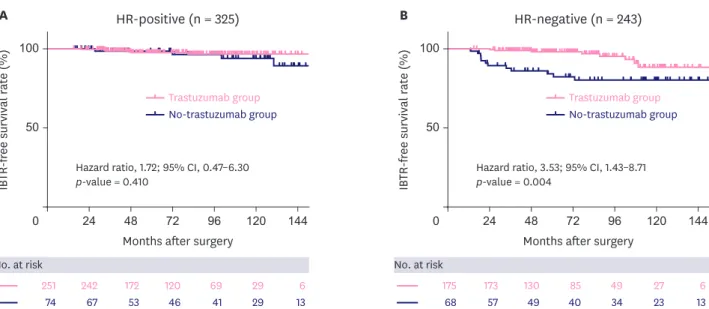
Tmab and N-Tmab groups (10-year IBTR rate, 96.7% vs. 94.0%, log-rank p = 0.410). Conversely, among the 243 patients with HR-negative breast cancer, the Tmab group had a significantly higher IBTR-free survival rate (10-year IBTR rate, 88.3% vs. 80.2%, log-rank p = 0.004).

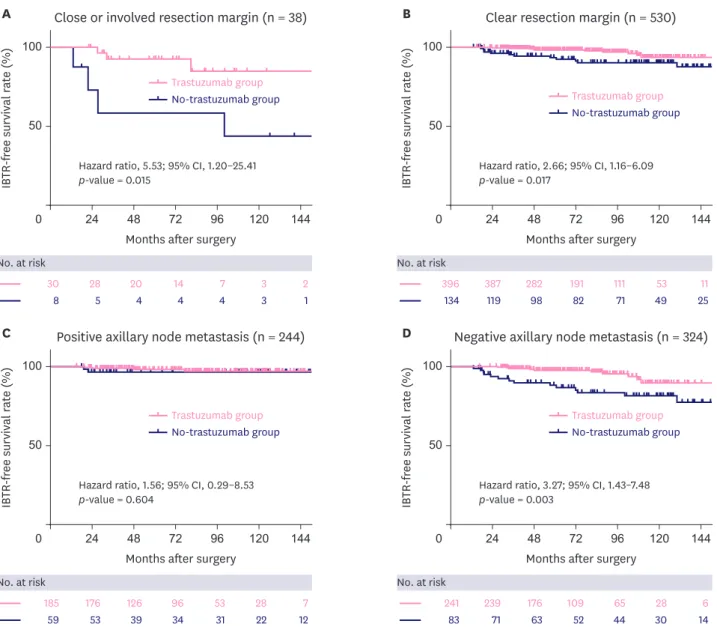
The Tmab group showed a higher IBTR-free survival rate regardless of the resection margin status. However, trastuzumab treatment had a greater effect on IBTR when the resection margin was close or positive (10-year IBTR rate, 84.9% vs. 43.8%, log-rank p = 0.015, Figure 3A and B).

Additionally, while there was no difference according to trastuzumab use among the axillary LN-positive patients (10-year IBTR-free survival rate, 97.0% vs. 96.5%, p = 0.604), the Tmab group had a significantly higher IBTR-free survival rate among the LN-negative patients (10-year IBTR-free survival rate, 89.6% vs. 81.5%, p = 0.003, Figure 3C and D).

DISCUSSION

In this study, we showed that the patients with HER2-postive breast cancer who received neoadjuvant and/or adjuvant trastuzumab treatment had a lower IBTR rate after BCS than those who did not receive trastuzumab treatment. Our result supports the importance of using trastuzumab for 1 year to reduce in-breast recurrence for HER2-positive cancer.

The systemic effect of trastuzumab for HER2-positive breast cancer has been well

established in metastatic breast cancer and early breast cancer. The HERA trial randomized patients into 1 and 2 years of trastuzumab and observation groups and showed that administration of trastuzumab for 1 year increased the disease-free survival rate from 77.4% to 85.8% (p < 0.001) and 72.2% to 78.6% (p < 0.001) after 2 and 4 years of follow-up, respectively [2]. The positive effect of trastuzumab remained beyond 10 years of follow-up (69.0% vs. 63.0%, p < 0.001) [3]. Further, the NSABP B-31 and NCCTG N9831 trials analyzed the effect of trastuzumab after doxorubicin and cyclophosphamide administration followed by paclitaxel administration [12]. Adding trastuzumab to chemotherapy improved the 10- A

24 48 72 96 120 144

0 50 100

Months after surgery Hazard ratio, 1.72; 95% CI, 0.47–6.30 p-value = 0.410

Trastuzumab group No-trastuzumab group

251 74

242 67

172 53

120 46

69 41

29 29

6 13 No. at risk

IB TR -fr ee survival r at e (%)

B

24 48 72 96 120 144

0 50 100

Months after surgery Hazard ratio, 3.53; 95% CI, 1.43–8.71 p-value = 0.004

Trastuzumab group No-trastuzumab group

175 68

173 57

130 49

85 40

49 34

27 23

6 13 No. at risk

IB TR -fr ee survival r at e (%)

HR-negative (n = 243) HR-positive (n = 325)

Figure 2. IBTR-free survival according to the HR status. The Kaplan-Meier curves show the OS of 325 HR-positive patients (A) and 243 HR-negative patients (B). A beneficial effect of trastuzumab on IBTR was found in the HR-negative patients but not in the HR-positive patients. The hazard ratio was calculated via a univariate Cox regression analysis.

CI = confidence interval; IBTR = ipsilateral breast tumor recurrence; HR = hormone receptor; OS = overall survival.

(9)

year disease-free survival and overall survival from 75.2% to 84% (p < 0.001) and 62.2% to 73.7% (p < 0.001), respectively.

For determining the efficacy of trastuzumab on locoregional recurrence (LRR), a few prospective and retrospective studies have been conducted. Cao et al. [13] retrospectively evaluated 278 patients with stage II/III cancer who underwent RT and observed a significant difference in LRR according to trastuzumab use (3-year LRR, 2.4% vs. 7.5%, p = 0.019). Kiess et al. [14] reported similar results that trastuzumab can prolong the 3-year locoregional RFS from 92% to 98% after BCS for node-negative HER2-positive breast cancer. Lanning et al.

[15] analyzed data from 501 women and found a significantly lower 5-year LRR rate in the trastuzumab-treated group after adjusting for other variables (hazard ratio, 0.21; p = 0.04).

Kim et al. [16] also found that trastuzumab had an effect on LRR in HR+/HER2+ tumors;

A

24 48 72 96 120 144

0 50 100

Months after surgery Hazard ratio, 5.53; 95% CI, 1.20–25.41 p-value = 0.015

Trastuzumab group No-trastuzumab group

30 8

28 5

20 4

14 4

7 4

3 3

2 1 No. at risk

IB TR -fr ee survival r at e (%)

B

24 48 72 96 120 144

0 50 100

Months after surgery Hazard ratio, 2.66; 95% CI, 1.16–6.09 p-value = 0.017

Trastuzumab group No-trastuzumab group

396 134

387 119

282 98

191 82

111 71

53 49

11 25 No. at risk

IB TR -fr ee survival r at e (%)

Clear resection margin (n = 530) Close or involved resection margin (n = 38)

C

24 48 72 96 120 144

0 50 100

Months after surgery Hazard ratio, 1.56; 95% CI, 0.29–8.53 p-value = 0.604

Trastuzumab group No-trastuzumab group

185 59

176 53

126 39

96 34

53 31

28 22

7 12 No. at risk

IB TR -fr ee survival r at e (%)

D

24 48 72 96 120 144

0 50 100

Months after surgery Hazard ratio, 3.27; 95% CI, 1.43–7.48 p-value = 0.003

Trastuzumab group No-trastuzumab group

241 83

239 71

176 63

109 52

65 44

28 30

6 14 No. at risk

IB TR -fr ee survival r at e (%)

Negative axillary node metastasis (n = 324) Positive axillary node metastasis (n = 244)

Figure 3. IBTR-free survival according to the resection margin and axillary node status. The survival curves for the patients with close or positive resection margin (A), clean resection margin (B), and negative axillary node status (D) show a significantly low IBTR-free survival rate with trastuzumab treatment.

However, in the patients with axillary node metastasis (C), trastuzumab treatment did not significantly affect IBTR. The hazard ratio was calculated via a univariate Cox regression analysis.

CI = confidence interval; IBTR = ipsilateral breast tumor recurrence.

(10)

however, contrary to our study results, no effect on LRR in HR−/HER2+ tumors was seen.

Importantly, most of these studies did not focus on IBTR, despite the fact that HER2-positive breast cancer is known to have a higher IBTR rate than other subtypes. The guidelines of Society of Surgical Oncology-American Society for Radiation Oncology [17] stated a positive effect of trastuzumab on IBTR after BCS based on the findings of 2 studies [18,19]. However, the 2 referenced studies lack the evidence to support the effect of trastuzumab on IBTR and analyzed its effect on only RFS and overall survival. To date, only assumptions on the effects on IBTR exist, and there is currently no statistical evidence to support it.

According to a previous study conducted in Korea in which the records of 520 patients were analyzed, the 7-year LRR rate was significantly lower in the trastuzumab-treated group than in the non-treated group (4.4% vs. 10.1%, p = 0.014); however, there was no evidence of a beneficial effect among patients with estrogen receptor (ER)-positive tumors and a low LN-positive ratio (2.1% vs. 4.2%, p = 0.75) [20]. Because our institution participated in this multicenter study, a substantial proportion of the patients analyzed in our study was also included in the previous study. However, we included more patients with a longer follow- up period and used 1:3 PSM instead of 1:1 PSM. In addition, only patients who underwent BCS were included for analysis in this study. We focused on IBTR and set stringent inclusion criteria for the tumor size and axillary node status. Finally, while the previous study included patients who received more than 6 months of trastuzumab treatment, our study excluded patients who did not complete the initially planned regimen for 1 year.

A significant proportion of IBTR seems to result in DM and reduced survival of patients [21]. It is well known that radiation after BCS can reduce IBTR. Expression of HER2/neu shows increased resistance to RT via the focal adhesion kinase-mediated pathway in vitro and in vivo [22]. Anti- HER2 therapy downregulates several HER2 signaling pathways, resulting in radio-sensitization of HER2 breast cancer [23,24]. It can be hypothesized that the synergistic effect of RT and trastuzumab might have elicited reduced IBTR in HER2-postive breast cancer. In our study, the administration of trastuzumab was an independent variable associated with IBTR after adjusting for other factors, such as RT, resection margin status, age at the time of operation, T/N stage, histologic grade, and lymphovascular invasion, which have been reported to affect IBTR.

There are several explanations for the different results according to the ER status. First, ER- positive cancers are more resistant to trastuzumab owing to diverse levels of bidirectional genomic crosstalk between ER and HER2 pathways [25]. Previous studies have demonstrated that highly manifested ER pathways can be an escape route for anti-HER2 treatment, resulting in de novo drug resistance and negating the effect [26]. In addition, Xia et al. [27]

reported that continuous exposure to anti-HER2 treatment enhances ER signaling by facilitating transcriptional activity (depressing FOXO3a and increasing caveolin-1). Acquired resistance enforces the ER and plays a major role in regulating the cancer cells. Second, ER signaling stimulates the G1/S phase transition in the cell cycle and diminishes DNA repair inducing radiosensitivity [28]. It results in favorable prognosis of RT for ER-positive breast cancer, making the effects of trastuzumab smaller than those for ER-negative cancer. In contrast, HER2-overexpressed cancer was reported to be radioresistant by cell adhesion and anoikis resistance, indicating that the importance of trastuzumab might be remarkable [22]. Finally, the magnitude of the HER2/CEP17 ratio on HER2/neu gene amplification is heterogeneous among HER2-positive breast cancers. The clinical significance of the HER2/

CEP17 ratio is important in that a lower ratio predicts a worse RFS and overall survival after

trastuzumab treatment [29]. As ER negativity was previously reported to be significantly

(11)

associated with a high HER2/CEP17 ratio [30], ER-negative breast cancer might have been more strongly affected by trastuzumab. Unfortunately, not all patients in our study underwent the FISH test; thus, the data for the HER2/CEP17 ratio are missing.

This study has several limitations. It was a long-term retrospective study conducted at a single institution. Owing to the inherent nature of a retrospective study, selection bias is bound to occur. To eliminate the selection bias and confounding effects, we conducted PSM to minimize the difference in the variables between the 2 groups. Despite our efforts, the number of patients who received neoadjuvant treatment was not able to be matched owing to large differences in the original cohort. Additionally, as trastuzumab has been recommended for HER2-positive breast cancer since 2007, and insurance coverage had been expanded for tumors exceeding 1 cm without LN metastasis since 2010 in Korea, the follow-up period of the Tmab group was shorter than that of the N-Tmab group (median, 65.9 vs. 100.9 months; p < 0.001). This selection bias may have affected the results as breast cancer recurs even more than several years after surgery.

In this study of 41 patients with IBTR, 8 patients showed recurrence after 7 years of surgery; 3 patients had HR-positive tumors, and 5 patients had HR-negative tumors. To circumvent this problem, we performed the landmark analysis discarding the follow-up at 5, 7, and 10 years after surgery (Supplementary Figure 1). The median follow-up period was not significantly different between the 2 groups at the 5th year follow-up; however, the beneficial effect of trastuzumab on IBTR significantly remained at all points of landmark. Further, we regarded RR and DM as non-informative censored data to exclude the effect of systemic therapy on subsequent IBTR, despite the shorter RFS of the patients with RR and DM than that of the patients with IBTR during the same period (Supplementary Figure 2). The N-Tmab group had a poorer DM-free survival than the Tmab group; thus, the IBTR rate may have been overestimated when competing risks were considered. This may be the reason for the lower IBTR rate for the patients with node-positive tumors than for the other patients. Nonetheless, several studies have reported that the node status is not associated with IBTR-free survival [8,13].

Moreover, diverse chemotherapy and RT regimens, except for RT boost, were not considered in this study. As most patients in the Tmab group were treated more recently than did the patients in the N-Tmab group, significant improvements of treatments, such as the operative technique, method of pathologic confirmation for the resection margin, and adjuvant treatments, including regimen of chemotherapy, might have resulted in better outcomes and led to bias. To reduce the bias, we analyzed the year of surgery using a Cox proportional hazard model. Finally, patients who discontinued their trastuzumab treatment before the end of the originally planned cycles were excluded from this study. However, the number of patients who discontinued the trastuzumab treatment was too small that the effect of early discontinuation could not be analyzed.

In conclusion, administration of trastuzumab for 1 year is an independent factor associated with reduced IBTR after BCS and RT in patients with HER2-positive breast cancer. The benefit of trastuzumab is more prominent in HR-negative cancer or axillary LN-negative breast cancer.

ACKNOWLEDGMENTS

The authors would like to sincerely thank Dr. Hyeong-Gon Moon (Department of Surgery,

Seoul National University College of Medicine, Seoul, Republic of Korea) for critical advice

and the Medical Research Collaborating Center at Seoul National University Hospital

Biomedical Research Institute for statistical analysis and consultation.

(12)

SUPPLEMENTARY MATERIALS

Supplementary Table 1

Reasons for discontinuation of trastuzumab Click here to view

Supplementary Figure 1

Kaplan-Meier curves showing IBTR-free survival rate after landmark analysis. To minimize the confounding effect of different follow-up period, we conducted landmark analysis at 5-, 7-, and 10-year of surgery. The median follow-up period was significantly different between 2 groups at 7- and 10-year, but it was not at the point of 5-year. All Kaplan-Meier curves show significant difference of IBTR-free survival between 2 groups at all points.

Click here to view

Supplementary Figure 2

Kaplan-Meier curves showing recurrence-free survival of all patients depending on metastasis sites. The Kaplan-Meier curves show RR-free survival (A), and DM-free survival (B) of all 568 patients according to trastuzumab administration.

Click here to view

REFERENCES

1. Yersal O, Barutca S. Biological subtypes of breast cancer: prognostic and therapeutic implications. World J Clin Oncol 2014;5:412-24.

PUBMED | CROSSREF

2. Gianni L, Dafni U, Gelber RD, Azambuja E, Muehlbauer S, Goldhirsch A, et al. Treatment with trastuzumab for 1 year after adjuvant chemotherapy in patients with HER2-positive early breast cancer: a 4-year follow-up of a randomised controlled trial. Lancet Oncol 2011;12:236-44.

PUBMED | CROSSREF

3. Cameron D, Piccart-Gebhart MJ, Gelber RD, Procter M, Goldhirsch A, de Azambuja E, et al. 11 years' follow-up of trastuzumab after adjuvant chemotherapy in HER2-positive early breast cancer: final analysis of the HERceptin Adjuvant (HERA) trial. Lancet 2017;389:1195-205.

PUBMED | CROSSREF

4. Sauter G, Lee J, Bartlett JM, Slamon DJ, Press MF. Guidelines for human epidermal growth factor receptor 2 testing: biologic and methodologic considerations. J Clin Oncol 2009;27:1323-33.

PUBMED | CROSSREF

5. Denduluri N, Chavez-MacGregor M, Telli ML, Eisen A, Graff SL, Hassett MJ, et al. Selection of optimal adjuvant chemotherapy and targeted therapy for early breast cancer: ASCO clinical practice guideline focused update. J Clin Oncol 2018;36:2433-43.

PUBMED | CROSSREF

6. Cardoso F, Kyriakides S, Ohno S, Penault-Llorca F, Poortmans P, Rubio IT, et al. Early breast cancer:

ESMO clinical practice guidelines for diagnosis, treatment and follow-up. Ann Oncol 2019;30:1674.

PUBMED | CROSSREF

7. van Maaren MC, de Munck L, Strobbe LJ, Sonke GS, Westenend PJ, Smidt ML, et al. Ten-year recurrence rates for breast cancer subtypes in the Netherlands: a large population-based study. Int J Cancer 2019;144:263-72.

PUBMED | CROSSREF

8. Kim HJ, Han W, Yi OV, Shin HC, Ahn SK, Koh BS, et al. Young age is associated with ipsilateral breast tumor recurrence after breast conserving surgery and radiation therapy in patients with HER2-positive/

ER-negative subtype. Breast Cancer Res Treat 2011;130:499-505.

PUBMED | CROSSREF

(13)

9. Moon HG, Han W, Noh DY. Comparable survival between pN0 breast cancer patients undergoing sentinel node biopsy and extensive axillary dissection: a report from the Korean Breast Cancer Society. J Clin Oncol 2010;28:1692-9.

PUBMED | CROSSREF

10. Edge SB, Compton CC. The American Joint Committee on Cancer: the 7th edition of the AJCC cancer staging manual and the future of TNM. Ann Surg Oncol 2010;17:1471-4.

PUBMED | CROSSREF

11. Ho DE, Imai K, King G, Stuart EA. MatchIt : nonparametric preprocessing for parametric causal inference. J Stat Softw 2011;42:42.

CROSSREF

12. Perez EA, Romond EH, Suman VJ, Jeong JH, Sledge G, Geyer CE Jr, et al. Trastuzumab plus adjuvant chemotherapy for human epidermal growth factor receptor 2-positive breast cancer: planned joint analysis of overall survival from NSABP B-31 and NCCTG N9831. J Clin Oncol 2014;32:3744-52.

PUBMED | CROSSREF

13. Cao L, Cai G, Xu F, Yang ZZ, Yu XL, Ma JL, et al. Trastuzumab improves locoregional control in HER2- positive breast cancer patients following adjuvant radiotherapy. Medicine (Baltimore) 2016;95:e4230.

PUBMED | CROSSREF

14. Kiess AP, McArthur HL, Mahoney K, Patil S, Morris PG, Ho A, et al. Adjuvant Trastuzumab Reduces Locoregional Recurrence in Women who Undergo Breast Conservation Therapy for Node-Negative HER2- Positive Breast Cancer. Int. J Radiat Oncol Biol Phys 2010;78:S98.

CROSSREF

15. Lanning RM, Morrow M, Riaz N, McArthur HL, Dang C, Moo TA, et al. The effect of adjuvant trastuzumab on locoregional recurrence of human epidermal growth factor receptor 2-positive breast cancer treated with mastectomy. Ann Surg Oncol 2015;22:2517-25.

PUBMED | CROSSREF

16. Kim MM, Dawood S, Allen P, Sahin AA, Woodward WA, Smith BD, et al. Hormone receptor status influences the locoregional benefit of trastuzumab in patients with nonmetastatic breast cancer. Cancer 2012;118:4936-43.

PUBMED | CROSSREF

17. Moran MS, Schnitt SJ, Giuliano AE, Harris JR, Khan SA, Horton J, et al. Society of Surgical Oncology- American Society for Radiation Oncology consensus guideline on margins for breast-conserving surgery with whole-breast irradiation in stages I and II invasive breast cancer. Int J Radiat Oncol Biol Phys 2014;88:553-64.

PUBMED | CROSSREF

18. Smith I, Procter M, Gelber RD, Guillaume S, Feyereislova A, Dowsett M, et al. 2-year follow-up of trastuzumab after adjuvant chemotherapy in HER2-positive breast cancer: a randomised controlled trial.

Lancet 2007;369:29-36.

PUBMED | CROSSREF

19. Romond EH, Perez EA, Bryant J, Suman VJ, Geyer CE Jr, Davidson NE, et al. Trastuzumab plus adjuvant chemotherapy for operable HER2-positive breast cancer. N Engl J Med 2005;353:1673-84.

PUBMED | CROSSREF

20. Jeon SH, Shin KH, Kim JH, Kim K, Kim IA, Lee KH, et al. Effects of trastuzumab on locoregional recurrence in human epidermal growth factor receptor 2-overexpressing breast cancer patients treated with chemotherapy and radiotherapy. Breast Cancer Res Treat 2018;172:619-26.

PUBMED | CROSSREF

21. Panet-Raymond V, Truong PT, Alexander C, Lesperance M, McDonald RE, Watson PH. Clinicopathologic factors of the recurrent tumor predict outcome in patients with ipsilateral breast tumor recurrence.

Cancer 2011;117:2035-43.

PUBMED | CROSSREF

22. Hou J, Zhou Z, Chen X, Zhao R, Yang Z, Wei N, et al. HER2 reduces breast cancer radiosensitivity by activating focal adhesion kinase in vitro and in vivo. Oncotarget 2016;7:45186-98.

PUBMED | CROSSREF

23. Pietras RJ, Poen JC, Gallardo D, Wongvipat PN, Lee HJ, Slamon DJ. Monoclonal antibody to HER-2/

neureceptor modulates repair of radiation-induced DNA damage and enhances radiosensitivity of human breast cancer cells overexpressing this oncogene. Cancer Res 1999;59:1347-55.

PUBMED

24. Liang K, Lu Y, Jin W, Ang KK, Milas L, Fan Z. Sensitization of breast cancer cells to radiation by trastuzumab. Mol Cancer Ther 2003;2:1113-20.

PUBMED

(14)

25. Lousberg L, Collignon J, Jerusalem G. Resistance to therapy in estrogen receptor positive and human epidermal growth factor 2 positive breast cancers: progress with latest therapeutic strategies. Ther Adv Med Oncol 2016;8:429-49.

PUBMED | CROSSREF

26. Rimawi MF, De Angelis C, Schiff R. Resistance to anti-HER2 therapies in breast cancer. Am Soc Clin Oncol Educ Book 2015;e157-64.

PUBMED | CROSSREF

27. Xia W, Bacus S, Hegde P, Husain I, Strum J, Liu L, et al. A model of acquired autoresistance to a potent ErbB2 tyrosine kinase inhibitor and a therapeutic strategy to prevent its onset in breast cancer. Proc Natl Acad Sci U S A 2006;103:7795-800.

PUBMED | CROSSREF

28. Abi Jaoude J, de Azambuja E, Makki M, Tamim H, Tfayli A, Geara F, et al. Post-mastectomy radiation therapy in human epidermal growth factor receptor 2 positive breast cancer patients: analysis of the HERA trial. Int J Radiat Oncol Biol Phys 2020;106:503-10.

PUBMED | CROSSREF

29. Perez EA, Reinholz MM, Hillman DW, Tenner KS, Schroeder MJ, Davidson NE, et al. HER2 and chromosome 17 effect on patient outcome in the N9831 adjuvant trastuzumab trial. J Clin Oncol 2010;28:4307-15.

PUBMED | CROSSREF

30. Adamczyk A, Kruczak A, Harazin-Lechowska A, Ambicka A, Grela-Wojewoda A, Domagała-Haduch M, et al. Relationship between HER2 gene status and selected potential biological features related to trastuzumab resistance and its influence on survival of breast cancer patients undergoing trastuzumab adjuvant treatment. Onco Targets Ther 2018;11:4525-35.

PUBMED | CROSSREF

수치

Figure 1. Kaplan-Meier curves showing the IBTR-free survival of all patients. The Kaplan-Meier curve shows  the IBTR-free survival of 568 patients after PSM according to trastuzumab administration
Table 2. Clinical characteristics of patients according to treatment of trastuzumab before and after propensity score matching
Figure 2. IBTR-free survival according to the HR status. The Kaplan-Meier curves show the OS of 325 HR-positive patients (A) and 243 HR-negative patients  (B)
Figure 3. IBTR-free survival according to the resection margin and axillary node status

참조

관련 문서

We compared the oncologic outcomes of breast-conserving surgery plus radiation therapy (BCS+RT) and modified radical mastectomy (MRM) under anthracycline plus taxane-based

Supraclavicular nodal failure in patients with one to three positive axillary lymph nodes treated with breast conserving surgery and breast irradiation, without supraclavicular

average apparent diffusion coef ficient, ALND = axillary lymph node dissection, ANL = axillary lymph node, BCS = breast conserving surgery, CI = confidence interval, DCE-MRI =

Purpose: The present study aimed to examine the clinical impli- cations of CD4, CD8, and FOXP3 expression on the prognosis of human epidermal growth factor receptor 2 (HER2)-positive

Differences in risk factors for local and distant recurrence after breast-conserving therapy or mas- tectomy for stage I and II breast cancer: pooled results of

The poor performance of preoperative imaging in predicting tumor area in HER2-positive breast cancer may raise a question regarding the increase in positive margin rates or secondary

4 on recurrence and survival rates in early breast cancer accord- ing to surgical procedure discovered that patients that received total mastectomy and breast con- serving

Despite the high incidence of locoregional recurrence in breast cancer, tumor recurring exclusively at the previous surgical drain site after breast conservative surgery seems to be