| Abstract |
6)PURPOSE: The purpose of this study was to provide fundamental clinical data to be used in therapeutic approach to patients with patellofemoral pain syndrome by administrating the squat exercise combined with whole body vibration exercise to them and investigating the effect of such exercise to leg muscle activity and muscle fatigue.
METHODS: The patients with patellofemoral pain syndrome were randomly assigned to experimental group I (n
= 9) where only squat exercise was administered and experimental group II (n = 9) where the squat exercise combined with whole body vibration exercise was provided.
The intervention program was administered for two weeks, four days a week, one session a day, three set a session, and 20 reps a set. The pre- and post-test were performed to measure
†Corresponding Author : Young-Jun Moon
[email protected], https://orcid.org/0000-0003-1141-8704 This is an Open Access article distributed under the terms of the Creative Commons Attribution Non-Commercial License (http://creativecommons.org/licenses/by-nc/3.0) which permits unrestricted non-commercial use, distribution, and reproduction in any medium, provided the original work is properly cited.
muscle activity and muscle fatigue of vastus medialis and vastus lateralis.
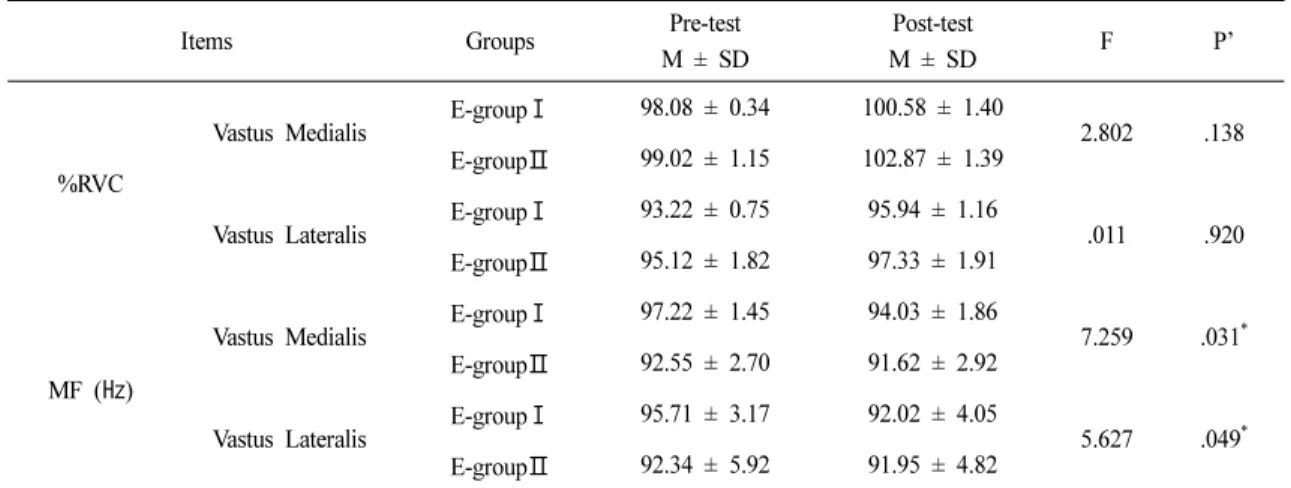
RESULTS: The muscle activity significantly changed in both group (p < .05, p < .01, respectively) and the muscle fatigue showed significant change only in group I (p < .05).
In addition, there was significant difference between groups in change of muscle fatigue of both muscles (p < .05) but not in change of muscle activity.
CONCLUSION: The results showed that both exercise are effective in improving muscle activity, however, that the squat exercise combined with whole body vibration exercise is more effective in preventing muscle fatigue.
Key Words: Muscle activity, Muscle fatigue, Patellar femoral pain syndrome, Whole body vibration exercise
Ⅰ. 서 론
무릎넙다리 통증 증후군(Patellar femoral Pain Syndrome) 이란 무릎관절 통증의 가장 흔한 증상으로 무릎뼈의 전방이나 후방에서 통증이 나타나고[1], 이 통증은 무 릎뼈의 비정상적인 정렬 상태에서 다리를 움직이기 때
Research Article Open Access
전신 진동 운동을 병행한 스쿼트 운동이 무릎넙다리 통증 증후군 환자의 넙다리네갈래근의 근 활성도 및 피로도에 미치는 영향
강정일⋅문영준
1†⋅정대근
세한대학교 물리치료학과,
1정다운요양병원 물리치료사
Effect of Squat Exercise Combined with Whole Body Vibration Exercise on Muscle Activity and Muscle Fatigue of Quadriceps in Patients with Patellofemoral Pain Syndrome
Jeong-Il Kang, PT, PhD⋅Young-Jun Moon, PT, PhD
1†⋅Dae-Keun Jeong, PT, PhD Department of Physical Therapy, Sehan University,
1
Jeong Da-un nursing hospital, physical therapist
Received: August 26, 2020 / Revised: September 01, 2020 / Accepted: October 12, 2020
ⓒ 2021 J Korean Soc Phys Med
문이며 일상생활에서 흔히 볼 수 있는 근골격계 질환 중 하나이다[2]. 이 질환은 넙다리네갈래근의 정상적인 근 수축능력이 불충분하고, 정상적인 무릎과 비교하였 을 때 무릎관절의 비정상적인 움직임을 야기시켜 무릎 주위 근육들의 근피로가 발생하게 된다[3]. 그리고 무 릎관절의 주위 근육들은 특성상 엉덩관절과 발목관절 을 가로지르고 있기 때문에 무릎관절 주위 근육들의 문제는 엉덩관절과 발목관절에도 영향을 미칠 수 있어 무릎관절 주위 근육 훈련은 매우 중요하다[4].
무릎넙다리 통증 증후군의 운동방법으로는 넙다리 네갈래근 근력 강화 운동이 중요시되어야 하며[3], 근 력 운동 방법 중 닫힌 사슬 유형인 스쿼트 운동은 발목 관절과 무릎관절 및 엉덩관절의 움직임을 동시에 일으 켜 관절 주변의 협력 수축, 압박력, 구심성 수축과 원심 성 수축의 동시 발생 및 고유수용감각 자극과 같은 기능 적 훈련 운동 방법 중 가장 효과적이다[5]. 스쿼트 운동 은 넙다리네갈래근과 넙다리두갈래근의 협력 수축으 로 인해 높은 안정성과 기능적인 범위 내에서 무릎넙다 리 관절에 최소한의 스트레스를 제공하기 때문에 효과 적이고 안전한 운동방법이지만[6], 운동 과정에서 중력 과 체중에 대항하여 운동을 하기 때문에 다리에 많은 부하가 적용되어 근피로를 유발시킬 수 있는 단점을 가지고 있다[7]. 이러한 단점을 보안하기 위해 최근 운 동 치료 영역에서 근력 증진을 위한 운동방법으로 전신 진동 자극 운동이 있으며, 이는 인체에 무해한 수준의 진동수와 진폭을 활용하여 근육과 신경을 자극하는 방 법이며[8], 근 피로 예방함으로써 근 지구력을 증진시 키는 방법이기도 한다[9]. 전신 진동 운동은 자극을 받 은 동안 골격근의 근육길이의 변화가 나타나 척수 반사 흥분 능력을 촉진시키고[10], 직접적으로 자극 받은 부 위 뿐만 아니라 주변 근육에도 긍정적인 효과가 나타나 며[11], 혈액량과 혈류속도를 증가시켜 말초 혈액 순환 을 증진시켜 근피로 감소에 효과적이기 때문에 전신 진동운동과 결합한 운동방법들이 제시되고 있다[12].
전신 진동 운동에 관한 많은 관심과 연구들이 진행 중에 있으며, 전신 진동 운동을 결합하여 여러 운동 프로그램을 접목시키는 다양한 연구들도 진행되고 있 으나[13], 근활성도는 근피로와 밀접한 관계를 가지고
있음에도 불구하고, 근활성도에 변화에 대한 단편적인 연구들이 대부분이다. 따라서 본 연구는 전신 진동 운 동을 결합한 스쿼트 운동을 무릎넙다리 통증 증후군 환자에게 적용하여 무릎 주위 근육들의 근활성도와 근 피로도에 미치는 영향을 규명하여, 향 후 임상에서 무 릎넙다리 통증 증후군 환자들의 치료적 접근 방법에서 있어서 임상적 기초자료를 제공하기 위해 실시하였다.
Ⅱ. 연구방법
1. 연구대상
본 연구는 2019년 3월부터 2019년 8월까지 전라남도 에 소재한 J 병원에 근무하고 있는 직원 137명을 대상으 로 사전 설문지인 Kujala patellofemoral score (KPS)을 통해 80점 이상 90점 미만인 무릎관절의 기능부전[15]
을 가지고 있는 18명을 최종 표본 추출하였으며, 무릎 관절을 포함한 다리 모든 관절에 정형외과적 수술이나 치료를 받지 않은 자, 엉덩관절과 무릎관절, 발목 관절 에 변형과 주위 근육들의 구축이 없는 자, 최근 헬스 등의 근력 강화 운동을 하지 않는 대상으로 본 연구의 목적을 이해하고 연구에 자발적으로 참여한 자를 연구 대상자로 선정하였으며, 일반적 특성은 다음과 같다 (Table 1).
2. 실험방법
1) 연구 설계
본 연구는 무릎관절의 기능부전을 가지고 있는 18명 을 표본 추출하여, 스쿼트 운동만 하는 집단을 실험군
Ⅰ로, 전신 진동 운동을 병행한 스쿼트 운동을 하는
집단을 실험군Ⅱ로 무작위 배치하여, 중재 전 사전 검
사로 표면근전도(Surface Elecromyography; sEMG)를 활
용하여 안쪽넓은근(vastus medialis), 가쪽넓은근(vastus
lateralis)의 근활성도와 근피로도를 측정하고, 각 집단
의 중재는 총 2주 간, 주 4회, 1일 1회, 1회 3세트, 세트당
20 회 중재 프로그램을 시행한 후, 사후 검사는 사전
검사와 동일하게 재측정하였다.
2) 전신 진동 운동(Whole-body vibration exercise) 전신 진동 운동(WellengangGmb Otisheim, Germany) 은 다양한 진폭과 진동수 자극을 통해 근방추와 같은 감각수용기에 기계적인 자극을 줌으로써 고유수용성 감각을 강화시키며, 근방추의 일차종말 신경을 자극하 여 Ia 들신경원들의 활동을 증가시켜 더 강한 알파운동 신경의 출력을 유발하고, 운동단위의 동원률을 증가하 여 근 활성화에 긍정적인 변화를 주기도 하며, 근-신경 계의 반응과 적응을 이끌어 근피로에도 영향을 줄 수 있는 방법이다[14].
3) 근활성도 및 근피로도 측정
다리 근활성도 및 근피로도 측정을 하기 위해 표면 근전도 MP100(Biopac system, USA) 2채널을 사용하였 으며, 근전도 신호 수집을 위한 표본 추출율(sampling rate)은 1,000 ㎐로 하였고, 주파수 대역 필터는 30~450
㎐ 설정하였다. 근전도 신호의 피부저항을 최소화하기 위해 대상자들의 피부에서 털을 제거하고 가는 사포를 이용하여 각질을 제거한 뒤 알코올 솜으로 문질러 피부 를 청결히 한 후, 2개의 Ag/Agcl 표면 전극을 사용하여 안쪽넓은근과 가쪽넓은근의 근복(muscle belly)에 근섬 유와 평행한 방향으로 2 cm 간격으로 부착하였다. 먼저 근활성도 측정방법은 김기철[15]연구 방법을 본 연구 에 맞게 수정하였고, 각 집단의 대상자들은 편안하게 선 자세에서 10초 동안 근전도 신호를 채취하였으며, 시작과 끝 2초를 뺀 6초 구간을 3회 측정하여 평균값을 구하여 이를 기준 동작 시 실효치 진폭 값으로 설정하였 다. 특정 동작 시 실효치 진폭 값은 팔 걸이가 없는
대상자들의 앉기-일어서기 동작을 측정하기 위해 우선 팔걸이가 없는 등받이만 있는 의자를 활용하여 대상자 들의 허리는 똑바로 편 상태를 취하고 고개는 정면을 향하여 시선이 전방을 주시하도록 하였고, 양 손은 허리 에 두고 치료사의 “시작”이라는 구두 지시에 따라 대상 자들은 앉은 자세에서 일어서기 동작을 시행하였다. 동 작 시 객관적인 평가를 위해 메트로놈(metronome)을 활용하여 10초 동안 반복적으로 앉기-일어서기 동작을 3 회 측정하여 평균값을 특정 동작 시 실효치 진폭 값으 로 설정하였다. 이들의 근활성도를 정규화하기 위해 기준 동작 시 실효치 진폭 평균 값을 특정 동작 시 실효 치 진폭 평균값으로 나눈 후 백분율(%)하여 정규화 하였으며, 측정 간 2분의 휴식시간을 동일하게 적용하 였다. 근피로도 측정은 30초 동안 약 60° 스쿼트 동작을 유지한 상태에서 안쪽넓은근과 가쪽넓은근의 처음과 끝 10초를 뺀 10초 구간을 3회 측정하여 중앙주파수 값을 측정하였다.
3. 중재 방법
각 집단의 대상자들의 중재 프로그램을 적용하기 전에 스쿼트 동작의 무릎 각도를 항상 일정하게 유지하 기 위해 각도계(goniometer)를 활용하여, 무릎관절 60°
굽힘시 골반 높이를 벽에 표시한 후, 실험군Ⅰ의 중재 프로그램은 벽에 기대어 무릎굽힘 60° 스쿼트 동작을 적용하였으며, 실험군Ⅱ의 중재프로그램은 전신 진동 운동기를 활용하여 25~45 ㎐ 주파수로 설정하여 진동 기구 위에서 벽에 기대어 무릎굽힘 60° 스쿼트 동작을 총 2주 간 주 4회 1일 1회, 1회 3세트, 세트당 20회를 Items Experimental GroupⅠ(n = 9) Experimental GroupⅡ (n = 9) P’
Age 35.60 ± 3.78 36.24 ± 3.03 .888
Height (cm) 169.92 ± 4.21 167.32 ± 4.87 .761
Weight (kg) 69.20 ± 12.99 66.4 ± 5.55 .135
Measuring Area (right / left) 8 / 1 8 / 1
KPS (score) 84.83 ± 3.35 85.62 ± 3.36 .888
‘Levene’s test
KPS: Kujala patellofemoral score
Table 1. General Characteristics
시행하였다. 이때 각 집단의 스쿼트 동작 시 양 발을 어깨 넓이만큼 벌리고 무릎이 발끝의 나오지 않도록 치료사의 지도 의해 중재프로그램을 적용하였으며, 중 재 프로그램 적용 후 통증을 조절하기 위해 아이스 팩 (Icing) 10분을 모든 집단에 적용하였다.
4. 자료분석
본 연구의 자료 처리는 Window용 SPSS 20.0을 이용 하여 측정항목에 대한 평균과 표준편차를 산출하였으 며, 연구대상자의 일반적 특성에 대한 동질성을 Levene 의 등분산 검정(Levene’s test)을 실시하였다. 그리고 각 집단 내 근활성도와 근피로도 변화를 알아보기 위해 대응표본 t-검정(Paired t-test)을 사용하였고, 각 집단 간 의 근활성도와 근피로도 변화를 비교하기 위해 공분산 분석(ANCOVA)을 사용하였으며, 유의수준은 α = .05로 설정하였다.
Ⅲ. 연구결과
1. 실험군Ⅰ의 넙다리네갈래근의 근활성도 및 근피로 도 변화 비교.
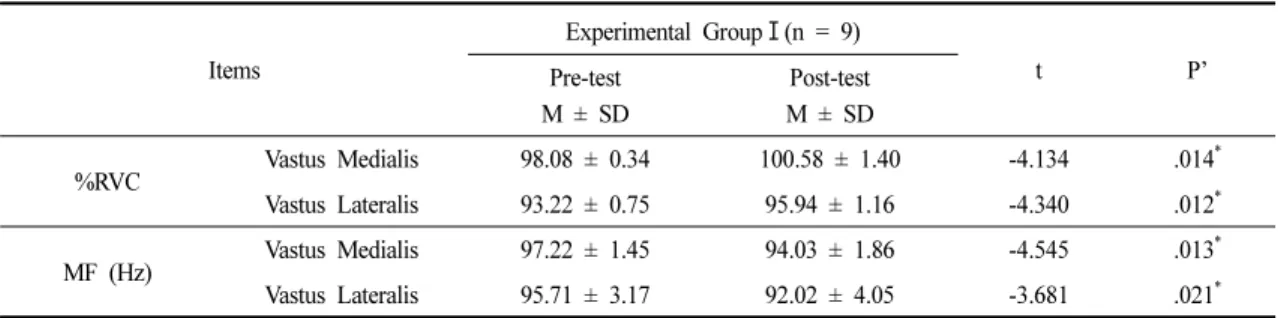
실험군Ⅰ의 안쪽넓은근과 가쪽넓은근의 근활성도 및 근피로도를 분석한 결과, 근활성도에서는 모든 근육 에서 유의한 차이가 있었으며(p < .05)(Table 2), 근피로 도에서도 모든 근육에서 유의한 차이가 있었다(p <
.05)(Table 2).
2. 실험군Ⅱ의 넙다리네갈래근의 근활성도 및 근피로 도 변화 비교.
실험군Ⅱ의 안쪽넓은근과 가쪽넓은근의 근활성도 및 근피로도를 분석한 결과, 근활성도에서는 모든 근육 에서 유의한 차이가 있었으나(p < .01)(Table 3), 근피로 도에서도 모든 근육에서 유의한 차이가 없었다.
3. 각 집단 간 넙다리네갈래근의 근활성도 및 근피로 도 변화 비교.
집단 간 안쪽넓은근과 가쪽넓은근의 근활성도 및 근피로도를 분석한결과, 근활성도는 모든 근육에서 집 단 간 유의한 차이가 나타나지 않았지만, 근피로도에서 는 모든 근육에서 집단 간 유의한 차이가 나타났다(p
< .05)(Table 4).
Ⅳ. 고 찰
스쿼트 운동은 다리 근력 강화를 위한 닫힌 사슬 운동 방법 중 하나로써 열린 사슬 운동의 비해 효과적으 로 근활성도 변화를 나타낼 수 있다[16]. 넙다리 통증 증후군이 있는 환자들을 대상으로 열린 사슬운동과 닫 힌 사슬 운동을 적용한 결과 두 집단 보다 효과적으로 관절의 안정성과 근력 증진에 효과적이지만, 닫힌 사슬 운동이 조금 더 관절의 안정성과 근력향상에 기여한다 고 하였다[17]. 또한 닫힌 사슬 운동인 스쿼트 운동을 환자에게 적용은 고유수용성감각에 긍정적인 영향을 Items
Experimental GroupⅠ(n = 9)
t P’
Pre-test M ± SD
Post-test M ± SD
%RVC Vastus Medialis 98.08 ± 0.34 100.58 ± 1.40 -4.134 .014
*Vastus Lateralis 93.22 ± 0.75 95.94 ± 1.16 -4.340 .012
*MF (Hz) Vastus Medialis 97.22 ± 1.45 94.03 ± 1.86 -4.545 .013
*Vastus Lateralis 95.71 ± 3.17 92.02 ± 4.05 -3.681 .021
*‘Paired t-test
*
p < .05
%RVC: %Reference voluntary contraction MF: Median frequency
Table 2. Comparisons of Changes in Muscle Activity and Muscle Fatigue for Experimental Group
준다고 하였다[18]. 본 연구에서도 두 집단 모두 안쪽넓 은근과 가쪽넓은근의 근활성도에 유의한 차이가 나타 나 선행연구를 지지한 결과를 도출할 수 있었다. 그러 나 스쿼트 운동은 동적인 움직임과 관절의 하중 부하로 인해 다른 다리 운동에 비해 많은 근피로가 누적되기 때문에, 이를 보안하기 위해 다양한 연구방법들이 진행 되고 있다.
근피로는 근전도 상에서 주파수 값이 높아지면 속근 섬유의 근비대가 원인이 되어 주파수 스펙트럼이 고주
파 대역에서 저주파 대역으로 이동은 근 피로 증가 또는 근 지구력 감소 현상이라고 하였으며[19], 고주파에서 저주파 이동하는 원인은 운동단위의 활동 빈도, 전도 속도, 근막의 흥분성 감소 등의 변화로 보고 있어, 운동 시 이를 보안할 수 있는 방법들이 필요하다[19,20]. Kim 등[21]은 스쿼트 운동의 단점을 보안하기 위해 수중에 서 스쿼트 운동을 시킨 결과, 다리의 근활성도 증가뿐 만 아니라 체중부하의 부담감을 줄여 근피로를 예방할 수 있었다고 하였고, 또 다른 방법으로는 전신 진동 Items
Experimental groupⅡ(n = 9)
t P’
Pre-test M ± SD
Post-test M ± SD
%RVC Vastus Medialis 99.02 ± 1.15 102.87 ± 1.39 -6.398 .003
*Vastus Lateralis 95.12 ± 1.82 97.33 ± 1.91 -5.435 .006
*MF (Hz) Vastus Medialis 92.55 ± 2.70 91.62 ± 2.92 -1.492 .208
Vastus Lateralis 92.34 ± 5.92 91.95 ± 4.82 -.463 .668
‘Paired t-test
*
p < .01
%RVC: %Reference voluntary contraction MF: Median frequency
Table 3. Comparisons of Changes in Muscle Activity and Muscle Fatigue for Experimental Group
Items Groups Pre-test
M ± SD
Post-test
M ± SD F P’
%RVC
Vastus Medialis E-group Ⅰ 98.08 ± 0.34 100.58 ± 1.40
2.802 .138 E-group Ⅱ 99.02 ± 1.15 102.87 ± 1.39
Vastus Lateralis E-group Ⅰ 93.22 ± 0.75 95.94 ± 1.16
.011 .920
E-group Ⅱ 95.12 ± 1.82 97.33 ± 1.91
MF ( ㎐)
Vastus Medialis E-group Ⅰ 97.22 ± 1.45 94.03 ± 1.86
7.259 .031
*E-group Ⅱ 92.55 ± 2.70 91.62 ± 2.92
Vastus Lateralis E-group Ⅰ 95.71 ± 3.17 92.02 ± 4.05
5.627 .049
*E-group Ⅱ 92.34 ± 5.92 91.95 ± 4.82
‘ANCOVA
*