*This work was supported by the 2019 Far East University Research Grant (FEU2019R11)
*Corresponding Author : Kyu-Cheol Shin([email protected]) Received October 31, 2019
Accepted January 20, 2020 Revised December 31, 2019
Published January 28, 2020
Vocabulary Improvement in EFL Writing through Narrative and Expository Texts
Kyu-Cheol Shin
Professor, College of Liberal Arts, Far East University
외국어교육 상황에서 텍스트 유형별 읽기에 따른 어휘력향상 연구
극동대학교 교양대학 교수 신규철
Abstract The purpose of this study is to investigate the effect of narrative and expository texts on incidental vocabulary learning of Korean university EFL learners while reading. The experimental groups were divided into 3 groups. The first experimental group were exposed to narrative texts and second group received expository texts. And the third group were administered narrative and expository texts alternately. The vocabulary tests were conducted after the last session to assess the incidental vocabulary gains of the learners. The results indicated the superiority of the expository texts over narratives in terms of enhancing learners' incidental acquisition of unknown words. Moreover, the results showed that the blended reading group of expository and narrative texts did better on the vocabulary gains than those of narrative reading group and expository reading group. However, in the essay writing assessment, the expository group committed the most vocabulary errors in writing.
Key Words : Narrative, Expository, EFL writing, Vocabulary, Extensive reading
요 약 이 논문의 목적은 외국어 학습자가 대화체와 설명체 텍스트를 읽기를 하는 동안, 텍스트 유형이 쓰기에 있어서 어휘향상에 어떻게 영향을 주는 지를 밝히는데 있다. 실험집단은 3개의 그룹으로 나뉘어졌다. 첫번째 그룹은 대화체 텍스트를 읽었고, 두번째 그룹은 설명체 텍스트를 읽었다. 한편, 세번째 그룹은 대화체와 설명체 글을 번갈아 가며 읽었 다. 학습과정이 끝난 후, 어휘 테스트를 통해 집단 간의 비교를 하였고, ETS 에세이 평가에 나타난 평가 결과를 토대로 어휘에 나타난 특징을 분석하여 비교 하였다. 실험 결과는, 학습자의 모르는 어휘에 대한 이해에 있어서, 설명체 텍스트 가 대화체 텍스트보다 우수하다는 것을 증명하였다. 더욱이, 대화체와 설명체를 동시에 읽은 집단이 대화체만 읽은 집 단이나 설명체만 읽은 집단보다 어휘 향상에 이어서 더 우수함을 보여 주었다. 한편, ETS 에세이 쓰기에 나타난 결과는 상대적으로 설명체 글의 학습자가 틀린 오류가 가장 많았다.
주제어 : 대화체, 설명체, 외국어 쓰기, 어휘, 다독
1. Introduction
Many language researchers have shown the role of reading related to vocabulary acquisition.
Vocabulary acquisition generally occurs as a by-product of reading activities not explicitly geared to vocabulary learning[1]. In this regard, the role of extensive reading is important for the vocabulary learning. Swanborn and de Glopper(2002) also argues that new word meanings are learned even if the readers' purpose is not the vocabulary learning[2]. The reader mentally represent and process differently, depending on the genre of the text[3]. So, when learners read different types of texts, the results can be different in the aspect of vocabulary learning. For instance, expository passages are thought as more difficult to process than narrative ones[4]. Moreover, expository texts are less cohesively organized by temporal and casual connections, so demanding more explicit logical inference. Therefore, learners face a greater challenges in expository reading than narrative one in terms of text structure, conceptual density and familarity, vocabulary knowledge and prior knowledge[5]. Texts should be also motivational to learners. According to Huckin & Coady(1999), interesting texts are more conductive to incidental vocabulary learning.
However, Pulido(2007) suggested that although topic familarity affects text processing, comprehension and lexical gain, it does not affect the role that comprehension plays in vocabulary learning. On the other hand, Gardner(2004) analyzed the lexical difference between narrative and expository texts and concluded that children's narratives tend to use a greater proportion of frequency words than expository texts[6]. In addition, he maintains that this is because narratives demands fewer lexical words in comprehension[1-6].
However, as we can see the previous studies, lots of researchers have not shown the effect of text types on the vocabulary acquisition while
learners write. So, in this study, based on the reading of narrative and expository texts, it is discussed how the vocabulary learning of the learners will be affected by the text types they read and what kind of text type will be better contribute to the learners' vocabulary acquisition.
2. Literature Review 2.1 vocabulary knowledge
When it comes to the vocabulary acquisition in EFL context, many linguists and educators have studied the role of reading. And they have researched the effects of text types on the vocabulary acquisition while learners read.
Vocabulary knowledge is an essential part of mastering a foreign language[7]. Researchers suggest that vocabulary knowledge should be constructed in context. In this regard, Richards(1976) defined vocabulary knowledge in terms of frequency and collocation, usage, syntactic behavior, basic forms, derivation, association, and semantics. According to Hulstin and Laufer(2001), incidental vocabulary acquisition is learning words as a by-product of reading committing lexical items to memory[8].
In this context, the research has shown that learners can learn and remember materials from some text genres better than others. Each type of text represents and organizes its context and structure differently in accordance with its specific communicative purpose that realizes different genres. In every text, the author chooses appropriate structures, language, technical vocabularies, and suitable genres to convey his purpose to the readers. According to Livingstone (1994), different genres result in different modes of the text-reader interaction and involvement that consequences result in different levels of learning from texts[9]. Wolf and Mienko (2007) conducted a study to
investigate learning and memory of factual content from the narrative and expository text[10]. According to the study, it was proved more benefits from the expository text than narrative text[7-10].
2.2 The Effect of Extensive Reading on Writing in EFL Context
Writing is believed to enable learners to develop their experiences into texts and the process of thinking[11]. Thus, good writing should be based on the learners' reading which contributes to critical thinking and background knowledge. In reality, a major challenge of EFL learners is to produce good-quality writing.
However, L2 writing is an obstacle to learners as a productive skill because writing should be presented appropriately, cohesively and accurately[12]. In this regard, learners' active engagement in reading should be a fundamental way for good writing[13].
On the other hand, Elley & Mangubhai (1981) argues that the young children made significant improvements in learning written English structure through reading. In addition, Day &
Bamford (2002) demonstrates that the influence of extensive reading goes into writing, supporting reading- writing connection and learners should learn to write through reading[14]. According to Hedgcock & Ferris (2009), extensive reading makes the background knowledge accessible for learners as helpful and essential aspect of writing[11-15].
As we can see the previous studies so far, we come to know that reading is very significant towards mastering writing in EFL context.
2.3 Narrative Texts vs Expository Texts The narrative text is important genre of oral discourse and the easiest genre to remember [Graesser, Olde, & Klettke, 2011] that includes myths, epics, fables, folk, tale, novel, tragedy,
comedy, and short stories[16]. The main purpose is to tell a story about people. Stories are written to entertain and excite the readers from the realistic experience and imagination of the writer. Dewaele and Alfawzan(2018) argues that learners have obtained good results for reading when they got higher levels of enjoyment from reading[17]. Language researchers suggest that using of literature is better than communicative textbooks to change the focus of the language learning from grammar to creative thinking [Hines, 2005]. Rosti Talif(1995) states the relationship between language and literature is that between sound and music[18]. In short, a narrative text is a story meant to entertain the learners. The texts are not always fictional.
Sometimes, they tell a story based on personal experiences or historical facts. In the respect of vocabulary learning, the narrative texts have combination of concrete and abstract language and abundance of personal pronouns. In addition, picturebooks can act as effective teaching materials in EFL classrooms for struggling English learners. This is because lots of English piturebooks have simple plots, natural English usages and simple sentences with illustrations[16-19].
The expository is a non-fiction, informational text, which is written to report, explain, describe, persuade or convey new information about an idea or topic. It includes newspaper articles, encyclopedia, textbooks, posters, manuals and the Internet. The expository text is different from the narrative text in format, purpose, linguistic features, and technical vocabulary. Exposing learners to the expository texts helps them to increase their knowledge of the genre as vocabulary, syntax, and the structure of the text [Duke, 2003]. The most common structures are description, compare & contrast, cause & effect, problem solution, and listing & sequence. In the expository text, learners will construct their situational model by interaction between explicit
information in the text and world knowledge.
The learners use various kinds of reading strategies such as inference, paraphrasing, self-explanation, prediction and monitoring[20].
Expository texts provide facts in a way that is educational and purposeful. The text is fact-based with the purpose of exposing the truth through a factual source. True expository text will focus on educating its readers. The style is commonly concise and simple. In conclusion, narrative texts allow the author to be creative and tell a story in a way that he wants to tell, while expository texts follow relatively strict writing rules[20].
As we can see in the previous studies, the narrative texts and the expository texts have played a role in reading and vocabulary acquisition differently. In this study, based on the text types of reading, it is shown that the different text types while reading will be reflected L2 learners’ writing differently.
2.4 The Effect of Extensive Reading on the Vocabulary Acquisition in Writing
All texts are composed of lexical and grammatical words that provide message. In texts, the vocabulary helps with the meaning formation, while grammatical words enable one to construct the meanings coherently. However, low proficiency L2 learners face challenges in completing writing tasks mainly due to lack of lexical and grammatical knowledge to develope their thinking into words that convey a certain meaning. In acquiring a foreign language, writing skills are known to pose the greatest burden to both the learners and the teachers. In L2 writing, the learners are asked to deliver their ideas, feelings, and experiences into text[21]. Studies have shown that English as a Foreign Language (EFL) learners use their L1 skills in L2 writing to compensate for linguistic deficiencies. Kim and Yoon (2014) investigated the extent to which
Korean learners of English use their L1 in L2 writing tasks and how this use varies according to their L2 proficiency[22]. This study indicated that lower level students used their L1 more than the advanced learners, So, in L2 reading, when the learners perceive the text positively, they will then have a lower level of anxiety towards the writing tasks and thus increase their willingness to write[23]. The lack of vocabulary also causes the difficulty of writing for a foreign language learner[24] and it is one of the most important factors that determine his writing quality[25].
Studies have shown that having the right input of reading is important when a foreign language is concerned[26]. In addition, frequent reading and writing exercises have a positive impact on writing performance[27]. Non-native learners face an added burden due to lack of vocabulary acquisition and poor command of lexical variety.
Therefore, one method of enhancing lexical mastery is by way of extensive reading (Renandya, 2007; Tsang, 1996). According to Krashen(1977), he maintains that comprehensible input related to reading can enhance learners' linguistic proficiency[28]. And Stinnett(2013) argues that lots of elements in the narrative story such as character, setting, problem, and solution, could be incorporated into learners' writing with writers' intended meaning[29]. The narrative genre also influence the cognitive aspects of the reader. In this context, Willingham(2004) exerts that narratives provide a familiar pattern for the readers to organize ideas as they can process the information more effectively in their mind[[21-30].
When it comes to vocabulary gains in writing while learners read, when the learners are provided with familiar topics, they are able to relate, reflect and translate their own experiences. So, with the systematic and organized content, the learners will be motivated to try to write towards a better output.
Writing-based tasks made many novice learners
get the high level of vocabulary acquisition and grammar[31]. In addition, they are able to reflect into words as they have acquired the vocabulary input and got their much background knowledge.
When the acquired words are used frequently and systematic instructions are given repeatedly, there will be retention of the patterning in the writing process. Ellis(2019) states that writing-based tasks cased high level of learners to get better language learning[32]. This can lead to the use of multiple synonymous vocabulary for their writing. Therefore, learners can improve in the lexical aspects and enhance their creative writing. These lexical words provide a base for learners to express their own ideas and consolidate their writing[31,32].
3. Methodology
In this study, nine Korean EFL college learners were selected. They were sophomore and majored in English. The class have read the different texts for four months. The vocabulary level test as a pre-test was used to assess the learners' vocabulary knowledge and get a homogeneous group. According to the learners’
scores in the pre-test as Table 2, the experiment group were divided into 3 groups as Table 1. The first group is Narrative group (Group1) who read the narrative texts, the second is Expository group (Group2) who read expository texts and the third is Blended group (Group3) who read both narrative texts and expository texts. To assess the vocabulary gains of the students, vocabulary tests were administered after four months as a post-test. They were given 50 questions in each test. The questions consisted of English-Korean translation questions. On the other hand, at the end of the course, the participants were provided ETS essay writing topics respectively to see the characteristics of the vocabulary in their writing.
Group 1 Group 2 Group 3
Narrative Reading Expository Reading Blended Reading Table 1. Experimental Groups
Narrative Group Expository Group Blended Group
Subject A1 A2 A3 B1 B2 B3 C1 C2 C3
Score 25 32 28 28 33 24 30 26 26
Table 2. Vocabulary pre-test
Research Questions:
1. Do the text types in EFL reading affect the vocabulary acquisition?
2. How are the text types in reading reflected the vocabulary gains in writing?
3. Are there any advantages in learning vocabulary when earners read the narrative texts and expository texts alternately?
4. Results and Discussion
This study demonstrated the relative superiority of expository texts (mean score: 32.3) over narratives (mean score: 26.6) in terms of vocabulary acquisition. Furthermore, the blended group (mean score: 35) cause learners to get the lexical words most efficiently among three groups.
Narrative Group Expository Group Blended Group
Subject A1 A2 A3 B1 B2 B3 C1 C2 C3
Score 25 35 26 34 35 28 38 32 35
Table 3. Vocabulary post-test
Table 3 implies that the interaction between narrative and expository texts triggered better vocabulary in terms of English-Korean translation and comprehension as well. In the perspective of language learning, learners who read narrative texts and expository texts
alternately could get more lexical words through their background knowledge and motivational attitudes towards vocabulary acquisition.
Narrative Group Expository Group Blended Group
Subject A1 A2 A3 B1 B2 B3 C1 C2 C3
Error 1 1 2 6 5 2 4 0 0
Table 4. Essay Writing Mechanics(Number of Error)
In the course of L2 writing, the learners of Expository Group have much more linguistic errors than those of Narrative Group and Blended Group. Table 4 shows that the learners in Expository Group had a most difficulty in acquiring accurate expressions. It means that the Expository Group are short of reading skills in inferring the reading contents. It seems that the learners don't have enough background knowledge to decipher exact meaning of the vocabulary. Moreover, learners who read expository texts only did not develop their writing skills enough to express their own stories.
Narrative Group Expository Group Blended Group
Subject A1 A2 A3 B1 B2 B3 C1 C2 C3
Score 0 5 1 0 7 0 0 0 0
Table 5. Essay Writing Style(ETS Score)
As shown in Table 5, the text type had little influence on the style of L2 writing. Table 5 indicated that Narrative Group (mean score: 2.0) and Expository Group (mean score: 2.3) got the similar scores in writing style. However, Expository Group did not get the significant scores (mean score: 0). It shows that reading narrative and expository texts alternately in the course did not contribute to improving the style of L2 writing. This result suggests that the consistency in reading narrative texts and expository texts can be a significant factor in vocabulary learning.
Narrative Group Expository Group Blended Group
Subject A1 A2 A3 B1 B2 B3 C1 C2 C3
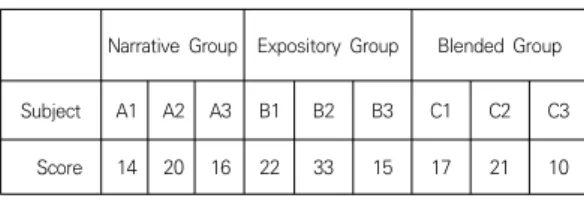
Score 14 20 16 22 33 15 17 21 10
Table 6. Essay Writing Development(ETS Score)
According to Table 6, Expository Group got the highest scores among Groups (mean score:
23.3). It shows that the learners who read expository texts could use the vocabulary more logically than the Narrative (mean score: 16.6) and Blended Group (mean score: 16). The data imply that expository texts while reading got the learners obtain their creative writing skills.
From a perspective of qualitative study, the subjects in each group had a tendency to share some characteristics of words in their writing.
Narrative group wrote the stotytelling elements and conjunction words in the text organization such as so, then, finally, first, at last. Expository group used the cause-and-effect expressions such as because and so that. And they also wrote the expression of showing example and conclusion such as for instance, for example, and in conclusion. Finally, Blended group used various types of words and more appropriate words in context. They used due to, as a result of, consequently to express the result of the event. And they expressed afterward, immediately, previously to show the development of the event and they used the words such as solution, problem, and response to show problem solution while writing as well.
In the course of writing, learners showed some characteristics in their style. Learners who read narrative texts used personal pronouns so often.
They wrote simple structures and did not use definite chronology of events. On the other hand, students who read expository texts edited the essay to remove all information that is not strictly necessary. Their writing style was concise and clear.
Finally, in the process of essay writing, Blended Group brought about better writing results than those of Narrative Group and Expository Group in the field of grammar and usage. On the other hand, Narrative Group had a tendency to misuse words and expressions in grammar and usage. In addition, Expository Group committed some grammatical errors and used inappropriate words in context many times as Table 7.
Subject Writing Analysis
A1. * Misuse Subject- Verb Agreement
* Misuse article and article omission
* Repeat same words in sentences
A2
* Grammatically incomplete sentence
* Misuse comma usage
* Misuse verbs in sentence
* Misuse article and article omission
* Misuse appropriate words in context
* Misuse capital letters and proper nouns
* Repeat same words in sentences
* Use short sentences A3
* Misuse verbs in sentence
* Misuse spelling and full stops
* Repeat same words in sentences
* Misuse passive sentences
B1
* Misuse Subject- Verb Agreement
* Misuse verbs in sentence
* Misuse appropriate words in context
* Misuse article and article omission
* Misuse words of similar spelling and pronunciation
* Misuse spelling
* Misuse capital letters and proper nouns
* Misuse compound words
* Repeat same words in sentences
B2
* Grammatically incomplete sentences
* Misuse comma usage
* Misuse possessive pronouns
* Misuse article and article omission
* Misuse capital letters and spelling
* Misuse comma usage
* Repeat same words in sentences
* Use short sentences B3
* Misuse Subject- Verb Agreement
* Misuse verbs in sentence
* Misuse article and article omission
* Misuse words of similar spelling and pronunciation
* Misuse spelling and full stops
* Repeat same words in sentences C1
* Misuse Subject- Verb Agreement
* Misuse article and article omission
* Misuse spelling and full stops
* Repeat same words in sentences C2
* No errors in grammar
* Misuse article and article omission
* Use appropriate words in context
* Repeat same words in sentences C3 * No errors in grammar
* No errors in usage
* Repeat same words in sentences Table 7. ETS Essay Writing Analysis
5. Conclusion
The role of extensive reading is critical for the vocabulary learning. Moreover, the reader mentally represent and process differently, depending on the genre of the text. So, when learners read the different types of texts, the results can be different in vocabulary acquisition.
In this study, the superiority of the expository texts over narratives is shown in terms of English-Korean translation and comprehension.
In addition, And the learners who read narrative and expository texts alternately got the highest scores in the vocabulary test. It implies that the interaction between narrative and expository texts triggered better vocabulary scores in terms of enhancing learners' incidental acquisition of unknown words. In the essay writing assessment, however, the expository group commits the most vocabulary errors in writing, which means that unlike the understanding domain of reading, writing is the more difficult for the expository group who did not get enough background knowledge. In the case of essay writing style and development, the text type did not contribute to the writing style and the expository group wrote most logically among the experimental groups. In the essay writing assessment, however, the expository group committed the most vocabulary errors in writing. In this study, the text types of extensive reading for vocabulary improvement in writing were discussed. In the light of previous studies on vocabulary learning, this study paved a way for new methodology in vocabulary learning through reading different types of texts in EFL context.
However, this study has some limitations as well. First, the number of subjects in the experiment was small. So, it was not easy to generalize all learners in EFL settings. Second, as the number of subjects was small, the mean scores of the learners were analyzed. So, significant statistical materials were not
suggested in this study. In the future study, if many learners participate in the study, more significant results will be provided.
For the future research, this study must be considered greatly in EFL vocabulary instruction, and the role of text types of EFL reading and writing must be elaborated as well for a better EFL teaching methodology.
REFERENCES
[1] T. Huckin, & J. Coady. (1999). Incidental vocabulary acquisition in a second language: a review. Studies in Second Language Acquisition, 21, 181-193.
[2] M. S. L. Swanborn, & K. de Glopper. (2002). The impact of reading purpose on incidental word learning from context. Language Learning, 52, 95-117.
[3] K. A. Zwaan. (1994). Effect of genre expectations on text comprehension. Journal of Experimental Learning, Memory and Cognition, 20, 920-933.
[4] K. M. Zabrucky & D. Moore. (1999). Influence of text genre on adult's monitoring of understanding and recall. Educational Gerontology, 25, 691-710.
[5] B. M. Taylor & R. W. Beach. (1984). The effects of text structure instruction on middle-grade students' comprehension and of expository text. Reading Research Quarterly, 19, 134-146.
[6] D. Gardner. (2004) Vocabulary Input through extensive reading; A comparison of words found in children's comprehension narrative and expository material. Applied Linguistics, 25, 1-37.
[7] N. Schmit. (2008). Review an article: Instructed second language vocabulary learning. Language Teaching Research, 12(3), 329-363.
[8] J. Hustin & B. Laufer. (2001). Incidental vocabulary acquisition in a second language; The construct of task-Induced involvement. Applied Linguistic, 22(1), 1-26.
[9] S. M. Livingstone. (1994). The rise and fall of audience research: An old story with a new ending. In M. R.
Levy., M. Gwevitch(Eds.), Defing media studies;
Reflections on the future of the field (PP. 54-247), New York; Oxford University Press.
[10] M. B. Wolfe & J. A. Mienko. (2007). Learning and memory of factual content from narrative and expository text. British Journal of Educational Psychology, 77, 541-564.
DOI : 10.1348/000709906X143902
[11] Z. Zainal & S. H. B. H. Husin. (2011). A Study on the effects of reading on writing performance among
faculty of civil engineering students.
[12] M. Alqadi & H. Alqadi. (2013). The Effect of Extensive Reading on Developing the Grammatical Accuracy of the EFL Freshmen at Al Al-Bayt University. Journal of Education and Practice, 4(6), 106-113.
[13] A. Alkhawaldeh. (2011). The effect of EFL reading comprehension on writing achievement among Jordanian English grade students. European Journal of Scientific Research, 66(33), 352-365.
[14] R. Day & J. Bamford. (2002). Top ten principles for teaching extensive reading. Reading in a Foreign Language, 14, 136-141.
[15] J. S. Hedgcock & D. R. Ferris. (2009). Teaching readers of English: Students, texts, and contexts. New York, NY: Rutledge/Taylor & Francis.
[16] A. C. Graesser, A. C. Olde & B. Klettke, (2011). How does the.mind construct and represent stories. In M.
Green, J. Strange, & T. Brock, Narrative Impact(pp.
1-51), Mahwah, NJ : Erbaum.
[17] J. M. Dewaele & M. Alfawzan. (2018). Does the effect of enjoyment outweigh that of anxiety in foreign language performance? Studies in Second Language Learning and Teaching, 8(1), 21-45.
[18] T. Rosli. (1995). Teaching Literature in ESL. the Malaysian center, Kuala Lumpur, Pinerbit University, Malaysia.
[19] N. Hu, (2019). The Effect of Bibliotherapy on Emotion Regulation Competence and Language Learning Outcomes. Global Creative Leader, 9(3), 1-27.
[20] Z. Alidib (2004). The effects of text genre on foreign language reading comprehension of college elementary and intermediate readers of French, The Ohio State University.
[21] W. Grabe. (2001). Reading-writing Relations:
Theoretical Perspectives and Institutional Practices.
In D. Belcher & A. Hirvela (Eds.). Linking Literacies:
Perspective on L2 Reading and Writing Connections (pp. 15-47), Ann Arbor: University of Michigan Press.
[22] Y. Kim & H. Yoon. (2014). The use of L1 as a Writing Strategy in L2 Writing Tasks. GEMA Online Journal of Language Studies, 14(3), 33-50.
[23] S. Abd Rahim, P. Jaganathan & T. S. Tenku Mahadi.
(2016). An Investigation on the Effects of Writing Anxiety on Readiness of Writing among Low Proficiency Undergraduates. International Journal of Language Education and Applied Linguistics (IJLEAL), 5, 11-20.
[24] G. G. Astika. (1993). Analytical Assessments of Foreign Students' Writing. RELC Journal. 24(1), 61-70.
[25] L. Leki & J. G. Carson. (1994). Students's Perceptions of EAP Writing Instruction and Wring Needs Across the Disciplines. TESOL Quarterly, 28(1), 81-101.
[26] W. A. Renandya, (2007). The Power of Extensive
Reading. RELC Journal, 38(2), 132-149.
[27] W. K. Tsang. (1996). Comparing the Effects of Reading and Writing on Writing Performance. Applied Linguistics, 17(20), 210-233.
[28] S. Krashen. (1977). Some Issues Relating to the Monitor Model. On TESOL, 77, 144-158.
[29] M. Stinnett. (2013). Research in Reading. Illinois Reading Council Journal, 42(13), 69-72.
[30] P. T. Willingham. (2004). Ask the Cognitive Scientists the Privileged Status of Story. American Educator, 28, 43-45.
[31] R. Erlam & R. Eliis. (2018). Taskk-based language teaching for beginner-level learners of L2 French: An exploratory Study. The Canadian Modern Language Review, 74(1), 1-26.
DOI: 10.3138/cmlr.3831
[32] R. Ellis. (2019). Towards a modular language curriculum for using tasks. Language Teaching Research, 23(4), 454-475.
DOI : 10.1177/1362168818765315
신 규 철(Kyu-Cheol Shin) [정회원]
․ 1985년 2월 : 고려대학교 영어교육학 과 (문학사)
․ 1987년 2월 : 한국외국어대학교 영어 과 (문학 석사)
․ 2001년 2월 : 고려대학교 영어영문학 과 (문학 박사)
․ 2003년 3월 ~ 현재 : 극동대학교 교양 대학 교수
․ 관심분야 : 언어습득, 영어교육
․ E-Mail : [email protected]