Characteristics of Schizandra chinensis Baillon Orchard Soils Located in Jangsu-gun, Jeollabuk-do
Jae-Young Cho
Department of Bio-environmental Chemistry, Chonbuk National University, Jeonju 561-756
This study was conducted to investigate the physico-chemical properties of Schizandra chinensis Baillon orchard soils located in Jangsu-gun, Jeollabuk-do. Surface (0 to 10 cm) soils were collected from 200 experimental sites located at Jangsu-eup (53 site), Gyenam-myeon (31), Chunchun-myeon (73), Janggye-myeon (12), Bunyam-myeon (31). The soil texture was mostly loamy sand, and the mean values of degree of soil aggregate and soil porosity were 33.1 and 59.9%, respectively. The pH, EC, total-N, available-P, soil organic matter, and cation exchange capacity of the soils were 5.51 ± 0.54, 290 ± 139 μS cm-1, 946.3 ± 65.5 mg kg-1, 319.6 ± 29.2 mg kg-1, 29.0 ± 13.9 g kg-1 and 4.11 ± 0.34 cmolc kg-1, respectively. The concentrations of Pb, Cd, Cu and Zn were 3.48 ± 0.55, 0.09 ± 0.04, 6.90 ± 0.91 and 97.7 ± 42.2 mg kg-1, respectively. The presented data can be utilized in better managing Schizandra chinensis Baillon orchard soils in the studied areas.
Key words: Medicinal plants, Omija, Schizandra chinensis Baillon, Soil properties
Received : August 5. 2010 Accepted : August 16. 2010
*Corresponding author : Phone: +82632702547
E-mail: [email protected]
Introduction
Schizandra chinensis Baillon, a tree species belonging to the Magnolia family, has two genus and 49 species globally, andtwo genus and three species in Korea.
Schizandra chinensis Baillon, a creeping perennial, has deciduous broad leaves and monoecious declinous flowers.
Its fruit are globular, like a berry,and red when ripe (Jangsu- gun, 2006).
The physiological active substances of Schizandra chinensis Baillon include the lignan component,such as schizandrin, schizandran, and gomisin, and are known to have blood glucose and blood pressure lowering, intestinal normalization, anti-aging and immunoregulation properties (Lee and Lee, 1990). Beverages containing healthy plant extracts are gaining a global market share. In this light, Schizandra chinensisBaillon is attracting attention as a raw material of high commercial value (Cho et al., 2007).
In South Korea, Schizandra chinensis Baillon is cultivated in Jangsoo, Muju, Jinan and Namwon in Jeonbuk Province;
Moonkyung in Kyunbuk Province; Hamyang and Geochang in Kyungnam Province and Inje and Hwacheon in Kangwon Province. As part of a strategy for specialized businesses,
the areas for Schizandra chinensis Baillon cultivation have sharply increased, centering on existing cultivation complexes. The total area of Schizandra chinensis Baillon cultivation was 393 ha in 1995, 261 ha in 2002, 453 ha in 2003 and 1,000 ha in 2007, showing dramatic increases since the early 2000s. Particularly in Jangsoo-gun, Jeonbuk Province, the total area of Schizandra chinensis Baillon cultivation has increased more than seven fold in the past 10 years, from only 20 ha in 1997 to 150 ha in 2007. As such, the Schizandra chinensisBaillon has growth potential as a specialty product for the revitalization of local agriculture and as an export-oriented item (Jangsu-gun, 2008).
Seventy-seven percent of Jangsoo-gun, Jeonbuk Province, is 400 m above sea level, with numerous valleys. The area able to be developed for the cultivation of Schizandra chinensis Baillon is about 45% of the total area of Jangsoo-gun, with a slope of less than 20%, as the Schizandra chinensis Baillon is cultivated mostly at the feet of mountains or slopes. In South Korea, although accurate data on soil are available, and used in agriculture as well as other industries, investigations of soil properties for medicinal crops, such as Schizandra chinensis Baillon that are grown in small areas, are rare (Hur et al., 2007). This study was conducted to investigate the the physicochemical properties of Schizandra chinensis Baillon orchard soils in Jangsoo-gun, Jeonbuk Province.
Fig. 1. Sampling sites of Schizandra Chinensis Baillon orchard soils in Jangsu-gun, Jeollabuk-do.
Fig. 2. Distribution of aggregates and texture in Schizandra Chinensis Baillon orchard soils (n=200).
Materials and Methods
Soil Sampling A total of 200 soil samples were collected from the following distribution of Schizandra chinensis Baillon cultivation areas: 53 sites in Jangsoo-eup, 31 sites in Gyenam-myun, 73 sites in Cheoncheon-myun, 12 sites in Janggye-myun and 31 sites in Beonam-myun (Fig. 1). Frozen aliquots of the samples were air dried for three to four days. After drying, the samples were sieved through a 2 mm sieve. According to the Jangsu weather station located near the experimental site, the average annual temperature at the site was 10.8℃, average annual
precipitation ranges from 1,250~1,380 mm, and more than 50~60% of this falls during the monsoon period (June~
August). The soils in Jangsu-gun area are on alluvial fans, low terraces and mountain foot slopes in high mountainous region derived from coarse textured materials (Lee et al., 2009).
Soil Analyses Soil properties were determined as follows: pH and EC (1:5 water extract), organic matter content (Walkely-Black method), total-N content (micro- Kjeldahl method), soil texture (pipette method by USDA), CEC (ammonium acetate method), avail.-P content (Bray No 1 method), soil aggregates (wet-sieving method), soil porosity (pycnometer method) and heavy metals (inductively coupled plasma spectrophotometer, Shimadzu ICP-7000S) (NIAST, 2000, Page et al., 1982).
Results and Discussion
Soil Texture The soils of Schizandra chinensis Baillon orchards were found to be mostly loamy sand (LS). In a Rubus coreanus orchard, the soil was mostly slit loam (SiL) and loam (L) (Chung et al., 2008). For the cultivation of Schizandra chinensis Baillon, silt loam (SiL), with good drainage, high humus and adequate moisture is known to be suitable.
Degree of Soil Aggregates The degree of soil aggregates in Schizandra chinensis Baillon orchards were found to be between 15.84 and 61.61% (average: 33.12%). Compared with the degree of soil aggregates in a Rubus coreanus orchard (Chung et al., 2008), those in the Schizandra chinensis Baill on orchard were considerably low. Forty- five percent of the Schizandra chinensis Baillon orchard soils had 20-30% soil aggregates (Fig. 2). It is presented
Fig. 3. Distribution of porosity in Schizandra Chinensis Baillon orchard soils (n=200).
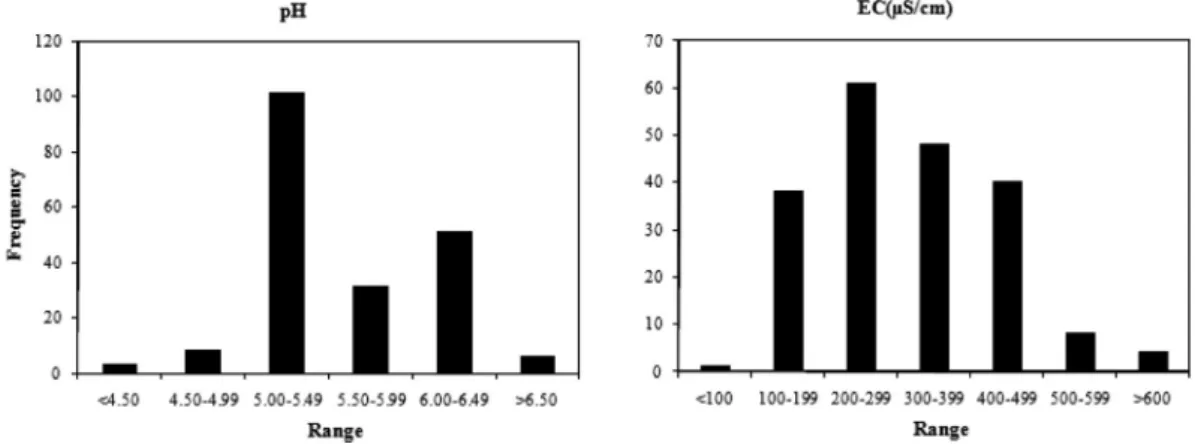
Fig. 4. Distribution of pH and EC in Schizandra Chinensis Baillon orchard soils (n=200).
that the degree of soil aggregates in the Schizandra chinensis Baillon orchards were low because most of these orchards were located in forests where the soil was immature. Organic matter and lime arerequired for the aggregation of soil clods.
Soil Porosity The soil porosity was about 45.30-75.
49% (average: 59.85%) (Fig. 3). It was assumed that the high soil porosity of the Schizandra chinensis Baillon orchards was due to the high sand content of the soil. To improve the physical properties of the Schizandra chinensis Baillon orchards, deep tillage, the application of organic matter and soil dressing are required.
Soil pH and Electric Conductivity The soil pH was found to be low,at 4.08-7.10, with an average of 5.51 (Fig. 4). Fifty percent or more of the total soils had a pH of 5.00-5.49. Compared with the average pH of 5.6 in South Korean uplands (Jung et al., 2001), that in the Schizandra chinensis Baillon orchards was relatively low, which was believed to be due to base leaching of the forest soil,
because many of the Schizandra chinensis Baill on orchards were located in mountainous areas. A low pH accelerates the elution of heavy metals and causes an imbalance of essential trace elements in soil. In addition, as a low pH can be disadvantageous for the activity of soil microorganisms, soil improvement, such as the application of organic matter, is required. The electrical conductivity of the soil was 77- 936 μS cm-1, with an average of 290 μS cm-1. In some sites, this was 600 μS cm-1 or more, which was assumed to be due to the overuse of manure or chemical fertilizers.
Total-N and Avail-P The total-N was 813.7-1,174.
8 mg kg-1, with an average of 946.3 mg kg-1. The avail-P was 247.8-452.2 mg kg-1, with an average of 319.6 mg kg-1 (Fig. 5). Although the nutrient needs of Schizandra chinensis Baillon are lower than those of other medicinal crops, farmers have applied about 3.3-9.6 kg N 10a-1, 2.3-7.0 kg P2O5 10a-1 and 1.7-7.3 kg K2O 10a-1 to improve the quality and production of Schizandra chinensis Baillon.
Soil Organic Matter and Cation Exchange Capacity (CEC) The soil organic matter content was 9.8-65.8 g kg-1 (average: 29.0 g kg-1). This value was similar or slightly higher than those of other general farmlands. The CEC was 3.47-5.23 cmolc kg-1, with an average of 4.11 cmolc
kg-1, which was lower than those of other general farmlands (8-10 cmolc kg-1). The low CEC was deemed to be due to the mostly sand, sandy loam or loamy sand soils in the Schizandra chinensis Baillon orchards (Fig. 6).
Heavy Metal Pollutants The heavy metal contents of most of the Schizandra chinensis Baillon orchard soils were found to be within background levels. Pb was in the range of 2.34-5.11 mg kg-1, with an average of 3.48 mg kg-1 Cd, 14.2-212.1 μg kg-1, with an average of 90 μg kg-1
Fig. 5. Distribution of total-N and avail-P in Schizandra Chinensis Baillon orchard soils (n=200).
Fig. 6. Distribution of organic matter and CEC in Schizandra Chinensis Baillon orchard soils (n=200).
Fig. 7. Distribution of heavy metals in Schizandra Chinensis Baillon orchard soils (n=200) [Warning standard in arable land: Pb (200 mg kg-1), Cd (4 mg kg-1), Cu (150 mg kg-1), and Zn (300 mg kg-1) ].
Cu, 5.15-9.42 mg kg-1, with an average of 6.90 mg kg-1 and Zn, 43.0-214.4 mg kg-1, with an average of 97.7 mg kg-1. The frequency distributions of each heavy metal are shown in Fig. 7. The heavy metals contents investigated were below the farmland soil pollution prevention criteria established by Korea's Soil Environment Preservation Law, which was devised to ensure the safety of crops from heavy metal pollution. Pollution can still be directly introduced however, through atmosphere dust, and indirectly from chemical fertilizers and fertilizer byproducts. Thus, a system for the production of safe agricultural products must be established based on constant monitoring.
Conclusion
The soils in most of the Schizandra chinensis Baillon orchards were loamy sand; the degree of soil aggregates was insufficient at 33.12%; the soil porosity was adequate at about 60%; the soil pH was moderately acidic; and the CEC was very low at 4.11 cmolc kg-1 (average). Although the level of plant nutrients was adequate, soil management, such as the application of organic matter or lime,is required to improve the soil physiochemical properties of Schizandra chinensis Baillon orchards. These results are can use new nutritional criteria in Schizandra chinensis Baillon orchard soils for the production of high quality fruit. The heavy metals contents were at background levels, which ensure the safety of the crops from heavy metal pollution.
Acknowledgements
This study was financially supported by the Korea Forest Service (Forest Science & Technology Projects).
References
Cho, Y.J., I.S. Ju, B.C. Kim, W.S. Lee, M.J. Kim, B.G.
Lee, B.J. An, J.H. Kim, and O.J. Kwon. 2007. Biological activity of Omija (Schizandra ChinensisBaillon) extracts. J.
Korean Soc. Appl. Biol. Chem. 50:198-203.
Chung B.Y., K.S. Lee, M.K. Kim, Y.H. Choi, M.K. Kim, and J.Y. Cho. 2008. Physico-chemical properties of rainfall interception culture and open field culture soils of Rubus sp. in Gochang-gun, Jeollabuk-do. Korean J. Soil Sci. Fert.
41:303-309.
Hur, B.K., C.H. Kim, S.G. Son, and O.J. Oh. 2007. Soil properties and plant yield in the cultivation area of Ostericum Koreanum Kit. Korean J. Medicinal Crop Sci. 15:12-16.
Jangsu-gun. 2006. A study on the marketing and manufacturing of Schizandra chinensis Baillion in Jangsu-gun. Jangsu, Korea.
Jangsu-gun. 2008. A study on the production status of Schizandra chinensis Baillion in Jangsu-gun. Jangsu, Korea.
Jung, B.G., J.W. Choi, J.H. Yoon, Y.H. Kim, and E.S. Yun.
2001. Monitoring on chemical properties of bench marked upland soils in Korea. Korean J. Soil Sci. Fert. 34:326-332.
Lee, J.S. and S.W. Lee. 1990. Effect of water extraction in fruit of Omija on alcohol metabolism. Korean J. Dietry Culture 5:259-262.
Lee, K.S., E.H. Kim, Y.S. Lee, S.H. Lee, Y.B. Seo, S.A.
Hwang, and J.Y. Cho. 2009. Control efficacy of Bordeaux mixture against powdery mildew on Omija. J. Korean Soc.
Appl. Biol. Chem. 52:58-62.
Ministry of Environment. 2009. The law of soil environment conservation. Seoul, Korea.
NIAST. 2000. Methods of soil chemical analysis. National Institute of Agricultural Science and Technology, RDA, Suwon, Korea.
Page, A.L. R.H. Miller, and D.R. Keeny. 1982. Methods of Soil Analysis. American Society of Agronomy. Madison, Wisconsin USA.
전라북도 장수군 오미자 재배과원 토양 특성
조재영
전북대학교 농업생명과학대학 생물환경화학과
전라북도 장수군 오미자 과원을 대상으로 토양의 이․화학적 특성을 조사하여 오미자의 품질향상, 수량증대 및 유해물질 종합 관리 시스템 구축을 위한 기초조사를 수행하였다. 오미자 재배과원 토양은 대부분 양질사토였으며, 토양입단화도는 약 33.12%
로 입단의 발달이 부족한 상태였으며, 토양공극율은 약 60% 수준으로 적당한 것으로 나타났다. 토양 pH는 평균 5.51이었으 며, 양이온교환용량은 평균 4.11 cmolc kg-1으로 매우 낮게 나타났다. 식물영양성분은 적정 수준으로 유지되고 있었으나, 장 수군 오미자 재배지 토양의 이화학적 특성 개량을 위해서는 유기물 및 석회처리 등의 토양관리가 필요한 것으로 나타났다. 조 사대상 중금속의 함량은 자연함유량 수준으로 중금속 오염으로 인한 작물 안정성은 확보된 것으로 조사되었다.