• 검색 결과가 없습니다.

Endophytic bacterium Pseudomonas fluorescens strain EP103 was effective against Phytophthora capsici causing blight in chili pepper

N/A
N/A
Protected

Academic year: 2021

Share "Endophytic bacterium Pseudomonas fluorescens strain EP103 was effective against Phytophthora capsici causing blight in chili pepper"

Copied!
7
0
0

로드 중.... (전체 텍스트 보기)

전체 글

(1)

http://dx.doi.org/10.7585/kjps.2014.18.4.422

Open Access

422

Endophytic bacterium Pseudomonas fluorescens strain EP103 was effective against Phytophthora capsici causing blight in chili pepper

Tack-Soo Kim, Swarnalee Dutta, Se Won Lee and Kyungseok Park*

Division of Agricultural Microbiology, National Academy of Agricultural Science (NAAS), Rural Development Administration (RDA), Jeonju 565-851, South Korea.

(Received on November 10, 2014. Revised on November 14, 2014. Accepted on December 3, 2014)

Abstract Endophytic bacterial strains from root tissue of strawberry were screened for their efficacy in growth improvement and control of Phytophthora blight disease of chili pepper plant under greenhouse condition. Plants treated with the strain EP103, identified as Pseudomonas fluorescens, showed growth improvement in terms of fresh weight and root length compared to the untreated control and other endophytic strains. When challenged with Phytophthora capsici, there was significant reduction of disease in EP103 treated plants with an efficacy of 78.7%. There was no direct inhibition of the target pathogen by EP103 when tested under in vitro antibiosis assay. Analysis of differential expression of selected marker genes for induced systemic resistance (ISR) in plants treated with EP103 and challenged with P. capsici showed up- regulation of PR1 and PR10 pathogenesis-related (PR) proteins. PCR analysis showed that EP103 produced secondary metabolites such as pyoluteorin, pyrrolnitrin, hydrogen cyanide and orfamide A. This study indicated the potential of endophytic P. fluorescens strain EP103 as an efficient biocontrol agent against P.

capsici in chili pepper plant.

Key words Endophyte, ISR, PR-proteins, Pseudomonas fluorescens, secondary metabolites

Introduction

Endophytic bacteria are the residents of plant tissues, particularly the intercellular spaces and vascular tissues, which do not harm the host plant but provide beneficial effects (Zinniel et al. 2002 and Hallmann et al. 1997). The population and diversity of endophytes is dependent on various factors like soil condition, crop rotation, population of phytopathogens and other colonizing microbes (Hallmann et al. 1997). These bacteria colonizing the internal tissues of plants have been considered as a rich source of functionally diverse microorganisms capable of establishing a mutualistic association with host plants (Azevedo et al. 2000). Endophytes have been reported to promote plant growth and yield, suppress phytopathogens, remove contaminants, solubilize nutrients like phosphate, and provide nitrogen to plants (Rosenblueth and Martinez-Romero 2006).

Beneficial rhizosphere bacteria are also known to colonize the internal roots and stems indicating that these bacteria can be a source of endophytes (Germaine et al. 2004). Therefore, search for source of potential plant growth promoting rhizobacteria (PGPR) has widened from rhizosphere and phyllosphere to internal tissues of roots. The population of endophytic bacteria is lower than rhizospheric bacteria or bacterial pathogens (Hallmann et al. 1997 and Rosenblueth and Martínez-Romero 2004). Endophytes are affected by biotic and abiotic factors similar to rhizobacteria (Hallmann et al. 1997, 1999 and Seghers et al. 2004). However, due to internal tissue colonization by endophytic bacteria, these could be better protected from biotic and abiotic stresses than rhizospheric bacteria (Hallmann et al. 1997).

However, in contrast to other plant-microbe association the molecular mechanisms involved in host-endophytic bacteria interaction is limited. Studies have reported similar mechanisms for endophytic bacteria as in PGPR (Compant et al., 2005). Nitrogen fixation (Iniguez et al. 2004 and Hurek et al. 2002), production of phytohormones, nutrient mobili-

*Corresponding author

Tel: +82-10-4750-3383, Fax: +82-31-290-8488 E-mail: [email protected]
ORIGINAL ARTICLES / CONTROL

(2)

zation and competition, enhancing the availability of minerals (Persello-Cartieaux et al. 2003 and Sturz et al.

2000) are some of the factors contributing towards growth and yield improvement. Biocontrol of phytopathogens due to production of antifungal or antibacterial agents, siderophore production and induction of systematic resistance (ISR) are the indirect mechanisms of growth promotion. Production of adenine ribosides have been reported for endophytes from pine that stimulate growth and mitigate browning of pine tissues (Pirttilä et al. 2004). Bacterial endophytes are also known to suppress nematode proliferation benefitting plant growth (Sturz and Kimpinski 2004).

Production of antibiotics by beneficial rhizospheric and endophytic bacteria, especially in several strains of fluorescent pseudomonads, has been recognized as a major factor in suppression of pathogens (Dowling and O’Gara 1994). A number of disease-suppressive antibiotic compounds have been characterized such as phenazines, pyrrole-type antibiotics, pyo-compounds and indole derivatives. The antibiotics pyoluteorin, pyrrolnitrin, phenazine-1-carboxylic acid (PCA) and 2,4-diacetylphloroglucinol (2,4-D) are major determi- nants in biological control. Hydrogen cyanide (HCN) and orfamides as potential antimicrobial secondary metabolite have been well established contributing towards disease control by Pseudomonas (Lanteigne et al. 2012, Raaijmakers et al. 2010 and Bhatia et al. 2005).

Disease control through ISR by beneficial bacteria, especially against soil borne pathogens, is associated with a state of increased defense activity in plants stimulated by specific biotic or chemical factors (Nowak and Shulaev 2003, van Loon et al. 1998). Differential regulation of pathogenesis-related (PR) proteins on application of beneficial bacteria leads to ISR in host plant thereby resulting in biocontrol of diseases (Van Wees et al. 2008 and Pieterse et al. 1998). Signalling pathways involved for ISR by P.

fluorescens include salicylic acid- (SA), jasmonic acid- (JA) and ethylene- (ET) mediated (Wang et al. 2005).

The present study involved characterization of potential non-pathogenic endophytic bacteria for growth promotion and biocontrol of diseases. A P. fluorescens strain EP103 originally isolated from the root tissue of strawberry was effective in controlling the blight caused by Phytophthora capsici. The bacteria significantly reduced the Phytophthora blight in chili pepper plant under greenhouse condition. We studied the diverse functions of EP103 such as antifungal activity, ISR and production of secondary metabolites. A

PCR analysis of EP103 was done for the present study using gene-specific primers to check the production of some major secondary metabolites which are characteristic for antagonistic activity of P. fluorescens. We also studied the expression pattern of some selected defense-related marker genes in EP103 treated chili pepper plants when challenged with P.

capsici.

Our studies indicated that endophytic P. fluorescens effectively improved growth of chili pepper and reduced Phytophthora blight under greenhouse condition. We also attempted to understand the mechanisms involved in the interaction.

Materials and Methods

Microorganisms

Endophytic bacterial strains from the culture collection of our laboratory were taken for the present study. Four isolates designated as EP103, TS62, TS66 and TS71 were originally isolated from the root tissue of strawberry. Briefly, strawberry roots were surface sterilized, crushed and plated in tryptic soy agar (TSA) and Kings’ B media (KB) after serial dilution for isolation of endophytes. Distinct colonies were isolated and maintained at −80°C in TS broth (TSB) with glycerol (20%) for long-term storage. Isolated bacteria were identified using 16S rRNA analysis.

The fungal pathogen Phytophthora capsici was obtained from the Korean Agriculture Cultural Collection (KACC), National Academy of Agricultural Sciences (NAAS), Suwon, South Korea. The P. capsici zoospore inoculum was prepared as described by Ploetz et al. (2002). The zoospore suspen- sions were adjusted to a final concentration of 1 × 10

5

zoospores/mL using a hemacytometer before the challenge inoculation.

Effect of selected endophyte on growth and suppression of Phytophthora blight in chili pepper under greenhouse condition

Chili pepper (Capsicum annum L.) cv. Hanbyul seedlings

were grown for three weeks and treated with 50 mL of the

bacterial suspension (1 × 10

8

cfu/mL) by soil drenching in

plastic pots (15 × 12 cm) containing soilless potting mix

(TKS2, Flora Gard Ltd., Germany). Plants were challenged

with zoospores of P. capsici after one week of bacterial

treatment. Disease severity was recorded after 7 days of

challenge inoculation using Phytophthora blight score

(3)

ranging from 0 (no symptoms) to 10 (dead plant). Distilled water and 0.1 mM Benzothiadiazole (BTH) treatments were taken as negative and positive controls, respectively. Plants without pathogen treatment were analyzed for growth promotion. Root length and fresh weight of plants were measured after 4 weeks of bacterial treatment.

In vitro antibiosis assay of isolated endophytes against P.

capsici

The endophytic bacterial isolates as above were studied for in vitro antibiosis test against the target pathogen P. capsici.

For this, the dual culture plate technique was used with potato dextrose agar (PDA) media. Mycelial plugs were placed on one side of PDA plates and bacterial isolate was placed on the other side loaded in sterile filter paper disks (8 mm diameter, Advantec Co. Japan). The plates were incubated at 28°C for 7 days and inhibition zone was recorded in diameter (mm). Five replications were performed per treatment.

qRT-PCR studies for marker genes of ISR in chili pepper Three-week-old chili pepper seedlings were treated as above with EP103 suspension. Distilled water and BTH (0.1 mM) were taken as negative and positive controls, respectively. Twenty four hours after challenge inoculation of P. capsici zoospore suspensions (1 × 10

5

zoospores/mL), third leaf of plants were collected and frozen in liquid nitrogen until further use. Total RNA was isolated using the easy-spin

TM

IIP Total RNA Extraction Kit (iNtRON Biotechnology, South Korea). Expression of defense-related genes PR-1 and PR-10 were analyzed using semi-quantitative RT-PCR (Kishimoto et al. 2005) with Ex Taq polymerase (Takara Biomedicals, Otsu, Japan). The gene-specific primer pairs used in this study were designed and are listed in Table 1 (Sang et al. 2010). The reaction mixture contained 0.1 µg of cDNA, 10 pMol each of the forward and reverse primers,

250 nM dNTPs and 0.5 U of Ex Taq polymerase in 20 µl of buffer solution. PCR was conducted in a MJ Research thermal cycler (PTC-100, USA) and conditions were as follows: denaturation at 94ºC for 5 min followed by 25 cycles at 94ºC for 1 min, annealing at 57ºC for 1 min and extension at 72ºC for 1 min followed by a final extension at 72ºC for 10 min. The PCR products were separated by electrophoresis on 1.5% agarose gels at 80 V for 60 min. The experiments were conducted twice with three replicates (plants).

PCR analysis for production of selected secondary metabolites from P. fluorescens

Total DNA was isolated from EP103 according to standard protocol (Sambrook et al. 1989). The oligonucleotide primers (Table 1) were developed from sequences available in NCBI for respective genes of P. fluorescens. PCR amplification was carried out with 25 µL reaction mixture containing 20 ng of total DNA, 1x PCR buffer, dNTPs, 20 pmol of each primer and 0.5 U of Ex Taq polymerase. Amplifications were done in MJ Research thermal cycler (PTC-100, USA) with the following conditions: denaturation at 94ºC for 2 min followed by 30 cycles at 94ºC for 60 s, 67ºC for 45 s and 72ºC for 60 s. The PCR products were separated by electrophoresis on 1.5% agarose gels at 75 V for 2 h and products visualized with a UV transilluminator.

Results and Discussion

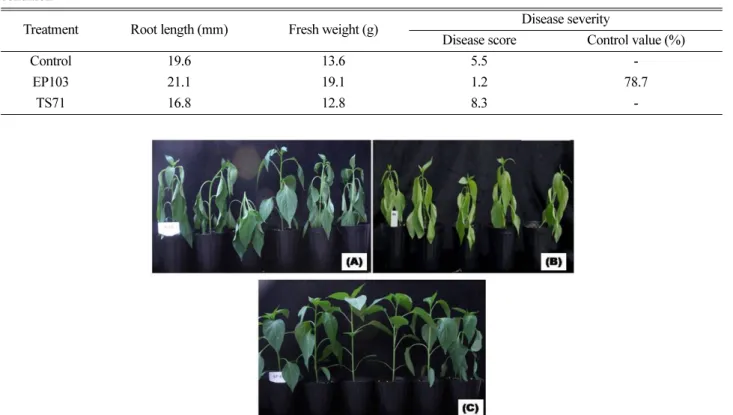
Of all the endophytes tested under greenhouse condition, chili pepper plants treated with suspension of EP103 as soil drench showed improvement in growth as compared to control. Root length and fresh weight of plants was higher as compared to untreated control and other endophytic treatments (Table 2). On challenge inoculation with P. capsici, plants Table 1. Sequences of primers used in the present study

Gene Forward primer (5'-3') Reverse primer (5'-3')

PR-1 TGCAACACTCTGGTGGCCCT AAGGCCGGTTGGTCTTCGAG

PR-10 TTTACTGACAAGTCCACAGCCT GCAGAAGCTTCAAATTTGCC

18s rRNA CGGTCCGCCTATGGTGAGCACCGGTCG TTCTTGCATTTATGAAAGACGAACAACTGC

Pyoluteorin GCTTCGAATACACCTCCATC TAGGCGTTGACGTCCTCGAC

Pyrrolnitrin GAGACATACCTGCCCTACGT GTGGAACACGAAGCCGAAGT

2,4-diacetylphloroglucinol CAGATGGAGTCCATGGGCAT GCATAGGACGATGTCGTACT

Hydrogen cyanide ATGCGCACCCGGGTGAGCAT GTACAACTCGTTGGACTGCA

Orfamide A AACTGCTCAATGTCGAGCGG TAGATGTCCTGCACGTTGGC

(4)

treated with EP103 showed significant reduction in disease with control value of 78.7% (Fig. 1 and Table 2). Compared to other endophytes, EP103 gave the best result in terms of growth and disease control. Similar result of endophytic P.

fluorescens inducing plant growth enhancement and disease control in Arabidopsis has been reported earlier (Wang et al.

2005).

In vitro antibiosis assay of the endophytes resulted in no inhibition by EP103 and TS66 against P. capsici (Fig. 2).

The strains TS71 showed significant inhibition zone but were not effective under greenhouse condition when treated plants were challenged with P. capsici. Since the strain did not show any antibiosis against the target pathogen, to understand the mechanism of disease control, the expression of some defence-related marker genes were studied in plants treated with EP103 and challenged with P. capsici as compared to control. Of all the genes studied, there was significant up- regulation of PR1 and PR10 in EP103 treated plants (Fig. 3).

Untreated control did not show any band for PR1 and a basal level expression of PR10. PR1 is a marker gene for SA- signaling pathway whereas PR10 is JA/ET-induced (Yang et al. 2009 and Cameron et al. 1999). Induction of defense gene

PR1 is essential for establishment of resistance in chilli pepper (Lee and Hwang 2005). Induction of PR10 genes in response to biotic stress has been reported earlier in pepper along with other plants like maize (Xie et al. 2010, Park et al. 2004). The enhanced expression of marker genes PR1 and Fig. 1. Effect of EP103 on disease control in chili pepper challenged with Phytophthora capsici under greenhouse condition. (A) untreated control (B) 0.1 mM BTH (C) EP103.

Table 2. Effect on growth of plants and control of Phytophthora blight by treatment with selected endophytic strains under greenhouse condition

Treatment Root length (mm) Fresh weight (g) Disease severity

Disease score Control value (%)

Control 19.6 13.6 5.5 -

EP103 21.1 19.1 1.2 78.7

TS71 16.8 12.8 8.3 -

Fig. 2. Antifungal activity as zone of inhibition of different endophytic strains against P. capsici under in vitro antibiosis assay. Dual culture test was done using PDA media with mycelia plug on one side of the the Petri plate and bacterial suspension embedded in sterile paper discs on the other side.

Plates were incubated at 28

o

C for 7 days and inhibition zone

was recorded in diameter (mm).

(5)

PR10 indicate that application of EP103 in chili pepper triggered the ISR-mediated defense response when challenged with P. capsici (Fu and Dong 2013).

The selected potential endophytic strain EP103 was identified based on complete 16S rRNA analysis using universal primers. It was identified as Pseudomonas fluorescens strain.

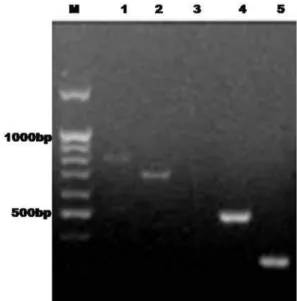
Once identified, we checked for the production of secondary metabolites characteristic to Pseudomonas using gene-specific primers. EP103 produced pyoluteorin, pyrrolnitrin, HCN and orfamide A as evident by PCR detection (Fig. 4). Antibiotics like pyoluteorin and pyrrolnitrin from Pseudomonas have been reported to play major role in disease control. A variety of antibiotics such as phenazines, pyrrole-type antibiotics, pyo-compounds and indole derivatives have been identified to be produced by pseudomonads (De Souza et al. 2003, Nielson and Sorensen 2003 and Dowling and O’Gara 1994).

Secondary metabolites with antibiotic activity like phenazines, pyrroles, acetylphloroglucinols and cyanides from Pseudomonas are also reported (Defago and Haas 1990). Pyoluteorin is produced by several Pseudomonas species, including strains that suppress plant diseases caused by phytopathogenic fungi (Kraus and Loper 1995). Pyrrolnitrin [3-chloro-4-(2'-nitro-3'- chloro-phenyl) pyrrole] is a broad spectrum antifungal metabolite produced by many fluorescent and non-fluorescent Pseudomonas strains (Howell and Stipanovic 1979). A phenyl pyrrol derivative of pyrrolnitrin has also been developed as an agricultural fungicide (Dwivedi and Johri 2003). The production of HCN by Pseudomonas has been reported to be involved in disease control and antibiosis (Lanteigne et al.

2012). Orfamides are cyclic lipopeptides with biosurfactant properties influencing surface adhesion and biofilm develop- ment of Pseudomonas (Raaijmakers et al. 2006). Orfamide- deficient mutants exhibited reduced swarming motility and deformed biofilm formation (Gross et al. 2007). It has been

reported that zoospores of Phytophthora lysed when exposed to orfamide (Gross et al. 2007).

However, disease suppression is a multifunctional attribute.

Although the strain EP103 did not inhibit the growth of P.

capsici under antibiosis assay, direct antagonism cannot be ruled out since it produces a range of antifungal compounds.

Moreover, it has been reported earlier that the media used for bacterial growth influenced the antagonistic activity and production of antibiotics in Pseudomonas (Michelsen and Stougaard 2012). They reported that on cultivation in carbohydrate-rich potato dextrose media, P. fluorescens did not produce HCN and therefore, were unable to inhibit the fungal growth. Similar may be the case of other antibiotic production which might influence the direct antagonism of EP103.

From this study we conclude that P. fluorescens strain EP103 is a potential candidate for growth enhancement and biocontrol of P. capsici in chili pepper. The mechanisms involved may be direct antagonism due to production of secondary antimicrobial compounds or triggering the defence system of the host plant.

Acknowledgements

The authors are grateful to the National Academy of Agricultural Sciences (NAAS), RDA, Jeonju, South Korea for providing financial support ( Project no : PJ00444).

Fig. 4. PCR detection of genes for secondary metabolites produced by P. fluorescens. The oligonucleotide primers developed from sequences available in NCBI for respective genes of P. fluorescens were used for this study. Lanes: (M) Ladder, (1) Pyoluteorin, (2) Pyrrolnitrin, (3) 2,4-diacetylphlo- roglucinol, (4) Hydrogen cyanide, (5) Orfamide A.

Fig. 3. Effect on the expression of selected defense-related marker genes in chili pepper plants by qRT-PCR on challenge inoculation with P. capsici. Distilled water and BTH (0.1 mM) were taken as negative and positive controls, respectively.

Lanes: (M) Ladder, (1) 18S rRNA, (2) PR1 gene, (3) PR10 gene.

(6)

Literature Cited

Azevedo, J. L., W. Maccheroni Jr., J. O. Pereira and W. L. de Araujo (2000) Endophytic microorganisms: A review on insect control and recent advances on tropical plants.

Electron. J. Biotechnol. Vol. 3, No. 1. Online publication Bhatia, S., R. C. Dubey and D. K. Maheshwari (2005)

Enhancement of plant growth and suppression of collar rot of sunflower caused by Sclerotium rolfsii through fluorescent Pseudomonas. Ind. Phytopathol. 58:17-24.

Cameron, R. K., N. L. Paiva, C. J. Lamb and R. A. Dixon (1999) Accumulation of salicylic acid and PR-1 gene transcripts in relation to the systemic acquired resistance (SAR) response induced by Pseudomonas syringae pv. tomato in Arabidopsis. Physiol. Mol. Plant Pathol. 55:121-130.

Compant, D., B. Duffy, J. Nowak, C. Clement and E. A. Barka (2005) Use of plant growth-promoting bacteria for biocontrol of plant diseases: Principles, mechanisms of action, and future prospects. Appl. Environ. Microbiol. 71:

4951-4959.

De Souza, J. T., D. M. Weller and J. M. Raaijmakers (2003) Frequency, diversity and activity of 2,4-diacetylphloro- glucinol-producing fluorescent Pseudomonas species in Dutch take-all decline soils. Phytopathology 93:54-63.

Defago, G. and D. Haas (1990) Pseudomonas as antagonists of soil borne pant pathogens: Modes of action and genetic analysis. In: Soil Biochemistry, Vol. 6; Jeen-Marc Bollag and G. Stotzky (Ed); Marcel Dekker, New York, USA. pp 249-291.

Dowling, D. N. and F. O’Gara (1994) Metabolites of Pseudomonas involved in the biocontrol of plant disease.

Trends Biotechnol. 12:133-141.

Dwivedi, D. and B. N. Johri (2003) Antifungals from fluorescent pseudomonads: Biosynthesis and regulation.

Curr. Sci. 85:1693-1703.

Fu, Z. Q. and X. Dong (2013) Systemic acquired resistance:

turning local infection into global defense. Annu. Rev. Plant Biol. 64:839-863.

Germaine, K., E. Keogh, G. Garcia-Cabellos, B. Borremans, D.

Van der Lelie, T. Barac, L. Oeyen, J. Vangronsveld, F. P.

Moore, E. R. B. Moore, C. D. Campbell, D. Ryan and D. N.

Dowling (2004) Colonisation of poplar trees by gfp expressing bacterial endophytes. FEMS Microbiol. Ecol.

48:109-118.

Gross, H., V. O. Stockwell, M. D. Henkels, B. Nowak- Thompson, J. E. Loper and W. H. Gerwick (2007) The genomisotopic approach: a systematic method to isolate products of orphan biosynthetic gene clusters. Chem. Biol.

14:53-63.

Hallmann, J., R. Rodriguez-Kabana and J. W. Kloepper (1999) Chitin mediated changes in bacterial communities of the soil, rhizosphere and within roots of cotton in relation to nematode control. Soil Biol. Biochem. 31:551-560.

Hallmann, J., Q. A. Hallmann, W. F. Mahaffee and J. W.

Kloepper (1997) Bacterial endophytes in agricultural crops.

Can. J. Microbiol. 43:895-914.

Howell, C. R. and R. D. Stipanovic (1979) Control of Rhizoctonia solani on cotton seedlings with Pseudomonas fluorescens and with an antibiotic produced by the bacterium.

Phytopathology 69:480-482.

Hurek, T., L. L. Handley, B. Reinhold-Hurek and Y. Piche (2002) Azoarcus grass endophytes contribute fixed nitrogen to the plant in an unculturable state. Mol. Plant-Microbe Interact. 15:233-242.

Iniguez, A. L., Y. Dong and E. W. Triplett (2004) Nitrogen fixation in wheat provided by Klebsiella pneumoniae 342.

Mol. Plant-Microbe Interact. 17:1078-1085.

Kishimoto, K., K. Matsui, R. Ozawa and J. Takabayashi (2005) Volatile C6-aldehydes and allo-ocimene activate defense genes and induce resistance against Botrytis cinerea in Arabidopsis thaliana. Plant Cell Physiol. 46:1093-1102.

Kraus, J. and J. E. Loper (1995) Characterization of a genomic locus required for production of the antibiotic pyoluteorin by the biological control agent Pseudomonas fluorescens Pf-5. Appl. Environ. Microbiol. 61:849-854.

Lanteigne, C., V. J. Gadker, T. Wallon, A. Novinscak and M.

Filion (2012) Production of DAPG and HCN by Pseudomonas sp. LBUM300 contributes to the biological control of bacterial canker of tomato. Biol. Cont. 102:967-973.

Lee, S. C. and B. K. Hwang (2005) Induction of some defense- related genes and oxidative burst is required for the establishment of systemic acquired resistance in Capsicum annuum. Planta 221:790-800.

Michelsen, C. F. and P. Stougaard (2012) Hydrogen cyanide synthesis and antifungal activity of the biocontrol strain Pseudomonas fluoresscens In5 from Greenland is highly dependent on growth medium. Can. J. Microbiol. 58:383-390.

Nielson, T. H. and J. Sorensen (2003) Production of cyclic lipopeptides by Pseudomonas fluorescens strains in bulk soil and in the sugar beet rhizosphere. Appl. Environ.

Microbiol. 69:861-868.

Nowak, J. and V. Shulaev (2003) Priming for transplant stress resistance in in vitro propagation. In vitro Cell Dev. Biol.

Plant. 39:107-124.

Park, C. J., K. J. Kim, R. Shin, J. M. Park, Y. C. Shin and K.

H..Paek (2004) Pathogenesis-related protein 10 isolated from hot pepper functions as a ribonuclease in an antiviral pathway. Plant J. 37:186-198.

Persello-Cartieaux, F., L. Nussaume and C. Robaglia (2003) Tales from the underground: molecular plant-rhizobacteria interactions. Plant Cell Environ. 26:189-199.

Pieterse C. M. J., S. C. M. Van Wees, J. A. Van Pelt, M.

Knoester, R. Laan, H. Gerrits, P. J. Weisbeek and L. C. van Loon (1998) A novel signalling pathway controlling induced systemic resistance in Arabidopsis. Plant Cell 10:

1571-1580.

(7)

Pirttila, A. M., P. Joensuu, H. Pospiech, H. J. Jalonen and A.

Hohtola (2004) Bud endophytes of Scots pine produce adenine derivatives and other compounds that affect morphology and mitigate browning of callus cultures.

Physiol. Plantarum 121:305-312.

Ploetz, R., R. J. Schnell and J. Haynes (2002) Variable response of open-pollinated seedling progeny of avocado to Phytophthora root rot. Phytoparasitica 30:262-268.

Raaijmakers J. M., I. de Bruijn, O. Nybroe and M. Ongena (2010) Natural functions of lipopeptides from Bacillus and Pseudomonas: more than surfactants and antibiotics. FEMS Microbiol. Rev. 34:1037-1062.

Raaijmakers, J. M., I. De Bruijn and M. J. de Kock (2006) Cyclic lipopeptide production by plant-associated Pseudomonas spp.: diversity, activity, biosynthesis, and regulation. Mol.

Plant Microbe Interact. 19:699-710.

Rosenblueth, M. and E. Martinez-Romero (2006) Bacteial endophytes and theri interactions with hosts. Mol. Plant- Microbe Interact. 19:827-837.

Rosenblueth, M. and E. Martinez-Romero (2004) Rhizobium etli maize populations and their competitiveness for root colonization. Arch. Microbiol. 181:337-344.

Sambrook, J. E., E. F. Fritsch and T. Maniatis (1989) Molecular cloning: a laboratory manual, 2

nd

ed. Cold Spring Harbor Laboratory, Cold Spring Harbor, N.Y.

Sang, M. K., J. G. Kim and K. D. Kim (2010) Biocontrol activity and induction of systemic resistance in pepper by compost water extracts against Phytophthora capsici.

Phytopathology 100:774-783.

Seghers, D., L. Wittebolle, E. M. Top, W. Verstraete and S. D.

Siciliano (2004) Impact of agricultural practices on the Zea mays L. Endophytic community. Appl. Environ. Microbiol.

70:1475-1482.

Sturz, A. and J. Kimpinski (2004) Endoroot bacteria derived from marigolds (Tagetes spp.) can decrease soil population densities of root lesion nematodes in the potato root zone.

Plant Soil 262:241-249.

Sturz, A. V., B. R. Christie and J. Nowak (2000) Bacterial endophytes: Potential role in developing sustainable systems of crop production. Crit. Rev. Plant Sci. 19:1-30.

van Loon, L. C., P. A. H. M. Bakker and C. M. J. Pieterse (1998) Systemic resistance induced by rhizosphere bacteria.

Ann. Rev. Phytopathol. 36:453-483.

Van Wees, S. C., S. Vander Ent and C. M. J. Pieterse, (2008) Plant immune responses triggered by beneficial microbes.

Curr. Opin. Plant Biol. 11:443-438.

Wang, Y. Q., Y. Ohara, H. Nakayashiki, Y. Tosha and S.

Mayama (2005) Microarray analysis of the gene expression profile induced by the endophytic plant growth promoting rhizobacteria, Pseudomonas fluorescens FPT9601-T5 in Arabidopsis. Mol Plant-Microbe Interact. 18:385-396.

Xie, Y. R., Z. Y. Chen, R. L. Brown and D. Bhatnagar (2010) Expression and functional characterization of two pathogenesis-related protein10 genes from Zea mays. J.

Plant Physiol.167:121-130.

Yang, J. W., S. H. Yu and C. M. Ryu (2009) Priming of defense- related genes confers root-colonizing Bacillus-elicited induced systemic resistance in pepper. Plant Pathol. J. 25:

389-399.

Zinniel, D. K., P. Lambrecht, N. B. Harris, Z. Feng, D.

Kuczmarski, P. Higley, C. A. Ishmaru, A. Arunakumari, R.

G. Barletta and A. K. Vidaver (2002) Isolation and characterization of endophytic colonizing bacteria from agronomic crops and prairie plants. Appl. Environ.

Microbiol. 68:2198-2208.

⊙ ··· ⊙

식물근권에서 분리한 Pseudomonas fluorescens strain EP103에 의한 고추역병억제

김택수, 스와나리더타, 이세원, 박경석*

농촌진흥청 국립농업과학원 농업미생물과

요 약 딸기 근권에서 분리한 내생균 중 고추역병균 방제 및 고추생육촉진 효과가 우수한 균주를 선발하였다.

Pseudomonas fluorescen EP103으로 명명된 내생균주는 다른 내생균주와 비교하여 식물의 뿌리 길이와 생체 중이 크 게 증가하였다. 고추역병에 대한 온실검정에서 EP103처리는 방제가 78.7%을 나타냈으며 항균력 실험결과 고추역병 균을 직접 억제하지는 않았다. EP103이 처리된 고추에서는 PR1, PR10등의 병저항성 유전자가 발현되었으며 EP103 의 PCR분석 결과 피올테오린, 파이로니트린, 하이드로젠 싸이아나이드, 오르화미드 등의 유용유전자를 함유하고 있 음이 밝혀졌다. 따라서 본 균주는 고추역병의 생물 방제용으로 활용할 가치가 있는 것으로 판단된다.

색인어 Endophyte, ISR, Phytophthora capsici, Pseudomonas fluorescens, secondary metabolites.

⊙ ··· ⊙

수치

Table 2. Effect on growth of plants and control of Phytophthora blight by treatment with selected endophytic strains under greenhouse condition
Fig. 4. PCR detection of genes for secondary metabolites produced by P. fluorescens. The oligonucleotide primers developed from sequences available in NCBI for respective genes of P

참조

관련 문서

A total of 445 samples including Red pepper powder (101), Gochujang (120), Kimchi (121) and sliced Kimchi (103) were receiving the support of manufacturers of related products

Alginate appears to play a key role in the stabilization of biofilms formed by Pseudomonas aeruginosa and some other pseudomonas, with most Pseudomonas strains producing

Days to emergence and heading, duration of growth, leaf traits and stem diameter of sweet sorghum as affected by soils. Soil type Days

Seasonal dispersion pattern of Liriomyza trifolii (Diptera: Agromyzidae) infesting bell pepper. Flight activity of Liriomyza trifolii

The antagonist SH-1 was somewhat effective to control common scab in the potato field with low occurrence of the disease... acidiscabies로

The expression of reporter genes driven by the ZAT1 promoter was observed in the tissues undergoing maturation such as border cell of root cap, endodermis,

This study, made up of 6 chapters in all, aims to handle the details and problems of the spouse inheritance system under existing law, as well as to review the draft of

In the region of Auerbach’s plexus (AP) of small intestine, the staining intensity of the ICC-IR cells was reduced in the HFD group compared to the control group.. The numbers