ISSN 2288-1069 (Online)
http://dx.doi.org/10.12925/jkocs.2019.36.3.779
사료용 복합생균제가 브로일러의 생산성과 닭고기 품질에 미치는 영향
신종서․엄경환
✝․김창래․최윤서․박희진․이혜선․박병성
✝ 강원대학교 동물생명과학대학(2019년 8월 5일 접수: 2019년 9월 16일 수정: 2019년 9월 17일 채택)
Effect of a Probiotic Feed Mixture on Chicken Meat Quality and Growth Performance in Broilers
J-S Shin․K-H Um✝․C-R Kim․Y-S Choi․H-J Park․H-S Lee․B-S Park✝
College of Animal Life Sciences, Kangwon National University,
Chuncheon, Gangwondo, 200-701, Republic of Korea
(Received August 5, 2019; Revised September 16, 2019; Accepted September 17, 2019)
요 약 : 브로일러의 생산성과 닭고기의 품질에 미치는
Bacillus. subtillus
,Streptomyces galilaeus
및Sphingobacteriaceae
로 구성된 사료용 복합생균제(PFM, probiotic feed mixture)의 효과를 조사하였다.병아리 (Ross 308) 240마리를 4개의 처리구로 나누어 35일간 사육하였다. 처리구는 사료용 복합 생균 제를 함유하지 않은 대조구(CON, control), 일반생균제(CP3, commercial probiotics 0.3%), 사료용 복 합 생균제 3(PFM3, 사료용 복합 생균제 0.3%), 사료용 복합 생균제 5(PFM5, 사료용 복합 생균제 0.5%)로 구분하였다. 체중은 CON과 비교할 때 CP3, PFM3, PFM5가 높았고 PFM3, PFM5는 CP3에 비해 우수하였다(p<0.05). F낭, 흉선, 비장의 무게 및 IgG 수준은 CON과 비교할 때 PFM3, PFM5 및 CP3에서 증가하였으며 PFM3, PFM5는 CP3에 비해 높았다(p<0.05). 맹장의
Lactobacillus
균수는 PFM3, PFM5 및 CP3를 섭취한 브로일러가 CON에 비해서 높았으나E.coli, Salmonella,
coliforms, 총 호기성 균수는 감소하였다(p<0.05). PFM3 및 PFM5를 섭취한 닭 가슴살의 보수력은 CON 및 CP3와 비교할 때 증가하였다(p<0.05). 결론적으로Bacillus subtillus
,Streptomyces galilaeus
및Sphingobacteriaceae
를 포함하는 사료용 복합생균제 0.3%가 브로일러의 생산성과 닭고기 품질향상에 기 여할 수 있음을 나타낸다.주제어 : 브로일러, 사료용 복합 생균제, 생산성, IgG, 맹장 미생물, 닭고기 품질
Abstract : An experiment was conducted with 240 broiler chickens (ROSS 308) to evaluate the influence of supplementation of a probiotic feed mixture (PFM) including
Bacillus subtillus
,Streptomyces galilaeus
, andSphingobacteriaceae
on growth performance and quality of chicken
✝
Corresponding author
(E-mail: [email protected]; [email protected])
meats. Broiler chickens were randomly allocated to one of four treatment groups: 1) CON (no PFM as control), 2) CP3 (0.3% commercial probiotics), 3) PFM3 (0.3% PFM), and 4) PFM5 (0.5% PFM 0.5). They were then reared for 35 days. Body weight was significantly increased in CP3, PFM3, and PFM5 compared to that in CON (p<0.05). In addition, PFM3 and PFM5 had higher body weights then CP3 (p<0.05). Weights of F-sac, thymus, and spleen and IgG levels were significantly higher in CP3, PFM3, and PFM5 than those in CON (p<0.05). In addition, they were higher in PFM3 and PFM5 than those in CP3 (p<0.05). Broiler chickens fed diet with PFM3, PFM5, and CP3 also had higher numbers of
Lactobacillus
in cecum than broiler chickens fed CON diet (p<0.05). However, their numbers ofE. coli, Salmonella,
coliforms, and total aerobic bacteria were significantly reduced (p<0.05). Water holding capacity of breast meat was significantly improved in PFM3 and PFM5 compared to that in CON and CP3 (p<0.05). These results suggest that dietary 0.3% probiotic feed mixture includingBacillus subtillus
,Streptomyces galilaeus
, andSphingobacteriaceae
may improve growth performance and meat quality of broiler chickens.Keywords : Brolier, Probiotic feed mixture, Growth performance, IgG, Cecum bacteria, Meat quality
1. 서 론
가축의 질병 예방과 성장촉진을 위해 사용되어 온 사료용 항생제로부터 기안한 슈퍼박테리아 문 제가 심각한 사회적 현안으로 대두되면서 브로일 러의 생산성과 닭고기 품질개선에 대해 관심이 많아졌다[1,2]. 전 세계적으로 사료용 항생제 사 용이 규제됨으로써 사료용 생균제는 가축의 면역 력 개선, 성장능력 및 축산물의 품질 향상을 위 한 항생제 대체재로서 널리 이용되고 있다[3]. 사 료용 생균제는 숙주동물에게 유익한 영향을 주어 장내 미생물 환경을 개선하고[4] 유해세균의 성 장을 억제함과 동시에 영양소의 소화 흡수를 도 와주어 가축의 생산성을 향상시키는 것으로 알려 졌다[5-7]. 생균제는 박테리오신을 분비하여 유 해 세균의 증식을 억압하고[8], 암모니아, 황화수 소, 각종 아민류, 인돌, 페놀류 등의 독성물질의 생성을 억제한다[9]. 생균제는 세균의 세포벽을 구성하는 물질인 펩티도글리칸을 파괴하고 소화 기관의 상피세포에 유해세균의 부착, 증식을 차단 한다[10, 11].
브로일러에서 사료용 생균제는 소화기관의 영 양대사 능력 개선을 통한 성장촉진제로써 널리 사용되며[12], 면역 시스템을 자극하여 항산화 능 력을 향상 시키고 닭고기의 생산성과 품질을 향 상시킨다[13, 14]. 최근, 브로일러에서 사료용 복 합 생균제가 단일 생균제와 비교할 때 항산화,
면역반응, 성장능력, 닭고기의 생산성 및 품질 개 선효과가 더욱 우수하다는 보고가 있다[15]. 브로 일러의 성장능력, 닭고기 생산성 및 품질개선에 관한
Bacillus. subtillus
,Streptomyces galilaeus
및Sphingobacteriaceae
를 포함하는 사료용 복합 생균제의 효과는 보고된 것이 거의 없다. 본 연 구는 사료용 복합 생균제의 급여가 브로일러의 성장능력, 닭고기 생산성 및 품질향상에 미치는 효과 및 그 작용 메카니즘을 조사하였다.2. 재료 및 방법
2.1. 사료용 복합 생균제의 제조
사료용 복합 생균제의 제조는 지렁이 분변토로 부터 분리된
Bacillus. subtillus
,Streptomyces galilaeus
및Sphingobacteriaceae
를 2%, 그리고 지렁이 분변토 98%로 구성하였다(대한민국 특허 출원번호 0092670). 제품 1 g은 각각의 균주를 최소 3.5×10⁸ colony forming unit (cfu/제품 g) 의 동일한 양을 함유하였다.2.2. 실험설계 및 사양관리
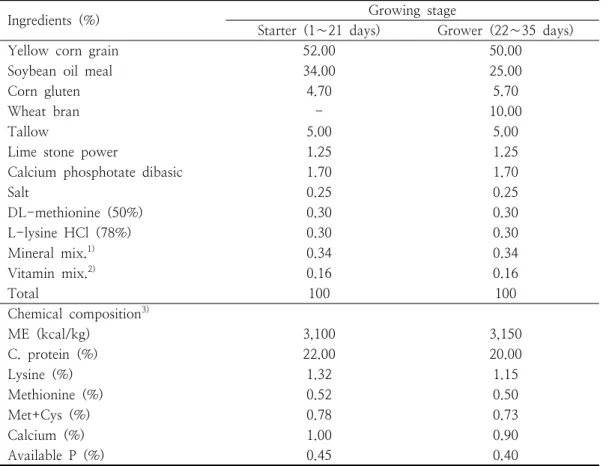
동물실험은 NRC[16]에서 제시된 과학적이고 윤리적인 절차를 따랐으며 강원대학교 동물실험 위원회(IACUC, Institutional Animal Care and Use Committee of Kangwon National
Ingredients (%) Growing stage
Starter (1∼21 days) Grower (22∼35 days)
Yellow corn grain 52.00 50.00
Soybean oil meal 34.00 25.00
Corn gluten 4.70 5.70
Wheat bran - 10.00
Tallow 5.00 5.00
Lime stone power 1.25 1.25
Calcium phosphotate dibasic 1.70 1.70
Salt 0.25 0.25
DL-methionine (50%) 0.30 0.30
L-lysine HCl (78%) 0.30 0.30
Mineral mix.1) 0.34 0.34
Vitamin mix.2) 0.16 0.16
Total 100 100
Chemical composition3)
ME (kcal/kg) 3,100 3,150
C. protein (%) 22.00 20.00
Lysine (%) 1.32 1.15
Methionine (%) 0.52 0.50
Met+Cys (%) 0.78 0.73
Calcium (%) 1.00 0.90
Available P (%) 0.45 0.40
1)Supplement/kg of diet: Fe, 80 mg; Zn, 80 mg; Mn, 70 mg; Cu, 7 mg; I, 1.20 mg; Se, 0.30 mg; Co, 0.70 mg. 2)Supplement/kg of diet: vitamin A(retinyl acetate), 10,500 IU; vitamin D3, 4,100 IU; vitamin E (DL-α-tocopheryl acetate), 45 mg; vitamin K3, 3.0 mg; thiamin, 2.5 mg; riboflavin, 5 mg; vitaminB 6, 5 mg; vitamin B 12, 0.02 mg; biotin, 0.18 mg; niacin, 44 mg; pantothenic acid, 17 mg; folic acid, 1.5 mg.
Table 1. Formula and chemical composition of basal diets University)에서 승인(승인번호: KW-151117-1)
을 받아서 진행하였다. 부화 당일에 브로일러 (Ross 308) 240마리를 4처리구로 나누어 35일 동안 사육하였다. 각 처리구는 총 60마리를 이용 하였으며 3반복 (반복 당 20마리)으로 구분하였 다. 처리구는 사료용 복합 생균제를 함유하지 않 은 대조구(CON, control), 일반생균제(CP3, commercial probiotics 0.3%), 사료용 복합 생균 제 3(PFM3, 사료용 복합 생균제 0.3%), 사료용 복합 생균제 5(PFM5, 사료용 복합 생균제 0.5%) 로 구분하였다. 일반 생균제는 PRIMALAC (
L.
acidophilus
3.3×10¹⁰,L. casei
3.3x10¹⁰,Bifidobacterim bifidum
3.3x10¹⁰cfu/g)을 사용하였다. 실험 사료는 NRC[17] 사양표준에 기초하 여 배합하였다(Table 1). 브로일러는 24시간 연 속 조명을 실시하였으며 음수와 사료섭취에 관해 서 자유롭게 접근할 수 있도록 하였다. 각 펜은 깔짚으로 왕겨를 10 cm 높이로 사용하였다. 양 계장의 온도는 입추 당일부터 3일째까지는 33°C로 유지하고 그 다음부터 매주 2-3°C씩 낮췄으며 22일째부터는 일반 환경온도로 유지하 였다. 사료섭취량, 증체량 및 사료요구율 등의 성 장능력을 조사하였다. 도계 12시간 전에 실험 사 료를 모두 철회하였고 실험 종료 시에 체중을 측 정하였다. 평균 체중의 범위에 해당하는 개체를 처리구 별로 20% 즉 12마리(각 펜 당 4마리)씩
Groups1)
CON CP3 PFM3 PFM5
Body weight, g 1,718±38.29c2) 1,834±43,88b 2,032±37.55a 2,087±38,01a Feed intake, g 2,867±12.80c 3,015±23.01b 3,255±33.17a 3,215±26.77a Feed conversion ratio 1.67±0.03b 1.64±0.02b 1.58±0.03a 1.54±0.02a
1)CON (control), CP3 (commercial probiotics 0.3%), PFM3 (probiotic feed mixture 0.3%), PFM5 (probiotic feed mixture 0.5%). 2)Mean values±standard error. a,b,cp<0.05.
Table 2. Effect of a probiotic feed mixture on growth performance of broiler chickens for 35 days (g/head)
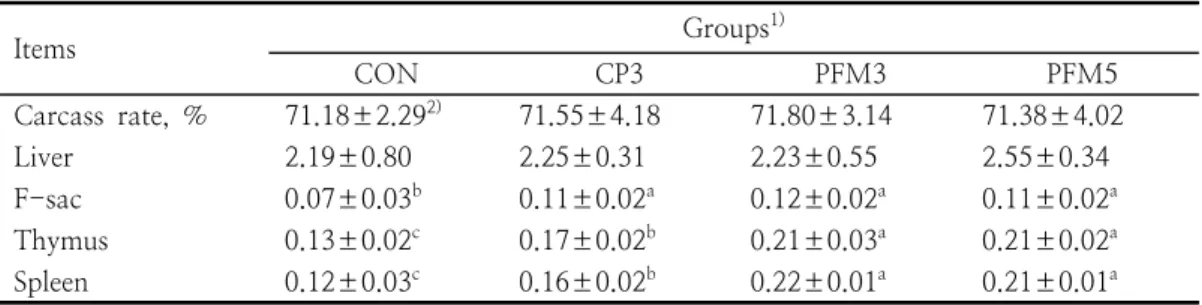
경추탈골법으로 안락사 하였다. 브로일러의 도체 율, 간, 면역기관(흉선, 비장, F낭) 무게를 측정하 여 복합생균제 급여에 의한 면역세포 발육 정도 를 조사하였다.
2.3. 혈액 면역물질
조류의 날개정맥에서 혈액 2 mL를 K3 EDTA-코팅 시험관 속으로 채혈 후 3,000 rpm 에서 30분간 원심분리하여 혈청을 얻었다. 혈청 면역물질은 chicken IgG ELISA kit (Bethyl Laboratories, Montgomery, TX, USA)를 사용하 여 제조사의 프로토콜에 따라서 측정하였다.
Precision microplate reader (Molecular Devices Inc, New York, USA)를 사용하여 450 nm에서 흡광도를 측정해서 IgG의 양을 계산하였다.
2.4. 맹장 미생물
맹장은 혐기적 상태에서 얻은 후 혐기자 (Oxoid, Basingstoke, UK)에서 유지하였다. 혐기 챔버(5% hydrogen, 5% CO2, balanced nitrogen)에서 멸균된 생리식염수(phosphorus buffered saline; PBS 0.1 M, pH 7.0)와 맹장 내 용물을 혼합하여 10배 희석(1:9, w/v) 한 뒤 10-2-10-7까지 희석을 계속하였다. 희석액 100 μL를 멸균된 평판 선택배지에 분주한 후 배양하 였다. 균주와 배지로써
Lactobacillus
(MRA agar, Oxoid, Basingstoke, UK),E. coli
(MaconKey purple agar, Difco),Salmonella
(SS agar, Difco), coliforms (Violet red bile agar, Difco), 총호기성균 (Nutrient agar, Difco)를 사 용하였다. 37°C에서 24∼48시간 배양 후 해당 균주에 대한 colony의 수를 조사하였다. 맹장 내 용물 g당 균수(CFU, colony forming unit/맹장 내용물 g)로써 log10으로 나타냈다.2.5. pH
도계 후 3시간 이내의 닭 가슴살을 채취하여 pH 4.0과 7.0 완충액으로 보정한 유리 전극이 부착된 휴대용 pH meter (Crison 507, Crison, Milan, Italy)를 이용해서 유리 전극을 닭고기에 직접 접촉하여 pH를 측정하였다[18].
2.6. 보수력
도체 후 3시간 이내의 닭 가슴살을 획득하여 보수력(WHC, water holding capacity)을 측정하 였다. 가슴살 10 g을 70℃ 항온 수조에서 30분 동안 유지한 후 4℃에서 48시간 동안 보관하였 다. 3,000 rpm에서 10분간 원심분리에 의해서 육즙 손실량을 측정하였다. 보수력은 (수분-육즙 손실량)/수분*100으로 계산하였다[19].
2.7. 통계처리
자료의 통계분석은 SPSS/Windows 24 (statistical package for the social science, SPSS Inc., Chicago, IL, USA)을 이용하였다. 각 처리구의 평균값에 대한 표준오차를 표기하였다. 일원배치 분산분석을 하였으며 던칸의 다중검정법으로 95% 신뢰수준에서 자료의 통계적인 유의차 (p<0.05)를 검증하였다.
3. 결과 및 고찰
3.1. 생산성
사료용 복합 생균제를 급여 후 조사한 브로일 러의 생산성과 관련한 체중, 사료섭취량 및 사료 요구율은 Table 2와 같다. 체중, 사료섭취량은 CON과 비교할 때 CP3, PFM3, PFM5가 높았고 PFM3, PFM5는 CP3에 비해 높았으나 이와 반
Items Groups1)
CON CP3 PFM3 PFM5
Carcass rate, % 71.18±2.292) 71.55±4.18 71.80±3.14 71.38±4.02
Liver 2.19±0.80 2.25±0.31 2.23±0.55 2.55±0.34
F-sac 0.07±0.03b 0.11±0.02a 0.12±0.02a 0.11±0.02a Thymus 0.13±0.02c 0.17±0.02b 0.21±0.03a 0.21±0.02a Spleen 0.12±0.03c 0.16±0.02b 0.22±0.01a 0.21±0.01a
1)CON (control), CP3 (commercial probiotics 0.3%), PFM3 (probiotic feed mixture 0.3%), PFM5 (probiotic feed mixture 0.5%). 2)Mean values±standard error. a,b,cp<0.05.
Table 3. Effect of a probiotic mixture on carcass rate, liver, F-sac, thymus and spleen in broiler chickens for 35 days (g/100 g BW)
대로 사료요구율은 유의하게 낮았다(p<0.05). 본 연구에서 사료용 복합 생균제가 브로일러의 면역 능력 증진 및 소화관 내 유해한 미생물의 성장을 억압하였고 유익한 균주의 성장을 자극하여 줌으 로써 체중 증가로써 생산성을 개선한다는 사실을 발견하였다[12]. 사료용 복합 생균제가 브로일러 의 사료섭취량 자극 및 영양소의 대사능력을 개 선시켜[20] 증체량이 향상된 것으로 볼 수 있다.
양계산업에서 생균제는 면역능력 증진 및 소화관 미생물 균형을 통한 성장촉진제로써 항생제를 대 체하여 사용할 수 있다[21]. 브로일러에게
Lactobacillus casei, Lactobacillus acidophilus, Scytalidium acidophilum
를 각각 급여하거나 또 는 사료용 복합 생균제를 급여하였을 때 성장을 촉진시켜 체중 증가를 통한 생산성 향상이 보고 되었다[12, 13, 22].3.2. 도체율, 면역세포 발육 및 혈액 면역물질 도체율, 간, 면역 기관인 F낭(bursa of Fabricius), 흉선, 비장의 무게는 Table 3과 같다.
혈청으로부터 면역물질을 측정한 결과는 Fig. 1과 같다. 도체율과 간 무게는 처리구 사이의 차이가 없었다. F낭은 CON과 비교할 때 PFM3, PFM5 및 CP3가 유의하게 높았으나(p<0.05) PFM3, PFM5 및 CP3 사이의 차이는 없었다. 흉선과 비 장은 CON과 비교할 때 PFM3, PFM5 및 CP3 가 높았고 PFM3, PFM5는 CP3에 비해 유의하 게 증가하였으나(p<0.05) PFM3와 PFM5 사이의 차이는 없었다. IgG 함량은 CON과 비교할 때 PFM3, PFM5 및 CP3가 높았고 PFM3, PFM5는 CP3에 비해 유의하게 증가하였으나(p<0.05)
Fig. 1. Changes in IgG concentration from broiler chickens fed a probiotic feed mixture. CON; control, CP3;
commercial probiotics 0.3%, PFM3;
probiotic feed mixture 0.3%, PFM5;
probiotic feed mixture 0.5%. Bars present standard error of mean values.
a,b,cp<0.05.
PFM3와 PFM5 사이의 차이는 없었다. 결과에서 사료용 복합 생균제가 조류의 면역기관인 F낭, 흉선, 비장 세포발육을 자극하여 줌으로써 혈액 중 IgG 수준을 높이는 것으로 나타났다[23, 24].
이러한 결과는 사료용 복합 생균제가 사료로부터 섭취된 영양소 흡수 및 이용율을 개선하여 줌으 로써 면역세포 발육을 자극하고 면역기관의 무게 를 증가시킨데 기인한 것으로 볼 수 있다[25]. 사 료용 생균제는 브로일러의 F낭, 흉선, 비장의 무 게를 증가시키는 것으로 알려졌다[26, 27]. 브로 일러에게
Bacillus subtilis
급여 시 F낭은 증가하 지만 비장은 차이가 없다는 보고도 있다[28]. 사 료용 생균제의 급여가 브로일러의 도체율 및 간 무게에 영향을 주지 않은 반면에[29, 30] 도체율Item Groups1)
CON CP3 PFM3 PFM5
Lactobacillus
7.07±0.16c2) 7.65±0.13b 7.97±0.22a 8.01±0.31aE. coli
4.52±0.28a 3.97±0.03b 3.71±0.02c 3.68±0.08cSalmonella
4.80±0.17a 3.97±0.06b 3.55±0.23c 3.57±0.06cColiforms 6.52±0.22a 6.11±0.27b 5.07±0.26c 5.07±0.27c Total aerobic bacteria 6.07±0.43a 5.12±0.38b 4.22±0.27c 4.12±0.22c
1)CON (control), CP3 (commercial probiotics 0.3%), PFM3 (probiotic feed mixture 0.3%), PFM5 (probiotic feed mixture 0.5%). 2)Mean values±standard error. a,b,cp<0.05.
Table 4. Effect of a probiotic mixture on changes in cecal microorganism in broiler chickens for 35 days (log10cfu/g, cecum content)
Item Groups1)
CON CP3 PFM3 PFM5
pH, Breast meat 6.07±0.17 6.04±0.15 6.15±0.22 6.07±0.13 Water holding capacity 65.15±3.27b2) 66.09±3.45b 68.07±4.12a 67.79±3.77a
1)CON (control), CP3 (commercial probiotics 0.3%), PFM3 (probiotic feed mixture 0.3%), PFM5 (probiotic feed mixture 0.5%). 2)Mean values±standard error. a,b,cp<0.05.
Table 5. Effect of a probiotic mixture on pH, water holding capacity in breast meat from broiler chickens for 35 days
이 증가한다는 보고도 있다[21, 22]. 이와 같이 사료용 생균제 급여효과가 차이를 보이는 점은 사료용 생균제에 포함된 균주 종류가 서로 다르 고 사육 환경 변이성의 결과로 판단된다.
3.4. 장내 미생물
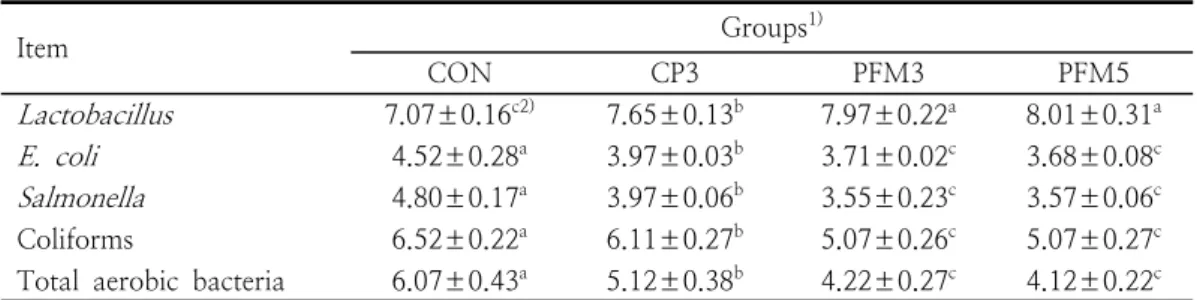
맹장 미생물 변화는 Table 4에 나타냈다.
Lactobacillus
균수는 CON과 비교할 때 PFM3, PFM5 및 CP3가 높았고 PFM3, PFM5는 CP3에 비해 유의하게 증가하였으나(p<0.05) PFM3, PFM5 사이의 차이는 없었다.E.coli, Salmonella,
coliforms, 총호기성 균수는 CON과 비교할 때 PFM3, PFM5 및 CP3가 낮았고 PFM3, PFM5는 CP3에 비해 유의하게 감소하였으나(p<0.05) PFM3, PFM5 사이의 차이는 없었다. 결과는 사 료용 복합 생균제가 소화관 맹장 내 pH를 낮추 어 줌으로써 유해균의 성장을 억제하고 유익균의 성장을 자극해주는 미생물 균형을 유지를 통하여 증체량을 개선하는데 기여하였을 것으로 보인다 [31-33]. 사료용 생균제는 브로일러의 맹장 내Lactobacillus
의 성장을 자극시킴과 동시에E.
coli
를 비롯한 유해세균의 증식을 억제하는 것으 로 알려졌다[34]. 한편, 사료용 생균제가 브로일 러의 맹장 내Salmonella
, coliforms에 영향을 미 치지 않는다는 결과[35, 36]는 본 결과와 차이가 있다. 사료용 생균제는 소화기관의 상피세포에서 유해세균과 경쟁적으로 작용하여 병원균 부착 및 서식을 방지하며[37], 젖산을 분비시켜서 맹장 내 pH를 낮추고 유해세균의 성장을 억압한다[19].3.5. 닭고기의 pH, 보수력
닭고기 가슴살에 대한 pH, 보수력을 측정한 결과는 Table 5와 같다. pH는 처리구 사이에 차 이가 없었다. 보수력은 CON 및 CP3와 비교할 때 PFM3 및 PFM5가 높았으나(p<0.05), PFM3 와 PFM5 사이의 차이는 없었다. 본 연구에서 사 료용 복합 생균제가 닭고기 보수력을 개선한다는 사실을 관찰하였다. 사료용 복합 생균제의 급여가 닭고기의 pH에 영향을 미치지 않은 점은 Zheng et al.[38]과 일치하며 닭고기 보수력을 개선한 사실은 이전의 보고[34, 38]와 일치한다. 닭고기 pH는 보수력의 변화에 영향을 미치는 것으로 알
려져 있으나[39] 결과에서 처리구 사이의 pH 변 화는 나타나지 않았다. 닭고기의 보수력이 낮으면 육즙이 흘러나와서 수용성 영양소와 풍미의 손실 을 나타내기 때문에 맛이 없고 품질이 떨어지는 원인이 될 수 있다[40].
4. 결 론
브로일러에서
Bacillus. subtillus
,Streptomyces galilaeus
및Sphingobacteriaceae
를 포함하는 사 료용 복합 생균제(PFM, probiotic feed mixture) 가 성장능력 및 닭고기 품질향상에 미치는 효과 및 그 작용 메카니즘을 조사하였다. 병아리는 사 료용 복합 생균제를 포함하지 않은 대조구(CON, control), 일반생균제(CP3, commercial probiotics 0.3%), 사료용 복합 생균제 3(PFM3, 사료용 복합 생균제 0.3%), 사료용 복합 생균제 5(PFM5, 사료용 복합 생균제 0.5%)로 구분하여 35일 간 사육하였다. 브로일러의 체중, F낭, 흉 선, 비장 무게, 혈액 IgG 및 닭고기 보수력은 PFM3, PFM5가 CP3, CON에 비해서 높았다.맹장 내
Lactobacillus
균수는 PFM3, PFM5가 CP3, CON에 비해서 높았으나E.coli
를 비롯한 유해균수는 이와 반대로 감소하였다. 전체적으로, CON과 비교할 때 PFM3, PFM5, CP3 순서로써 결과의 우수함을 관찰하였으나 PFM3, PFM5사 이의 차이는 없었다.References
1. X. Zhou, Y. Wang, Q. Gu, W. Li, “Effect of dietary probiotic,
Bacillus coagulans
, on growth performance, chemical composition, and meat quality of Guangxi Yellow chicken”,Poult. Sci.
, Vol. 89, No. 3 pp.588-593, (2010).
2. G. Abbas, M. A. Iqbal, M. Riaz, M.
Sajid, O. Zahid, S. Abbas, A. I. Raza, M.
Z. Ali, “Comparative effect of different levels of probiotics (protexin) on hemato- chemical profile in broilers”,
Advanced Zoology Botany.
, Vol. 6, No. 3 pp.84-87, (2018).
3. G. V. D. Silva, N. D. J. B. Machado, L.
W. D. Freitas, M. F. D. Lima, R. H.
Luchese, “Performance and carcass yield of female broilers fed with diets containing probiotics and symbiotics as an alternative to growth enhancers”,
Acta Scientiarum.
Anim. Sci.
, Vol. 40. pp. 1-6, (2018).4. A. Alkhalf, M. Alhaj, I. Al-Homidan,
“Influence of probiotic supplementation on blood parameters and growth performance in broiler chickens”,
Saudi J. Biol. Sci.
, Vol. 17, No. 3 pp. 219-225, (2010a).5. T. Inatomi, O. Konosuke, “Effect of dietary probiotics on the semen traits and antioxidative activity of male broiler breeders”,
Scientific Reports.
, Vol. 8. No.1 pp. 5874-5879, (2018).
6. M. Aalaei, A. Khatibjoo, M. Zaghari, K.
Taherpour, M. Soltani, “Comparison of single- and multi-strain probiotics effects on broiler breeder performance, egg production, egg quality and hatchability”,
Brit. Poult. Sci.
, Vol. 59, No. 5 pp.531-538, (2018).
7. S. Yasar, E. Boselli, F. Rossetti, M. S.
Gok, “Effect of Fermented Cereals, Probiotics, and Phytase on the Sensory Quality of Poultry Meat”,
Scientia Agri.
Bohemica.
, Vol. 49, No. 3 pp. 225-235, (2018).8. S. R. Konstantinov, H. Smidt, A. D.
Akkermans, L. Casini, P. Trevisi, M.
Mazzoni, S. D. Filippi, P. Bosi, W. M. De Vos, “Feeding of
Lactobacillus sobrius
reducesEscherichia coli
F4 levels in the gut and promotes growth of infected piglets”,FEMS Microbial. Ecol.,
Vol. 66, No. 3 pp. 599-607, (2008).9. J. S. Yoo, J. H. Cho, Y. G. Chen, H. J.
Kim, Q. Wang, Y. Hyun, T. G. Ko, C. S.
Park, I. H. Kim, “The effects of
environment-friendly diets on the growth
performance, nutrient digestibility, fecal
excretion, nitrogen excretion and emission
gases in manure for growing pigs”,
J. Anim.Sci. Technol.,
Vol. 49, No. 4 pp. 491-500, (2007).
10. J. Walter, “Ecological role of
Lactobacilli
in the gastrointestinal tract: implications for fundamental and biomedical research”,App. Environ. Microbial.,
Vol. 74, No. 16 pp. 4985-4996, (2008).11. S. Sugiharto, T. Yudiarti, I. Isroli, E.
Widiastuti, E. Kusumanti, “Dietary supplementation of probiotics in poultry exposed to heat stress–a review”,
Annals Anim. Sci.,
Vol. 17, No. 3 pp. 591-604, (2017).12. W. A. Awad, K. Ghareeb, S.
Abdel-Raheem, J. Böhm, 2“Effects of dietary inclusion of probiotic and synbiotic on growth performance, organ weights, and intestinal histomorphology of broiler chickens”,
Poult. Sci.,
Vol. 88, No. 1 pp.49-56, (2009).
13. K. Bai, Q. Huang, J. Zhang, J. He, L.
Zhang, T. Wang, “Supplemental effects of probiotic
Bacillus subtilis fmbJ
on growth performance, antioxidant capacity, and meat quality of broiler chickens”,Poult.
Sci.
, Vol. 96, No. 1 pp. 74-82, (2016).14. X. Wei, X. Liao, J. Cai, Z. Zheng, L.
Zhang, T. Shang, Y. Fu, C. Hu, L. MA, R. Zhang, “Effects of
Bacillus amyloliquefaciens
LFB112 in the diet on growth of broilers and on the quality and fatty acid composition of broiler meat”,Anim. Prod. Sci.,
Vol. 57, No. 9 pp.1899-1905, (2017).
15. A. Seidavi, M. Dadashbeiki, M. H.
Alimohammadi-Saraei, R. van den Hoven, R. Payan-Carreira, V, Laudadio, V.
Tufarelli, “Effects of dietary inclusion level of a mixture of probiotic cultures and enzymes on broiler chickens immunity response”,
Environ. Sci. Pollut. Res.,
Vol.24, No. 5 pp. 4637-4644, (2017).
16. NRC. Guide for the care and use of laboratory animals. Eighth Ed. The national academies press. Washington D.C.
USA, (2011a).
17. NRC. Nutrients requirements of poultry.
9th rev. National Academy Press, Washington DC, (2001b).
18. C. Berri, J. Besnard, C. Relandeau,
“Increasing dietary lysine increases final pH and decreases drip loss of broiler breast meat”,
Poult. Sci.,
Vol. 87, No. 3 pp. 480-484, (2008).19. D. Djenane, J. A. Beltrán, J. Camo, P.
Roncalés, P. “Influence of vacuum-ageing duration of whole beef on retail shelf life of steaks packaged with oregano active film under high O2”,
J. Food Sci. Tech.,
Vol. 53, No. 12 pp. 4244-4257, (2016).20. T. W. Hahn, J. D. Lohakare, S. L. Lee, W.
K. Moon, B. J. Chae, “Effects of supplementation of β-glucans on growth performance, nutrient digestibility, and immunity in weanling pigs”,
J. Anim. Sci.,Vol. 84, No. 6 pp. 1422-1428, (2006).
21. J. A. Patterson, K. M. Burkholder,
“Application of prebiotics and probiotics in poultry production”,
Poult. Sci.,
Vol. 82, No. 4 pp. 627-631, (2003).22. A. Alçiçek, M. Bozkurt, M. Çabuk, “The effect of a mixture of herbal essential oils, an organic acid or a probiotic on broiler performance”,
South African J. Anim. Sci.,
Vol. 34, No. 4 pp. 217-222, (2004).23. C. M. Yang, G. T. Cao, P. R. Ferket, T.
T. Liu, L. Zhou, L. Zhang, Y. P. Xiao, A. G. Chen, “Effects of probiotic,
Clostridium butyricum
, on growth performance, immune function, and cecal microflora in broiler chickens”,Poult. Sci.,
Vol. 91, No. 9 pp. 2121-2129, (2012).24. M. M. Fathi, T. A. Ebeid, I. Al-Homidan, N. K. Soliman, O. K. Abou-Emera,
“Influence of probiotic supplementation on immune response in broilers raised under hot climate”,
Brit. Poult. Sci.
, Vol. 58, No.5 pp. 512-516, (2017).
25. S. K. Singdevsachan, P. Auroshree, J.
Mishra, B. Baliyarsingh, K. Tayung, H.
Thatoi, “Mushroom polysaccharides as potential prebiotics with their antitumor
and immunomodulating properties: A review”,
Bioact. Carbohydry. Diet. Fibre.,
Vol. 7, No. 1 pp. 1-14, (2016).26. A. Alkhalf, M. Alhaj, I. Al-Homidan,
“Influence of probiotic supplementation on immune response of broiler chickens”,
Egypt. Poult. Sci.,
Vol. 30, No. 1 pp.271-280, (2010b).
27. D. M. T. Jwher, S. K. Abd, A. G.
Mohammad, “The study of using effective microorganisms (EM) on health and performance of broiler chicks”,
Iraqi J.
Vet. Sci.,
Vol. 27, No. 2 pp, 73-78, (2013).28. J. H. Park, I. H. Kim, “Supplemental effect of probiotic
Bacillus subtilis
B2A on productivity, organ weight, intestinalSalmonella
microflora, and breast meat quality of growing broiler chicks”,Poult.
Sci.,
Vol. 93, No. 8 pp. 2054-2059, (2014).29. H. A. Kaoud, “Functional food supplementation and health of broilers”,
Nature Sci.
, Vol. 8, No. 5 pp. 181-189, (2010).30. M. Toghyani, M., Toghyani, S. A.
Tabeidian, “Effect of probiotic and prebiotic as antibiotic growth promoter substitutions on productive and carcass traits of broiler chicks”,
Int. Conf. Food Eng. Biotechnol.,
Vol. 9, pp. 82-86, (2011).31. G. M. Chu, S. J. Lee, H. S. Jeong, S. S.
Lee, “Efficacy of probiotics from anaerobic microflora with prebiotics on growth performance and noxious gas emission in growing pigs”,
Anim. Sci. J.,
Vol. 82, No.2 pp. 282-290, (2011).
32. S. Mookiah, C. C. Sieo, K. Ramasamy, N.
Abdullah, Y. W. Ho, “Effects of dietary prebiotics, probiotic and synbiotics on performance, caecal bacterial populations and caecal fermentation concentrations of broiler chickens”,
J. Sci. Food Agri.,
Vol.94, No. 2 pp. 341-348, (2014).
33. Z. F. Zhang, I. H. Kim, “Effects of multistrain probiotics on growth performance, apparent ileal nutrient digestibility, blood characteristics, cecal microbial shedding, and excreta odor contents in broilers”,
Poult. Sci.,
Vol. 93, No. 2 pp. 364-370, (2014).34. X. Lei, X. Piao, Y. Ru, H. Zhang, A.
Péron, H. Zhang, “Effect of
Bacillus amyloliquefaciens
-based direct-fed microbial on performance, nutrient utilization, intestinal morphology and cecal microflora in broiler chickens”,AAJAS.
, Vol. 28, No. 2 pp. 239-246, (2015).35. K. C. Mountzouris, P. Tsirtsikos, E.
Kalamara, S. Nitsch, G. Schatzmayr, K.
Fegeros, “Evaluation of the efficacy of a probiotic containing
Lactobacillus, Bifidobacterium, Enterococcus, and
Pediococcusstrains in promoting broiler performance and modulating cecal microflora composition and metabolic activities”,
Poult.Sci.,
Vol. 86, No. 2 pp. 309-317, (2007).
36. H. M. Salim, H. K. Kang, N. Akter, D.
W. Kim, J. H. Kim, M. J. Kim, J. C. Na, H. B. Jong, H. C. Choi, O. S. Suh, W. K.
Kim, “Supplementation of direct-fed microbials as an alternative to antibiotic on growth performance, immune response, cecal microbial population, and ileal morphology of broiler chickens”,
Poult.
Sci.,
Vol. 92, No. 8 pp. 2084-2090, (2013).37. S. Y. Kim, H. Kim, H. J. Chae, “Selection of probiotic yeasts from soil, characterization and application for feed additives”,
J. App. Biol. Chem.,
Vol. 47, No. 1 pp. 20-26, (2004).38. A. Zheng, J. Luo, K. Meng, J. Li, S.
Zhang, K. Li, G. Liu, H. Cai, W. L.
Bryden, B. Yao, B. “Proteome changes underpin improved meat quality and yield of chickens (
Gallus gallus
) fed the probioticEnterococcus faecium
”,BMC
Genomics.,
Vol. 15, No. 1 pp. 1167-1180, (2014).39. J. F. Young J. Stasted S. K. Jensen A. H.
Karlsson P. Henckel “Ascorbic acid, α -tocopherol, and oregano supplements reduce stress-induced deterioration of chicken meat quality”, Poult. Sci., Vol. 82, No. 8 pp. 1343-1351, (2003).
40. B. S. Park, “Effect of dietary cinnamon powder on savor and quality of chicken meat in broiler chickens”,
J. Korean Soc.
Food Sci. Nutr.,
Vol. 37, No. 5 pp.618-624, (2008).