Vol. 39, No. 2, 97–103 (2011)
제주 연안의 해수로부터 분리한 Cellulase 생산균 Bacillus sp. GC-1과 GC-4의 동정
지원재1·박다연1·Uyangaa Temuujin1·이종열2·장용근3· 홍순광1*
1명지대학교 생명과학정보학부, 2농촌진흥청 국립농업과학원, 3한국과학기술원 생명화학공학과 Received: February 1, 2011 / Revised: March 10, 2011 / Accepted: March 28, 2011
Identification of a Cellulase Producing Marine Bacillus sp. GC-1 and GC-4 Isolated from Coastal Sea- water of Jeju Island. Chi, Won-Jae1, Da Yeon Park1, Uyangaa Temuujin1, Jong Yeol Lee2, Yong-Keun Chang3, and Soon-Kwang Hong1*. 1Department of Biological Science, Myongji University, Yongin 449-728, Korea, 2National Academy of Agricultural Science, Rural Development Administration, Suwon 441-707, Korea,
3Dept. of Chemical and Biomolecular Engineering, Korea Advanced Institute of Science and Technology, Taejon 305-701, Korea − Two Gram positive bacterial strains, designated strain GC-1 and GC-4, were isolated from coastal seawater near Jeju Island in the Republic of Korea. The two strains were identified as members of the genus Bacillus, based on 16S rRNA gene sequencing and data for physiological characteristics analyses. A subtle difference in physiological and genotypical characteristics has led us to designate the strains GC-1 and GC-4. The strain GC-1 showed a 99.91% similarity in 16S rRNA gene sequencing with B. tequiliensis and B.
subtilis subsp. inaquosorum and the strain GC-4 showed a 100% similarity in 16S rRNA gene sequencing with those of B. altitudinis, B. stratosphericus, and B. aerophilus. However, both strains exhibited different physio- logical and genotypical characteristics in many aspects from those of their phylogenetically closest neighbors listed above, which implies that genus Bacillus has diversified into various species during its evolutionary pro- cess.
Key words: Cellulase, marine bacterium, Bacillus, phylogeney
서 론
Cellulose는 고등식물, 선태식물, 일부 조류의 세포벽의 주 성분으로서 β-1,4-D-glycosidic 결합에 의해 연결되어 있는 anhydro-β-1,4-glucose로 구성된 unbranched glucose 복합체 이다. Cellulose를 glucose로 완전히 분해하기 위해서는 endoglucanase(1,4-β-D-glucan 4-glucohydrolase)에 의해서 celluose내의 β-1,4-D-glycosic bond가 절단되고 exoglucanase (β-1, 4-D-glucan cellobiohydrolase)에 의해서 cellobiose로 절단되어, 이를 최종적으로 β-glucosidase가 절단하여 glucose로 만드는 일련의 효소반응이 필요하다[14, 4, 6]. 최 근에 cellulose는 전분을 대체하여 바이오에탄올의 원료로서 각광받고 있으나 cellulose로부터 화학적 또는 생화학적 처 리로 분해하여 glucose를 얻는데 많은 비용과 어려움을 겪 고 있어, 이를 효율적으로 생분해 할 수 있는 효소의 개발이 필요한 실정이다. Cellulase는 cellulose를 분해 할 수 있는 효소의 통칭으로 제지공업, 섬유, 식품산업, 바이오에너지 산
업분야에 널리 이용되고 있다. 많은 연구자들로부터 cellulose 를 효과적으로 분해할 수 있는 미생물의 탐색 및 cellulase 효소에 대한 연구가 진행되고 있는데 특히 동물 및 곤충의 소화기관과 토양 및 식물 등의 많은 환경조건에서 cellulase 생산 미생물이 탐색되고 있다[8, 2]. 본 연구에서는 glucose 생산을 위한 원료로서 해조류(marine algae)를 주목하고 이 를 생분해 할 수 있는 cellulase를 탐색하기 위해서 해수로 부터 celluase 생산 균주를 얻고자 하였다. 특히 Bacillus 속 은 호기성 또는 통혐기성 세균으로 배양이 간편하고 토양, 담수, 해수에서도 많이 발견되고 있는 미생물로서 cellulase, protease, amylase 등의 다양한 효소를 세포외부로 분비하는 특징으로 산업적으로 많이 연구되고 있다. 또한 유전자조작 에 관련한 분자생물학적 방법이 잘 정립되어 있어 기초과학 적인 연구에도 용이하다. 이에 본 연구에서는 해수에 존재 하는 cellulase 생산균주로서 Bacillus 속을 주목하여 동정하 고자 하였다.
*Corresponding author
Tel: +82-31-330-6198, Fax: +82-31-335-8249 E-mail: [email protected]
균주 GC-1과 GC-4는 제주도 연안에서 수집된 해수로부 터 분리되었다. 수집된 해수는 10-2-10-5으로 희석하여 각각 의 희석액 200 µL를 Modified Artificial Sea Water(ASW) 고체배지(6.1 g Tris base, 12.3 g MgSO4, 0.74 g KCl, 0.13 g (NH4)2HPO4, 17.5 g NaCl, 0.14 g CaCl2, 3 g bacto peptone, 0.2 g yeast extract, and 15 g bacto agar per L, pH 7.2)에 도말하여 40oC에서 24시간 배양하였다. 분리된 균들로부터 세포외부로 cellulase를 분비하는 균을 선별하기 위해서 0.3%(w/v) carboxyl methyl cellulose(CMC)가 포함 된 고체배지에 계대하여 배양한 후 2%(w/v) congo red 용 액으로 염색하였다. 1 M NaCl 용액으로 2회 탈염색한 후 콜 로니 주변에 cellulose 분해환을 형성하는 균을 선별하였다.
선별된 균의 순수배양을 위해서 0.3%(w/v) CMC가 포함된 액체배지에서 배양하여 serial dilution 후 고체배지에 도말 하여 콜로니를 선별하는 과정을 3회 반복하였다.
Determination of 16S rRNA gene sequence and phylo- genetic analysis
선별된 균을 액체배양 후 균체을 회수하여 genomic DNA Extraction kit(DyneBio, Korea)로 genomic DNA를 추출하 였다. 16S rRNA 유전자를 증폭하기 위해서 bacterial uni- versial primer(27F와 1492R)가 사용되었다. 증폭된 유전자 단편의 염기서열분석은 Genotech(Daejeon, Korea)에 의뢰하 여 수행하였다. 균주 GC-1(1444 base)과 GC-4(1437 base) 로부터 결정된 16S rRNA 유전자의 염기서열은 GenBank에 각각 JF262082과 JF262083으로 등록하였다. 결정된 염기서 열의 상동성 검사는 BLAST program(http://www.ncbi.nlm.
nih.gov/blast/)을 사용하여 수행되었고, 표준균주 (type strain) 들과의 유사성(similarity) 조사 및 관련된 분류군의 16S rRNA 유전자 염기서열의 확보는 ExTaxon server(http://
www.eztaxon.org/)에서 수행되었다[1]. Multialignment는 Clustal W softaware[20]를 사용하여 결정하었고 5’ 및 3’의 gap은 BioEdit program[7]을 사용하여 편집하였다. 균주 GC-1과 GC-4에 대한 Phylogenetic tree는 PHYLIP program [3]을 사용한 neighbor-joining 법[16]과 maximum parsimony 법[11]으로 작성되었다. Bootstrap value는 1,000회의 재구성 된 자료로부터 계산되었고, evolutionary distance matrices는 Kimura two-parameter model[10]의 algorithm에 따라서 계 산되었다.
Phenotypic and biochemical characteristics
균의 형태적 특성을 알아보기 위해서 Gram stain kit (BD, USA)를 사용하여 제시된 방법에 따라 수행하여 광학 현미경으로 관찰하였다. 생리학적 특성은 API 50CH kit
건을 알아보기 위해서, pH 4-9(pH 1 간격)의 고체배지에 접 종하여 40oC에서 2일간 배양하여 관찰하였다. 생육에 미치 는 온도의 영향은 4, 15, 30, 37, 40, 50oC의 조건에서 2일 간 고체배양하여 관찰하였다. 생육을 위한 NaCl 요구성 검사 는 동정된 균을 0, 1, 2, 3, 5, 7, 10, 15, 20%(w/v) NaCl이 포함된 고체배지에 접종하여 40oC에서 2일간 배양하여 관 찰하였다.
Antibiotics susceptibility test
균주 GC-1과 GC-4를 ASW-YP 고체배지에 골고루 도말 한 후, 각각의 항생제(thiostrepton(50 µg/ml), kanamycin (50 µg/ml), neomycin(30 µg/ml), ampicillin(50 µg/ml), apramycin(50 µg/ml), chloramphenicol(25 µg/ml))를 30 ml 씩 함유하는 paper disc를 올려 40에서 24시간 배양하여 paper disc 주변에 형성되는 투명환을 측정하였다.
Cell growth and cellulase activity
동정된 균의 cellulase 활성은 고체배지와 액체배지에서 배 양하여 활성을 관찰하였다. 균주 GC-1과 GC-4를 0.3%(w/
v) CMC가 포함된 고체배지에 접종하여 40oC에서 2일간 배 양하여 2%(w/v) congo red 용액으로 20분간 염색한 후 1M NaCl 용액으로 2회 탈염색하였다. 액체배양의 경우, 균주 GC-1과 GC-4는 각각 0.3%(w/v) CMC가 포함된 액체배지 에서 진탕배양하고 일정한 시간 간격으로 배양액을 채취하 여 균의 성장을 흡광도 600 nm에서 측정하였고, 균체 배양 액을 원심분리 후 균체를 제거한 상등액을 회수하여 cellulase 활성을 측정하였다. Cellulase 활성은 bicinchronic acid (BCA) 방법[13]에 따라 수행하였으며 흡광도 562 nm에서 환원당을 측정하였다. 효소활성의 1 U(unit)은 CMC로부터 1분간 1 µmol의 glucose를 생산하는 효소의 양으로 하였다.
결과 및 고찰
Cellulase 생산균주로서 제주도 연안의 해수로부터 분리된 균주 GC-1과 GC-4는 Gram 염색 결과 Gram 양성균으로 관찰되었고 콜로니는 Modified ASW 고체배지에서 각각 흰 색과 옅은 노란색의 불규칙적인 형태였다. 액체배양을 통해 서 두 균의 성장에 따른 cellulase 생산을 관찰 한 결과, 균 주 GC-1은 배양 18-24시간에 최대성장을 보이고 균의 성장 이 사멸기에 접어들 때부터 효소를 급격하게 생산하여 배양 48-60시간에 cellulase의 최대생산량이 관찰되었다(Fig. 1A).
반면, 균주 GC-4는 배양초기에 급격한 성장을 보여 배양 9 시간째에 최대성장을 보인 후 급격한 성장저하가 관찰되었 다(Fig. 1B). Cellulase 생산은 배양초기부터 서서히 증가하 여 균이 완전한 사멸기에 접어들었을 때인 배양 24시간째
최대생산량을 보이고 이후 서서히 생산량이 줄어드는 것으 로 관찰되었다(Fig. 1B). 두 균주 모두 24시간 이내에 stationary phase에 들어가는 빠른 성장을 보이는데, 이는 사 용한 배지(modified ASW)에 함유된 탄소원(0.3% CMC) 및 질소원(0.3% bacto peptone, 0.02% yeast extract)의 양이 적어, 이용 가능한 영양분이 고갈되어 발생한 결과로 판단 된다.
API 50CH kit를 사용하여 생리적 특성을 분석한 결과, 균 주 GC-1은 glycerol, L-arabinose, ribose, D-xylose, D- glucose, D-fructose, galactose, D-mannose, mannitol, alpha- methyl-D-mannoside, α-mehtyl-D-glucoside, N-acetyl-glu- cosamine, amygdaline, arbutine, esculine, salicine, cellobiose, melibiose, saccharose, trehalose, β-gentiobiose, D-tagatose 등 대해서 양성반응을 보였고(Table 1), 균주 GC-4는 gly- cerol, L-arabinose, ribose, D-glucose, D-fructose, D-mannose,
inositol, mannitol, alpha-mehtyl-D-glucoside, amygdaline, esculine, melibiose, cellobiose, saccharose, trehalose, inuline, D-raffinose, D-turanose에 대해서 양성반응을 보였다(Table 1).
균주 GC-1과 GC-4가 분비하는 효소를 API ZYM kit를 이용하여 분석한 결과, 균주 GC-1은 alkaline phosphatase, esterase(C4), esterase(C8), leucine arylamidase, acid phos- phatase, naphtol-AS-BI-phosphohydrolase, α-glucosidase, β- glucosidase 등의 효소반응에 대해서 양성반응을 보였고 (Table 2), 균주 GC-4는 alkaline phosphatase, esterase(C4), esterase(C8), acid phosphatase, naphtol-AS-BI-phospho- hydrolase, β-glucosidase 등의 효소반응에 대해서 양성반응 을 보였다(Table 2).
균주 GC-1과 GC-4는 API50CH kit와 API ZYM kit 등 에서 cellobiose 사용과 β-glucosidase 활성에 양성반응을 보였 Fig. 1. Cell growth and cellulase production of strain GC-1 (A) and GC-4 (B). (Upper) Cellulase activity on the modified ASW plate was observed by staining with congo red. (Lower) Cellulase production and cell growth (A600) depending on cultivation time was mea- sured in the modified ASW broth containing 0.3% (w/v) CMC. -●-, cell density; -■-, cellulase activity.
고(Table 1 and 2), AZCL-HE-cellulose(Megazyme, Ireland) 를 기질로 하는 endo-cellulase의 활성 측정에서도 양성반응 을 보였다(data not shown). 이 결과로부터 본 연구를 통해 서 동정된 균주 GC-1과 GC-4는 celluose를 가수분해하여 glucose로 전환시킬 수 있는 세가지 효소 활성을 모두 갖는 미생물로 판단되고, 따라서 유용한 cellulose 유전자 탐색균 으로서의 가치를 갖을 것으로 기대된다.
균주 GC-1은 0-5%(w/v) NaCl 농도에서 생육이 관찰되었 Pigmentation white yellow-
ish
yellow-
ish white white white Colony shape irregu-
lar
irregu- lar
regu- lar
irregu- lar
irregu- lar regular Utilization of (with API 50CH Kit):
Glycerol + w - + + +
D-Arabinose - - + + + +
L-Arabinose + w + - - -
Ribose + w + + + -
D-Xylose + - + + + -
L-Xylose - - + - - -
Adonitol - - + - - -
Galactose + - + - - -
D-Glucose + + - + + -
D-Fructose + + - + + -
D-Mannose + + - + + -
L-Sorbose - - + + + +
Rhamnose - - - + + +
Dulcitol - - - - + +
Inositol - w - - + +
Mannitol + w - + + -
Sorbitol - - - + - +
α-methyl-D-mannoside + - - - - -
α-mehtyl-D-glucoside + + + - - -
N-acetyl-glucosamine + - + - - +
Amygdaline + + + - - -
arbutine + - - - - -
Esculine + + - - - -
Salicine + - - - - -
Cellobiose + w - - - +
Maltose - - - + + -
Lactose - - + + + -
Melibiose + + + + + -
Saccharose + w - - - -
Trehalose + w + + -
Inuline - w + + + +
D-Raffinose - + + + + -
Glycogen - - + - - -
Xylitol - - + + - -
β-gentiobiose + - + - - -
D-Turanose - + + - - -
D-Lyxose - - + - - -
D-Tagatose + - + - - -
D-Fucose - - + - - -
L-Fucose - - + - - -
D-Arabitol - - + - - -
L-Arabitol - - + - - -
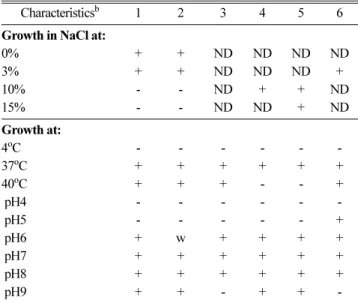
aStrains: 1, Bacillus sp. GC-1; 2, Bacillus sp. GC-4; 3, B. tequilensis 10bT; 4, B. aerophilus 28KT; 5, B. stratophericus 41KF2aT; 6, B.
altitudinis 41KF2bT. Data were obtained from Gatson et al. (2006), and Shivaji et al. (2006)
b+, Positive; -, negative; w, weak positive. ND, no data available.
Growth in NaCl at:
0% + + ND ND ND ND
3% + + ND ND ND +
10% - - ND + + ND
15% - - ND ND + ND
Growth at:
4oC - - - -
37oC + + + + + +
40oC + + + - - +
pH4 - - - -
pH5 - - - +
pH6 + w + + + +
pH7 + + + + + +
pH8 + + + + + +
pH9 + + - + + -
Table 2. Determination of enzymatic activities from strains Bacillus sp. GC-1 and GC-4 by API ZYM kit.
Enzymea Bacillus sp.
GC-1
Bacillus sp.
GC-4
Alkaline phosphatase + +
Esterase (C4) + +
Esterase (C8) + +
Lipase (C14) - -
Leucine arylamidase w -
Valine arylamidase - -
Crystine arylamidase - -
Trypsin - -
α -chymotrypsin - +
Acid phosphatase + w
Naphtol-AS-BI-phosphohydrolase + +
α-galactosidase - -
β-galactosidase - -
β-glucuronidase - -
α-glucosidase + -
β-glucosidase w +
N-acetyl-β-glucosaminase - -
α-mannosidase - -
α-fucosidase - -
a +, Positive; -, negative; w, weak positive.
고 7%(w/v) 이상의 농도에서는 생육이 억제되었다. 균주 GC-4는 0-3%(w/v) NaCl 농도에서 생육이 관찰되는 반면 5%(w/v) 이상의 농도에서는 생육이 관찰되지 않았다(Table 1). 균주 GC-1은 pH 6-9의 조건에서 생육이 관찰되고 pH 5 이하와 pH 10 이상의 조건에서는 생육이 관찰되지 않았다.
균주 GC-4는 pH 7-9의 조건에서는 왕성한 생육이 관찰된 반면 pH 6의 조건에서는 아주 약한 생육이 관찰되었으며, pH 5 이하와 pH 10이상의 조건에서는 생육이 관찰되지 않 았다(Table 1). 균주 GC-1과 GC-4는 28oC-40oC의 배양온도 조건에서 생육이 관찰되었고 4oC-15oC 그리고 50oC의 조건 에서는 생육이 관찰되지 않았다(Table 1). 균주 GC-1과 GC- 4는 thiostrepton(50 µg/ml)과 ampicillin(50 µg/ml)에 대하 여 높은 감수성이 관찰되었고 kanamycin(50 µg/ml)과 neo- mycin(30 µg/ml)에 대해서도 감수성이 관찰되었다. Chlo- ramphenicol(25 µg/ml)에 대해서는 아주 약한 감수성이 관 찰되었다. 균주 GC-1은 apramycin(50 µg/ml)에 대해서 감 수성이 관찰되지 않은 반면, 균주 GC-4는 감수성이 관찰되 었다(Table 1).
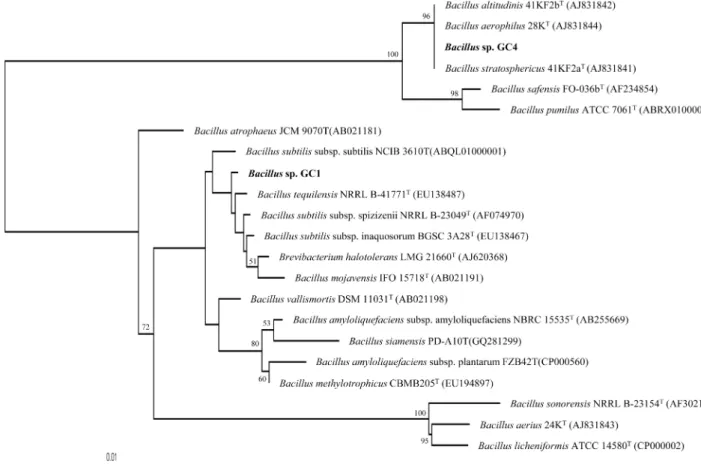
또한 16S rRNA 유전자 염기서열분석결과를 이용한 BLAST 검색 및 phylogenetic tree 작성 결과, 균주 GC-1과
GC-4는 Bacillus 속의 균으로 판명되어 각각 Bacillus sp.
GC-1과 Bacillus sp. GC-4로 명명되었다(Fig. 2). 두 균간의 유사성은 96.94%로 낮은 수치를 보였고, 생리적 분석 결과 에서도 많은 차이를 보이고 있어 두 균은 같은 속(genus)에 속하지만 다른 종(species)으로 판단되었다. 16S rRNA 유전 자 염기서열을 사용한 ExTaxon server 2.1에서의 표준균주들 과의 상동성 검색결과, 균주 GC-1(1,444 bp)은 B. tequiliensis NRRL B-41771T(EU138487)[15], B. subtilis subsp. inaqu- osorum BGSC3A28T(EU138467)[15], B. subtilis subsp.
subtilis NCIB 3610T(ABQL01000001)[19], B. subtilis subsp.
spizizenii NRRL B23049T(AF074970)[12] 등과 각각 99.91%, 99.91%, 99.86%, 99.85%의 유사성을 나타냈다. 균주 GC-4 (1437 base)는 B. altitudinis 41KF2bT(AJ831842)[18], B.
stratosphericus 41KF2aT(AJ831841)[18], B. aerophilus 28KT (AJ831844)[18] 등과 100%의 유사성을 나타냈고 B. safensis FO036bT(AF234854)[17]와 99.58%의 유사성을 나타냈다.
16S rRNA 유전자 염기서열을 토대로한 phylogenetic tree 에서, 균주 GC-1은 위에서 언급한 Bacillus 속의 다른 종들 과는 분리된 monophyletic clade를 형성하고 있는 것으로부 터 새로운 종일 가능성이 있는 것으로 생각된다. 또한 생리
Fig. 2. Neighbour-joining phylogenetic tree based on 16S rRNA gene sequences showing the relationship between the strains GC-1 and GC-4 and closely related species of Bacillus. Bootstrap values (expressed as percentages of 1,000 replications) >50% are given at branching points of interest. Nucleotide sequence accession numbers are given in parentheses. Bar, 1 substitution per 100 nucleotides.
유전자 염기서열의 분석으로부터 기존에 동정되어 있 는 균주와 100% 유사성을 보이고 같은 clade를 형성하고 있지만, 생리적 특성에서 많은 차이가 관찰되어 앞에서 언 급된 계통발생적 유연관계가 높은 균들과 다른 종이거나 그 들의 아종(subspecies)일 가능성이 있는 것으로 판단된다. 실 제, B. altitudinis 41KF2bT(AJ831842), B. stratosphericus 41KF2aT(AJ831841), B. aerophilus 28KT(AJ831844)는 16S rRNA 유전자 염기서열에서 100%의 유사성을 보이고 있지 만 서로 다른 종으로 분류된 예처럼 [18], Bacillus속 균주는 다양한 환경에 노출되어도 생존이 가능하여 종 다양성이 크 게 진화한 것으로 생각된다.
지금까지 많은 Bacillus속 균주로부터 cellulase 생산이 보 고되었지만, 해양에서 유래한 cellulase 생산 Bacillus속 균주 로는 B. subtilus subsp. subtilis A-53이 보고된 바 있다 [9]. CMC를 기질로 하여 측정했을 때 B. subtilus subsp.
subtilis A-53 균주는 109 U/ml의 cellulase 활성을 보였으며, 동일 조건에서 Bacillus sp. GC-1은 24 U/ml, Bacillus sp.
GC-4는 10.5 U/ml의 비교적 낮은 효소 활성을 생산하였다.
이러한 차이는, 본 연구에서 사용한 배지(modified ASW)내 의 탄소원(0.3% CMC)의 농도가 낮아 -B. subtilus subsp.
subtilis A-53의 경우 2% CMC 사용- 균체 성장이 충분하지 못해 발생한 결과로 추정된다.
목질계 바이오메스를 활용하기 위해서는 강산이나 강알칼 리 조건에서의 화학적 처리가 필수이며, 이러한 화학적 처 리에서 기인한 고농도의 염 존재 하에서 효과적으로 작용할 수 효소의 source로는 해양미생물이 적합할 것으로 판단된 다. 따라서 본 연구에서 분리한 균주가 바이오메스 분해에 효과적으로 이용될 수 있도록 각 균주가 생산하는 cellulase 의 속성에 관한 추가 연구가 필요하다.
요 약
GC-1과 GC-4로 명명된 두 종의 그람 양성 박테리아가 제 주도 연안해수로부터 동정되었다. 이 두 균주는 16S rRNA 유전자 염기서열 분석과 생리적 특성 분석결과를 토대로 Bacillus 속의 박테리아로 규명되었다. 균주 GC-1의 16S rRNA 유전자 염기서열은 B. tequiliensis와 B. subtilis subsp. inaquosorum의 16S rRNA 유전자 염기서열과 99.91%의 상동성을 보였고, 균주 GC-4의 16S rRNA 유전 자 염기서열은 B. altitudinis, B. stratosphericus 및 B.
aerophilus의 16S rRNA 유전자 염기서열과 100%의 상동성 을 보였다. 그러나 두 균주의 생리학적-유전학적 특성 분석 결과, 이들이 계통적 유연관계를 갖는 다른 Bacillus 속의 균 주들과 상당한 차이가 있었고, 따라서 조사된 Bacillus 속과 는 다른 속에 속할 가능성이 높았다. 이러한 결과는 Bacillus
Acknowledgement
This supported by the National Research Foundation of Korea (NRF) grant no. 2010-0027796 funded by the Korea government (MEST).
R
EFERENCES1. Chun, J. S., J. H. Lee, Y. Y. Jung, M. J. Kim, S. I. Kim, B.
K. Kim, and Y. W. Lim. 2007. Eztaxon: a web-based tool for the identification of prokaryotes based on 16S ribosomal RNA gene sequences. Int. J. Syst. Evol. Microbiol. 57: 2259- 2261.
2. Devi, S. H., K. Vijayalakshmi, K. P. Jyotsna, S. K. Shaheen, K. Jyothi, and M. S. Rani. 2009. Comparative assessment in enzyme activities and microbial populatins during normal and vermicomposing. J. Envrion. Biol. 30: 1013-1017.
3. Felsenstein, J. 1993. PHYLIP (phylogeny inference package), version 3.5c. Distributed by the author. Department of Genome Sciences, University of Washington, Seatle, USA.
4. Gardner, R. M., K. C. Doerner, and B. A. White. 1987. Puri- fication and characterization of an exo-beta-1, 4-glucanase from Ruminococcus flavefaciens FD-1. J. Bacteriol. 169:
4581-4588.
5. Gatson, J. W., B. F. Benz, C. Chandrasekara, M. Satomi, K.
Venkateswara, and M. E. Hart. 2006. Bacillus tequilensis sp.
nov., isolated from a 2000-year-old Mexican shaft-tomb, is closely related to Bacillus subtilis.Int. J. Syst. Bacteriol. 56:
1475-1484.
6. Gilkes, N. R., M. L. Langsford, D. G. Kilburn, R. C. Miller, and R. A. Warren. 1984. Mode of action and substrate speci- ficities of cellulases from cloned bacterial genes. J. Biol.
Chem. 259: 10455-10459.
7. Hall, T. A. 1999. BioEdit: a user-friendly biological sequence alignment editor and analysis program for Windows 95/98/
NT. Nucleic. Acids Symp. Ser. 41: 95-98.
8. Jager, G., H. Wulfhorst, E. U. Zeithammel, E. Elinidou, A.
C. Spiess, and J. Buchs. 2011. Screening of cellulases for biofuel production: Online monitoring of the enzymatic hydrolysis of insoluble cellulose using high-throughput scattered light detection. Biotechnol. J. 6: 74-85.
9. Kim, B.-K., B.-H. Lee, Y.-J. Lee, I.-H. Jin, C.-H. Chung, and J.-W. Lee. 2009. Purification and characterization of carboxymethylcellulase isolated from a marine bacterium, Bacillus subtilis subsp. subtilis A-53. Enzyme Microb.
Technol. 44: 411-416.
10. Kimura, M. 1983. The Neutral Theory of Molecular Evolution. Cambridge University Press, Cambridge, UK.
11. Kluge, A. G and F. S. Farris. 1969. Quantative phyletics and the evolution of anurans. Syst. Zool. 18: 1-32.
12. Nakamura, L. K., M. S. Roberts, and F. M. Cohan. 1999.
Relationship of Bacillus subtilis clades associated with strains 168 and W23: a proposal for Bacillus subtilis subsp.
subtilis subsp. nov. and Bacillus subtilis subsp. spizizenii subsp. nov. Int. J. Syst. Bacteriol. 49: 1211-1215
13. Patrick, J. A., P. J. Meeuwsen, J. P. Vincken, G. Beldman, and A. G. Voragen. 2000. A universal assay for screening expression libraries for carbohydrases. J. Biosci. Bioeng. 89:
107-109.
14. Robson, L. M., and G. H. Chambliss. 1987. Endo-beta-1, 4- glucanase gene of Bacillus subtilis DLG. J. Bacteriol. 169:
2017-2025.
15. Rooney, A. P., N. P. Price, C. Ehrhardt, J. L. Swezey, and J.
D. Bannan. 2009. Phylogeny and molecular taxonomy of the Bacillus subtilis species complex and description of Bacillus subtilis subsp. inaquosorum subsp. nov. Int. J. Syst. Evol.
Microbiol. 59: 2429-2436
16. Saitou, N. and M. Nei. 1987. The neighbor-joining method:
a new method for reconstructing phylogenetic trees. Mol.
Biol. Evol. 4: 406-425.
17. Satomi, M., M. T. Laduc, and K. Venkateswaran. 2006.
Bacillus safensis sp. nov., isolated from spacecraft and assembly-facility surfaces. Int. J. Syst. Evol. Micbiolol. 56:
1735-1740.
18. Shivaji, S., P. Chaturvedi, K. Suresh, G. S. Reddy, C. B.
Dutt, M. Wainwright, J. V. Narlikar, and P. M. Bhargava.
2006. Bacillus aerius sp. nov., Bacillus aerophilus sp. nov., Bacillus stratosphericus sp. nov. and Bacillus altitudinis sp.
nov., isolated from cryogenic tubes used for collecting air samples from high altitudes. Int. J. Syst. Evol. Microbiol. 56:
1465-1473.
19. Srivatsan, A., Y. Han, J. Peng, A. K. Tehranchi, R. Gibbs, J.
D. Wang, and R. Chen. 2008. High-precision, whole- genome sequencing of laboratory strains facilitates genetic studies. PLoS Genet. 4: E1000139
20. Thomson, J. D., D. G. Higgins, and T. J. Gibson. 1994.
CLUSTAL W: improving the sensitivity of progressive multiple sequence alignment through sequence weighting, position-specific gap penalties and weight matrix choice.
Nucleic. Acids Res. 22: 4673-4680.