Effect of Different Feeding Ratios of Whole Crop Barley Silage on the Embryo Production in Hanwoo Donors
Dong-Soo Son
1,*, Chang-Yong Choe
1, Sang-Rae Cho
1, Nam-Tae Kim
1, Hyun-Jong Kim
1, Seong-Heum Yeon
1, Il-Sun Ryu
2, Jun-Kyu Son
1, Sun-Ho Choi
1and Ill-Hwa Kim
31
Animal Genetic Resources Station, National Institute Animal Science, RDA, Namwon 590-832, Korea
2
Technology Services Division, National Institute Animal Science, RDA, Suwon 441-706, Korea
3
College of Veterinary Medicine, Chungbuk National University, Cheongju 361-763, Korea
ABSTRACT
The purpose of this study was to determine the effect of different feeding ratios of whole crop barley silage on the embryo production in Hanwoo donors. All donors were basically fed 2.5 kg concentrate daily. Donors were divided into three groups according to the different feeding of forage; hay 70% and rice straw 30% (control, n = 21), whole crop barley silage 80% and rice straw 20% (T1, n = 25), and whole crop barley silage 60% and rice straw 40% (T2, n = 23) fed based on TDN 6.70/ BW 500 kg. All Hanwoo donors received a CIDR together with injections of 1 mg estradiol benzoate and 50 mg progesterone (P
4, Day 0). Four days later, they were superovulated with 28 mg FSH twice daily IM in decreasing doses over 4 days. Then donors received 2 doses of PGF
2α (25 and 15 mg) with the 5th and 6th injections of FSH on Day 6. CIDR were withdrawn at the 6th FSH injection and the donors received 100 μg GnRH 36 h after the second PGF
2α injection. The donors were artificially inseminated twice, at 8 and 24 h after GnRH, and embryos were recovered 7 or 8 days after the 1st insemination. The flush rate of the donors following positive superovulation responses did not differ among groups (76.2∼96.0%, p>0.05). The number of corpus luteum (CL) at embryo recovery also did not differ among groups (10.6∼14.0, p>0.05). Furthermore, the mean numbers of total ova (9.4, 10.5 and 12.0) and transferable embryos (5.3, 12.0 and 6.5) did not significantly differ among the control, T1 and T2 groups, respectively (p>0.05). However, mean concentrations of serum P
4of the T1 (64.2 ng/ml) and T2 groups (55.7 ng/ml) were higher than that of control group (43.3 ng/ml, p<0.01), while serum cholesterol concentrations in the control (105.8 mg/dl) and T2 groups (96.9 ± mg/dl) were significantly lower than in the T1 group (121.1 mg/dl, p<0.05). Conclusively, whole crop barley silage can be fed a good substitute for hay forage for Hanwoo donors. Furthermore the ratios of whole crop barley silage 60% and rice straw 40% might be more worthful for embryo production.
(Key words : Hanwoo, donor, superovulation, embryo, whole crop barley silage)
*
Correspondence : E-mail : [email protected]
INTRODUCTION
Worldwide, bovine embryo transfer has been used for gene- tic improvement or multiplication using the superovulation treatment and embryo transfer technology (Jung et al., 1986;
Christensen, 1991; Ruvuna et al., 1992; Hasler, 2003; Son et al., 2006). Successful superovulation responses and subsequently collection of more transferable embryos from donor animals must be critically important to improve embryo production, which has been closely associated with nutritional management of the donor animals (Yaakub et al., 1999; Dawuda et al., 2002;
Rhoads et al., 2006).
Stroud and Hasler (2006) reported that the donor cow managed
in good quality grassland had higher superovulation responses and produced good quality embryos than the donor cows fed in poor quality grassland, hay or silage. Feeding of domestic whole crop barley silage could replace as a cattle feed instead of assorted feed and imported forage (Youn et al., 1991; Kim et al., 2003). Cho et al. (2000) reported that feeding of whole crop barley silage had a higher gain in body weight than feeding of rice straw in castrated Hanwoo. Whereas, Son et al.
(2009) suggested that the feeding of whole crop barley silage alone without supplement of other forage was not efficient for embryo production in Hanwoo donors.
Recently, whole crop barley silage is increasingly used as
a good forage substitute for concentrate or imported hay in
Hanwoo farms. Therefore, this study was to determine the effect of different feeding ratios of whole crop barley silage on the embryo production in Hanwoo donors.
MATERIAL AND METHODS
1. Experimental Animals
Forty seven Hanwoo cows with an average body weight of 495 kg (325~639 kg) and age of 4.8~14.3 years raising at the Animal Genetic Resources Station, National Institute of Animal Science were used for this study.
2. Nutritional Management of Donor Animals
All donors were basically fed 2.5 kg concentrate daily. Do- nors were divided into three groups according to the different feeding of forage; hay (mixing of orchard grass, perennial ryegrass, tall fescue, timothy and kentucky bluegrass) 70% and rice straw 30% (control, n = 21), whole crop barley silage 80%
and rice straw 20% (T1, n = 25), and whole crop barley silage 60% and rice straw 40% (T2, n = 23) fed based on TDN 6.70/
BW 500 kg.
3. Superovulatory Treatment and Artificial Insemination
All Hanwoo donors, at random stages of the estrous cycle, re- ceived a CIDR
Ⓡ(InterAg, New Zealand) together with injec- tions of 1 mg estradiol benzoate (SY Esrone, Samyang, Seoul, Korea) and 50 mg progesterone (P
4,SY Ovaron, Samyang, Day 0). Four days later, they were superovulated with 28 mg Antorin
ⓇR․10 (Kawasaki Pharm, Japan) twice daily IM in decreasing doses over 4 days (5, 5, 4, 4, 3, 3, 2 and 2 mg).
Then donors were received 2 doses (25 and 15 mg) of PGF
2α (Lutalyse
TM, Pharmacia & Upjohn) with the 5th and 6th injec- tions of FSH on Day 6. CIDR were withdrawn at the 6th FSH injection and the donors received 100 μg Gonadorelin (GnRH, Fertagyl
Ⓡ, Intervet, European Union) 36 h after the second PGF
2α injection. The donors were artificially inseminated using 2 straws of frozen-thawed semen twice, at 8 and 24 h after Gonadorelin, and embryos were recovered 7 or 8 days after the 1st insemination.
4. Collection and Evaluation of Embryos
Embryos were recovered 7 or 8 days after the 1st insemina- tion by flushing the uterus with flushing solution (BioLife
TMAdvantage Embryo Collection Medium, Agtech, Inc., USA) using 3 way Foley catheter (IMV Technologies) and collected
at 14-84× under the stereomicroscope (Olympus, Japan). Em- bryos were evaluated according to the Manual of the Inter- national Embryo Transfer Society (Stringfellow and Seidel, 1998).
Codes 1 (excellent or good), 2 (fair) and 3 (poor) were classi- fied as transferable embryos, but code 4 (dead or degenera- ting) as non-transferable one.
5. Ultrasound Scanning
The ovaries of each cow were examined at embryo recovery by ultrasonography (Sonoace 600 with a 5.0 MHz linear array transducer; Medison Co., Ltd., Seoul, Korea). Examination in- volved counting the number of CL and large follicles (≥ 10 mm in diameters).
6. Analyses of Serum Steroid Hormones and Metabolites Blood samples were collected from the jugular vein just be- fore embryo collection in donor cows. Ten ml of whole blood was centrifuged at 3,000 rpm for 10 min at 4℃ in a refrige- rated centrifuge (Union 5KR, Hanil Co., Ltd, Seoul, Korea) to separate serum. The serum was stored at -20℃ until used. P
4and estradiol (E
2) concentrations were read on Wallac 1420D Delfia fluorometer (Wallac, Turku, Finland) with use of P
4and E
2kits (Delfia Progesterone kit, Inc, USA). Blood urea nitro- gen (BUN), cholesterol and glucose levels were analyzed on the automated Thermo Scientific Konelab 20XT analyzer (Ther- mo, Finland) using Thermo lab reagents.
7. Statistical Analyses
Statistical analyses were performed using SAS program (SAS, 1999). The proportion of donors flushed vs. treated were compared by chi-square analysis among groups. The mean num- ber of CL, large follicles, transferable embryos, degenerate embryos, unfertilized ova, and total ova at embryo recovery among the control, T1 and T2 groups were analyzed by ANOVA.
Mean concentrations of steroid hormones (P
4and E
2), and se- rum metabolites (BUN, cholesterol and glucose) among groups were also analyzed by ANOVA.
RESULTS AND DISCUSSION
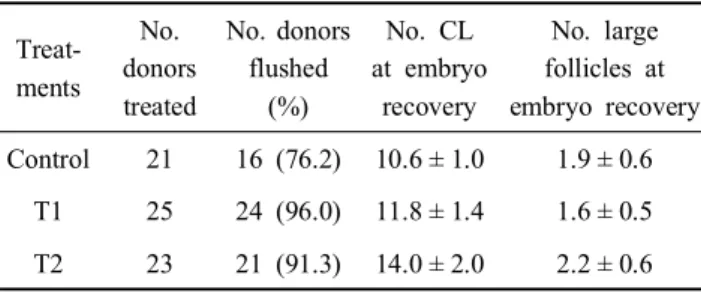
The superovulatory responses according to the different fee- ding ratios of whole crop barley silage in Hanwoo donors were shown in Table 1. The flush rate of the donors following positive superovulation responses were 76.2, 96.0 and 91.3%
for the control, T1 and T2 groups, respectively (p>0.05). The
Table 1. Superovulatory responses according to the different fee- ding ratios of whole crop barley silage in Hanwoo donors
Treat- ments
No.
donors treated
No. donors flushed
(%)
No. CL at embryo
recovery
No. large follicles at embryo recovery Control 21 16 (76.2) 10.6 ± 1.0 1.9 ± 0.6
T1 25 24 (96.0) 11.8 ± 1.4 1.6 ± 0.5
T2 23 21 (91.3) 14.0 ± 2.0 2.2 ± 0.6
There were no significant differences among groups (p>0.05).
number of CL counted by ultrasonography at embryo recovery were 10.6 ± 1.0, 11.8 ± 1.4, and 14.0 ± 2.0 for the control, T1 and T2 groups, respectively (p>0.05). Un-ovulated large folli- cles (≥ 10 mm in diameters) also counted by ultrasonography at embryo recovery were 1.9 ± 0.6, 1.6 ± 0.5 and 2.2 ± 0.6 for the control, T1 and T2 groups, respectively (p>0.05).
Son et al. (2006) previously reported that the flush rate was 73.7~75.0% among Hanwoo donors superovulated during mid- cycle after estrus detection or in CIDR-treated at any stage of the estrous cycle. The same group demonstrated that the number of CL at embryo recovery was 15.9~16.7 following superovulation treatment in CIDR-treated Hanwoo donors (Son et al., 2007). The outcome of embryo recovery according to the different feeding ratios of whole crop barley silage in Hanwoo donors were shown in Table 2. The mean number of total ova (9.4 ± 1.2, 10.5 ± 1.5 and 12.0 ± 2.1) and transferable embryos (5.3 ± 0.9, 5.0 ± 1.0 and 6.5 ± 1.9) did not statistically differ among the control, T1 and T2 groups, respectively (p>
0.05). Rhoads et al. (2006) reported that there were no diffe- rences on embryo quality among dairy donors with high plas- ma urea nitrogen (PUN) level (24.4 ± 1.0 mg/dl) or moderate
Table 2. The outcome of embryo recovery according to the diffe- rent feeding ratios of whole crop barley silage in Hanwoo donors
Treat- ments
No. recovered Transferable
embryos
Degenerate embryos
Unfertilized ova
Total ova Control 5.3 ± 0.9 1.3 ± 0.6 2.9 ± 0.7 9.4 ± 1.2
T1 5.0 ± 1.0 1.3 ± 0.6 4.1 ± 1.2 10.5 ± 1.5 T2 6.5 ± 1.9 0.8 ± 0.3 4.4 ± 1.2 12.0 ± 2.1 There were no significant differences among groups (p>0.05).
PUN level (15.5 ± 0.7 mg/dl). However, they demonstrated that transfer of embryos collected from donors with high PUN level resulted in a lower pregnancy rate than the transfer of embryos collected from donors with moderate PUN level. Moreover, Sinclair et al. (2000) demonstrated that feeding of high plasma ammonia-generating diets in heifers increased ammonia level in follicular fluid. These results indicate that the ratios of diffe- rent diets for donor cows affect the subsequent embryo survi- val or embryo transfer outcome.
In addition, Stroud and Hasler (2006) emphasized suitable husbandry and management practices on success of embryo pro- duction and transfer. In their study, the number of transferable embryos was more in a farm which has been in operation for 25 years maintaining pasture consisting primarily of native glasses (9.8) than in the other farm which has been in opera- tion for only 3 years with much less experience (4.5). Son et al. (2007) reported that CIDR-treated Hanwoo donors kept on pasture produced 4 transferable embryos following superovu- lation with FSH. In addition, Son et al. (2009) demonstrated that the feeding of whole crop barley silage alone without supple- ment of other forage as a substitute for hay tend to decrease the number of transferable embryos after 1st superovulation (6.4 vs. 3.9) and 2nd superovulation treatments (4.2 vs. 1.2).
In this study, however, the embryo recovery results following superovulation treatment of the Hanwoo donors fed two diffe- rent feeding ratios of whole crop barley silage were compara- ble to that of Hanwoo donors fed imported hay.
Serum concentrations of P
4and E
2in donor cows were shown in Table 3. Concentrations of P
4in the control, T1 and T2 was 43.3 ± 6.8, 64.2 ± 4.6 and 55.7 ± 6.6 ng/ml, respectively. The P
4concentrations were significantly higher in the T1 and T2 groups than control group (p<0.01). Concentrations of E
2in the control, T1 and T2 groups were 39.3 ± 3.1, 47.9 ± 5.3 and 40.9 ± 3.8 pg/ml respectively. It did not statistically differ
Table 3. Serum concentrations of P
4and E
2according to the diffe- rent feeding ratios of whole crop barley silage in Hanwoo donors
Treatments P
4concentration (ng/ml)
E
2concentration (pg/ml)
Control 43.3 ± 6.8
a39.3 ± 3.1
T1 64.2 ± 4.6
b47.9 ± 5.3
T2 55.7 ± 6.6
b40.9 ± 3.8
a,b
Values with different superscripts differ significantly (p<0.01).
among the control, T1 and T2 groups, respectively (p>0.05).
Goto et al. (1987) reported that the number of transferable embryos was recovered highly when the blood concentration of P
4was high level just before the superovulation using FSH hormone in donor cows. Furthermore, high concentration of P
4at the time recovery of embryos was induced by plenty of CL, recovered embryos and transferable embryos. Bellows et al.
(1991) also reported that the recovered number of normal and grade 1 embryos was increased when the blood concentration of P
4was shown high level after superovulation in donor cows.
Thus, the higher blood concentration of P
4in donor cows could be related to the better responses of superovulation and more recovery of transferable embryos.
Serum metabolites of BUN, cholesterol and glucose accor- ding to the different feeding ratios of whole crop barley silage just before embryo recovery of Hanwoo donors were shown in Table 4. The BUN concentration (9.7 ± 0.7, 12.9 ± 3.0 and 15.7
± 4.3 mg/dl) and glucose (66.2 ± 5.4, 68.0 ± 3.6 and 67.4 ± 5.2 mg/dl) did not differ among the control, T1 and T2 groups, respectively (p>0.05). But the cholesterol concentrations were significantly (p<0.05) lower in the control (105.8 ± 6.0 mg/dl) and T2 groups (96.9 ± 8.4 mg/dl) than T1 group (121.1 ± 6.8 mg/dl). Many researchers reported previously that donor cows having the higher blood concentrations of cholesterol produced more transferable embryos (Kweon et al., 1987; Balakrishnan et al., 1993; Leroy et al., 2005). In the present study, however, the results related to the cholesterol concentration in Hanwoo donors did differ from the previous reports. Green et al. (2005) demonstrated that the blood concentration of glucose had no effect on the embryo survival and development, whereas glu- cose concentration collected in oviduct had an effect on the con- ception and development of embryo in dairy cattle. On the other hand, Chorfi et al. (2007) reported that the blood concentra- tions of glucose, cholersterol and BUN had no effect on the
Table 4. Concentrations of serum metabolites according to the different feeding ratios of whole crop barley silage in Hanwoo donors
Treatments BUN
(mg/dl)
Cholesterol (mg/dl)
Glucose (mg/dl) Control 9.7 ± 0.7 105.8 ± 6.0
a66.2 ± 5.4
T1 12.9 ± 3.0 121.1 ± 6.8
b68.0 ± 3.6
T2 15.7 ± 4.3 96.9 ± 8.4
a67.4 ± 5.2
a,b