* Corresponding author : Hyung Soo Park, National Institute of Animal Science RDA, Cheonan 330-801, Korea. Tel: +82-41-580-6753, Fax: +82-41-580-6757, E-mail: [email protected]
Prediction of the Chemical Composition and Fermentation Parameters of Winter Rye Silages by Near Infrared Spectroscopy
Hyung Soo Park*, Sang Hoon Lee, Ki Choon Choi, Young Cheol Lim, Ji Hea Kim, Ki Won Lee and Gi Jun Choi National Institute of Animal Science, Cheonan, 330-801, Korea
ABSTRACT
This study was carried out to explore the accuracy of near infrared spectroscopy (NIRS) for the prediction of chemical and fermentation parameters of whole crop winter rye silages. A representative population of 216 fresh winter rye silages was used as database for studying the possibilities of NIRS to predict chemical composition and fermentation parameters. Samples of silage were scanned at 1 nm intervals over the wavelength range 680~2,500 nm and the optical data recorded as log 1/Reflectance (log 1/R) and scanned in fresh condition. NIRS calibrations were developed by means of partial least-squares (PLS) regression. NIRS analysis of fresh winter rye silages provided accurate predictions of moisture, acid detergent fiber (ADF), neutral detergent fiber (NDF), crude protein (CP) and pH as well as lactic acid content with correlation coefficients of cross-validation (R2cv) of 0.96, 0.86, 0.79, 0.85, 0.82 and 0.78 respectively and standard error of cross-validation (SECV) of 1.89, 2.02, 2.79, 1.14, 1.47 and 0.46
% DM respectively. Results of this experiment showed the possibility of NIRS method to predict the chemical parameters of winter rye silages as routine analysis method in feeding value evaluation and for farmer advice.
(Key words : Silage, Winter rye, Near infrared spectroscopy, Feed value, Fermentation)
Ⅰ. INTRODUCTION
Winter rye silage is important forage in cattle and dairy feeding programs, not only in winter rations but also as supplement during the grazing period in northern and central areas of Korea. According to increase cultivation areas of forage crops every year in Korea, forage quality control is very important in increasing the utilization of domestic forage.
Nowadays near infrared spectroscopy (NIRS) is routinely used in the feedstuff industry as a tool to determine feedstuff composition for quality control (Cheli et al., 2012) and is the only tool for analysis of large scale materials and real-time evaluation of multiple constituents (Roberts et al., 2004). A major advantage of NIRS is its ability to analyse samples without chemical treatments, hence costs sample material (Barber et al., 1990) and chemical wastes can be reduced. Furthermore, NIRS has less variance in analyses of the same sample than laboratory analyses (Marum and Aastveit, 1990).
To increase the utilization of NIRS in forage production
field and quality control, establishment of robust NIRS calibration prediction systems and field sample preparation method is very important. The development of robust and accurate NIRS prediction systems depends on having a large calibration database which represents a wide range in the characteristics of the forage to be predicted. There are studies about predicting chemical composition and fermentation parameters of maze silages (Sørensen, 2004; Lovett et al., 2004) or the chemical composition and nutritional attributes of green crop cereals (Aminda et al., 1998).
Sample preparation and measurement conditions of the calibration set and the predicted samples should match for good results (Stuth et al., 2003). Faster, more direct techniques of data acquisition are required on a farm scale where the rapid demand of biochemical and structural parameters is countered by excessive, time consuming sample preparation.
Relatively few studies have been published to compare the
effect of sample preparation and storage conditions of
forages on NIRS to determine quality parameters. Gordon et
al. (1998) studied the prediction of intake potential and
organic matter digestibility of grass silages by NIRS of
undried samples. Park et al. (2002) studied the effect of freezing and thawing on grass silage quality predictions on NIRS.
The aim of this study was to assess the possibility of NIRS to predict the chemical composition and fermentation parameter of whole crop winter rye silage and to establish NIRS calibrations set on fresh samples.
Ⅱ. MATERIALS AND METHODS 1. Collection and preparation of the silages
Whole crop winter rye silage samples (n = 216) were collected from cattle farms and total mixed ration company in Korea during 2010~2013. When the samples were collected, information was recorded about the date and stage of maturity at harvest, type of structure in which the forage was ensiled, use of additives. The samples were frozen as soon as arrived at the laboratory, and stored frozen (-20℃) until analyzed. Prior to NIRS scanning of the fresh samples, the silages were thawed at 4℃ and cut in pieces of 3 to 5 cm in order to be packed easily in the sample cell. A subsample of each silage was dired in a forced-air oven at 65℃ for 78 h and milled to pass 1 mm screen for subsequent chemical analysis.
2. NIRS scanning and statistical analysis
NIRS scanning of the fresh samples was performed on a NIRS system SPECTRASTAR
TM2500 (Unity scientific, USA).
The fresh silage samples were packed in a rotating circular quartz cell of 10 cm diameter. Each of the 185 silage samples was scanned as log 1/R over the wavelength range 680 to 2500 nm at 1nm intervals and the average spectrum was recorded.
The mathematical treatment of the spectral data was performed using UCAL software (Unity scientific, USA).
NIRS calibrations were developed by means of partial least- squares (PLS) regression (Shenk and Westerhaus, 1993). The following mathematical treatments were applied separately and simultaneously and then compared for choosing the best treatment combination: smoothing, derivative, standard normal variate and detrend (SNVD). Cross-validation was
carried out to select the optimal number of terms in the equation, so avoiding overfitting.
Calibration statistics calculated include the standard error of calibration (SEC), the coefficient of multi determination in calibration (R
2), and the standard error of cross-validation (SECV). The optimal calibrations were selected on the basis of minimizing the SECV.
3. Wet chemical analysis
All chemical analysis was carried out concurrently with the scanning. The contents of moisture, ash, pH and crude protein (CP) were analysed according to official methods (AOAC, 1990). Neutral detergent fibre (NDF) and acid detergent fibre (ADF) were analysed following the method of Van Soest et al. (1991). To determine pH, 10 g of plant tissue were macerated in a blender with 100 ml of distilled water. The pH was measured with an electrometric pH meter (HI 9024; HANNA Instrument Inc., UK). Water extracts (2 mL) were acidified with 10 μL of 50% H
2SO
4(vol/vol) and frozen before analysis for fermentation end products (Canale et al., 1984). Water-acidified extracts were analyzed for lactic acid by HPLC (Waters. Milford, MA.
US).
Ⅲ. RESULTS AND DISCUSSION
1. NIR spectra and chemical parameters of winter rye silages
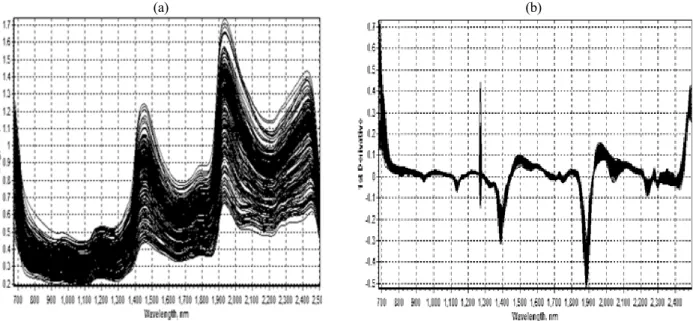
NIR original spectra and first derivative for 216 fresh whole crop winter rye silages presented in Fig. 1. Two group of peaks were observed in the spectra of fresh coarse winter rye silage samples, which provided abundant information for calibrations. There were two apparent peaks at about 1410 and 1900 nm, which may be attributed to the absorption by water in fresh silage samples. It was concluded that the physical state affected the NIR spectra of silage.
The number of samples, mean, minimum, maximum value
and standard deviation (SD) of the chemical parameters for
the calibration set are summarized in Table 1. The silage
samples collected for this study showed a wide variation in
chemical parameters, as would be expected for a broad
Table 1. The range in chemical parameters of the 217 fresh whole crop winter rye silage samples on dry matter basis
Parameter Min. Max. Mean SD
Moisture (%) 13.5 80.2 59.8 15.1
Acid detergent fiber (ADF, %) 24.7 52.8 40.9 4.6
Neutral detergent fiber (NDF, %) 41.4 79.3 64.8 5.6
Crude protein (CP, %) 3.7 15.2 9.1 2.7
Crude ash (%) 4.3 37.1 8.8 5.3
pH (1:5) 4.1 5.8 4.8 4.5
Lactic acid (%) 0.07 2.70 1.44 0.65
(a) (b)
Fig. 1. NIR original spectra as log 1/R (a) and as a first derivative (b) for fresh whole crop winter rye silages.
prediction. Similar chemical composition of silage reported by Park et al.(2012) for 286 fresh Italian ryegrass silages.
2. Predicting chemical parameters of winter rye silage
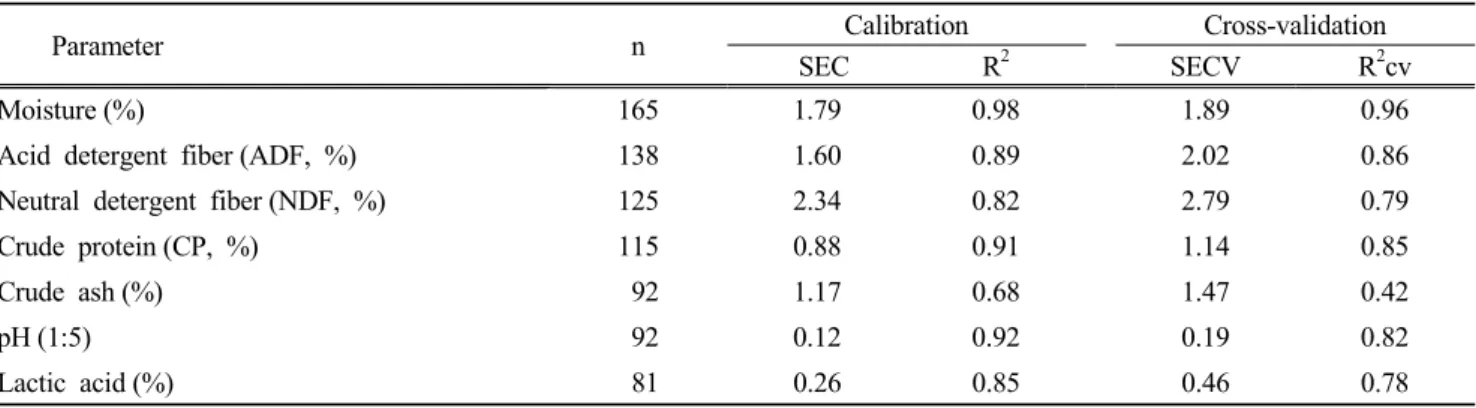
The statistics of the calibrations with the lowest SECV on the whole data set and those of the corresponding calibrations on the calibration set are given in Table 2. The calibrations on the whole data set were good for all parameters, except for crude ash. High R
2cv values were found for moisture, ADF and CP ranging from 0.85 for CP to 0.96 for moisture. Moderate R
2cv values were obtained for NDF, pH and lactic acid.
The moisture content of silage is very important in the forage quality control and feeding system. The standard error of cross validation (SECV) for the prediction of
moisture content in winter rye silage sample (1.51%) was similar to those reported by Park et al. (2013; 2012) and Sinnaeve et al. (1994).
Mineral analysis of forages by NIRS appears unlikely as NIRS do not absorb energy in the NIRS region. However, correlations between minerals and other organic components allow reasonable NIRS calibrations to be obtained in some cases. Total ash content for common hay and pasture crops have been successfully measured with NIRS (Windharm et al., 1991; Vazques de Aldana, 1996). However, In the present study, the prediction value for total ash was the lowest accuracy among chemical parameter.
pH and short chain fatty acids are an indicator of the
fermentation quality of the silage yet they are costly to
measure in routine silage analysis. As these volatile
components are lost when grass silages are dried, NIRS
Table 2. The calibration and validation statistics for the prediction of chemical and fermentation parameter of fresh whole crop winter rye silages
Parameter n Calibration
Cross-validation
SEC R
2SECV R
2cv
Moisture (%) 165 1.79 0.98 1.89 0.96
Acid detergent fiber (ADF, %) 138 1.60 0.89 2.02 0.86
Neutral detergent fiber (NDF, %) 125 2.34 0.82 2.79 0.79
Crude protein (CP, %) 115 0.88 0.91 1.14 0.85
Crude ash (%) 92 1.17 0.68 1.47 0.42
pH (1:5) 92 0.12 0.92 0.19 0.82
Lactic acid (%) 81 0.26 0.85 0.46 0.78
SEC = Standard error of calibration, R2= Multiple correlation coefficient of determination SECV = Standard error of cross validation, R2cv
= Multiple correlation coefficient of cross validation.
analysis based on dried samples provides a poor prediction of fermentation parameters. However in the present study, using undried silages, the pH and lactic acid formed good calibrations. Liu and Han (2006) reported NIRS calibrations based on dried samples performed better than those based on fresh samples for most parameters, but not for DM, propionic acid and butyric acid.
The results of this study have shown that NIRS analysis of fresh whole crop winter rye silages can provide accurate prediction of a wide range of chemical and fermentation parameters. The lower accuracy of calibrations based on fresh samples may be due to the heterogeneity of the plant materials, particle size effects or spectral peak broadening by the large amount of water present. Although NIRS analysis of fresh silages is less accurate, it is more convenient to use fresh than dried samples, allowing rapid prediction of the composition onsite without drying losses (Reeves and Blosser, 1991). Therefore, this offers considerable potential for using fresh silage analysis in routine advisory systems.
Ⅳ. CONCLUSION
NIRS analysis of fresh whole crop winter rye silages could provide accurate prediction of a wide range of chemical compositions, including moisture, ADF, NDF, pH and lactic acid. This study presented opportunities for the NIRS technique to characterize the feeding value of straw silages at different situations in the ruminant feeding system.
Although the number of samples used in the present study was not enough to test the ability of NIRS to predict
chemical composition of fresh whole crop winter rye silage, maybe a broader population could be used to improve the robustness of these equations.
Ⅴ. ACKNOWLEDGEMENTS
This work was carried out with the support of the
“Cooperative Research Program for Agriculture Science and Technology Development (Project No. PJ00939601),” Rural Development Administration, Republic of Korea.
Ⅵ. REFERENCES
AOAC, 1990. Association of Official Analytical Chemists, Official Methods of Analysis. 15th Edition. Washington, DC.
Arminda M. Bruno-Soaresa, Ian Murrayb, Rhona M. Patersonb, and Jose M.F. Abreua. 1998. Use of near infrared reflectance spectroscopy (NIRS) for the prediction of the chemical composition and nutritional attributes of green crop cereals.
Animal Feed Science and Technology. 75:15-25.
Barber, G.D., Givens, D.I., Kridis, M.S., Offer, N.W. and Murray, I.
1990. Prediction of the organic matter digestibility of grass silage. Animal Feed Science and Technology. 28:115-128.
Canale, A., Valenti, M.E. and Ciotti, A. 1984. Determination of volatile carboxilic acids (C1-C5i) and lactic acid in aqueous acid extracts of silage by high performance liquid chromatography.
Journal of Science Food Agricultural. 35:1178-1182.
Cheli, F., Battaglia, D., Pinotti, L. and Baldi, A. 2012. State of the art in feedstuff analysis: a technique-oriented perspective. Journal of Agricultural Food Chemistry. 60:9529-9542.
prediction of intake potential and organic matter digestibility of grass silages by near infrared spectroscopy analysis of undried samples. Animal. Feed Science Technology. 70:339-351.
Liu. X. and Han, L. 2006. Evaluation of near infrared reflectance spectroscopy (NIRS) for prdicting chemical composition of straw silage. Journal of Animal and Feed Science. 15:329-336.
Lovett, D.K., Deaville, E.R., Mould, F., Givens, D.I. and Owen, E.
2004. Using near infrared reflectance spectroscopy (NIRS) to predict the biological parameters of maize silage. Animal Feed Science and Technology. 115:179-187.
Marum, A.H. and Aastveit, P. 1990. The precision of the Tilley and Terry method compared to the NIRS method in estimating digestibility in breeding programs. In: Proceedings of the 3rd International Conference on Near Infrared Spectroscopy, pp.
566-569.
Park, H.S., Lee, S.H., Choi, K.C., Lim, Y.C., Kim, J.G., Jo, K.Y.
and Choi, G.J. 2012. Evaluation of the quality of Italian ryegrass silages by near infrared spectroscopy. Journal of The Korean Society of Grassland and Forage Science. 32(3):30-308.
Park, H.S., Lee, S.H., Lim, Y.C., Seo, S., Choi, K.C., Kim, J.G., Kim, J.G. and Choi, G.J. 2013. Prediction of the Chemical Composition of Fresh Whole Crop Barley Silages by Near Infrared Spectroscopy. Journal of The Korean Society of Grassland and Forage Science. 33(3):171-176.
Park, R.S., Gordon, F.J., Agnew, R.E. and Steen, R.W.J. 1998. The use of near infrared reflectance spectroscopy (NIRS) on undried samples of grass silage to predict chemical composition and digestibility parameters. Animal. Feed Science Technology. 72:
155-167.
Reeves J.B.III. and Blosser, T.H. 1991. Near infrared spectroscopic analysis of undried silages as influenced by sample grind, presentation method, and spectral region. Journal of Dairy
Science. 742:882-895.
Roberts, C.A., Workman, J. and Reeves, J.B. (Eds.). 2004. Near- Infrared Spectroscopy in Agriculture. American Society of Agronomy; Crop Science Society of America; Soil Science Society of America, Madison, Wis.
Shenk J.S. and Westerhaus, M.O. 1993. Monograph: Analysis of Agriculture and Food Products by Near Infrared Reflectance Spectroscopy. Infrasoft International, Port Matilda, PA (USA), pp.
103.
Sinnaeve, G., Dardenne, P., Agneessens, R. and Biston, R. 1994. The use of near infrared spectroscopy for the analysis of fresh grass silage. Journal of Near infrared Spectroscopy. 2:79-84.
Sørensen, L.K. 2004. Prediction of Fermentation Parameters in Grass and Corn Silage by Near Infrared Spectroscopy. Journal of Dairy Science. 87:3826-3835.
Stuth, J, Jama, A. and Tolleson, D. 2003. Direct and indirect means of predicting forage quality through near infrared reflectance spectroscopy. Field Crops Research. 84:45-56.
Van Soest, P.J., Robertson, J.B. and Lewis, B.A. 1991. Method for dietary fiber, neutral detergent fiber and non starch poly- saccharides in relation to animal nutrition. Journal of Dairy Science. 74:3583-3597.
Vazquez de Aldana, B.R., 1996. Non-destructive method for determining ash content in pasture samples: application of near infrared reflectance spectroscopy. Communication in Soil Science and Plant Analysis. 27(3):795-802.
Windham, W.R., Hill, N.S. and Stuedemann, J.A. 1991. Ash in forage esophageal and fecal samples analyzed using near-infrared reflectance spectroscopy. Crop Science. 31:1345-1349.
(Received August 18, 2014 / Revised September 15, 2014 / Accepted September 18, 2014)