* Corresponding author : Dr. Ki-Won Lee, National Institute of Animal Science, Cheonan, 330-801, Korea, Tel: +82-41-580-6757, E-mail: [email protected]
Research Article
Prediction of the Chemical Composition and Fermentation Parameters of Fresh Coarse Italian Ryegrass Haylage using Near Infrared Spectroscopy
Ji Hye Kim, Hyung Soo Park, Ki Choon Choi, Sang Hoon Lee and Ki-Won Lee *
Grassland & Forages Division, National Institute of Animal Science, Rural Development Administration, Cheonan, 330-801, Republic of Korea.
ABSTRACT
Near infrared spectroscopy (NIRS) is a rapid and accurate method for analyzing the quality of cereals, and dried animal forage.
However, one limitation of this method is its inability to measure fermentation parameters in dried and ground samples because they are volatile, and therefore, respectively lost during the drying process. In order to overcome this limitation, in this study, fresh coarse haylage was used to test the potential of NIRS to accurately determine chemical composition and fermentation parameters. Fresh coarse Italian ryegrass haylage samples were scanned at 1 nm intervals over a wavelength range of 680 to 2500 nm, and optical data were recorded as log 1/reflectance. Spectral data, together with first- and second-order derivatives, were analyzed using partial least squares (PLS) multivariate regressions; scatter correction procedures (standard normal variate and detrend) were used in order to reduce the effect of extraneous noise. Optimum calibrations were selected based on their low standard error of cross validation (SECV) values. Further, ratio of performance deviation, obtained by dividing the standard deviation of reference values by SECV values, was used to evaluate the reliability of predictive models. Our results showed that the NIRS method can predict chemical constituents accurately (correlation coefficient of cross validation, R2cv, ranged from 0.76 to 0.97); the exception to this result was crude ash (R2cv = 0.49 and RPD = 2.09). Comparison of mathematical treatments for raw spectra showed that second-order derivatives yielded better predictions than first-order derivatives. The best mathematical treatment for DM, ADF, and NDF, respectively was 2, 16, 16, whereas the best mathematical treatment for CP and crude ash, respectively was 2, 8, 8. The calibration models for fermentation parameters had low predictive accuracy for acetic, propionic, and butyric acids (RPD < 2.5). However, pH, and lactic and total acids were predicted with considerable accuracy (R2cv 0.73 to 0.78; RPD values exceeded 2.5), and the best mathematical treatment for them was 1, 8, 8. Our findings show that, when fresh haylage is used, NIRS-based calibrations are reliable for the prediction of haylage characteristics, and therefore useful for the assessment of the forage quality.
(Key words : Italian ryegrass haylage, Near Infrared Spectroscopy, Calibration model, Chemical composition, Fermentation parameters)
Ⅰ. INTRODUCTION
Italian ryegrass (Lolium multiflorum) is an annual forage grass species that is widely cultivated in South Korea. It grows extensively in the southern part of the country and is an important component of winter forage for livestock. Each year, in Korea, over one million hectares of Italian ryegrass is converted to round bale haylage.
Quality control is an important field in forage utilization research and marketing, and involves the estimation of forage nutrient content. Wet chemistry is the traditional method used to analyze the nutrient content of forage. However, this technique is often destructive, expensive, and time consuming, and it is not suitable for real-time feedstuff analysis. Near
infrared spectroscopy (NIRS), on the other hand, is an alternative technique that has several major advantages over traditional methods—(1) it can measure forage nutrient content both accurately and quickly, (2) it can analyze samples without chemical treatments, thus reducing costs, and chemical waste (Barber et al., 1990), (3) it has shown great potential for assessing the physicochemical properties of many substances and materials, and (4) very little sample preparation is required before analysis (Roggo et al., 2007; Siesler et al., 2002).
Fresh fodder is often converted to silage, which has several
nutritional advantages as feed for livestock. The analysis of
silage nutrient content, using NIR, conventionally includes the
drying and milling of samples. However, these processes can
lead to reduction of volatile acids, which are important
components of silage (Abrams et al., 1988; Reeves et al., 1989; Sørensen, 2004). The predictive accuracy of NIRS depends on (1) obtaining a calibration set that represents the variation in the main population, (2) accurate laboratory analyses, and (3) the application of the best mathematical transformations for spectral data (Park et al., 1998).
NIRS can be affected by spectral regions, drying and grinding methods, particle size, packing density and the temperature of samples (Reeves and Blosser, 1991). Therefore, it is recommended that consistent sample preparation methods be used for both calibration and routine analysis. In order to obtain accurate NIRS results, sample preparation, and the measurement conditions of the calibration set and predicted samples, need to match (Stuth et al., 2003). However, studies evaluating the effects of sample preparation, and forage storage conditions on NIRS results, in order to determine quality parameters, are scarce. Fermentation parameters, obtained by calibration on wet material, have been reported for grass (Snyman and Joubert, 1992; Sinnaeve et al., 1994; Park et al., 1998), alfalfa, and corn silages (Reeves et al., 1989). Although NIRS measurements on wet material can be taken quickly and can quantify volatile (especially non-ionic volatile) compounds better than measurements on dried material, wet material does not afford the same prediction accuracy of the main constituents of the silage, as dried material does.
The development of an optimum system, for sample preparation and scanning, demands that spectral data be fully investigated, in order to produce the best prediction relationships.
A wide range of regression and data transformation techniques have been explored for the prediction of biological parameters of silage, using fresh (not dried) samples for the analysis of chemical composition (Park et al., 1998). However, a comprehensive examination of wet coarse fresh silage has not been conducted. Therefore, in the present study, different permutations of several mathematical treatment techniques were explored, within each of the parameters.
The objectives of this study were to (1) assess the usefulness of NIRS in determining the nutritional composition and fermentative parameters of fresh coarse samples of Italian ryegrass haylage, (2) assess the predictive value of various NIRS calibration models, and (3) explore cost-effective and timesaving methods for forage quality estimation, in field
populations. It was hypothesized that NIRS-based calibrations would be good for prediction of chemical composition and fermentation parameters of fresh coarse Italian ryegrass haylage.
Ⅱ. MATERIALS AND METHODS 1. Sample collection and preparation
Whole crop Italian ryegrass haylage samples (n = 216) were collected from cattle farms and total mixed ration companies in Korea, between 2011 and 2014. During sample collection, the following data were recorded: (1) stage of maturity at harvest, (2) type of structure in which the forage was ensiled, and (3) the use of additives. Particle sizes, in all sample haylages, ranged from 15 to 20 cm. Samples were stored at -20 °C, immediately after collection. Prior to the NIRS scanning of fresh samples, haylages were thawed overnight at 4 °C, and cut into 3- to 5-cm pieces, in order to facilitate packing into sample cells. A subsample of each haylage was dried in a forced-air oven at 65 °C for 78 h, and then milled so as to pass through a 1-mm screen, for subsequent chemical analysis.
2. Reference analysis
All reference analyses, except those of fermentation parameters,
were performed on dried sample material—a subsample of each
haylage was dried at 68 °C, and milled in order to prepare the
sample for the determination of crude ash (CA), neutral detergent
fiber (NDF), and acid detergent fiber (ADF) content, according
to the methods of the Association of Official Analytical Chemists
(AOAC, 1990). Crude protein (CP) was estimated from total
nitrogen, determined by the Dumas combustion method using
an Rapid N Ⅲ (Elementar GmbH, Hanau, Germany). Dry matter
(DM) was determined by evaporating moisture from the samples
at 68 °C for 72 h. Aqueous extracts of the haylage samples
were used to quantify volatile fatty acids, as described by Porter
(1992). Total acids in the haylage were calculated as the sum
of individual acid concentrations. Determination of pH was
performed on a sample equilibrated overnight at 4 °C with water
(AOAC, 1990).
3. NIR spectra collection
Reflectance spectra were obtained using SpectraStar 2500 (Unity Scientific, Brookfield, USA) that can scan a wavelength range of 680 to 2500 nm; coarse fresh haylage samples (particle size 3 to 5 cm) were packed in a circular rotating quartz sample cup of 150 mm diameter for spectral analyses.
Data were recorded at 1 nm intervals, as log 1/R (where R is reflectance at the given wavelength), yielding 1820 data-points per sample analyzed.
4. NIR Calibration
Before developing calibration models, the original spectra were subjected to different pre-treatment methods for improving signal-to-noise ratio, thus, maximizing signal intensity for analytes of interest (Heise and Winzen, 2002). A spectral correction algorithm—standard normal variate (SNV) and detrend (SNV&D)—was used to decrease the effects of light scattering, due to particle size, on spectral readings.
Mathematical transformations described by four digits (e.g., 1, 4, 4, 1) were tested. The 1
st, 2
nd, 3
rd, and 4
thdigits indicate subtraction order, gap or subtraction interval, first smoothing segment, and second smoothing segment, respectively. These treatments were applied in order to extract relevant spectral information, and reduce the volume of data, via the subtraction of smoothed segments of the spectra.
Calibration equations were obtained from a modified partial least squares (MPLS) regression (Martens and Martens, 2001).
In order to select the optimal number of terms in the equation, and avoid over-fitting, cross-validation was conducted by determining the standard error of cross-validation (SECV;
uncertainty estimator), and the proportion of observed variance (R
2cv; certainty estimator; Shenk and Westerhaus, 1994).
The quality and predictive ability of the calibration equations were evaluated using the following statistical parameters: (1) coefficient of determination of the calibration (R
2), (2) standard error of the calibration (SEC), (3) coefficient of determination of cross-validation (R
2cv), (4) SECV, and (5) ratio of performance deviation (RPD) calculated as the ratio of the standard deviation of reference values to SECV (Shenk and Westerhaus, 1996; Williams and Sobering, 1996). The best
spectral mathematical treatments were selected from a total of 20 calibrations, developed for each chemical parameter, based on their R
2cv, SECV, and RPD values. RPD (SD/SECV) compares the performance of all NIRS calibrations, irrespective of differences in the units of the chemical parameters. The following scale guided our evaluation of model suitability based on RPD values—RPD < 2.4: low reliability, 2.4 < RPD > 3.0:
higher predictive quality which justified the application of the model for approximation or classification in ranges, and RPD
> 3.0: the equation is acceptable for prediction (Williams, 2001).
Spectral data processing and statistical analyses were performed using the U-Cal (V.2.04) software package.
Ⅲ. RESULTS AND DISCUSSION 1. Reference data
The haylage samples varied widely in their chemical composition and fermentation parameters (Table 1). The ranges of variation for dry matter were very large—2-fold or more as described previously (Gordon et al., 1998; Park et al., 1998).
Variation in the values of all fermentation parameters, except for lactic and total acids, was small (Table 1). The haylage samples contained non-detectable (or nearly non-detectable) propionic and butyric acids that were not found in good quality silage. Mean ash content in our samples was slightly higher than that reported from other studies on extensive grassland (Richter et. al., 2010). For the other constituents, the values were continuously dispersed.
2. NIR spectra of fresh coarse haylages
Both raw spectral data, as well their first derivatives
(between 680 nm and 2500 nm) show two distinct peaks at
approximately 1440 and 1940 nm (Fig. 1), which may have
resulted from water absorption by fresh coarse haylage
samples. Stronger absorption peaks indicate high moisture
content in fresh haylage, which can mask other spectral
features (Hooper et al., 1979; Sprague et al., 2003). These
peaks suggest that the physical characteristics of haylages
(such as moisture content) can influence their NIR spectra.
Constituent
nMean Min Max
S.D.Chemical composition
Dry matter (%) 216 51.76 20.60 88.57 14.23
Acid detergent fiber (%, DM) 216 39.16 33.12 47.40 2.67
Neutral detergent fiber (%, DM) 216 61.41 52.37 69.95 3.57
Crude protein (%, DM) 216 10.07 4.66 19.44 2.99
Crude ash (%, DM) 171 8.48 4.62 17.17 2.04
Fermentation parameters
pH (1:5) 216 4.99 3.81 6.72 0.65
Acetic acid (%, DM) 216 0.38 0.01 2.21 0.42
Propionic acid (%, DM) 216 0.68 0.00 3.21 0.58
Butyric acid (%, DM) 216 0.69 0.00 3.82 0.94
Lactic acid (%, DM) 216 3.96 0.04 18.85 2.83
Total acid (%, DM) 216 4.66 0.07 20.97 3.21
Table 1. Chemical composition and fermentation parameters as determined from 216 samples of fresh coarse Italian ryegrass haylages.
Fig. 1. NIRS spectra of fresh coarse Italian ryegrass haylage of samples—(a) original, and (b) and second-order derivation.
3. NIRS calibration of chemical components of haylage
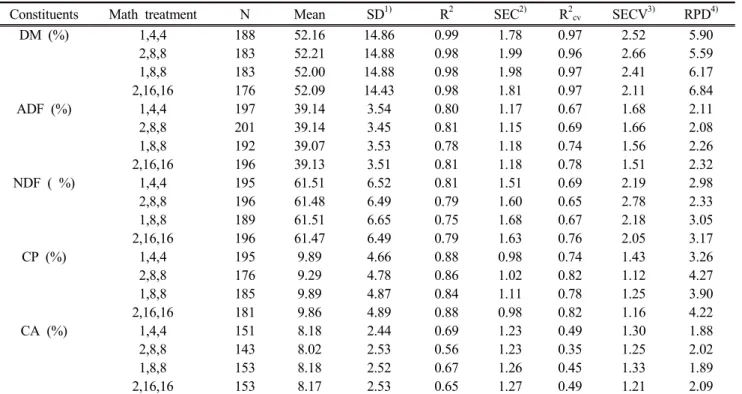
A comparison of mathematical treatments for raw spectra showed that second-order derivatives consistently yielded the best results (Table 2). The best mathematical treatment for DM, ADF, and NDF, respectively was 2, 16, 16, whereas the best mathematical treatment for CP and CA, respectively was 2, 8, 8. Previous studies have shown that transformations of spectral data, such as derivatization allied to scatter correction procedures (Baker and Barnes, 1990), can enhance the prediction performance of NIRS techniques. Liu et al. (2008) found that good calibration models can be obtained using first-order derivative treatments for the prediction of DM and NDF digestibility in fresh silages. On the other hand, Ibáñez and Alomar (2008) found that better calibration models were obtained from second-order derivative mathematical treatments
for DM, NDF, and ADF, in fresh pasture. Our results varied in their predictive quality across the evaluated parameters, but were in accordance with Ibáñez and Alomar’s findings (2008) in terms of the value of second-order derivatives in prediction models.
A comparison of R
2cvvalues between models showed that all the selected calibrations were robust except for the total crude ash calibration (R
2cv= 0.47). The low predictive value of the CA calibration was expected because crude ash consists mainly of inorganic and mineral substances that do not have absorption in the near infrared region. Nevertheless, these compounds are associated with organic structures, through oxides, chelates, and other compounds, which can allow their indirect estimation using NIRS (Shenk and Westerhaus, 1994;
Cozzolino et al., 2000). In contrast with our findings for fresh
haylage, accurate calibration was possible for crude ash (SECV
Constituents Math treatment N Mean SD
1)R
2SEC
2)R
2cvSECV
3)RPD
4)DM (%) 1,4,4 188 52.16 14.86 0.99 1.78 0.97 2.52 5.90
2,8,8 183 52.21 14.88 0.98 1.99 0.96 2.66 5.59
1,8,8 183 52.00 14.88 0.98 1.98 0.97 2.41 6.17
2,16,16 176 52.09 14.43 0.98 1.81 0.97 2.11 6.84
ADF (%) 1,4,4 197 39.14 3.54 0.80 1.17 0.67 1.68 2.11
2,8,8 201 39.14 3.45 0.81 1.15 0.69 1.66 2.08
1,8,8 192 39.07 3.53 0.78 1.18 0.74 1.56 2.26
2,16,16 196 39.13 3.51 0.81 1.18 0.78 1.51 2.32
NDF ( %) 1,4,4 195 61.51 6.52 0.81 1.51 0.69 2.19 2.98
2,8,8 196 61.48 6.49 0.79 1.60 0.65 2.78 2.33
1,8,8 189 61.51 6.65 0.75 1.68 0.67 2.18 3.05
2,16,16 196 61.47 6.49 0.79 1.63 0.76 2.05 3.17
CP (%) 1,4,4 195 9.89 4.66 0.88 0.98 0.74 1.43 3.26
2,8,8 176 9.29 4.78 0.86 1.02 0.82 1.12 4.27
1,8,8 185 9.89 4.87 0.84 1.11 0.78 1.25 3.90
2,16,16 181 9.86 4.89 0.88 0.98 0.82 1.16 4.22
CA (%) 1,4,4 151 8.18 2.44 0.69 1.23 0.49 1.30 1.88
2,8,8 143 8.02 2.53 0.56 1.23 0.35 1.25 2.02
1,8,8 153 8.18 2.52 0.67 1.26 0.45 1.33 1.89
2,16,16 153 8.17 2.53 0.65 1.27 0.49 1.21 2.09
1) Standard Deviation
3) Standard Error of Cross Validation
2) Standard Error of Calibration
4) Ratio of Performance Deviation (SD/SECV)
Table 2. Mathematical treatments and statistical indicators of the calibrations developed for the prediction of chemical composition parameters. DM: Dry matter, ADF: Acid Detergent Fiber, NDF: Neutral Detergent Fiber, CP:
Crude protein, and CA: Crude Ash
Fig. 2. Relationship between near infrared spectroscopy (NIRS) prediction and reference values for (a) dry matter (DM), and (b) crude protein (CP) measured in a dry matter base (%).
values of 1.70 and 5.14 g/kg, and R
2cvvalues of 0.87 and 0.89) from undried milled silage (Park et al., 1998), and dried pasture silage (Ibáñez and Alomar, 2008), respectively.
RPD values for our predictive calibration models ranged from 1.88 for CA to 6.84 for DM content, indicating that whereas the model used to predict total ash was not robust (supported by a low R
2cvof 0.49), the predictive model for DM was. Previous studies, on coarsely ground hay (Reddersen
et al., 2014), and undried ground pasture silage (Park et al., 1998) report robust predictions of total ash using calibration models with RPD values of 4.8 and 3.07, respectively.
4. NIRS calibration of fermentation parameters of haylage
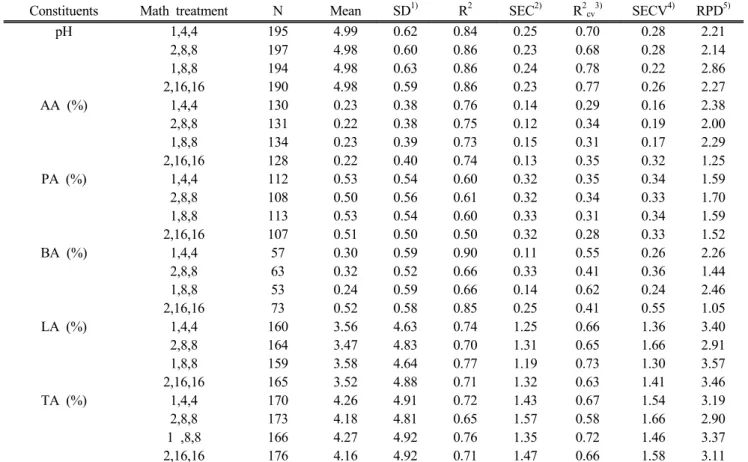
The calibration models developed in our study were robust
for all fermentation parameters except acetic, propionic, and
Constituents Math treatment N Mean SD
1)R
2SEC
2)R
2cv3)SECV
4)RPD
5)pH 1,4,4 195 4.99 0.62 0.84 0.25 0.70 0.28 2.21
2,8,8 197 4.98 0.60 0.86 0.23 0.68 0.28 2.14
1,8,8 194 4.98 0.63 0.86 0.24 0.78 0.22 2.86
2,16,16 190 4.98 0.59 0.86 0.23 0.77 0.26 2.27
AA (%) 1,4,4 130 0.23 0.38 0.76 0.14 0.29 0.16 2.38
2,8,8 131 0.22 0.38 0.75 0.12 0.34 0.19 2.00
1,8,8 134 0.23 0.39 0.73 0.15 0.31 0.17 2.29
2,16,16 128 0.22 0.40 0.74 0.13 0.35 0.32 1.25
PA (%) 1,4,4 112 0.53 0.54 0.60 0.32 0.35 0.34 1.59
2,8,8 108 0.50 0.56 0.61 0.32 0.34 0.33 1.70
1,8,8 113 0.53 0.54 0.60 0.33 0.31 0.34 1.59
2,16,16 107 0.51 0.50 0.50 0.32 0.28 0.33 1.52
BA (%) 1,4,4 57 0.30 0.59 0.90 0.11 0.55 0.26 2.26
2,8,8 63 0.32 0.52 0.66 0.33 0.41 0.36 1.44
1,8,8 53 0.24 0.59 0.66 0.14 0.62 0.24 2.46
2,16,16 73 0.52 0.58 0.85 0.25 0.41 0.55 1.05
LA (%) 1,4,4 160 3.56 4.63 0.74 1.25 0.66 1.36 3.40
2,8,8 164 3.47 4.83 0.70 1.31 0.65 1.66 2.91
1,8,8 159 3.58 4.64 0.77 1.19 0.73 1.30 3.57
2,16,16 165 3.52 4.88 0.71 1.32 0.63 1.41 3.46
TA (%) 1,4,4 170 4.26 4.91 0.72 1.43 0.67 1.54 3.19
2,8,8 173 4.18 4.81 0.65 1.57 0.58 1.66 2.90
1 ,8,8 166 4.27 4.92 0.76 1.35 0.72 1.46 3.37
2,16,16 176 4.16 4.92 0.71 1.47 0.66 1.58 3.11
1) Standard Deviation
3) Coefficient of Determination of Cross Validation 5) Ratio of Performance Deviation (SD/SECV).
2) Standard Error of Calibration 4) Standard Error of Cross Validation
Table 3. Mathematical treatments and statistical indicators of the calibrations developed for the prediction of fermentation parameters. AA: Acetic acid, PA: Propionic acid, BA: Butyric acid, LA: Lactic acid, TA: Total acid
Fig. 3. Relationship between near infrared spectroscopy (NIRS) prediction and reference values for (a) pH, and (b) lactic acid measured in a dry matter base (%).
butyric acids; the models for these three acids had RPD values between 1.70 and 2.46. In contrast, Reeves et al. (1989), who studied undried alfalfa silages, developed successful calibrations for these three parameters (R
2values of 0.84, 0.86, and 0.80, and SECV values of 5.1, 0.6, and 2.2 g/kg DM, for acetic, propionic, and butyric acids, respectively). Park et al. (1998),
who used undried ground grass silages, also obtained successful calibrations for them (R
2cvvalues of 0.73, 0.83, and 0.83, and SECV values of 2.0, 2.6, and 2.5 for acetic, butyric and lactic acids, respectively).
Further, first-order derivative treatments provided better
results than second-order derivatives. The best mathematical
treatment for pH, lactic acid, and total acid was found to be was 1.8.8. Although our calibration result for butyric acid was accurate (R
2= 0.90), the cross-validation result for butyric acid had low accuracy (mean of 0.68%, and range of 0.00 to 3.82%
for fresh haylage). This is likely because either the range of butyric acid content in the population of haylages was too narrow for robust calibration or the butyric acid concentrations in our samples were too low to accurately represent the population of haylages from which our samples were drawn. Therefore, the calibration developed from our dataset was unsuitable for accurately predicting high concentrations of acetic, butyric, and propionic acids in fresh coarse Italian ryegrass silages.
In general, the pH and acid components of a haylage are good indicators of its fermentation quality. However, they are costly to measure in routine haylage analyses because they are volatile components that are lost from haylage during drying.
Therefore, NIRS analysis based on dried samples is known to be inaccurate in predicting these parameters. However, our study examined fresh haylage from which these components are unlikely to have volatilized. Therefore, but for three fermentation parameters (viz., pH, and lactic and total acids), the models developed here were accurate for predicting fermentation parameters, especially considering the diversity of the population of Italian ryegrass haylages that our study samples were derived from.
Our study showed that the analysis of fresh coarse Italian ryegrass haylages, using NIRS, can provide accurate predictions for a wide range of chemical components, and fermentation parameters. These predictions may be applied to forage quality assessment in ruminant feeding systems. Our results clearly indicate that calibration prediction accuracy increases with increased consistency in sample preparation, and measurement standardization. Furthermore, in comparison with scatter correction, the mathematical treatment approach for the analysis of spectral data could produce better predictions.
Finally, whereas first-order derivative treatments provided better prediction accuracy for fermentation parameters, the combination of the smooth and second-order derivative treatments were better for predicting for chemical components in haylage. Overall, our study findings highlight the considerable potential of NIRS for haylage analysis in routine adversary systems.
Ⅳ. ACKNOWLEDGMENTS
This work was carried out with the support of Cooperative Research Program for Agriculture Science & Technology Development (Project No. PJ01201203) Rural Development Administration, Republic of Korea.
Ⅴ. REFERENCES
Abrams, S.M., Shenk, J.S. and Harpster, H.W. 1988. Potential of near infrared reflectance spectroscopy for analysis of silage composition.
Journal of Dairy Science. 71:1955-1959.
Association of Official Analytical Chemists (AOAC). 1990. Official methods of analysis. 15th Edition.Washington, DC.
Baker, C.W. and Barnes, R. 1990. The application of near infra-red spectrometry to forage evaluation in the agricultural development and advisory service. In: Feedstuff evaluation. Eds. Wiseman, J.;
Cole, D.J. London, Butterworths.
Barber D.D., Givens, D.I., Kridis, M.S., Offer, N.W. and Murray, I.
1990. Prediction of the organic matter digestibility of grass silage.
Animal Feed Science and Technology. 28:115-128.
Cozzolino, D., Fassio, A. and Gimenez, A. 2000. The use of near- infrared reflectance spectroscopy to predict the composition of whole maize plants. Journal of the Science of Food and Agriculture.
81:142-146.
Gordon, F.J., Cooper, K.M., Park, R.S. and Steen, R.W.J. 1998. The prediction of intake potential and organic matter digestibility of grass silages by near infrared spectroscopy analysis of undried samples. Animal Feed Science and Technology. 70:339-351.
Heise, H.M. and Winzen, R. 2002. Fundamental chemometric methods.
In: Siesler, H.W., Ozaki, Y., Kawata, S., Heise, H.M. (Eds.), Near-Infrared Spectroscopy: Principles, Instruments, Applications.
Wiley-VCH, Weinheim, pp. 125-162.
Hooper, A.W., Smith, R.A., & Bowman, G.E. 1979. A near-infrared diffuse reflectance spectrophotometer. Journal of Agricultural Engineering Research. 24:79-85.
Ibáñez, L. and Alomar, D. 2008. Fermentation parameters of pasture silage by near infrared refelectance spectroscopy (NIRS). Chilean Journal of Agricultural Research. 68:352-359.
Liu X., Han, L., Yang, Z. and Ch, Xu. 2008. Prediction of silage digestibility by near infrared reflectance spectroscopy. Journal of Animal and Feed Sciences. 17:631-639.
Martens, H. and Martens, M. 2001. Multivariate Analysis of Quality: An Introduction. John Wiley & Sons Ltd, Chichester, UK.
Park, R.S., Agnew, R.E., Gordon, F.J., and Steen, R.W.J. 1998. The use
of near infrared reflectance spectroscopy (NIRS) on undried samples of grass silage to predict chemical composition and digestibility parameters. Animal Feed Science and Technology. 72:155-167.
Porter, M.G. 1992. Comparison of five methods for the determination of lactic acid in silage. In: Br. Grass. Science., 3rd Res. Conf. pp.
123-124.
Reddersen, B., Fricke, T. and Michael, W. 2014. Effects of sample preparation and measurement standardization on the NIRS calibration quality of nitrogen, ash and NDFom content in extensive experimental grassland biomass. Animal Feed Science and Technology. 183:77-85.
Reeves, III, J.B., Blosser, T.H. and Colenrander, V.F. 1989. Near infrared reflectance spectroscopy for analyzing undried silages.
Journal of Dairy Science. 72:79-88.
Reeves, J.B. and Blosser, T.H. 1991. Near infrared spectroscopic analysis of undried silages as influenced by sample grind, presentation method, and spectral region. Journal of Dairy Science.
74:882-895.
Richter, F., Fricke, T. and Wachendorf, M. 2010. Utilization of semi- natural grassland through integrated generation of solid fuel and biogas from biomass, III. Effects of hydrothermal conditioning and mechanical dehydration on solid fuel properties and on energy and greenhouse gas balances. Grass and Forage Science. 65:185-199.
Roggo, Y., Chalus, P., Maurer, L., Lema-Martinez, C., Edmond, A., &
Jent, N. 2007. A review of near infrared spectroscopy and chemometrics in pharmaceutical technologies. Journal of pharmaceutical and biomedical analysis. 44:683-700.
Shenk, J.S. and Westerhaus, M.O. 1994. The application of near infrared reflectance spectroscopy (NIRS) to forage analysis. In Forage Quality Evaluation and Utilization. p. 406. American Society of Agronomy, Madison, WI.
Shenk, J.S., and Westerhaus, M.O. 1996. Calibration the ISI way. In:
Davies, A.M.C.,Williams, P.C. (Eds.), Near Infrared Spectroscopy:
The Future Waves. NIR Publi-cations, Chichester, pp. 198-202.
Siesler, H.W., Ozaki, Y., Kawata, S. and Heise, H.M. 2002.
Near-Infrared Spectroscopy: Principles, Instruments, Applications.
Wiley-VCH Verlag GmbH D-69469, Welnheim, Germany.
Sinnaeve, G., Dardenne, R., Agneessens, R., and Biston, R. 1994. The use of near infrared spectroscopy for the analysis of fresh grass silage. Journal of Near Infrared Spectroscopy. 2:79-84.
Snyman, L.D. and Joubert, H.W. 1992. Near-infrared reflectance analysis of the fermentation characteristics of silage prepared by chemical treatment to prevent volatilization of fermentation end products. Animal Feed Science and Technology. 37:47-58.
Sørensen, L. K. 2004. Prediction of fermentation parameters in grass and corn silage by near infrared spectroscopy. Journal of Dairy Science.
87:3826-3835.
Sprague, M., Flinn, P., Smith, K., Ciavarella, T. and Jacobs, J. 2003.
Development of near infrared (NIR) spectroscopy techniques for analyzing the nutritive value of fresh silage. In Proceedings of the Australian Agronomy Conference.
Stuth, J., Jama, A., and Tolleson, D. 2003. Direct and indirect means of predicting forage quality through near infrared reflectance spectroscopy.
Field Crops Research. 84:45-56.
Williams, P.C. 2001. Implementation of near-infrared technology. In:
Near-infrared Technology in the Agricultural and Food Industries, 2nd ed. Eds Williams, P. & Norris, K., St. Paul, USA: American Association of Cereal Chemists. pp. 145-169.
Williams, P.C. and Sobering, D.C. 1996. How do we do it?: a brief summary of the meth-ods we use in developing near infrared calibrations. In: Davies, A.M.C., Williams,P.C. (Eds.), Near Infrared Spectroscopy: The Future Waves. NIR Publications, Chichester, pp.
185-188.
(Received : November 08, 2017 | Revised : November 13, 2017 | Accepted : November 13, 2017)