* 케이씨테크(KC Tech Co. LTD, Bundang-Gu, Gyeonggi-Do 463-806, Korea)
Corresponding author : Hyung Soo Park, National Institute of Animal Science RDA, Cheonan 330-801, Korea. Tel: +82-41-580-6753, Fax: +82-41-580-6757, E-mail: [email protected] 2012년 8월 29일 투고, 2012년 9월 29일 심사완료, 2012년 10월 16일 게재확정
시료 전처리 방법이 근적외선분광법을 이용한 이탈리안 라이그라스 사일리지의 화학적 조성분 및 발효품질 평가에
미치는 영향
박형수⋅이상훈⋅최기춘⋅임영철⋅김종근⋅서 성⋅조규채*
농촌진흥청 국립축산과학원
Effect of Sample Preparation on Predicting Chemical Composition and Fermentation Parameters in Italian ryegrass
Silages by Near Infrared Spectroscopy
Park, Hyung Soo, Lee, Sang Hoon, Choi, Ki Choon, Lim, Young Chul, Kim, Jong Gun, Seo, Sung and Jo, Kyu Chea*
National Institute of Animal Science, RDA, Cheonan 331-808, Korea
Summary
Near infrared reflectance spectroscopy (NIRS) has become increasingly used as a rapid, accurate method of evaluating some chemical constituents in cereal and dired animal forages. Analysis of forage quality by NIRS usually involves dry grinding samples. Costs might be reduced if samples could be analyzed without drying or grinding. The objective of this study was to investigate effect of sample preparations on prediction ability of chemical composition and fermentation parameter for Italian ryegrass silages by NIRS. A population of 147 Italian ryegrass silages representing a wide range in chemical parameters were used in this investigation. Samples were scanned at 1nm intervals over the wavelength range 680-2500 nm and the optical data recorded as log 1/Reflectance (log 1/R) and scanned in oven-dried grinding and fresh ungrinding condition. The spectral data were regressed against a range of chemical parameters using partial least squares (PLS) multivariate analysis in conjunction with four spectral math treatments to reduced the effect of extraneous noise. The optimum calibrations were selected on the basis of minimizing the standard error of cross validation (SECV) and maximizing the correlation coefficient of cross validation (R
2CV). The results of this study show that NIRS predicted the chemical parameters with high degree of accuracy in oven-dried grinding treatment except for moisture contents. Prediction accuracy of the moisture contents was better for fresh ungrinding treatment (SECV 1.37%, R
20.96) than for oven-dried grinding treatments (SECV 4.31%, R
20.68). Although the statistical indexes for accuracy of the prediction were the lower in fresh ungrinding treatment, fresh treatment may be acceptable when processing is costly or when some changes in component due to the processing are expected. Results of this experiment showed the possibility of NIRS method to predict the chemical composition and fermentation parameter of Italian ryegrass silages as routine analysis method in feeding value evaluation and for farmer advice.
(Key words : Forage quality, NIRS, Sample preparation, Calibration, Prediction accuracy)
서 론
최근 국제 곡물가격 상승 및 정부의 강력 한 조사료 증산 정책에 힘입어 국내산 조사 료의 공급량이 늘어나면서 조사료의 유통물 량이 급속히 증가하고 있다 . 하지만 현장에 서 조사료의 품질을 신속하게 평가할 수 있 는 품질평가 관리체계가 미흡하여 품질이 불 균일한 조사료가 유통되어 생산자와 소비자 간의 품질에 대한 마찰이 빈번히 발생되고 있다.
현장에서 조사료의 품질평가는 주로 외관 이나 경험 등 비과학적 방법으로 평가됨으로 서 조사료의 유통시장에서 생산자와 소비자 서로가 품질에 대한 신뢰도가 낮아 국내산 조사료의 유통 활성화에 장애요인으로 지적 되고 있다. 따라서 국내산 조사료의 품질에 대한 신뢰도 회복을 위해서는 신속하고 정확 한 조사료 품질평가체계 구축과 현장에서 신 속하게 품질을 평가할 수 있는 평가기술 개 발이 시급하다고 할 수 있다 .
최근 농식품분야에서 품질의 변이가 많은 다량의 제품의 품질을 신속하게 평가할 수 있는 기술로 근적외선분광법 (NIRS)이 현장 에서 많이 이용되어지고 있는데 기존의 근적 외선분광법을 이용한 조사료의 품질 분석절 차는 시료를 건조 분쇄하는 전처리 과정이 반드시 필요하여 시간 및 공간상 현장에서 직접 품질을 평가하기에는 다소 어려움이 있 었다 . 또한 사일리지의 경우 주요 발효품질 의 평가항목인 수분 , pH, 유기산 등은 건조 과정 중에 휘발하여 소실되어 건조 분쇄시료 상태로는 분석이 불가능하다 .
최근 사일리지 시료를 건조하거나 분쇄하 지 않고 원물상태로 직접 조사료의 사료가치 및 발효품질을 평가하려는 연구들이 보고되 고 있는데 (Reeves 및 Blosser, 1989; Park 등,
1998), Gordon 등 (1998)과 Reeves 및 Blosser (1991)은 사일리지 시료의 전처리방법에 따 른 예측 정확성의 차이가 있음을 보고하였 다. 건조하지 않은 원물시료의 예측 정확성 이 떨어진다고 하였으며 이는 시료의 수분, 입자도 및 충진 정도의 차이가 스펙트럼의 변화를 초래함으로써 분석 정확성을 떨어뜨 린다 (Baker 등, 1994; Givens 등, 1997)고 하 였다. 하지만 원물시료에 대한 예측 정확성 은 다양한 검량기법의 개발과 스펙트럼의 수 처리 방법 및 시료 형태에 따른 스펙트럼 수 집방법이 개선되면서 분석 예측능력에 많은 진전을 가져올 수 있다고 하였다 (Geladi 등, 1985; Hruschka, 1987).
따라서 본 연구는 현장에서 유통되고 있는 조사료를 신속하고 정확하게 품질을 평가하 기 위하여 근적외선분광법을 이용한 이탈리 안 라이그라스 사일리지의 품질평가 가능성 을 탐색하고 또한 시료 전처리 방법이 근적 외선분광법을 이용한 사일리지의 사료가치 및 발효품질의 예측 정확성에 미치는 영향을 구명하기 위하여 수행되었다.
재료 및 방법
1. 시료 수집 및 NIR 스펙트럼 수집
(1) 시료 수집
신속한 조사료 품질평가를 위한 NIR 검량 식 개발을 위하여 전북지역에서 생산되어 전 주 김제 완주축협 TMR 공장에 납품된 이탈 리안 라이그라스 사일리지 시료 174점을 수 집하였으며 수집된 시료는 NIR 스펙트럼 측 정 전까지 -20℃ 냉동고에 밀봉하여 보관하 였다 .
(2) 시료 전처리 및 NIR 스펙트럼 수집
① 원물(생) 사일리지 전처리
냉동된 이탈리안 라이그라스 사일리지 시 료를 5℃ 냉장고에서 해동하여 식물체를 가 위로 5~7 cm 정도로 절단하여 직경 15 cm인 원형 시료컵에 약 100 g 정도를 충진하여 근 적외선분광기 (Spectrastar RTW 2,500)를 이용 하여 680~2,500 nm의 파장범위에서 매 1 nm 의 간격으로 반사도를 측정한 후 검량식 유 도를 위해서 흡광도 (log 1/R : absorbance)로 변환시켜 수집하였다.
② 건조 분쇄(Oven dried grinding) 전처리
이탈리안 라이그라스 사일리지 300 g 정도 의 시료를 취하여 65℃ 순환식 송풍건조기에 서 2일간 건조 후 1mm 채를 가진 Cyclotec mill (Tecator, Rodgau, Germany)로 분쇄한 후 원형 소형컵을 이용하여 측정하였다.
2. 사료가치 및 발효품질 분석
이탈리안 라이그라스 사일리지의 조단백질 및 조회분 함량은 AOAC (1990)법에 의거하 여 분석하였으며 NDF 및 ADF 함량은 Goering 및 Van Soest (1970)법에서 사용되어 지는 시약을 이용하여 Ankom fiber analyzer (Ankom technology, 2005a; 2005b)로 분석하였 다.
사일리지의 pH 측정은 시료 25 g에 증류수 255 ml을 첨가하여 잘 혼합하여 electrometric pH meter (HI 9024; HANNA Instrument Inc., UK)를 이용하여 측정하였다. 젖산 분석은 사 일리지 추출액을 Gas Chromatography (6890N, Agilent Co., USA)를 이용하여 Fussell 및 McCalley (1987)가 제시한 80/120 mesh Carbopack, B-DA/4% Carbowax (Supelco Inc., Bellefonte, PA, Catalog No. 1-1889) 컬럼을 이용하여 분 석하였다.
3. NIR 검량식 작성
검량식 작성 알고리즘은 시료의 스펙트럼 에서 입자의 크기, 수분, 밀도 등 물리적 성 질에 의한 산란효과에 대한 오차를 줄이기 위해 원시 스펙트럼을 Standard Normal Variate and Detrending (SNV-D) 전처리 기법 과 수처리 (Math treatment) 기법을 이용하여 보정하고 회귀분석은 부분최소제곱법 (Partial Least Square)을 이용하여 검량식을 유도하였 다. 통계적 처리는 상업용 프로그램인 Unistar (Unity, USA)를 이용하였다. 작성된 검량식의 예측 정확성에 대한 평가에는 검량식 결정계 수 (Determination Coefficient, R
2), 검량식 표 준오차 (Standard Error of Calibration, SEC), 상호검증표준오차 (Standard Error of Cross Validation, SECV)를 이용하였다. 최적의 검량 식은 SECV가 가장 낮은 값을 갖는 것을 선 택하였다.
결과 및 고찰 1. NIR 스펙트럼의 특성
이탈리안 라이그라스의 건조 후 분쇄 사일
리지 시료와 원물 미 분쇄 사일리지 시료의
근적외선 영역에서의 NIR 스펙트럼과 1차
미분 스펙트럼은 Fig. 1과 2에서 보는 바와
같다. 이탈리안 라이그라스 사일리지의 시료
전처리 방법별 근적외선 배역대에서의 흡수
스펙트럼을 살펴보면 건조 후 분쇄 시료의
원시 스펙트럼은 흡수 피크가 전 배역대에서
다양하게 나타나고 있으나 서로 중첩되어 성
분별 피크의 구분이 어려운 반면 수 (미분)처
리를 수행하게 되면 성분별 피크가 명확하게
구분됨을 알 수 있다. 원물 (생) 미 분쇄 사
일리지 시료의 근적외선 흡수 스펙트럼은
Fig. 2. NIR original spectrum as log 1/R(a) and as a first derivative(b) for fresh ungrinded Italian ryegrass silages.
Fig. 1. NIR original spectrum as log 1/R(a) and as a first derivative(b) for dry grinded Italian ryegrass silages.
1,400~50과 1,900~50 nm 배역대에서 흡수피크 가 가장 크게 나타났으며 나머지 성분들에 대한 흡수 스펙트럼은 큰 차이를 보이지 않 았다 .
근적외선 분광기의 재현 및 반복성은 우수 한 편이지만 항상 같은 스펙트럼을 얻는 것 은 현실적으로 불가능하고 측정된 근적외선 흡수스펙트럼은 성분별 흡수피크 (peak)들이 넓고 중첩되어 있으며 시료의 밀도 , 온도, 입 자크기 등의 차이로 인한 산란차에 의해 바 탕선의 변화가 발생하게 된다 . 이러한 변화 는 검량식 작성시 많은 오차를 유발하는데 스펙트럼 수 처리 방법 (미분법)은 바탕선의
변동 및 흡광도의 방해요인으로 인한 오차를 보정해주고 , 검량식을 안정하게 하여 정량 및 정성분석의 필수적인 도구로 이용되어진 다 (Garcia-Cuidad 등, 1993).
Deaville과 Flynn (2000)은 사일리지의 근적
외선 스펙트럼의 성분별 주요 흡수 배역대는
수분함량은 1,450과 1,940 nm에서 흡수가 주
로 일어나고 탄수화물은 2,100과 1,600 nm,
단백질은 2,180과 2,055 nm 배역대에서 흡수
가 일어난다고 하였다 . 또한 세포벽 물질인
NDF와 ADF는 1,555~1,674, 2,294 nm (Williams,
1987) 근처에서 흡수가 주로 일어난다고 보
고 하였다 . 한편 각 성분별 근적외선 흡수
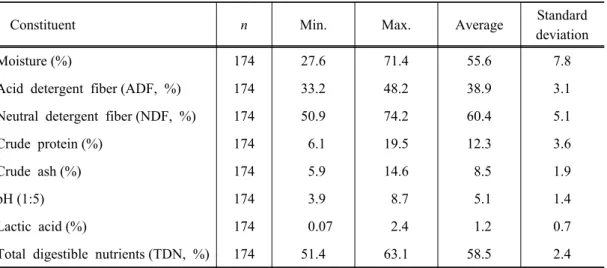
Table 1. The range of chemical composition and fermentation parameter for collected Italian ryegrass silages (calibration set)
Constituent n Min. Max. Average Standard
deviation
Moisture (%) 174 27.6 71.4 55.6 7.8
Acid detergent fiber (ADF, %) 174 33.2 48.2 38.9 3.1 Neutral detergent fiber (NDF, %) 174 50.9 74.2 60.4 5.1
Crude protein (%) 174 6.1 19.5 12.3 3.6
Crude ash (%) 174 5.9 14.6 8.5 1.9
pH (1:5) 174 3.9 8.7 5.1 1.4
Lactic acid (%) 174 0.07 2.4 1.2 0.7
Total digestible nutrients (TDN, %) 174 51.4 63.1 58.5 2.4 스펙트럼은 연구자들에 따라 조금씩 차이를
보이는데 파장대역의 적용범위는 근적외선분 광기 또는 기기조건 변화 등에 따라 ±20 nm 의 차이를 보인다고 보고 하였다 (Garcia- Cuidad 등, 1993).
2. 이탈리안 라이그라스 사일리지의 이화 학적 특성
이탈리안 라이그라스 사일리지 시료 집단 (Calibration set)의 화학적 조성분, pH 및 젖 산함량의 범위는 Table 1에서 보는 바와 같 다. 수집된 시료집단의 수분함량은 평균 55.6
%, ADF 함량은 평균 38.9%, 조단백질 함량 은 평균 12.3%, TDN 함량은 58.5%로 나타났 다. 각 성분에 대한 표준편차는 수분함량과 NDF 함량이 높게 나타났으며 젖산함량이 가 장 낮게 나타났다. 사일리지의 발효품질을 평가할 수 있는 pH와 젖산함량의 범위는 각 각 3.9~8.7, 0.07~2.4%로 다른 성분에 비해 작은 것으로 나타났으며 시료집단내 함량변 이가 작은 것으로 나타났다.
Valdes 등 (1987)은 예측 정확성이 우수한
검량식을 개발하기 위해서는 검량식 작성을 위한 모집단의 중요성을 강조하였는데, 모집 단은 넓은 범위와 고른 분포를 가지고 있어 야한다고 보고하였다. 또한 넓은 범위를 가 진 검량식 작성 모집단이라고 할지라도 각 성분에 대한 분포빈도가 고르지 못하면 그 만큼 측정 능력이 떨어지게 된다.
3. 검량식 개발 및 검증
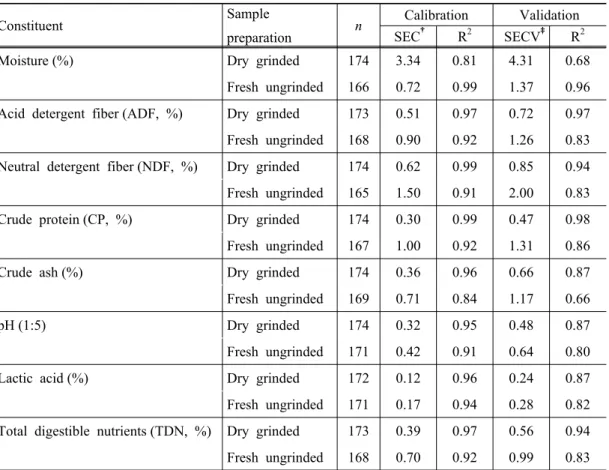
시료 전처리 방법에 따른 이탈리안 라이그 라스 사일리지의 사료가치 및 발효품질 평가 를 위한 NIR 검량식과 개발된 검량식의 검 증결과는 Table 2와 Fig. 2에서 보는 바와 같 다.
개발된 검량식의 평가는 검량식 결정계수 (R
2), SEC (Standard Error of Calibration) 및 SECV (Standard Error of Cross Validation) 가 이용되어지는데 결정계수 (R
2)는 높을수록 우 수한 검량식이고 SEC와 SECV는 낮을수록 우수한 검량식으로 평가되어진다 (Shenk 및 Westerhaus, 1991).
시료 전처리 방법에 따른 이탈리안 라이그
Table 2. The calibration and validation statistics for the prediction of chemical composition and fermentation quality of Italian ryegrass silages
Constituent Sample
preparation n Calibration Validation SEC
†R
2SECV
‡R
2Moisture (%) Dry grinded 174 3.34 0.81 4.31 0.68
Fresh ungrinded 166 0.72 0.99 1.37 0.96 Acid detergent fiber (ADF, %) Dry grinded 173 0.51 0.97 0.72 0.97 Fresh ungrinded 168 0.90 0.92 1.26 0.83 Neutral detergent fiber (NDF, %) Dry grinded 174 0.62 0.99 0.85 0.94 Fresh ungrinded 165 1.50 0.91 2.00 0.83 Crude protein (CP, %) Dry grinded 174 0.30 0.99 0.47 0.98 Fresh ungrinded 167 1.00 0.92 1.31 0.86 Crude ash (%) Dry grinded 174 0.36 0.96 0.66 0.87 Fresh ungrinded 169 0.71 0.84 1.17 0.66
pH (1:5) Dry grinded 174 0.32 0.95 0.48 0.87
Fresh ungrinded 171 0.42 0.91 0.64 0.80 Lactic acid (%) Dry grinded 172 0.12 0.96 0.24 0.87 Fresh ungrinded 171 0.17 0.94 0.28 0.82 Total digestible nutrients (TDN, %) Dry grinded 173 0.39 0.97 0.56 0.94 Fresh ungrinded 168 0.70 0.92 0.99 0.83
†Standard error of calibration, ‡Standard error of cross validation.
라스 사일리지의 수분함량의 예측 정확성은 건조 분쇄하지 않은 원물 (생)시료를 그대로 측정하는 방법 (SECV 1.37%, R
2=0.96)이 건조 분쇄처리 방법 (SECV 4.31%, R
2=0.68) 보다 예측 정확성이 우수하였다 . Windham 등(1989) 과 Williams (1987)는 근적외선분광법을 이용 한 조사료의 수분/건물함량의 예측 정확성은 연구자들마다 차이가 많다고 보고하였는데 이는 수분함량의 정량법이 연구자들 마다 조 금씩 다르고 또한 시료의 전처리 과정 동안 수분의 증발 등 시료내 수분의 불분명한 변 화들 때문이라고 하였다 .
조사료의 섬유소의 주요 평가항목인 ADF 와 NDF 함량의 예측 정확성은 건조 후 분쇄
처리한 방법이 개발된 검량식을 상호검증 (SECV)한 결과 각각 0.72% (R
2=0.97)와 0.85%
(R
2=0.94)로 높게 나타났다. 또한 근적외선분 광법을 이용한 사일리지의 조단백질 함량의 예측 정확성은 두 처리 모두에서 다른 평가 항목의 예측정확성 보다 매우 높게 나타났 다. 사일리지에 흙과 같은 이물질의 혼입 여 부를 판정하기위해 개발된 조회분함량 평가 에 대한 검량식개발 결과는 건조 분쇄하지 않은 원물(생) 시료 전처리 방법에서 가장 낮은 정확성 (SECV 1.17%, R
2=0.66)을 나타내 었다 .
사일리지의 발효품질의 주요 평가항목인
pH와 젖산함량은 시료가 건조 과정을 거치
Fig. 3. Relationships between laboratory determined and NIRS predicted moisture, ash and crude protein values of Italian ryegrass silages as sample preparation.
Oven dry grinded sample preparation Fresh ungrinded sample preparation
면서 휘발되어 예측 정확성이 낮을 것으로 예상되었으나 건조 분쇄 전처리 방법에서 각 각 0.48 (R
2=0.87)와 0.24% (R
2=0.87)로 우수한 결과를 보임으로써 향후 이에 대한 원인 구 명 등의 많은 연구가 진행되어져야 할 것으 로 생각되어진다.
이상의 연구결과를 종합해보면 근적외선분
광법을 이용한 시료 전처리 방법에 따른 이
탈리안 라이그라스 사일리지의 사료가치 및
발효품질 평가에 대한 예측정확성은 수분함
량을 제외하고는 건조 후 분쇄하는 시료 전
처리 방법이 예측 정확성 측면에서는 우수한
것으로 나타났다. 실제 조사료 생산 및 이용
현장에서 조사료의 품질평가는 정확성도 중
요하지만 보다 신속한 품질평가 분석법이 요 구되어지기 때문에 시료 전처리가 필요치 않 은 원물(생) 시료의 측정 방법도 매우 양호 한 예측 정확성을 보임으로써 실제 근적외선 분광법의 현장 활용측면에서는 매우 유용한 전처리 방법으로 판단되어진다.
요 약
본 연구는 조사료 품질평가에서 근적외선 분광법의 현장 이용성 확대를 위하여 시료 전처리 방법에 따른 이탈리안 라이그라스 사 일리지의 사료가치 및 발효품질의 예측정확 성을 평가하기 위하여 수행되었으며 검량식 개발을 위하여 이탈리안 라이그라스 사일리 지를 전북지역에서 174점을 수집하였다. 시 료 전처리 방법은 사일리지를 건조 후 분쇄 하는 방법과 원물 (생) 시료를 건조 분쇄하지 않는 방법을 두었으며 각각의 시료는 근적외 선 분광기를 이용하여 스펙트럼을 측정한 후 측정된 스펙트럼과 실험실 분석값간에 상관 관계를 이용한 다변량회귀분석법을 통하여 검량식을 유도한 다음 각 성분별로 예측 정 확성을 평가하였다. 시료 전처리 방법에 따 른 이탈리안 라이그라스 사일리지의 수분함 량의 예측 정확성은 건조 분쇄하지 않은 원 물(생)시료를 그대로 측정하는 방법 (SECV 1.37%, R
2=0.96)이 건조 분쇄처리 방법 (SECV 4.31%, R
2=0.68) 보다 예측 정확성이 높게 나 타났다. ADF와 NDF 함량의 예측 정확성은 건조 후 분쇄처리한 방법이 개발된 검량식을 상호검증 (SECV)한 결과 각각 0.72% (R
2=0.97) 와 0.85% (R
2=0.94)로 높게 나타났으며 조회 분함량 평가에 대한 검량식개발 결과는 건조 분쇄하지 않은 원물(생) 시료 전처리 방법에 서 가장 낮은 정확성 (SECV 1.17%, R
2=0.66) 을 나타내었다. pH와 젖산함량은 건조 분쇄
전처리 방법에서 각각 0.48 (R
2=0.87)와 0.24%
(R
2=0.87)로 우수한 결과를 나타내었다. 이상 의 연구결과를 종합해보면 근적외선분광법을 이용한 시료 전처리 방법에 따른 이탈리안 라이그라스 사일리지의 사료가치 및 발효품 질 평가에 대한 예측정확성은 수분함량을 제 외하고는 건조 후 분쇄하는 시료 전처리 방 법이 예측 정확성 측면에서는 우수한 것으로 나타났으나 시료 전처리가 필요치 않은 원물 (생) 시료의 측정 방법도 매우 양호한 예측 정확성을 보임으로써 실제 근적외선분광법의 현장 활용측면에서는 매우 유용한 전처리 방 법으로 판단되어진다.
인 용 문 헌