MISMATCH IN WORKING HOURS AND WORKAHOLISM
IN PERMANENT WAGED WORKERS
SHIN-GOO PARK
1, HYUNG-DOO KIM
1, JIN-YOUNG MIN
2, KYOUG-BOK MIN
3, SANG-HEE HWANG
4, and EUN-CHUL JANG
51
Inha University Hospital, Incheon, Republic of Korea Department of Occupational and Environmental Medicine
2
Seoul National University, Seoul, Republic of Korea Institute of Health and Environment
3
Seoul National University, Seoul, Republic of Korea Department of Preventive Medicine, College of Medicine
4
Keimyung University School of Medicine, Daegu, Republic of Korea Department of Dentistry
5
Soonchunhyang University Cheonan Hospital, Cheonan, Republic of Korea Department of Occupational and Environmental Medicine
Abstract
Objectives: A cross-sectional study was conducted to investigate whether working hours mismatch is associated with workaholism. Material and Methods: This study used the data from the 17th wave (2014) of the nationwide Korean Labor and Income Panel Study. Workaholism was evaluated using the Workaholism Analysis Questionnaire. The final study involved 3157 subjects who answered questions regarding both workaholism and work- ing hours mismatch. To identify the association between working hours mismatch and workaholism according to weekly working hours, a stratification analysis was conducted by dividing the number of working hours/week into 3 groups (≤40 h, 41–59 h, and ≥60 h). The odds ratios were calculated us- ing a multiple logistic regression model, which was adjusted for potential confounders. Results: The workers working more hours than desired showed the greatest frequency of workaholism. As regards workaholism, in all weekly working hours groups, the odds ratios of the group working more hours than desired were 4.28, 95% CI: 2.29–7.99 (≥40 h), 2.14, 95% CI: 1.34–3.43 (41–59 h), 3.40, 95% CI: 1.60–7.21 (≤60 h), which were statistically sig- nificant compared to the reference (matched) group. There was no statistically significant relationship between working hours and workaholism when stratified according to the mismatch in working hours. Conclusions: The workers’ working hours mismatch can be significantly related to workaholism.
Int J Occup Med Environ Health. 2020;33(2):187 – 94 Key words:
workaholism, working hours mismatch, waged worker, workaholic, mismatched, weekly working hours
Funding: this work was supported by Inha University Hospital.
Received: February 25, 2019. Accepted: November 22, 2019.
Corresponding author: Shin-Goo Park, Inha University Hospital, Department of Occupational and Environmental Medicine, 27 Inhang-Ro, Jung-Gu, Incheon 22332, Republic of Korea (e-mail: [email protected]).
– Cornelißen [14] provided evidence on the decline in job satisfaction corresponding to an increase in mis- matched hours;
– Wilkins [15] found that underemployed male full-time employees reported lower life satisfaction compared to matched male full-time employees;
– Green and Tsitsianis [16] revealed a large and statisti- cally significant negative impact on job satisfaction in Britain and both parts of Germany due to the mismatch in working hours.
The authors of this study hypothesized that not only long working hours but also the mismatch between the actual and desired working times could be related to workahol- ism. However, no research has been conducted in this regard.
In the current study, the association between workahol- ism and the abovementioned mismatch in working hours was investigated using a representative sample of Kore- ans from the nationwide Korean Labor and Income Panel Study (KLIPS).
MATERIAL AND METHODS Data
In this study, data from the 17th wave (2014) of the nation- wide KLIPS were used, which included the selection of a representative panel sample of Korean households and individuals aged ≥15, residing in urban areas. The first survey was launched in 1998, and since then, data have been collected annually.
The 17th wave (2014) of the survey was the first to include questions on both workaholism and the mismatch in work- ing hours. As a person’s employment status can be an im- portant related factor that influences working hours and workaholism, permanent waged workers were selected for this investigation.
The participants in the study were 3275 permanent waged workers from among 7199 respondents of an additional survey on workaholism in the 17th wave of the survey.
INTRODUCTION
The term “workaholism” was first introduced by Oates [1,2], who defined it as an addiction to work and “the compulsion or the uncontrollable need to work inces- santly.” Although considerable attention has been paid to the definition and techniques of measuring workaholism, disagreements still exist on these issues beyond the core feature of “heavy work investment” [1,2]. A worka- holic appears to be a person who experiences an inter- nal compulsion to work, and tends to consistently think about work [1,2]. Working for an extended duration daily is considered as the main characteristic of workaholism [3,4]. On average, North American workaholics work for 50–60 h/week [5,6]. Positive correlations have been found between long working hours and workaholism [7,8]. How- ever, expending more time on the job is not necessarily a workaholic’s attribute. External factors (e.g., financial issues, organizational culture, and pressure exerted by su- periors), rather than the obsessive internal drive evinced by a typical work addict, may force certain people to invest more time in their jobs [9]. It may, thus, be misleading to understand workaholism only in terms of excessive work- ing hours, considering that the condition is an addiction to work that exerts an internal pressure compelling a person to continue undertaking official duties.
Recent concerns have been expressed with regard to the mismatch between the actual and desired work- ing hours [10]. The mismatch in working hours refers to the lack of correspondence between the preferential week- ly working time and the actual hours spent weekly on work, whether a person desires to work more or fewer hours ev- ery week [11]. Many studies have demonstrated the nega- tive outcomes of such a mismatch in working hours:
– Bell et al. [12] found damaging effects on health satis- faction and self-assessed health;
– Constant and Otterbach [13] detected unconstruc-
tive consequences on self-assessed mental health
measures;
aspects of your work by choosing 1 of the 5 alternatives that best reflects your answer.”
The category of workaholism was assigned to respondents based on varied components that represent an addiction to work.
The designation of workaholism was calculated as the to- tal score of the 29 items in the completed WAQ, which was then divided by 29. Each item of the survey indicated a respondent’s agreement on a 5-point scale, ranging from 1 (strongly disagree) to 5 (strongly agree). The respon- dents who answered “agree” or “strongly agree” on aver- age to workaholism related factors, and thus scored >3, were defined as workaholics.
Working hours mismatch
The mismatch in the actual and desired working hours was assessed by asking the participants to respond to a ques- tion that was asked by a trained interviewer, “What do you think about the time for work or income activities in your daily life?”. The following answers to this question were possible: “working fewer hours than desired,” “working more hours than desired,” and “matched.”
Statistical analysis
The authors performed χ
2tests to compare the differences in workaholism associated with general characteristics. A strati- fication analysis was conducted with regard to weekly work- ing hours. Following the initial analysis, a multiple logistic regression model was used to assess the association between the mismatch in working hours and workaholism while ad- justing for potential confounders. To identify the association between the mismatch in working hours and workaholism ac- cording to weekly working hours, a stratification analysis was conducted by dividing the working hours/week into 3 groups (≤40 h, 41–59 h, and ≥60 h). The odds ratios (ORs) were calculated using a multiple logistic regression model, which was adjusted for potential confounders. The authors used SPSS for Windows (version 19.0; SPSS Inc., an IBM com- The final study involved 3157 individuals who answered
questions on both workaholism and the mismatch in work- ing hours.
For the purpose of this study, only workers who satisfied all 4 of the following conditions were defined as perma- nent waged workers:
– directly hired by their employers (not subcontracted or dispatched workers);
– full-time workers (not part-time workers);
– no fixed term in their employment contract (not tem- porary workers);
– a high probability of maintaining the current job (hav- ing relatively reduced job insecurity and not a day la- borer) [17].
As suggested in the KLIPS, the total household income was divided by the square root of the number of house- hold members. Subsequently, the value was divided into quartiles which were scaled from the highest quartile (the number below which 75% of the data lie) to the lowest (the number below which 25% of the data lie).
Occupations were classified into 3 types: white-, pink-, and blue-collar. A pink-collar worker is a person who is mainly engaged in the service industry.
Ethical approval was not required as the KLIPS provides secondary data that are publicly available for scientific use, and do not contain private information.
Workaholism
Aziz et al. [18] conceptualized workaholism as an addic- tion that is characterized by an intense work drive that leads to the neglect of other interests and brings negative consequences. They developed the Workaholism Analysis Questionnaire (WAQ), which emphasizes work drive and work-life balance. The WAQ was used to measure worka- holism in the present investigation [18].
The WAQ consisted of 29 items rated on a 5-point Likert
scale. The framing question was: “Please answer the fol-
lowing questions concerning how you feel about various
Korea was investigated. In comparison to the workers whose real and preferred weekly working times matched, those who declared a mismatch in working hours were more likely to be workaholics as per the definition of this term. The outcomes of the present investigation suggest that a mismatch between the actual and desired weekly working hours may be related to workaholism in waged workers.
These findings indicate that people who work more hours than desired, regardless of their actual weekly working time, are statistically significantly more likely to become addicted to work than matched workers. Workaholics tend to think about their work after work because of their ob- sessive nature [19], so they are likely to feel as if they work more hours than desired, regardless of their actual work- ing time.
Among the workers with a weekly working time of 41–
59 h, those who worked fewer hours than desired dis- played more statistically significant tendencies of worka- holism compared to matched workers. Those who worked
≤40 h/week or ≥60 h/week displayed similar trends but were not statistically significant. It is considered that the workers with 41–59 h/week occupied the largest num- ber of study participants and displayed statistically signifi- cant results. Further studies with large sample sizes are, nonetheless, needed.
The authors presume that people with a strong work drive are likely to feel as if they work fewer hours than desired, regardless of their actual working time, and tend to be- come addicted to work.
From the addictive perspective, the condition of worka- holism is evidenced by a more intensive internal compul- sion to work, a consistent contemplation of work, and an excessive involvement with work compared to that observed in an average worker [18,20]. Workaholics may spend their time in a manner that is beyond their control.
However, discerning the association between mismatched working times and workaholism based on the concept of pany, Chicago, IL, USA) for all analyses. Null hypotheses of
no difference were rejected if p-values were < 0.05.
RESULTS
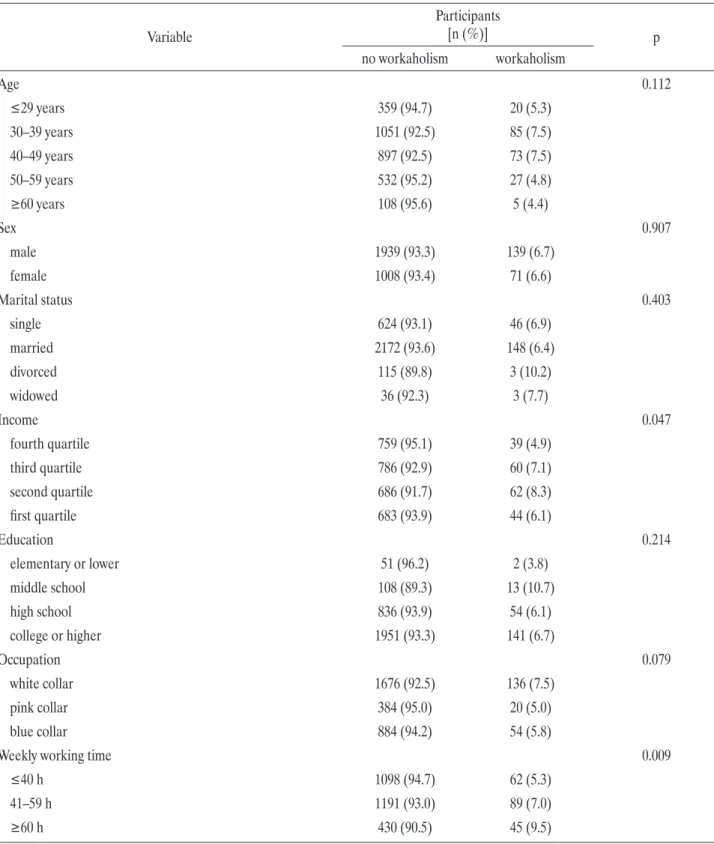
Table 1 indicates the relationship between the general characteristics and workaholism.
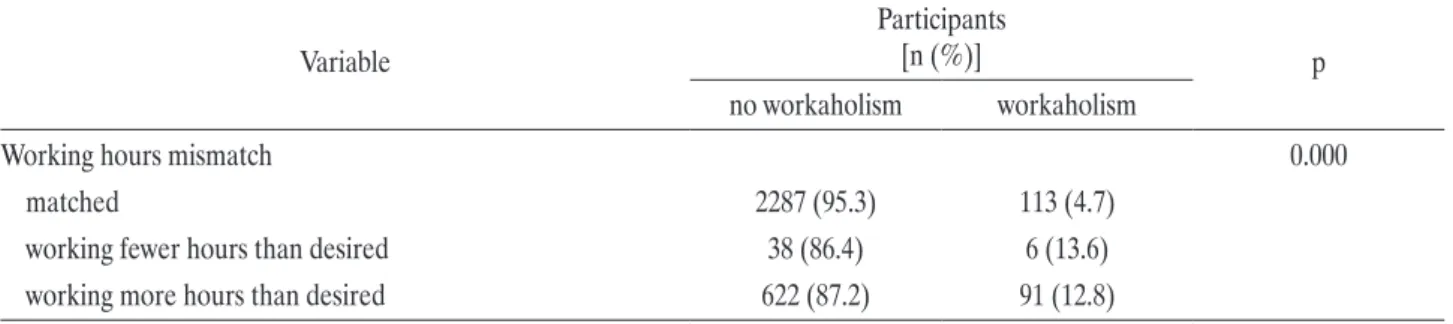
There was a tendency towards increased workaholism un- til the second quartile level when income was higher (for the fourth quartile, third quartile, second quartile, and first quartile incomes, respectively; workaholism p = 0.047, 4.9%, 7.1%, 8.3%, and 6.1%). The participants who worked more weekly hours tended to become more addicted to work (for ≤40 h, 41–59 h, and ≥60 h, respectively; workaholism p = 0.009, 5.3%, 7.0%, and 9.5%). The respondents who worked more hours than desired displayed the highest fre- quencies of workaholism (for matched, working fewer hours than desired, and working more hours than desired, respec- tively; workaholism p < 0.001, 4.7%, 13.6%, and 12.8%).
Table 2 indicates that there was no statistically signifi- cant relationship between the weekly working hours and workaholism when stratified according to the mismatch in working hours.
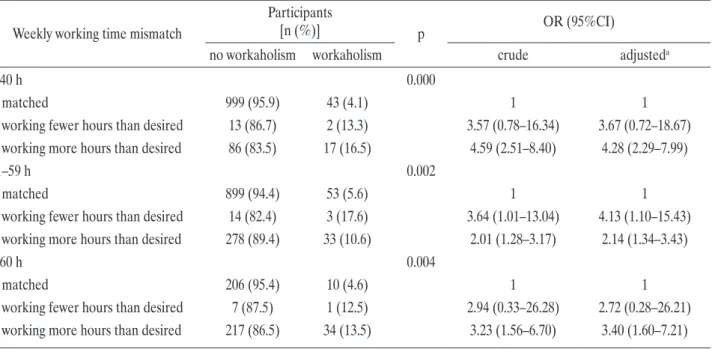
In terms of workaholism, the ORs of the group work- ing more hours than desired was statistically significant at 4.28 (95%CI: 2.29–7.99) in comparison to the reference (matched) group when the weekly working hours were
≤40 h. At 41–59 h, the OR of working fewer hours than desired was 4.13, and the OR of working more hours than desired was 2.14, which was statistically significant com- pared to the reference (matched) group. For weekly work of
>60 h, the OR of working more hours than desired was sta- tistically significant at 3.40 when compared to the reference (matched) group. These results are displayed in Table 3.
DISCUSSION
In this study, the association between the mismatch in
the actual and desired working hours, and the condition of
workaholism among permanent waged workers in South
Table 1. The relationship between general characteristics and workaholism in the study on the association between working hours mismatch and workaholism, using data on a representative sample of Koreans
#from the 17th wave of the Korean Labor and Income Panel Study (2014)
Variable
Participants
[n (%)] p
no workaholism workaholism
Age 0.112
≤29 years 359 (94.7) 20 (5.3)
30–39 years 1051 (92.5) 85 (7.5)
40–49 years 897 (92.5) 73 (7.5)
50–59 years 532 (95.2) 27 (4.8)
≥60 years 108 (95.6) 5 (4.4)
Sex 0.907
male 1939 (93.3) 139 (6.7)
female 1008 (93.4) 71 (6.6)
Marital status 0.403
single 624 (93.1) 46 (6.9)
married 2172 (93.6) 148 (6.4)
divorced 115 (89.8) 3 (10.2)
widowed 36 (92.3) 3 (7.7)
Income 0.047
fourth quartile 759 (95.1) 39 (4.9)
third quartile 786 (92.9) 60 (7.1)
second quartile 686 (91.7) 62 (8.3)
first quartile 683 (93.9) 44 (6.1)
Education 0.214
elementary or lower 51 (96.2) 2 (3.8)
middle school 108 (89.3) 13 (10.7)
high school 836 (93.9) 54 (6.1)
college or higher 1951 (93.3) 141 (6.7)
Occupation 0.079
white collar 1676 (92.5) 136 (7.5)
pink collar 384 (95.0) 20 (5.0)
blue collar 884 (94.2) 54 (5.8)
Weekly working time 0.009
≤40 h 1098 (94.7) 62 (5.3)
41–59 h 1191 (93.0) 89 (7.0)
≥60 h 430 (90.5) 45 (9.5)
the present study is cross-sectional, it cannot confirm any progress or change. In the future, cohort studies or meta- analytic investigations should be conducted to arrive at more definitive conclusions.
The current study is the first to establish a significant association between workaholism and the mismatch be- tween the actual and preferred weekly working hours, regardless of whether the actual work duration corre- sponds to fewer or more hours than desired per week.
Admittedly, preliminary results are provided in this pa- per to report the observed association, and it is, thus, difficult to demonstrate the underlying mechanisms addiction seems quite restrictive. A further study is essen-
tial to replicate the current findings on this association, and to explain the underlying mechanisms of the observed association using discrete theoretical frameworks pertain- ing to workaholism.
In congruence with the previous studies [1,21], this investi- gation also established that workaholism tended to inten- sify with an increasing number of working hours. Howev- er, long working hours were not associated with workahol- ism when stratified according to the mismatch in working hours. The mismatch in an employee’s working hours can exert a significant impact on workaholism. However, since
Variable
Participants
[n (%)] p
no workaholism workaholism
Working hours mismatch 0.000
matched 2287 (95.3) 113 (4.7)
working fewer hours than desired 38 (86.4) 6 (13.6)
working more hours than desired 622 (87.2) 91 (12.8)
# N = 3157. These are the individuals who answered questions on both workaholism and the mismatch in working hours from among 3275 permanent waged workers included in a group of 7199 respondents of an additional survey on workaholism in the 17th wave of the Korean Labor and Income Panel Study.
Table 2. The relationship between weekly working hours and workaholism when stratified by working hours mismatch
in the study on the association between working hours mismatch and workaholism, using data on a representative sample of Koreans
#from the 17th wave of the Korean Labor and Income Panel Study (2014)
Weekly working time
Participants [n (%)]
workaholism in the matched group* workaholism in the mismatched group**
no yes no yes
≤40 h 999 (95.9) 43 (4.1) 99 (83.9) 19 (16.1)
41–59 h 899 (94.4) 53 (5.6) 292 (89.0) 36 (11.0)
≥60 h 206 (95.4) 10 (4.6) 224 (86.5) 35 (13.5)
# Explanations as in Table 1.
* p = 0.321; ** p = 0.324.
Table 1. The relationship between general characteristics and workaholism in the study on the association between working hours
mismatch and workaholism, using data on a representative sample of Koreans
#from the 17th wave of the Korean Labor
and Income Panel Study (2014) – cont.
ployment environment on the mismatch in working hours.
The employment environment of irregular workers can af- fect both the mismatch in working hours and workaholism [22,23]. Thus, it is problematic to generalize the associa- tion between the mismatch in working time and workahol- ism in all workers.
CONCLUSIONS
A significant association between the mismatch in working time and workaholism was observed among permanent waged employees in South Korea. This preliminary result should be confirmed by a further study using a sample size that has sufficient statistical power.
REFERENCES
1. Snir R, Harpaz I. Beyond workaholism: Towards a general model of heavy work investment. Hun Resour Manage R.
2012;22(3):232–43.
of the rationale of workaholism being associated with the discrepancy of the actual and preferred working time among individuals.
Although this preliminary study offers novel insights into the associations between workaholism and the mismatch in working time, some of its limitations should be ac- knowledged. Most importantly, this investigation is cross- sectional, and it cannot identify the causal link of the ob- served association. The authors did not use the weight in the statistical analyses, and the finding cannot be general- ized to a general population.
Personal and environmental factors may have influenced workaholism and the mismatch in working times, but the KLIPS data did not include all potential confound- ing variables; therefore, the effect of residual confound- ing cannot be ruled out from the currently observed out- comes. Finally, the study population was limited to per- manent waged workers to minimize the effects of the em-
Table 3. Odds ratios (ORs) for workaholism by working hours mismatch according to weekly working hours mismatch
in the study on the association between working hours mismatch and workaholism, using data on a representative sample of Koreans
#from the 17th wave of the Korean Labor and Income Panel Study (2014)
Weekly working time mismatch
Participants
[n (%)] p OR (95%CI)
no workaholism workaholism crude adjusted
a≤40 h 0.000
matched 999 (95.9) 43 (4.1) 1 1
working fewer hours than desired 13 (86.7) 2 (13.3) 3.57 (0.78–16.34) 3.67 (0.72–18.67) working more hours than desired 86 (83.5) 17 (16.5) 4.59 (2.51–8.40) 4.28 (2.29–7.99)
41–59 h 0.002
matched 899 (94.4) 53 (5.6) 1 1
working fewer hours than desired 14 (82.4) 3 (17.6) 3.64 (1.01–13.04) 4.13 (1.10–15.43) working more hours than desired 278 (89.4) 33 (10.6) 2.01 (1.28–3.17) 2.14 (1.34–3.43)
≥60 h 0.004
matched 206 (95.4) 10 (4.6) 1 1
working fewer hours than desired 7 (87.5) 1 (12.5) 2.94 (0.33–26.28) 2.72 (0.28–26.21) working more hours than desired 217 (86.5) 34 (13.5) 3.23 (1.56–6.70) 3.40 (1.60–7.21)
# Explanations as in Table 1.
a Adjusted by age, sex, marital status, income, education, and occupation.
13. Constant A, Otterbach S. Work hours constraints: Impacts and policy implications. In: Institute of Labor Economics, editor. IZA Policy Papers; 2011;35.
14. Cornelißen T. The interaction of job satisfaction, job search, and job changes. An empirical investigation with German panel data. J Happiness Stud. 2009;10(3):367–84.
15. Wilkins R. The consequences of underemployment for the underemployed. J Ind Relat. 2007;49(2):247–75.
16. Green F, Tsitsianis N. An investigation of national trends in job satisfaction in Britain and Germany. Br J Ind Relat.
2005;43(3):401–29.
17. Kim S-S, Subramanian S, Sorensen G, Perry MJ, Chris- tiani DC. Association between change in employment status and new-onset depressive symptoms in South Korea-a gen- der analysis. J Work Environ Health. 2012:537–45.
18. Aziz S, Uhrich B, Wuensch KL, Swords B. The Workaholism Analysis Questionnaire: Emphasizing Work-Life Imbalance and Addiction in the Measurement of Workaholism. J Behav Appl Manage. 2013;14(2).
19. Harpaz I, Snir R. Workaholism. Its definition and nature.
Human Relat. 2003;56(3):291–319.
20. Scottl KS, Moore KS, Miceli MP. An exploration of the meaning and consequences of workaholism. Human Relat.
1997;50(3):287–314.
21. Schaufeli WB, Taris TW, Van Rhenen W. Workaholism, burnout, and work engagement: three of a kind or three different kinds of employee well-being? Appl Psychol.
2008;57(2):173–203.
22. Wooden M, Warren D, Drago R. Working time mismatch and subjective well-being. Br J Ind Relat. 2009;47(1):147–79.
23. Shimazu A, Demerouti E, Bakker AB, Shimada K, Kawaka- mi N. Workaholism and well-being among Japanese dual- earner couples: A spillover-crossover perspective. Soc Sci Med. 2011;73(3):399–409.
2. Andreassen CS. Workaholism: An overview and current sta- tus of the research. J Behav Addict. 2013;3(1):1–11.
3. Buelens M, Poelmans SA. Enriching the Spence and Rob- bins’ typology of workaholism: Demographic, motivational and organizational correlates. J Organ Change Manag.
2004;17(5):440–58.
4. Brett JM, Stroh LK. Working 61 plus hours a week: Why do managers do it? J Appl Psychol. 2003;88(1):67.
5. Spence JT, Robbins AS. Workaholism: Definition, measure- ment, and preliminary results. J Pers Assess. 1992;58(1):
160–78.
6. Peiperl M, Jones B. Workaholics and overworkers: Produc- tivity or pathology? Group Organ Manag. 2001;26(3):369–93.
7. Taris T, Schaufeli W, Verhoeven L. Internal and external vali- dation of the Dutch Work Addiction Risk Test: Implications for jobs and non-work conflict. J Appl Psychol. 2005;54(1):
37–60.
8. Kanai A, Wakabayashi M. Workaholism among Japanese blue-collar employees. Int J Stress Manag. 2001;8(2):129–45.
9. Shkoler O, Rabenu E, Vasiliu C, Sharoni G, Tziner A. Or- ganizing the Confusion Surrounding Workaholism: New Structure, Measure, and Validation. Front Psychol. 2017;
8:1803.
10. Wunder C. Working hours mismatch and well-being: com- parative evidence from Australian and German panel data.
In: German Economic Association. Annual Conference 2016 (Augsburg): Demographic Change. Augsburg: The Associa- tion; 2016.
11. Van Emmerik I, Sanders K. Mismatch in working hours and affective commitment: Differential relationships for distinct employees groups. J Managerial Psycho. 2005;20(8):712–26.
12. Bell D, Otterbach S, Sousa-Poza A. Work hours constraints and health. Ann Econ Stat. 2012:35–54, https://doi.org/10.23 07/23646455.
This work is available in Open Access model and licensed under a Creative Commons Attribution-NonCommercial 3.0 Poland License – http://creativecommons.org/
licenses/by-nc/3.0/pl/deed.en.