INTRODUCTION
Green euglenoids are reported to show mor- phological and ecological plasticity in the field (Kiss et al., 1986; Conforti, 1998). The natural habitats are not consistent and make a diverse condition of environmental factors, which, in turn, bring about the diversity of natural popula- tions of some euglenoids (Lackey, 1968; Kim and Boo, 2000). However, there are few studies on relationships of morphological variation of eugl- enoids related to environmental factors in the f ield (Kim and Boo, 1998).
Euglena viridis Ehrenberg has been known as the typical species having one star-like cluster of chloroplast lobes among the genus Euglena members (Pringsheim, 1956; Zakrys, 1986). It is unicellular, free-living, and cosmopolitan, inha- biting very wide range of water environments (Kim et al., 1998). The species often predomi- nates in eutrophic waters including a high or- ganic and inorganic content (Munawar, 1972;
Kim and Boo, 1996, 2001). However, E. viridis is very changeable in various waters, and many varieties are described on minor differences of chloroplast morphology, shape and size of the cells (Zakrys, 1986; Kim et al., 1998). In addition,
* Corresponding Author: Tel: 042) 821-6555, Fax: 042) 822-9690, E-mail: [email protected]
─
─ 185 ──
Morphological Variation and Density of Euglena viridis (Euglenophyceae) Related to Environmental Factors
in the Urban Drainages
Kim, Jun Tae and Sung Min Boo
(Department of Biology, Chungnam National University, Daejon 305-764, Korea)
도시하천의 환경요인과 Euglena viridis의 형태 변이 및 밀도와의 관계. 김준태∙부성민 (충남 대학교 자연과학대학 생물학과)
Euglena viridis의 형태변이, 밀도 및 환경요인과의 관계를 규명하기 위하여, 무심천, 미호천, 대전 천, 전주천, 광주천 및 금호강의 도시하천에서 1996년 12월 25일에서 1997년 1월 4일 사이에 E.
viridis의 형태와 밀도 및 수환경 요인들을 조사하였다. 각 하천에서 Euglena viridis는 형태적으로 두 가지 형태형으로 구분되었으나, 엽록체가 별 모양인 점에서 동일종으로 동정되었다. 형태형I은 E. viridis의 일반적인 형태와 일치하였고, 대부분의 정점에서 대발생하여 광주천에서 최대 5386 cells∙mL-1이었다. 형태형I의 밀도는 암모늄과 아질산염에 각각 정의 상관관계(r = 0.80과 0.68), 질산염과는 부의 상관관계에 있었다. 형태형II는 엽록체들의 가장자리가 거치형이며, 세포질 소립 들이 불규칙하게 분산되어 있는 점 등이 특징이었다. 형태형II의 밀도는 질산염과 정의 상관관계 (r = 0.98)를 보인 반면, 암모늄이나 아질산염과는 각각 부의 상관관계에 있었다. 그러나 두 가지 형 태형은 각각 인산염, 수온 및 pH는 밀도와 유의한 상관을 보이지 않았다. 이 결과는 E. viridis의 두 가지 형태형들이 서로 다른 질소성 영양염들을 이용하므로서 동 시기 및 동일 지소에서 공존하 고 있다는 것을 보여준다.
Key words : Density, ecology, Euglena, Euglenophyceae, Eutrophic waters, Morpho- types, Nitrogenous nutrients
Euglena viridis
Euglena viridis
E. stellata Mainx is treated as a synonym of E.
viridis because of identity in structure of chloro- plast under transmission electron microscopy (Dragos et al., 1979; Zakrys and Walne, 1998) and because of genetic similarity between E.
stellata and E. viridis (Zakrys et al., 1997). How- ever, additional research on the ‘Euglena viridis’
group in the field is necessary for understanding morphological variation (Kim et al., 1998).
We have preliminarily observed that Euglena viridis predominated in the winter season in urban waters in Korea (Kim and Boo, 2001). The urban waters are usually turbid and are suitable for studying euglenoids response to the water environments, since urban waters budget a high degree of nitrogenous or phosphorus nutrients, derived from waste waters of domestic or indu- strial activities (Lackey, 1968; Kim and Boo, 2000). The present study was aimed to know 1) whether morphologically different populations of E. viridis occur in several waters, 2) which type of population is more abundant than others, and 3) if there are some relationships between densi- ties of populations and environmental factors.
MATERIALS AND METHODS
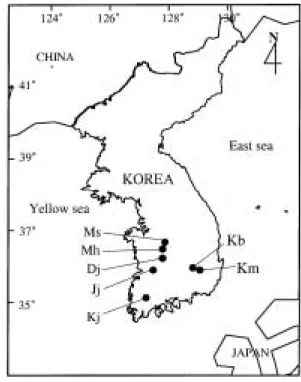
A total of seven stations were selected in the urban waterways receiving heavy inputs of indu- strial or domestic sewage, after the preliminary survey (Fig. 1). All samplings were completed during 11 days from 25 December 1996 to 4 January 1997 to minimize the temporal varia- tions of environmental factors such as water temperature and dissolved nutrients. Data of surface water temperature, pH and dissolved in- organic nutrient were from Kim and Boo (1998).
Two aliquots of algal suspension were collected using 1,000 mL bottle from each station. One ali- quot was concentrated for observing the mor- phology of Euglena viridis. Half of this sample was put under cooled dark conditions (below 4�C) and observed at an interval of five days. The other half was f ixed with Lugol’s solution. Both samples were used for scrutinizing the intracel- lular details because of difficulty in observations due to many chloroplasts in live cells. The re- maining 1,000 mL aliquot for cell counting was f ixed with the f ixative (Lugol’s solution) just after sampling. The number was determined us- ing the Sedgwick-Rafter (S-R) counting cell and
an inverted microscope (Olympus IX70) at 400×
or 1,000× magnif ications. A total of 50 strips (10 strips multiplied 5 times) in the S-R cell were counted to derive the cell number per milliliter.
The mean cell measurement for each count was used to assign the density of Euglena viridis cells in each station. Correlation and linear regression analyses (Sokal and Rohlf, 1995) were performed to determine relationships between the cell den- sity and dissolved inorganic nutrients.
RESULTS
Morphology of Euglena viridis
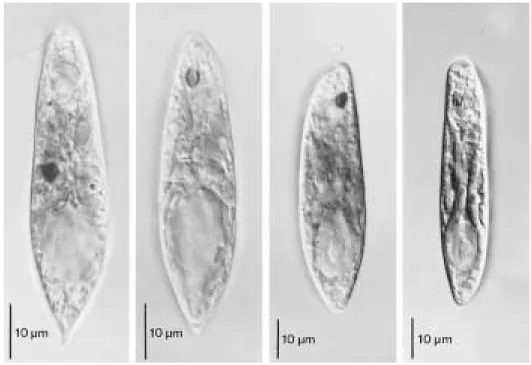
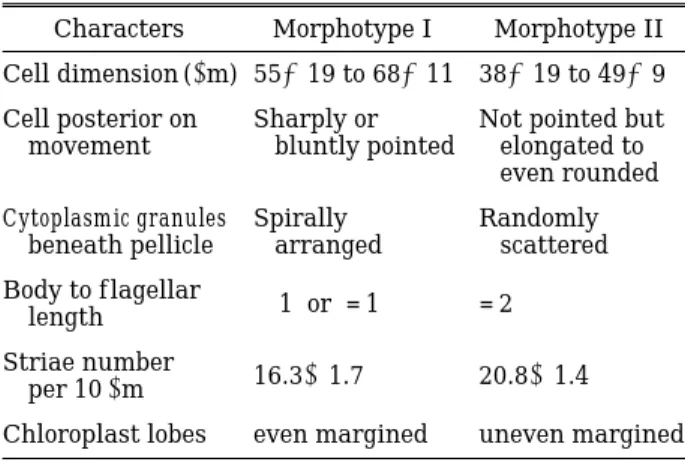
Euglena viridis cells from the seven urban waters were morphologically separated into two morphotypes (Fig. 2). Morphotype I was spindle, 55 to 68µm in length and 11 to 19µm in width.
The posterior part of cell was sharply or bluntly pointed on movement. The cytoplasmic granules were spirally arranged beneath the pellicle. The pellicles were finely and spirally striated and the number of striae was 15 to 17 per a 10-µm leng-
Fig. 1. Stations of urban drainages sampled in this study.
Dj = Daejoncheon, Jj = Jeonjucheon, Kb = Keum- hogang-Bisan, Kj = Kwangjucheon, Km = Keum- gogang-Mangwoo, Mh = Mihocheon, and Ms = Mu- shimcheon.
th of cell surface. The chloroplasts, band-shaped and even-margined lobes, were aggregated into the star-like form with centrally located pyre- noid. This aggregate was located before the nu- cleus. The paramylon grains were small rods or discoid in shape. They were densely clustered in the aggregation center of chloroplast lobes and some were freely scattered in the cytoplasm. In the cells starved in dark, the central pyrenoid space sometimes occurred and the paramylon grains massed in the chloroplast center were de- tached. The emergent flagellum was similar to the body or slightly shorter than the body length.
In the morphotype II, the cells were 38 to 49 µm in length and 9 to 19µm in width. The pos- terior of cells was not pointed but elongated to round on movement. The cytoplasmic granules were randomly scattered beneath the pellicle.
The chloroplast lobes were uneven-margined.
The number of pellicular striae was 20 to 22 per a 10-µm length of cell surface. The f lagellar length was about twice of body length. Other features are similar to those of the morphotype I.
A morphological comparison of the above- mentioned two morphotypes is given in Table 1.
Density of local populations
The total density of Euglena viridis cells was high at 5,592 cells∙mL-1 in Kwangjucheon and low at 780 cells∙mL-1 in Mushimcheon (Fig. 3).
The density of morphotype I remarkably bloomed with 5,149 cells∙mL-1 in Mihocheon and 5,386 cells∙mL-1 in Kwangjucheon, while the density
Fig. 2. Two morphotypes of Euglena viridis occurred in urban drainages in Korea. A-B. Morphotype I cells. C-D.
Morphotype II cells.
Fig. 3. Comparison of densities of two Euglena viridis morphotypes in urban drainages. Left column in each station indicates morphotype I and right column indicates morphotype II. Abbreviations in figure are same in Figure 1.
Fig. 4. Relationships between densities and dissolved inorganic nutrients. Lef t panel corresponds to morphotype I and right panel to morphotype II. Abbreviations in f igure are same in Figure 1.
was small with 320 cells∙mL-1 in Daejoncheon and 780 cells∙mL-1in Mushimcheon.
The density of the morphotype II was high at 1,410 cells∙mL-1 in Daejoncheon, but less than that of morphotype I in most stations (Fig. 3).
Environmental variables
Temperature of surface water was an average of 5.6±1.9�C during the study period. The pH value f luctuated within a neutral zone with an average 7.80±0.14. The ammonium concentra- tion was high at 1.21 mg∙L-1in Mihocheon and low at 0.39 mg∙L-1 in Jeonjucheon. The nitrite concentration was a high of 0.476 mg∙L-1in Mi- hocheon and a low of 0.075 mg∙L-1 in Daejon- cheon. The nitrate concentration was a high of 3.89 mg∙L-1 in Daejoncheon and a low of 2.06 mg∙L-1 in Mihocheon. The phosphate concen- tration was below 0.84 mg∙L-1in every station.
All contents of this section were described in Kim and Boo (1998) and should be changed just as its citation.
Relationships between the population size and environmental variables
The density of each type of Euglena viridis cor- related with the dissolved ammonium, nitrite, and nitrate, respectively (Fig. 4). The density of the morphotype I positively correlated to ammo- nium (r = 0.80, P⁄0.01) and nitrite (r = 0.68, P⁄
0.05), while negatively with nitrate concentra- tion (r =-0.55, P⁄0.05). The density of the mor- photype II positively correlated with nitrate, and the correlation was highly signif icant (r = 0.98, P
⁄0.01). However, the density negatively corre-
lated with ammonium (r =-0.36) and nitrite (r = -0.71, P⁄0.05).
The relationships between the density of each morphotype and inorganic phosphate concentra- tion were not signif icant. The density of each morphotype was not signif icantly related with temperature and pH of surface water measured in the sampling time (data not shown).
DISCUSSION
Although all Euglena viridis cells in the urban waterways in Korea are same in having single star-like cluster of chloroplast lobes, the detail- ed observations show that E. viridis consists of two morphotypes, as seen in Table 1. The mor- photype I cells agree well with the typical form of E. viridis on the basis of the traditionally known diagnostic features (Pringsheim, 1956; Zakrys, 1986; Kim et al., 1998). On the other hand, the morphotype II may be recognized as E. stellata Mainx (Pringsheim, 1956) because of small di- mension of cells, randomly scattered cytoplasmic granules beneath pellicle, and uneven-margined lobes of chloroplasts. However, we consider that the morphotype II should be def ined as E. viridis because the features such as cell dimension, mu- coplasts, and shape of chloroplast lobes are vari- able in the f ield and are not suff icient to disting- uish E. stellata and E. viridis. So both morpho- types of E. viridis are recognized as ecological clones, not different species. This wide concep- tion of E. viridis concurs with the view of Zakrys et al. (1997) that E. viridis and E. stellata are not different species but rather clones of the same species based on studies of the cell size and the DNA polymorphism among clones of both speci- es. Similar result was obtained for a very com- mon and changeable species such as E. genicu- lata Dujardin (Kim and Boo, 1998), as in other phytoplanktonic microalgae (Wood and Leatham, 1992; Mann, 1999).
Another interesting results are that the two morphotypes occupy the same habitats in the urban drainages but the density of each mor- photype is limited by different nutrients, as seen in Fig. 3. The positive relationship between the morphotype I and ammonium and nitrite indi- cates that the morphotype I cells may take up both nutrients eff iciently even at low ammonium and nitrite concentrations. However, the prefer-
Table 1. A comparison of two Euglena viridis morpho- types in urban drainages in Korea.
Characters Morphotype I Morphotype II Cell dimension (µm) 55×19 to 68×11 38×19 to 49×9 Cell posterior on Sharply or Not pointed but movement bluntly pointed elongated to
even rounded Cytoplasmic granules Spirally Randomly
beneath pellicle arranged scattered Body to f lagellar
length ⁄1 or = 1 = 2
Striae number
per 10µm 16.3±1.7 20.8±1.4 Chloroplast lobes even margined uneven margined
ence of the morphotype I cells for ammonium nitrogen is shown by the great decline of the den- sity in Daejoncheon and Mushimcheon having a low concentration of ammonium. These results agree with previous reports that ammonium is preferentially assimilated by euglenoids (Muna- war, 1972; Kim and Boo, 1998, 2001) as well as other freshwater algae (e.g. Liao and Lean, 1978). On the other hand, the fact that the mor- photype II positively correlated with nitrate while negatively with ammonium and nitrite shows that the density of the morphotype II is depen- dent on the concentration of nitrate. This result is in accordance with the reports of Munawar (1972) and Kilham and Kilham (1978) that some euglenoids require the unique resource require- ments of nitrate nitrogen.
Inorganic phosphate concentration is a key element controlling the algal blooms in many waters (Kim and Boo, 2000). In previous study (Kim and Boo, 1998) carried out in the same place and period with this research, the density of Euglena geniculata is positively related to phosphate. It is unexpected that the density of each morphotype of E. viridis was not signif i- cantly related with inorganic phosphate. This result indicates that E. viridis is more dependent on the concentrations of nitrogenous nutrients than that of phosphate. Because E. viridis is favored in nitrogenous nutrients while E. geni- culata is in phosphate, two species appear to coexist in the same place and period.
It is certain that Euglena viridis is common in the urban drainages in Korea and is morpho- logically and ecologically separated into two types. The morphological differences between two morphotypes are considered to be responses to different sources of dissolved nitrogenous nutrients. The morphotype II cells are small- sized and have a larger surface area/volume ratio than the large-sized morphotype I cells, giving a better capacity for nutrient uptake and a compe- titive advantage in conditions of ammonium nitrogen decline (Banse, 1977; Foy, 1980). How- ever, the densities of morphotype II are less than those of the morphotype I. This may be due to the fact that the morphotype I cells use both ammonium and nitrite while the morphotype II cells use only nitrate. The significant correla- tions of the densities of both morphotypes with nitrogenous nutrients also indicate that the mor- photype I is quite different from the morphotype
II. Such a morphological and ecological differ- ence in E. viridis in Korea may question the wide concept of the E. viridis species. Before the mor- photype II may be appraised as an infraspecific category or even an independent species, taxono- mic evidences such as laboratory culture and DNA taxonomy should be supplemented.
ABSTRACT
The morphological variation and density of the Euglena viridis cells and environmental factors of urban waterways of Daejoncheon, Jeonju- cheon, Kwangjucheon, Kumhogang, Mihocheon, and Musimcheon, Korea were studied from 25 December, 1995 to 5 January, 1997 in order to elucidate possible relationships among the bio- logical and abiological factors. All E. viridis cells were same in having single star-cluster of chlo- roplast lobes and included two morphotypes bas- ed on other detailed morphology. The morpho- type I cells agreed well with the typical form of E. viridis and commonly occurred in most of wa- ters and bloomed with 5,386 cells∙mL-1 in Kwangjucheon. The density of the morphotype I positively correlated with ammonium (r = 0.80) and nitrite (r = 0.68), while negatively with nit- rate concentration. The morphotype II cells were characterized by having randomly scattered cyto- plasmic granules beneath pellicle and uneven- margined lobes of chloroplasts. The density of the morphotype II positively correlated with nit- rate (r = 0.98), while negatively correlated with ammonium and nitrite. However, the density of each morphotype was not significantly related with inorganic phosphate, temperature and pH of surface water. These results indicate that E.
viridis includes two morphotypes in urban wa- terways in Korea, that coexist in the same period and station as a response of allocation of nitro- genous nutrients.
ACKNOWLEDGEMENT
This work was supported by Ecotopia grant from Korean Environmental Department.
REFERENCES
Banse, K. 1977. Determining the carbon to chloro-
phyll ratio of natural phytoplankton. Mar. Biol.
41: 199-212.
Conforti, V. 1998. Morphological changes of Eugleno- phyta in response to organic enrichment. Hydro- biologia 369/370: 277-285.
Dragos, N., L.S. Peterf i, and C. Craciun. 1979. Fine structure of Euglena. II. Euglena stellata Mainx and Euglena viridis Ehrenberg. Nova Hedwigia 31: 223-246.
Foy, R.H. 1980. The inf luence of surface to volume ration on the growth rates of planktonic blue- green algae. Br. J. Phycol. 15: 279-289.
Kilham, S.S. and P. Kilham. 1978. Natural commu- nity bioassays: Predictions of results based on nu- trient physiology and competition. Verh. Int. Ver.
Limnol. 20: 68-74.
Kim, J.T. and S.M. Boo. 1996. Seasonal changes of the euglenoid species and the biomass in the Kumgang river. Algae 11: 375-379.
Kim, J.T. and S.M. Boo. 1998. Morphology, popula- tion size and environmental factors of two mor- photypes in Euglena geniculata (Euglenophyceae) in Korea. Arch. Hydrobiol. Suppl. 126: 27-36.
Kim, J.T. and S.M. Boo. 2000. Taxonomy and ecology of euglenoids (Euglenophyceae) and their applica- tion to environmental education. Korean. J. Envi- ron. Biol. 18: 367-376.
Kim, J.T. and S.M. Boo. 2001. The relationships of green euglenoids to environmental variables in Jeonjucheon, Korea. Korean J. Limnol. 34: 81-89.
Kim, J.T., S.M. Boo, and B. Zakry´s. 1998. Floristic and taxonomic accounts of the genus Euglena (Euglenophyceae) from Korean fresh waters.
Algae 13: 173-197.
Kiss, J., A. Vasconcelos, and R. Triemer. 1986. Para- mylon synthesis and chloroplast structure asso-
ciated with nutrient levels in Euglena (Eugleno- phyceae). J. Phycol. 22: 327-333.
Lackey, J.B. 1968. Ecology of Euglena. In Buetow, D.E. (ed.), The Biology of Euglena. Academic Press. New York: 27-44.
Liao, C.F.H. and D.R.S. Lean. 1978. Nitrogen trans- formations within the trophogenic zone of lakes.
J. Fis. Res. Bd. Can. 35: 1102-1108.
Mann, D.G. 1999. The species concept in diatoms.
Phycologia 38: 437-495.
Munawar, M. 1972. Ecological studies of Eugleninae in certain polluted and unpolluted environments.
Hydrobiologia 39: 307-320.
Pringsheim, E.R. 1956. Contributions towards a mo- nograph of the genus Euglena. Nova Acta Leopo- lcina 18: 1-168.
Sokal, R.R. and F.J. Rohlf. 1995. Biometry: The Prin- ciples and Practice of Statistics in Biological Rese- arch. W.H. Freeman, New York, 887 pp.
Wood, A.M. and T. Leatham. 1992. The species con- cept in phytoplankton ecology. J. Phycol. 28: 723- 729.
Zakry´s, B. 1986. Contribution to the monograph of Polish members of the genus Euglena Ehrenberg 1830. Nova Hedwigia 42: 491-540.
Zakry´s, B. and P.L. Walne. 1998. Comparative ultra- structure of chloroplasts in the subgenus Euglena (Euglenophyta): taxonomic signif icance. Crypto- gamie, Algol. 19: 3-18.
Zakry´s, B., I. Moraczewski, and R. Kucharski. 1997.
The species concept in Euglena in the light of DNA polymorphism analyses. Arch. Hydrobiol.
Suppl. 120: 51-79.
(Received 20 Jul. 2001, Manuscript accepted 26 Aug. 2001)